

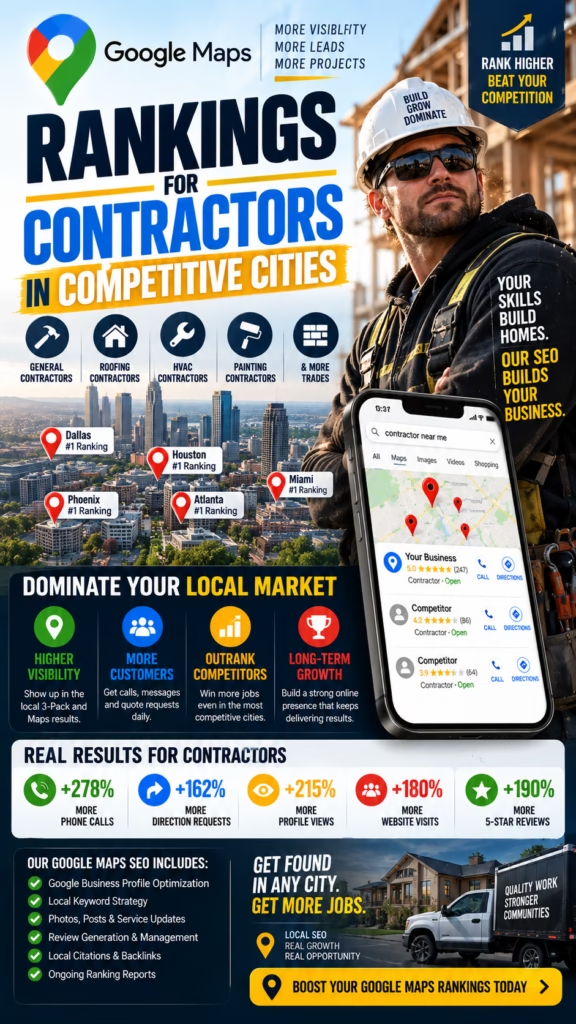
Google Maps Rankings for Contractors in Competitive Cities
Contractors operating in major cities and crowded metropolitan markets compete against businesses with years of reviews, strong websites, experienced SEO campaigns, established brands, aggressive advertising, and extensive local authority. Winning meaningful Google Maps visibility in these markets requires a deeper strategy built around relevance, reputation, geographic strength, service-specific SEO, project proof, and lead conversion.
Ranking a contractor business on Google Maps in a smaller market can already require meaningful work. Ranking in a highly competitive city is a different challenge entirely. Contractors in large metropolitan areas may compete against dozens or hundreds of businesses for valuable searches such as roofer near me, HVAC contractor, painting company, plumber near me, remodeling contractor, electrician, concrete contractor, or flooring company.
The businesses appearing prominently in these markets may have years of reviews, established domains, large project portfolios, strong backlinks, aggressive content strategies, professional sales teams, and dedicated local SEO campaigns.
That does not mean a smaller or newer contractor cannot compete. It means the strategy must be more complete, more disciplined, and more geographically aware.
Why Competitive Cities Are Different
Contractor SEO becomes more difficult as the market becomes more valuable.
Large metropolitan areas often contain:
- more contractors;
- more established businesses;
- higher advertising budgets;
- more SEO agencies;
- more review competition;
- stronger websites;
- more aggressive lead generation;
- higher customer acquisition values.
High-value searches attract stronger competitors
A keyword such as commercial roofer or HVAC replacement near me can be worth considerably more than a low-value informational search.
Contractors understand this, which is why valuable search terms tend to attract serious competition.
More Businesses
Major cities can contain hundreds of contractors competing within the same category and service area.
Stronger Reviews
Top competitors may have hundreds or thousands of genuine customer reviews accumulated over years.
More Website Authority
Established contractors may have domains with years of content, links, project pages, and local recognition.
Higher Lead Value
Competitive cities often offer larger customer populations and higher potential project values, making rankings financially attractive.
Competition also varies within the same city
A contractor might compete heavily downtown but face less competition in:
- outer suburbs;
- adjacent cities;
- specific neighborhoods;
- industrial districts;
- smaller service categories;
- specialized commercial searches.
This creates opportunities for a geographic strategy rather than trying to dominate every keyword everywhere immediately.
Understanding Contractor Search Intent
Contractors in competitive markets should not optimize only for broad keywords.
Different searches reveal different types of customer intent.
Immediate service intent
Searches such as:
- plumber near me;
- roofer near me;
- electrician near me;
- HVAC repair near me;
- painter near me;
- concrete contractor near me;
often represent customers ready to contact businesses quickly.
Project-specific intent
Customers may search:
- roof replacement;
- interior house painting;
- bathroom remodeling;
- air conditioner replacement;
- commercial flooring contractor;
- driveway concrete contractor;
- electrical panel replacement.
These searches can be extremely valuable because the user already knows the project type.
Commercial intent
Commercial searches may include:
- commercial roofing contractor;
- commercial painter;
- commercial HVAC company;
- industrial electrician;
- commercial flooring company;
- multifamily renovation contractor;
- property maintenance contractor.
Search volume may be lower, but project values can be much higher.
Research intent
Prospects may still be researching:
- average replacement costs;
- project timelines;
- materials;
- repair versus replacement;
- contractor licensing;
- maintenance options.
Educational content can bring these prospects into the business earlier.
Google Maps Ranking Factors for Contractors
Google explains local rankings using concepts that include relevance, distance, and prominence. Contractors should think about those concepts across the entire local marketing system.
Relevance
Google needs to understand exactly what the contractor does.
Relevance can be supported through:
- appropriate Google Business Profile categories;
- accurate services;
- service-specific website pages;
- customer reviews;
- project content;
- local service-area pages;
- business descriptions;
- relevant citations.
Distance
Searcher location influences local search results.
A contractor can rank strongly within several miles of the business location yet drop substantially farther across the city.
Prominence
Prominence reflects broader authority and recognition.
Potential signals can include:
- reviews;
- website authority;
- backlinks;
- citations;
- brand mentions;
- industry relationships;
- local recognition;
- business history.
Competition changes the threshold
The same profile quality that performs well in a small city may not be enough in a major metro.
Local SEO is competitive. Your performance is evaluated within the context of other relevant businesses.
Auditing the Local Competition
Contractors should understand the businesses already winning before deciding where to invest.
Review the dominant competitors
Examine companies appearing repeatedly for your highest-value keywords.
Compare:
- review volume;
- review recency;
- review rating;
- business categories;
- project photos;
- website quality;
- service pages;
- city pages;
- commercial content;
- backlinks;
- brand visibility.
Audit geographically
The strongest competitor on the west side of a metro may be different from the strongest competitor downtown.
Track results across:
- central city areas;
- north, south, east, and west sectors;
- high-income suburbs;
- industrial areas;
- adjacent municipalities.
Look for underserved service categories
A general contractor may face extreme competition for general contractor near me but significantly less for:
- commercial tenant improvement contractor;
- multifamily renovation;
- exterior siding repair;
- specific specialty services;
- niche commercial work.
Service depth can uncover opportunities broad keyword analysis misses.
Google Business Profile Optimization
Contractors in competitive cities need a complete, accurate, credible Google Business Profile.
Use the genuine business name
The profile should reflect the contractor's real-world business name.
Avoid artificial names such as:
“ABC Contractors – Best Roofer Plumber Painter HVAC Near Me”
when those words are not genuinely part of the business name.
Maintain accurate contact information
Confirm:
- phone number;
- website;
- hours;
- address when applicable;
- service areas;
- business status.
Complete relevant profile sections
Depending on available Google Business Profile features, contractors should provide useful and accurate information about services, business operations, and customer contact options.
Use realistic service areas
Contractors should represent where they genuinely work rather than adding distant markets purely for SEO.
Keep information current
Competitive profiles are actively maintained.
Update changes to:
- hours;
- phone numbers;
- website URLs;
- services;
- business locations;
- operational status.
Contractor Categories and Services
Categories are an important relevance signal.
Choose the most accurate primary category
A roofer should not choose a general contractor category merely because it seems broader if roofing is the company's primary business.
The same principle applies to:
- HVAC companies;
- painters;
- plumbers;
- electricians;
- flooring companies;
- concrete contractors;
- landscapers;
- remodelers.
Use secondary categories accurately
Add secondary categories only if the business genuinely operates in those areas.
Build website alignment
If a contractor wants visibility for:
- roof replacement;
- commercial HVAC;
- interior painting;
- bathroom remodeling;
- concrete driveways;
- commercial flooring;
the website should contain useful pages supporting those real services.
Reviews and Reputation in Competitive Markets
Reviews can become a major competitive differentiator.
Imagine three contractors appear together:
- Contractor A: 82 reviews;
- Contractor B: 410 reviews;
- Contractor C: 690 reviews.
Review count alone does not determine who ranks or wins the customer, but it can influence perception.
Build a continuous review system
Contractors should request genuine feedback throughout the year instead of collecting reviews in occasional bursts.
Review recency matters to customers
A company with many reviews but no recent customer feedback may appear less active.
Review quality matters
Detailed genuine customer reviews can communicate:
- workmanship;
- communication;
- punctuality;
- cleanliness;
- project management;
- professionalism;
- problem resolution.
Respond professionally
Review responses should be useful and human.
Avoid turning every response into an artificial block of local keywords.
Never fabricate reputation
Avoid:
- fake reviews;
- purchased reviews;
- review farms;
- fabricated customer accounts;
- employees posing as customers.
Project Photos and Visual Proof
Contractor marketing is easier when customers can see proof.
Authentic photos can demonstrate:
- work quality;
- project scale;
- service type;
- crew professionalism;
- commercial capabilities;
- before-and-after transformation.
Before-and-after projects
These work especially well for:
- painting;
- flooring;
- roofing;
- remodeling;
- landscaping;
- concrete;
- cabinet work.
Process photos
Showing progress can demonstrate:
- surface preparation;
- demolition;
- installation;
- repair techniques;
- equipment;
- safety procedures.
Commercial project photos
Contractors seeking commercial leads should show commercial work.
Examples include:
- warehouses;
- apartment complexes;
- retail spaces;
- office buildings;
- industrial facilities;
- large construction sites.
Create a standard photo workflow
Ask crews to capture:
- wide before photo;
- close-up problem photo;
- work in progress;
- completed wide view;
- finished detail;
- crew or equipment image when appropriate.
These images become reusable marketing assets.
Contractor Website SEO
In competitive cities, a weak website can significantly limit local SEO growth.
The homepage should establish clear relevance
Visitors and search engines should quickly understand:
- what the company does;
- which services it provides;
- where it works;
- how to contact it;
- why customers should trust it.
Build service depth
Competitive contractor websites usually need more than a homepage and one generic services page.
Service-specific pages help capture:
- different customer intent;
- different keywords;
- different project values;
- different commercial and residential segments.
Build local depth
Service-area content can help explain the markets the business genuinely serves.
Improve technical performance
Contractor websites should be:
- mobile friendly;
- secure;
- easy to navigate;
- reasonably fast;
- indexable;
- free from major technical errors;
- easy to contact from.
Show proof prominently
Include:
- reviews;
- project galleries;
- case studies;
- business credentials where applicable;
- real team imagery;
- commercial projects when relevant.
Service-Specific Contractor Pages
Service depth can be especially important in highly competitive cities.
Roofing contractors
Useful pages may include:
- roof replacement;
- roof repair;
- storm damage;
- commercial roofing;
- metal roofing;
- roof inspections.
Painting contractors
- interior painting;
- exterior painting;
- cabinet painting;
- commercial painting;
- brick painting;
- deck and fence painting.
HVAC contractors
- AC repair;
- AC installation;
- heating repair;
- furnace replacement;
- heat pumps;
- commercial HVAC.
Plumbing contractors
- emergency plumbing;
- water heater replacement;
- drain cleaning;
- sewer services;
- fixture installation;
- commercial plumbing.
Remodeling contractors
- kitchen remodeling;
- bathroom remodeling;
- home renovation;
- basement finishing;
- room additions;
- commercial buildouts.
Concrete contractors
- driveways;
- patios;
- foundations;
- sidewalks;
- commercial concrete;
- concrete repair.
Each service page should help the customer—not simply exist for a keyword.
City, Neighborhood, and Service-Area SEO
Competitive metros are rarely one uniform search market.
They contain:
- downtown areas;
- suburbs;
- neighborhoods;
- industrial districts;
- adjacent municipalities;
- different ZIP codes;
- different customer demographics.
Build service-area content around real markets
A useful local page can discuss:
- services available in the city;
- local project examples;
- property types;
- common customer needs;
- local climate conditions;
- commercial districts;
- customer FAQs.
Do not mass-produce doorway pages
Avoid creating hundreds of low-value pages where only the city name changes.
Use actual project data
Project content can help establish real service-area relevance.
A contractor might publish:
- a roof replacement in one suburb;
- an interior painting project in another city;
- a warehouse HVAC installation in an industrial district;
- a concrete driveway project in a nearby community.
Prioritize markets strategically
Evaluate:
- population;
- home value;
- commercial property density;
- project value;
- travel time;
- competition;
- historical lead quality;
- close rate.
Citations, Links, and Local Authority
Contractors in highly competitive cities often need stronger authority than businesses in easier markets.
Maintain accurate citations
Important citation sources can include:
- major directories;
- local business directories;
- industry associations;
- chambers of commerce;
- contractor platforms;
- manufacturer directories;
- supplier websites;
- local organizations.
Build legitimate backlinks
Useful opportunities may come from:
- suppliers;
- manufacturers;
- general contractor relationships;
- property management partners;
- community sponsorships;
- local news;
- trade associations;
- business organizations.
Local relevance can be powerful
A legitimate mention from a respected local organization can help reinforce the contractor's connection to the market.
Avoid link schemes
Thousands of unrelated low-quality links are not a substitute for real local authority.
Contractor Content Strategy
Useful contractor content can attract organic traffic while reinforcing service expertise.
Cost and planning content
Customers frequently search for:
- project cost;
- replacement cost;
- installation cost;
- repair versus replacement;
- project timelines;
- material comparisons.
Problem-based content
Examples:
- Why is my roof leaking?
- Why is my AC not cooling?
- Why is paint peeling?
- Why is my concrete cracking?
- Why does my breaker keep tripping?
- Why is my water pressure low?
Local content
Useful local topics may address:
- regional weather;
- common home styles;
- older housing inventory;
- commercial construction types;
- seasonal maintenance;
- local project conditions.
Project case studies
Case studies can combine:
- service relevance;
- geographic relevance;
- proof;
- photos;
- customer outcomes.
This makes project content particularly useful in competitive markets.
Commercial Contractor Google Maps SEO
Commercial contractor searches can create significant opportunities in major cities because commercial property density is often high.
Potential commercial customers include:
- property managers;
- facility managers;
- commercial landlords;
- developers;
- general contractors;
- real estate investors;
- apartment operators;
- retail operators;
- industrial companies.
Commercial pages should be distinct
Residential content does not always address commercial buyer concerns.
Commercial pages may need to communicate:
- project scale;
- crew capacity;
- service coverage;
- property types;
- maintenance capabilities;
- scheduling;
- bid processes;
- commercial project experience.
Show commercial proof
Use real examples from:
- warehouses;
- office buildings;
- shopping centers;
- apartment communities;
- industrial facilities;
- restaurants;
- commercial construction.
Contractor Google Maps SEO by Industry
Roofing
Roofing companies frequently compete for high-value replacement, repair, storm damage, and commercial roofing searches.
HVAC
HVAC search intent can become urgent during temperature extremes, making local visibility and fast response especially valuable.
Painting
Painting companies can use strong visual proof, reviews, and service-specific pages to compete for residential and commercial searches.
Plumbing
Plumbing combines urgent repair searches with high-value replacement and commercial work.
Electrical
Electricians can target emergency work, installations, panel upgrades, lighting, generators, and commercial services.
Remodeling
Remodelers compete for high-ticket projects where trust, project galleries, and detailed service pages matter significantly.
Flooring
Flooring companies can build service depth around LVP, hardwood, tile, commercial flooring, and installation categories.
Concrete
Concrete contractors can target driveways, patios, foundations, repairs, commercial slabs, and other project-specific terms.
Landscaping
Landscapers can compete across maintenance, design, hardscaping, grading, commercial landscaping, and seasonal services.
Why Geographic Rank Tracking Matters More in Competitive Cities
A contractor that ranks number two near the office may rank number fourteen on the opposite side of the city.
One manual search cannot reveal the true picture.
Search results are geographically dynamic
Different neighborhoods can produce different local packs because:
- the searcher's location changes;
- nearby competitors change;
- service relevance varies;
- business prominence differs geographically.
Use grid-based tracking
A local rank grid can reveal:
- strong zones;
- weak zones;
- competitive pockets;
- suburban opportunities;
- ranking improvements over time.
Track service keywords separately
A contractor can rank strongly for one service but poorly for another.
For example:
- roof repair may rank strongly;
- roof replacement may be weaker;
- commercial roofing may have little visibility;
- metal roofing may present an opportunity.
Separate tracking reveals those differences.
Tracking Rankings Across Competitive Cities
A useful contractor tracking system should measure more than one keyword.
Track primary service keywords
Examples include:
- contractor near me;
- roofing company;
- painting company;
- HVAC company;
- plumber;
- electrician;
- remodeling contractor;
- flooring company;
- concrete contractor.
Track high-value specific services
Examples:
- roof replacement;
- AC replacement;
- cabinet painting;
- water heater installation;
- electrical panel upgrade;
- commercial flooring;
- driveway installation.
Track city-modified terms
Example:
- roofing contractor + city;
- painter + city;
- HVAC company + suburb;
- commercial contractor + city;
- concrete company + neighborhood.
Track competitors
Monitor whether leading competitors:
- gain reviews;
- change categories;
- publish new pages;
- gain local visibility;
- enter new suburbs.
Track trends instead of obsessing over daily movement
Local rankings can fluctuate.
Focus on meaningful directional improvements over weeks and months.
Using Project Data to Expand Local Visibility
Contractors generate valuable geographic data every day.
Every completed project has:
- a location;
- a service type;
- a property type;
- a problem;
- a solution;
- photos;
- a customer experience.
Turn project history into content
A completed job can become:
- Google Business Profile media;
- a project case study;
- a city-page example;
- a blog post;
- social media content;
- sales proof.
Build market-specific proof
If a contractor wants more business in a particular suburb, showcasing real projects completed there can help reinforce credibility with prospective customers from that market.
Google Maps SEO vs. Paid Ads in Competitive Contractor Markets
| Factor | Google Maps SEO | Paid Advertising |
|---|---|---|
| Visibility | Organic local discovery | Purchased placement |
| Speed | Usually develops over time | Can create traffic quickly |
| Direct Click Cost | No direct charge for organic local clicks | Advertiser generally pays for traffic |
| Competition | Requires stronger local authority in difficult markets | Higher competition can increase advertising costs |
| Long-Term Value | Can compound through reviews, content, authority, and rankings | Visibility generally depends on continued ad spend |
| Best Use | Long-term local customer acquisition | Immediate demand capture and scalable traffic |
Contractors in competitive markets often benefit from both.
Paid ads can generate immediate lead opportunities while SEO builds increasingly valuable organic visibility.
Why Contractor Brands Matter More in Competitive Cities
When customers see ten similar contractors, branding becomes an important differentiator.
Professional visual identity
Consistency across:
- website;
- Google Business Profile;
- vehicles;
- uniforms;
- social media;
- project photos;
- proposals;
can make the company easier to recognize.
Brand searches can become valuable
As reputation grows, customers may begin searching directly for the business name.
Project quality strengthens brand authority
Strong workmanship creates:
- referrals;
- reviews;
- photos;
- repeat business;
- brand mentions.
Marketing and operational quality reinforce each other.
Neighborhood SEO for Contractors
Large cities contain neighborhoods with very different:
- housing stock;
- home values;
- commercial properties;
- construction activity;
- service demand.
Use neighborhood targeting carefully
Contractors can create useful content around neighborhoods where they genuinely perform work.
Focus on customer value
Local content can discuss:
- common property styles;
- local project examples;
- common service needs;
- regional climate concerns;
- commercial property types.
Avoid creating thin neighborhood doorway pages solely for keyword coverage.
Suburban SEO for Contractors
Competitive metro areas frequently contain valuable suburban markets that deserve their own strategy.
Suburbs can have high project value
Areas with:
- higher home values;
- large homes;
- new development;
- commercial growth;
- older homes requiring renovation;
may create strong contractor demand.
Competition may differ significantly
A contractor may have more realistic ranking opportunities in suburbs than in the city's most competitive core.
Create suburban project proof
Real local projects, reviews, and useful pages can strengthen trust with customers in those areas.
Google Maps SEO for Multi-Location Contractors
Contractors with multiple legitimate locations may have opportunities to build stronger geographic coverage.
Each location should be legitimate
Do not create fake offices simply to obtain additional map profiles.
Build location-specific website content
Each real branch may need:
- accurate location details;
- service coverage;
- local project examples;
- team information;
- city-specific content;
- local contact information where appropriate.
Track each location separately
Different branches may perform differently for the same keywords.
Google Maps SEO for Service-Area Contractors
Many contractors travel to customers rather than serving them at a storefront.
Service-area businesses should still maintain accurate Google Business Profile information.
Service-area SEO does not eliminate geography
Adding a large service area does not guarantee rankings throughout that entire area.
Contractors still need:
- local authority;
- service relevance;
- reviews;
- website content;
- project evidence;
- strong conversion.
Local SEO for New Contractors in Competitive Cities
New contractors face an obvious challenge: established competitors may have years of digital history.
The answer is to build legitimate authority systematically.
Start with accuracy
Create:
- an accurate business profile;
- a professional website;
- clear service pages;
- accurate citations;
- consistent business branding.
Capture every project
Early work should produce:
- photos;
- videos;
- case studies;
- genuine reviews;
- social content.
Focus geographically
Instead of attempting to dominate an entire metropolitan area immediately, focus on:
- core neighborhoods;
- one or two nearby suburbs;
- specific high-value services;
- specialized customer segments.
Local SEO for Established Contractors in Competitive Cities
Established contractors often have underused marketing assets.
They may already have:
- thousands of completed jobs;
- long-term customers;
- commercial accounts;
- supplier relationships;
- historical photos;
- local recognition;
- experienced crews.
Translate offline reputation online
Historical assets can become:
- reviews;
- case studies;
- project galleries;
- commercial portfolio pages;
- local authority links;
- city content.
Audit outdated digital assets
Review:
- old addresses;
- old phone numbers;
- outdated website pages;
- duplicate profiles;
- weak directory listings;
- unused project content.
Turning Maps Visibility Into Qualified Contractor Leads
Rankings are valuable only when they produce business.
Answer leads quickly
Customers in major cities can contact several contractors within minutes.
Qualify efficiently
Useful information may include:
- project location;
- service needed;
- property type;
- project size;
- timeline;
- commercial versus residential;
- urgency;
- budget where appropriate.
Route the lead correctly
Larger contractor businesses may route inquiries according to:
- service type;
- sales territory;
- commercial team;
- residential team;
- estimator availability;
- branch location.
Track source and outcome
Record:
- Google Maps lead;
- service requested;
- market;
- estimate value;
- appointment status;
- closed project;
- revenue.
Follow up after estimates
Customers may delay because they are:
- collecting multiple bids;
- waiting on financing;
- waiting on insurance;
- coordinating another project;
- waiting for internal approval;
- delaying the timeline.
Follow-up can recover valuable opportunities.
Why Speed-to-Lead Matters Even More in Competitive Cities
Competition does not end when the contractor appears on Google.
The customer may contact multiple businesses from the same search result.
Fast response can create an advantage
The first contractor to:
- answer;
- understand the problem;
- confirm the service area;
- explain the next step;
- schedule an estimate;
may win the opportunity before slower competitors respond.
Automated lead systems can reduce missed inquiries
Contractors can use structured workflows to:
- notify sales staff;
- route leads;
- send acknowledgments;
- track follow-up;
- record outcomes.
Contractor Rank Tracking Checklist
- Track the main service keyword.
- Track major secondary services.
- Track commercial keywords.
- Track city-modified terms.
- Track suburb keywords.
- Use a geographic grid.
- Compare multiple months.
- Track leading competitors.
- Compare review growth.
- Compare service-page growth.
- Track website traffic.
- Track calls.
- Track forms.
- Track estimates.
- Track booked projects.
Competitive City SEO Mistakes to Avoid
1. Keyword stuffing the business name
Use the genuine business name.
2. Creating fake locations
Do not create false offices simply to expand map coverage.
3. Purchasing fake reviews
Build genuine reputation instead.
4. Targeting every service with one page
Competitive markets often require stronger service depth.
5. Creating hundreds of thin city pages
Build genuinely useful local content.
6. Ignoring project photography
Contractors perform highly visual work that should be documented.
7. Ignoring commercial opportunities
If the company performs commercial work, build dedicated commercial positioning.
8. Tracking only one location
Competitive cities require geographic ranking analysis.
9. Ignoring website authority
Strong Google Business Profiles are supported by strong websites.
10. Building random low-quality links
Focus on legitimate local and industry authority.
11. Ignoring customer experience
Poor service creates poor reviews and weak referrals.
12. Responding slowly to leads
Competitive markets punish slow sales processes.
13. Measuring rankings but not revenue
A ranking report is incomplete without understanding calls, estimates, and booked jobs.
Scaling Contractor Rankings Across a Metro Area
Contractors should expand local SEO strategically rather than trying to rank everywhere at once.
Phase 1: Strengthen the core market
Focus on the area around the legitimate business location and strongest historical customer base.
Phase 2: Expand into priority suburbs
Choose suburbs based on:
- lead quality;
- population;
- property value;
- project value;
- competition;
- drive time.
Phase 3: Expand service coverage
Build deeper content for valuable secondary services.
Phase 4: Add commercial verticals
Develop pages and proof for:
- property management;
- commercial buildings;
- multifamily;
- industrial;
- retail;
- office properties.
Phase 5: Build broader brand authority
Strengthen:
- reviews;
- media;
- partnerships;
- supplier relationships;
- industry recognition;
- community presence.
Competitive Contractor SEO Checklist
- Use the real business name.
- Confirm Google Business Profile eligibility.
- Use accurate location or service-area settings.
- Select the correct primary category.
- Add only legitimate secondary categories.
- List genuine contractor services.
- Verify phone and website information.
- Maintain current hours.
- Upload authentic project photos.
- Build before-and-after galleries.
- Show commercial work when applicable.
- Request genuine customer reviews.
- Respond professionally to reviews.
- Build a strong homepage.
- Create service-specific pages.
- Create useful city pages.
- Create suburb pages where appropriate.
- Avoid doorway pages.
- Maintain accurate citations.
- Build legitimate local backlinks.
- Publish project case studies.
- Create educational content.
- Track rankings geographically.
- Track major competitors.
- Measure call volume.
- Measure estimate requests.
- Improve speed-to-lead.
- Follow up after estimates.
- Track closed jobs.
- Measure revenue by source.
Building a Repeatable Contractor Lead System
Contractors that succeed in highly competitive cities tend to connect SEO with sales operations rather than treating ranking as the only objective.
Layer 1: Google Business Profile
- accurate information;
- categories;
- services;
- photos;
- posts;
- reviews.
Layer 2: Contractor Website
- homepage;
- service pages;
- city pages;
- suburb pages;
- commercial pages;
- project case studies.
Layer 3: Reputation
- review requests;
- review responses;
- customer service;
- project documentation.
Layer 4: Authority
- citations;
- backlinks;
- supplier relationships;
- local partnerships;
- industry associations.
Layer 5: Geographic Rank Tracking
- local grids;
- service keyword tracking;
- suburb tracking;
- competitor monitoring;
- monthly visibility trends.
Layer 6: Lead Response
- fast notifications;
- qualification;
- sales routing;
- estimate scheduling;
- follow-up.
Layer 7: Revenue Tracking
- lead source;
- service requested;
- city;
- estimate amount;
- close rate;
- booked revenue.
Google Maps and Other Contractor Marketing Channels
| Channel | Main Role | Contractor Opportunity |
|---|---|---|
| Google Maps | Local search discovery | High-intent local contractor leads |
| Google Organic SEO | Search visibility | Service, city, project, and research traffic |
| Google Ads | Paid demand capture | Immediate high-intent traffic |
| Awareness and retargeting | Local project promotion and visual proof | |
| Visual brand building | Project transformations and crew content | |
| YouTube Shorts | Video discovery | Project reveals and educational contractor content |
| Craigslist | Classified local visibility | Additional local opportunities where appropriate |
| CRM | Lead conversion | Qualification, estimate tracking, and follow-up |
Contractors in difficult markets often need multiple acquisition channels.
Google Maps captures customers with immediate local intent. Organic SEO can capture deeper service and research queries. Paid advertising can create faster exposure. Social media builds visual trust. CRM and automation help convert opportunities after the initial inquiry.
Final Thoughts: Google Maps Rankings for Contractors in Competitive Cities
Contractors operating in major metropolitan markets should expect local SEO to be competitive.
Valuable markets attract:
- more contractors;
- stronger websites;
- larger review profiles;
- greater advertising spend;
- more experienced marketing campaigns;
- higher customer acquisition pressure.
But competition does not eliminate opportunity.
Contractors can build stronger Google Maps rankings by developing a complete local authority system built around:
- accurate Google Business Profile optimization;
- appropriate contractor categories;
- genuine reviews;
- authentic project photography;
- service-specific website pages;
- useful city and suburb content;
- consistent citations;
- legitimate local backlinks;
- commercial positioning;
- geographic rank tracking;
- speed-to-lead;
- estimate follow-up;
- revenue attribution.
When those elements work together, Google Maps rankings for contractors in competitive cities can become more than a visibility metric. They can become a scalable local customer acquisition engine capable of producing residential, commercial, service, replacement, and high-ticket project opportunities throughout a metropolitan market.
Frequently Asked Questions About Google Maps Rankings for Contractors in Competitive Cities
1. Why are Google Maps rankings important for contractors in competitive cities?
Google Maps can place contractors in front of local customers actively searching for roofing, HVAC, plumbing, painting, remodeling, electrical, flooring, concrete, and other high-value services.
2. Why is contractor SEO harder in competitive cities?
Large cities usually have more contractors, stronger review profiles, established websites, experienced SEO campaigns, larger backlink profiles, and more competition for valuable local terms.
3. How can contractors improve Google Maps rankings in difficult markets?
Strengthen the Google Business Profile, earn genuine reviews, improve service pages, publish useful local content, maintain citations, showcase authentic project photos, build legitimate authority, and track rankings geographically.
4. What affects contractor Google Maps rankings?
Factors can include relevance, distance, prominence, categories, reviews, website authority, citations, backlinks, local content, business history, and competition.
5. What Google Business Profile category should contractors use?
Select the category that most accurately represents the contractor's primary real-world business and use secondary categories only when they genuinely apply.
6. Do reviews matter more in competitive contractor markets?
Reviews can become especially important because customers often compare several highly visible contractors before deciding whom to contact.
7. How many reviews does a contractor need to compete?
There is no universal target. Compare your reputation with real competitors and focus on steady, genuine review growth rather than an arbitrary number.
8. Should contractors respond to Google reviews?
Yes. Professional responses can demonstrate customer care and active reputation management without resorting to artificial keyword stuffing.
9. Do project photos help contractor Google Maps SEO?
Authentic project photos can improve trust, demonstrate service capabilities, and provide useful proof to prospective customers.
10. Should contractors post regularly on Google Business Profile?
Posts can be used to share completed projects, company updates, educational information, seasonal topics, and service-related content.
11. Can contractor service pages improve local rankings?
Strong service pages help search engines and customers understand the specific services the contractor provides.
12. Should contractors create city pages?
Useful city pages can support local relevance for genuine service areas when they contain meaningful, differentiated information.
13. How many city pages should a contractor have?
There is no ideal number. Prioritize the cities and suburbs where the business genuinely works and where useful local content can be created.
14. What are citations for contractors?
Citations are online references to a contractor's business information on directories, local sites, associations, industry platforms, and similar sources.
15. Does NAP consistency matter for contractors?
Accurate and consistent name, address where applicable, and phone information helps maintain a clear local business identity.
16. Do backlinks help contractors rank in competitive cities?
Legitimate local and industry backlinks can strengthen website authority and prominence. Quality and relevance matter more than random volume.
17. Why does a contractor rank differently across the same city?
Local results can vary because of searcher location, distance, competitor proximity, relevance, prominence, and other contextual factors.
18. How should contractors track Google Maps rankings?
Use geographic grid tracking across neighborhoods, ZIP codes, suburbs, and commercial districts instead of relying on one search location.
19. What keywords should contractors track?
Track primary trade keywords, high-value service terms, commercial terms, near-me searches, city-modified searches, and suburb-specific keywords relevant to the business.
20. Can a contractor rank across an entire major city?
Visibility can vary greatly by geography. Broad coverage generally requires strong authority, relevance, reviews, website quality, project proof, and sustained optimization.
21. Can contractors rank in nearby suburbs?
Contractors may build stronger suburban visibility through genuine service-area relevance, useful local pages, project content, reputation, and broader authority.
22. Does a contractor website affect Google Maps rankings?
A strong contractor website reinforces service relevance, geographic relevance, authority, trust, and conversion while supporting local search visibility.
23. How long does contractor Google Maps SEO take in competitive cities?
Timelines vary depending on competition, existing rankings, profile quality, reviews, website authority, content, citations, and local prominence. Difficult markets usually require sustained work.
24. Can a new contractor compete with established businesses?
Yes. New contractors can build visibility by developing genuine reviews, documenting projects, creating useful service content, maintaining accurate business information, and building local authority over time.
25. Can established contractors improve weak Google Maps rankings?
Yes. Established companies can often turn years of offline experience, customer history, project photos, partnerships, and commercial work into stronger digital authority.
26. Should contractors create fake locations to rank across a city?
No. Contractors should accurately represent legitimate eligible business locations and service areas according to current Google Business Profile guidelines.
27. Should contractors add keywords to their Google Business Profile name?
The profile should use the genuine real-world business name rather than adding marketing keywords that are not actually part of the company's name.
28. Can commercial contractor SEO help in competitive cities?
Yes. Commercial SEO can reach property managers, facility managers, building owners, developers, investors, and other high-value business buyers.
29. What contractor Google Maps SEO mistakes should be avoided?
Avoid fake locations, fake reviews, keyword-stuffed names, irrelevant categories, duplicate profiles, thin city pages, low-quality links, weak website content, and slow lead response.
30. What is the best strategy for contractor Google Maps rankings in competitive cities?
Combine accurate Google Business Profile optimization, genuine reviews, strong service pages, useful city and suburb content, authentic project media, legitimate citations and links, geographic rank tracking, fast lead response, and disciplined follow-up.
30 Additional SEO Keywords
Turn Competitive Google Maps Rankings Into More Contractor Leads
Strengthen your contractor company's Google Maps presence, improve visibility across competitive cities and suburbs, build stronger reviews, expand service and location content, showcase real project proof, track rankings across your market, and connect new opportunities with faster AI-powered lead response and follow-up.
Schedule a MarketWiz.ai Demo












