

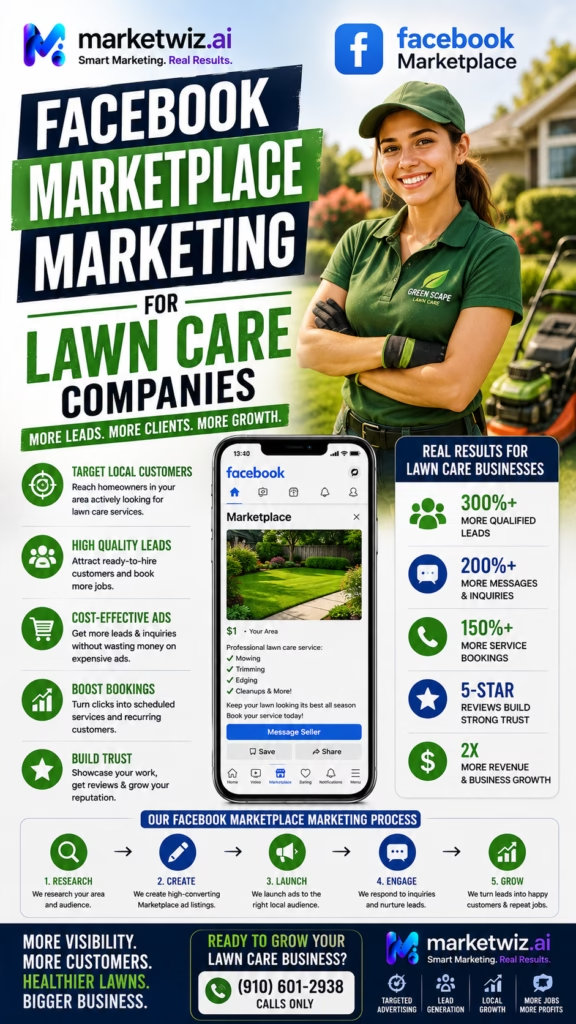
Facebook Marketplace Marketing for Lawn Care Companies
Lawn care companies compete in one of the most local, visual, and relationship-driven service markets. Facebook Marketplace can become another important discovery channel when it is used strategically, accurately, and in combination with strong local branding, fast lead response, customer qualification, CRM tracking, and AI-powered marketing workflows.
For a lawn care business, growth often comes down to one basic challenge: getting in front of more property owners inside the right service area at the right time. Facebook Marketplace marketing can help lawn care companies create additional local visibility, generate conversations, display completed work, promote relevant offers, and build a more diversified customer acquisition system.
Lawn care is especially well suited to visual local marketing because customers can immediately understand the difference between an overgrown property and a professionally maintained one. A clean edge, evenly cut lawn, refreshed mulch bed, completed seasonal cleanup, or properly maintained commercial property can communicate value much faster than a long sales pitch.
At the same time, simply placing content on Facebook Marketplace is not a complete marketing strategy. The strongest systems connect listing creation with geographic planning, creative testing, fast response, lead qualification, customer follow-up, route density, reputation management, local SEO, social media, and CRM tracking.
That broader system is where Marketplace activity can become measurable business growth instead of random posting.
1. What Is Facebook Marketplace Marketing for Lawn Care Companies?
Facebook Marketplace marketing for lawn care companies refers to using Marketplace visibility, locally relevant creative, compliant listings, customer conversations, and supporting Facebook marketing tactics to connect with people inside a company's genuine service territory.
The objective is not simply to create listings. The objective is to create profitable customer opportunities.
Depending on the company's operations and current platform policies, broader Marketplace and Facebook marketing may support customer awareness around areas such as:
- lawn maintenance,
- mowing and edging,
- yard cleanup,
- leaf cleanup,
- mulch and bed maintenance,
- property cleanup,
- seasonal lawn care,
- commercial property maintenance,
- other legitimate lawn and property services.
Because platform policies can evolve, businesses should always make sure their Marketplace activity accurately represents what is being offered and complies with the current rules applicable to the listing category and account.
2. Why Facebook Marketplace Can Matter for Lawn Care Marketing
Facebook already contains large local audiences. Marketplace adds a browsing environment where users are often looking at products, property-related needs, equipment, home improvement items, vehicles, furniture, and other locally relevant offers.
That creates an opportunity for lawn care companies to become visible to nearby property owners who may already be thinking about improving or maintaining their homes and properties.
Local Audience
Lawn care companies do not need leads hundreds of miles away. Marketplace is naturally organized around geographic discovery, making local targeting central to the experience.
Visual Marketing
Lawns, landscaping, cleanups, and property improvements are highly visual, allowing strong project photography to communicate value quickly.
Direct Conversations
Interested users may begin a conversation quickly, allowing the company to qualify the property and determine whether the opportunity fits its service area.
Additional Brand Exposure
Marketplace can supplement Google, Facebook Pages, social content, referrals, signs, vehicles, and other local marketing channels.
3. Understand the Lawn Care Customer Behind the Search
Different lawn care prospects have very different motivations.
One homeowner may want someone to mow every week because they are tired of doing it themselves. Another may need a one-time cleanup before putting a property on the market. A landlord may need ongoing maintenance across multiple properties. A commercial property manager may care about reliability, appearance, scheduling, invoicing, and consistent service.
Strong marketing begins by understanding those different customer situations.
Recurring Maintenance Customers
These prospects can be especially valuable because one successful sale may create ongoing weekly or biweekly revenue.
One-Time Cleanup Customers
These opportunities may include overgrown lawns, seasonal cleanup, leaf removal, move-in or move-out property cleanup, and similar project-based needs.
Landlords and Property Managers
Property investors may value fast scheduling, reliable maintenance, clear billing, and the ability to handle more than one property.
Commercial Accounts
Commercial customers may have a higher total contract value but can require different sales processes, insurance, service schedules, documentation, and account management.
4. Build Marketing Around a Profitable Service Area
One of the biggest mistakes lawn care companies make is chasing every possible lead. More leads are not always better.
A customer twenty-five minutes away from every other account can create a completely different profit profile than a customer located three streets away from an existing route.
That makes geographic planning one of the most important parts of lawn care marketing.
Companies should consider:
- current route density,
- crew travel time,
- fuel costs,
- equipment transport,
- neighborhood concentration,
- average property value,
- local competition,
- average service price,
- recurring account potential.
The best marketing territory is not always the largest possible territory. Often, the most profitable growth comes from adding more customers inside areas the company already serves.
5. Create Clear, Accurate Marketplace Listings
Marketplace listings should immediately communicate what the user is looking at and why it may be relevant.
Avoid complicated wording, exaggerated promises, misleading prices, vague offers, and content that does not accurately represent the listing.
Use Clear Titles
Titles should be readable and specific rather than overloaded with keywords.
The wording should match what is actually being promoted and should not imply services, pricing, guarantees, or availability that the business cannot support.
Write for Local Customers
The description should answer the practical questions that matter:
- What is being offered?
- What type of property is it suited for?
- What geographic area is relevant?
- What does the customer need to know before contacting the business?
- What information will help determine whether the opportunity is a fit?
Clear descriptions can reduce repetitive questions and improve lead quality.
6. Use Lawn Care Images That Stop the Scroll
Visual quality can make or break local service marketing.
Customers want to see results.
A lawn care company's strongest creative library may include:
- freshly striped lawns,
- clean lawn edges,
- before-and-after cleanups,
- mulch bed transformations,
- leaf cleanup results,
- commercial properties,
- professional equipment,
- uniformed crews,
- branded trucks and trailers,
- well-maintained residential properties.
Make the Property the Hero
Customers are primarily interested in the outcome. Equipment can reinforce professionalism, but completed work should usually remain the central visual focus.
Avoid Cluttered Graphics
When text overlays are used, keep them easy to read. Too much small text can make an image feel like a flyer rather than a professional local advertisement.
Rotate Creative
Different customers respond to different visuals. One audience may respond well to dramatic before-and-after cleanup photos, while another may respond to premium finished lawns or commercial properties.
7. Use Before-and-After Marketing Strategically
Before-and-after content is particularly powerful for lawn care because the improvement is easy to understand.
An overgrown yard next to a finished cleanup visually explains the value of the service without requiring a long description.
Useful transformation themes can include:
- overgrown lawn to maintained lawn,
- leaf-covered property to clean yard,
- untidy flower bed to fresh mulch bed,
- untrimmed edges to crisp edging,
- neglected rental property to cleaned exterior,
- commercial property before and after maintenance.
Use genuine examples whenever possible and avoid implying that stock imagery represents completed company work if it does not.
8. Build Seasonal Lawn Care Campaigns
Lawn care demand changes dramatically throughout the year.
The marketing message should change with it.
| Season | Customer Concern | Marketing Theme |
|---|---|---|
| Early Spring | Property looks neglected after winter | Cleanup and lawn preparation |
| Late Spring | Grass growth accelerates | Recurring mowing and maintenance |
| Summer | Keeping the property maintained | Reliable scheduled lawn service |
| Early Fall | Leaves and seasonal debris begin | Fall cleanup and property maintenance |
| Late Fall | Heavy leaf accumulation | Leaf cleanup and final seasonal service |
| Winter | Planning next season | Commercial contracts and early scheduling where appropriate |
Seasonality creates opportunities for new creative, new listing themes, new content, and different lead qualification scripts.
9. Write Local Copy Without Sounding Spammy
Local wording can help a listing feel relevant, but marketers should avoid turning every sentence into a string of city names and keywords.
Natural local copy might explain that the company serves a particular market, nearby communities, or a specific service radius.
The objective is clarity, not keyword density.
Focus on the Customer Problem
Instead of repeatedly saying “best lawn care company,” explain the problem the customer wants solved.
Examples of messaging themes include:
- tired of spending weekends mowing,
- need an overgrown property cleaned up,
- need dependable recurring lawn maintenance,
- need a rental property cleaned before a tenant arrives,
- need a commercial property kept presentable.
Problem-first messaging usually feels more relevant than generic advertising claims.
10. Handle Lawn Care Pricing Carefully
Lawn care pricing often depends on multiple variables.
Those can include:
- property size,
- grass height,
- terrain,
- obstacles,
- service frequency,
- cleanup requirements,
- travel distance,
- equipment needed,
- crew time.
If a price is shown in a listing, it should accurately represent what the customer is actually receiving.
Avoid placeholder or misleading pricing intended only to generate clicks.
If the actual price requires property-specific information, the description should make that clear rather than implying that every property receives the same rate.
11. Respond to Marketplace Leads Fast
Marketplace conversations can move quickly.
A homeowner who needs lawn service may contact several nearby companies during one sitting. The company that replies professionally while the customer is still engaged has an important advantage.
A strong response process should:
- acknowledge the inquiry quickly,
- identify the requested service,
- confirm the service area,
- collect enough information to evaluate the property,
- move qualified prospects toward an estimate or next step.
Do Not Over-Question the Prospect
Customers do not want to complete a twenty-question interview before learning whether the company can help them.
Ask only the questions necessary to determine fit and move the conversation forward.
12. Qualify Lawn Care Leads Efficiently
Not every Marketplace message should receive the same amount of sales attention.
Lead qualification protects crew time and helps the company focus on profitable opportunities.
Common qualification areas can include:
- service location,
- type of service needed,
- property type,
- approximate yard or lot size,
- one-time versus recurring service,
- current condition of the lawn,
- desired timing,
- special access requirements.
A recurring weekly mowing account inside an existing route may deserve a different priority than a one-time job far outside the normal service territory.
13. Put Marketplace Leads Into a CRM
One of the fastest ways to lose local leads is to leave them scattered across messaging threads.
A CRM or structured lead system can help track:
- customer name,
- phone number,
- email when available,
- property location,
- service requested,
- lead source,
- estimate status,
- appointment date,
- follow-up status,
- customer outcome,
- recurring account value.
This also helps the business understand whether Marketplace is generating real customers or merely conversations.
14. Build a Professional Follow-Up System
Some good prospects will not respond immediately.
They may be at work, dealing with family responsibilities, comparing providers, or simply forget to return to the conversation.
A structured follow-up system can help recover those opportunities.
The key is to remain professional and avoid excessive messaging.
A useful follow-up process might include:
- an initial response,
- a later check-in when appropriate,
- an estimate follow-up,
- a scheduling reminder,
- a future seasonal reactivation opportunity.
15. Use AI to Improve Marketplace Lead Handling
AI can help lawn care companies manage a larger volume of local conversations without forcing employees to manually perform every repetitive task.
AI-Assisted Replies
AI can help draft natural responses based on the customer's inquiry and the company's service information.
AI Lead Qualification
Automation can help collect basic property information and identify whether a prospect falls within the company's target service area.
AI CRM Updates
Lead information can potentially be organized into structured fields so sales and operations teams know which opportunities require attention.
AI Follow-Up Assistance
Systems can help remind teams about unresolved inquiries and generate appropriate follow-up drafts.
AI Reporting
AI can summarize which markets, listings, creative styles, and lead sources are producing the strongest results.
16. Support Marketplace With a Strong Facebook Page
A prospect who discovers a business through one Facebook surface may investigate the company elsewhere before making a decision.
A professional Facebook Page can support that research process.
Useful Page content might include:
- recent completed lawns,
- before-and-after projects,
- crew photos,
- maintenance tips,
- seasonal reminders,
- commercial property work,
- customer education,
- company updates.
A Page that looks active and professional can reinforce the credibility created by the Marketplace conversation.
17. Use Local Facebook Groups Carefully
Neighborhood and community groups can sometimes provide additional local exposure. However, every group has its own rules.
Businesses should avoid repetitive promotional posting in communities where advertising is prohibited or discouraged.
A better strategy is to participate where appropriate, answer useful questions, share relevant information, and respect the culture of the community.
Local reputation can be damaged quickly when a company becomes known for spam instead of helpful participation.
18. Combine Marketplace With Google Maps
Facebook Marketplace and Google Maps serve different parts of the customer journey.
Marketplace can create discovery while customers are browsing Facebook. Google Maps can capture people who are actively searching for lawn care.
A strong local marketing system can use both.
| Channel | Customer Behavior | Marketing Role |
|---|---|---|
| Facebook Marketplace | Browsing local offers | Create awareness and conversations |
| Facebook Page | Researching company activity | Build trust and brand familiarity |
| Google Maps | Searching for local providers | Capture high-intent demand |
| Website | Evaluating services and credibility | Educate and convert |
| CRM | Post-inquiry customer journey | Track and manage opportunities |
19. Use the Website to Reinforce Marketplace Marketing
A strong lawn care website gives prospects a place to learn more about the business, services, service areas, commercial capabilities, and customer experience.
Useful pages can include:
- lawn mowing,
- lawn maintenance,
- yard cleanup,
- leaf removal,
- mulch services,
- commercial lawn care,
- service-area pages,
- project galleries,
- frequently asked questions.
Customers who first discover the company on Facebook may later search the business name or visit its website before making a decision.
20. Build Reputation Around Every New Customer
Marketing becomes easier when customers can see evidence that other people trust the company.
A lawn care company can build reputation through:
- Google reviews,
- Facebook recommendations where available,
- customer testimonials,
- project photos,
- before-and-after images,
- repeat customer relationships,
- referrals.
The objective is not simply to collect ratings. It is to create visible evidence of a consistent, professional customer experience.
21. Use Marketing to Increase Route Density
Route density can be one of the most important economic variables in a lawn care business.
If a crew completes several nearby properties with minimal driving, the business can potentially serve more customers during the workday while reducing fuel use and lost travel time.
That means marketing can be used strategically to fill geographic gaps.
For example, if the company already maintains several lawns inside one subdivision, additional marketing in that exact area may create more operational value than advertising randomly across an entire county.
22. Marketplace Marketing for Commercial Lawn Care Growth
Commercial lawn care requires a different sales approach than residential mowing.
Potential commercial customers can include:
- retail centers,
- office buildings,
- apartment communities,
- industrial properties,
- warehouses,
- restaurants,
- medical offices,
- property managers,
- HOAs,
- real estate investors.
Commercial decision makers may care less about a simple per-cut price and more about:
- reliability,
- insurance,
- crew capacity,
- service schedules,
- communication,
- appearance standards,
- billing processes,
- multi-property capabilities.
For these prospects, Marketplace may be only one discovery channel inside a broader B2B marketing strategy.
23. Test Different Lawn Care Creative Styles
Businesses should avoid assuming one advertisement or image will perform equally well forever.
Creative testing can compare:
- before-and-after transformations,
- premium finished lawns,
- crew and equipment imagery,
- commercial property images,
- seasonal cleanup visuals,
- close-up edging and detail work,
- minimal text overlays,
- different headline styles.
Track what generates actual qualified opportunities rather than simply which image gets the most attention.
24. Track Marketplace Performance by Location and Listing
Without tracking, businesses cannot distinguish a good marketing channel from a busy messaging channel.
Useful metrics may include:
- listing views where available,
- inquiries,
- qualified leads,
- estimates scheduled,
- estimates completed,
- customers won,
- recurring accounts,
- average customer value,
- revenue by market,
- route density improvement.
A listing generating fifty low-quality inquiries may be less valuable than one generating five recurring customers in the company's strongest neighborhood.
25. Facebook Marketplace Marketing Mistakes Lawn Care Companies Should Avoid
Misleading Pricing
Do not use fake or unrealistic pricing simply to attract clicks.
Posting Outside Real Service Areas
Leads outside the company's operational territory can consume time without producing profitable work.
Using Identical Creative Forever
Seasonal and visual variation can help maintain relevance and provide better performance data.
Ignoring Messages
A marketing channel that generates inquiries but receives slow responses will rarely reach its potential.
Failing to Track Leads
Without a CRM or structured tracking process, valuable conversations can disappear into old message threads.
Overposting or Spamming
Aggressive repetitive activity can weaken customer trust and may create platform or community problems.
Making Claims the Company Cannot Support
Avoid unrealistic guarantees, fake urgency, inaccurate project images, or misleading service claims.
26. The Lawn Care Marketplace Growth Framework
Define the Best Service Areas
Identify where recurring customers, route density, pricing, and operational efficiency create the strongest opportunity.
Define the Best Customer Types
Separate recurring residential, cleanup, landlord, commercial, and other opportunities so messaging can match the buyer.
Create Strong Visual Assets
Build a library of quality property photos, transformations, finished lawns, equipment, and seasonal creative.
Create Accurate Listings
Use clear titles, relevant descriptions, legitimate locations, and accurate information that follows current platform requirements.
Respond Quickly
Make sure new inquiries are identified and answered while customer interest is still high.
Qualify Efficiently
Determine location, property type, requested service, timing, and other information needed to identify good opportunities.
Move Leads Into a CRM
Track customer details, source, estimates, follow-up, appointments, and final sales outcomes.
Follow Up Professionally
Create a repeatable process for unresolved inquiries and estimates without overwhelming the prospect.
Track Profitability
Measure not only lead count but also recurring account value, route density, revenue, crew utilization, and customer retention.
Scale the Best Markets
Increase marketing activity in locations and customer segments already producing profitable business.
27. Measure Lawn Care Marketing From Listing to Revenue
The true purpose of Marketplace marketing is not messages. It is customers.
| Stage | Question | Possible KPI |
|---|---|---|
| Exposure | Are local customers seeing us? | Views and local reach |
| Inquiry | Are they starting conversations? | Messages and inquiries |
| Qualification | Are they inside our target market? | Qualified lead rate |
| Estimate | Are qualified leads moving forward? | Estimate appointments |
| Customer | Are estimates closing? | New accounts |
| Retention | Are customers staying? | Recurring account retention |
| Profitability | Is marketing improving the business? | Revenue and route economics |
28. A 90-Day Facebook Marketplace Lawn Care Marketing Plan
Days 1–30: Build the Foundation
- Define the best service territory.
- Identify profitable neighborhoods and cities.
- Separate recurring and project-based services.
- Build a photo library.
- Review current Meta policies and account requirements.
- Create multiple listing concepts.
- Develop a fast response process.
- Create basic lead qualification questions.
- Set up CRM tracking.
- Establish baseline performance metrics.
Days 31–60: Test and Improve
- Test different creative styles.
- Compare local markets.
- Track inquiry quality.
- Improve titles and descriptions.
- Refine response scripts.
- Improve lead routing.
- Add seasonal content.
- Strengthen the Facebook Page.
- Improve Google Maps presence.
- Track estimate conversion.
Days 61–90: Scale Profitable Activity
- Identify the highest-converting markets.
- Identify the best recurring customer segments.
- Increase creative variation.
- Improve follow-up automation.
- Measure route density gains.
- Analyze revenue by lead source.
- Reduce time spent on poor-fit inquiries.
- Build additional local content.
- Expand into profitable adjacent areas carefully.
- Repeat the campaigns producing customers.
29. The Future of Lawn Care Marketplace Marketing
Local customer acquisition is becoming increasingly automated and interconnected.
A future-ready lawn care company may use multiple channels at the same time:
- Facebook Marketplace for discovery,
- Facebook and Instagram for brand visibility,
- Google Maps for high-intent local search,
- the company website for conversion,
- AI for lead organization,
- CRM systems for follow-up,
- automated reporting for performance analysis.
The companies that benefit most from automation will likely be those that already have strong operational processes.
AI can help organize messages, prioritize leads, summarize conversations, generate content drafts, improve response speed, and track customer acquisition. But the lawn still has to be cut properly, crews still need to arrive reliably, and customers still need to trust the company.
Technology amplifies the underlying business.
30. Final Thoughts: Turn Marketplace Visibility Into Lawn Care Growth
Facebook Marketplace can become a valuable component of a lawn care company's broader local marketing strategy.
The biggest opportunity is not simply gaining more views.
It is creating a complete system that connects local visibility to qualified conversations, estimates, recurring accounts, customer retention, and profitable route growth.
The strongest strategy combines:
- accurate and compliant Marketplace activity,
- high-quality lawn care creative,
- strong geographic targeting,
- clear customer messaging,
- seasonal marketing,
- fast lead response,
- efficient qualification,
- CRM tracking,
- professional follow-up,
- AI-assisted workflows,
- Facebook Page content,
- Google Maps visibility,
- website support,
- reputation management,
- route-density analysis.
A lawn care business does not need every person on Facebook.
It needs the right property owners in the right neighborhoods who need the right service and can become profitable long-term customers.
When Marketplace marketing is built around that principle, it becomes more than another place to post advertisements.
It becomes part of a measurable local customer acquisition engine.
Frequently Asked Questions About Facebook Marketplace Marketing for Lawn Care Companies
1. Can lawn care companies use Facebook Marketplace for marketing?
Marketplace can support local visibility when businesses use it in ways permitted by Meta's current policies and accurately represent what they are offering.
2. Why can Facebook Marketplace be useful for lawn care companies?
Marketplace provides access to local Facebook users and can create additional awareness and customer conversations when paired with strong creative and fast response.
3. What should lawn care businesses promote?
Businesses should focus on legitimate offers they actually provide and ensure that the listing category, wording, pricing, imagery, and format comply with current platform requirements.
4. Can Marketplace generate lawn care leads?
Marketplace can contribute to local lead generation by increasing visibility and creating conversations with nearby prospects.
5. How important are listing images?
Images are extremely important for visually driven businesses such as lawn care. Quality property photography and authentic project results can quickly demonstrate professionalism.
6. What makes a good Marketplace title?
A strong title is clear, relevant, easy to understand, and accurately describes the offer without excessive keyword stuffing.
7. Should lawn care companies target specific cities?
Yes. Marketing should focus on areas the company legitimately serves and where the business can efficiently support additional customers.
8. How quickly should Marketplace inquiries be answered?
Fast response is generally valuable because prospects may contact several local companies during the same buying session.
9. Can AI help answer Marketplace leads?
AI can assist with reply drafting, inquiry organization, qualification, CRM updates, and follow-up workflows when used appropriately.
10. Should Marketplace leads go into a CRM?
A CRM helps businesses track customer information, service requests, estimates, follow-up, sales outcomes, and marketing attribution.
11. What should a lawn care company ask a new lead?
Important information may include the service location, property type, requested work, approximate size, one-time or recurring need, and desired timing.
12. Do before-and-after lawn photos work well?
Authentic before-and-after images can communicate the value of lawn maintenance or cleanup quickly because customers can immediately see the improvement.
13. Should lawn care marketing change with the seasons?
Yes. Customer needs change throughout the year, making seasonal creative and messaging important for lawn care marketing.
14. What lawn care services can be promoted locally?
Companies can market legitimate services they provide, such as mowing, edging, maintenance, cleanup, leaf removal, mulch, commercial maintenance, and related property services, subject to platform rules.
15. Should Marketplace be combined with a Facebook Page?
Yes. A professional Page can provide project photos, company updates, educational content, branding, and additional trust signals for prospects researching the company.
16. Can local Facebook Groups help?
Relevant local groups can sometimes support awareness when businesses follow community rules and participate helpfully rather than spamming members.
17. Should lawn care listings show prices?
If pricing is shown, it should be accurate and clearly explain what the stated amount covers, especially when final pricing depends on property-specific factors.
18. How often should creative be refreshed?
Creative can be refreshed based on seasonality, new projects, audience response, and performance data.
19. What should lawn care companies avoid?
Avoid fake prices, inaccurate locations, misleading claims, repeated spam-like content, poor lead response, and activity that violates current platform policies.
20. Can landscaping companies use similar strategies?
Yes. Many of the same customer acquisition principles apply, although landscaping projects may require different qualification, visuals, pricing, and sales processes.
21. How can lawn care companies improve Marketplace conversions?
Improve creative, local relevance, listing clarity, response speed, qualification, trust, follow-up, and the overall path from inquiry to estimate.
22. Should every listing be tracked?
Tracking individual campaigns or listing types can help identify the images, markets, offers, and seasons producing the best opportunities.
23. Can video help lawn care marketing?
Short videos can strengthen broader Facebook and social marketing by showing lawn transformations, crews, equipment, maintenance tips, and completed projects.
24. How important is local branding?
Consistent branding helps prospects recognize the company across Facebook, Google, vehicles, websites, project photos, and other customer touchpoints.
25. Should lawn care companies follow up with leads?
Appropriate follow-up can recover good opportunities when prospects become busy or miss an initial response, provided communication remains respectful.
26. Can Marketplace leads become recurring customers?
Yes. A customer initially acquired through Marketplace may become a recurring account if the company provides reliable service and has a strong retention process.
27. What is the best geographic strategy?
Focus on areas where demand, route density, crew efficiency, service pricing, and customer quality create profitable growth.
28. Should lawn care companies also optimize Google Maps?
Yes. Google Maps can capture customers actively searching for lawn care, making it a strong complement to Facebook-based discovery.
29. Can Facebook Marketplace marketing be automated?
Some administrative, reporting, lead-routing, and response-support workflows can be automated, but businesses should maintain oversight and comply with platform rules.
30. What is the best long-term Marketplace strategy for lawn care?
Combine compliant local listings, strong creative, geographic focus, fast response, effective qualification, CRM tracking, follow-up, seasonal campaigns, reputation building, and ongoing profitability analysis.
30 Additional SEO Keywords
These additional keywords can support future blog content, internal linking, landing pages, social marketing content, FAQs, local SEO pages, and broader topical authority around Facebook Marketplace marketing and lawn care lead generation:
Turn Local Facebook Activity Into Lawn Care Leads
MarketWiz.ai combines AI-powered local marketing, Facebook Marketplace strategies, lead response systems, automation, CRM workflows, and customer acquisition technology designed to help local companies create more opportunities and build stronger growth systems.
Call MarketWiz.ai: (910) 601-2938












