
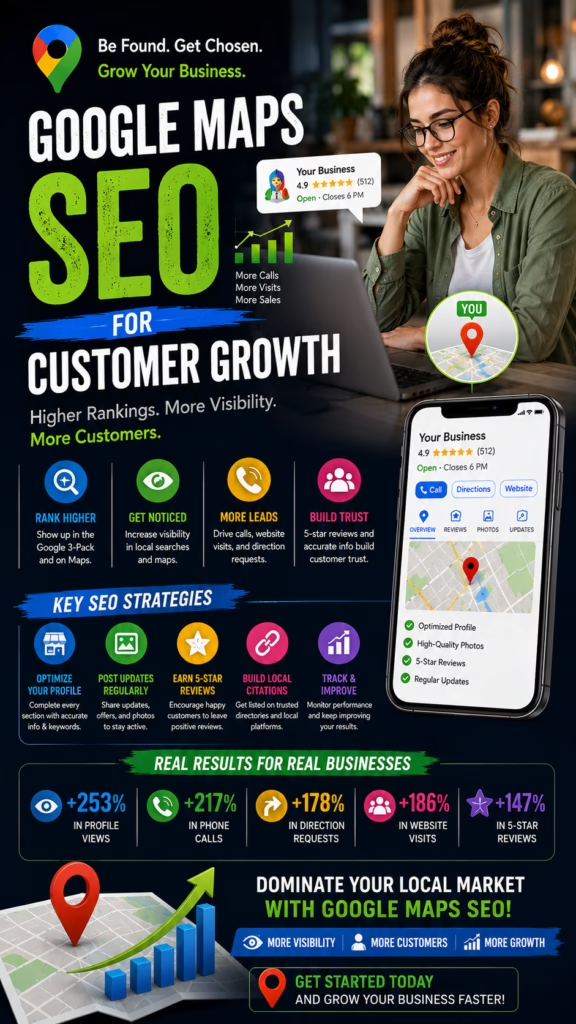
Google Maps SEO for Customer Growth
A complete guide to turning stronger Google Maps visibility into more calls, website visits, local inquiries, appointments, store visits, and long-term customer growth.
For local businesses, appearing at the right moment can be just as important as having the right product or service. When a customer searches Google for a nearby contractor, medical office, flooring store, HVAC company, restaurant, attorney, auto dealer, appliance company, warehouse, hotel, or another local provider, Google Maps can become one of the most valuable customer acquisition channels available.
That is why Google Maps SEO for customer growth is much more than a ranking strategy. At its best, it is a complete local acquisition system designed to connect a business with people who already have a reason to search.
Unlike many forms of advertising that attempt to interrupt consumers and create demand, local search often captures demand that already exists. Someone searching for a nearby service provider may already be comparing options, checking reviews, looking at photos, reviewing business hours, deciding whom to call, or preparing to visit a location.
What Is Google Maps SEO?
Google Maps SEO is the process of improving a business's visibility and competitiveness within Google Maps and local search results.
It typically includes the optimization of a company's Google Business Profile, website, local landing pages, reputation, categories, services, citations, location information, media, customer experience, local authority, and other signals that help Google understand the business and help customers decide whether to engage.
The term is often used interchangeably with phrases such as local SEO, Google Business Profile SEO, map pack SEO, Google Maps optimization, and local search optimization. In practice, the strongest strategy connects all of these disciplines rather than treating the business profile as an isolated listing.
Google Maps SEO is not just profile optimization
A common mistake is assuming that Google Maps SEO consists of editing a profile, adding a few keywords, uploading photos, and waiting for rankings. A complete strategy goes much further.
Google must understand what the company does, where it operates, how trustworthy it appears, whether its website supports the same business information, and whether customers consistently engage with the company.
Meanwhile, users need enough information and confidence to take the next step. That means ranking visibility and conversion performance should be developed together.
Why Google Maps SEO Matters for Customer Growth
Customer growth depends on consistently reaching people who are likely to buy. Google Maps can be powerful because many local searches happen close to the moment of action.
A person searching for a local provider may want to make a phone call immediately, schedule an appointment, visit a store, request directions, compare prices, inspect reviews, or locate the nearest qualified company.
This creates a fundamentally different marketing opportunity than audience-based channels in which a business is attempting to attract people who may or may not currently need the service.
High Intent
Local searches frequently come from consumers who already know what they need and are actively comparing providers.
Immediate Actions
Google Maps can place phone calls, directions, websites, reviews, and business details directly in front of the searcher.
Local Trust
Ratings, photos, profile completeness, business information, and customer feedback can influence purchase confidence.
Compounding Visibility
Strong organic local visibility can continue producing customer opportunities without paying for every individual click.
Customer growth begins before the click
Local prospects can evaluate a business without immediately visiting its website. They may see the company's name, star rating, review count, category, hours, photos, service information, location, and other details directly in Google's local interface.
Therefore, every element of the profile can influence whether visibility turns into a lead.
A business can theoretically rank well while still losing customers if the profile feels incomplete, the reviews look weak, the photos are outdated, the service descriptions are unclear, or the website experience fails after the click.
Understanding Local Search Behavior
Effective Google Maps SEO begins by understanding the way people search. Local queries are rarely uniform. Different users express the same need in different ways.
A homeowner looking for air-conditioning help might search for:
- AC repair near me
- air conditioning repair
- HVAC company near me
- emergency AC service
- AC repair in Dallas
- best HVAC contractor nearby
- air conditioner not cooling
Each phrase may represent slightly different intent, but all may lead to the same type of company.
Discovery searches versus branded searches
A branded search occurs when the consumer already knows the business name. A discovery search occurs when the consumer is looking for a service, product, or category without necessarily knowing which company to choose.
Discovery visibility is especially important for customer acquisition because it gives the business an opportunity to reach people who have not yet selected a provider.
Near-me searches are only one part of local SEO
Local intent does not always contain the phrase “near me.” Google can infer local meaning from the query, the user's location, prior context, and the type of business being searched.
Searches such as “plumber,” “roofing company,” “Italian restaurant,” or “storage units” may automatically produce local results because Google understands that geographic proximity matters.
The Foundations of Google Maps Rankings
Local search rankings are influenced by numerous signals and can differ from one person or geographic point to another. Businesses should avoid oversimplified strategies built around one supposed ranking factor.
A more useful framework is to think about three broad concepts: relevance, distance, and prominence.
| Local SEO Concept | What It Means | Business Implication |
|---|---|---|
| Relevance | How well the business matches the searcher's intent. | Use accurate categories, services, website content, and profile information. |
| Distance | The geographic relationship between the searcher and possible businesses. | Visibility naturally changes across different areas of a market. |
| Prominence | Signals that may indicate how established, trusted, or notable a business is. | Build reputation, authority, reviews, citations, local recognition, and website strength. |
The strategic lesson is simple: businesses should build a complete local presence rather than hunting for shortcuts.
Google Business Profile Optimization
The Google Business Profile is the central asset in most Google Maps SEO campaigns. It needs to communicate clear, accurate, and consistent information about the company.
Business name
The profile should represent the legitimate real-world name of the business. Artificially stuffing services, locations, or promotional terms into the business name can create compliance problems and is not a sustainable local SEO strategy.
Address and service area
Location information should reflect the actual business setup and follow platform requirements. Storefront businesses, hybrid businesses, and service-area businesses may require different profile configurations.
Business hours
Hours should be accurate and updated for holidays or special schedules. Incorrect hours are more than an SEO issue; they can directly create poor customer experiences.
Phone number
The phone number should connect customers with the correct business or location. Businesses using call tracking should implement it carefully so measurement does not create inconsistent or confusing business information.
Website URL
The destination should be relevant to the listing. For a single-location business, that may be the primary website. For a multi-location company, it may be more effective to connect each legitimate location with the corresponding local page.
Business description
The description should clearly explain the company's primary services, value proposition, and market. It should be written for customers first, not as a block of repetitive search keywords.
Categories, Services, and Relevance
Categories are among the most important profile decisions because they communicate the nature of the business.
Select the strongest primary category
The primary category should represent the company's main business activity. A roofing contractor should not choose a broad category simply because it receives more search volume if another category accurately represents the business.
Use relevant secondary categories
Secondary categories can represent legitimate additional business functions. They should be selected because the company genuinely provides those services, not because the category appears attractive from a search volume perspective.
Build out service information
Services can help prospects quickly determine whether the business is a good fit. Where appropriate, include major service categories and useful descriptions.
A flooring company, for example, might legitimately describe categories such as luxury vinyl plank, laminate, engineered hardwood, commercial flooring, or related product types when those offerings are actually available.
Reviews and Local Reputation
Reviews sit at the intersection of SEO, trust, conversion, and customer experience.
A prospect may see several nearby businesses with similar services. The profile with a strong history of authentic reviews may appear safer and more credible than a competitor with limited feedback.
Build a repeatable review process
Businesses often struggle with review generation because they treat it as an occasional campaign instead of an operating process.
A stronger system can include:
- asking satisfied customers for honest feedback;
- making the review process easy to access;
- training employees on appropriate review requests;
- incorporating requests into follow-up workflows;
- responding professionally to both positive and negative reviews;
- monitoring reputation trends over time.
Review freshness matters to customers
Even a business with hundreds of historical reviews can appear less active if the most recent feedback is old. A natural stream of current customer experiences communicates that the business is still operating and serving people consistently.
Respond to reviews with substance
Responses do not need to be long, but they should sound human, professional, and specific enough to demonstrate that the business values customer feedback.
Website SEO and Google Maps Performance
Google Maps SEO and website SEO should support one another. The website can help establish the business's services, market presence, authority, expertise, location information, and overall credibility.
Optimize core service pages
Every major revenue-producing service should have enough useful website information for customers and search engines to understand the offering.
Thin service pages often fail because they provide little beyond a generic headline, a stock photo, and a contact form. Strong pages answer real questions about the service, customer problem, process, use case, location, expectations, and next step.
Keep business information aligned
Important business information should not conflict between the website and Google Business Profile. If the website displays outdated numbers, addresses, hours, branding, or location details, the overall local presence becomes less trustworthy.
Improve mobile performance
Local searches frequently lead to mobile website sessions. A slow page, intrusive popup, broken layout, tiny text, poor navigation, or confusing contact process can destroy the value of strong Google Maps visibility.
The mobile experience should make important actions obvious, including calling, requesting information, locating a store, or understanding the service.
Local Landing Pages
Location-specific pages can support a broader local SEO strategy when they represent legitimate markets and provide useful information.
The mistake is creating hundreds of near-identical pages that simply swap one city name for another.
What a useful local page can include
- specific services offered in that market;
- local customer problems and use cases;
- legitimate location or service-area details;
- relevant testimonials or case examples;
- photos associated with the location or work area;
- service expectations;
- frequently asked local questions;
- clear next steps for contacting the business.
Think usefulness, not city-name repetition
Repeating a city twenty times does not automatically make a page locally valuable. Good local pages help customers determine whether the business can solve their problem in that market.
Citations and Business Information Consistency
Citations are online mentions of a business, often including its name, address, phone number, website, or other identifying information.
These references can appear on directories, chamber websites, associations, social networks, industry websites, mapping platforms, and other legitimate sources.
Accuracy matters more than directory volume
An old-school local SEO strategy often focused on submitting a company to as many directories as possible. A more sustainable approach is to focus on accurate, legitimate, and relevant sources.
Major inconsistencies can create customer confusion. A prospect who sees one phone number on Google, another on a directory, and a third on the website may hesitate to contact the company.
Local Content Strategy
Useful local content can expand the number of relevant searches for which a business becomes discoverable while building expertise and trust.
Create content around real customer questions
The best topics usually come directly from customers. What do they ask before buying? What problems create urgency? What do they compare? What causes hesitation? What location-specific issues affect the purchase?
A roofing contractor might publish information about storm damage, insurance-related questions, local roofing materials, maintenance, repair versus replacement, and weather-specific concerns.
A commercial warehouse company might publish information about clear height, loading configuration, industrial zoning, square-foot requirements, access, location logistics, and evaluating warehouse space.
Build topic clusters
Instead of publishing disconnected blog posts, create groups of content around major service categories.
A local HVAC company might create content clusters around:
- AC repair;
- heating repair;
- HVAC replacement;
- indoor air quality;
- maintenance;
- energy efficiency;
- thermostats;
- local seasonal cooling problems.
This creates deeper topical relevance than trying to force every possible keyword into one page.
Photos, Media, and Profile Engagement
Photos can play an important role in customer decision-making. Local prospects often want visual evidence that a business is active, real, and capable of delivering what it promises.
Useful Google Business Profile photo types
- storefront or building photos;
- team photos;
- completed projects;
- products and inventory;
- service vehicles;
- interior photos;
- before-and-after images where appropriate;
- customer-facing areas;
- equipment or work environments.
Authenticity matters. A real project, real employee, real storefront, or real product can communicate more trust than generic stock imagery.
Video can deepen confidence
Short videos can introduce the company, show a location, demonstrate a project, highlight products, explain a service, or provide a quick look at the team.
Even when media is not a direct ranking lever, improved engagement and customer confidence can make the local listing more commercially valuable.
Turning Map Visibility Into Customers
Traffic is not the final objective. Customer growth is.
A strong Google Maps SEO campaign should therefore optimize every step between visibility and revenue.
Step 1: Win the search result
The business first needs enough local visibility to appear when qualified customers are searching.
Step 2: Win the profile comparison
The prospect may compare ratings, reviews, photos, services, hours, location, and other visible profile information.
Step 3: Win the interaction
The business must make it easy for prospects to call, visit the website, request directions, or take another meaningful action.
Step 4: Win the website session
When users click through, the website should load quickly, communicate a clear value proposition, answer major questions, provide trust signals, and make the next step easy.
Step 5: Win the lead response
A lead generated through Google Maps can still be wasted through slow response times or a poor sales process. Businesses should have systems in place to answer calls, respond to inquiries, qualify prospects, and follow up.
Step 6: Win the customer experience
Customer acquisition and reputation are connected. A strong service experience can produce repeat business, referrals, and new reviews that reinforce future local visibility.
Tracking Google Maps SEO Performance
Local SEO becomes much easier to manage when a business measures outcomes instead of relying on vague impressions.
Track visibility
Measure how the business appears for strategically important searches across different points in the service area.
Local ranking grids can be particularly helpful because ranking position often changes significantly across a city.
Track profile interactions
Relevant engagement metrics can include phone calls, website visits, direction requests, and other available profile interactions.
Track leads and sales
The most meaningful performance questions are commercial:
- How many qualified leads are coming from local search?
- How many become appointments?
- How many appointments become customers?
- What is the average customer value?
- Which services are generating the most profitable inquiries?
- Which markets produce the highest conversion rate?
Track review momentum
Monitor the quantity, quality, freshness, and sentiment of customer reviews. Reputation trends can reveal operational problems as well as marketing opportunities.
Track website conversions
A ranking improvement does little good if visitors arrive at the website and leave without taking action. Track call clicks, forms, appointment requests, ecommerce activity, lead quality, and other relevant conversion events.
Google Maps SEO Mistakes to Avoid
1. Keyword stuffing the business name
A business should not rewrite its name purely to add ranking keywords. Sustainable optimization starts with accurate business information.
2. Choosing irrelevant categories
Categories should reflect real business functions rather than every potentially attractive search term.
3. Creating fake locations
Fake offices, virtual addresses used improperly, nonexistent storefronts, and other fabricated location strategies can create serious platform problems.
4. Buying fake reviews
Manufactured reviews undermine customer trust and can create policy, reputation, and legal exposure.
5. Ignoring the website
A profile and website should reinforce one another. Poor website performance can restrict the commercial value of excellent map rankings.
6. Publishing thin city pages
Duplicated pages with only the city name changed provide little value to customers and create a weak long-term SEO foundation.
7. Obsessing over one keyword
Customer acquisition usually comes from many search variations. A business should build broad relevance around its major services and markets.
8. Tracking rankings from only one location
Local visibility changes with geography. One ranking check cannot represent an entire metropolitan area.
9. Failing to respond to leads
Local SEO does not solve poor sales operations. A business needs fast response systems, professional communication, and consistent follow-up.
10. Treating local SEO as a one-time task
Competitors change, reviews accumulate, services evolve, websites age, search behavior changes, and business information must be maintained.
Google Maps SEO for Multi-Location Businesses
Multi-location businesses face additional complexity because each eligible location can have different competition, customer demographics, review strength, search behavior, and geographic ranking patterns.
Create location-level ownership
Every location should have accurate business information and a process for keeping hours, services, contacts, photos, and other details updated.
Build individual location pages
Each legitimate location can benefit from a useful page that communicates location-specific details rather than serving customers a generic national page.
Track each market independently
A company may dominate one city while underperforming in another. Aggregate metrics can hide these differences.
Local visibility, lead volume, reviews, conversions, and sales should be reviewed by location whenever possible.
Maintain brand consistency without deleting local relevance
The company should maintain consistent branding while allowing legitimate location differences in services, hours, photos, staff, customer stories, and local content.
Service-Area Business SEO
Contractors, mobile service providers, cleaning companies, home service businesses, delivery businesses, and similar companies may operate across large service territories without customers visiting a storefront.
These businesses need a strategy that reflects how they actually operate while staying aligned with Google Business Profile requirements.
Build market relevance through the website
Service-area companies can publish useful pages about core markets, provided those pages contain meaningful information and represent places the company genuinely serves.
Use reviews to demonstrate service coverage naturally
Authentic customer feedback can help prospective customers understand the company's reach and track record without forcing unnatural location keywords into every piece of content.
Develop regional content
Content can address climate, property types, building conditions, regulations, seasonal issues, and other legitimate regional factors that affect the service.
Winning in Competitive Local Markets
Competitive local SEO requires more than completing a checklist. When several businesses have optimized profiles, strong websites, many reviews, and substantial local authority, the strategy needs to become more sophisticated.
Perform a local competitor gap analysis
Compare the business with visible competitors across factors such as:
- primary and secondary categories;
- service depth;
- website content;
- review count and freshness;
- rating patterns;
- local landing pages;
- backlink authority;
- citation quality;
- media quality;
- profile completeness;
- customer experience;
- brand recognition.
Improve the weakest layer first
A company with excellent reviews but a weak website may benefit more from rebuilding service content than from attempting to add another hundred reviews immediately.
Another company may have strong organic pages but poor ratings. Its next growth opportunity may be operational reputation management.
Competitive local SEO should therefore be based on the actual gap between the business and the strongest competitors.
Focus on conversion advantages
A business does not always need the absolute top ranking for every query to grow. A company that converts significantly better than competitors can produce more revenue from similar visibility.
Conversion advantages can include:
- stronger reviews;
- better photos;
- clearer service information;
- faster phone response;
- better website usability;
- more persuasive trust signals;
- easier appointment scheduling;
- stronger follow-up systems.
Building a Repeatable Customer Growth System
The most powerful Google Maps strategies create a system rather than a collection of disconnected tactics.
Phase 1: Establish local search fundamentals
- verify accurate business information;
- review profile eligibility and setup;
- optimize categories;
- complete service information;
- correct major citation problems;
- align website information;
- fix technical website issues;
- establish baseline performance.
Phase 2: Build service and market relevance
- improve service pages;
- develop useful location pages;
- publish local content;
- strengthen internal linking;
- add useful FAQs;
- expand legitimate service information.
Phase 3: Strengthen reputation
- create a compliant customer review process;
- respond to feedback;
- monitor recurring complaints;
- use reputation insights to improve operations.
Phase 4: Build authority
- earn relevant local mentions;
- develop industry relationships;
- participate in legitimate community opportunities;
- create useful content worth referencing;
- strengthen the overall website.
Phase 5: Improve conversion
- improve calls to action;
- make mobile contact easier;
- improve profile media;
- strengthen landing pages;
- reduce slow lead response;
- improve appointment and sales follow-up.
Phase 6: Measure and iterate
Review local rankings, calls, leads, website conversions, reviews, sales, and customer acquisition performance. Then prioritize the next improvements based on data.
Google Maps SEO and the Customer Journey
Search marketing becomes more effective when businesses understand that customers move through stages.
Awareness
The user discovers the business while researching a service, category, or nearby provider.
Evaluation
The user compares businesses, ratings, reviews, photos, pricing information, services, hours, distance, and websites.
Action
The customer calls, requests directions, submits a form, books an appointment, visits the location, or makes a purchase.
Experience
The company delivers the service or product. Operational performance now influences future marketing.
Advocacy
A satisfied customer may leave a review, refer another customer, return for another purchase, or engage with the brand again.
This is why local SEO should not sit separately from customer service, sales, reputation management, and operations.
How Google Maps SEO Supports Different Business Models
Home service companies
HVAC businesses, plumbers, roofers, electricians, painters, landscapers, pest control companies, and similar providers can use local search to capture urgent and high-intent service demand.
Retail businesses
Flooring stores, furniture stores, appliance retailers, automotive dealers, and specialty shops can use local visibility to increase store visits, calls, inventory inquiries, and website traffic.
Professional services
Attorneys, accountants, consultants, financial service providers, and agencies often compete heavily on reputation and local authority. Strong profiles and high-quality educational content can improve trust before the first conversation.
Medical and health-related practices
Local visibility can help qualified consumers discover nearby providers, evaluate reviews, examine services, verify hours, and navigate to a practice. Businesses in regulated sectors should ensure that all marketing practices comply with applicable professional and advertising rules.
Hospitality businesses
Hotels, extended-stay properties, restaurants, event venues, and other hospitality businesses depend heavily on location, reputation, photos, convenience, and customer experience.
Commercial real estate
Industrial properties, warehouses, office locations, storage businesses, and other commercial real estate operators can build local visibility around property type, market, size, location, and buyer or tenant intent.
Organic Google Maps SEO vs. Paid Advertising
Businesses often ask whether they should invest in organic local SEO or paid advertising. In many cases, the strongest strategy is not choosing one forever but understanding what each channel does best.
| Factor | Google Maps SEO | Paid Advertising |
|---|---|---|
| Traffic model | Organic local visibility | Purchased exposure or clicks |
| Speed | Often requires sustained optimization | Can begin generating visibility quickly |
| Compounding value | Can strengthen over time | Generally depends on continued spending |
| Trust | Can benefit from strong organic presence and reviews | Depends heavily on ad message and landing page |
| Control | Less direct control over exact rankings | Greater control over budget, targeting, and campaigns |
Paid advertising can help create immediate reach while SEO builds. Strong organic visibility can reduce dependence on paid acquisition over time.
Google Maps SEO for Long-Term Customer Acquisition
A high-quality local SEO program creates assets that can continue supporting the business:
- a stronger Google Business Profile;
- a better website;
- useful service content;
- local landing pages;
- a growing reputation base;
- stronger brand recognition;
- better local citations;
- more customer data;
- improved conversion processes.
This is an important distinction. A mature SEO strategy should leave the business with a stronger digital presence than it had before, even as individual rankings naturally fluctuate.
Local SEO and Brand Growth
Google Maps visibility can also strengthen brand awareness. A customer may encounter the same business repeatedly while searching for related services across several weeks or months.
Repeated exposure can make the company name more familiar. Familiarity can improve branded searches, direct website visits, conversion confidence, referrals, and future customer recognition.
For this reason, Google Maps SEO can gradually evolve from simple keyword-based lead generation into broader local brand building.
How to Prioritize Google Maps SEO Work
Local SEO campaigns often contain dozens of potential tasks. Trying to execute everything simultaneously can waste time and budget.
Priority 1: Fix inaccurate information
Incorrect names, addresses, numbers, hours, website links, or location details can directly damage customer experience.
Priority 2: Fix eligibility and profile problems
The business needs a legitimate and correctly configured profile before advanced optimization matters.
Priority 3: Improve commercial relevance
Make sure the profile and website clearly communicate high-value services.
Priority 4: Improve reputation
Strong visibility combined with poor customer sentiment will frequently underperform.
Priority 5: Improve conversion
Better calls to action, stronger mobile pages, useful photos, and faster responses can increase revenue without requiring additional ranking gains.
Priority 6: Expand reach
After fundamentals are strong, expand service content, local content, authority, relevant landing pages, and broader keyword coverage.
The Future of Google Maps SEO
Search continues to become more conversational, personalized, visual, and AI-assisted. Users increasingly expect search engines to understand not just keywords, but context, intent, location, reputation, availability, products, services, and business suitability.
This means local SEO strategies should become more customer-centered rather than less.
Structured business information will remain important
Search engines need accurate information about companies, services, locations, categories, hours, and customer experiences in order to present useful results.
Authority and trust will become more valuable
As content generation becomes easier, authentic reputation, real business experience, recognizable brands, useful resources, and credible local signals can become increasingly important differentiators.
Conversion quality will matter more than traffic volume
Businesses should focus on whether search visibility creates meaningful commercial outcomes rather than celebrating impressions that never become customers.
Automation can improve execution
AI and automation can help businesses organize keyword research, identify optimization opportunities, monitor listings, analyze reviews, prioritize content, track local rankings, route leads, and improve follow-up.
However, automation should support real business information and authentic customer value rather than producing spam at greater scale.
Google Maps SEO Customer Growth Checklist
Businesses can use the following checklist as a practical framework:
- Confirm Google Business Profile eligibility.
- Verify the real-world business name.
- Verify address and service-area configuration.
- Confirm the primary business category.
- Add legitimate secondary categories.
- Complete important service information.
- Verify phone number accuracy.
- Verify website URL accuracy.
- Keep business hours updated.
- Write a clear business description.
- Upload authentic photos.
- Establish a consistent review process.
- Respond professionally to customer reviews.
- Audit major citations.
- Align website business information.
- Improve core service pages.
- Create useful local landing pages where appropriate.
- Improve mobile website performance.
- Build internal links between related services and locations.
- Publish useful customer-focused content.
- Track local rankings geographically.
- Track calls and inquiries.
- Measure lead quality.
- Measure appointment rate.
- Measure sales conversion.
- Improve lead response speed.
- Monitor competitor visibility.
- Track review growth.
- Strengthen local authority.
- Repeat the optimization process continuously.
Final Thoughts on Google Maps SEO for Customer Growth
Google Maps SEO can become one of the most valuable customer acquisition systems available to a local company, but only when rankings are connected to the larger business objective.
The strongest strategy is not simply “rank number one.” It is:
- be visible for the right searches;
- make a strong first impression;
- demonstrate credibility;
- help the customer understand the service;
- make contacting the business simple;
- respond quickly;
- deliver an excellent customer experience;
- turn satisfied customers into future reputation and referrals.
Businesses that build this entire system can transform Google Maps from a passive directory listing into a repeatable engine for local visibility, lead generation, customer acquisition, and sustainable growth.
Frequently Asked Questions About Google Maps SEO
1. What is Google Maps SEO?
Google Maps SEO is the process of improving a company's visibility in Google Maps and other local search results through profile optimization, website SEO, reviews, citations, local relevance, reputation, and authority.
2. How can Google Maps SEO help customer growth?
Greater local visibility can put a business in front of consumers who are actively searching for its products or services. This can generate calls, website visits, direction requests, appointments, inquiries, and purchases.
3. What is the Google local map pack?
The local map pack is a prominent group of local results that can appear when Google determines that a search has geographic intent. It commonly contains a map and several relevant businesses.
4. How important is a Google Business Profile for local SEO?
It is a central component of most local SEO strategies because it communicates important information about the company's services, category, location, reputation, hours, contact details, and other business attributes.
5. How long does Google Maps SEO take?
Timing varies based on competition, market size, website strength, review profile, category, business history, and the quality of existing local signals. Competitive markets typically require sustained work rather than a one-time optimization.
6. Do reviews affect Google Maps performance?
Reviews can contribute to reputation and customer conversion while also forming part of the business's broader local prominence. Authentic, current customer feedback is particularly valuable for establishing trust.
7. Do photos help a Google Business Profile?
High-quality authentic photos can make the profile more informative and persuasive. They can show customers the business, staff, products, projects, location, or services before the first direct interaction.
8. Should services be added to a Google Business Profile?
When available and applicable, accurately listing important services can make the business offering clearer to both customers and search engines.
9. What are local citations?
Local citations are references to a business's identifying information on other websites, directories, organizations, mapping services, or industry resources.
10. Does the business website affect Google Maps SEO?
Yes. Strong website content can reinforce service relevance, location information, business authority, and conversion performance, all of which make the broader local SEO strategy more effective.
11. What is proximity in local SEO?
Proximity describes the geographic relationship between the searcher and the businesses that could satisfy the query. This is one reason Google Maps rankings may change across different parts of the same city.
12. Can service-area businesses rank in Google Maps?
Eligible service-area businesses can appear in local search. Visibility depends on factors such as market competition, search relevance, location context, profile quality, reputation, and the broader local presence.
13. How often should a Google Business Profile be updated?
Core information should remain accurate at all times. Businesses should update hours, services, media, contact details, and other information whenever meaningful changes occur.
14. Are Google Business Profile posts useful?
Posts can communicate offers, announcements, updates, events, and service information to people viewing the profile. Their primary value is often engagement and communication rather than being treated as a standalone ranking tactic.
15. What categories should a Google Business Profile use?
The primary category should closely describe the company's main business function. Legitimate secondary categories can represent meaningful additional services or business activities.
16. Should keywords be placed in the business name?
Businesses should use their legitimate real-world name and comply with Google's naming requirements rather than adding artificial keywords solely for ranking purposes.
17. Do local landing pages help Google Maps SEO?
Useful local landing pages can support location and service relevance, especially when they contain genuine market-specific information rather than duplicated text.
18. What should businesses track in Google Maps SEO?
Track local visibility, calls, website visits, direction requests, lead quality, review growth, conversion rate, appointments, customer acquisition, and revenue whenever reliable attribution is possible.
19. What is local search intent?
Local search intent means the user is looking for a provider, product, service, or destination associated with a particular geographic area or nearby location.
20. Can Google Maps SEO generate phone calls?
Yes. Local results can place a phone action directly in front of a high-intent prospect, allowing customers to contact the company without navigating through multiple website pages.
21. Does responding to customer reviews matter?
Review responses can demonstrate professionalism, customer care, and reputation management. They also give future prospects more information about how the company handles customers.
22. Should every location page use the same content?
No. Location pages should contain meaningful information relevant to the specific location or service market rather than duplicating the same page and replacing only geographic terms.
23. Can spam hurt Google Maps SEO?
Manipulative tactics can create unnecessary risk. Businesses should focus on accurate information, real locations, authentic reviews, useful content, legitimate optimization, and a strong customer experience.
24. Is Google Maps SEO useful for multi-location companies?
Yes. Each eligible location can develop its own local visibility, reputation, website page, and market strategy while remaining part of the larger brand.
25. What makes a Google Business Profile convert better?
Accurate business details, strong reviews, authentic photos, relevant services, clear hours, persuasive website content, and an easy contact experience can all increase the likelihood of conversion.
26. Does mobile website optimization matter for local SEO?
Yes. Local searchers frequently use smartphones. A fast, mobile-friendly website helps turn Google Maps traffic into calls, forms, appointments, purchases, and other customer actions.
27. Can Google Maps SEO work without Google Ads?
Yes. Google Maps SEO is focused on organic local visibility and can be pursued independently from paid advertising. Some businesses combine both strategies for broader coverage.
28. What is local rank tracking?
Local rank tracking measures search visibility from different geographic points. This is useful because a company's ranking can vary dramatically across a metropolitan area.
29. Why do Google Maps rankings change by location?
Rankings can vary because Google considers factors including search intent, the searcher's location, business relevance, competition, proximity, prominence, and contextual signals.
30. What is the best Google Maps SEO strategy for customer growth?
The strongest strategy combines accurate profile optimization, relevant services and categories, website SEO, local landing pages, reputation management, authentic reviews, useful content, local authority, conversion optimization, lead tracking, and ongoing improvement.
30 Additional SEO Keywords
Turn Google Maps Visibility Into More Customers
Build a stronger local search presence with Google Maps SEO, AI-powered local visibility strategies, reputation optimization, and customer acquisition systems designed to help your business compete in the markets that matter.
Schedule a MarketWiz.ai Demo