
AI Marketing Tips That Increase Conversions
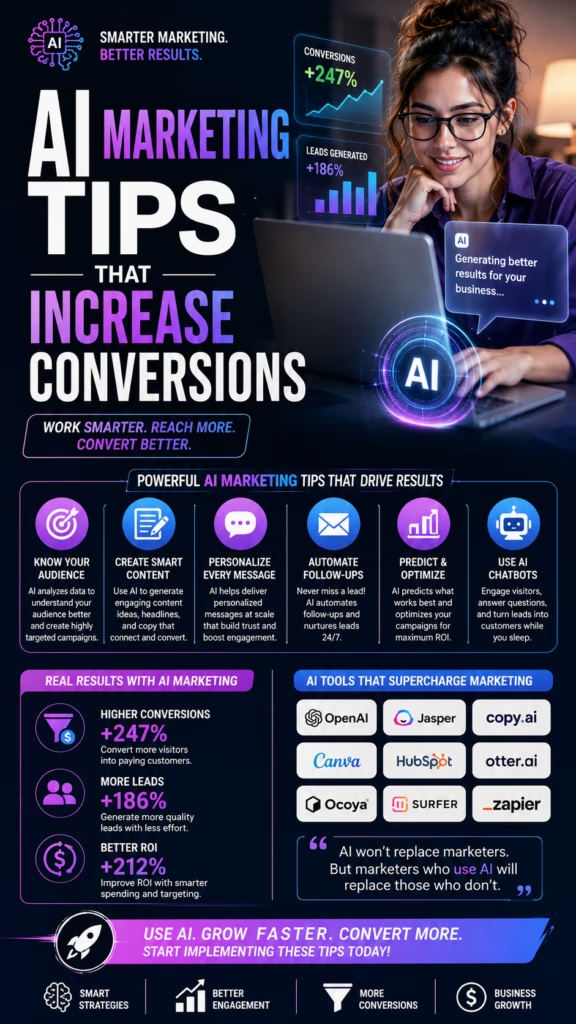
AI marketing tips that increase conversions can help businesses improve targeting, messaging, response speed, personalization, qualification, follow-up, and campaign optimization across the customer journey.
AI marketing tips that increase conversions are most effective when they make the customer journey clearer, faster, more relevant, and easier to complete.
Core conversion principle: Use AI where it removes friction or improves relevance. Do not automate a broken process and expect the technology to fix the strategy.
Introduction
AI marketing tips that increase conversions can help businesses improve how they attract prospects, personalize communication, prioritize leads, follow up, and measure customer behavior across the sales journey.
Artificial intelligence is most useful when it supports a clear conversion strategy. The goal is not to add automation everywhere. The goal is to remove friction, improve relevance, speed up decisions, and help the right prospect take the next step.
This guide explains practical ways businesses can use AI to improve landing pages, advertising, local marketing, lead response, sales qualification, customer follow-up, content, analytics, and conversion optimization while maintaining accuracy, trust, and human oversight.
What AI Marketing for Higher Conversions Means
AI marketing for higher conversions is the use of artificial intelligence to improve decisions and customer interactions that influence whether a prospect clicks, responds, books, buys, visits, calls, or returns.
Useful applications include audience analysis, content assistance, lead scoring, message routing, offer testing, personalization, search optimization, conversational support, campaign analysis, and CRM automation.
AI should support a measurable business objective. A tool that creates more content but does not improve qualified leads, sales efficiency, customer experience, or revenue may add activity without adding value.
Start With the Conversion Goal
Every AI marketing workflow should begin with one primary conversion. Examples include a booked consultation, phone call, form submission, store visit, property tour, quote request, trial signup, checkout, or repeat purchase.
Once the conversion is defined, identify the steps a prospect must complete before reaching it. AI can then be applied to the areas where people hesitate, leave, wait too long, or receive irrelevant information.
Conversion-first planning prevents businesses from using AI simply because a feature is available. It creates a practical connection between automation and revenue.
Map the Customer Journey Before Automating
Businesses should understand how prospects discover the company, evaluate the offer, ask questions, compare alternatives, and make a decision.
Map the journey from first impression to final conversion. Include paid ads, social media, search, local listings, website pages, chat, email, phone calls, appointments, proposals, checkout, onboarding, and post-purchase support.
AI can help identify common drop-off points and repetitive tasks, but the underlying customer journey should remain easy to understand and easy to complete.
Use AI to Understand High-Intent Audiences
AI can assist with analyzing customer records, lead notes, search terms, campaign data, review themes, and sales outcomes to identify patterns among high-value buyers.
Look for differences in location, industry, company size, product interest, urgency, budget, buying stage, source, device, and previous engagement.
These insights can improve targeting, messaging, offer design, and lead prioritization. The goal is to understand which audiences are most likely to convert and why.
Build Smarter Audience Segments
Generic marketing often underperforms because buyers have different goals. AI-assisted segmentation can help businesses organize prospects by need, intent, value, lifecycle stage, or behavior.
Examples include new visitors, returning visitors, abandoned leads, high-value accounts, price-sensitive shoppers, urgent buyers, past customers, inactive customers, and prospects interested in specific products.
Each segment can receive different messaging, proof points, offers, and next steps without requiring a completely separate marketing system.
Personalize Without Creating Friction
Personalization can improve conversions when it makes the experience more relevant. AI can help adapt headlines, recommendations, follow-up, product suggestions, and educational content based on known customer context.
Effective personalization should be subtle and useful. It should not feel invasive or expose private information.
Use only data the business is permitted to use, respect consent requirements, and provide clear options for customers who do not want personalized communication.
Use AI to Improve Offers
AI can help analyze which product bundles, pricing structures, bonuses, delivery options, financing choices, or service packages attract the strongest qualified response.
Review conversion rate by offer rather than assuming the most heavily promoted offer is the best one. A smaller number of high-quality leads may be more valuable than a large number of weak inquiries.
AI can also help summarize customer objections and reveal whether the offer is unclear, too complex, poorly timed, or missing an important benefit.
Create Conversion-Focused Marketing Copy
AI writing tools can accelerate first drafts for headlines, descriptions, emails, ads, FAQs, and sales follow-up.
High-converting copy should explain the customer's problem, the value of the solution, what makes the offer credible, what the prospect should do next, and what uncertainty can be removed.
Human review remains important. Verify factual claims, pricing, product availability, guarantees, testimonials, legal disclosures, and industry-specific requirements before publishing.
Test Stronger Headlines
Headlines influence whether people continue reading. AI can generate multiple headline angles based on urgency, outcome, specificity, audience, location, or problem awareness.
Test one meaningful variable at a time. For example, compare a benefit-focused headline with a problem-focused headline rather than changing the entire page.
Measure downstream conversion, not only click-through rate. A headline that attracts curiosity but poorly qualifies the visitor can reduce sales quality.
Optimize Landing Pages With AI
AI can help review landing pages for clarity, relevance, hierarchy, missing objections, weak calls to action, and unnecessary friction.
Strong landing pages usually have one primary goal, a clear value proposition, concise proof, useful details, mobile-friendly design, fast loading, and an obvious next step.
Use behavior data, heatmaps, form completion, bounce patterns, and sales outcomes to decide what should be changed. AI should help interpret evidence rather than replace testing.
Reduce Form Friction
Long forms can reduce conversion when every field is treated as mandatory. AI can help determine which information is genuinely needed before a sales conversation.
Consider progressive qualification. Collect the minimum information required for the next step, then gather additional details later when the prospect has more intent.
Use clear labels, mobile-friendly inputs, helpful error messages, and transparent expectations about what happens after submission.
Use AI Chat to Answer Questions Faster
AI chat can improve conversions by answering common questions, routing users, collecting basic details, and helping prospects reach the correct next step.
The system should be trained on accurate business information and should avoid inventing prices, policies, availability, guarantees, or technical answers.
Escalation is important. If the question is complex, sensitive, high-value, or uncertain, the conversation should move to a qualified human.
Improve Lead Response Speed
Response speed is one of the clearest opportunities for AI automation. New leads can be categorized, routed, acknowledged, and assigned without waiting for manual review.
A fast first response should confirm the inquiry and help the prospect continue. It should not overwhelm the person with a long script or irrelevant questions.
Businesses should monitor response quality as well as speed. Fast automation that provides inaccurate information can harm conversion.
Use AI for Lead Qualification
AI can help classify leads based on location, need, company type, budget, timeline, product interest, property details, or other relevant criteria.
Qualification should be proportionate to the sale. Low-friction purchases may need only a few details, while complex B2B or high-ticket sales may require deeper discovery.
Do not let automated scoring permanently exclude valuable prospects without review. Models can be wrong, incomplete, or influenced by poor historical data.
Prioritize High-Intent Leads
AI-assisted lead scoring can help sales teams decide which inquiries deserve immediate attention.
Useful signals may include recent engagement, requested pricing, repeat website visits, completed forms, booking attempts, opened proposals, product pages viewed, or clear buying timelines.
Lead scores should be compared with actual close rates. If the score does not predict sales outcomes, the model or inputs need to be adjusted.
Automate Helpful Follow-Up
Many prospects do not convert during the first interaction. AI can support follow-up sequences that adapt based on behavior and previous responses.
A useful follow-up may answer a common objection, remind the prospect of an appointment, clarify pricing, share a relevant case study, or offer the next available time.
Avoid excessive frequency and repetitive messaging. Follow-up should feel useful and context-aware.
Improve Email Conversion With AI
AI can help segment email audiences, write subject-line variations, personalize content, summarize customer history, and identify useful follow-up timing.
Emails should have one primary purpose. The reader should understand the message quickly and know what action to take.
Track opens carefully because privacy features can affect accuracy. Clicks, replies, bookings, purchases, and downstream revenue are usually more useful conversion metrics.
Use AI to Improve Paid Advertising
AI can help analyze creative performance, audience segments, keyword themes, landing-page alignment, and conversion quality.
Creative generation should be paired with testing. Produce multiple legitimate variations, then use real conversion data to determine which messages attract the right customers.
Do not optimize only for the cheapest click or lead. Compare cost per qualified opportunity, appointment, sale, gross profit, or lifetime value when possible.
Use AI to Strengthen Local Marketing
Local businesses can use AI to organize location-specific content, customer questions, review themes, service-area pages, advertising ideas, and local lead routing.
Each location should remain accurate. Business names, addresses, hours, service areas, inventory, pricing, and contact details should match reality.
AI can increase content speed, but local relevance still depends on genuine information about the market and customer.
Use AI for SEO Without Creating Thin Content
AI can assist with keyword clustering, content outlines, internal-link opportunities, FAQ development, title tags, meta descriptions, and content-gap analysis.
Search content should provide real value. Publishing large amounts of repetitive, shallow, or inaccurate text can create a poor user experience.
Use AI to improve research organization and production efficiency while maintaining subject-matter accuracy, original insight, and useful structure.
Analyze Reviews for Conversion Insights
Customer reviews contain valuable information about what buyers appreciate, fear, misunderstand, and expect.
AI can summarize recurring themes across positive and negative reviews. These themes can improve landing pages, sales scripts, FAQs, onboarding, and offer positioning.
Do not fabricate testimonials or alter customer meaning. Review-based marketing should accurately reflect genuine customer feedback.
Support Sales Teams With AI
AI can summarize calls, extract action items, prepare account notes, suggest follow-up questions, and help representatives understand prior interactions.
This can reduce administrative work and improve continuity between marketing and sales.
Sales teams should remain responsible for judgment, relationship building, negotiation, and final commitments. AI support works best when it makes human conversations more informed.
Connect AI With CRM Workflows
A CRM becomes more valuable when lead source, status, next action, appointment, owner, and outcome are kept accurate.
AI can help classify notes, identify stale leads, summarize history, trigger reminders, and surface accounts that need attention.
Automation should never create duplicate records or overwrite important customer information without safeguards. Data hygiene is essential.
Use AI to Analyze Conversion Data
AI can help businesses interpret complex dashboards and identify patterns across channels, campaigns, locations, products, and customer segments.
Useful questions include which campaigns generate the highest close rate, where leads drop out, which locations have slow response times, and which offers create the strongest average order value.
Treat AI-generated analysis as a starting point. Important decisions should be validated against the underlying data.
Build a Consistent Testing Program
AI can accelerate experimentation by generating hypotheses and variations, but testing discipline still matters.
Choose a specific element, define the expected outcome, run the test long enough to collect meaningful data, and evaluate the result against the correct metric.
Document winning and losing tests. Over time, the business develops a conversion knowledge base instead of repeating the same experiments.
Use AI Without Damaging Customer Trust
Customers should receive accurate information and a clear path to human support when needed.
Businesses should avoid impersonation, deceptive personalization, fabricated reviews, undisclosed material claims, and automated promises that cannot be fulfilled.
Trust compounds. A slightly slower but accurate process often produces more long-term value than aggressive automation that creates confusion.
Common AI Marketing Conversion Mistakes
Common mistakes include automating before defining the process, measuring activity instead of revenue, using weak data, over-personalizing, publishing inaccurate content, and removing human review from important decisions.
Another mistake is using the same AI workflow for every audience. High-ticket buyers, repeat customers, urgent leads, and casual visitors may require different experiences.
Finally, do not assume more automation means better conversion. The correct amount of automation is the amount that improves speed, relevance, clarity, or consistency.
A 30-Day AI Marketing Conversion Plan
During the first week, define primary conversions, map the customer journey, identify friction points, and audit current response times and tracking.
During the second week, implement one or two high-impact workflows such as lead routing, FAQ support, sales follow-up, or landing-page testing.
During the third week, analyze results and refine segmentation, messaging, and qualification. During the fourth week, compare revenue and conversion metrics, document lessons, and expand only the workflows that create measurable value.
Conclusion
AI marketing tips that increase conversions work best when AI is connected to a clear customer journey and measurable business outcomes.
The highest-value use cases improve relevance, response speed, qualification, follow-up, testing, sales visibility, and decision-making without sacrificing accuracy or trust.
Start with the biggest conversion bottleneck, apply AI carefully, measure the result, and keep what works. That approach creates sustainable improvement instead of automation for its own sake.
Frequently Asked Questions
What are AI marketing tips that increase conversions?
They are practical ways to use artificial intelligence to improve targeting, messaging, personalization, lead response, qualification, follow-up, testing, and analytics so more qualified prospects complete a desired action.
How can AI improve marketing conversion rates?
AI can improve relevance, response speed, audience segmentation, content testing, lead prioritization, and customer follow-up when it is connected to accurate data and a clear conversion goal.
What is the best place to start with AI marketing?
Start by identifying the most important conversion goal and the biggest source of friction in the current customer journey.
Can AI improve landing pages?
Yes. AI can help review copy, hierarchy, objections, calls to action, and page structure, but changes should be validated with real user behavior and conversion data.
Can AI write high-converting ad copy?
AI can create useful variations and first drafts, but businesses should verify claims, pricing, availability, legal requirements, and brand accuracy before publishing.
How can AI improve lead response time?
AI can acknowledge inquiries, categorize leads, route them to the correct team, create CRM records, and trigger the next action quickly.
Can AI qualify leads?
Yes. AI can help classify leads using relevant criteria such as location, need, budget, timeline, product interest, or company size.
What is AI lead scoring?
AI lead scoring uses available behavioral and customer data to estimate which prospects may have the strongest purchase intent or sales potential.
Can AI help with email marketing conversions?
Yes. AI can support segmentation, subject-line testing, personalized content, timing, follow-up, and analysis of clicks, replies, bookings, and sales.
Can AI improve paid advertising performance?
AI can help analyze audiences, creative, keywords, landing-page alignment, and downstream lead quality so campaigns are optimized toward meaningful business results.
Can local businesses use AI marketing?
Yes. Local businesses can use AI for lead routing, local content, review analysis, response automation, appointment follow-up, and location-specific campaign analysis.
Can AI improve SEO conversions?
AI can support keyword organization, content structure, FAQs, internal links, and search intent, while strong conversion still depends on useful content and a clear next step.
How should AI personalization be used?
Personalization should make the experience more relevant without exposing sensitive information or making customers feel monitored.
Can AI reduce form abandonment?
It can help businesses identify unnecessary fields, simplify qualification, and improve form instructions and error messages.
Can AI chatbots increase conversions?
They can when they provide accurate answers, reduce waiting, collect useful information, and escalate appropriately to a human.
Should AI replace human sales representatives?
Usually no. AI is most valuable as support for research, summaries, routing, follow-up, and prioritization while humans handle judgment and relationship building.
How can AI help with follow-up?
AI can trigger relevant reminders, answer common objections, recommend next actions, and personalize follow-up based on previous customer behavior.
What conversion metrics should businesses track?
Common metrics include qualified-lead rate, booking rate, checkout rate, close rate, average order value, customer acquisition cost, revenue, and lifetime value.
Can AI analyze reviews?
Yes. AI can summarize recurring themes in genuine customer reviews to identify common benefits, objections, complaints, and expectations.
How can AI improve social media conversions?
AI can help create and test content for different stages of the customer journey and connect high-performing posts to clear conversion paths.
Can AI improve CRM data?
AI can help classify notes, summarize history, surface stale leads, and trigger reminders, but businesses should use safeguards to protect data quality.
What is the biggest mistake in AI marketing?
A major mistake is automating without a clear conversion goal or measurable process.
Should businesses automate every marketing task?
No. Automation should be used where it improves speed, relevance, consistency, or efficiency without reducing accuracy or trust.
How can AI help with A/B testing?
AI can generate test hypotheses and creative variations, while the actual winner should be determined using reliable conversion data.
Can AI help reduce customer acquisition cost?
Potentially. Better targeting, qualification, response speed, and conversion can reduce wasted spend and improve the value generated from each marketing dollar.
How do businesses keep AI marketing accurate?
Use verified source information, human review, clear escalation rules, CRM hygiene, and regular audits of automated responses and decisions.
Can AI help increase repeat purchases?
Yes. It can identify lifecycle stages, purchase patterns, relevant reminders, and cross-sell opportunities for customers who have given appropriate permission for communication.
How quickly can AI marketing improve conversions?
Some improvements such as faster lead routing can produce immediate operational benefits, while reliable conversion gains usually require testing and enough data to evaluate performance.
Does AI marketing work for B2B companies?
Yes. B2B companies can use AI for account research, segmentation, lead scoring, sales summaries, follow-up, proposal workflows, and pipeline analysis.
What is the main goal of AI marketing optimization?
The main goal is to make the customer journey more relevant, efficient, trustworthy, and measurable so more qualified prospects become customers.
30 Additional SEO Keywords
Use these related phrases naturally in supporting articles, internal links, image alt text, related pages, and future content.
Turn AI Marketing Into More Qualified Conversions
MarketWiz.ai helps businesses connect AI marketing, lead response, automation, local visibility, and conversion-focused workflows into a more measurable customer-acquisition system.
Request a MarketWiz.ai Strategy ReviewMarketing results vary by offer, industry, market, traffic quality, sales process, and implementation. AI-generated content and automation should be reviewed for accuracy before use.














Use AI to Improve Social Media Conversion Paths
Social content should connect attention to a clear next step. AI can help create content variations for awareness, education, proof, objection handling, and direct response.
Not every post should sell. A strong social strategy builds familiarity and trust before asking for a conversion.
Track which posts create profile visits, website traffic, messages, calls, leads, and purchases rather than focusing only on likes.