

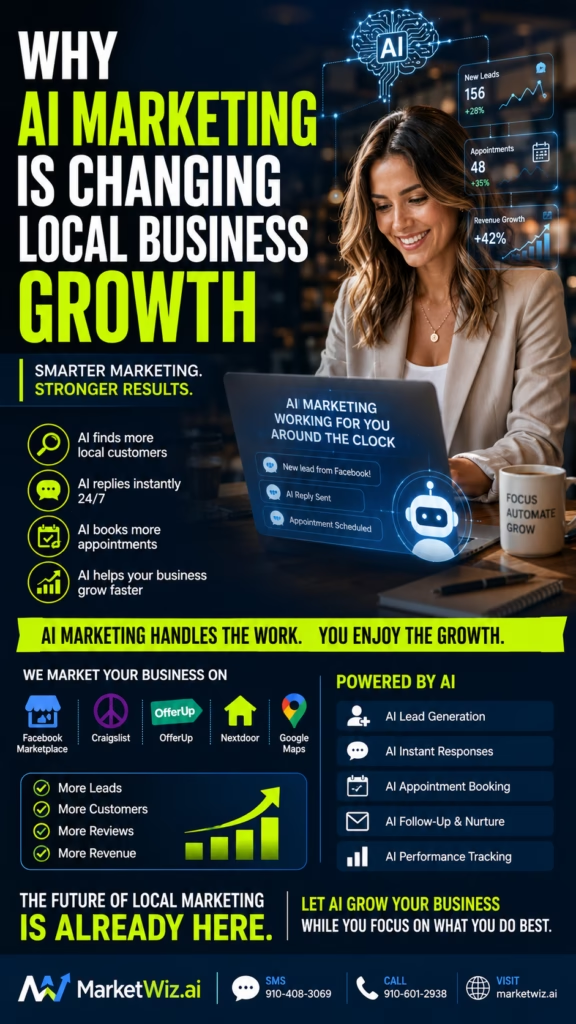
Why AI Marketing Is Changing Local Business Growth
Why AI Marketing Is Changing Local Business Growth explains how local companies can use artificial intelligence to generate more leads, respond faster, create consistent content, improve follow-up, strengthen local visibility, reduce repetitive work, and build a more scalable customer acquisition system.
Introduction
Why AI Marketing Is Changing Local Business Growth begins with a challenge faced by almost every small and mid-sized company: customers expect faster communication, more personalized service, useful content, accurate information, and convenient scheduling, but most local teams already have limited time.
A contractor may be driving between estimates. A furniture store may be helping customers on the showroom floor. A medical practice may be managing calls, appointments, and patient questions. A real estate company may be qualifying properties and scheduling tours. A restaurant may be handling orders while trying to maintain reviews and social media activity.
Traditional marketing systems often require employees to manually complete every task. Someone must create posts, update listings, answer repeated questions, organize lead information, send reminders, write follow-up messages, request reviews, prepare reports, and determine which campaigns are working.
Artificial intelligence changes this model. AI can assist with repetitive marketing work, organize information, prepare content, respond to routine questions, identify customer intent, route leads, recommend next actions, and help local businesses operate with greater speed and consistency.
AI marketing gives local businesses the ability to deliver faster and more organized customer experiences without requiring every task to be completed manually.
This does not mean AI should replace human judgment, relationships, accountability, or customer care. The strongest systems use AI to support employees, reduce delays, improve consistency, and create more time for the conversations that require real expertise.
Local businesses can use AI marketing for Facebook Marketplace responses, Google Maps content, local SEO, Nextdoor posts, Craigslist listings, website chat, voice agents, appointment scheduling, social media videos, customer follow-up, review requests, reporting, lead scoring, and customer relationship management.
The value comes from connecting these tools to real business outcomes. More content is not useful if it produces no qualified leads. Faster responses are not valuable if the information is inaccurate. Automation is not successful if customers feel confused or ignored.
The strongest AI marketing strategy begins with a clear problem, an organized workflow, accurate business information, defined customer goals, human oversight, and measurable performance.
Main idea: AI is changing local business growth by helping companies turn limited time, customer data, marketing channels, and staff capacity into a faster and more scalable growth system.
Table of Contents
- 1) Why local business marketing is becoming more difficult
- 2) How AI changes the traditional marketing workflow
- 3) Improving speed to lead with AI
- 4) Using AI for customer conversations
- 5) Automating lead qualification
- 6) Improving appointment scheduling
- 7) Creating more consistent local content
- 8) Using AI for Google Maps growth
- 9) Using AI for local SEO and answer engines
- 10) Using AI for Marketplace marketing
- 11) Using AI for Nextdoor and community marketing
- 12) Using AI for social media and short-form video
- 13) Personalizing local customer communication
- 14) Improving follow-up with AI
- 15) Using AI voice agents
- 16) Connecting AI with CRM systems
- 17) Improving review generation and reputation
- 18) Using AI analytics for better decisions
- 19) Reducing repetitive marketing work
- 20) Protecting accuracy, privacy, and customer trust
- 21) Choosing the right AI marketing tools
- 22) Measuring AI marketing performance
- 23) Common AI marketing mistakes
- 24) Final thoughts
- 25) FAQs
- 26) Extra keywords
1) Why Local Business Marketing Is Becoming More Difficult
Local business marketing is becoming more difficult because customers are spread across more platforms and expect faster service on each one.
A customer may discover a business through Google Maps, Facebook Marketplace, Instagram, Nextdoor, Craigslist, OfferUp, TikTok, YouTube, a website, an online review, or a referral. The business must maintain accurate information and respond professionally across every channel.
Common local marketing challenges include:
- Rising advertising costs
- Slow lead response
- Too many marketing platforms
- Inconsistent posting
- Missed phone calls
- Unorganized customer information
- Weak follow-up
- Limited staff time
- Poor campaign tracking
- Difficulty creating content
Small businesses often depend on one owner or a small team to manage sales, operations, customer service, marketing, scheduling, billing, and fulfillment.
When the business becomes busy, marketing slows down. When marketing slows down, future lead volume may decline. This creates an inconsistent cycle of too much work followed by not enough work.
AI can help break this cycle by allowing essential marketing tasks to continue even when the team is focused on customers and operations.
AI becomes valuable when it helps local businesses maintain consistent growth activity during their busiest operational periods.
2) How AI Changes the Traditional Marketing Workflow
Traditional marketing workflows depend on people completing each step manually. AI can assist with several steps at once while keeping employees in control of important decisions.
Traditional workflow:
Lead arrives
Employee notices message
Employee researches service
Employee writes response
Employee asks qualification questions
Employee records contact information
Employee schedules follow-up
Employee updates CRM
Employee prepares report

AI-supported workflow:
Lead arrives
AI responds immediately
AI identifies inquiry type
AI asks approved questions
AI records lead details
AI routes qualified opportunity
AI schedules next action
AI updates CRM
Employee handles complex conversation
The goal is not to remove the employee from the process. The goal is to prevent unnecessary delays and repetitive manual work.
AI can prepare drafts, summarize customer conversations, recommend follow-up messages, classify leads, identify missing information, and create reminders.
Employees can review the information and focus on pricing, strategy, negotiation, problem-solving, relationship building, and final decisions.
AI changes marketing by moving people away from repetitive administration and toward higher-value customer work.
3) Improving Speed to Lead with AI
Speed to lead is the amount of time between a customer inquiry and the first useful response. Local customers often contact several businesses when they need a product, repair, estimate, appointment, property, or service.
A delayed response gives competitors more time to answer questions, collect contact information, and schedule the next step.
AI can improve speed to lead by:
- Sending an immediate first response
- Acknowledging the exact inquiry
- Confirming availability information
- Asking initial qualification questions
- Collecting location information
- Requesting photos
- Collecting phone numbers
- Scheduling appointments
- Notifying staff
- Creating follow-up tasks
Example AI first response:
Thank you for reaching out. We may be able to help. What city are you located in, what service do you need, and what timeline are you considering? Photos or additional details would help us explain the best next step.
The response should use approved business information. AI should not guess about pricing, inventory, scheduling, guarantees, financing, or service availability.
Fast responses should remain helpful and natural. An instant robotic message that ignores the customer’s question may reduce trust.
AI improves growth when it helps the business begin a useful conversation before the customer moves to a competitor.
4) Using AI for Customer Conversations
AI can support routine customer conversations across website chat, social media messages, Marketplace inquiries, email, voice calls, and other channels.
AI customer conversations may include:
- Service availability
- Business hours
- Service-area questions
- Product information
- Appointment options
- Delivery questions
- Basic pricing clarification
- Qualification questions
- Contact information collection
- Human handoff
The system should be trained on the actual business rather than generic industry information. A roofing company, medical practice, furniture store, property business, and moving company need different response logic.
Customer conversations should also adapt to the inquiry. Someone asking about a mattress should not receive a remodeling response. A homeowner requesting a plumbing repair should not receive a generic sales message.
The AI should recognize when the customer has a complex, emotional, legal, medical, financial, technical, or high-value question that requires a qualified person.
AI should make customer conversations faster and more organized without pretending to have expertise or authority it does not possess.
5) Automating Lead Qualification
Not every inquiry is a qualified lead. AI can help businesses collect important details before a salesperson, estimator, office manager, or owner enters the conversation.
Common qualification details include:
- Customer location
- Service or product needed
- Project size
- Property type
- Current condition
- Preferred timeline
- Delivery requirements
- Appointment availability
- Photos or documents
- Best contact information
AI qualification flow:
Identify inquiry
Confirm city or ZIP code
Confirm service needed
Ask timeline
Request photos when useful
Collect phone number
Determine next step
Notify correct team member
The system should not ask too many questions at once. Start with the details that determine whether the business can help.
Qualification logic should change by industry. A moving company may need origin, destination, move date, and home size. A contractor may need property location, photos, project type, and timeline. A retailer may need product size, delivery location, and availability.
AI qualification helps sales teams spend more time on realistic opportunities and less time collecting basic information.
6) Improving Appointment Scheduling
Scheduling delays can cause qualified customers to disappear. AI can help move conversations toward appointments, consultations, tours, estimates, demonstrations, or service calls.
AI scheduling can support:
- Appointment availability
- Estimate scheduling
- Property tours
- Consultation calls
- Showroom visits
- Service windows
- Appointment reminders
- Rescheduling
- Missed-appointment follow-up
- Calendar updates
The scheduling system should use real calendar availability and account for travel time, service territories, appointment length, staff assignments, and business hours.
AI should not offer unavailable times or confirm appointments that require human approval.
Example scheduling response:
We can help schedule the next step. Please share your preferred day, whether morning or afternoon works better, and the property or service location. We will confirm the available appointment options.
Automated reminders can reduce missed appointments and help customers prepare photos, measurements, documents, or other required information.
AI improves conversion when it reduces the delay between a qualified conversation and a confirmed appointment.
7) Creating More Consistent Local Content
Local businesses often struggle to publish consistently because content creation competes with daily operations.
AI can help create drafts for blog posts, Google Business Profile updates, social media captions, service pages, FAQs, email campaigns, video scripts, and customer education.
AI content can support:
- Local blog articles
- Service descriptions
- City landing pages
- Google Business Profile posts
- Social media captions
- Short-form video scripts
- Frequently asked questions
- Email newsletters
- Seasonal campaigns
- Project descriptions
AI-generated content should be reviewed for accuracy, uniqueness, tone, local relevance, and customer usefulness.
Businesses should avoid publishing large amounts of generic content that adds no real information. Strong local content includes actual services, locations, project examples, customer questions, photos, business processes, and local expertise.
The business should also avoid creating duplicate city pages that change only the location name.
AI helps local businesses publish more consistently, but human knowledge turns generic drafts into trustworthy local content.
8) Using AI for Google Maps Growth
Google Maps visibility depends on accurate business information, local relevance, reviews, photos, website content, citations, customer engagement, and ongoing profile activity.
AI can support Google Maps marketing through:
- Google post drafts
- Service description drafts
- Review response drafts
- Photo caption ideas
- Local FAQ content
- Location-page planning
- Keyword organization
- Competitor comparison
- Performance summaries
- Content calendars
AI should not create fake reviews, false locations, duplicate profiles, misleading business names, or unsupported local claims.
Review responses should protect customer privacy and sound natural. Businesses should not publish the exact same response to every customer.
AI-supported Google post:
Preparing Your Home for Exterior Painting

Before exterior painting begins, homeowners may need to review peeling surfaces, moisture concerns, damaged trim, caulking, access, landscaping, and weather conditions.

Our local team is currently reviewing selected exterior projects. Contact us with your city, several photos, and your preferred timeline.
AI can increase Google Maps activity, but accurate business information and genuine customer experiences remain essential.
9) Using AI for Local SEO and Answer Engines
Customers increasingly search through Google, AI assistants, maps, voice tools, and answer engines. Local businesses need content that clearly explains who they help, what they provide, where they operate, and how customers can take the next step.
AI local SEO tasks may include:
- Keyword research organization
- Service-page outlines
- Location-page outlines
- FAQ creation
- Internal linking recommendations
- Metadata drafts
- Content gap analysis
- Schema planning
- Search-intent grouping
- Content refresh suggestions
AI can help businesses create content that answers specific customer questions, such as pricing factors, service areas, preparation, timelines, delivery, appointment steps, project options, and common problems.
Content should be written for real customers rather than search engines alone.
Answer engines are more likely to understand businesses that maintain clear, structured, consistent information across websites, profiles, directories, reviews, and other trusted sources.
AI helps local businesses organize knowledge into content that customers and modern search systems can understand.
10) Using AI for Marketplace Marketing
Facebook Marketplace, Craigslist, OfferUp, and similar platforms can generate direct local conversations for products, properties, services, and appointments.
AI Marketplace marketing can support:
- Listing title variations
- Unique descriptions
- Product categorization
- Local market versions
- Pricing clarification
- Customer response
- Lead qualification
- Phone number collection
- Appointment scheduling
- Lead tracking
Businesses should avoid publishing misleading listings, fake inventory, unsupported prices, repetitive spam, or inaccurate location information.
AI Marketplace workflow:
Select product or service
Generate focused title
Create accurate description
Add real photos
Publish in supported market
Respond to inquiry
Qualify customer
Collect contact information
Schedule next step
Track outcome
AI can help create variation, but every listing should represent a real product, service, property, or business opportunity.
AI makes Marketplace marketing more scalable when listing quality, customer trust, and platform accuracy remain protected.
11) Using AI for Nextdoor and Community Marketing
Nextdoor and other community platforms require a more local and conversational style than traditional advertising.
AI can help prepare:
- Neighborhood maintenance tips
- Seasonal reminders
- Project spotlights
- Service availability updates
- Helpful responses
- Recommendation requests
- Local event posts
- Community education
- Estimate calls to action
- Neighborhood content calendars
Businesses should avoid using AI to publish repetitive promotional comments or generic replies under every neighborhood request.
Community marketing works when the business provides useful information and demonstrates real local involvement.
Example neighborhood post:
Three Signs Your Gutters May Need Attention

1. Water spilling over the edges
2. Staining near the roofline
3. Water collecting near the foundation

These signs may indicate blockage, improper drainage, or damaged sections. Homeowners should use safe access methods and request professional help when the system is difficult to reach.
AI can support community marketing, but genuine local participation is what builds neighborhood trust.
12) Using AI for Social Media and Short-Form Video
Short-form video helps local businesses show projects, products, employees, locations, processes, and customer results.
AI video marketing can support:
- Video topic ideas
- Hooks
- Text-on-screen scripts
- Voiceover drafts
- Shot lists
- Captions
- Hashtags
- Video descriptions
- Content repurposing
- Publishing calendars
Short-form video structure:
0–3 seconds:
Customer problem or visual hook

3–10 seconds:
Show project, product, or process

10–20 seconds:
Explain benefit or transformation

20–27 seconds:
Display proof or result

Final seconds:
Clear local call to action
A contractor can turn one completed project into several videos. A retailer can show product features, delivery, comparisons, and customer questions. A medical practice can publish approved educational content within professional guidelines.
AI-generated scripts should be reviewed for claims, accuracy, legal restrictions, medical rules, financial disclosures, and brand tone.
AI helps local businesses turn ordinary daily operations into a consistent stream of visual marketing content.
13) Personalizing Local Customer Communication
Customers respond more positively when communication reflects their location, service, product, timing, and previous conversation.
AI personalization can use:
- Customer name
- Service requested
- Property city
- Product interest
- Appointment history
- Previous questions
- Project timeline
- Lead source
- Conversation stage
- Preferred contact method
Generic follow-up:
Are you still interested?

Personalized follow-up:
Hi Jordan, I wanted to follow up regarding the two-car garage project you were considering in Raleigh. Are you still planning for a fall timeline, and have the desired dimensions changed?
Personalization should not become invasive. Businesses should use only appropriate customer information and protect private data.
AI should not invent previous conversations, personal details, or customer preferences.
Personalized communication improves customer experience when it is accurate, relevant, and respectful.
14) Improving Follow-Up with AI
Many local leads are lost because the business responds once and never follows up.
Customers may be comparing options, waiting for a paycheck, speaking with a spouse, choosing materials, reviewing estimates, planning a future move, or waiting for a better time.
AI follow-up can support:
- Unanswered inquiry reminders
- Estimate follow-up
- Appointment reminders
- Missed appointment recovery
- Long-term project nurturing
- Inventory updates
- Seasonal reminders
- Promotion follow-up
- Review requests
- Repeat customer outreach
Simple follow-up:
Hi, I wanted to follow up regarding your request. Are you still considering the same service and timeline? We can answer updated questions, confirm availability, or explain the next step whenever you are ready.
Follow-up frequency should remain reasonable. Customers should not receive excessive messages.
The system should stop or change the sequence when the customer replies, books, declines, or asks not to be contacted.
AI follow-up helps local businesses recover qualified opportunities that would otherwise disappear after the first conversation.
15) Using AI Voice Agents
AI voice agents can answer routine calls, qualify inquiries, provide approved information, schedule appointments, route callers, and support after-hours coverage.
AI voice agents can support:
- Inbound call answering
- Basic customer service
- Lead qualification
- Appointment scheduling
- Business-hours information
- Service-area confirmation
- Call routing
- Missed-call recovery
- Reminder calls
- Conversation summaries
The voice agent should be trained on the business’s real services, locations, hours, policies, and escalation rules.
Customers should not be misled about the nature of the system. The agent should not claim professional credentials, make binding commitments, or provide restricted advice.
Voice-agent qualification:
Confirm caller name
Identify service needed
Confirm location
Ask timeline
Collect relevant details
Schedule or route call
Create summary
Notify team
Human transfer should be available for complex questions, complaints, emergencies, sensitive issues, negotiation, and high-value decisions.
AI voice agents help local businesses answer more calls while protecting staff time for conversations that require human judgment.
16) Connecting AI with CRM Systems
AI becomes more valuable when customer conversations are connected to an organized lead-management system.
AI and CRM integration can support:
- New lead creation
- Contact information updates
- Lead-source tracking
- Conversation summaries
- Lead-status updates
- Task creation
- Appointment records
- Estimate follow-up
- Sales notifications
- Performance reporting
Example lead stages:
New inquiry
Awaiting details
Qualified
Appointment scheduled
Estimate completed
Proposal sent
Follow-up needed
Won
Lost
Closed
Without a CRM or organized lead sheet, AI may create faster conversations without creating a dependable sales process.
Every qualified lead should have an owner, status, next action, and follow-up date.
Businesses should limit access to customer information and use appropriate security practices.
AI creates stronger growth when conversations become organized sales opportunities instead of isolated messages.
17) Improving Review Generation and Reputation
Reviews influence local search visibility, customer trust, and conversion. AI can help businesses request, monitor, summarize, and respond to feedback.
AI reputation support may include:
- Review request drafts
- Follow-up timing
- Review response drafts
- Sentiment summaries
- Complaint identification
- Common praise themes
- Service-quality trends
- Customer feedback reports
- Team notifications
- Reputation dashboards
Review request:
Thank you for choosing our business. If you are comfortable sharing your experience, we would appreciate an honest review describing the communication, service, and overall process. Your feedback helps other local customers know what to expect.
AI should never create fake reviews, impersonate customers, or publish fabricated experiences.
Review responses should be reviewed carefully when complaints involve health, safety, legal disputes, billing, privacy, contracts, or sensitive personal information.
AI can make reputation management more consistent, but genuine customer experience remains the foundation of every strong review profile.
18) Using AI Analytics for Better Decisions
Local businesses often collect data from ads, websites, phone calls, forms, social media, CRM systems, Google Business Profile, and sales records but struggle to turn that data into clear decisions.
AI analytics can help identify:
- Best-performing lead sources
- Strongest service categories
- Highest-value locations
- Slow response periods
- Common customer questions
- Lead-quality patterns
- Conversion bottlenecks
- Seasonal demand
- Follow-up opportunities
- Revenue trends
Example AI performance summary:
Marketplace generated the most messages.
Google Maps generated the highest appointment rate.
Nextdoor produced fewer leads but larger average projects.
Weekend response time was slower than weekday response.
Bathroom remodeling leads required more follow-up than painting leads.
AI recommendations should be checked against complete and accurate data. Poor tracking can create misleading conclusions.
The business should connect marketing metrics to revenue rather than optimizing only for impressions, clicks, views, or messages.
AI analytics helps local businesses move from guessing about marketing performance to making decisions from organized evidence.
19) Reducing Repetitive Marketing Work
Many marketing tasks are necessary but repetitive. AI can reduce the time required to complete them while keeping employees responsible for quality and approval.
Repetitive tasks AI can support:
- Caption drafts
- Listing variations
- FAQ creation
- Lead summaries
- Follow-up messages
- Review responses
- Appointment reminders
- Report summaries
- Content calendars
- Data organization
The time saved can be redirected toward sales calls, customer relationships, project quality, strategy, employee training, and business development.
Businesses should not automate a broken process. If the company has unclear services, inaccurate pricing, weak communication, or poor follow-up, AI may reproduce those problems faster.
Best automation sequence:
Define process
Correct business information
Create approved responses
Set qualification rules
Define human handoff
Test workflow
Review results
Improve system
Scale carefully
AI creates operational leverage when it improves a clear process instead of multiplying confusion.
20) Protecting Accuracy, Privacy, and Customer Trust
AI marketing systems may process customer names, phone numbers, addresses, property details, appointment information, conversation histories, and other sensitive information.
Trust protections should include:
- Accurate business information
- Approved response rules
- Limited data access
- Secure integrations
- Human escalation
- Customer privacy
- Clear consent practices
- Data retention policies
- Regular system review
- Error correction
AI should not invent prices, guarantees, credentials, inventory, appointments, legal conclusions, medical advice, financial promises, or service capabilities.
Businesses should be especially careful in healthcare, legal, financial, housing, employment, insurance, and other regulated industries.
Customer conversations should be reviewed when the system shows uncertainty, receives a complaint, encounters an emergency, or handles a high-value opportunity.
AI marketing growth is not sustainable if customers cannot trust the information, privacy, or decisions produced by the system.
21) Choosing the Right AI Marketing Tools
Businesses should choose tools based on real operational needs rather than buying every new AI product.
AI marketing tool categories include:
- Content creation
- Website chat
- Voice agents
- CRM automation
- Appointment scheduling
- Social media publishing
- Local SEO tools
- Review management
- Marketplace response
- Analytics and reporting
Tool evaluation questions:
What problem does the tool solve?
Does it connect to current systems?
Can the team control responses?
How is customer data protected?
Can conversations be reviewed?
Does it support human handoff?
How is performance measured?
What does it cost to operate?
Can the workflow scale?
What happens when the tool fails?
A small business may begin with one focused workflow, such as missed-call recovery, website chat, Marketplace response, or review follow-up.
After the workflow produces reliable results, the company can expand into additional channels.
The best AI marketing tool is the one that solves a measurable business problem without creating unnecessary complexity.
22) Measuring AI Marketing Performance
AI marketing should be measured through real business outcomes.
Useful AI marketing metrics include:
- Lead response time
- Conversations handled
- Qualified leads
- Phone numbers collected
- Appointments scheduled
- Missed calls recovered
- Follow-ups completed
- Reviews generated
- Content published
- Estimates completed
- Sales closed
- Average transaction value
- Customer acquisition cost
- Revenue by channel
- Time saved
Example AI marketing performance:
420 customer inquiries
390 immediate first responses
170 qualified leads
92 appointments scheduled
48 completed sales
160 staff hours saved

Response coverage:
390 ÷ 420 = 92.9%

Qualification rate:
170 ÷ 390 = 43.6%

Appointment rate:
92 ÷ 170 = 54.1%

Qualified lead-to-sale rate:
48 ÷ 170 = 28.2%
Businesses should compare AI-supported performance with the previous manual process.
Comparison questions:
Did response time improve?
Did lead quality improve?
Were more appointments scheduled?
Did fewer leads disappear?
Did staff save time?
Did customer satisfaction improve?
Did revenue increase?
Did acquisition cost decrease?
AI marketing should be judged by qualified customers, operational efficiency, and revenue—not the number of automated messages sent.
23) Common AI Marketing Mistakes
AI marketing often fails because businesses automate too quickly, use inaccurate information, or focus on volume instead of customer experience.
Common AI marketing mistakes include:
- Automating a broken process
- Using generic business information
- Publishing unreviewed content
- Sending robotic responses
- Asking too many questions
- Making unsupported claims
- Failing to provide human handoff
- Ignoring customer privacy
- Using fake reviews
- Creating duplicate content
- Tracking activity but not revenue
- Buying too many disconnected tools
- Failing to train employees
- Failing to review conversations
- Scaling before testing
Another mistake is expecting AI to replace strategy. The system still needs clear services, pricing rules, service areas, qualification standards, customer policies, and sales goals.
Businesses should test AI with a limited workflow, review real conversations, correct errors, and gradually expand.
Customer feedback should also be monitored. Faster automation is not helpful if customers feel misunderstood.
AI marketing fails when the business prioritizes automation volume over accuracy, trust, and customer outcomes.
24) Final Thoughts
Why AI Marketing Is Changing Local Business Growth comes down to speed, consistency, organization, personalization, scalability, and better use of limited staff time.
AI can help local businesses answer leads faster, qualify customers, schedule appointments, create content, maintain Google Maps activity, publish Marketplace listings, manage Nextdoor posts, produce short-form video scripts, organize CRM data, request reviews, and prepare performance reports.
The strongest systems do not remove people from the customer experience. They allow employees to spend less time on repetitive administration and more time on relationships, service, expertise, sales, and problem-solving.
Local businesses should begin with one measurable problem. Slow response, missed calls, inconsistent follow-up, weak content production, poor lead tracking, and limited review generation are all practical starting points.
AI tools should be trained on accurate business information, connected to organized workflows, protected by human oversight, and measured through real outcomes.
Businesses should also protect customer privacy, avoid unsupported claims, and create clear escalation rules for complex or sensitive conversations.
Most importantly, AI should support a real growth system. More automation without better customer service will not produce sustainable results.
Build an AI-Powered Local Customer Growth System
Market Wiz AI helps local businesses automate Marketplace posting, customer responses, Google Maps growth, local SEO, Nextdoor marketing, short-form content, lead qualification, follow-up, CRM organization, and performance tracking.
Schedule a Market Wiz AI DemoFinal takeaway: AI marketing is changing local business growth by helping companies respond faster, operate more consistently, and turn everyday customer activity into an organized and scalable acquisition system.
25) FAQs
1) What is AI marketing for local businesses?
AI marketing uses artificial intelligence to support lead generation, customer response, content creation, follow-up, scheduling, local SEO, advertising, reporting, and customer relationship management.
2) Why is AI changing local business growth?
AI helps local businesses complete more marketing work, respond faster, improve consistency, organize customer information, and reduce repetitive manual tasks.
3) Can small businesses afford AI marketing?
Yes. Small businesses can begin with one focused workflow, such as lead response, appointment scheduling, review requests, content creation, or missed-call recovery.
4) Does AI marketing replace employees?
AI is usually most valuable when it supports employees by handling repetitive work while people manage customer relationships, complex questions, and important decisions.
5) What local businesses can use AI marketing?
Contractors, retailers, restaurants, medical practices, real estate companies, automotive businesses, home service providers, professional services, and many other local companies can use AI.
6) Can AI respond to leads?
Yes. AI can send approved first responses, answer routine questions, collect location and service details, and route qualified opportunities.
7) Can AI qualify local business leads?
Yes. AI can ask approved questions about location, service needs, project size, timing, photos, delivery, appointments, and contact information.
8) Can AI schedule appointments?
AI can support appointment scheduling when it is connected to real availability, business hours, staff calendars, service areas, and approval rules.
9) Can AI create local business content?
Yes. AI can draft blogs, Google posts, service pages, social captions, video scripts, FAQs, emails, and seasonal campaigns.
10) Should AI-generated content be reviewed?
Yes. Businesses should review content for accuracy, usefulness, tone, local relevance, legal requirements, and unsupported claims.
11) Can AI improve Google Maps marketing?
AI can support Google posts, service descriptions, review responses, local FAQs, photo ideas, location content, and performance summaries.
12) Can AI help with local SEO?
AI can organize keywords, create outlines, identify content gaps, prepare metadata, build FAQs, suggest internal links, and support service or location pages.
13) Can AI manage Marketplace leads?
AI can respond to Marketplace inquiries, answer routine questions, qualify customers, collect phone numbers, schedule appointments, and update lead records.
14) Can AI help with Nextdoor marketing?
AI can draft neighborhood posts, seasonal tips, project spotlights, recommendation requests, helpful responses, and local content calendars.
15) Can AI create short-form video scripts?
Yes. AI can create hooks, text-on-screen sequences, voiceovers, shot lists, captions, descriptions, and calls to action.
16) Can AI personalize customer messages?
AI can personalize messages using accurate information such as customer name, location, requested service, timeline, previous conversation, and appointment status.
17) Can AI improve follow-up?
Yes. AI can send reminders, follow up after estimates, recover missed appointments, nurture long-term leads, and request reviews.
18) Can AI answer business phone calls?
AI voice agents can answer routine calls, collect information, schedule appointments, route callers, and provide approved business details.
19) Can AI connect with a CRM?
Yes. AI can create lead records, update statuses, summarize conversations, assign tasks, record appointments, and support follow-up.
20) Can AI help businesses get more reviews?
AI can automate review request timing and prepare response drafts, but reviews should always come from genuine customer experiences.
21) Is AI marketing safe for customer data?
AI systems should use secure integrations, limited access, appropriate consent, privacy protections, clear retention rules, and regular human oversight.
22) What AI marketing metrics should businesses track?
Track response time, qualified leads, appointments, follow-ups, reviews, sales, revenue, customer acquisition cost, conversion rate, and staff time saved.
23) What is the biggest AI marketing mistake?
One of the biggest mistakes is automating an unclear or broken process without accurate information, testing, human handoff, or performance tracking.
24) How should a local business start with AI?
Choose one measurable problem, document the current process, create approved rules, test the AI workflow, review results, and expand carefully.
25) What is the best AI marketing strategy?
Use AI to improve one high-value workflow, connect it to accurate business data and human oversight, measure customer outcomes, and scale only after the system works reliably.
25) Extra Keywords
- Why AI Marketing Is Changing Local Business Growth
- AI marketing for local businesses
- local business automation
- AI lead generation
- small business AI marketing
- local customer acquisition
- AI marketing automation
- artificial intelligence for business growth
- AI customer response
- AI lead qualification
- AI appointment scheduling
- AI local SEO
- AI Google Maps marketing
- AI Marketplace responder
- AI Nextdoor marketing
- AI social media automation
- AI short-form video marketing
- AI CRM automation
- AI review management
- AI voice agent for local business
- AI follow-up automation
- AI content creation for small business
- local business growth technology
- AI customer acquisition strategy
- AI marketing business growth













