
Why Reviews Matter for Google Maps Rankings
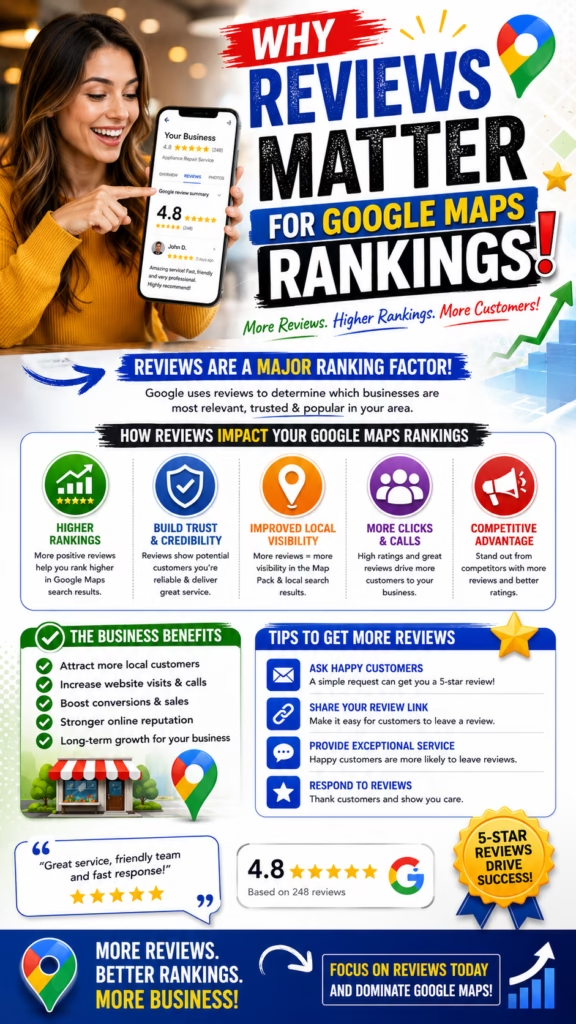
Why Reviews Matter for Google Maps Rankings explains how customer reviews help local businesses build trust, improve prominence, increase clicks, and compete more effectively in Google Maps.
Introduction
Why Reviews Matter for Google Maps Rankings starts with one important truth: Google Maps is not only about being close to the searcher. It is also about trust, relevance, and prominence. Reviews help support all three.
When a customer searches for a local service, restaurant, contractor, store, medical provider, repair company, or professional business, they often compare review count, star rating, recent feedback, owner responses, and customer experiences before choosing who to call.
Reviews matter because they help Google and customers understand whether a business is trusted, active, relevant, and worth choosing.
Google’s local ranking system considers relevance, distance, and prominence. Reviews can support prominence because they show public reputation. They can also improve conversion because a business with more positive reviews usually looks safer to contact than a competitor with fewer reviews.
Main idea: Reviews can influence Google Maps performance by improving trust, prominence, click-through rate, customer confidence, and local lead quality.
Table of Contents
- 1) What Google Maps rankings depend on
- 2) Why reviews affect local trust
- 3) Review quantity and visibility
- 4) Review quality and star rating
- 5) Review frequency and freshness
- 6) Review keywords and relevance
- 7) Owner responses and engagement
- 8) Reviews and prominence
- 9) Reviews and click-through rate
- 10) Reviews and conversion rate
- 11) How reviews help service businesses
- 12) How reviews help contractors
- 13) How reviews help medical and wellness businesses
- 14) How reviews help restaurants and retail
- 15) How to ask for reviews properly
- 16) How to respond to positive reviews
- 17) How to respond to negative reviews
- 18) Review mistakes to avoid
- 19) Creating a review growth system
- 20) Final thoughts
- 21) FAQs
- 22) Extra keywords
1) What Google Maps Rankings Depend On
Google Maps rankings are mainly influenced by relevance, distance, and prominence. Relevance means how well your Business Profile matches the search. Distance means how close your business is to the searcher or searched area. Prominence means how well-known, trusted, and established your business appears online.
Reviews are not the only factor, but they are one of the most visible trust signals on a Google Business Profile. A business with strong reviews, accurate information, helpful photos, correct categories, and consistent activity often has a stronger local presence than a business with a thin or neglected profile.
Google Maps ranking foundations:
Relevance
Distance
Prominence
Profile completeness
Accurate categories
Customer reviews
Review responses
Photos
Business information
Overall local reputation
Reviews matter because they support the public reputation side of local ranking.
2) Why Reviews Affect Local Trust
Reviews are often the first proof customers look at. A business can claim to be the best, but customer reviews show whether real people had good experiences.
For local businesses, trust is everything. Customers want to know if the business shows up on time, communicates well, solves the problem, charges fairly, and treats people professionally. Reviews help answer those questions before a customer calls.
Reviews build trust by showing:
- Real customer experiences
- Service quality
- Responsiveness
- Professionalism
- Reliability
- Problem-solving ability
- Customer satisfaction
- Business consistency
Better reviews can make a business feel safer to choose before the customer ever visits the website.
3) Review Quantity and Visibility
Review quantity matters because it gives customers more confidence. A business with hundreds of reviews usually looks more established than a business with only a few reviews, assuming the rating and review quality are strong.
More reviews can also create more content around your business. Customers may mention services, products, neighborhoods, staff names, project types, and common problems. This can help your profile look active and relevant.
Review quantity can help show:
- More customer history
- More proof of activity
- More trust signals
- More service examples
- More reputation depth
- More confidence for new customers
Review count matters most when it is supported by strong ratings, real feedback, and steady review growth.
4) Review Quality and Star Rating
Review quality matters just as much as review count. A business with many low-quality or negative reviews may struggle to convert leads. A business with strong, detailed, positive reviews often looks more trustworthy.
Star rating is important because customers compare it quickly. A strong average rating can improve confidence, while a weak rating can create hesitation even if the business ranks well.
Strong review quality includes:
Specific details
Real customer language
Mentioned services
Clear positive experience
Professional tone
Recent feedback
Local context
Problem solved
High star rating
Helpful owner response
High-quality reviews do more than improve appearance. They help customers understand why they should choose your business.
5) Review Frequency and Freshness
Fresh reviews matter because they show that the business is active now. A business with many old reviews but no recent feedback can look less current than a business that receives steady new reviews.
Review frequency should be natural. A healthy review profile usually grows consistently over time. Sudden unnatural spikes or suspicious patterns can reduce trust.
Fresh reviews help show:
- The business is active
- Customers are still using the service
- Recent experiences are positive
- The company is still relevant
- The profile is not abandoned
- The reputation is current
Consistent review growth is usually better than random bursts followed by silence.
6) Review Keywords and Relevance
Review keywords can help customers and search engines better understand what your business does. When customers naturally mention services, products, cities, neighborhoods, or problems solved, those words add useful context to your Google Business Profile.
Never tell customers exactly what to write or pressure them to use keywords. Instead, provide a great experience and ask for honest feedback. Detailed reviews often include helpful keywords naturally.
Helpful natural review details:
Service performed
Product purchased
City or neighborhood
Problem solved
Team member name
Project type
Experience quality
Timeline
Result
Reason for recommendation
Do not fake keyword-heavy reviews. Real customer language is safer and more trustworthy.
7) Owner Responses and Engagement
Responding to reviews shows customers that your business pays attention. A thoughtful reply can reinforce trust, show professionalism, and encourage future customers to feel comfortable contacting you.
Owner responses should be short, professional, and specific when possible. Thank the customer, mention the service if natural, and show appreciation.
Positive review response example:
Thank you for the kind review. We appreciate you choosing us for your project and are glad the team could help. It means a lot to serve local customers like you.
Review replies are part of your public reputation. Future customers read them too.
8) Reviews and Prominence
Prominence is about how well-known and trusted a business appears. Reviews can support prominence because they show public feedback, customer activity, and reputation strength.
A business with strong reviews, consistent mentions, quality links, accurate citations, complete profile information, and a strong website usually has a better local trust footprint than a business with little public proof.
Prominence signals can include:
Google reviews
Review score
Review count
Business mentions
Website authority
Local citations
Directories
Photos
Profile completeness
Overall reputation
Reviews help strengthen the public reputation that supports local prominence.
9) Reviews and Click-Through Rate
Reviews can influence whether people click your listing. When customers compare businesses in Google Maps, they often look at star rating, review count, photos, hours, and distance.
If two businesses appear near each other, the one with stronger reviews may win more clicks. More clicks and engagement can lead to more calls, website visits, direction requests, and bookings.
Review elements customers compare:
- Average rating
- Total review count
- Most recent reviews
- Review details
- Owner responses
- Photos attached to reviews
- Customer sentiment
- Repeated service mentions
Reviews do not just help rankings. They help turn visibility into action.
10) Reviews and Conversion Rate
Ranking high is only useful if customers choose you. Reviews help convert searchers into leads because they reduce doubt. A strong review profile can make customers feel safer calling, booking, requesting a quote, or visiting your location.
This is why reviews matter even when they do not directly move a ranking position. A business in position three with excellent reviews may win more calls than a business in position one with weak reviews.
Reviews can improve conversions by increasing:
Trust
Confidence
Call volume
Website clicks
Direction requests
Quote requests
Appointment bookings
Purchase decisions
Referral confidence
Brand preference
The best Google Maps strategy improves both rankings and conversions.
11) How Reviews Help Service Businesses
Service businesses depend heavily on trust. Customers want to know if the company is reliable, skilled, clean, honest, and responsive. Reviews help prove those qualities.
For HVAC, plumbing, roofing, painting, cleaning, pest control, landscaping, appliance repair, junk removal, and home services, reviews often influence the customer’s first call.
Service business review topics customers care about:
- Was the technician on time?
- Was the price fair?
- Was the issue fixed?
- Was communication clear?
- Was the work clean?
- Would the customer hire again?
- Was the company professional?
- Was the response fast?
For service companies, reviews often act like local word-of-mouth at scale.
12) How Reviews Help Contractors
Contractors need reviews because customers are making bigger decisions. A homeowner hiring a remodeler, painter, roofer, deck builder, flooring company, or general contractor wants proof before spending money.
Detailed reviews that mention project type, communication, timeline, cleanliness, and final results can help contractors stand out in Google Maps.
Contractor review details that help:
Project type
Quality of work
Before-and-after result
Communication
Timeline
Professionalism
Clean job site
Fair pricing
Problem solving
Would recommend
Contractor reviews help reduce risk for homeowners choosing who to hire.
13) How Reviews Help Medical and Wellness Businesses
Medical, wellness, dental, chiropractic, physical therapy, spa, and healthcare-related businesses rely on confidence and comfort. Reviews can help potential patients understand the experience before scheduling.
Customers often look for kindness, professionalism, clear communication, cleanliness, appointment availability, and positive outcomes.
Wellness review signals include:
- Friendly staff
- Clean office
- Helpful provider
- Comfortable experience
- Clear explanations
- Easy scheduling
- Professional care
- Positive results
In trust-heavy industries, reviews can be the deciding factor between booking and leaving.
14) How Reviews Help Restaurants and Retail
Restaurants and retail businesses benefit from reviews because customers make quick decisions based on rating, photos, menu mentions, product quality, service, and atmosphere.
Positive reviews can increase foot traffic, direction requests, calls, and website visits. Review photos can also influence customer decisions.
Restaurant and retail review details:
Food quality
Customer service
Cleanliness
Atmosphere
Product selection
Pricing
Wait time
Location
Parking
Overall experience
For restaurants and retail, reviews help turn search visibility into real visits.
15) How to Ask for Reviews Properly
The best way to get more reviews is to ask happy customers at the right time. Do not pressure them. Do not offer rewards for positive reviews. Do not ask people to write fake feedback.
Make the review process simple. Send a direct review link after a completed job, appointment, purchase, or positive customer interaction.
Simple review request script:
Thank you for choosing us. If you were happy with the experience, a quick Google review would mean a lot and help more local customers find our business.
Review growth should be honest, consistent, and customer-driven.
16) How to Respond to Positive Reviews
Positive review responses should show gratitude and reinforce professionalism. Keep them personal, simple, and natural.
Positive review response formula:
Thank the customer
Mention the service if natural
Show appreciation
Invite them back or offer future help
Do not copy the exact same response every time. Repetitive replies can look lazy. A few small details make responses feel more human.
Responding to positive reviews shows future customers that your business is active and appreciative.
17) How to Respond to Negative Reviews
Negative reviews should be handled calmly. Do not argue, insult, or reveal private customer information. A professional response can protect your reputation even when the review is not ideal.
Negative review response example:
Thank you for your feedback. We are sorry to hear the experience did not meet expectations. Please contact our team directly so we can better understand what happened and work toward a solution.
Your response to a negative review is not only for that customer. It is for every future customer reading the profile.
18) Review Mistakes to Avoid
Bad review practices can hurt trust and create long-term problems. Businesses should avoid fake reviews, review gating, paying for positive reviews, keyword stuffing, and ignoring customer feedback.
Avoid these review mistakes:
- Buying reviews
- Posting fake reviews
- Asking only happy customers while blocking unhappy ones
- Offering rewards for positive reviews
- Ignoring negative reviews
- Copying the same reply every time
- Arguing publicly with customers
- Asking customers to use exact keywords
A fake-looking review profile can damage trust faster than a low review count.
19) Creating a Review Growth System
Review growth works best when it becomes part of your normal customer process. Instead of randomly asking for reviews once in a while, build a system that asks at the right time every time.
Simple review growth system:
Complete the service
Confirm customer satisfaction
Send review request
Make the link easy
Follow up politely once
Respond to every review
Track review growth monthly
Improve service based on feedback
Train your team to ask naturally. Add review links to follow-up emails, invoices, QR cards, SMS messages, and thank-you pages when appropriate.
Consistent review systems create steady reputation growth.
20) Final Thoughts
Why Reviews Matter for Google Maps Rankings comes down to trust, prominence, and customer choice. Reviews help Google understand public reputation, and they help customers decide whether your business deserves the call.
The strongest local businesses do not treat reviews as an afterthought. They build review systems, respond professionally, learn from feedback, and use customer trust as a long-term ranking and conversion advantage.
Final takeaway: Reviews matter for Google Maps because they help your business look trusted, active, relevant, and worth choosing.
21) FAQs
1) Why do reviews matter for Google Maps rankings?
Reviews matter because they support trust, prominence, customer confidence, and local conversion signals.
2) Are reviews a Google Maps ranking factor?
Reviews can influence local visibility as part of reputation and prominence, along with relevance, distance, and other signals.
3) Does review count matter?
Yes. More real reviews can help show that a business is active, trusted, and experienced.
4) Does star rating matter?
Yes. A strong rating can improve customer confidence and make a business more attractive in Maps results.
5) Do recent reviews matter?
Yes. Recent reviews show that the business is active and still serving customers.
6) Should businesses respond to reviews?
Yes. Review responses show engagement, professionalism, and customer care.
7) Do keywords in reviews help?
Natural keywords in customer reviews can add helpful context, but businesses should not tell customers exactly what to write.
8) Can reviews improve click-through rate?
Yes. Strong reviews can make more people click, call, visit, or request directions.
9) Can reviews improve conversion rate?
Yes. Reviews reduce doubt and help customers feel safer choosing the business.
10) How many reviews does a business need?
There is no universal number. The right goal depends on the industry, city, and competitor review profiles.
11) Is it better to have many reviews or a high rating?
Both matter. A strong profile usually has a healthy review count and a strong rating.
12) Should I ask every customer for a review?
You can ask customers for honest feedback, but the request should be fair, natural, and not manipulative.
13) Can I pay for Google reviews?
No. Paying for positive reviews can violate platform rules and damage trust.
14) What is review velocity?
Review velocity is the pace at which a business receives new reviews over time.
15) Is steady review growth important?
Yes. Steady review growth looks more natural and keeps the profile fresh.
16) Should I remove negative reviews?
You can report reviews that violate policies, but legitimate negative feedback should be handled professionally.
17) How should I respond to negative reviews?
Stay calm, thank the customer, avoid arguing, and invite them to contact the business directly.
18) Can fake reviews hurt a business?
Yes. Fake reviews can damage trust and may create platform issues.
19) Do review photos help?
Review photos can help customers understand real experiences and may increase confidence.
20) Do reviews help service businesses?
Yes. Reviews are especially important for service businesses because customers want proof before hiring.
21) Do reviews help contractors?
Yes. Contractor reviews can show project quality, communication, and reliability.
22) Do reviews help restaurants?
Yes. Restaurant reviews influence customer decisions, foot traffic, and trust.
23) Should review requests include a direct link?
Yes. A direct review link makes the process easier for customers.
24) What is the best review strategy?
The best strategy is to deliver great service, ask consistently, respond professionally, and improve based on feedback.
25) What is the biggest reason reviews matter?
Reviews matter because they help customers trust your business before contacting you.
22) Extra Keywords
- Why Reviews Matter for Google Maps Rankings
- Google Maps reviews
- Google Business Profile reviews
- local SEO reviews
- Google Maps ranking factors
- Google review strategy
- Google Maps SEO
- Google reviews for local SEO
- Google review count
- Google review rating
- review velocity local SEO
- Google review responses
- Google Business Profile optimization
- Google Maps prominence
- local business reviews
- customer reviews SEO
- Google local pack reviews
- Google Maps lead generation
- review management strategy
- Google review growth
- local reputation management
- Google Maps visibility
- Google Business Profile ranking
- local SEO reputation
- Google review marketing