

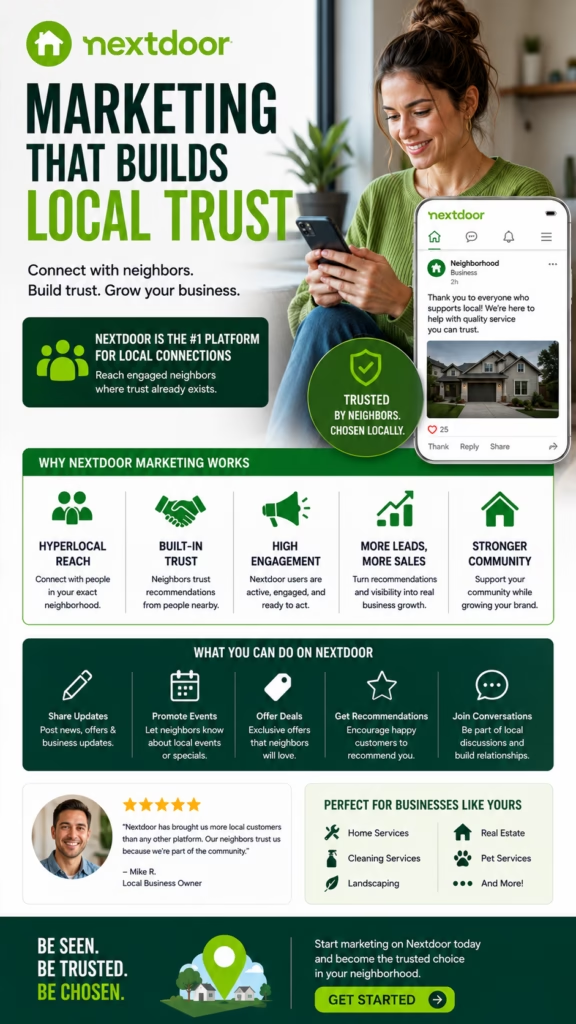
Nextdoor Marketing That Builds Local Trust
Nextdoor Marketing That Builds Local Trust explains how local businesses can use neighborhood visibility, recommendations, helpful posts, real photos, local offers, fast replies, and follow-up systems to become the trusted choice in nearby communities.
Introduction
Nextdoor Marketing That Builds Local Trust is one of the most valuable strategies for businesses that depend on nearby customers, homeowners, residents, property owners, and local referrals. Unlike broad advertising platforms, Nextdoor is built around neighborhoods, community conversations, recommendations, and local decision-making. That makes trust the main currency.
People on Nextdoor often want recommendations before they hire, buy, book, or visit. They may ask for a painter, plumber, HVAC company, landscaper, cleaner, roofer, restaurant, local store, repair provider, real estate service, wellness provider, or professional service. If a business already appears helpful, recommended, and familiar, it has a better chance of earning the inquiry.
Nextdoor marketing builds local trust when businesses show up consistently with helpful content, real proof, neighborhood recommendations, and fast communication.
The goal is not to post random promotions. The goal is to become a business people recognize, trust, and feel comfortable contacting. That requires a complete Nextdoor business page, clear services, useful local posts, customer recommendations, project photos, service proof, local offers, response systems, tracking, and follow-up.
Trust-driven marketing works because local customers want confidence before taking action. A neighbor’s recommendation, a real project photo, a helpful post, or a quick professional reply can make a business feel safer and more credible than a generic ad.
Main idea: Nextdoor Marketing That Builds Local Trust helps businesses turn neighborhood visibility into credibility, conversations, referrals, quote requests, appointments, and customers.
Table of Contents
- 1) Why local trust matters on Nextdoor
- 2) How neighbors choose local businesses
- 3) Building a complete Nextdoor business page
- 4) Recommendations and social proof
- 5) Helpful local posts that build credibility
- 6) Photos and real-world proof
- 7) Local offers that feel trustworthy
- 8) Service descriptions that reduce doubt
- 9) Neighborhood targeting and relevance
- 10) Fast replies and professional communication
- 11) Reviews, reputation, and customer experience
- 12) Tracking trust-based leads
- 13) Follow-up systems that protect trust
- 14) Common mistakes that damage trust
- 15) Final thoughts
- 16) FAQs
- 17) Extra keywords
1) Why Local Trust Matters on Nextdoor
Local trust matters on Nextdoor because people often use the platform to make safer local decisions. They are not only browsing random content. They are asking real neighbors who they should hire, where they should shop, what businesses are reliable, and which providers have done good work nearby.
This is especially important for home services, contractors, repair companies, local retailers, wellness providers, restaurants, and service businesses. Customers want to know that a company is real, responsive, professional, and trusted by people close to them.
Local trust can help businesses generate:
- More messages
- More calls
- More quote requests
- More referrals
- More service appointments
- More repeat customers
- More store visits
- More neighborhood recognition
- Better lead quality
- Stronger word-of-mouth
Nextdoor Marketing That Builds Local Trust works because people are more likely to contact businesses that feel familiar and recommended.
2) How Neighbors Choose Local Businesses
Neighbors often choose businesses based on recommendations, responsiveness, proof of work, helpfulness, and local relevance. They may ask a question, search previous conversations, view business pages, check photos, read comments, compare offers, and message the provider that feels most trustworthy.
A business does not need to be the loudest voice on Nextdoor. It needs to be clear, useful, and credible. When a business appears helpful over time, customers are more likely to remember it when they need service.
Neighbor has a local need
Neighbor asks for recommendations or searches Nextdoor
Trusted businesses appear through pages, posts, and comments
Neighbor checks proof, services, offers, and responsiveness
Neighbor messages, calls, books, or requests a quote
Trust-based decisions happen when local customers see proof that a business is reliable before they reach out.
3) Building a Complete Nextdoor Business Page
The business page is the foundation of trust on Nextdoor. When someone clicks a business name, the page should immediately answer the most important questions: What does the business do? Where does it serve? Is it real? Is it professional? How can I contact it?
An incomplete page can create hesitation. A complete page gives customers confidence and supports every recommendation, post, offer, and message.
A trust-building Nextdoor business page should include:
- Business name
- Clear business category
- Phone number
- Website link
- Service area or location
- Business description
- Detailed services
- Photos or proof of work
- Customer recommendations
- Clear call to action
A complete business page helps local customers feel more confident before sending a message or making a call.
4) Recommendations and Social Proof
Recommendations are one of the strongest trust signals on Nextdoor. A business can say it is reliable, but a neighbor’s recommendation often feels more believable. This is why recommendations can help turn local visibility into real inquiries.
Businesses should encourage satisfied customers to recommend them when appropriate. These recommendations can support future posts, strengthen the business page, and make new prospects more comfortable reaching out.
Recommendations help prove:
- Real customer experience
- Local credibility
- Service quality
- Professionalism
- Reliability
- Good communication
- Timely service
- Customer satisfaction
Neighborhood recommendations make a business feel trusted before the first conversation even starts.
5) Helpful Local Posts That Build Credibility
Helpful posts build credibility because they show expertise without feeling overly aggressive. Businesses can use posts to educate, answer common questions, share seasonal reminders, explain local issues, highlight completed work, and offer useful tips.
For example, an HVAC company can post seasonal maintenance advice. A painter can share exterior prep tips. A landscaper can explain spring cleanup timing. A cleaning company can post move-in cleaning reminders. A retailer can announce local availability or helpful product guidance.
Helpful Nextdoor post formula:
Local hook
Common neighborhood problem
Useful advice or explanation
Proof or example
Simple next step
Nextdoor Marketing That Builds Local Trust works best when posts provide value before asking for the sale.
6) Photos and Real-World Proof
Photos help businesses prove they are real and active. For many local customers, visual proof can reduce doubt quickly. Photos can show completed projects, products, team members, storefronts, vehicles, before-and-after examples, equipment, or customer-approved results.
Businesses should use real images whenever possible. Stock-style images may look polished, but real local proof often builds stronger trust.
Trust-building photos include:
- Before-and-after photos
- Completed work photos
- Team photos
- Storefront photos
- Service vehicle photos
- Product photos
- Equipment photos
- Local project examples
- Customer-approved results
Real photos help local customers believe the business can deliver what it promises.
7) Local Offers That Feel Trustworthy
Offers can help motivate action, but they should feel honest and local. Overly aggressive offers may reduce trust. A strong Nextdoor offer should be clear, simple, realistic, and useful to nearby residents.
Examples include free estimates, neighborhood discounts, seasonal checks, first-time customer offers, local delivery, consultation openings, limited appointment windows, or maintenance packages.
Trustworthy local offer ideas:
- Free estimate
- Neighborhood discount
- Seasonal service check
- First-time customer special
- Limited appointment openings
- Local delivery option
- Free consultation
- Project planning call
Local offers build trust when they are clear, realistic, and connected to real customer needs.
8) Service Descriptions That Reduce Doubt
Clear service descriptions reduce doubt because customers do not have to guess whether the business can help them. Vague descriptions can create confusion, while specific descriptions attract better inquiries.
A service description should explain what the business does, who it helps, where it serves, what problem it solves, and how to take the next step.
Service description formula:
What service is offered
Who it helps
Where it is available
Why the business is trusted
How to request help
Clear service descriptions help local customers feel informed enough to contact the business.
9) Neighborhood Targeting and Relevance
Nextdoor marketing becomes more effective when businesses focus on the neighborhoods and service areas where they can truly serve customers. Local relevance is important because customers want businesses that understand their area and can respond conveniently.
Businesses should consider where their best customers live, where past projects happened, which neighborhoods have demand, and where travel or delivery makes sense.
Neighborhood targeting should consider:
- Service area fit
- Distance from business
- Customer demand
- Average job value
- Home or property type
- Past customer locations
- Referral potential
- Local competition
Nextdoor Marketing That Builds Local Trust works better when the business feels relevant to the exact neighborhoods it serves.
10) Fast Replies and Professional Communication
Fast replies build trust because they show the business is attentive and organized. A customer who asks a question may be contacting several providers. The business that replies quickly and professionally can win the conversation.
A good reply should be friendly, clear, specific, and action-focused. It should answer the question, ask for helpful details, and guide the customer toward the next step.
Trust-building reply:
Thanks for reaching out. Yes, we help with that in your area.
Can you send a few details or photos?
We can review it and share the next available appointment or estimate option.
Professional communication turns local interest into trust, and trust turns messages into booked opportunities.
11) Reviews, Reputation, and Customer Experience
Trust on Nextdoor does not exist in isolation. Customers may also check Google reviews, websites, social profiles, or other local listings before contacting a business. Reputation should be consistent across platforms.
Businesses should focus on delivering good customer experiences, requesting honest reviews, responding to feedback, and keeping information accurate. A strong reputation outside Nextdoor can reinforce trust created inside Nextdoor.
Reputation signals that support trust:
- Positive reviews
- Recent feedback
- Customer recommendations
- Professional responses
- Consistent contact information
- Real photos
- Clear website
- Reliable follow-up
Nextdoor trust becomes stronger when the business reputation is consistent everywhere customers look.
12) Tracking Trust-Based Leads
Tracking helps businesses understand whether Nextdoor trust-building efforts are producing real results. A business should track messages, calls, referrals, quote requests, appointments, booked jobs, store visits, and closed revenue.
Tracking can be done through CRM tags, spreadsheets, call tracking, lead forms, message records, intake questions, and appointment systems. Each inquiry should be connected to its source whenever possible.
Nextdoor trust-based lead tracking should include:
- Lead name
- Contact method
- Neighborhood source
- Post or recommendation source
- Service requested
- Lead status
- Follow-up date
- Appointment status
- Booked job or sale
- Revenue outcome
Tracking helps businesses understand which trust signals create real customer action.
13) Follow-Up Systems That Protect Trust
Trust can be lost quickly if a business does not follow up. A customer may send a message, request a quote, ask for availability, or show interest, but if the business forgets to respond, the opportunity can disappear.
A good follow-up system includes saved replies, reminders, CRM notes, appointment confirmations, quote follow-ups, missed call text-back, and post-service review requests. The goal is to stay helpful and organized.
Follow-up workflow:
Customer sends inquiry
Business replies quickly
Lead details are saved
Next step is offered
Follow-up reminder is created
Customer is booked, nurtured, or closed
Follow-up protects local trust by showing customers the business is reliable after the first interaction.
14) Common Mistakes That Damage Trust
Many businesses hurt trust on Nextdoor by posting too aggressively, using generic content, ignoring messages, failing to show proof, or treating the platform like a simple ad board. Nextdoor works best when the business behaves like a helpful local presence.
- Posting only sales pitches
- Using generic copy
- No real photos
- No recommendations
- Incomplete business page
- Slow responses
- No clear service area
- No helpful content
- No clear call to action
- No tracking system
- No follow-up process
- Inconsistent business information
Big mistake: using Nextdoor only to promote instead of using it to build neighborhood trust.
15) Final Thoughts
Nextdoor Marketing That Builds Local Trust is about becoming a reliable, visible, helpful business in the communities you serve. Local customers want confidence before they hire, buy, book, or visit. Nextdoor gives businesses a way to earn that confidence through recommendations, helpful posts, real proof, and consistent communication.
A strong strategy includes a complete business page, customer recommendations, local posts, real photos, clear services, trustworthy offers, fast replies, tracking, and follow-up. When these pieces work together, Nextdoor can become a powerful trust-building and lead generation channel.
Final takeaway: Nextdoor marketing builds local trust when businesses show up consistently, provide value, prove credibility, and make it easy for nearby customers to take action.
16) FAQs
1) What is Nextdoor marketing that builds local trust?
It is the process of using Nextdoor pages, recommendations, posts, offers, photos, and communication to make nearby customers more confident in choosing a business.
2) Why is local trust important on Nextdoor?
Local trust is important because residents often use Nextdoor to ask neighbors for recommendations before hiring or buying.
3) Can Nextdoor help businesses build trust?
Yes. Businesses can build trust with complete pages, helpful posts, real photos, recommendations, and fast replies.
4) What businesses can use Nextdoor marketing?
Home service companies, contractors, retailers, restaurants, local professionals, repair businesses, wellness providers, and service-area businesses can use Nextdoor marketing.
5) What should a Nextdoor business page include?
It should include business details, services, service area, contact information, photos, recommendations, and a clear call to action.
6) Do recommendations matter on Nextdoor?
Yes. Recommendations are one of the strongest trust signals because they come from local people.
7) What should businesses post on Nextdoor?
Businesses should post helpful tips, local updates, service reminders, project photos, offers, customer proof, and useful neighborhood content.
8) Do photos help build trust?
Yes. Real photos show proof and make the business feel more active, credible, and reliable.
9) What offers work well on Nextdoor?
Free estimates, consultations, neighborhood discounts, seasonal checks, local delivery, and limited appointment openings can work well.
10) How fast should businesses reply?
Businesses should reply as quickly as possible because fast responses show professionalism and help win inquiries.
11) Should businesses track Nextdoor leads?
Yes. Tracking helps businesses understand which posts, recommendations, neighborhoods, and offers create real inquiries.
12) What should businesses track?
Businesses should track messages, calls, quote requests, appointments, neighborhood source, service requested, follow-up status, and revenue outcome.
13) Can Nextdoor work with Google Maps?
Yes. Nextdoor builds neighborhood trust while Google Maps captures high-intent local searches.
14) Does a website support Nextdoor trust?
Yes. A professional website can reinforce services, reviews, photos, contact options, and credibility.
15) What is the biggest mistake on Nextdoor?
The biggest mistake is using Nextdoor only for generic sales posts instead of building trust and local value.
16) Can contractors build trust on Nextdoor?
Yes. Contractors can use project photos, recommendations, local posts, and fast replies to build trust.
17) Can home service businesses use Nextdoor?
Yes. Home service businesses can use Nextdoor to reach homeowners who want trusted local providers.
18) Can retailers build local trust on Nextdoor?
Yes. Retailers can share local offers, product updates, store information, and customer-friendly posts.
19) What makes a Nextdoor post trustworthy?
A trustworthy post is helpful, local, specific, honest, visual, and easy to respond to.
20) Should businesses ask for recommendations?
Yes. Satisfied customers can help strengthen local trust by recommending the business.
21) Can Nextdoor generate referrals?
Yes. Neighborhood conversations and recommendations can create referral opportunities.
22) How does follow-up affect trust?
Follow-up shows reliability and helps customers feel the business is organized and responsive.
23) Should businesses use saved replies?
Yes. Saved replies can help businesses respond quickly while keeping communication consistent.
24) What is the goal of Nextdoor trust marketing?
The goal is to turn neighborhood visibility into credibility, conversations, referrals, inquiries, and customers.
25) Is Nextdoor trust marketing a one-time task?
No. It works best with consistent posts, recommendations, updates, fast replies, tracking, and follow-up.
17) Extra Keywords
- Nextdoor Marketing That Builds Local Trust
- Nextdoor marketing
- local trust marketing
- neighborhood marketing
- Nextdoor lead generation
- local business marketing
- Nextdoor recommendations
- local service leads
- Nextdoor business page
- Nextdoor local posts
- neighborhood trust
- local customer trust
- Nextdoor for local businesses
- Nextdoor for contractors
- Nextdoor for home services
- Nextdoor for retailers
- local recommendation marketing
- community marketing strategy
- local customer acquisition
- service area marketing
- Nextdoor trust signals
- local referral marketing
- Google Maps and Nextdoor marketing
- local reputation marketing
- neighborhood lead generation













