
The Complete Guide to Google Maps Optimization
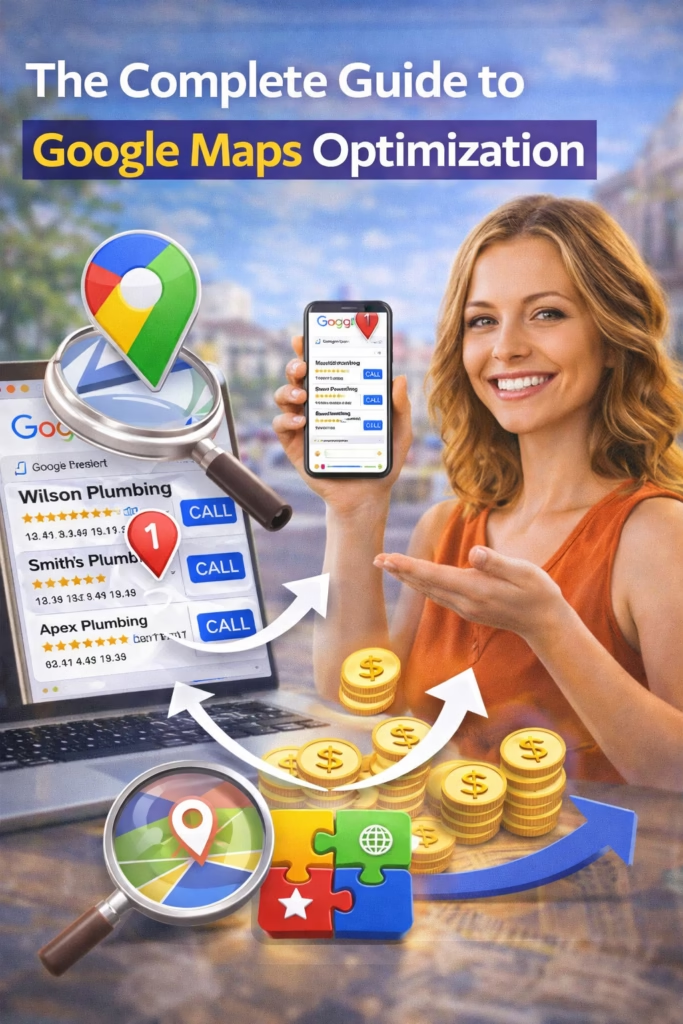
The Complete Guide to Google Maps Optimization explains how local businesses improve visibility, strengthen Google Business Profile performance, earn more trust, and convert Google Maps traffic into real calls, clicks, appointments, visits, and customers.
Note: This is general guidance. Keep all business information accurate, current, and aligned with platform rules, privacy expectations, and local marketing requirements.
Introduction
The Complete Guide to Google Maps Optimization is built around a simple truth: local visibility only creates business value when it turns into action.
Google Maps optimization is not just about ranking. It is about becoming the local option people trust enough to contact.
Many businesses think of Google Maps as a place where customers either find them or do not. That view is too narrow. Google Maps is really a local decision environment. When someone searches for a service or product nearby, the businesses that show up are immediately being evaluated for relevance, trust, convenience, and credibility. That is why optimization matters so much.
A stronger Google Maps presence can lead to more visibility, but the real goal is not visibility alone. The goal is more phone calls, more website clicks, more direction requests, more quote requests, more appointments, and more real customers. That means Google Maps optimization has to be treated as both a ranking system and a conversion system.
That system usually depends on several things working together. The Google Business Profile has to be complete and accurate. The primary and supporting categories have to fit the business properly. Reviews have to build trust. Photos have to make the business feel current and real. Services and business details have to clarify relevance. Local SEO has to support the profile. And once a lead comes in, the business still has to respond and convert the opportunity effectively.
This is why many businesses underperform even when they are visible. Visibility without trust creates weak clicks. Trust without relevance creates weak rankings. Rankings without good lead handling create wasted opportunity. Real Google Maps optimization improves the full chain.
Big idea: Google Maps optimization works best when rankings, profile trust, local relevance, and conversion systems are improved together as one local lead engine.
Expanded Table of Contents
- 1) What Google Maps optimization actually is
- 2) Why Google Maps optimization matters for local growth
- 3) How local search intent becomes lead intent
- 4) Google Business Profile as the foundation
- 5) Categories, services, and relevance signals
- 6) Reviews, ratings, and trust
- 7) Photos and visual confidence
- 8) Business details, accuracy, and profile completeness
- 9) How local SEO supports Maps optimization
- 10) Calls, clicks, and direction requests
- 11) Turning Google Maps actions into real leads
- 12) Response speed and follow-up
- 13) Measuring Google Maps optimization performance
- 14) Common mistakes businesses make
- 15) 30–60–90 day rollout plan
- 16) 25 Frequently Asked Questions
- 17) 25 Extra Keywords
1) What Google Maps optimization actually is
Google Maps optimization is the process of improving how a business appears, performs, and converts inside Google Maps and map-based local search. It is not just one action. It is a collection of improvements that make the business easier for Google to understand and easier for customers to trust.
| Optimization area | What it improves | Why it matters |
|---|---|---|
| Profile quality | Business clarity | Improves first impressions |
| Categories and services | Relevance | Helps match search intent |
| Reviews | Trust | Improves conversion confidence |
| Photos | Engagement and credibility | Makes the business feel real |
| Local SEO support | Authority and fit | Strengthens map performance |
Rule: Google Maps optimization is most effective when the business improves both ranking signals and customer-facing trust signals at the same time.
2) Why Google Maps optimization matters for local growth
Google Maps optimization matters because many local customers search for nearby businesses when they are already prepared to act. That makes the visibility especially valuable. Instead of trying to create demand from scratch, the business is stepping into demand that already exists.
What good Maps optimization can create
- More local visibility
- More profile views
- More calls and clicks
- More qualified local leads
What weak Maps optimization can cause
- Lower visibility
- Weak first impressions
- Lost local demand
- Wasted profile traffic
Pro move: Google Maps matters most because it can place the business in front of people who are already close to making a local decision.
3) How local search intent becomes lead intent
Local search intent becomes lead intent when the searcher moves from “I need something nearby” to “This business might be the one I contact.” Google Maps accelerates this process because it presents options inside a local context where location, reviews, and profile signals are visible immediately.
Signs of strong local intent
- Category-specific local searches
- Map comparisons
- Review checking
- Clicking for directions, calls, or websites
Rule: The faster a business turns map visibility into confidence, the faster local intent becomes lead intent.
4) Google Business Profile as the foundation
Google Business Profile is the center of Google Maps optimization. It is where the business communicates its category fit, reviews, services, location details, photos, and many of the signals users rely on when deciding whether to engage.
Why the profile matters so much
- It shapes first impressions
- It supports ranking relevance
- It influences trust and conversion
- It controls many direct action pathways
Rule: Businesses cannot optimize Google Maps seriously without treating Google Business Profile as a major local marketing asset.
5) Categories, services, and relevance signals
Categories and service descriptions help Google understand what the business does and when it should appear. They also help users understand whether the business is a fit for the search they just made.
Why relevance signals matter
- Improve ranking fit
- Improve lead quality
- Reduce user confusion
- Support conversion confidence
What to optimize
- Primary category
- Supporting categories
- Service descriptions
- Clear business positioning
Pro move: Better relevance attracts not just more visibility, but more of the right visibility.
6) Reviews, ratings, and trust
Reviews are one of the strongest trust signals in the entire Google Maps ecosystem. They often help decide which visible business actually gets the lead. Even strong rankings lose value if the profile looks risky or unproven.
Why reviews matter
- Reduce customer hesitation
- Support comparison decisions
- Improve click and call confidence
- Strengthen credibility in competitive markets
Rule: Google Maps rankings create the opportunity, but reviews often decide who wins the customer.
7) Photos and visual confidence
Photos help the business feel current, real, and trustworthy. For many searchers, photos are a fast emotional signal that the company is active and legitimate.
What strong photos support
- Profile engagement
- Visual trust
- Business legitimacy
- Action confidence before contact
Simple photo update SOP
[ ] Keep photos current
[ ] Show real work, products, or location
[ ] Use clear, well-lit images
[ ] Review profile engagement regularly
[ ] Refresh over time
Rule: Better photos improve Maps optimization because they help turn profile views into real customer actions.
8) Business details, accuracy, and profile completeness
Profile completeness matters because both Google and the user need clear information. Missing or weak details create friction, and friction weakens both trust and action.
Important profile details
- Business name accuracy
- Hours
- Phone number
- Website link
- Service details
- Service area or location clarity
Accurate details reduce hesitation because the customer does not have to work hard to understand the business.
Rule: Completeness helps optimization because it strengthens both user trust and relevance clarity.
9) How local SEO supports Maps optimization
Google Maps optimization is stronger when it is supported by local SEO. The website, service pages, local pages, and overall geographic relevance signals can reinforce what the profile is trying to communicate.
What local SEO can reinforce
- Service relevance
- Location relevance
- Site credibility
- Conversion readiness
Rule: Google Maps optimization performs better when the listing and the broader local SEO system support the same local message.
10) Calls, clicks, and direction requests
These are the visible signals that the optimization is beginning to turn into real business activity. A call, a click, or a direction request means the user moved from seeing the business to acting on it.
Common Google Maps actions
- Phone calls
- Website clicks
- Direction requests
- Profile engagements
- Appointment interest
Map actions are where ranking visibility starts becoming measurable lead value.
11) Turning Google Maps actions into real leads
Optimization does not stop when the customer clicks or calls. The business still needs a conversion system that turns those actions into real conversations, bookings, visits, and customers.
How actions become real leads
- Calls become quote conversations
- Website clicks become form submissions or bookings
- Direction requests become visits
- Visits become appointments or sales
Rule: The value of Google Maps optimization is measured by what happens after the profile action, not just by the profile action itself.
12) Response speed and follow-up
Maps-driven leads are often fast-moving. Many nearby customers compare multiple options quickly, so response speed matters heavily. Businesses that reply slowly can waste strong local visibility.
Why fast follow-up matters
- Protects local intent
- Builds trust quickly
- Improves booked next steps
- Reduces lead leakage
Simple follow-up sequence
Same day: Respond to call or inquiry quickly
Day 1: Follow up if no next step was booked
Day 3: Offer the best next step
Day 5: Share a reminder or proof point
Day 7: Close politely while leaving the door open
Rule: Better Maps optimization creates more opportunities, but faster lead handling captures more of them.
13) Measuring Google Maps optimization performance
Businesses should measure whether Google Maps improvements are translating into real business outcomes. Rankings matter, but action and conversion matter more.
| KPI | What it measures | Target direction |
|---|---|---|
| Profile views | Visibility impact | Up |
| Phone calls | Direct-response activity | Up |
| Website clicks | Profile-to-site engagement | Up |
| Direction requests | Visit intent | Up |
| Qualified lead rate | Lead quality | Up |
| Booked next steps | Pipeline creation | Up |
| Close rate | Revenue conversion | Up |
Rule: The best Google Maps optimization strategy is the one that turns stronger visibility into stronger local business outcomes.
14) Common mistakes businesses make
The most common mistake is treating Maps optimization like a rank-only problem. Businesses often ignore review growth, photo quality, service relevance, website support, and lead handling even though those elements heavily influence the final result.
Common mistakes
- Ranking-only focus
- Weak review discipline
- Poor or outdated photos
- Weak categories or service positioning
- Incomplete profile details
- Slow lead response
Avoid: assuming higher visibility automatically means more revenue without strengthening trust and conversion too.
Rule: Google Maps optimization becomes much stronger when businesses improve the full chain from discovery to conversion.
15) 30–60–90 day rollout plan
Days 1–30: Strengthen the foundation
- Improve Google Business Profile completeness
- Refine categories and services
- Strengthen photos and profile trust
- Improve review gathering consistency
- Track calls, clicks, and direction requests
Days 31–60: Improve conversion quality
- Review which actions create real leads
- Strengthen website and contact-path conversion
- Improve response speed and follow-up
- Refine local SEO support
Days 61–90: Scale what works
- Document the best-performing profile patterns
- Double down on review, photo, and service relevance strengths
- Review KPI trends weekly
- Focus on what turns map visibility into qualified local pipeline
Rule: Google Maps optimization improves fastest when businesses strengthen both visibility signals and lead-conversion systems at the same time.
16) 25 Frequently Asked Questions
1) What is Google Maps optimization?
It is the process of improving how a business appears and performs in Google Maps and map-based local search results.
2) Why is Google Maps optimization important?
Because many nearby customers search in Maps or local map results when they are ready to take action.
3) What is the difference between Google Maps optimization and local SEO?
Maps optimization focuses on the listing and map performance, while local SEO is broader and also includes website support and other local signals.
4) Does it help service-area businesses too?
Yes. It can help both service-area businesses and storefronts.
5) What is the biggest benefit?
Stronger visibility in front of nearby searchers with real local intent.
6) What role does Google Business Profile play?
It is central because it controls much of the business information, trust signals, and action pathways users see.
7) Do reviews matter?
Yes. Reviews are one of the strongest trust signals in Maps.
8) Do photos help optimization?
Yes. Photos improve trust, engagement, and profile appeal.
9) How important are business categories?
Very important, because they help Google understand what the business does.
10) Does proximity affect rankings?
Yes. Google often tries to show nearby results that fit the search.
11) What is relevance in Maps optimization?
It is how well the business matches what the searcher is looking for.
12) Can optimization generate more phone calls?
Yes. Better visibility and stronger trust can increase call activity.
13) Can optimization increase website clicks?
Yes. A stronger map presence can drive more website engagement.
14) Do direction requests count as leads?
Yes. They often show strong local visit intent.
15) How does local SEO support Maps?
It strengthens the relevance and authority signals behind local map performance.
16) What is the biggest mistake businesses make?
Focusing only on rankings while ignoring trust, profile quality, and lead handling.
17) Can one person manage Google Maps optimization?
Yes, with a clear routine for profile updates, reviews, photos, and follow-up.
18) Do service pages help Maps performance?
Yes. Strong service and local pages can reinforce relevance and conversion readiness.
19) Why does profile completeness matter?
Because accurate complete information strengthens both user trust and local clarity.
20) Does posting updates to GBP help?
It can help keep the profile current, though profile quality and trust usually matter more.
21) How should businesses measure Maps optimization results?
Track calls, clicks, direction requests, qualified leads, booked next steps, and close rate.
22) Can small businesses compete against bigger brands?
Yes. Small businesses can compete very well with stronger local relevance, reviews, and faster lead handling.
23) How quickly can optimization improve results?
Some movement can happen early, with stronger gains usually building over time through consistency and trust growth.
24) Should businesses document their best optimization patterns?
Yes. Documentation makes the whole system easier to improve and repeat.
25) What is the main lesson in the complete guide to Google Maps optimization?
That the strongest results happen when rankings, trust, relevance, and conversion systems are improved together.
17) 25 Extra Keywords
- The Complete Guide to Google Maps Optimization
- Google Maps optimization
- Google Business Profile optimization
- Google Maps SEO
- local SEO
- Google Maps rankings
- local lead generation
- Google Maps visibility
- Google Maps reviews
- Google Maps photos
- Google Maps categories
- Google Maps local leads
- Google Business Profile rankings
- local maps marketing
- maps profile optimization
- Google Maps calls
- Google Maps website clicks
- Google Maps direction requests
- service-area business maps SEO
- near me optimization
- 2026 Google Maps strategy
- organic local lead system
- local business profile optimization
- maps-based customer acquisition
- Google Maps conversion strategy