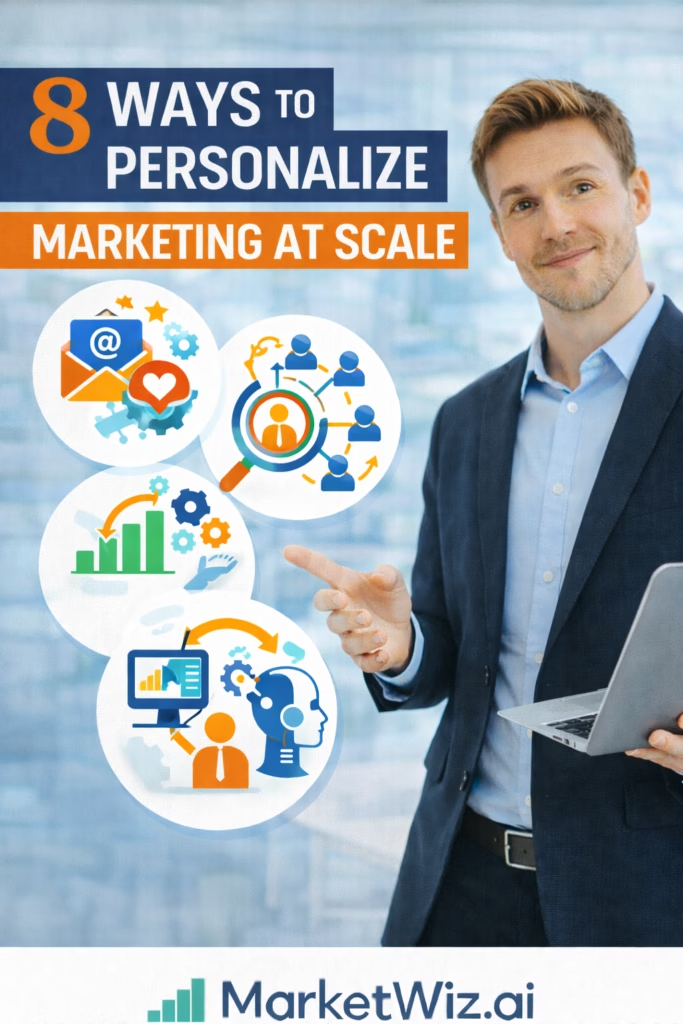
8 Ways to Personalize Marketing at Scale
8 Ways to Personalize Marketing at Scale helps you deliver “this was made for me” experiences—without writing every message by hand.
Note: This is general marketing guidance. Follow privacy, consent, and platform rules when tracking behavior and sending automated messages.
Introduction
8 Ways to Personalize Marketing at Scale is about making your marketing feel human even when your business is growing. The goal isn’t “Hi {FirstName}” personalization. The goal is the right message, to the right person, at the right time—with the right offer.
When personalization is done correctly, you’ll usually see:
- Higher reply rates (people feel understood)
- More booked calls/appointments (less friction, more relevance)
- Better conversion rates (the offer matches intent)
- Lower churn (lifecycle messaging improves retention)
This playbook breaks personalization into eight repeatable systems you can implement in almost any CRM, email platform, or automation tool.
Expanded Table of Contents
- 1) Why personalization at scale wins in 2025
- 2) The 5 rules of personalization that doesn’t feel creepy
- 3) 8 Ways to Personalize Marketing at Scale
- 4) Copy/paste examples (email, SMS, ads, landing pages)
- 5) Data you actually need (and what to ignore)
- 6) KPIs to track personalization performance
- 7) 30–60–90 day rollout plan
- 8) 25 Frequently Asked Questions
- 9) 25 Extra Keywords
1) Why personalization at scale wins in 2025
Buyers are overwhelmed. They ignore generic messages because generic messages signal “this is for everyone.”
8 Ways to Personalize Marketing at Scale works because personalization increases relevance, and relevance increases response. Done well, personalization also reduces waste:
- Fewer low-quality leads (better targeting and qualification)
- Less time spent on unqualified conversations
- More conversions from the same traffic
2) The 5 rules of personalization that doesn’t feel creepy
Rule 1: Personalize by intent, not surveillance
Use actions the buyer expects you to notice (form submissions, quotes, pricing views), not sensitive behavior that feels invasive.
Rule 2: Keep it simple
Personalization should reduce friction, not add complexity. If your team can’t maintain it, it will break.
Rule 3: Use “helpful language”
Frame personalization as support: “Based on what you requested…” not “We tracked you…”
Rule 4: Always give a next step
Personalization without a CTA is a wasted advantage. Make the next action obvious.
Rule 5: Measure outcomes
Personalization is only “good” if it improves booked calls, conversions, and retention—not just opens.
3) 8 Ways to Personalize Marketing at Scale
1) Segment by “job to be done” (the real reason they want you)
Most segmentation is demographics. Better segmentation is intent-based: what outcome are they trying to achieve?
Examples:
- “Need more leads” vs “Need better close rate”
- “Emergency” vs “Plan-ahead” buyers
- “Budget” vs “Premium” buyers
Implementation: Add one intake question or tag: Primary Goal.
2) Use dynamic content blocks (one template, many versions)
Instead of writing 10 emails, write 1 email with blocks that change based on tags (industry, service type, city, pain point).
IF tag = "Local Service"
  show: booking CTA + service area proof
IF tag = "B2B"
  show: case study + calendar CTA
IF tag = "Marketplace Buyer"
  show: availability + pickup/delivery steps
3) Trigger messages based on behavior (not schedules)
Scheduled blasts are generic. Behavioral triggers feel personal because they match what the buyer just did.
- Visited pricing → send pricing explainer + FAQ
- Requested quote → send next steps + timeline
- Started checkout → send “need help?” + reassurance
- No response 24 hours → send a gentle bump
Rule: Trigger within minutes/hours, not days, while intent is warm.
4) Personalize the offer (not just the message)
Changing a first name is weak. Changing the offer is strong.
- New lead → “Fast-start setup” offer
- Price-sensitive lead → “Starter package” offer
- High-intent lead → “Priority scheduling” offer
- Returning buyer → “Loyalty bonus / upgrade” offer
5) Use intent routing (fast lane vs nurture lane)
Create lanes based on intent signals so your best leads get immediate attention.
| Signal | Intent Level | Action |
|---|---|---|
| Pricing + booking click | High | Fast lane: alert + call/SMS now |
| Services page + contact click | Medium | Nurture + soft booking CTA |
| Single blog visit | Low | Education + lead magnet |
6) Personalize by location (especially for local services)
Location personalization increases trust because it proves relevance.
- City-specific proof (“We serve [City] weekly.”)
- Neighborhood-specific delivery/pickup expectations
- Local FAQs (permits, timing, seasonality)
Low effort, high impact: Dynamic city insertion + one local proof line.
7) Use AI to generate variations (while keeping your framework fixed)
AI is best for controlled variation: different hooks, different objections, different tones—within your approved structure.
Generate 5 versions of this message:
- Same offer
- Same CTA
- Different hook + benefit angle
- 80–120 words
- Tone: helpful, confident, not salesy
Important: Keep the system consistent. AI should fill variations, not rewrite your strategy every time.
8) Personalize lifecycle messaging (before, during, after purchase)
Most personalization focuses on acquisition. The easiest wins often come after the first conversion.
- Post-purchase onboarding (what to expect)
- Usage tips (reduce buyer’s remorse)
- Renewal reminders (timed to reality)
- Referral prompts (after a win)
Lifecycle personalization increases retention and referrals—often the highest-ROI personalization you can do.
4) Copy/paste examples (email, SMS, ads, landing pages)
Email example (intent-based)
Subject: Quick next step for {Goal}

Hey {FirstName} — based on your interest in {Goal}, here’s the fastest path:
1) {StepOne}
2) {StepTwo}
3) {ExpectedOutcome}

If you want, I can map this for your business in 10 minutes.
Book a time here: {CalendarLink}
SMS example (local service)
Hey {FirstName} — got your request for {Service} in {City}.
What day were you hoping to get this done? I can confirm availability + pricing options.
Landing page personalization (dynamic blocks)
Headline: Get {Outcome} in {City}
Proof Block: “We’ve helped {Industry} businesses in {City} improve {Metric}.”
CTA: “Get your 2-minute plan”
Personalization note: The message changes based on intent and location, not just names.
5) Data you actually need (and what to ignore)
Most teams fail personalization because they chase too much data. Start with a minimal set:
High-impact data
- Goal / service requested
- Location (city/region)
- Budget range (optional)
- Intent signals (pricing, booking, quote request)
- Lifecycle stage (new lead, active, customer)
Often ignored at first
- Excessive micro-tracking
- Overly complex personas
- Dozens of segments nobody maintains
- “Creepy” personalization based on sensitive behavior
Rule: If you can’t maintain it weekly, don’t build it into personalization.
6) KPIs to track personalization performance
Top-line KPIs
• Reply rate (email/SMS/DM)
• Booked rate (lead → appointment)
• Conversion rate (lead → sale)

Quality KPIs
• Qualified lead rate
• Time-to-first-response
• Sales touches per conversion

Personalization-specific KPIs
• Segment performance (which segments convert best)
• Trigger performance (pricing trigger vs quote trigger)
• Offer performance (starter vs premium vs fast-start)
Best measurement: compare personalized vs non-personalized flows by booked rate and close rate.
7) 30–60–90 day rollout plan
Days 1–30 (Baseline)
- Define 3–5 core segments based on “job to be done.”
- Add 1–2 intake questions to tag leads correctly.
- Build one dynamic email/SMS template with block logic.
- Launch 2 behavioral triggers (pricing view, quote request).
Days 31–60 (Scale workflows)
- Add intent routing: fast lane vs nurture lane.
- Create 3 CTA variations and test weekly.
- Introduce lifecycle personalization (post-purchase onboarding).
- Track segment performance and reduce weak segments.
Days 61–90 (Optimize)
- Use AI to generate controlled copy variations inside your framework.
- Improve personalization based on outcomes (booked/closed).
- Expand triggers (checkout start, no-response, reactivation).
- Document the system as an SOP.
8) 25 Frequently Asked Questions
1) What are 8 Ways to Personalize Marketing at Scale?
They’re repeatable systems—segmentation, dynamic blocks, behavior triggers, offer personalization, intent routing, location personalization, AI variation, and lifecycle messaging.
2) Do I need AI to personalize at scale?
No. Segmentation + triggers can do a lot. AI helps with variations and intent classification once basics are stable.
3) What’s the biggest personalization mistake?
First-name personalization only while sending the same message to everyone.
4) How many segments should I start with?
3–5 segments you can maintain weekly.
5) What’s better: segmentation or personalization tokens?
Segmentation. Tokens are useful, but relevance comes from intent-based messaging.
6) How do I avoid creepy personalization?
Use expected signals (forms, quotes, bookings) and frame it as support.
7) What triggers work best?
Pricing visits, quote requests, booking clicks, checkout starts, and no-response follow-ups.
8) Can personalization work for local businesses?
Yes—location + service requested + fast response is extremely effective.
9) What’s dynamic content?
One template with sections that change based on tags or attributes.
10) How do I personalize ads?
Personalize by audience segment and intent stage, not by invasive data.
11) How do I personalize landing pages?
Dynamic headlines, proof blocks, and CTAs based on segment/location.
12) Does personalization increase conversions?
Often yes—if it changes relevance, timing, or offer, not just names.
13) How do I personalize follow-up?
Use behavior triggers and intent routing, then send the next best step.
14) What’s intent routing?
Separating leads into lanes (fast lane vs nurture) based on buyer signals.
15) What’s the best CTA for personalization?
A next step that matches intent: “book,” “get quote,” “see options,” or “reply with timeline.”
16) How do I personalize without a CRM?
Start with tags in a spreadsheet and use template variations manually.
17) How do I keep personalization consistent?
Limit segments, document rules, and standardize templates.
18) Should I personalize every channel?
Start with your highest-converting channel (usually email/SMS/DM) first.
19) What’s the best first workflow?
Quote request → next steps + timeline question + booking CTA.
20) How do I personalize offers?
Match offers to stage: new lead vs high intent vs returning customer.
21) How do I measure personalization success?
Booked rate, conversion rate, reply rate, and lead quality—not just opens.
22) What data is essential?
Goal/service requested, location, intent signals, and lifecycle stage.
23) Can personalization reduce ad spend?
Yes—higher conversion rates mean you need fewer clicks to get leads.
24) How do I use AI safely for personalization?
Generate controlled variations inside a fixed framework and review outputs.
25) What’s the fastest improvement I can make?
Segment by goal and trigger a fast, helpful follow-up within minutes.
9) 25 Extra Keywords
- 8 Ways to Personalize Marketing at Scale
- personalization at scale strategy
- marketing personalization framework
- dynamic content blocks
- behavioral trigger marketing
- intent based marketing automation
- segmentation for personalization
- email personalization at scale
- sms personalization automation
- website personalization examples
- personalized follow up sequences
- lead routing automation
- fast lane lead response
- lifecycle marketing personalization
- personalized offers strategy
- AI assisted copy variations
- personalization tokens best practices
- CRM personalization workflows
- local business personalization
- personalization KPIs
- increase conversion rate personalization
- customer journey personalization
- intent signals marketing
- marketing automation personalization
- personalized messaging templates