
Why Marketplace Is the New Retail Showroom
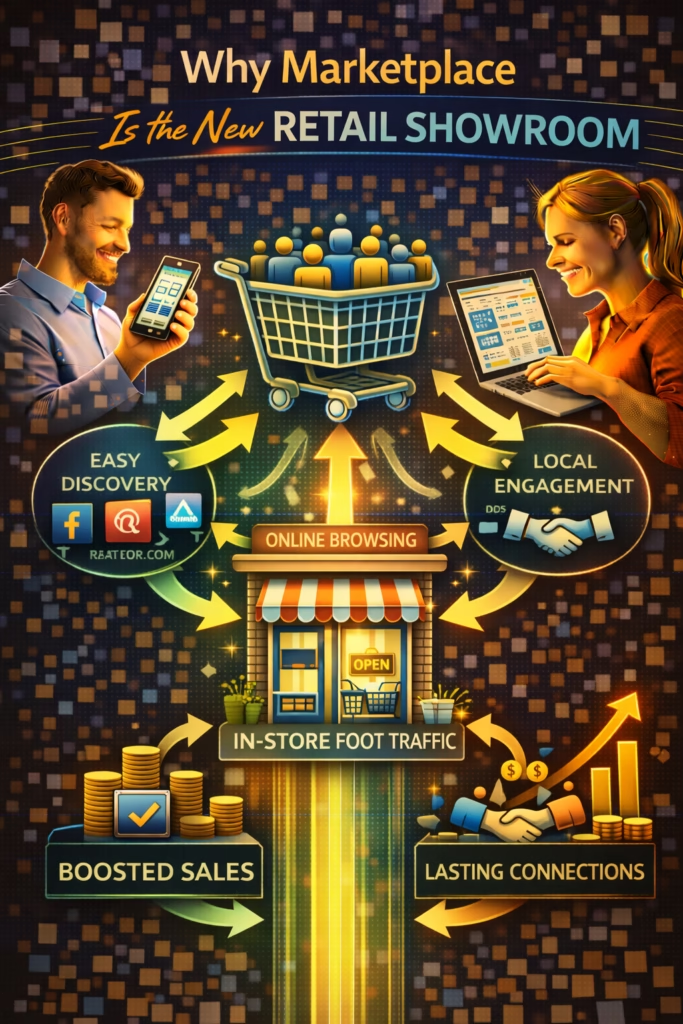
Why Marketplace Is the New Retail Showroom is the blueprint for retailers using Marketplace as a digital showroom—turning browsing into messages, messages into visits, and visits into local purchases.
Note: This is general guidance. Follow platform rules, keep claims truthful, and avoid spam/duplication. Confirm compliance before automating posting or messaging.
Introduction
Why Marketplace Is the New Retail Showroom is not hype. It’s a behavior shift.
Shoppers don’t “start at the store” anymore. They start in a feed.
For decades, retailers relied on location, signage, and walk-in traffic. Today, local buyers browse on their phone first—comparing options, checking photos, validating prices, and deciding who feels safe and easy to buy from before they ever drive anywhere.
This is why Marketplace has become the new showroom. It’s where people “walk the aisles” digitally—scrolling thumbnails the way they used to walk rows of inventory.
Big idea: If you treat Marketplace like a showroom, you stop chasing “random leads” and start building a predictable local buyer engine.
Expanded Table of Contents
- 1) The showroom shift: how buyers shop now
- 2) Why Marketplace beats traditional retail discovery
- 3) What a “digital showroom” actually is
- 4) The conversion path: thumbnail → message → visit
- 5) Trust signals that replace “in-store confidence”
- 6) Inventory variety: how to create showroom depth without spam
- 7) Offer framing that turns browsing into action
- 8) Speed-to-lead: the showroom salesperson effect
- 9) Message scripts that book local visits
- 10) Follow-up that feels helpful (and recovers sales)
- 11) KPIs for a Marketplace showroom system
- 12) 30–60–90 day rollout plan
- 13) 25 Frequently Asked Questions
- 14) 25 Extra Keywords
1) The showroom shift: how buyers shop now
Buyers still want the same outcomes: a good product, a fair price, a safe transaction, and no wasted time. What changed is where they begin the journey.
Old path vs new path
| Old retail path | New retail path | What this changes |
|---|---|---|
| Drive → browse in store | Browse feed → shortlist sellers | Discovery happens online |
| Talk to staff first | Message first | Chat is the new handshake |
| See inventory in person | See thumbnails first | Photos become the “aisle” |
| Decide after walking around | Decide before driving | Trust must be earned early |
Pro move: Stop thinking “Marketplace = classified ads.” Start thinking “Marketplace = showroom traffic.”
2) Why Marketplace beats traditional retail discovery
Marketplace wins because it matches what local shoppers want: speed, comparison, transparency, and convenience.
Marketplace advantages as a showroom
Immediate comparison
Buyers can compare options in minutes instead of driving store-to-store.
Visual-first decision
Photos communicate faster than ads. Thumbnails decide who gets clicked.
Local intent
Buyers are browsing with local pickup, delivery, and timing in mind.
Low friction messaging
Messaging is easier than calling. It feels safer for buyers.
Rule: The platform isn’t replacing the store. It’s replacing the first visit.
3) What a “digital showroom” actually is
A showroom is not a building. It’s an experience: clarity, variety, confidence, and help at the moment of decision.
Your Marketplace showroom is built from
- Thumbnail wall: your first photos and titles (the “front window”)
- Inventory aisles: listing variety that covers different buyer intents
- Salesperson effect: fast responses that guide the buyer
- Trust anchors: proof, transparency, and local legitimacy
- Checkout path: booked visit, pickup, delivery, or quote
Pro move: If your store is clean but your Marketplace looks chaotic, buyers will never walk in.
4) The conversion path: thumbnail → message → visit
Retailers win when they design the entire path—not just the listing.
The 6-step path
- Impression: buyer sees your thumbnail in feed/search
- Click: title + photo win the scroll
- Confidence: listing proves it’s real, clear, local
- Message: buyer asks availability/price/option
- Momentum: you reply fast and guide to next step
- Visit: appointment booked (or pickup/delivery scheduled)
Rule: Views are not the goal. Booked next steps are the goal.
5) Trust signals that replace “in-store confidence”
In a physical showroom, trust is built by seeing a real place and real people. Online, trust must be communicated through signals.
High-impact trust signals
- Real photos (not just polished brand images)
- Clear location language (neighborhood/city + hours if applicable)
- Reviews/testimonials (screenshots or links when possible)
- Consistent branding and clean listing structure
- Fast, helpful replies
Trust stack template (add to listings/messages)
Real photos ✅
Clear details ✅
Local pickup/delivery options ✅
Fast replies ✅
What zip are you in and are you looking for today or this week?
Pro move: Trust is built in layers. Add one trust element every week and your conversion rate compounds.
6) Inventory variety: how to create showroom depth without spam
A showroom feels “big” because it serves multiple intents: value, premium, quick pickup, financing, bundles, and availability. Your Marketplace presence should do the same—without duplicating.
Showroom variety map
| Buyer intent | Listing angle | Example hook line |
|---|---|---|
| Value | Best budget option | “Solid choice if you want quality without overspending.” |
| Fast | Available now | “Quick pickup/delivery options—tell me your zip.” |
| Premium | Upgraded experience | “For buyers who want the best comfort/quality.” |
| Trust | Proof-heavy listing | “Real photos + transparent details + local pickup.” |
| Payments | Financing/terms | “Options available—ask what fits your budget.” |
Important: Avoid posting identical duplicates. Rotate photos, hooks, and angles responsibly and stay truthful.
7) Offer framing that turns browsing into action
In a showroom, a salesperson makes buying feel easy. Online, your offer must do that job.
The “low-friction offer” checklist
- Clear price (or a clear range when appropriate)
- Clear availability (what’s actually in stock)
- Clear next step (visit, pickup, delivery, quote)
- Clear convenience (timing options)
- Clear trust (real photos, proof, transparency)
Rule: If the buyer has to ask 5 questions, your offer is too complex.
8) Speed-to-lead: the showroom salesperson effect
When someone walks into a showroom and no one greets them, they leave. Marketplace works the same way.
Response speed targets
| Response time | Effect |
|---|---|
| < 1 minute | Best: captures peak intent |
| < 5 minutes | Strong: competitive advantage |
| > 30 minutes | High leakage risk |
Pro move: Your fastest reply should be the shortest reply—one question that moves the sale forward.
9) Message scripts that book local visits
Universal instant reply
Yes — I can help ✅
What city/zip are you in, and are you looking for today or this week?
I’ll confirm the best options.
3-option booking (turn messages into visits)
Perfect — quickest next step is a quick visit.

Which works best?
1) Today (late afternoon)
2) Tomorrow (morning)
3) This weekend

Send your preferred option + your zip and I’ll lock it in.
When they ask “best price?”
Totally fair question.
If you tell me your zip + timeline (today/this week), I’ll confirm the best option and the fastest next step.
Rule: Don’t pitch. Guide. Book. Confirm.
10) Follow-up that feels helpful (and recovers sales)
Most local retail revenue is lost in silence. Follow-up recovers it—when done correctly.
Simple follow-up cadence
| When | Message | Goal |
|---|---|---|
| +2 hours | “Do you want the fastest option today or this week?” | Recover intent |
| +24 hours | “Want me to recommend the best option for your budget?” | Offer help |
| +72 hours | “If you tell me zip + timeline, I’ll line it up.” | Reduce friction |
| +7 days | “Should I keep this open for you?” | Reactivation |
Pro move: Follow-up should feel like customer service, not pressure.
11) KPIs for a Marketplace showroom system
| KPI | What it measures | Target direction |
|---|---|---|
| Views → messages | Listing clarity + offer strength | Up |
| Median response time | Salesperson effect | Down |
| Messages → booked visits | Script effectiveness | Up |
| Booked visits → sales | In-store close quality | Up |
| Follow-up recovery rate | Saved “lost” leads | Up |
| Flags/removals | Compliance risk | Down |
Rule: “Booked next steps” is your revenue KPI. Track it weekly.
12) 30–60–90 day rollout plan
Days 1–30 (Build the showroom foundation)
- Upgrade first photos + titles for clarity
- Add trust elements (proof, transparency, local legitimacy)
- Deploy instant replies + one-question CTA
- Implement 3-option booking script
- Start tracking booked next steps
Days 31–60 (Increase showroom depth)
- Expand listings by intent (value/speed/premium/trust)
- Rotate photos and hooks to avoid duplication
- Run weekly A/B tests (thumbnail + first line)
- Improve follow-up cadence
Days 61–90 (Systemize and scale)
- Document SOPs for posting, messaging, and follow-up
- Automate safe parts (instant replies, routing, reminders)
- Optimize based on KPI trends weekly
- Replicate system across a second platform
Pro move: When your showroom system is stable, scaling becomes easy and predictable.
13) 25 Frequently Asked Questions
1) What does “Why Marketplace Is the New Retail Showroom” mean?
It means Marketplace is now the first place shoppers browse, compare, and shortlist sellers—like a digital showroom.
2) Why do shoppers browse Marketplace before visiting a store?
They want fast comparison, real photos, pricing clarity, and less wasted time.
3) How do retailers convert browsing into store visits?
Use clear listings, trust signals, fast replies, and a simple booked next step.
4) Do real photos matter?
Yes. Real photos increase trust, click-through, and messages.
5) What’s the best CTA for Marketplace retail?
Ask: “What city/zip are you in, and are you looking for today or this week?”
6) What’s the best way to book visits?
Use a 3-option booking prompt (today/tomorrow/weekend).
7) What’s the biggest reason retailers lose Marketplace leads?
Slow responses and no follow-up system.
8) How many listings should a retailer post?
As many as you can sustain with variety and compliance—avoid duplicates.
9) What causes Marketplace flags/removals?
Duplicate patterns, misleading claims, and spam-like behavior.
10) How do I create variety without duplicating?
Change intent angle, photos, opening hook, and feature emphasis while staying truthful.
11) Is Marketplace better than paid ads?
They serve different goals. Marketplace can produce strong organic leads because buyers are already shopping.
12) How do I build trust fast in messages?
Be clear, helpful, and fast. Share proof when appropriate.
13) What’s the best proof to show?
Reviews, real in-store photos, delivery/setup photos, and testimonials.
14) Should I include pricing?
Yes—pricing clarity reduces friction and increases serious messages.
15) What if my pricing varies?
Use a truthful range and clarify the exact price after the buyer shares needs.
16) How do I follow up without being pushy?
Offer help and reduce friction with one simple question.
17) What follow-up schedule works best?
2 hours, 24 hours, 72 hours, and 7 days.
18) What is the “showroom salesperson effect”?
Fast helpful responses mimic a salesperson greeting a customer in-store.
19) What KPI matters most?
Booked next steps (visits, pickups, deliveries) because it predicts revenue.
20) How do I track success?
Track views-to-messages, response time, messages-to-booked steps, and booked steps-to-sales.
21) How quickly can results improve?
Often within 1–2 weeks, compounding over 30–90 days.
22) Does this work for high-ticket retail?
Yes—high-ticket buyers often rely even more on trust and proof before visiting.
23) Should retailers use automation?
Automation can protect response speed and follow-up when used compliantly.
24) What should I not automate?
Spam-like bulk messaging or repetitive posting that violates platform rules.
25) What’s the simplest improvement I can make today?
Reply faster and ask one question that moves the buyer to a next step.
14) 25 Extra Keywords
- Why Marketplace Is the New Retail Showroom
- marketplace as retail showroom
- Facebook Marketplace showroom strategy
- digital showroom for retailers
- local retail leads marketplace
- turn marketplace browsing into store visits
- marketplace to in-store sales
- retail marketplace conversion
- speed to lead marketplace retail
- retail follow up scripts marketplace
- booked next steps KPI
- local buyer trust signals
- real photos marketplace selling
- marketplace inventory variety strategy
- avoid duplicate listing flags
- marketplace messaging scripts retail
- how to book showroom visits from marketplace
- local retail marketing 2026
- marketplace lead conversion system
- turn browsers into buyers locally
- organic marketplace leads for stores
- marketplace as sales funnel
- retail appointment booking scripts
- marketplace trust and proof stacking
- how retailers use facebook marketplace