
Why Free Traffic Beats Paid Campaigns Long-Term
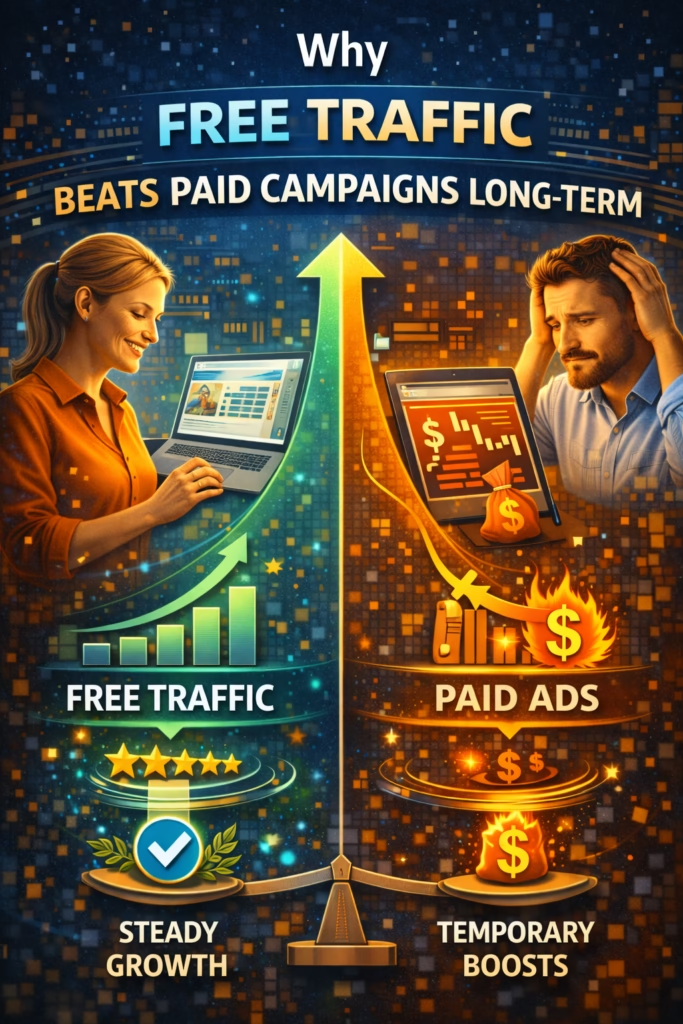
Why Free Traffic Beats Paid Campaigns Long-Term comes down to one reality: paid campaigns rent attention, while organic systems build an asset that keeps producing leads even when spend pauses.
Note: This is general marketing guidance. Always comply with platform rules, ad policies, and privacy laws when messaging leads.
Introduction
Why Free Traffic Beats Paid Campaigns Long-Term is not a slogan—it’s unit economics. Paid campaigns can be great for speed, but they come with a hard truth: when the budget stops, the traffic stops. Organic traffic doesn’t work that way.
Free traffic systems (SEO, Google Business Profile visibility, content, Marketplace visibility where appropriate, and retention) behave like an asset. Each week of effort can stack on the last week, raising baseline demand and lowering your dependence on ads.
Big idea: Paid traffic is a lever. Free traffic is a foundation. The long game is building a foundation strong enough that you can choose when to use the lever.
Expanded Table of Contents
- 1) Renting vs owning attention: the core difference
- 2) The compounding effect: why organic grows while ads reset
- 3) Trust economics: why “free” clicks convert differently
- 4) CAC and margin: why paid often gets more expensive over time
- 5) The Free Traffic Stack: channels that build durable demand
- 6) Content that ranks and sells: the operating model
- 7) Local dominance: Maps + reviews + proximity signals
- 8) Marketplace visibility as organic intent capture
- 9) Offers that pull leads without “boosting” everything
- 10) How to measure organic like an operator
- 11) The hybrid plan: when paid makes sense inside an organic engine
- 12) 30–60–90 day rollout plan
- 13) 25 Frequently Asked Questions
- 14) 25 Extra Keywords
1) Renting vs owning attention: the core difference
To understand Why Free Traffic Beats Paid Campaigns Long-Term, start with a simple metaphor: paid traffic is renting a billboard. Organic traffic is buying the property where the billboard lives.
Paid campaigns (rent)
- Immediate visibility
- Predictable spend → clicks
- Stops instantly when spend stops
- Performance fluctuates with auctions
Free traffic systems (own)
- Slower ramp
- Visibility improves with consistency
- Leads continue after work is done
- Trust and authority compound over time
Operator takeaway: You don’t “choose” organic instead of paid. You build organic so paid becomes optional and strategic—not required for survival.
2) The compounding effect: why organic grows while ads reset
Paid campaigns have a reset button. Organic does not. Every ranking page, every review, every helpful post, every saved Marketplace listing, and every branded search adds a little more baseline demand.
What “compounding” looks like in real life
| Asset | What you do once | What it can produce repeatedly |
|---|---|---|
| SEO page | Write a focused page targeting a keyword | Monthly clicks and leads for months/years |
| Google Business Profile | Optimize categories, photos, services, Q&A | Calls and direction requests daily |
| Reviews | Systemize requests post-sale | Higher conversion rate + Maps visibility lift |
| Short-form content | Publish weekly videos answering real questions | Discovery traffic + branded searches |
| Marketplace listings | Consistent compliant posting + fast replies | High-intent messages without boosting |
Reality: Paid traffic can scale fast. But it does not compound unless you turn it into assets (emails, reviews, content, brand searches, retargeting audiences).
3) Trust economics: why “free” clicks convert differently
Organic clicks often convert better because the buyer feels like they “found you,” not like you chased them. When someone discovers you through Maps, an SEO article, a helpful video, or a Marketplace search, they usually have higher intent and less skepticism.
Trust signals that organic traffic naturally carries
- Context: the person searched for a problem you solve
- Proof: reviews, photos, and consistency reinforce legitimacy
- Relevance: content answers the exact question they have
- Proximity: local visibility builds “they’re near me” confidence
Simple truth: Organic works best when your content mirrors buyer intent—what they’re searching, not what you wish they searched.
4) CAC and margin: why paid often gets more expensive over time
Most businesses don’t quit paid ads because they hate ads. They quit because unit economics collapse: cost-per-lead rises, lead quality drops, and margin gets squeezed—especially in competitive markets.
Why paid can degrade over time
- Auction pressure: more advertisers enter and bid up costs
- Creative fatigue: performance decays unless you constantly refresh
- Targeting shrink: platform privacy changes can reduce precision
- Low-intent exposure: interruption-based traffic needs more nurturing
Paid is a treadmill: it can drive growth, but you must keep running to stay in place. Organic is a flywheel: it turns easier as it gains momentum.
5) The Free Traffic Stack: channels that build durable demand
If you want the full picture of Why Free Traffic Beats Paid Campaigns Long-Term, think in layers. One channel is good. A stack is unstoppable.
1) SEO pages
Service pages, city pages, comparison pages, and “how-to” posts that match search intent.
2) Google Business Profile
Maps visibility, photos, services, posts, and consistent NAP citations.
3) Reviews engine
Systematic requests, fast responses, and review velocity.
4) Short-form content
Reels/Shorts/TikTok that answer buyer questions and create branded search.
5) Marketplace intent capture
Listings that show up when people search on-platform—without boosting.
6) Retention/referrals
Email/SMS follow-up, reactivation, and referral offers that recycle customers.
Rule: Build at least 3 organic layers. Any single layer can wobble. A stack keeps producing even when one channel dips.
6) Content that ranks and sells: the operating model
Content fails when it’s written for algorithms instead of humans. The easiest way to win is to publish what customers actually ask—then structure it so it ranks.
High-performing content formats
- Buyer guides: “Best option for X budget / X problem”
- Comparisons: “Option A vs Option B”
- Local pages: “Service in [City]” with real proof and photos
- FAQ hubs: “Everything you need to know before buying”
- Process pages: “What to expect / timeline / pricing range”
The content cadence that compounds
Weekly:
• 1 long-form SEO article OR 1 major service/city page improvement
• 2–5 short-form videos clipped from the article (15–30 seconds)
• 5–15 Google Business Profile photos/posts (real activity)
• Review requests after every completed sale/service
Most important: Consistency beats intensity. Ten weeks of “good” beats one week of “perfect.”
7) Local dominance: Maps + reviews + proximity signals
For local businesses, “free traffic” is often Maps traffic. People searching “near me” are not browsing—they’re ready.
Local signals that drive Maps visibility
Primary category Service keywords Review velocity Photo freshness Q&A completeness Citations/NAP Click-to-call rate Driving directions On-site relevance
Local flywheel: More visibility → more calls → more customers → more reviews → more visibility.
8) Marketplace visibility as organic intent capture
Another reason Why Free Traffic Beats Paid Campaigns Long-Term is that platforms like Marketplace (when used compliantly) let you intercept demand where people are already shopping.
Marketplace “free traffic” rules that keep it clean
- Rotate unique listings (don’t spam duplicates)
- Use real photos and proof of legitimacy
- Keep offers honest and inventory accurate
- Respond fast (speed-to-lead is your multiplier)
- Refresh winners with new first photo + minor title edits
Compliance note: Avoid misleading claims, prohibited items, or repetitive posting behavior that violates platform rules.
9) Offers that pull leads without “boosting” everything
Organic traffic converts when the offer is clear. Many businesses lose the organic game because their offer requires too much thinking.
Offer clarity checklist
| Element | What “clear” looks like | Why it matters |
|---|---|---|
| Price | Visible starting price or range | Reduces friction |
| Next step | Call/text/book/message | Increases conversion |
| Timeframe | Same-day / this week availability | Creates urgency |
| Proof | Reviews/photos/results | Builds trust fast |
| Risk reversal | Warranty / guarantees where appropriate | Reduces hesitation |
Pro move: Build one “hero offer” you repeat everywhere—website, Maps, content, Marketplace, and follow-ups. Repetition builds recognition.
10) How to measure organic like an operator
Free traffic isn’t “free” if you don’t measure it. The goal is to see your baseline demand rise month after month.
Weekly scorecard
[ ] Organic website clicks (SEO pages)
[ ] Google Business Profile calls + direction requests
[ ] New reviews (count + rating)
[ ] Marketplace messages (if relevant)
[ ] Lead-to-booked rate
[ ] Response time (median)
North Star metric: Baseline leads when ad spend is $0. That number should grow every month.
11) The hybrid plan: when paid makes sense inside an organic engine
Paid campaigns are most powerful when they are not your only source of oxygen. Use paid to amplify what already works organically.
Smart uses of paid
- Testing: validate new offers fast
- Retargeting: warm audiences from organic traffic
- Launch boosts: accelerate initial traction for proven assets
- Seasonal spikes: when demand is naturally higher
Bad use of paid: spending to cover weak fundamentals (slow replies, unclear offers, no proof, no reviews).
12) 30–60–90 day rollout plan
Days 1–30 (Build the foundation)
- Fix your offer clarity (price, proof, next step)
- Optimize Google Business Profile (services, photos, Q&A, posts)
- Create 4–8 high-intent SEO pages (service + city + buyer guide)
- Set a weekly content cadence (2–5 short videos)
- Install tracking and a weekly scorecard
Days 31–60 (Create compounding assets)
- Publish 4 more long-form pages and refresh top performers
- Systemize review requests (every sale/service)
- Improve photos and proof across web + Maps + listings
- Build a simple follow-up and reactivation sequence
Days 61–90 (Scale baseline demand)
- Double down on the top 20% of topics/offers producing leads
- Expand into adjacent keywords and nearby cities
- Increase content output without sacrificing quality
- Use paid only to amplify proven winners (retargeting + testing)
90-day goal: A measurable baseline lead flow that continues even if you pause ads.
13) 25 Frequently Asked Questions
1) Why free traffic beats paid campaigns long-term?
Because organic traffic compounds into assets (rankings, reviews, brand demand) while paid campaigns stop producing the moment you stop spending.
2) Is paid traffic a waste of money?
No. Paid traffic is useful for speed, testing, and retargeting. It becomes risky when it’s your only source of leads.
3) What counts as “free traffic”?
Organic website traffic from SEO, Google Maps/Business Profile visibility, referrals, social discovery, Marketplace visibility (where appropriate), and repeat customers.
4) Does free traffic really work for local businesses?
Yes—especially through Google Maps, reviews, and local SEO pages targeting “near me” intent.
5) How long does SEO take to work?
Many sites see early traction in 30–90 days, with stronger compounding gains over 3–12 months depending on competition and consistency.
6) Why do paid campaigns get more expensive over time?
More competition enters auctions, creatives fatigue, and targeting changes can reduce efficiency—raising CPA and squeezing margins.
7) What’s the biggest advantage of organic traffic?
Durability. A ranking or Maps position can generate leads repeatedly without additional spend per click.
8) Can organic traffic outperform paid traffic in volume?
Yes, in many markets. It’s common for strong Maps + SEO to become a primary lead driver once the system is built.
9) What’s the best “free traffic” channel for local intent?
Google Business Profile/Maps, supported by reviews, photos, and a relevant website.
10) What role do reviews play in free traffic?
They improve trust and can influence visibility and conversion across Maps, website, and listings.
11) How do I start building free traffic with limited time?
Start with Google Business Profile optimization, review requests, and one high-intent service/city page.
12) Is social media “free traffic”?
It can be—especially short-form discovery content—but it’s strongest when it drives branded searches and repeat exposure.
13) What is the “Free Traffic Stack”?
A layered strategy combining SEO, Maps, reviews, content, listings/marketplaces, and retention so no single channel controls your pipeline.
14) Why does organic traffic convert better sometimes?
Because it’s intent-driven—people searched for the problem and found you, which feels more trustworthy than interruption ads.
15) What kind of content ranks best?
Pages that directly answer buyer questions: guides, comparisons, local pages, pricing/process explainers, and FAQs.
16) Do I need to blog to get free traffic?
No, but publishing helpful pages consistently accelerates rankings and expands your keyword footprint.
17) Can Marketplace generate “free traffic”?
In many niches, yes—if you post consistently, use real proof photos, rotate listings, and respond quickly while staying compliant.
18) What’s the fastest organic lever?
Often Google Business Profile improvements + photo freshness + review velocity.
19) What’s the most overlooked organic lever?
Response speed and follow-up systems. Many leads are lost due to slow replies, not lack of traffic.
20) Should I ever stop running paid campaigns?
Not necessarily. The goal is to build organic so paid becomes optional and strategic rather than required.
21) What’s the best way to use paid in a long-term plan?
Retarget warm audiences, test new offers, and amplify proven organic winners.
22) How do I know organic is working?
Your baseline leads should rise month over month even when ad spend is reduced.
23) What KPIs matter most for organic?
Maps calls/directions, organic clicks, review velocity, lead-to-booked rate, and median response time.
24) What’s the risk of relying only on paid?
Dependency. If costs rise or accounts get restricted, your lead flow can collapse overnight.
25) What’s the simplest long-term marketing principle?
Build assets that produce demand repeatedly, then use paid to accelerate—not to survive.
14) 25 Extra Keywords
- Why Free Traffic Beats Paid Campaigns Long-Term
- free traffic vs paid traffic
- organic traffic strategy 2025 2026
- SEO vs paid ads long term
- compounding content marketing
- local SEO traffic system
- Google Maps SEO strategy
- Google Business Profile optimization
- how to get free leads online
- reduce dependence on ads
- marketing flywheel vs treadmill
- lower CAC with organic traffic
- build an organic lead engine
- content cadence for organic growth
- how to rank locally on Google
- review engine for local businesses
- organic lead generation for small business
- long term marketing strategy for local business
- free traffic sources for local businesses
- Marketplace organic lead strategy
- Maps calls and directions tracking
- organic traffic measurement KPIs
- retargeting warm organic audiences
- 30 60 90 day organic marketing plan
- how to build brand demand without ads













