
Why Facebook Marketplace Outperforms Traditional Online Ads
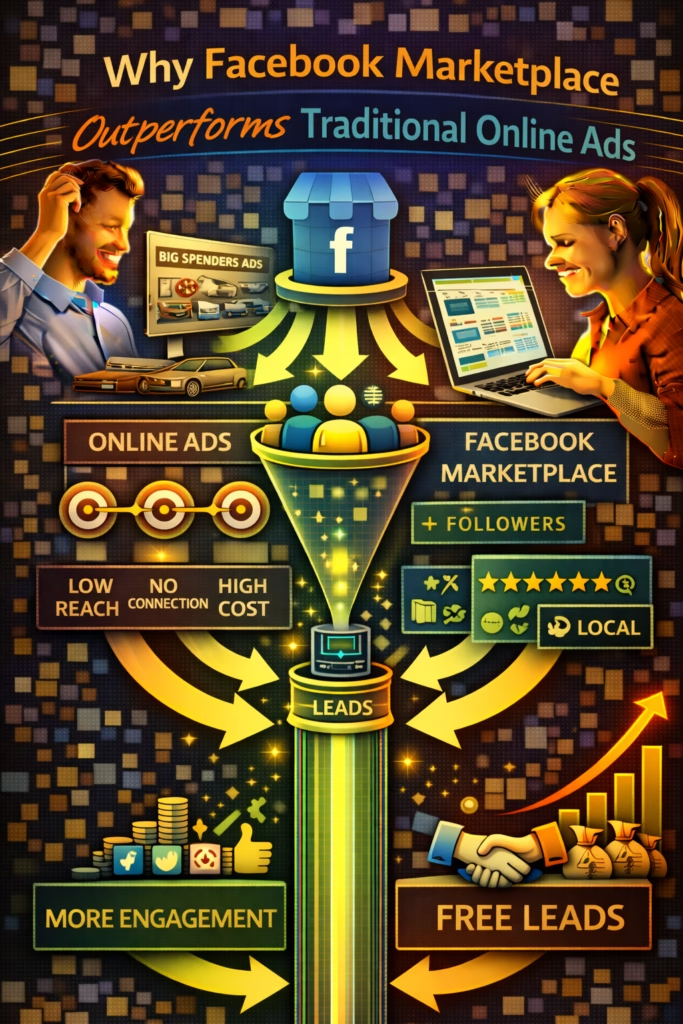
Why Facebook Marketplace Outperforms Traditional Online Ads is the blueprint for understanding why intent-driven, message-first visibility often beats many paid online ad models for local lead generation.
Note: This is general guidance. Follow Facebook policies and all applicable advertising, privacy, and consumer protection rules. Avoid misleading claims and spam-like posting behavior.
Introduction
Why Facebook Marketplace Outperforms Traditional Online Ads comes down to one core principle:
Marketplace meets buyers when they are already in “shopping mode,” while many traditional online ads still have to interrupt attention first.
That difference matters. Traditional online ads often depend on paying for clicks, impressions, or reach before a buyer is ready. Facebook Marketplace, by contrast, often places your offer in front of someone already browsing, comparing, and open to messaging immediately.
That is why Marketplace can feel faster, cheaper, and more direct—especially for local businesses, local inventory, home services, retail, automotive, real estate, furniture, and many appointment-driven offers.
Big idea: Marketplace often wins because it compresses discovery, trust, and inquiry into one user behavior.
Expanded Table of Contents
- 1) The core difference between Marketplace and traditional online ads
- 2) Buyer intent: why Marketplace traffic converts differently
- 3) Cost structure: rent vs compounding asset
- 4) Trust signals that make Marketplace leads move faster
- 5) Why Marketplace reduces lead friction
- 6) Why consistent listing activity compounds visibility
- 7) Why photos and titles outperform creative-heavy ad funnels
- 8) Speed-to-lead: where Marketplace has a massive edge
- 9) Marketplace vs paid online ads: side-by-side comparison
- 10) When traditional online ads still make sense
- 11) The Marketplace-first lead system
- 12) KPI dashboard for Marketplace performance
- 13) 30–60–90 day rollout plan
- 14) 25 Frequently Asked Questions
- 15) 25 Extra Keywords
1) The core difference between Marketplace and traditional online ads
Traditional online ads usually work by buying interruption. You pay to appear in front of someone who may or may not be ready. Marketplace works by capturing active shopping behavior.
| Channel type | Primary mechanism | Typical buyer state | Lead quality effect |
|---|---|---|---|
| Traditional online ads | Paid interruption / targeting | Often passive or distracted | Can require more nurturing |
| Facebook Marketplace | Intent-driven browsing | Actively looking and comparing | Often higher immediate inquiry intent |
Rule: When people are already browsing to buy, you need less persuasion and more clarity.
2) Buyer intent: why Marketplace traffic converts differently
Intent changes everything. On Marketplace, buyers often behave like this:
- They are looking for something specific or nearby.
- They are comfortable comparing multiple options fast.
- They are willing to message immediately if the listing is clear.
- They expect quick answers and simple next steps.
Marketplace mindset
“I’m browsing for something I may buy soon.”
Ad-click mindset
“Something interrupted me—maybe I’ll look, maybe I won’t.”
Rule: Marketplace traffic often converts better because the buyer has already self-qualified with browsing behavior.
3) Cost structure: rent vs compounding asset
Many traditional online ads behave like rent. When you stop paying, exposure usually stops. Marketplace can behave more like a compounding asset—if your process is consistent.
| Factor | Traditional online ads | Facebook Marketplace |
|---|---|---|
| Traffic source | Paid impressions / clicks | Organic + activity-driven visibility |
| Cost structure | Ongoing spend to keep reach | More effort- and system-based |
| Compounding effect | Limited unless backed by strong remarketing | Higher when listings stay fresh and engaging |
| Speed of feedback | Moderate | Fast |
Pro move: Use Marketplace as the organic core and paid ads as a booster—not the entire strategy.
4) Trust signals that make Marketplace leads move faster
Marketplace is not just about reach. It is also about trust. Buyers can see photos, descriptions, messaging responsiveness, and local relevance in one place.
Trust signals that improve conversion
- Real photos
- Clear titles and local context
- Fast reply speed
- Simple details and transparent next steps
- Consistent posting behavior
Rule: Traditional ads often ask buyers to trust first. Marketplace lets you demonstrate trust immediately.
5) Why Marketplace reduces lead friction
Traditional online ads often send buyers through multiple steps: ad click, landing page, form, email, wait. Marketplace often reduces that to one action: send a message.
Lower-friction pathway
- Buyer sees listing
- Buyer checks photo + title + details
- Buyer messages
- Business replies and qualifies
- Next step is booked
Pro move: Fewer steps usually means more leads—especially on local and mid-consideration offers.
6) Why consistent listing activity compounds visibility
Marketplace tends to reward activity that looks current, relevant, and engaging. That means the businesses that stay active often gain more consistent exposure over time.
Activity signals that support visibility
- Fresh listings
- Meaningful listing updates
- Photo rotation
- Title and hook improvements
- Fast responses to buyer messages
Rule: Marketplace visibility is often earned daily, not bought all at once.
7) Why photos and titles outperform creative-heavy ad funnels
Traditional ad systems often rely on polished creative, audience targeting, and paid optimization. Marketplace often rewards simpler fundamentals:
- A stronger first photo
- A clearer title
- A better first 1–2 lines
- A single CTA question
Simple title structure
[What it is] + [Benefit/Hook] + [Availability or Option]Simple first-line structure
Real photos + clear details ✅
What city/zip are you in and are you looking for today or this week?
Pro move: Marketplace wins are often built on clarity, not complexity.
8) Speed-to-lead: where Marketplace has a massive edge
Marketplace encourages instant messaging. That gives businesses a major advantage if they respond quickly.
Instant reply example
Yes — I can help ✅

Quick question so I send the best option:
Are you looking for today or this week?

What city/zip are you in?
Why this matters
- Momentum is still high
- The buyer is still browsing and deciding
- The fastest useful reply often wins the lead
Rule: Marketplace often outperforms online ads because the lead can convert before attention fades.
9) Marketplace vs paid online ads: side-by-side comparison
| Metric | Facebook Marketplace | Traditional online ads |
|---|---|---|
| Buyer intent | Often high and local | Varies widely |
| Lead friction | Low (message-first) | Often higher (click → page → form) |
| Trust building | Immediate through listing + context | Often delayed until landing page or retargeting |
| Cost structure | Often lower cash cost, higher process discipline | Higher ongoing cash cost |
| Compounding potential | Strong with cadence and variation | More dependent on spend continuity |
| Response sensitivity | Very high | High, but path is usually slower |
Rule: Marketplace is often stronger when local intent and quick action matter more than broad audience reach.
10) When traditional online ads still make sense
Marketplace is powerful, but it is not the only tool. Traditional online ads can still be the better fit when:
- You need broad regional or national reach quickly.
- Your category has limited Marketplace fit.
- You are validating a new offer and need controlled audience testing.
- You want to retarget visitors who already engaged elsewhere.
Best use: Let Marketplace drive organic intent capture, and let paid ads amplify winners or support retargeting.
11) The Marketplace-first lead system
If you want Marketplace to outperform traditional online ads consistently, you need a real system.
The Marketplace-first system
- Offer clarity: know what you are selling and the next step.
- Listing structure: build for clicks and messages.
- Rotation: rotate photos, titles, and hooks responsibly.
- Cadence: stay active every week.
- Speed-to-lead: respond in minutes, not hours.
- Follow-up: recover leads that do not answer immediately.
- Tracking: measure booked next steps and optimize weekly.
Big idea: Marketplace outperforms online ads when it is run like a system, not a side task.
12) KPI dashboard for Marketplace performance
| KPI | What it measures | Target direction |
|---|---|---|
| Messages/day | Lead volume | Up |
| Messages per listing | Listing quality | Up |
| Median response time | Speed-to-lead | Down |
| Booked next steps | Revenue predictor | Up |
| Follow-up recovery rate | Recovered opportunities | Up |
| Flags/removals | Compliance risk | Down |
| Active listings | Surface area | Stable/Up |
Pro move: If you only track one number, track booked next steps. That is the clearest bridge from Marketplace activity to revenue.
13) 30–60–90 day rollout plan
Days 1–30 (Foundation)
- Clarify the offer and CTA.
- Improve first photos and titles on core listings.
- Set a sustainable posting and refresh cadence.
- Deploy instant replies and simple qualification.
- Start KPI tracking.
Days 31–60 (Compounding)
- Build a rotation library for photos, titles, and hooks.
- Improve follow-up sequences.
- Retire weak listings and replace them with stronger angles.
- Test one variable per week.
Days 61–90 (Scale)
- Document SOPs for posting, rotation, and response.
- Expand surface area across categories or regions.
- Use paid online ads only where they amplify proven Marketplace winners.
- Review KPIs weekly and optimize the biggest bottleneck.
Rule: Marketplace outperforms best when your process becomes repeatable and measurable.
14) 25 Frequently Asked Questions
1) Why does Facebook Marketplace outperform traditional online ads for many local businesses?
Because buyers are often already browsing with intent and can message immediately.
2) Is Facebook Marketplace cheaper than traditional online ads?
It can be much more efficient because organic activity can generate leads without the same constant paid spend.
3) What is the fastest way to improve Facebook Marketplace results?
Upgrade the first photo, improve the title, rotate responsibly, and respond faster.
4) Does Marketplace replace all paid ads?
No. It often replaces a large portion of local lead generation, but paid ads can still support scaling and retargeting.
5) Why do Marketplace leads feel more ready to buy?
Because browsing behavior often signals active shopping intent.
6) What makes Marketplace traffic different from ad traffic?
Marketplace traffic is often more local and more action-oriented.
7) What matters most for Marketplace visibility?
Freshness, engagement, variation, and response speed.
8) What matters most for paid ad performance?
Targeting, budget, creative, landing pages, and conversion tracking.
9) Why do photos matter so much on Marketplace?
The first photo drives click-through, which often drives exposure and messages.
10) What should my first line say?
Something clear and trustworthy, like “Real photos + clear details ✅”
11) What CTA works best on Marketplace?
One simple question: “What city/zip are you in and are you looking for today or this week?”
12) What response time should I aim for?
Under 5 minutes is strong; under 1 minute is best when possible.
13) Why is speed-to-lead so important?
Because the buyer is often actively deciding while messaging.
14) How do I avoid spam patterns?
Rotate photos, titles, hooks, and timing rather than reposting identical duplicates.
15) What is listing rotation?
Refreshing content through meaningful variation to keep listings current and engaging.
16) Can Marketplace work without paid ads?
Yes, especially for local and high-intent offers.
17) When should I still use traditional online ads?
When you need faster scale, broader reach, or retargeting support.
18) What KPI matters most?
Booked next steps, because they best predict revenue.
19) What are booked next steps?
Appointments, calls, pickups, delivery slots, tours, or quotes that are scheduled.
20) Why track messages per listing?
It shows how efficiently each listing turns visibility into leads.
21) What is the biggest Marketplace mistake?
Posting inconsistently and responding too slowly.
22) What is the biggest paid ad mistake?
Sending traffic into weak offers or poor conversion systems.
23) Can a small team outperform bigger advertisers on Marketplace?
Yes, if the team is more consistent, clearer, and faster.
24) How quickly can Marketplace results improve?
Often within 1–2 weeks, with stronger gains over 30–90 days.
25) What is the best combined strategy?
Use Marketplace as the core local lead engine and paid online ads as a support channel for winners.
15) 25 Extra Keywords
- Why Facebook Marketplace Outperforms Traditional Online Ads
- Facebook Marketplace vs online ads
- Marketplace lead generation
- Facebook Marketplace marketing strategy
- local lead generation Marketplace
- Marketplace organic reach
- Marketplace vs Google Ads local business
- Marketplace vs Facebook ads
- Marketplace intent-driven traffic
- Facebook Marketplace daily leads
- Marketplace lead conversion
- speed to lead Marketplace
- Marketplace listing strategy
- Marketplace title optimization
- Marketplace first photo strategy
- Marketplace listing rotation
- anti-flag Marketplace framework
- messages per listing KPI
- booked next steps KPI
- Marketplace follow-up system
- organic local marketing strategy
- replace paid ads with Marketplace
- Marketplace trust signals
- 2026 Marketplace marketing blueprint
- Facebook Marketplace lead engine