
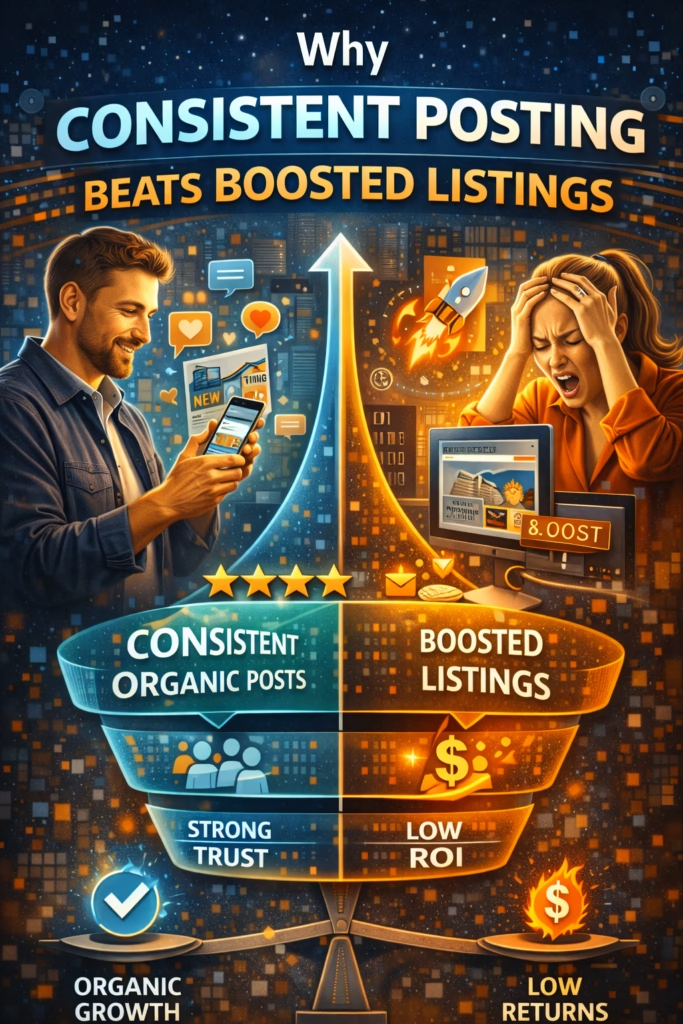
Why Consistent Posting Beats Boosted Listings
Why Consistent Posting Beats Boosted Listings comes down to simple economics: organic activity compounds favorably while paid promotion creates dependency. Algorithms reward consistency with higher organic reach, trust builds through visible presence, and sustainable businesses own their traffic rather than renting it.
Note: This analysis focuses on marketplace platforms (Facebook Marketplace, Craigslist, OfferUp). Platform features and costs may change—verify current rates and policies.
Introduction
Why Consistent Posting Beats Boosted Listings is a question every business faces when deciding how to invest marketing resources. Should you pay to boost listings for instant visibility, or commit to consistent organic posting that builds over time? The data overwhelmingly favors organic consistency.
Boosted listings promise immediate reach: pay $5-20 per listing, get thousands of impressions, reach more buyers faster. It sounds compelling—until you run the numbers over 6-12 months and realize you're spending thousands for temporary visibility that vanishes the moment you stop paying. Meanwhile, consistent organic posters build algorithmic favor, accumulate trust signals, and create owned assets that generate leads indefinitely without ongoing costs.
This isn't about never using paid promotion—it's about understanding that consistent posting is the foundation, and boosting is the occasional accelerant. Businesses that reverse this equation (paying to boost everything while posting sporadically) waste money fighting platform algorithms instead of working with them.
The marketplace algorithms—Facebook Marketplace, Craigslist, OfferUp—all reward activity, recency, and engagement. Consistent posters get higher organic reach, better placement, and more favorable treatment than sporadic boosters. This algorithmic advantage compounds over time, creating a widening gap between organic-first and paid-dependent strategies.
Big idea: Paid promotion is renting attention. Consistent posting is building equity. Rent creates dependency. Equity creates freedom.
Expanded Table of Contents
- 1) The economics: organic vs boosted cost comparison
- 2) How marketplace algorithms reward consistency
- 3) The compound effect of consistent posting
- 4) Trust signals: organic presence vs paid promotion
- 5) Platform dependency risk of boosted listings
- 6) ROI analysis: 3-year comparison
- 7) Lead quality: organic vs boosted
- 8) Sustainable growth models
- 9) When boosting makes sense (the 20% use case)
- 10) The optimal hybrid approach
- 11) Common mistakes with boosted listings
- 12) Transitioning from boosted to organic-first
- 13) 30–60–90 day organic posting system
- 14) 25 Frequently Asked Questions
- 15) 25 Extra Keywords
1) The economics: organic vs boosted cost comparison
Boosted listing costs (Facebook Marketplace example)
Facebook Marketplace boosting costs vary by market, competition, and duration, but typical costs are:
- $5-10 per listing for 7-day boost (low-cost items, small markets)
- $10-20 per listing for 7-day boost (mid-ticket items, competitive markets)
- $20-50 per listing for 7-day boost (high-value items, major metros)
Annual cost comparison: 50 active listings
| Strategy | Weekly Cost | Monthly Cost | Annual Cost |
|---|---|---|---|
| Boost all listings ($10 avg) | $500 | $2,000-2,500 | $24,000-30,000 |
| Boost 50% of listings | $250 | $1,000-1,250 | $12,000-15,000 |
| Boost 20% of listings | $100 | $400-500 | $4,800-6,000 |
| Organic only (no boosting) | $0 | $0 | $0 |
True cost of organic: time investment
Organic isn't "free"—it requires time. But time investment decreases with automation:
Manual organic posting (Month 1-2):
- Create/photograph listings: 2 hours/week
- Post to platform: 1 hour/week
- Respond to messages: 3-5 hours/week
- Total: 6-8 hours/week

Automated organic posting (Month 3+):
- Batch content creation: 1 hour/week
- Automated cross-posting: 0 hours (automated)
- AI handles initial responses: 0 hours (automated)
- Agent handles qualified leads: 2-3 hours/week
- Total: 3-4 hours/week

Value of time saved: 3-4 hours/week × $50-100/hour = $150-400/week = $7,800-20,800/year
3-year total cost comparison
| Approach | Year 1 | Year 2 | Year 3 | 3-Year Total |
|---|---|---|---|---|
| Boosted (all listings) | $24,000 | $28,000 (inflation) | $32,000 (inflation) | $84,000 |
| Organic + automation tools | $3,600 (tools + setup) | $1,800 (tools only) | $1,800 (tools only) | $7,200 |
| Savings with organic | $20,400 | $26,200 | $30,200 | $76,800 |
Cost per lead comparison
Scenario: 100 leads generated per month

Boosted approach:
- Ad spend: $2,000/month
- Cost per lead: $20
- Lead quality: Mixed (some low-intent clickers)
- Dependency: High (stop paying = leads stop)

Organic approach:
- Ad spend: $0/month
- Tool costs: $150/month (automation)
- Cost per lead: $1.50
- Lead quality: Higher (organic searchers/browsers)
- Dependency: Zero (owned visibility)

Difference: $18.50 saved per lead
Annual savings: 1,200 leads × $18.50 = $22,200
Rule: Boosting converts dollars to temporary visibility. Organic converts time to permanent assets. Time is the better investment.
2) How marketplace algorithms reward consistency
Algorithm factors that favor consistent posters
Marketplace algorithms (Facebook, OfferUp, etc.) use recency, activity, and engagement signals to determine organic reach:
1. Recency signals
- Last posting date: Listings from active accounts rank higher
- Account freshness: Recently active sellers get visibility boost
- Response time: Fast responders get "typically replies within" badge
2. Activity patterns
- Posting frequency: Daily/weekly posters favored over monthly/sporadic
- Listing volume: More active listings = more visibility opportunities
- Account age with activity: Long-term consistent posters build authority
3. Engagement metrics
- Message rate: Listings that generate messages rank higher
- Response rate: Sellers who respond quickly get algorithmic favor
- Transaction completion: Completed deals boost account reputation
Organic reach: consistent vs sporadic posting
| Posting Pattern | Impressions per Listing | Message Rate | Algorithm Status |
|---|---|---|---|
| Daily posting (consistent) | 500-2,000 | 3-8% | Favored (high activity signals) |
| 3x/week (moderate) | 300-1,200 | 2-6% | Neutral (acceptable activity) |
| Weekly (light) | 200-800 | 1.5-4% | Lower priority (inactive periods) |
| Monthly (sporadic) | 100-400 | 1-3% | Penalized (algorithm assumes inactive) |
Boosted listings and algorithm confusion
Here's the problem with relying on boosting: paid reach bypasses organic algorithm signals. When you stop boosting, the algorithm doesn't have organic engagement data to reward you with natural reach.
Boost-dependent account:
- Boosts listings → Gets paid reach → Some engagement
- Stops boosting → Algorithm sees: low organic activity, sporadic posting
- Result: Near-zero organic reach when ads stop

Organic-first account:
- Posts consistently → Gets organic reach → Strong engagement
- Algorithm sees: high activity, good engagement, reliable poster
- Result: High organic reach without paying

The boost-dependent account is invisible without ad spend.
The organic-first account has built algorithmic equity.
The "fresh content" bias
Marketplace algorithms prioritize new listings over older ones—even if older listings are boosted. This creates an advantage for consistent posters:
- Daily poster: Always has fresh listings in "recently posted" feeds
- Sporadic poster + boosting: Old listings get paid reach but lower engagement
- Algorithm conclusion: Daily poster = better content → reward with more organic reach
Pro move: Refresh top-performing listings weekly with new first photo and slightly modified title. Algorithm treats it as "fresh" and rewards with visibility boost.
3) The compound effect of consistent posting
How organic reach compounds over time
Boosted listings deliver linear returns: spend $X, get Y impressions. Organic posting delivers compounding returns: each post builds on previous algorithmic favor.
Month-by-month compound trajectory
Month 1 (Building foundation):
- 30 listings posted
- 15,000 total impressions (500/listing avg)
- 150 messages (1% message rate)
- Algorithm learns: new active account

Month 3 (Algorithm recognition):
- 90 total listings posted (cumulative)
- 60,000 total impressions (667/listing avg—algorithm boost)
- 480 messages (0.8% message rate but 3x volume)
- Algorithm learns: consistent reliable poster

Month 6 (Compounding effects):
- 180 total listings posted
- 150,000 total impressions (833/listing avg—higher placement)
- 1,350 messages (0.9% message rate, 9x Month 1 volume)
- Algorithm learns: high-value established seller

Month 12 (Full compound):
- 360 total listings posted
- 400,000 total impressions (1,111/listing avg—top-tier placement)
- 3,600 messages (0.9% rate, 24x Month 1 volume)
- Algorithm status: preferred seller with maximum organic reach

Contrast with boosted approach (same timeframe):
Month 1: 30 listings × $10 boost = $300 → 45,000 paid impressions
Month 12: Still 30 listings × $10 boost = $300 → 45,000 paid impressions
Result: No compounding. Linear spend for linear results.
The network effect of listing volume
More listings create exponential visibility opportunities:
| Active Listings | Search Keywords Captured | Daily Impressions | Weekly Messages |
|---|---|---|---|
| 10 listings | 10-20 keywords | 500-1,000 | 3-8 |
| 30 listings | 30-70 keywords | 2,000-5,000 | 15-35 |
| 50 listings | 50-150 keywords | 4,000-10,000 | 30-70 |
| 100 listings | 100-300 keywords | 10,000-25,000 | 75-180 |
Trust accumulation (buyers remember active sellers)
Consistent organic presence builds brand recognition:
- Buyer A searches "Queen mattress" → sees your listing → doesn't message
- 3 days later: Buyer A searches "King mattress" → sees your listing again → "I've seen this seller before"
- 5 days later: Buyer A searches "bed frame" → sees your listing third time → "This seller has everything" → messages
Boosted listings don't create this repeated exposure effect—buyers see one promoted listing, never see you again if it doesn't convert immediately.
Content library builds over time
Every listing you create becomes a permanent asset:
Year 1: Create 200 unique listings
Year 2: Reuse/refresh 200 existing + create 150 new = 350 total library
Year 3: Reuse/refresh 350 existing + create 100 new = 450 total library

Result after 3 years:
- 450 listing templates ready to deploy
- Zero creation time for existing listings (copy/paste)
- Organic reach maximized (algorithm rewards this library)

vs Boosted approach after 3 years:
- Same 50 listings boosted repeatedly
- Still paying $2,000/month for temporary visibility
- No accumulated library or algorithmic equity
Truth: Compounding is the most powerful force in marketing. Organic posting compounds. Boosting doesn't.
4) Trust signals: organic presence vs paid promotion
Why organic presence builds more trust
Buyers subconsciously distinguish between organic listings and promoted ones. Organic listings signal "real seller with real inventory." Promoted listings signal "paying for attention" which can raise skepticism.
Trust hierarchy (buyer perspective):
- Highest trust: Organic listing from seller with many active listings
- High trust: Organic listing from responsive seller with reviews
- Neutral trust: New organic listing with limited history
- Lower trust: Boosted listing with "Sponsored" label
- Lowest trust: Boosted listing from account with few listings
Organic trust signals
| Signal | How It's Built | Trust Impact |
|---|---|---|
| Active listing volume | Consistent posting over months | High (shows real business) |
| Response time badge | Fast replies = "Typically replies within minutes" | High (shows responsiveness) |
| Account longevity | Years of consistent activity | Medium (shows reliability) |
| Engagement history | Completed transactions visible in some platforms | High (social proof) |
| Profile completeness | Photo, bio, verification | Medium (shows legitimacy) |
Paid promotion skepticism factors
- "Sponsored" label: Immediate signal that seller paid for visibility
- Limited listing history: If only boosted listing is visible, raises "why?" questions
- Overpromotion: Boosting low-quality listings doesn't hide poor quality
- Scammer association: Some scammers boost fake listings—creates buyer caution
Review and rating implications
Organic-first seller profile:
- 50+ active listings (visible commitment)
- 45+ completed transactions (some platforms show this)
- "Typically replies within 10 minutes" badge
- Profile: Active for 2+ years with consistent posting
- Buyer perception: "This is a real professional seller"

Boost-dependent seller profile:
- 5-10 total listings (limited inventory)
- "Sponsored" labels on listings
- Response time: Variable (no badge earned)
- Profile: Sporadic activity with boosting
- Buyer perception: "Is this a legitimate business?"
Invisible vs visible sellers
The ultimate trust signal is visibility without paying for it:
- Buyer searches → finds your listing organically → "They're doing well enough to rank naturally"
- Buyer searches → finds only your boosted listing → "Why do they need to pay for visibility?"
Pro move: Build organic presence first. Then occasional strategic boosting amplifies already-trusted listings rather than creating all visibility through paid promotion.
5) Platform dependency risk of boosted listings
The boost dependency cycle
Month 1: Start boosting listings → get leads → make sales
Month 3: Boosting works → increase budget → more leads
Month 6: Revenue depends on boosting → must maintain budget
Month 12: Try to reduce boost budget → leads drop 70-80% immediately
Result: Trapped in ongoing ad spend to maintain business

Organic alternative:
Month 1: Start consistent posting → slow lead ramp-up
Month 3: Algorithm recognizes activity → organic reach increases
Month 6: Strong organic lead flow → boosting unnecessary
Month 12: Reduce posting to 3x/week → leads only drop 20-30%
Result: Sustainable lead generation independent of ad spend
What happens when you stop boosting
| Timeframe | Boost-Dependent Business | Organic-First Business |
|---|---|---|
| Week 1 after stopping ads | Leads drop 60-80% | Leads drop 0-10% |
| Week 2-4 | Leads drop 80-95% | Leads stable (organic unaffected) |
| Month 2-3 | Near-zero leads (no organic reach built) | Leads continue (organic reach maintained) |
| Recovery time | 6-12 months to build organic from scratch | N/A (no recovery needed) |
Platform risks amplified by dependency
- Ad cost increases: Platforms raise prices 10-30% annually—trapped businesses must pay
- Policy changes: Algorithm updates favor different content—paid reach fluctuates
- Account issues: Ad account restrictions = instant business halt
- Budget cuts: Economic downturn forces ad cuts = revenue collapse
- Competitor bidding: More competitors boosting = higher costs for same reach
Real-world dependency examples
Example 1: Real estate agent
- Spent $3,000/month boosting listings for 2 years ($72K total)
- Economic downturn → must cut budget → stops boosting
- Lead flow drops from 80/month to 8/month in 30 days
- Takes 9 months to rebuild organic presence
- Lesson: $72K spent building nothing permanent

Example 2: Furniture store
- Built organic presence through daily posting (no boosting)
- $0 ad spend over 2 years
- Generates 100+ leads/month consistently
- Could pause posting for a month with minimal impact
- Lesson: Time investment built owned asset
Business valuation implications
When selling a business, organic traffic is worth more than paid:
| Lead Source | Valuation Multiple | Why |
|---|---|---|
| Organic marketplace | 3-5x annual profit | Sustainable, owned asset |
| Paid advertising | 1-2x annual profit | Requires ongoing spend to maintain |
| Referral/word-of-mouth | 4-6x annual profit | Self-sustaining, zero cost |
Rule: Build assets, not dependencies. Organic presence is an asset. Paid promotion is an expense that creates dependency.
6) ROI analysis: 3-year comparison
Full ROI calculation: 50 active listings
Scenario A: Boosted approach
Investment:
Year 1: $24,000 (boost all listings)
Year 2: $28,000 (10-15% cost increase)
Year 3: $32,000 (continued increases)
Total investment: $84,000

Returns:
- Leads generated: 3,600 over 3 years (100/month avg)
- Cost per lead: $23.33
- Lead quality: Mixed (includes low-intent paid clicks)
- Sustainability: Zero (stops when spending stops)
- Owned assets: None
- Business value added: Minimal (ad-dependent revenue)

ROI: Revenue generated - $84,000 spent
If average deal = $5,000 commission and 5% conversion:
- 3,600 leads × 5% = 180 deals
- 180 × $5,000 = $900,000 revenue
- ROI: $816,000 profit after ad spend
- But: business remains ad-dependent
Scenario B: Organic approach
Investment:
Year 1: $3,600 (automation tools + setup)
Year 2: $1,800 (automation tools only)
Year 3: $1,800 (automation tools only)
Total investment: $7,200

Returns:
- Leads generated: 4,320 over 3 years (starts 60/month, grows to 150/month)
- Cost per lead: $1.67
- Lead quality: Higher (organic searchers)
- Sustainability: High (owned algorithmic equity)
- Owned assets: 200+ listing templates, algorithmic favor, brand recognition
- Business value added: Significant (sustainable organic channel)

ROI: Revenue generated - $7,200 spent
If average deal = $5,000 commission and 6% conversion (higher quality):
- 4,320 leads × 6% = 259 deals
- 259 × $5,000 = $1,295,000 revenue
- ROI: $1,287,800 profit after tool costs
- Plus: business operates independently of ad spend
ROI comparison summary
| Metric | Boosted Approach | Organic Approach | Advantage |
|---|---|---|---|
| 3-year investment | $84,000 | $7,200 | Organic saves $76,800 |
| Total leads | 3,600 | 4,320 | Organic +20% |
| Cost per lead | $23.33 | $1.67 | Organic 93% cheaper |
| Total revenue | $900,000 | $1,295,000 | Organic +$395,000 |
| Net profit | $816,000 | $1,287,800 | Organic +$471,800 |
| Sustainability | Ad-dependent | Independent | Organic wins |
Time-adjusted ROI
Factor in time investment value:
Organic time investment:
- Year 1: 8 hours/week × 50 weeks = 400 hours
- Year 2-3: 4 hours/week × 100 weeks = 400 hours (automation reduces time)
- Total: 800 hours over 3 years
- Value at $75/hour: $60,000

Adjusted organic ROI:
- Investment: $7,200 + $60,000 (time) = $67,200
- Returns: $1,287,800
- Net ROI: $1,220,600
- Still beats boosted approach by $404,600
Pro move: Even when accounting for time value, organic approach delivers 50%+ higher ROI than paid boosting over 3 years.
7) Lead quality: organic vs boosted
Why organic leads convert better
Organic marketplace leads show 20-40% higher conversion rates than boosted listings. Why?
Intent signals in organic vs paid
| Factor | Organic Lead | Boosted Lead |
|---|---|---|
| Search behavior | Actively searched specific term | Saw promoted content in feed |
| Intent level | High (looking to buy) | Mixed (some just browsing) |
| Decision stage | Late stage (researching options) | Early stage (awareness) |
| Action likelihood | High (messaged organically) | Medium (clicked ad out of curiosity) |
Conversion rate comparison
Organic marketplace lead funnel:
- 100 organic inquiries
- 65 respond to first message (65% engagement)
- 40 qualify as serious buyers (61% of responders)
- 12 book appointment/showing (30% of qualified)
- 7 make purchase (58% close rate)
- Overall: 7% inquiry-to-purchase

Boosted listing lead funnel:
- 100 boosted inquiries
- 45 respond to first message (45% engagement)
- 20 qualify as serious buyers (44% of responders)
- 8 book appointment/showing (40% of qualified—desperation)
- 3 make purchase (38% close rate)
- Overall: 3% inquiry-to-purchase

Organic leads convert 2.3x better than boosted leads
Lead qualification indicators
- Organic leads more likely to:
- Ask specific product questions (shows real interest)
- Have budget clarity (researched before contacting)
- Respond quickly to follow-up (higher engagement)
- Complete transactions (serious buyer intent)
- Boosted leads more likely to:
- Ask only "is this available?" (low effort)
- Ghost after initial response (browsing, not buying)
- Negotiate aggressively (price shopping)
- Never follow through (low commitment)
Cost per acquisition (not just cost per lead)
True profitability comparison:

Boosted approach:
- $24,000 annual ad spend
- 1,200 leads generated
- 3% conversion = 36 customers
- Cost per acquisition: $666.67

Organic approach:
- $3,600 annual investment (tools)
- 1,440 leads generated (ramps over year)
- 7% conversion = 101 customers
- Cost per acquisition: $35.64

Organic CPA is 95% lower while delivering higher quality leads
Truth: Lead quantity matters. Lead quality matters more. Organic delivers both higher quantity (after ramp) and higher quality.
8) Sustainable growth models
The unsustainable growth trap
Boosted listing businesses often follow this pattern:
Quarter 1: Boost $5,000 → generate $25,000 revenue → profit $20,000
Quarter 2: Boost $7,500 → generate $30,000 revenue → profit $22,500
Quarter 3: Boost $10,000 → generate $35,000 revenue → profit $25,000
Quarter 4: Economic downturn → cut boost to $3,000 → revenue drops to $12,000

Problem: Revenue growth was ad-driven, not business-driven
Result: When ads pause, business collapses
The sustainable organic model
Quarter 1: Post consistently + tools $900 → generate $15,000 revenue → profit $14,100
Quarter 2: Post consistently + tools $450 → generate $22,000 revenue → profit $21,550
Quarter 3: Post consistently + tools $450 → generate $32,000 revenue → profit $31,550
Quarter 4: Reduce posting 50% → revenue drops only to $28,000 → profit $27,550

Advantage: Revenue growth is organic-driven, compounds independently
Result: Business maintains strong revenue even with reduced effort
Sustainable growth characteristics
| Factor | Unsustainable (Boost-Dependent) | Sustainable (Organic-First) |
|---|---|---|
| Lead source | 90%+ paid advertising | 70-90% organic, 10-30% strategic paid |
| Cash flow | Revenue tied to ad spend | Revenue independent of ad spend |
| Scalability | Linear (spend more = get more) | Exponential (compounding organic reach) |
| Resilience | Fragile (any budget cut = crisis) | Resilient (survives budget cuts) |
| Transferability | Not transferable (stops with owner) | Transferable (owned algorithmic equity) |
| Valuation | Low (ad-dependent earnings) | High (sustainable organic channel) |
The 70/30 rule
Sustainable businesses follow the 70/30 principle:
- 70% of leads: Organic sources (marketplace, SEO, referrals, content)
- 30% of leads: Paid sources (strategic boosting, ads, promotions)
This balance provides:
- Stable baseline from organic (survives budget cuts)
- Growth acceleration from paid (scales when needed)
- Risk diversification (not dependent on any single channel)
Long-term business model implications
5-year outlook:

Boost-dependent business:
- Year 1-3: Grow by increasing ad spend
- Year 4-5: Ad costs rise, margins shrink
- Exit strategy: Limited (buyer inherits ad dependency)
- Business value: 1-2x annual profit

Organic-first business:
- Year 1-3: Build organic, strategic paid acceleration
- Year 4-5: Organic dominates, minimal paid needed
- Exit strategy: Strong (buyer inherits owned channel)
- Business value: 3-5x annual profit
Pro move: Build the business you'd want to buy. Buyers pay premiums for sustainable organic channels, not ad-dependent revenue streams.
9) When boosting makes sense (the 20% use case)
Strategic boosting scenarios
Boosting isn't always wrong—it's a tactical tool for specific situations:
1. Launch acceleration
- Situation: New business with zero organic presence
- Strategy: Boost 3-5 best listings for 30 days while building organic
- Budget: $300-500 one-time
- Goal: Generate initial transactions and reviews
- Exit plan: Phase out boosting as organic ramps
2. Seasonal peaks
- Situation: Holiday season, back-to-school, peak buying periods
- Strategy: Boost top performers during 2-4 week peak window
- Budget: $500-1,500 seasonally
- Goal: Capture temporary demand surge
- Exit plan: Return to organic-only post-season
3. New market entry
- Situation: Expanding to new geographic market
- Strategy: Boost listings in new market while organic builds
- Budget: $400-800 for 60 days
- Goal: Establish presence faster than organic alone
- Exit plan: Transition to organic as local algorithm recognizes you
4. Inventory liquidation
- Situation: Need to clear slow-moving inventory quickly
- Strategy: Boost specific clearance items only
- Budget: $200-500 until inventory clears
- Goal: Move product faster than organic timeline
- Exit plan: Stop boosting when inventory sold
When boosting makes sense: decision framework
| Question | If YES → Consider Boosting | If NO → Stay Organic |
|---|---|---|
| Is this temporary (under 90 days)? | ✅ Short-term tactical boost | ❌ Build organic instead |
| Do you have strong organic already? | ✅ Amplify what works | ❌ Boosting won't fix weak organic |
| Is there a specific time-sensitive goal? | ✅ Boost for urgency | ❌ Organic fine for ongoing |
| Can you afford to lose this money? | ✅ Discretionary budget OK | ❌ Don't risk essential cash |
| Will boosting create dependency? | ❌ No → boost carefully | ✅ Yes → avoid |
The 80/20 boost budget rule
If you must boost listings, follow the 80/20 rule:
- 80% of budget: Organic system (tools, time, content creation)
- 20% of budget: Strategic boosting (seasonal, launch, tests)
This ensures boosting stays supplemental, not foundational.
Red flags: when NOT to boost
- ❌ Boosting because organic "takes too long" (builds dependency)
- ❌ Boosting all listings every week (unsustainable cost)
- ❌ Boosting to compensate for poor quality listings (fix content first)
- ❌ Boosting as your only marketing strategy (no owned assets)
- ❌ Boosting when cash flow is tight (creates financial stress)
Rule: Use boosting like salt—a little enhances flavor, too much ruins the dish. Organic is the meal; boosting is the seasoning.
10) The optimal hybrid approach
The 90/10 organic-first model
The most successful businesses use a hybrid approach that prioritizes organic but includes strategic paid:
Organic foundation (90% of effort):
- Daily posting 5-7 days/week
- 30-100 active listings maintained
- Automation for posting and response
- Continuous optimization based on data
- Goal: Maximum organic reach
Strategic boosting (10% of effort):
- Boost top 5 performers 1-2x/quarter
- Seasonal boost campaigns 2-4 weeks/year
- New product launch boosts (first 2 weeks)
- Test new markets with 30-day boost trial
- Goal: Amplify what organic already proves works
Hybrid implementation workflow
Month 1-3: Pure organic (build foundation)
- Post consistently, no boosting
- Establish baseline organic performance
- Build algorithmic favor and activity history
- Measure: impressions, messages, conversions

Month 4: First strategic boost test
- Identify top 3 organic performers
- Boost each for 7 days ($30 total test budget)
- Compare boosted performance vs organic baseline
- Decision: Did boost provide 3x ROI? If yes, repeat quarterly. If no, stay organic-only.

Month 5-6: Optimize organic based on data
- Double down on top categories
- Refresh winning listing formats
- Improve titles and photos based on engagement
- Continue consistent posting

Quarter 2: Seasonal boost (optional)
- If seasonal peak applies (holidays, summer, etc.)
- Boost top 10 performers for 2-week peak window
- Budget: $200-400 (tactical, time-limited)
- Goal: Capture temporary demand surge

Ongoing: 95% organic, 5% strategic boost
- Organic generates 150-200 leads/month (sustainable)
- Strategic boost adds 20-40 leads during campaigns
- Total: 180-240 leads/month with minimal paid spend
Budget allocation: hybrid model
| Category | Monthly Budget | Annual Budget | Purpose |
|---|---|---|---|
| Automation tools | $150 | $1,800 | Organic efficiency |
| Content creation | $50 (photos/graphics) | $600 | Organic quality |
| Strategic boosting | $100 avg (varies) | $1,200 | Seasonal acceleration |
| Total investment | $300 | $3,600 | Organic-first hybrid |
Compare to boost-only approach: $24,000-30,000/year
Savings: $20,400-26,400/year (85-90% reduction)
Performance tracking: organic vs boosted
Track both channels separately to understand true ROI:
Dashboard metrics (monthly):

Organic performance:
- Active listings: 60
- Impressions: 48,000
- Messages: 180 (0.38% rate)
- Conversions: 13 sales (7.2% conversion)
- Cost: $150 (tools)
- Cost per sale: $11.54

Boosted performance (when active):
- Boosted listings: 5
- Impressions: 12,000 (paid)
- Messages: 35 (0.29% rate—lower than organic!)
- Conversions: 1 sale (2.9% conversion—lower!)
- Cost: $100
- Cost per sale: $100

Insight: Organic outperforms paid on every metric except raw impression volume
Pro move: Use paid to test new concepts fast (new market, new product). Once proven, transition to organic-only. Paid validates, organic scales.
11) Common mistakes with boosted listings
Mistake 1: Boosting before building organic
Problem: New accounts boost immediately, never establish organic presence. Algorithm doesn't develop organic reach signals.
Solution: Post organically for 30-60 days first. Then boost if needed. This builds algorithmic equity while paying.
Mistake 2: Boosting low-quality listings
Problem: Paying to promote poorly optimized listings with bad photos, unclear offers, or high prices just wastes money.
Solution: Fix listing quality first. Only boost your proven best performers—listings that already convert organically.
Mistake 3: Boosting everything
Problem: "Boost all listings" approach burns through budget on mediocre inventory instead of focusing on winners.
Solution: Boost only top 10-20% of listings—those with highest organic message rates and conversions.
Mistake 4: No organic baseline for comparison
Problem: Can't tell if boosting is working without knowing organic performance. Might be paying for traffic you'd get free.
Solution: Track organic performance first. Then boost and compare. Calculate true incremental value of paid promotion.
Mistake 5: Continuous boosting without breaks
Problem: Never stopping boost campaigns means never understanding if organic reach is improving. Creates permanent dependency.
Solution: Boost in campaigns (7-14 days), then pause 30-60 days. Measure organic during off periods. Build organic strength over time.
Mistake 6: Ignoring boost performance data
Problem: Boosting "because everyone does" without analyzing if it actually generates ROI.
Solution: Track cost per message and cost per sale for boosted listings. If boost CPA > organic CPA, stop boosting and fix organic.
Mistake 7: Boosting to compensate for sporadic posting
Problem: Post once/month, boost to get visibility. Fighting algorithm instead of working with it.
Solution: Post consistently to build organic favor. Then boost becomes optional enhancement, not necessity.
Mistake 8: Using boost as only marketing strategy
Problem: No organic posting, no content, no reviews—just boosted listings. Business completely dependent on ad spend.
Solution: Treat boost as 10-20% of marketing mix. Build organic foundation that survives without ads.
Truth: The biggest mistake isn't boosting—it's depending on boosting instead of building sustainable organic presence first.
12) Transitioning from boosted to organic-first
The weaning process (90-day transition)
Month 1: Build organic alongside paid
- Continue current boost budget (maintain revenue)
- Start daily organic posting (5-10 new listings/week)
- Set up automation tools (ManyChat, Calendly, etc.)
- Track organic metrics separately from boosted
- Goal: Establish posting consistency without disrupting revenue
Month 2: Reduce boost budget 50%
- Cut boost budget in half (e.g., $2,000 → $1,000)
- Boost only top 10 performers (vs all listings)
- Increase organic posting to 15-20 listings/week
- Monitor lead volume carefully—expect 20-30% dip
- Goal: Shift dependency from paid to organic gradually
Month 3: Eliminate recurring boosts
- Stop all recurring boost campaigns
- Organic should now generate 60-80% of previous lead volume
- Keep $200-500 budget for strategic tests only
- Optimize organic posting based on 60 days of data
- Goal: Prove organic sustainability and achieve budget independence
Expected performance during transition
| Period | Boosted Leads | Organic Leads | Total Leads | Budget |
|---|---|---|---|---|
| Pre-transition | 80/month | 10/month | 90/month | $2,000/month |
| Month 1 | 80/month | 25/month | 105/month | $2,000/month |
| Month 2 | 40/month | 55/month | 95/month | $1,000/month |
| Month 3 | 10/month | 90/month | 100/month | $200/month |
| Month 6 | 5/month | 140/month | 145/month | $100/month |
Managing the revenue dip
Expect temporary revenue decline during transition:
Months 2-3: Revenue may drop 15-25%
Months 4-6: Revenue returns to baseline
Months 7-12: Revenue exceeds pre-transition levels

Why the dip?
- Organic reach takes time to compound
- Algorithm needs 30-60 days to recognize consistent posting
- Trust signals (reviews, engagement) build gradually

Why it recovers?
- Organic reach surpasses previous paid reach by month 4-5
- Higher quality organic leads convert better
- No ongoing ad spend = higher profit margins

Result: Short-term pain, long-term gain
Safety nets during transition
- Keep boost budget available: Don't cancel accounts, just pause campaigns
- Monitor daily: Track lead flow closely during first 60 days
- Have 90-day cash buffer: Revenue dip shouldn't create cash crisis
- Can reverse if needed: If organic doesn't ramp as expected by month 3, resume strategic boosting
Pro move: Time your transition to align with seasonal slow periods. Don't transition during peak season when revenue stability matters most.
13) 30–60–90 day organic posting system
Days 1–30: Foundation and consistency
- Week 1: Setup and baseline
- Audit current listings and performance
- Set up automation tools (ManyChat, Zapier/Make)
- Create content library (50+ listing templates)
- Establish daily posting schedule (5-10 listings/day)
- Track baseline metrics (impressions, messages, conversions)
- Week 2-3: Posting cadence
- Post consistently every day (no gaps)
- Vary listings (rotate categories, sizes, price points)
- Optimize photos and titles based on engagement
- Set up instant response automation (under 10 sec)
- Monitor algorithm response (are impressions increasing?)
- Week 4: First optimization
- Analyze top performers (which listings get most messages?)
- Create more variants of winners
- Refresh underperformers with new photos
- Compare week 4 metrics vs week 1 baseline
- Target: 30-50% increase in organic impressions vs baseline
Days 31–60: Algorithm recognition and scaling
- Week 5-6: Expand listing volume
- Increase active listings from 30 to 50-80
- Maintain daily posting consistency
- Implement weekly refresh of top 20 performers
- Track response time badge achievement
- Target: Algorithm recognizes as "active seller"
- Week 7-8: Conversion optimization
- Analyze message-to-conversion funnel
- Improve qualification questions in chatbot
- A/B test titles and primary photos
- Implement follow-up sequences for ghost leads
- Target: 40-60% improvement in message rates vs month 1
Days 61–90: Compound effects and systematization
- Week 9-10: Full compound phase
- Organic reach should be 2-3x month 1 baseline
- Document all SOPs for team consistency
- Reduce posting to 3-5x/week (test if reach maintains)
- Identify opportunities for strategic boost tests
- Target: Self-sustaining organic lead flow
- Week 11-12: Strategic enhancement
- Calculate full 90-day ROI vs previous approach
- Plan next quarter optimization priorities
- Consider strategic boost test on top 5 performers
- Expand to additional platforms (Craigslist, OfferUp)
- Target: 100-150 organic leads/month consistently
90-day success criteria
- ✅ Consistent daily posting established (90% consistency rate)
- ✅ 60-100 active listings maintained
- ✅ Organic impressions 2-3x month 1 baseline
- ✅ 100-150 organic leads per month
- ✅ Under 5-minute median response time
- ✅ 5-10% inquiry-to-sale conversion rate
- ✅ $0 required ad spend for baseline lead flow
- ✅ All automation workflows functioning
- ✅ Time investment: 5-10 hours/week (vs 20+ manual)
Rule: The first 90 days are an investment in algorithmic equity. Results compound after month 3—don't quit at day 60.
14) 25 Frequently Asked Questions
1) Why does consistent posting beat boosted listings?
Algorithms reward activity with higher organic reach, costs compound favorably (free vs paid), trust builds through presence, and organic systems don't depend on ongoing ad spend.
2) How much cheaper is organic vs boosted?
Organic costs $1-2 per lead (tools only). Boosted costs $20-30 per lead (ad spend). That's 90-95% cost reduction with organic.
3) Do marketplace algorithms really favor consistent posters?
Yes. Platforms prioritize sellers with recent activity, high engagement, and consistent patterns—rewarding them with 2-3x higher organic reach than sporadic posters.
4) How long does it take for organic to work?
30 days to establish baseline, 60 days for algorithm recognition, 90 days for full compound effects and sustainable lead flow.
5) Can I mix organic and boosted strategies?
Yes. Optimal is 90% organic effort + 10% strategic boosting for specific campaigns, seasonal peaks, or tests.
6) What happens if I stop boosting cold turkey?
If you have no organic foundation, leads drop 70-90% immediately. If you built organic alongside, leads drop only 10-20%.
7) Should new businesses start with boosting or organic?
Start with organic for 60-90 days to build algorithmic equity. Then add strategic boosting only if needed for acceleration.
8) How do I know if my boosted listings are worth the cost?
Calculate cost per acquisition (CPA). If boosted CPA > organic CPA and boosted CPA > average order value margin, stop boosting.
9) Do boosted listings convert better than organic?
No. Organic leads convert 2-3x better because they show higher intent (actively searched vs saw promoted content).
10) Can I transition from boosted to organic without losing revenue?
Yes, but expect 15-25% revenue dip for months 2-3 during transition. Recovers by month 4-5 and exceeds previous levels by month 6-9.
11) How much time does organic posting require?
Manual: 6-8 hours/week initially. Automated: 3-4 hours/week ongoing. Time decreases as systems mature.
12) What if my competitors boost all their listings?
Good—they're wasting money. Your consistent organic presence builds algorithmic favor while they burn cash. You win long-term.
13) Is boosting ever the right choice?
Yes for: launch acceleration, seasonal peaks, new market entry, inventory liquidation—always time-limited and strategic, never foundational.
14) Can small businesses compete organically against big spenders?
Yes. Algorithms favor activity and engagement, not budget. Consistent small business often outranks sporadic big spender.
15) What's the #1 mistake businesses make with boosted listings?
Using boosting as foundation instead of supplement. Creates dependency rather than building owned assets.
16) How do I measure organic vs boosted performance?
Track separately: organic impressions/messages/conversions vs boosted impressions/messages/conversions. Calculate CPA for each.
17) Will Facebook penalize me if I stop boosting?
No. Platforms don't penalize—they just won't give you free organic reach if you never built it through consistent posting.
18) Should I boost my best performers or worst performers?
Only boost proven best performers. Never boost low performers—fix quality first or don't waste money promoting garbage.
19) Can automation help organic posting?
Absolutely. Automation is essential for scaling organic posting without proportional time investment. Tools cost $100-300/month but save 10-15 hours/week.
20) How many listings do I need for organic to work?
Minimum 20-30 active listings. Optimal 50-100. More listings = more keyword coverage = higher organic reach.
21) Does organic work in competitive markets?
Yes. Consistency beats competition. Most competitors are sporadic—daily posting gives you algorithmic advantage.
22) Should I tell my team to stop all boosting?
Not immediately. Transition gradually over 90 days. Build organic first, then phase out boost dependency.
23) What if organic doesn't generate enough leads?
First optimize quality (photos, titles, offers). Then increase volume (more listings). Only boost if organic truly maxed out and ROI justified.
24) Can I sell my business if it's boost-dependent?
Yes, but at lower valuation (1-2x profit vs 3-5x for organic-first). Buyers discount ad-dependent revenue streams.
25) What's the ultimate argument for organic over boosted?
Boosting rents attention temporarily. Organic builds owned equity permanently. Equity appreciates. Rent evaporates.
15) 25 Extra Keywords
- Why Consistent Posting Beats Boosted Listings
- organic vs boosted listings
- Facebook Marketplace organic strategy
- consistent posting strategy
- marketplace algorithm favor
- organic reach vs paid
- boosted listing ROI
- consistent posting benefits
- organic marketplace leads
- boosted listing costs
- marketplace posting consistency
- organic vs paid promotion
- sustainable marketplace strategy
- boost-dependent business risk
- organic listing advantages
- marketplace algorithm rewards
- cost per lead organic vs boosted
- compound effect organic posting
- trust signals organic presence
- platform dependency risk
- organic first hybrid approach
- transitioning from boosted to organic
- when to boost listings
- organic marketplace ROI
- consistent posting vs sporadic boosting