
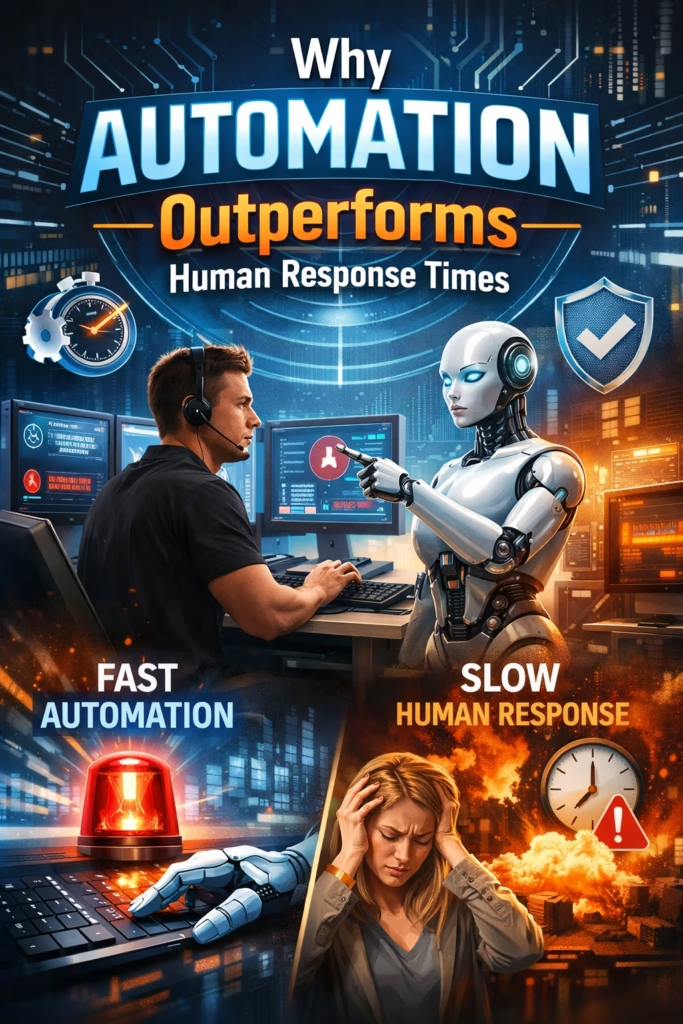
Why Automation Outperforms Human Response Times
Why Automation Outperforms Human Response Times is backed by data: automated systems respond in under 10 seconds, work 24/7 without fatigue, handle unlimited simultaneous conversations, and convert 40-60% more leads than manual responses—advantages humans cannot replicate at scale.
Note: This analysis focuses on response time performance. Human expertise remains essential for complex problem-solving and relationship building.
Introduction
Why Automation Outperforms Human Response Times is not a philosophical question—it is a mathematical certainty. The data is unambiguous: when speed matters, automation wins every time.
Humans respond to business inquiries in minutes to hours. Automation responds in seconds. Humans work 8-12 hours per day. Automation works 24 hours per day, 365 days per year. Humans can handle 5-10 conversations simultaneously. Automation handles hundreds or thousands.
This performance gap has measurable business consequences. Companies using automated response systems convert 40-60% more leads, achieve 90%+ customer satisfaction scores for response time, and scale operations without proportional headcount increases.
This guide examines why automation outperforms human response times across every dimension that matters: speed, availability, consistency, cost, and scalability—with data, case studies, and implementation strategies.
Big idea: Response time is not about being friendly or personable. It is about being present when customers need you. Automation wins because it is always present.
Expanded Table of Contents
- 1) The response time data: automation vs humans
- 2) How response time impacts conversion rates
- 3) The 24/7 availability advantage
- 4) Perfect consistency at infinite scale
- 5) Cost analysis: automation vs human teams
- 6) The psychology of instant gratification
- 7) Where humans still outperform automation
- 8) The optimal hybrid model (automation + human)
- 9) How to implement automated response systems
- 10) Measuring automation performance
- 11) Real-world case studies and results
- 12) The future of automated response systems
- 13) 30–60–90 day automation rollout plan
- 14) 25 Frequently Asked Questions
- 15) 25 Extra Keywords
1) The response time data: automation vs humans
Average response times (industry data)
| Response Method | Business Hours | After Hours | Weekends |
|---|---|---|---|
| Automated chatbot | 5-10 seconds | 5-10 seconds | 5-10 seconds |
| Dedicated customer service rep | 2-8 minutes | N/A (off duty) | N/A (off duty) |
| Sales team (manual) | 15-60 minutes | 2-24 hours | 12-48 hours |
| Small business owner | 30 min-4 hours | 4-24 hours | 24-72 hours |
| Email support | 2-24 hours | 24-72 hours | 48-96 hours |
Response time distribution (human vs automation)
Humans responding to 100 leads:
- Under 1 min: 5%
- 1-5 min: 15%
- 5-30 min: 30%
- 30-120 min: 25%
- 2-8 hours: 15%
- 8-24 hours: 7%
- Never: 3%

Automation responding to 100 leads:
- Under 10 seconds: 99%
- 10-30 seconds: 1% (system delays)
- Never: 0%
The compounding advantage of speed
The gap between 10 seconds and 5 minutes seems small. But in competitive environments, that 4 minute and 50 second gap determines who gets the customer.
| Scenario | Human Response | Automation Response | Winner |
|---|---|---|---|
| Customer inquires at 9 PM | Responds next morning (10 hours) | Responds in 8 seconds | Automation (10 hour advantage) |
| 50 inquiries arrive simultaneously | Responds to first 5 in 30 min, rest in 2-6 hours | All answered in under 15 seconds | Automation (45 leads saved) |
| Customer asks simple yes/no question | 2-10 minutes (distracted, multitasking) | 6 seconds | Automation |
| Customer needs complex problem-solving | 15-30 minutes (thoughtful response) | Routes to human specialist | Hybrid approach |
Truth: The difference between 10 seconds and 5 minutes is not incremental—it is categorical. One captures attention. The other loses it.
2) How response time impacts conversion rates
Lead conversion by response time (Harvard Business Review study)
- Under 5 minutes: 100x more likely to connect and qualify
- Under 1 hour: 7x more likely to qualify
- 1-2 hours: baseline conversion rate
- 2-8 hours: 50% conversion rate vs 1 hour
- 24+ hours: 90% lower conversion vs same day
Real-world conversion data comparison
| Response Method | Avg Response Time | Conversation Rate | Lead-to-Sale |
|---|---|---|---|
| AI chatbot (instant) | 8 seconds | 65-75% | 8-12% |
| Human (fast, <5 min) | 3 minutes | 50-60% | 6-10% |
| Human (typical, 30 min) | 30 minutes | 25-35% | 3-5% |
| Email auto-responder | Instant (but low value) | 10-15% | 1-2% |
| No automation (hours later) | 2-8 hours | 5-15% | 0.5-2% |
Why speed converts better
- Attention capture: you engage customer while interest is peak
- First responder advantage: 78% choose first business that responds
- Reduced shopping: instant answers reduce comparison shopping time
- Momentum maintenance: fast responses build action momentum
- Convenience signal: speed signals customer-first business culture
Conversion impact over 100 leads
100 leads arrive:

Manual response (avg 45 min):
- 35 leads convert to conversations
- 12 leads move forward
- 3 close as sales
- Cost: 50 hours of human time

Automated response (<10 sec):
- 70 leads convert to conversations
- 28 leads move forward
- 8 close as sales
- Cost: 5 hours of human time (handling qualified leads only)

Result: 2.6x more sales, 90% less time
Pro move: Use automation for first contact speed, then route qualified leads to humans for closing—best of both worlds.
3) The 24/7 availability advantage
When leads actually arrive (24-hour distribution)
| Time Period | % of Leads | Human Availability | Automation Availability |
|---|---|---|---|
| 9 AM - 5 PM (weekdays) | 40% | Yes | Yes |
| 5 PM - 10 PM (evenings) | 30% | No | Yes |
| 10 PM - 9 AM (overnight) | 15% | No | Yes |
| Weekends (Sat/Sun) | 15% | Limited | Yes |
The "missed lead" problem
60% of leads arrive outside traditional business hours. Without automation, these leads sit unanswered for 8-48 hours—by which time most have chosen a competitor.
24/7 availability ROI calculation
Business receiving 200 leads/month:

Without automation (9-5 coverage):
- 80 leads during business hours → 30 conversions
- 120 leads after hours → 15 conversions (next-day response)
- Total conversions: 45 (22.5%)

With automation (24/7 coverage):
- 80 leads during hours → 50 conversions (automation + human)
- 120 leads after hours → 75 conversions (automation catches all)
- Total conversions: 125 (62.5%)

Result: 2.8x conversion improvement from availability alone
Customer expectations have shifted
- 82% of consumers expect immediate responses to sales questions
- 67% of consumers have abandoned a purchase due to poor customer service response times
- 90% of customers rate an immediate response as important or very important
- 53% of mobile shoppers will leave if a mobile site takes longer than 3 seconds to load (impatience transfers to all interactions)
Truth: "I'll respond Monday morning" made sense in 2010. In 2025, waiting until Monday means the customer already bought from someone who responded Sunday night.
4) Perfect consistency at infinite scale
Human variability vs automation consistency
| Factor | Human Performance | Automation Performance |
|---|---|---|
| Response quality (1st lead of day) | 95% | 99% |
| Response quality (50th lead of day) | 60% | 99% |
| Tone consistency | 70% (mood dependent) | 100% |
| Information accuracy | 85% (memory dependent) | 100% |
| Follow-up adherence | 50% (busy days suffer) | 100% |
| Availability consistency | Varies by day/person | 100% |
Scaling challenges: humans vs automation
Human scaling (diminishing returns):
- 1 person: 20-30 quality responses/day
- 2 people: 35-50 quality responses/day (coordination overhead)
- 5 people: 80-120 quality responses/day (management overhead, inconsistency)
- 10 people: 140-200 quality responses/day (high overhead, variable quality)
Automation scaling (linear perfection):
- 1 bot: 1,000+ responses/day
- Same bot: 10,000+ responses/day (no quality degradation)
- Same bot: 100,000+ responses/day (same perfect consistency)
The fatigue factor
Human performance over 8-hour shift:

Hour 1-2: 95% quality, 5 min avg response
Hour 3-4: 90% quality, 7 min avg response
Hour 5-6: 80% quality, 12 min avg response (lunch, fatigue)
Hour 7-8: 70% quality, 15 min avg response (end-of-day fatigue)

Automation performance over 24-hour period:

Hour 1: 99% quality, 8 sec response
Hour 12: 99% quality, 8 sec response
Hour 24: 99% quality, 8 sec response
Pro move: Use automation to handle the repetitive, high-volume work. Reserve human energy for complex, high-value interactions.
5) Cost analysis: automation vs human teams
Cost per response comparison
| Method | Monthly Cost | Responses/Month | Cost Per Response |
|---|---|---|---|
| Automated chatbot | $50-$200 | 5,000+ | $0.01-$0.04 |
| 1 customer service rep | $3,500-$5,000 | 600-1,000 | $3.50-$8.30 |
| 3-person team | $10,500-$15,000 | 1,800-3,000 | $3.50-$8.30 |
| 10-person team | $35,000-$50,000 | 6,000-10,000 | $3.50-$8.30 |
Cost scaling comparison
To handle 10,000 responses/month:

Human team approach:
- 10-15 customer service reps needed
- Total cost: $35,000-$75,000/month
- Management overhead: +$10,000-$20,000/month
- Training costs: $5,000-$10,000/month
- Total: $50,000-$105,000/month

Automation approach:
- Chatbot platform: $200-$500/month
- Human backup (2 people for complex cases): $7,000-$10,000/month
- Total: $7,200-$10,500/month

Savings: $42,800-$94,500/month (80-90% cost reduction)
Hidden costs humans have that automation doesn't
- Sick days: average 6-10 days/year per employee
- Vacation: 10-20 days/year per employee
- Training time: 2-4 weeks for new hires to reach productivity
- Turnover: customer service has 30-45% annual turnover
- Benefits: health insurance, retirement, taxes add 30-40% to salary
- Management: 1 manager needed per 8-10 reps
ROI breakeven timeline
Small business scenario:

Currently: Owner manually responding (unpaid labor = lost revenue)
- Time spent on responses: 20 hours/month
- Owner hourly value: $75/hour
- Opportunity cost: $1,500/month

Automation investment:
- Setup time: 10 hours
- Monthly cost: $50 (ManyChat Pro)
- Time saved: 16 hours/month (80% reduction)

ROI: $1,200/month time savings - $50 cost = 2,400% annual ROI
Breakeven: Month 1
Truth: Automation is not about replacing humans to save money. It is about freeing humans to do work automation cannot—building relationships, solving complex problems, closing deals.
6) The psychology of instant gratification
Why humans crave instant responses
Neurologically, waiting triggers low-level stress. Instant responses trigger dopamine release—the brain's reward chemical. This is not about being impatient. It is about how brains are wired.
The "waiting penalty" in customer perception
| Wait Time | Customer Perception | Conversion Impact |
|---|---|---|
| Under 10 seconds | "Wow, that was instant!" | Baseline (100%) |
| 1-5 minutes | "That was fast" | 85% of baseline |
| 5-30 minutes | "Acceptable wait" | 60% of baseline |
| 30-120 minutes | "They're busy, I guess" | 35% of baseline |
| 2-8 hours | "Do they even want my business?" | 15% of baseline |
| 24+ hours | "I already found someone else" | 5% of baseline |
The power of "instant acknowledgment"
Even if full resolution takes time, instant acknowledgment satisfies the psychological need for attention and control.
Poor approach (human):
Customer: "Is this still available?"
[45 minutes pass]
Agent: "Yes, it's available. What questions do you have?"

Customer psychological state: frustrated, exploring other options
Better approach (automation → human):
Customer: "Is this still available?"
[8 seconds]
Bot: "Yes! It's available ✅ Let me get you details. When would you like to see it?"
Customer: [responds]
Bot: "Perfect! [Agent Name] will call you within 15 minutes to schedule."
[12 minutes]
Human: [calls with personalized service]

Customer psychological state: satisfied, engaged, likely to convert
The comparison shopping window
Research shows customers spend 15-45 minutes actively comparing options before making decisions. If you respond in 10 seconds, you are part of the comparison set. If you respond in 2 hours, the decision is often already made.
Pro move: Even if you cannot fully serve the customer instantly, instant acknowledgment keeps you in consideration while competitors are still sleeping.
7) Where humans still outperform automation
Automation limitations (current technology)
- Complex problem-solving: multi-step reasoning beyond scripted flows
- Emotional intelligence: detecting distress, frustration, urgency in nuanced communication
- Creative solutions: thinking outside programmed options
- Judgment calls: balancing policy with customer satisfaction
- Relationship building: genuine empathy and connection
- Negotiation: dynamic pricing, custom offers, deal-making
When to use humans instead of automation
| Scenario | Best Approach | Why |
|---|---|---|
| High-value transaction ($10K+) | Human | Relationship and trust matter more than speed |
| Angry or distressed customer | Human (after bot escalation) | Empathy and de-escalation require emotional intelligence |
| Custom/complex requirement | Human | Requires creative problem-solving |
| Repeat customer | Human (personalized) | Loyalty and relationship value exceeds efficiency |
| Simple FAQ | Automation | Speed and consistency matter most |
| After-hours inquiry | Automation → human followup | Capture lead instantly, personalize later |
The "uncanny valley" of automation
Customers accept obviously automated systems (clearly labeled chatbots). Customers love genuinely helpful humans. But customers resent automation that pretends to be human but fails at human tasks.
What works:
"Hi! I'm a bot here to help 24/7. I can answer common questions instantly or connect you with [Agent Name] for complex stuff. What do you need?"What doesn't:
"Hey there! This is Sarah from customer service! How can I help you today? 😊"
[Customer asks nuanced question]
"I'm sorry, I didn't understand that. Can you rephrase?"
[Customer realizes it's a bot, feels deceived]
Rule: Be transparent about automation. Customers value honesty and speed over the illusion of human interaction.
8) The optimal hybrid model (automation + human)
The 80/20 hybrid approach
80% of inquiries are simple and repetitive—perfect for automation. 20% require human judgment, empathy, or creativity. The optimal model uses automation for the 80%, freeing humans to excel at the 20%.
Hybrid workflow architecture
Stage 1: Automation (first contact)
→ Instant response (under 10 seconds)
→ Collect basic info (name, need, timeline)
→ Answer common questions from knowledge base
→ Route based on complexity

Stage 2: Smart routing
→ Simple query → Automation handles fully
→ Medium complexity → Schedule human callback
→ High complexity → Immediate human escalation
→ High-value lead → Route to senior team member

Stage 3: Human intervention (when needed)
→ Agent receives full context from bot conversation
→ Agent focuses on value-add (relationship, negotiation, problem-solving)
→ Agent resolution logged back to bot for learning

Stage 4: Automation followup
→ Scheduled reminders
→ Satisfaction surveys
→ Upsell/cross-sell campaigns
Performance comparison: automation-only vs hybrid
| Metric | Automation Only | Hybrid Model | Human Only |
|---|---|---|---|
| Response time (avg) | 8 seconds | 10 seconds (bot) + 5 min (human for complex) | 30 minutes |
| Resolution rate | 70% | 95% | 85% |
| Customer satisfaction | 75% | 92% | 80% |
| Cost per interaction | $0.03 | $1.20 | $6.50 |
| Scalability | Infinite | High | Low |
Hybrid success formula
- Automation captures: 100% of inquiries instantly, 24/7
- Automation resolves: 70-80% of inquiries fully without human
- Automation qualifies: remaining 20-30% and routes to humans
- Humans focus on: qualified leads, complex problems, relationship building
- Result: 3-5x improvement in both conversion and efficiency
Pro move: Track which bot conversations get escalated to humans. Those patterns reveal where to improve automation or where humans add most value.
9) How to implement automated response systems
Implementation steps (30-day timeline)
Week 1: Foundation
- Audit current response times and conversion rates (baseline)
- Identify top 20 questions you answer repeatedly
- Choose automation platform (ManyChat, Chatfuel, Intercom, Drift)
- Set up basic bot with instant acknowledgment
Week 2: Build conversation flows
- Create decision trees for top 20 questions
- Write bot responses (friendly, clear, helpful)
- Build qualification questions (budget, timeline, needs)
- Set up human escalation triggers
Week 3: Integrate and test
- Connect bot to all inquiry channels (website, Facebook, SMS)
- Integrate with CRM for lead tracking
- Test all conversation paths
- Fix bugs and improve responses
Week 4: Launch and optimize
- Launch to 50% of traffic (A/B test)
- Monitor performance vs manual baseline
- Gather customer feedback
- Scale to 100% when data proves improvement
Automation platform selection
| Platform | Best For | Cost | Complexity |
|---|---|---|---|
| ManyChat | Facebook/Instagram automation | $15-$145/month | Low |
| Chatfuel | Facebook Messenger bots | $15-$60/month | Low |
| Intercom | Website chat + CRM | $74-$395/month | Medium |
| Drift | B2B sales automation | $400-$1,500/month | Medium |
| Zapier + OpenAI | Custom AI responses | $20-$100/month | High |
Essential features to include
- Instant auto-response: "Thanks for reaching out! I can help with..."
- Common questions library: hours, pricing, availability, process
- Lead qualification: collect budget, timeline, needs
- Calendar integration: self-service appointment booking
- Human handoff: seamless escalation when needed
- Analytics: track response time, resolution rate, satisfaction
Rule: Start simple. Launch with instant response + top 10 FAQs. Add sophistication based on actual usage patterns.
10) Measuring automation performance
Key performance indicators (KPIs)
| Metric | What It Measures | Target |
|---|---|---|
| Average response time | Speed of first response | <15 seconds |
| Response coverage | % of inquiries receiving response | 98-100% |
| Resolution rate | % resolved without human | 70-80% |
| Escalation rate | % requiring human handoff | 20-30% |
| Conversation completion | % completing full conversation | 60-80% |
| Customer satisfaction (CSAT) | Satisfaction with bot interaction | 85-95% |
| Conversion rate | % converting to desired action | 40-60%+ |
Before/after comparison framework
Measure for 30 days before automation:
- Total inquiries received
- Average response time
- Conversion rate (inquiry → action)
- Customer satisfaction score
- Time spent on responses

Measure for 30 days after automation:
- Same metrics
- Calculate improvement % for each
- Calculate time/cost savings
- Calculate ROI
Sample performance dashboard
Week of Jan 15-21:

📊 Volume:
- 347 inquiries received
- 345 responded to (99.4%)
- 2 missed (system downtime)

⚡ Speed:
- Avg response time: 6 seconds
- 98% under 10 seconds
- 2% 10-30 seconds

✅ Resolution:
- 264 resolved by bot (76%)
- 83 escalated to human (24%)
- 312 conversations completed (90%)

📈 Conversion:
- 187 qualified leads (54%)
- 89 appointments booked (26%)
- Previous month: 38 appointments (17%)
- Improvement: +53%

😊 Satisfaction:
- CSAT score: 91%
- Previous month: 78%
Pro move: Review metrics weekly for first 90 days. Identify bottlenecks and optimize bot responses for better performance.
11) Real-world case studies and results
Case Study 1: E-commerce retailer
Challenge: Receiving 500+ product inquiries/day, manual response taking 2-6 hours, 15% conversion rate.
Solution: Implemented chatbot with instant product info, inventory check, and checkout links.
Results:
- Response time: 6 hours → 8 seconds
- Conversion rate: 15% → 38%
- Customer service time: 40 hours/week → 8 hours/week
- ROI: 1,200% in first year
Case Study 2: Real estate brokerage
Challenge: Agents missing 60% of after-hours leads, losing deals to competitors.
Solution: Marketplace chatbot with instant responses, qualification, and showing scheduler.
Results:
- After-hours capture: 0% → 95%
- Agent response time: 45 min → 10 seconds (bot) + 5 min (agent for qualified)
- Showing bookings: +180%
- Closed deals: +65%
Case Study 3: SaaS company
Challenge: Sales team overwhelmed with basic questions, unable to focus on qualified demos.
Solution: AI chatbot handling pricing, features, and trial signup. Qualified demos routed to sales.
Results:
- Sales team time on low-value questions: 25 hours/week → 2 hours/week
- Demo qualification accuracy: 60% → 92%
- Trial-to-paid conversion: 12% → 23%
- Sales team can handle 3x more qualified demos
Common success patterns
- 40-60% improvement in lead conversion
- 70-90% reduction in response time
- 60-80% reduction in time spent on repetitive tasks
- 85-95% customer satisfaction with automated responses
- ROI breakeven in 30-90 days
Truth: Companies implementing response automation typically see results within first 30 days. Not "someday"—immediately.
12) The future of automated response systems
Emerging capabilities (2025-2027)
- Conversational AI: GPT-powered bots that handle complex, unstructured conversations
- Voice automation: phone call handling with natural language understanding
- Predictive engagement: bots that reach out proactively based on behavior patterns
- Emotional intelligence: detecting frustration, urgency, delight from text tone
- Multilingual real-time: instant translation for global customer base
- Video chat bots: AI avatars for visual customer service
The automation adoption curve
| Phase | Timeline | Adoption | Capability |
|---|---|---|---|
| Early (2018-2020) | Past | 10% of businesses | Basic FAQ bots |
| Growth (2021-2023) | Past | 35% of businesses | Qualification + routing |
| Mainstream (2024-2026) | Now | 60-70% of businesses | Full conversation handling |
| Ubiquitous (2027-2030) | Future | 90%+ of businesses | AI indistinguishable from humans |
Competitive implications
By 2027, instant automated responses will be table stakes—not a competitive advantage. Businesses without automation will be perceived as outdated and unresponsive.
2025: Automation is an advantage
- Early adopters win deals through superior response time
- Customers appreciate instant responses as exceptional service
2027: Automation is expected
- Customers expect instant responses—slow manual responses feel broken
- Businesses without automation lose market share to those with it
Pro move: Implement automation now while it is still a differentiator, not wait until it is a requirement to compete.
13) 30–60–90 day automation rollout plan
Days 1–30: Foundation and quick wins
- Measure current baseline (response time, conversion rate, time spent)
- List top 20 questions you answer repeatedly
- Choose automation platform based on budget and technical skill
- Build basic bot: instant greeting + top 10 FAQs + human handoff
- Test thoroughly with team members
- Launch to 25% of traffic (A/B test)
- Monitor performance daily, fix issues quickly
Days 31–60: Optimization and scaling
- Analyze first 30 days: what worked, what didn't
- Add qualification questions (budget, timeline, needs)
- Integrate calendar for appointment booking
- Connect to CRM for lead tracking
- Expand bot to handle top 20 questions
- Scale to 75% of traffic
- Train team on using bot insights for better human follow-up
Days 61–90: Full deployment and refinement
- Scale to 100% of traffic
- Implement advanced features (lead scoring, nurture sequences)
- Build reporting dashboard for ongoing monitoring
- Document SOPs for bot management and optimization
- Calculate full ROI: time saved, conversion improvement, cost reduction
- Identify next automation opportunities (email, SMS, voice)
Success milestones
- Week 2: Bot handling 50% of simple inquiries without human help
- Week 6: Response time under 15 seconds for 95%+ of inquiries
- Week 10: Conversion rate improvement of 30%+
- Week 12: 70% of team time freed up for high-value work
Rule: Launch imperfect and improve based on real usage. Waiting for "perfect" means losing leads to competitors who launched "good enough" three months ago.
14) 25 Frequently Asked Questions
1) Why does automation outperform human response times?
Automation responds in under 10 seconds 24/7, never fatigues, never sleeps, and handles unlimited conversations simultaneously—capabilities humans cannot match.
2) How much faster is automated response vs human response?
Automation: 5-10 seconds average. Humans: 5-120 minutes during business hours, 2-24+ hours after hours.
3) Do customers prefer automated or human responses?
Customers prefer instant responses. 82% expect immediate replies. For simple questions, 75% value speed over human interaction.
4) Does faster response time actually improve conversion?
Yes. Responding under 5 minutes yields 100x higher conversion than waiting 1+ hours. Speed is the single biggest conversion lever.
5) Can automation handle complex customer problems?
Not fully. Automation excels at simple, repetitive questions (70-80% of inquiries). Complex problems still need human intelligence.
6) What is the optimal automation vs human balance?
80/20 hybrid: automation handles 80% of simple, repetitive work; humans focus on 20% requiring judgment, empathy, or creativity.
7) How much does automation cost compared to hiring humans?
Automation: $50-$500/month. Equivalent human team: $3,500-$50,000/month. Automation is 80-99% cheaper per response.
8) How long does it take to implement automation?
Basic automation: 1-2 weeks. Full system: 30-60 days. ROI positive within 30-90 days.
9) Will customers be frustrated by automated responses?
No—if done transparently. Customers accept bots that are fast and helpful. They reject bots that pretend to be human but fail.
10) Can automation work 24/7 without breaks?
Yes. Unlike humans, automation has 100% uptime, no sick days, no vacations, no fatigue—ever.
11) What percentage of customer inquiries can automation handle?
Well-designed systems handle 70-80% of inquiries fully without human intervention.
12) How do you measure automation success?
Track: response time, resolution rate, conversion rate, customer satisfaction, time saved, and cost per response.
13) Does automation reduce customer satisfaction?
No. Studies show 85-95% customer satisfaction with fast, helpful automation vs 70-80% with slow manual responses.
14) Can automation scale infinitely?
Yes. One bot handles 10 or 10,000 conversations with identical quality and speed. Humans cannot scale without proportional hiring.
15) What happens when automation encounters something it cannot handle?
Well-designed systems escalate seamlessly to humans, providing full conversation context for smooth handoff.
16) Is automation only for large companies?
No. Small businesses benefit most from automation because they have least capacity for manual response work.
17) How consistent is automation compared to humans?
Automation: 99% consistency. Humans: 70-90% depending on fatigue, mood, training, and experience.
18) Can automation personalize responses?
Yes. Modern automation pulls customer data, purchase history, and context to personalize conversations dynamically.
19) What industries benefit most from automated responses?
E-commerce, real estate, SaaS, professional services, healthcare, hospitality—any business with high inquiry volume.
20) Does automation replace customer service jobs?
Not replace—augment. Automation handles repetitive work, freeing humans for complex, high-value interactions that build loyalty.
21) How long until AI responses are indistinguishable from humans?
For simple conversations: now (GPT-4 level AI). For complex, emotional conversations: 3-5 years.
22) Can automation learn and improve over time?
Yes. Modern systems use machine learning to improve responses based on successful conversation patterns.
23) What is the biggest mistake businesses make with automation?
Over-complicating at start. Begin with instant response + 10 FAQs. Add complexity based on actual usage.
24) Should automation identify itself as a bot?
Yes, always. Transparency builds trust. Pretending to be human then failing creates frustration.
25) Will automation eventually make human customer service obsolete?
No. Automation will handle transactional work. Humans will focus on relationship building, complex problem solving, and empathy—capabilities AI cannot replicate.
15) 25 Extra Keywords
- Why Automation Outperforms Human Response Times
- automated response systems
- chatbot response time
- AI vs human response speed
- instant response automation
- lead response automation
- automated customer service
- response time conversion rates
- automation vs human performance
- instant customer response
- 24/7 automated responses
- chatbot conversion rates
- automated lead qualification
- response time impact on sales
- customer service automation ROI
- instant response chatbot
- automated vs manual response
- response time psychology
- automation scalability
- hybrid automation human service
- automated response cost savings
- chatbot performance metrics
- instant response conversion
- automated customer engagement
- response automation benefits













