
Market Wiz AI

Uncategorized

Turn Your Inbox into a Sales Machine for Jewelry Stores with AI
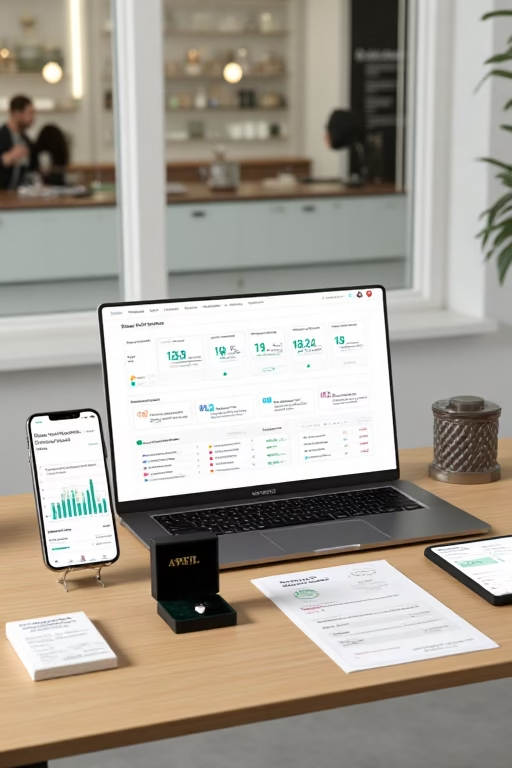
Acutting e 4013739086 12 50 58
Turn Your Inbox into a Sales Machine for Jewelry Stores with AI (2025 Guide)

Turn Your Inbox into a Sales Machine for Jewelry Stores with AI

Capture every bridal, custom, repair, and appraisal inquiry—then book, quote, and collect deposits faster.

Introduction

Turn Your Inbox into a Sales Machine for Jewelry Stores with AI is more than a slogan—it's a compact, repeatable system that transforms chaotic emails into scheduled appointments, approved designs, and paid invoices. In jewelry retail, moments matter: proposal deadlines, anniversary dates, heirloom repairs, insurance appraisals. AI helps you triage, personalize, and move every thread toward a clear next step—without sounding robotic.

Benchmarks to aim for: First reply ≤ 60 seconds (during hours) Lead → appointment ≥ 55% Quote → deposit ≥ 35% No-show ≤ 12% 12–20 new Google reviews/month

We’ll naturally reference the focus phrase—Turn Your Inbox into a Sales Machine for Jewelry Stores with AI—throughout for strong topical relevance.

Table of Contents

1) Why Email Is the Hidden Goldmine for Jewelers

1.1 Bridal, Custom, Repair, Appraisal = High Intent

Inbox messages often include timelines (“proposal in 3 weeks”), budgets, and inspiration photos. That’s buying intent—don’t let it idle.

1.2 Speed Beats Price

The first credible reply that sets a next step usually wins. AI drafts that reply in seconds and offers two times to meet.

1.3 AI + Human, Not AI vs. Human

AI handles triage, reminders, and documentation; your team handles taste, trust, and design advice.

2) The Inbox-to-Revenue Blueprint

2.1 Triage & Tagging

  • Auto-detect intent: bridal, custom, repair, appraisal, gift, aftercare.
  • Extract fields: timeline, budget band, metal preference, stone specs, ring size (if stated), city.

2.2 Snippets & Templates

  • Insertable blocks for diamond education, sizing, production timelines, financing disclosures, and care.

2.3 Calendar Booking & Holds

  • Offer two time options, then confirm with an .ics invite and a T-24 / T-2 / T-30m reminder sequence.

3) Core AI Flows for Jewelry Stores

3.1 Bridal Inquiry → Design Consult

AI replies in under a minute, asks for ring size, center stone preference, and timeline, then offers two consult slots and a link to a mood board questionnaire.

3.2 Custom Design → CAD Approval → Deposit

  • Send CAD images and a simple approve/revise button.
  • On approve, trigger deposit link and production timeline.

3.3 Repair Intake → Quote → Ready-for-Pickup

  • AI collects photos, issue description, sentimental notes.
  • Once quoted, a pay link or approval button moves the job to bench.
  • “Ready” emails include care tips and optional review link.

3.4 Appraisal Booking → Documentation

Auto-sends a checklist (photos, prior paperwork), books the appointment, and prepares a file stub for the final PDF.

3.5 Event & Trunk Show RSVP

Segment past buyers and nudge VIPs; confirm attendance and hold private preview slots.

4) Emails That Sell Without Sounding Salesy

Bridal “First Reply”

“Thanks for reaching out—congratulations! To get you a perfect fit on timeline and budget: do you prefer lab-grown or natural for the center stone, and what’s your target date? I can hold Thu 5:30 or Sat 10:00 for a design consult.”

Custom CAD Handoff

“Attached are your CAD views (top, side, gallery). Tap Approve to start casting, or Request a Tweak and note changes—shoulders, prong style, or height.”

Repair Quote

“For your heirloom ring: prong re-tip + polish, 3–5 days. Total $___ + tax. Approve with one click and we’ll reserve bench time.”

Appraisal Booking

“Appraisals run 30–45 minutes per piece. I can hold Tue 2:30 or Thu 11:00. Please bring prior paperwork if you have it.”

This tone helps Turn Your Inbox into a Sales Machine for Jewelry Stores with AI while staying warm and human.

5) Tech Stack: CRM, Calendar, Payments, Files

  • CRM: tracks stages (New → Consult → Quote → Deposit → In Production → Ready → Delivered → Review).
  • Calendar: shared availability per associate; auto-invites + reminders.
  • Payments: secure deposit links (ACH/card) with clear terms; partial payments for custom work.
  • Files: centralized CAD, photos, appraisals; share view-only links in email.

6) Google Business + Inbox: Messages, Q&A, Reviews

  • Enable Messages; auto-reply asks “occasion + timeline” and offers two appointment times.
  • Seed Q&A with education (“lab vs natural,” “resize time”). Link to email for longer threads.
  • After delivery or repair, trigger a one-tap review link—no gating.

7) Automations: Sequences, Nudges & Safeguards

  • Nudges: CAD approval reminders at 48h and 7d; repair pickup reminders with hours & parking.
  • Safeguards: quiet hours, opt-out language, escalation when questions exceed preset confidence.
  • Aftercare: cleaning check-ins at 90 days; resize follow-up if needed.

8) KPIs & Dashboards You’ll Actually Check

  • Speed-to-first-reply, appointment rate, show rate, quote-to-deposit, production cycle time, review velocity.
  • Attribute revenue by source (Maps, email, social) using UTMs and unique call tracking.

9) Multi-Store & Team Workflows

  • Route by store, language, or product specialty (bridal, custom, watches).
  • Shared inbox views with ownership, SLAs, and internal notes.

10) 30–60–90 Day Rollout Plan

Days 1–30: Foundation

  1. Install shared inbox + CRM; turn on booking links and secure payment.
  2. Create 8 core templates (bridal, custom, repair, appraisal).
  3. Enable Messages on Google; add auto-reply and two-time holds.

Days 31–60: Scale

  1. Launch CAD approval flow + deposit links; start review engine.
  2. Publish education snippets; add photo proof to replies.

Days 61–90: Optimize

  1. A/B test subject lines, timing, and CTAs; refine handoffs and dashboards.

11) Troubleshooting: Slow Replies, Ghosting, Price Objections

  • Slow replies: add auto-ack + two times; highlight urgency (proposal date).
  • Ghosting: send a photo-led nudge and a lighter ask (“Would you like a budget-friendly option?”).
  • Price objections: restate materials, craftsmanship, warranty, resize & lifetime cleaning; offer financing facts (no promises).

Apply these and you’ll truly Turn Your Inbox into a Sales Machine for Jewelry Stores with AI.

12) 25 Frequently Asked Questions

1) Will AI replace my sales associates?

No. AI speeds triage and booking; your experts advise on taste, fit, and design.

2) How fast should AI reply?

Under 60 seconds during hours, with clear next steps and two time options.

3) Can AI handle diamond education?

Yes—provide concise 4Cs guidance and links to your in-depth page; escalate nuanced questions.

4) Is it safe to send deposit links by email?

Use secure, PCI-compliant processors; never request card details via plain email.

5) Can we automate CAD approvals?

Yes—approval buttons, revision notes, and automatic deposit requests on approve.

6) How do we avoid sounding robotic?

Humanize templates with names, occasion, timeline, and a warm sign-off.

7) What about repair quotes?

Collect photos, describe the fix, give a range with drivers, then a firm quote after bench review.

8) Can AI schedule appraisals?

Yes—send prep checklist, collect documents, book time, and create a file placeholder.

9) Do we need opt-in for email/SMS?

Yes—obtain consent, include opt-out, and respect quiet hours.

10) How can we reduce no-shows?

Send T-24/T-2/T-30m reminders, map pin, parking tips, and allow easy reschedule.

11) Can AI handle financing questions?

Provide factual options and a pre-qual link; avoid promising approvals.

12) How do we track revenue by source?

Use UTMs + unique call numbers; tie invoices to source in CRM.

13) Should we send price ranges in email?

Yes—“From $” with drivers (metal, stone, labor) prevents misalignment.

14) Can AI manage multi-store routing?

Yes—route by store, skill, or language; keep ownership visible.

15) How many templates do we need?

Start with 8: bridal first reply, custom intake, CAD approval, repair intake, repair quote, appraisal booking, event RSVP, review ask.

16) What if a customer emails after hours?

Auto-acknowledge, set expectations, and provide self-serve booking.

17) Can we attach large media safely?

Use cloud links with view permissions; avoid giant attachments.

18) Should designers have their own signatures?

Yes—build rapport and accountability; AI drafts, designer signs.

19) How do we solicit reviews ethically?

One-tap link after delivery or repair; no gating; reply to all reviews within 72 hours.

20) Can AI translate messages?

Yes—offer bilingual options and route to staff when nuance matters.

21) What KPIs matter most?

First reply time, appointment rate, deposit rate, production cycle time, review velocity.

22) Do photo-led replies help?

Absolutely—attach CADs, before/after repairs, or similar pieces to inspire confidence.

23) How do we handle price-matching?

Share your policy factually; ask for comparable specs; avoid blanket promises.

24) Is WhatsApp useful for jewelry?

Yes—great for international clients and quick photo exchanges.

25) First step to start today?

Enable a shared inbox, create 8 templates, turn on booking links, and set AI auto-acks with two time options.

13) 25 Extra Keywords

  1. Turn Your Inbox into a Sales Machine for Jewelry Stores with AI
  2. AI email assistant for jewelers
  3. bridal jewelry email automation
  4. custom ring CAD approval workflow
  5. jewelry repair intake form
  6. appraisal booking automation
  7. jeweler CRM pipeline stages
  8. diamond education email template
  9. lab-grown vs natural outreach
  10. proposal deadline jewelry consult
  11. deposit link custom jewelry
  12. Google Business messages for jewelers
  13. jewelry store review engine
  14. aftercare cleaning reminder
  15. ring sizing follow-up email
  16. VIP trunk show RSVP automation
  17. watch repair quote email
  18. heirloom restoration workflow
  19. insurance appraisal checklist
  20. bilingual jewelry sales emails
  21. UTM tracking jewelry inbox
  22. no-show reduction reminders
  23. photo-led jewelry replies
  24. multi-store jeweler routing
  25. 2025 jewelry AI playbook

© 2025 Market Wiz AI. All Rights Reserved.

Turn Your Inbox into a Sales Machine for Jewelry Stores with AI Read More »
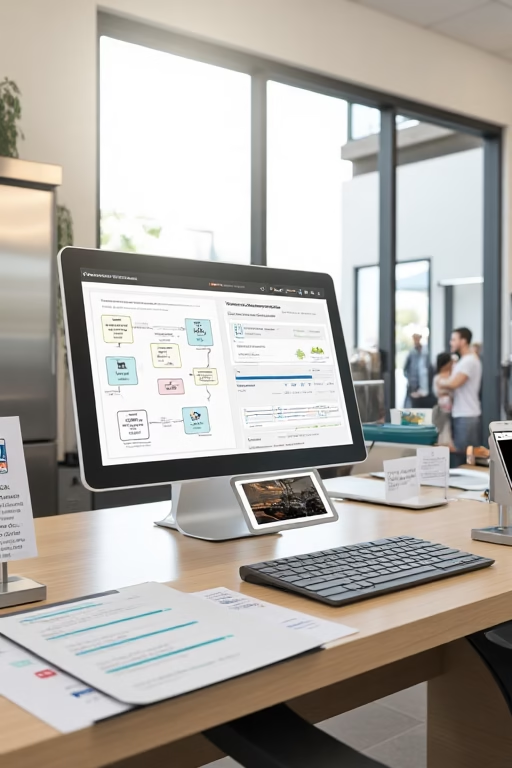
AI Follow-Up Bots Closing Sales for Appliance Stores

Acutting e 2790335067 12 49 20
AI Follow-Up Bots Closing Sales for Appliance Stores (2025 Playbook)

AI Follow-Up Bots Closing Sales for Appliance Stores

Capture every inquiry. Quote faster. Book delivery without phone tag.

Introduction

AI Follow-Up Bots Closing Sales for Appliance Stores isn’t hype—it’s the cleanest path to convert missed calls, price shoppers, and abandoned quotes into paid deliveries. In appliance retail, speed, stock accuracy, delivery windows, and financing options decide the sale. This guide shows how to deploy compliant SMS, chat, and email automations that feel human, protect your brand, and ship more units.

Benchmarks to aim for: Speed-to-first-reply ≤ 30s Lead → appointment ≥ 55% Cart/re-quote recovery ≥ 18% No-show ≤ 10–12% Reviews/month ≥ 12

You’ll see the phrase AI Follow-Up Bots Closing Sales for Appliance Stores naturally throughout this article for strong topical relevance.

Table of Contents

1) Why Follow-Up Bots Win in Appliance Retail

1.1 Speed-to-Lead Beats Price

When shoppers compare fridges or ranges, the first credible reply that confirms stock and delivery often wins—even at a slightly higher price.

1.2 Inventory, Delivery, Financing = Decisions

Appliance buyers need three answers: Is it in stock? When can you deliver? What will it cost me monthly? Bots deliver those answers in seconds.

1.3 Human + AI Handoff

Bots qualify and schedule; humans consult and close. The bot never guesses—when uncertain, it escalates with context.

2) Anatomy of a High-Converting Follow-Up Bot

2.1 Opt-In & Compliance

  • Collect consent for SMS/WhatsApp/email; always include opt-out language.
  • Respect quiet hours; throttle frequency; no review gating.

2.2 Intent Detection & Routing

  • Recognize intents: price check, stock check, delivery date, financing, warranty, service.
  • Route service/warranty to support; route commercial bids to sales desk.

2.3 Goals: Quote, Appointment, Checkout

  • Offer two appointment times, a firm delivery window, or a secure checkout link—whichever is closest to the buyer’s goal.

3) Channel Strategy (SMS, Email, Chat, WhatsApp)

  • SMS: fastest; use for missed calls, stock/ETA, delivery scheduling.
  • Email: long-form quotes, spec sheets, financing disclosures.
  • Website Chat: live + bot blend; capture number or email early.
  • WhatsApp/Messenger: great for international or social-origin leads.

4) Core Flows for Appliance Stores

4.1 Missed-Call Text Back

“Sorry we missed you—looking for the 27 cu ft counter-depth? I can check stock and delivery for Thu 2–5 pm or Sat 9–12. Which works?”

4.2 Quote Follow-Up & Price-Match Policy

Bot shares a secure quote link, clarifies model variants (finish, handles, depth), and explains your price-match rules without promising blanket approvals.

4.3 Financing Pre-Qualification

Offer a soft-pull pre-qual link with clear, factual language. Bot answers term/APR structure questions and books a call for details when needed.

4.4 Delivery Window Booking & Upsells

  • Offer two windows; collect stairs/haul-away info.
  • Upsell: water lines, gas kits, cord kits, stacking kits, surge protectors, extended care plans.

4.5 Abandoned Cart & Re-Quote Rescue

“Still deciding on the stainless slide-in? We reserved your price for 24 hours. Want help picking delivery or checking fit depth?”

4.6 Scratch-and-Dent & Open-Box Clearance

Geo-targeted messages: “Two open-box dishwashers with full warranty, 18% below new. Photos & cosmetic notes here.”

5) Message Templates That Don’t Sound Robotic

Price/Stock

“Great choice—Model QN65… We have 3 in stock. Want Fri PM delivery or Sat AM? I’ll hold your window.”

Fit Check

“Cabinet depth looks 24''. Your choice is 26 7/8''. Want a counter-depth alternative with 25'' depth to sit flush?”

Financing

“Most customers choose 12 or 24 months. I can text a soft-pull link—no obligation. Proceed?”

Service Routing

“I’m routing you to our service coordinator. Quick note: is the unit under 1-year manufacturer warranty or extended care?”

This human-first voice is the heart of AI Follow-Up Bots Closing Sales for Appliance Stores.

6) Tech Stack & Integrations (POS/ERP/Calendar/Phone)

  • Phone: missed-call detection → SMS trigger with model context.
  • POS/ERP: stock levels, serials, pricing, open-box flags, delivery fees.
  • Calendar: delivery and installer availability with rules (stairs, gas, haul away).
  • Payments: secure checkout links and deposit capture.
  • CRM: source tags (Maps, web, social), pipeline stages, attribution.

7) KPIs, Dashboards & Attribution

  • First-response time, reply rate, appointment rate, cart recovery %, delivery scheduled %, average order value.
  • Attribute revenue by channel using UTMs and unique tracking numbers.

8) Local SEO Assist: Bots + Google Business Profile

  • Enable Messages with an auto-reply offering two delivery windows.
  • Product cards for best-sellers with “From $” ranges and clear install add-ons.
  • Weekly posts: fit guides, panel-ready explainers, care plan FAQs.

9) Review Engine & Care After Delivery

  • Ask after successful install; include a quick maintenance tip and one-tap review link.
  • No gating; respond to every review within 72 hours, mentioning model and city.

10) Quality, Safety & Brand Guardrails

  • Never provide repair instructions that could risk safety—route to certified techs.
  • Use factual, non-deceptive financing language; do not promise approval.
  • Escalate complex questions to humans with full chat history attached.

11) 30–60–90 Day Rollout Plan

Days 1–30 (Foundation)

  1. Turn on missed-call SMS; publish 6 product cards; enable Messages on Google.
  2. Map intents and build flows for stock, delivery, financing, and re-quotes.

Days 31–60 (Scale)

  1. Integrate inventory/ERP; add calendar rules; launch cart rescue & open-box alerts.
  2. Start review engine; add UTM tracking and unique call numbers.

Days 61–90 (Optimize)

  1. A/B test voice/timing; refine upsells; expand to WhatsApp or Messenger.
  2. Publish dashboards; coach staff on AI-to-human handoffs.

12) Troubleshooting: Low Replies, Stalled Carts, Price Objections

  • Low replies: shorten first message, offer two concrete delivery windows, add opt-out language.
  • Stalled carts: send fit/depth check and delivery ETA; clarify haul-away and install fees.
  • Price objections: restate value (install, haul-away, warranty), mention lawful price-match policy, offer financing link.

With these fixes, AI Follow-Up Bots Closing Sales for Appliance Stores becomes a repeatable revenue engine.

13) 25 Frequently Asked Questions

1) Do follow-up bots replace sales reps?

No—bots handle speed, reminders, and scheduling; reps advise and close.

2) What channels work best?

SMS for speed, email for quotes/specs, chat for website visitors, WhatsApp for social/international leads.

3) How fast should the first reply be?

Under 30 seconds for SMS/chat; under 2 minutes

AI Follow-Up Bots Closing Sales for Appliance Stores Read More »

2025 marketing tools for building companies companies

Acutting e 2111157166 18 15 15
2025 Marketing Tools for Building Companies Companies Make with Google Business (Full Playbook)

2025 Marketing Tools for Building Companies Companies Make with Google Business

Win the Map Pack, capture every call, and book jobs faster—without adding headcount.

Introduction

2025 marketing tools for building companies companies Make with Google Business is more than a keyword—it’s your blueprint to own local search, automate follow-ups, and attribute every booked job back to the touchpoint that won it. In this playbook you’ll assemble a lean, modern stack that helps general contractors, remodelers, and specialty trades turn Google views into signed proposals.

Targets to aim for: Map calls/messages ↑ 35–60% Lead → booked estimate ≥ 50% No-show ≤ 12% 15–30 new reviews/month

We’ll naturally reference the focus phrase—2025 marketing tools for building companies companies Make with Google Business—across the guide for on-page relevance.

Table of Contents

1) The 2025 Minimalist Stack for Builders

1.1 Google Business Profile (GBP) Essentials

  • Primary category aligned to your core trade; honest service list; product cards for common jobs (“Bathroom Remodel — From $X”).

1.2 Call Tracking & Missed-Call SMS

  • Unique numbers per channel; missed calls trigger an instant text offering two estimate times.

1.3 CRM + Pipeline + Proposals

  • Stages: New lead → Qualified → Estimate Booked → Proposal Sent → Won/Lost. E-sign + deposits when appropriate.

1.4 Review Engine & Reputation

  • Branded short review link + QR on trucks, invoices, and follow-ups; response within 72h.

1.5 AI Follow-Up & Appointment Booking

  • DM/SMS replies in seconds; captures zip, scope, photos; holds times on your calendar automatically.

2) Google Business Profile That Ranks & Converts

2.1 Categories, Services, Products

  • Services: site prep, framing, drywall, roofing, permits guidance (no legal guarantees).
  • Products: “Kitchen Remodel – From $XXk,” “Roof Replacement – From $X/sq,” “ADU Build – From $XXXk.”

2.2 Photos, Captions, and Posts

  • Upload 3–5 photos weekly: demo → framing → finish; captions with city + specs.
  • Posts: timeline explainer, material choices, safety checklist, before/after reels.

2.3 Messaging Scripts + Booking Links

Auto-greet: “Zip + brief scope? I can hold Thu 4:30 or Sat 10:00 for a site visit.” Include a booking URL with UTMs.

3) Lead Capture Flows that Builders Actually Need

3.1 Tap-to-Call & Chat

Put call and chat fixed on mobile. First response in < 60s changes everything.

3.2 Estimate Request Form (5 Fields Max)

  • Name, phone, zip, service, photo upload. That’s it. Speed beats perfection.

3.3 “Send Photos of Your Project” Flow

Customers attach photos/video; AI tags: interior/exterior, sqft guess, urgency.

4) AI Follow-Up & Scheduling (Fast, Policy-Safe)

4.1 Two-Option Time Holds

Suggest two realistic slots; if neither works, offer the next two automatically.

4.2 Qualification: Zip, Scope, Budget Band

  • Collect zip, project type, timeline, photos. Tag “budget: starter/standard/premium.”

4.3 Reminders & Rescheduling

  • T-24 / T-2 / T-30m reminders with map pin and reschedule link; optional refundable holds for site visits.

This section anchors 2025 marketing tools for building companies companies Make with Google Business to real-world automation.

5) Review Velocity with Zero Gating

5.1 QR/NFC Assets

Truck decals, estimate PDFs, job-site signs—each with a branded review link.

5.2 SMS + Email Sequences

Ask at “wow” moments (cleanup reveal). Follow up next day with a photo reminder.

5.3 Response Playbook

Name the project, city, and crew; invite offline for issues; update reply after resolution.

6) Content that Wins Local Intent

6.1 City/Service Pages

“Kitchen Remodeler in {City}” pages with local photos and review snippets.

6.2 Photo Proof Libraries

Sort by material, price band, timeline; include cost drivers.

6.3 Cost & Timeline Explainers

Short explainers reduce tire-kickers and boost conversion quality.

7) Ads You Can Actually Measure

7.1 Local Services Ads (LSA)

Backstop organic. Track booked estimates and wins in CRM stages.

7.2 Click-to-Message Campaigns

Send prospects straight into AI scheduling with two-option holds.

7.3 Retargeting with Proof Assets

Before/after carousels, review screenshots, and timeline infographics.

8) Ops Integrations (Calendar, Routing, Docs)

  • Calendar sync for estimators; radius routing for clustered jobs; e-sign proposals and file in the CRM.

9) KPIs & Attribution (UTMs Done Right)

  • Views → calls/messages → booked estimates → proposals → won jobs → reviews.
  • UTMs on every GBP link/post/product; unique call numbers per channel with outcome tags.

10) 30–60–90 Day Rollout Plan

Days 1–30: Foundation

  1. Fix GBP categories/services/products; enable messages + call tracking.
  2. Add booking link with UTMs; upload 30 proof photos; seed 6 Q&A.
  3. Deploy 5-field estimate form + photo upload; switch on missed-call SMS.

Days 31–60: Scale

  1. Activate AI follow-up with two-option holds; publish two city pages.
  2. Launch review engine (QR/NFC + SMS/email); start LSA or C2M ads.

Days 61–90: Optimize

  1. A/B test scripts, captions, and offers; expand winning services/cities.
  2. Build dashboards for booking rate, show rate, and win rate by source.

11) Copy & Script Templates

GBP Auto-Reply

“Thanks for reaching out! Zip + brief scope? I can hold Thu 4:30 or Sat 10:00 for a site visit.”

Missed-Call Text

“Sorry we missed you. Want a quick estimate? I can hold Today 5:30 or Sat 10:15.”

Review Ask

“If we earned 5★ today, a quick Google review helps neighbors find us. Link: yourbrand.com/review.”

Follow-Up Nudge

“Sharing yesterday’s photos—shall we lock a time for your estimate? Thu 4:30 or Sat 10:00?”

12) Troubleshooting: Low Views/Calls/Shows

  • Low views: weak categories/services/photos—refresh GBP weekly, add product cards, post consistently.
  • Low calls: unclear CTAs/pricing—add “From $” ranges and two-option booking in auto-replies.
  • Low shows: enable reminders and refundable holds; confirm address + parking.

Run this cycle and you’ll fully leverage 2025 marketing tools for building companies companies Make with Google Business.

13) 25 Frequently Asked Questions

1) What’s the single most important tool to start with?

Google Business Profile + messages + call tracking. That’s where local intent lives.

2) Do product cards help a builder?

Yes—treat common jobs as products with “From $” ranges and photos.

3) Should I enable messages?

Absolutely—pair with instant auto-replies offering two estimate times.

4) How many photos per week?

3–5 with city/spec captions. Quality beats volume.

5) What about review incentives?

Keep neutral (e.g., monthly drawing open to all). No gating or paid reviews.

6) Is AI follow-up worth it?

Yes—seconds matter. AI captures details, holds times, and reduces no-shows.

7) Can I route leads by zip?

Yes—route to nearest estimator calendar with coverage windows.

8) How do I track channel ROI?

UTM every link; unique call numbers per channel; tie jobs won to source in your CRM.

9) Should I publish prices?

Use “From $” plus cost drivers. It qualifies leads without scaring serious buyers.

10) Do city pages still matter?

Yes—local photos, reviews, and project notes win conversions.

11) What causes GBP suspensions?

Keyword-stuffed names, virtual addresses as storefronts, inconsistent NAP.

12) How fast should I reply to new leads?

Auto-acknowledge in seconds; human within five minutes during hours.

13) Can I collect deposits online?

Yes—use e-sign + secure payment links with clear terms.

14) What’s a good booking rate from leads?

50%+ to booked estimates with instant replies and two-option holds.

15) How do I reduce tire-kickers?

Ask for zip + brief scope + photos; publish ranges and timelines upfront.

16) Are video reels necessary?

Short before/after reels lift clicks and trust; phone-shot is fine.

17) Multi-location rules?

Unique phones, hours, photos, and service areas per location.

18) Best ad to start with?

Local Services Ads (when available) or Click-to-Message campaigns tied to AI booking.

19) Do backlinks help local?

Local links (chambers, sponsors, community blogs) help prominence and trust.

20) Should estimators text prospects?

Yes—through your system, not personal numbers; maintain history in CRM.

21) What if I get a negative review?

Acknowledge, invite offline, resolve, then update your reply with the outcome.

22) How do I keep staff consistent?

Dashboards for asks, replies, bookings; weekly stand-ups; celebrate wins.

23) Can I embed reviews on my site?

Yes—embed or quote with attribution; never alter wording.

24) What KPIs matter weekly?

Calls/messages, booking rate, show rate, proposals, wins, new reviews.

25) First step today?

Fix GBP categories/products, enable messages + call tracking, add booking link, and turn on missed-call SMS.

14) 25 Extra Keywords

  1. 2025 marketing tools for building companies companies Make with Google Business
  2. Google Business Profile for builders
  3. contractor call tracking
  4. AI appointment booking construction
  5. missed call text back contractors
  6. review engine for builders
  7. local SEO for construction 2025
  8. city pages contractor SEO
  9. before after remodel photos
  10. kitchen remodel product card
  11. roof replacement pricing range
  12. ADU builder google maps
  13. contractor messaging scripts
  14. construction CRM pipeline
  15. proposal e-sign contractors
  16. utm tracking contractor leads
  17. gbp posts for builders
  18. estimate request photo upload
  19. contractor reputation management
  20. two option booking script
  21. site visit refundable hold
  22. local services ads builders
  23. retargeting construction proof
  24. multi location contractor maps
  25. 2025 contractor marketing playbook

© 2025 Market Wiz AI. All Rights Reserved.

2025 marketing tools for building companies companies Read More »

how to get more reviews for my jewelry stores business

Acutting e 2461946187 18 12 44
How to Get More Reviews for My Jewelry Stores Business with Google Business (2025 Guide)

How to Get More Reviews for My Jewelry Stores Business with Google Business (2025 Guide)

Turn delighted customers into local proof that sells—ethically and at scale.

Introduction

how to get more reviews for my jewelry stores business Make with Google Business is the question every jeweler with a showcase full of sparkle (and a phone full of happy customers) should be asking. Reviews don’t just boost rankings—they de-risk big purchases like engagement rings, custom work, and luxury repairs. This playbook gives you a compliance-safe, repeatable system to ask, remind, and celebrate reviews without sounding pushy.

Targets to aim for: 12–25 new Google reviews/month ≥ 45% ask→review conversion on “wow” moments Response time ≤ 72 hours to every review Average rating ≥ 4.7★

We’ll naturally reference the focus phrase—how to get more reviews for my jewelry stores business Make with Google Business—throughout for on-page SEO relevance.

Table of Contents

1) Review Psychology for Jewelers

1.1 High-Emotion Purchases & “Peak Moments”

Engagements, anniversaries, heirloom repairs—these are peak emotion. Ask right after the unveiling, resizing fit, or pickup.

1.2 Friction vs. Forgetfulness

Most customers intend to review but forget. Make it a 10-second task with a QR/NFC tap and a single clean link.

1.3 Social Proof That Maps to Intent

Group reviews by intent: “custom design,” “engagement ring,” “watch repair,” “appraisal.” Future shoppers skim by category.

2) Google Business Profile (GBP) Readiness

2.1 Categories, Hours, and Messaging

  • Primary category: jeweler/jewelry store. Add services you actually offer (repairs, appraisals, custom design).
  • Turn on Messages and set auto-reply: “Thanks for reaching out! Need the review link? Tap below.”

2.2 Review Link: Short, Branded, Trackable

  • Generate your official “Write a review” link in GBP and shorten it with your domain (e.g., yourstore.com/review).
  • Add ?utm_source=ask&utm_medium=sms to measure which channel drives reviews.

2.3 Photo Cadence & Highlights

  • Upload 3–5 photos weekly: before/after repairs, custom wax → finished piece, ring on hand (with consent).

3) Timing Your Ask Without Feeling Pushy

3.1 The 4 Perfect Moments to Ask

  1. The reveal: when they see the finished piece.
  2. Resize fit: comfort + sparkle moment.
  3. Pickup & inspection: “Everything perfect?” → ask.
  4. Next-day SMS: gentle nudge with photo.

3.2 Staff Hand-Off Script

“If we earned a 5★ today, a quick Google review helps local couples find us. I can text the link—okay?”

3.3 In-Store vs. After-Visit Prompts

In-store QR (fast) + after-visit SMS (backup). Two chances, zero pressure.

4) QR Cards, NFC & Display Signage

4.1 Counter Tent + Mirror Decal

Place a small tent by the POS and a subtle mirror decal in the bridal area with a QR to your review link.

4.2 Warranty Card Insert

Add a “How did we do?” QR to cleaning/warranty cards. Customers keep and scan later.

4.3 Event Day Review Station

During trunk shows or proposal events, set an iPad kiosk to your review page (never write reviews for customers).

5) SMS & Email Review Flows (Policy-Safe)

5.1 Two-Step SMS Template

Step 1 (instant): “This is Mia from Aurora Jewelers—so happy you love the fit! May I text our Google review link?” Step 2 (on OK): “Thank you! It’s here: yourstore.com/review?utm_source=ask&utm_medium=sms.”

5.2 Email Follow-Up with Photo Reminder

Include a photo of the actual piece (with consent) to re-spark the moment.

5.3 Opt-Ins and Consent

Get written consent for SMS; always include “STOP to opt out.”

6) Incentives & Compliance (The Right Way)

Okay: neutral thank-you drawings (e.g., monthly cleaning kit raffle open to all customers, reviewed or not).

Not okay: paying for reviews, offering discounts only for positive reviews, or review gating (“happy or not?” filter).

7) Responding to Reviews Like a Pro

  • Positive: name the service and associate. “Thanks, Alex! Kira loved designing your oval halo.”
  • Neutral/negative: acknowledge → invite offline → resolve → update reply once fixed.
  • Always reply within 72 hours; it signals active care.

8) Spotlighting Reviews on Site & Social

  • Embed recent 5★ reviews on “Custom,” “Bridal,” and “Repair” pages.
  • Create “From our clients” reels: screenshot + quick video of the piece (with consent).

9) KPIs, Dashboards & UTM Tracking

  • Asks made, review clicks, reviews posted, avg ★, response time.
  • Use UTM parameters to compare SMS vs. email vs. QR scans.

10) 30–60–90 Day Review Engine Playbook

Days 1–30: Foundation

  1. Create branded review link + QR/NFC assets; train staff on scripts.
  2. Enable Messages with auto-reply; define SMS consent capture.

Days 31–60: Scale

  1. Launch two-step SMS + email follow-ups; add mirror decal + warranty insert.
  2. Start monthly “thank-you” drawing (no gating).

Days 61–90: Optimize

  1. A/B test ask wording and send times; build “Bridal Reviews” and “Repair Reviews” sections on site.

11) Copy & Script Templates (Steal These)

POS Script

“If we earned 5★ today, a quick Google review helps local couples find us. Can I text you the link?”

SMS Nudge

“Hope the sparkle still makes you smile ✨ Review link: yourstore.com/review (takes 10s).”

Email

Subject: “How did we do?” — body with piece photo + one-tap link.

Negative Response

“We’re sorry we missed the mark. I’m the manager and would love to fix this—could we call today?”

12) Troubleshooting: Few Reviews or Mixed Ratings

  • Few reviews: staff not asking → track asks per shift; simpler QR signage; add next-day SMS.
  • Low conversions: link too long → branded short link; send within 2 hours of visit.
  • Mixed ratings: fix root issues (wait times, resizing delays); respond to every review.

Execute these steps and you’ll master how to get more reviews for my jewelry stores business Make with Google Business—consistently and ethically.

13) 25 Frequently Asked Questions

1) What’s the fastest way to get more reviews this week?

Print a QR tent for the POS, create a branded short review link, and train staff to ask at the reveal moment.

2) Is it okay to ask in-store?

Yes—if the customer initiates the action on their own device. Never type reviews for them.

3) Can I offer a discount for a review?

No. Keep incentives neutral (e.g., a drawing open to all customers, reviewed or not).

4) Should I ask every customer?

Prioritize “wow” moments (bridal, custom, repairs done right). Aim for consistency daily.

5) Best time to send the SMS?

Within 1–2 hours after pickup, while excitement is high.

6) What if a customer had a small issue?

Fix first, then ask. Resolution stories become your best reviews.

7) Do photos in reviews help?

Yes—photo reviews stand out and convert future shoppers.

8) How often should I upload photos to GBP?

3–5 per week is a healthy cadence.

9) Should I reply to positive reviews?

Absolutely. Name the piece/service and associate; it humanizes your brand.

10) How do I handle a fake or unfair review?

Reply calmly, state facts, invite offline resolution. You can flag if it violates platform policies.

11) Can staff ask via personal phones?

Use store systems or short links; avoid personal numbers for privacy and attribution.

12) Is a kiosk okay?

Show the link but let customers use their own devices to avoid policy issues.

13) What’s a good monthly goal?

12–25 new reviews per location, depending on volume.

14) Do star-only reviews help?

Yes, but text + photos help more. Gently ask for “a sentence about your experience.”

15) How do I get reviews for specific services (e.g., repairs)?

Ask with context: “If we restored your heirloom perfectly, a review mentioning ‘repair’ helps others find us.”

16) Should managers or associates ask?

Both. Tie asks to milestones (reveal, fit check) so anyone can trigger it.

17) What about multiple locations?

Each store needs its own review link and QR. Attribute by location.

18) Can I copy reviews to my website?

Yes—embed or quote with attribution. Don’t edit wording.

19) How do I keep staff consistent?

Track asks per shift, celebrate wins, and role-play scripts monthly.

20) What if customers don’t want SMS?

Offer a small card with the QR + short link; email is a fine backup.

21) Will more reviews boost my Maps ranking?

Steady, authentic reviews help both visibility and conversion.

22) Can I remove old negative reviews?

Only if they clearly violate policies. Otherwise, respond and outweigh with fresh positives.

23) How long should my reply be?

2–4 sentences is perfect—personal and specific.

24) What’s the best CTA in my ask?

“If we earned 5★ today, a quick Google review (10 seconds) helps local couples find us.”

25) First step today?

Create a branded review link + QR, train the reveal-moment script, and send your first SMS asks.

14) 25 Extra Keywords

  1. how to get more reviews for my jewelry stores business Make with Google Business
  2. jewelry store Google reviews strategy
  3. bridal jewelry review request
  4. custom ring review template
  5. watch repair Google review
  6. appraisal service review flow
  7. jeweler reputation management
  8. Google Business Profile for jewelers
  9. review link QR card jewelry
  10. NFC review tap jeweler
  11. SMS review request jeweler
  12. email review follow-up jewelry
  13. photo reviews engagement ring
  14. mirror decal review QR
  15. POS review script jewelry
  16. in-store review signage jeweler
  17. monthly review raffle neutral
  18. responding to jewelry reviews
  19. negative review resolution jewelry
  20. UTM tracking review link
  21. Maps ranking jewelry store
  22. GBP messages jeweler
  23. review velocity jeweler
  24. local SEO jewelry reviews
  25. 2025 jewelry review playbook

© 2025 Market Wiz AI. All Rights Reserved.

how to get more reviews for my jewelry stores business Read More »

Avoid This Costly Mistake Most Shipping Container Companies Make with Google Business

Acutting e 1489121007 18 10 48
Avoid This Costly Mistake Most Shipping Container Companies Make with Google Business (2025 Playbook)

Avoid This Costly Mistake Most Shipping Container Companies Make with Google Business

Set it up right, stay visible, and turn searches into booked deliveries.

Introduction

Avoid This Costly Mistake Most Shipping Container Companies Make with Google Business is not a scare tactic—it’s a simple truth: most container dealers list a non-staffed yard as a storefront and stuff keywords into their business name. That combo triggers suspensions, crushed rankings, and lost calls. This playbook shows the compliant setup that ranks and converts.

Benchmarks to aim for: First reply ≤ 60s Lead → Quote ≥ 55% No-show ≤ 12% 12–20 new reviews / month

We’ll naturally reference Avoid This Costly Mistake Most Shipping Container Companies Make with Google Business throughout for strong topical relevance.

Table of Contents

1) The Costly Mistake Explained

1.1 Storefront vs. Service-Area Business (SAB)

Many container companies operate lots or depots that aren’t staffed for walk-ins. Listing these as storefronts violates guidelines and risks suspension. If customers don’t visit you at that address, choose Service-Area Business and hide the address while listing real cities/ZIPs you serve.

1.2 Keyword-Stuffed Names & Shared Phones

“Acme Shipping Containers – Cheap Storage & Portable Offices CityName” looks clever—but it’s a red flag. Use your legal/trade name only, and give each location a unique phone number. Shared numbers across multiple profiles confuse systems and users.

1.3 Suspension Triggers

  • Virtual office/PO box listed as a storefront
  • Keyword-stuffed business name
  • Inconsistent NAP across web citations
  • Fake reviews or manipulated photos

This is exactly why you must Avoid This Costly Mistake Most Shipping Container Companies Make with Google Business—it’s not just rankings; it’s the risk of disappearing entirely.

2) Google Business Profile Foundations

2.1 Correct Business Model

  • SAB: Hide address; set service areas to real delivery zones. Show accurate hours for phone/chat.
  • Storefront: Only if staffed during posted hours. Add exterior signage photo.

2.2 NAP Consistency

  • Exact Name/Address/Phone match on your site, citations, and social.
  • Use a tracking number on GBP, but display the main line on your site (and add the main line as an additional number in GBP).

2.3 Primary & Secondary Categories

  • Primary: the closest fit for your core (e.g., container supplier, storage container service).
  • Secondary: delivery service, equipment rental, portable building service—only if truly offered.

3) Products vs. Services for Container Dealers

3.1 Product Cards (Sales & Rentals)

  • 20’ Standard — From $X,XXX · Grade (New/Used) · Wind/Water Tight
  • 40’ High Cube — From $X,XXX · Doors: Standard/Double · CSC options
  • Rental 20’ — From $XXX/mo · Minimum term · Delivery zone
  • Office Conversion — From $XX,XXX · HVAC · Windows · Power

3.2 Service Menu (Delivery, Modifications)

  • Delivery & placement (tilt-bed, crane)
  • Doors/windows, vents, insulation, electrical
  • Painting, decals/branding
  • Relocation/pick-up

3.3 Pricing Ranges Without Bait

Use “From $” ranges and explain drivers: condition, size, delivery distance, modifications. Transparent ranges increase calls and reduce tire-kickers.

4) Photo & Video Proof That Wins Clicks

4.1 Weekly Shot List

  • Delivery day (tilt-bed/crane), interior condition, door seals
  • Mod shop: framing, insulation, electrical, finished office
  • Customer placement with scale (yard, site, driveway)

4.2 Spec Tags & Captions

“40’ HC · WWT · Lockbox · CityName delivery · 3-day lead time.”

4.3 Before/After: Mods

Door cut-outs, vent installs, paint—short time-lapses convert curiosity into quotes.

5) Posts & Q&A: Educate, Don’t Hype

  • Posts: delivery access checklist, crane vs. tilt-bed, condensation control tips.
  • Q&A: “Can you place on a slope?” “What is WWT vs. cargo worthy?” “Do you offer rentals?”

6) Review Velocity Engine

  • Request after delivery with a one-tap link; ask for photos of placement.
  • Reply within 72h; mention size/model and city; highlight on your site.

7) Messages, Missed-Call SMS & Instant Replies

  • Auto-greet: “Zip + delivery access? I can hold Thu 4:30 or Sat 10:00 for a quote call.”
  • Missed call → instant text with two times; reminders T-24/T-2/T-30m with map pin.

8) Local SEO on Your Site (E-E-A-T)

  • City pages with delivery photos, lead times, and review snippets.
  • Spec sheets: size guides, access clearances, crane requirements.
  • Short forms (5 fields), tap-to-call, embedded map, and FAQs.

10) Tracking, UTMs & Call Attribution

  • UTMs on every profile/post link: ?utm_source=google&utm_medium=organic&utm_campaign=gbp
  • Unique phone numbers per channel; tag outcomes (quote, booked, delivered).

11) Multi-Yard & Dealer Network Structure

  • Each staffed location: unique phone, hours, photos. Don’t reuse numbers.
  • SAB model for delivery-only regions; mirror those cities on your site.

12) 30–60–90 Day Rollout Plan

Days 1–30 (Foundation)

  1. Switch to correct model (SAB vs storefront), fix name, add unique phone.
  2. Add 6–10 product cards; publish service menu; enable messages + call tracking.
  3. Upload 30 photos; post 4 updates; seed 6 Q&A.

Days 31–60 (Scale)

  1. Publish 3 city pages; create delivery access checklist PDF.
  2. Launch review engine; start missed-call SMS; add UTMs everywhere.

Days 61–90 (Optimize)

  1. A/B test product card CTAs, captions, and auto-reply scripts; expand winning cities.

13) Troubleshooting: Low Views/Calls/Quotes

  • Low views: wrong category/SAB setup, thin photos—fix model, upload weekly proof, post consistently.
  • Low calls: missing booking/call buttons, unclear ranges—add “From $” and two-option booking.
  • Low quotes: qualify access early; show delivery windows and fees transparently.

Follow these steps to truly Avoid This Costly Mistake Most Shipping Container Companies Make with Google Business and turn visibility into booked deliveries.

14) Compliance & Suspension Recovery

  • Gather proof: signage photo, utility bill/lease, business registration.
  • Reinstate with correct model (SAB if no staffed storefront), clean name (no keywords), and consistent NAP.
  • Remove fake/irrelevant photos and respond respectfully to reviews.

15) Conclusion & Next Steps

Set the model right, name it cleanly, prove your work with photos, and reply instantly. That’s the durable way to rank and convert. The Map Pack rewards clarity, consistency, and speed—give it all three.

Launch with Market Wiz AI to centralize calls/messages, automate review asks, and attribute revenue by city, product, and channel.

16) 25 Frequently Asked Questions

1) What exactly is the “costly mistake”?

Listing a non-staffed yard as a storefront and stuffing keywords in your name—leading to suspensions and lost rankings.

2) How do I know if I’m a Service-Area Business?

If customers don’t visit your address, use SAB. You deliver to them—so hide the address and set service areas.

3) Can I keep my storage yard public if it’s staffed?

Yes—if staffed during posted hours, with signage. Otherwise choose SAB.

4) Is keyword stuffing ever OK?

No. Use your legal/trade name only. Put services in the description, products, and posts.

5) What’s the best primary category?

Pick the closest to your core (e.g., container supplier). Add true secondaries only.

6) Should I show prices?

Use “From $” ranges and explain drivers—size, condition, delivery distance, modifications.

7) Do Products or Services matter more?

Both. Products catch buyers; Services answer delivery and mod questions that unlock quotes.

8) How often should I upload photos?

Weekly. Delivery day, interior condition, mod shop, and finished placement shots.

9) Do reviews affect rankings?

Fresh, steady reviews help visibility and conversions. Ask after every delivery.

10) Can I use a call tracking number?

Yes—use it on GBP and add your main line as an additional number. Keep NAP consistent elsewhere.

11) What should my auto-reply say?

“Zip + access (street width/slope)? I can hold Thu 4:30 or Sat 10:00 for a quick quote call.”

12) How fast should we reply?

Auto-ack in seconds; human follow-up within five minutes during hours.

13) Are geo-tagged photos needed?

Helpful captions with city/specs are more reliable than metadata tricks.

14) What causes immediate suspensions?

Virtual offices, PO boxes as storefronts, keyword-stuffed names, and inconsistent public info.

15) How do I recover from suspension?

Submit reinstatement with proof (signage/lease/utility bill), correct model, and clean name.

16) Multi-location: can I use one phone number?

Each location needs a unique phone number. Shared numbers hurt clarity and performance.

17) Should I enable messages?

Yes—messages convert well when paired with instant replies and two appointment options.

18) What KPIs matter weekly?

Calls/messages, booking rate, show rate, quotes, deliveries, review velocity.

19) Can I link to a configurator?

Yes—great for qualification. Track with UTMs and mention it in product cards.

20) Do I need city pages on my site?

They help—show local delivery photos, lead times, and reviews per city.

21) How do I reduce tire-kickers?

Publish ranges and access requirements; qualify with zip + access in the first reply.

22) What photos convert best?

Delivery placement with scale, door seals, interior condition, and finished office conversions.

23) Can I list rentals and sales together?

Yes—separate product cards for each, with clear terms and minimums.

24) Is it okay to publish lead times?

Yes—transparency builds trust; update posts if seasonal changes occur.

25) First action to take today?

Switch to the correct model (SAB if needed), clean the name, add product cards with ranges, and enable missed-call SMS.

17) 25 Extra Keywords

  1. Avoid This Costly Mistake Most Shipping Container Companies Make with Google Business
  2. shipping container Google Business setup
  3. container supplier Google Maps ranking
  4. service area business containers
  5. container yard storefront rules
  6. container delivery local SEO
  7. WWT vs cargo worthy containers
  8. 20 foot container price range
  9. 40 HC container sales nearby
  10. container office conversion marketing
  11. container rental GBP products
  12. container delivery access checklist
  13. tilt bed vs crane container delivery
  14. container condensation solutions
  15. container lockbox installation
  16. NAP consistency container dealers
  17. keyword stuffing Google Business risk
  18. container review strategy
  19. missed call text back containers
  20. UTM tracking container leads
  21. city pages container delivery
  22. mod shop container photos
  23. multi yard container network SEO
  24. map pack container supplier
  25. 2025 container marketing playbook

© 2025 Market Wiz AI. All Rights Reserved.

Avoid This Costly Mistake Most Shipping Container Companies Make with Google Business Read More »

Dominate the Map Pack in 2025 for Your Shed Companies Business

Acutting e 398962583 18 07 57
Dominate the Map Pack in 2025 for Your Shed Companies Business (Full Playbook)

Dominate the Map Pack in 2025 for Your Shed Companies Business

Be findable, believable, and bookable—right where buyers are searching.

Introduction

Dominate the Map Pack in 2025 for Your Shed Companies Business starts with one truth: shoppers compare three nearby options and pick the profile that answers their questions fastest—sizes, prices, delivery/installation, and timeline. This playbook shows you how to structure Google Business Profile (GBP), your website, media, and follow-up so Maps views turn into booked lot visits and signed invoices.

Benchmarks to aim for: First reply ≤ 60s Lead → Appointment ≥ 50% No-show ≤ 12% 12–20 new reviews/month

We’ll naturally reference the focus phrase again so your page ranks for Dominate the Map Pack in 2025 for Your Shed Companies Business.

Table of Contents

1) 20-Minute Quick Wins

1.1 Primary & Supporting Categories

  • Primary: choose the closest fit (e.g., “Shed builder” or “Portable building manufacturer”).
  • Supporting: “Construction company,” “Garage builder,” “Storage facility” only if truly offered—avoid stuffing.

1.2 Products vs. Services Setup

  • Products: treat like mini shop cards (sizes, roof, siding). Example: “10×16 Gable Shed — From $3,9XX.”
  • Services: “Delivery & setup,” “Site prep,” “Concrete pads,” “Anchoring,” “Permitting support.”

1.3 Booking/Call Links & UTMs

  • Add a Book link (“15-minute sizing call” or “Lot visit”).
  • Append UTMs: ?utm_source=google&utm_medium=organic&utm_campaign=gbp.

2) Profile Architecture That Converts

2.1 NAP Consistency & Service Areas

  • Exact Name/Address/Phone across site, citations, and social. Service-area businesses: hide address, list true cities/ZIPs.

2.2 Location Pages & Internal Links

  • Create “Sheds in {City}” pages with install photos, reviews, and a “Find us on Google” link back to GBP.

2.3 Pricing Ranges the Right Way

  • Use “From $” ranges; explain drivers (size, siding, roof, doors, windows, site). Avoid bait pricing.

3) Productize Your Shed Offers (Even If Custom)

3.1 Best-Seller Cards

  • 8×12 Utility — From $2,9XX: quick install, lawn & garden, optional ramp.
  • 10×16 Gable — From $3,9XX: HOA-friendly look, two windows, double doors.
  • 12×24 Lofted Barn — From $6,9XX: storage + loft, side entry upgrade.

3.2 Add-Ons & Upgrades

  • Ramps, windows, shelving, electrical prep, paint/stain, metal roof, insulation.

3.3 Financing Language (Compliant)

  • Keep it factual; link to terms. Avoid blanket approvals or guarantees.

4) Service Menu that Matches Intent

4.1 Delivery & Installation

  • List lead times, access constraints (gates/trees), and anchoring options.

4.2 Site Prep & Pads

  • Gravel vs. concrete, thickness, drainage notes, and sample costs/ranges.

4.3 Permitting/HOA Guidance

  • Explain typical steps; don’t offer legal guarantees. Provide downloadable checklist.

5) Photos & Video: Proof that Wins Clicks

5.1 Weekly Shot List

  • Lot display, delivery day, anchors, ramps, interior shelves, HOA-friendly facades.

5.2 Before/After & Time-Lapse

  • Short time-lapse from pad to set; include ramp installation and leveling.

5.3 Spec Tags in Captions

  • “10×16 | LP SmartSide | metal roof | CityName install | 2-day lead time.”

6) Posts & Q&A: Educate, Don’t Hype

  • Post weekly: pad thickness guide, HOA tips, delivery access checklist, popular add-ons.
  • Seed Q&A with common queries: “Can you place on a slope?” “Do you move sheds?”

7) Review Velocity System

  • Ask after delivery with a one-tap link; encourage photo reviews (shed + yard shot).
  • Reply within 72 hours; mention the model and city.

8) Messages, Missed-Call SMS & Instant Replies

  • Auto-greet: “Zip + size? I can hold Thu 5:30 or Sat 10:00 for a lot visit.”
  • Missed calls trigger SMS with two appointment options and a reschedule link.

9) Local SEO on Your Site (E-E-A-T)

  • City pages with install galleries and snippets from real reviews.
  • Guides: “Gravel pad vs. concrete,” “Ramp width by mower size.”
  • Fast forms (5 fields), tap-to-call, and embedded map.

10) Citations, Links & Neighborhood Signals

  • Keep NAP identical on major directories; add chamber of commerce and local sponsorships.
  • Publish event recaps (open lot days) and link back to GBP.

11) Tracking, UTMs & Call Attribution

  • Unique numbers per channel; tag outcomes (lot visit, quote, deposit).
  • UTM discipline on every link from GBP posts/products.

12) Multi-Location & Dealer Network Tips

  • Each staffed lot needs unique phone, hours, photos. Avoid shared numbers across profiles.
  • Service areas reflect real delivery zones; mirror on city pages.

13) 30–60–90 Day Rollout Plan

Days 1–30 (Foundation)

  1. Fix categories; add 6–10 product cards; enable booking + call tracking.
  2. Upload 40 photos; post 4 updates; seed 6 Q&A items.

Days 31–60 (Scale)

  1. Publish 3 city pages; create pad checklist PDF; start review engine.
  2. Test missed-call SMS and DM auto-replies.

Days 61–90 (Optimize)

  1. A/B test product-card CTAs, captions, and auto-reply scripts; expand winning cities.

14) Troubleshooting: Low Views/Calls/Shows

  • Low views: thin services/photos; add media weekly, refine categories, post consistently.
  • Low calls: missing booking/call buttons; add price ranges and clear CTAs.
  • Low shows: use T-24/T-2/T-30m reminders, map pins, and refundable holds for lot visits.

Execute these steps and you’ll truly Dominate the Map Pack in 2025 for Your Shed Companies Business.

15) Conclusion & Next Steps

Clarity, proof, and speed win the Map Pack. Make your GBP the quickest place to understand sizes, pricing ranges, delivery/installation, and how to book a visit. Then measure, iterate, and expand city by city.

Launch with Market Wiz AI to centralize calls/messages, automate review asks, and attribute deposits to the touchpoints that earned them.

16) 25 Frequently Asked Questions

1) What’s the best primary category for shed companies?

Use the category that matches most of your work (e.g., builder/dealer/manufacturer for sheds). Add secondaries only if truly offered.

2) Should I show prices on GBP?

Use “From $” ranges with drivers (size, siding, roof, site). It sets expectations and increases calls.

3) Products or Services—what matters more?

Both. Products capture buyers, Services answer delivery, site prep, and permitting questions.

4) How often should I post?

Weekly is enough—pad specs, delivery tips, model spotlights, event invites.

5) Do reviews affect ranking?

Fresh, steady reviews help visibility and conversions. Ask after every delivery.

6) What photos convert best?

Delivery day, anchors, ramps, interior shelves, and “shed in yard” scale shots.

7) Should I enable Messages?

Yes—auto-reply with two appointment times and a phone fallback.

8) How do I track phone calls?

Use unique call tracking numbers per channel and tag outcomes in your CRM.

9) Can I link a configurator?

Yes—great for qualification. Track with UTMs; reference it in product cards.

10) How fast should we reply?

Auto-acknowledge in seconds; human response within five minutes during hours.

11) Multi-location: one profile or many?

Each staffed lot needs its own profile with unique phone, hours, and photos.

12) Are geo-tagged photos necessary?

Helpful captions with city names and specs are more reliable than metadata hacks.

13) Can I list “Concrete pads” as a Product?

Better as a Service with specs; use a Product card to promote the pad checklist.

14) What causes suspensions?

Inaccurate addresses, virtual offices listed as storefronts, keyword stuffing.

15) How do I recover from suspension?

Submit reinstatement with signage photos, lease/utility bill, and consistent NAP.

16) Best CTA for shed buyers?

“Hold two lot visit times” or “Book a 15-minute sizing call.”

17) What’s a good show rate for lot visits?

≥ 80% with reminders and refundable holds when appropriate.

18) Should we run Q&A ourselves?

Yes—seed common questions and answer clearly. It becomes pre-sales content.

19) Do product photos need exact dimensions?

Yes—label sizes and options; add a spec tag in captions.

20) How many product cards?

Start with 6–10 covering best-sellers and popular upgrades.

21) Best way to reduce tire-kickers?

Publish ranges and site requirements; offer a quick sizing call before visits.

22) Should we accept deposits online?

Yes—use secure checkout and clear terms for site checks or orders.

23) Do backlinks still matter?

Local links (chambers, sponsorships, blogs) help prominence and trust.

24) What KPIs should I watch weekly?

Calls/messages, booking rate, show rate, deposits, installs, review velocity.

25) First step to start today?

Add product cards with ranges, enable messages + missed-call SMS, upload 15 photos, and publish one “pad spec” post.

17) 25 Extra Keywords

  1. Dominate the Map Pack in 2025 for Your Shed Companies Business
  2. shed company Google Maps ranking
  3. shed builders near me SEO
  4. Google Business Profile sheds
  5. portable buildings local SEO
  6. storage sheds map pack
  7. shed delivery and setup marketing
  8. gravel pad vs concrete shed
  9. shed ramp installation tips
  10. lofted barn shed marketing
  11. utility shed product cards
  12. metal roof shed upgrade
  13. HOA friendly shed designs
  14. shed site prep services
  15. missed call text back sheds
  16. shed lot visit booking
  17. review engine for shed dealers
  18. UTM tracking shed leads
  19. city pages sheds SEO
  20. time lapse shed install video
  21. anchoring and leveling sheds
  22. financing sheds terms
  23. dealer network shed SEO
  24. Q&A shed profile examples
  25. 2025 shed marketing playbook

© 2025 Market Wiz AI. All Rights Reserved.

Dominate the Map Pack in 2025 for Your Shed Companies Business Read More »

how to get more local leads for tiny home companies

Acutting e 1281110427 15 54 49
How to Get More Local Leads for Tiny Home Companies (2025 Playbook)

How to Get More Local Leads for Tiny Home Companies (2025 Playbook)

Be findable, believable, and bookable — in your own backyard.

Introduction

how to get more local leads for tiny home companies comes down to three levers: show up where locals search (Maps, groups, marketplaces), prove you’re the safest & most helpful choice (photos, specs, compliance), and reply instantly with a time to talk or tour. In this guide we’ll build a simple, repeatable system that runs weekly.

Local benchmarks to aim for: Map Pack calls ↑ 30–60% Lead → consult ≥ 45% No-show ≤ 12% Review velocity ≥ 10/month

We’ll naturally reference the focus phrase again so searchers find this tutorial when looking for how to get more local leads for tiny home companies.

Table of Contents

1) Define Your Local Buyer Avatar

1.1 Primary Use-Cases

  • Backyard ADU for family or rental income
  • Off-grid/weekend land getaway
  • Travel-ready THOW (tiny house on wheels)
  • Backyard office/studio

1.2 Budget & Timeline Bands

Segment by Starter (shell, DIY finishes), Standard (turnkey), and Premium (custom). Align ad copy and CTAs to each band.

1.3 Compliance Sensitivity

Local leads care about zoning, tow weight, and hookups. Put compliance answers up front.

2) Google Maps Wins (GBP)

2.1 Categories, Services, Products

  • Primary category that fits your model (builder/dealer). Add services: permitting guidance, transport, hookups.
  • Products like “24’ Off-Grid Model — From $XXk”; include height/weight, power, plumbing.

2.2 Photo Cadence & Captions

  • Upload 3–5 photos weekly: framing, interior, towing, utility hookups, before/after pads.
  • Caption with specs + city: “26’ | 10,200 lb | solar 800W | Asheville.”

2.3 Q&A, Posts, Booking Links

  • Seed Q&A: height limits, parking, permits, delivery windows.
  • Post weekly: build diaries, checklists, open house invites.
  • Use a “Book Consult” link with UTMs for attribution.

3) Local SEO on Your Site

3.1 City Pages with Proof

  • “Tiny Homes in {City}” pages with local photos, zoning notes, and review snippets.

3.2 Spec Sheets & Calculators

  • Weight, tow vehicle, solar sizing, and pad spec PDFs to capture emails ethically.

3.3 Fast Forms + Tap-to-Call

  • 5 fields max; show phone & calendar side-by-side.

4) Community Channels (Groups & Marketplaces)

4.1 Facebook Groups Etiquette

Do: teach first (build diaries, safety tips), invite DM opt-ins only if rules allow.

Don’t: paste the same promo in 10 groups in a day or hide phone numbers in images.

4.2 Marketplace, OfferUp, Nextdoor

  • List 2–3 models with “From $” ranges and bookable time slots for tours.

4.3 Events & Local Press

  • Host monthly open yards; post to community calendars; pitch human-interest stories.

5) Partnerships that Print Leads

5.1 Realtors & Land Flippers

  • Co-market raw land + tiny package; create a one-sheet with timelines and utility options.

5.2 RV Parks, Campgrounds, Farms

  • Referral fees for long-term pad placements; showcase amenity fit (water, septic, 30/50A).

5.3 Finance & Logistics Partners

  • Transparent financing language; vetted transporters; publish lead times.

6) Offers that Book Tours (No Discounts Required)

  • Compliance Consult: 15-minute zoning/utility quick check.
  • Layout Mini-Plan: credit toward build; deliver a one-page PDF.
  • Site-Check Reservation: refundable hold to reduce no-shows.

7) Photos & Video That Convert

7.1 Weekly Shot List

  • Exterior wide, interior natural light, loft/ladder, plumbing/electrical panels, towing day.

7.2 Proof Reels & Testimonials

  • 20–30s reels: before → after → happy owner; add city captions.

7.3 Spec Tags & Safety

  • Overlay size, weight, insulation, solar/shore power; add safety disclaimers where needed.

8) AI Follow-Up & Appointment Booking

  • Missed-call text-back within 10s offering two tour times.
  • DM flows collect zip, use-case, budget band, and schedule.
  • Reminders T-24/T-2/T-30m with map pin + reschedule link.

9) Review Engine: Ethical & Effective

  • Ask post-tour and post-delivery; encourage photo reviews (kitchen/loft reveal).
  • Reply by name and model; feature quotes on city pages.

10) KPI Dashboard & Attribution

  • Map views → calls/messages → consults → proposals → deposits → deliveries → reviews.
  • Track by city and use-case (ADU, off-grid, THOW) using UTMs and call tags.

11) 30-60-90 Day Rollout Plan

Days 1–30 (Foundation)

  1. Fix GBP categories/services/products; upload 30 photos; seed 6 Q&A.
  2. Publish two city pages; add “Book Consult” calendar.
  3. Enable missed-call text-back + DM auto-reply.

Days 31–60 (Scale)

  1. List on Marketplace/OfferUp; host one open yard; launch local press outreach.
  2. Sign 2 referral partners (realtor + park).

Days 61–90 (Optimize)

  1. A/B test offers and first-reply scripts; expand city pages; add deposit holds for site-checks.

12) Troubleshooting: Low Views/Calls/Shows

  • Low views: thin GBP/services/photos → upload weekly, refine categories, add posts.
  • Low calls: unclear pricing/next step → add “From $” ranges and two-option booking.
  • Low shows: add refundable holds + tighter reminders + weather backup language.

This is the practical core of how to get more local leads for tiny home companies: clarity, proof, and instant next steps.

13) 25 Frequently Asked Questions

1) What’s the fastest way to get local leads this week?

Refresh GBP with product cards, upload 10 proof photos, post an open-yard invite, and enable missed-call text-back.

2) Do I need prices on my profile?

Use “From $” ranges plus drivers (length, off-grid kit, finish level) to set expectations.

3) How do I handle zoning questions?

Offer a 15-minute compliance consult; publish a general checklist and avoid legal promises.

4) Are Facebook Groups worth it?

Yes—teach first (build diaries/how-tos). Invite DM opt-ins only if rules allow.

5) Marketplace vs. Google Maps?

Marketplace generates chats; Maps brings calls. Run both and attribute with UTMs/call tags.

6) What photos convert best?

Exterior scale with a person, interior natural light, utility panels, towing day, and happy owner shots.

7) Should I use video?

Short reels (20–30s) lift CTR and trust; even phone-shot tours work.

8) Can I book tours automatically?

Yes—AI assistant offers two times via DM/SMS and drops a calendar invite with reminders.

9) How do I reduce no-shows?

Two-option times, T-24/T-2/T-30m reminders, and small refundable holds.

10) What about financing questions?

Share factual terms and next steps; avoid guarantees; book a follow-up if needed.

11) Do reviews impact ranking?

Fresh photo reviews help both visibility and conversions. Ask after every tour/delivery.

12) Separate pages for each city?

Yes—real photos, testimonials, and local notes beat generic pages.

13) Should I list transport services?

If you offer them, yes—include distance limits, permits, and insurance basics.

14) Is it okay to show shells and turnkey on one page?

Yes—label clearly; use comparison blocks and budget bands.

15) What’s a good lead-to-consult rate?

45–60% with instant replies and two-option scheduling.

16) How many photos per week?

At least 3–5 on GBP and 3 on social; quality beats volume.

17) Can I use stock imagery?

Prefer real builds. If used, label as inspiration and don’t mislead.

18) Do I need a chatbot?

Helpful, yes—just keep it transparent, fast, and hand off to a human when complex.

19) How do I track phone leads?

Use unique call tracking numbers per channel and tag outcomes (consult, deposit, not qualified).

20) What’s the best CTA?

“Hold a 15-minute compliance consult” or “Tour two models this Saturday.”

21) How big should my service radius be?

Start with profitable transport range; expand only where ops can support.

22) Are giveaways good for leads?

Often low-quality. Prefer educational resources and tours.

23) How often to post on GBP?

Weekly is enough—focus on useful updates and event invites.

24) Can I collect deposits online?

Yes—use secure checkout for refundable site-check holds and clear terms.

25) First step today?

Publish one city page, refresh GBP with product cards, schedule an open-yard, and turn on missed-call text-back.

14) 25 Extra Keywords

  1. how to get more local leads for tiny home companies
  2. tiny home google maps ranking
  3. tiny house builder near me
  4. google business profile tiny homes
  5. tiny home zoning checklist
  6. tiny house compliance consult
  7. tiny home marketplace listing
  8. offerup tiny house leads
  9. nextdoor tiny home tours
  10. tiny home city pages SEO
  11. tiny house photo captions specs
  12. tiny home video testimonials
  13. missed call text back tiny homes
  14. ai appointment booking tiny homes
  15. open yard tiny home event
  16. tiny home financing info
  17. transport and delivery tiny houses
  18. off-grid tiny home leads
  19. ADU backyard tiny house
  20. tiny house layout mini plan
  21. site check refundable hold
  22. review engine tiny homes
  23. UTM tracking tiny house leads
  24. local partnerships tiny homes
  25. 2025 tiny home marketing playbook

© 2025 Market Wiz AI. All Rights Reserved.

how to get more local leads for tiny home companies Read More »

ai appointment booking for appliance stores

Acutting e 1520046023 15 52 13
AI Appointment Booking for Appliance Stores (2025 Playbook) | Market Wiz AI

AI Appointment Booking for Appliance Stores (2025 Playbook)

Turn chats and calls into same-day deliveries, installs, and showroom visits — automatically.

Table of Contents

Introduction: Why AI Booking Wins for Appliance Retail

ai appointment booking for appliance stores works because buyers want fast answers about stock, delivery windows, install requirements, and haul-away — not tomorrow, but now. An AI booking assistant replies in seconds, qualifies with two or three smart questions, holds a time, and syncs everything to your calendar and CRM. The result: fewer lost calls, fewer no-shows, and more paid deliveries.

Benchmarks to aim for: First reply ≤ 10s Lead → Booking ≥ 55% No-show ≤ 12% Delivery attach ≥ 70% 12+ new reviews / month

We’ll naturally reference ai appointment booking for appliance stores throughout to ensure on-page relevance.

1) Outcomes to Target

1.1 Faster First Reply & Hold Rate

  • Instant DM/SMS reply captures shoppers while intent is hot.
  • Offer two time windows automatically; hold the preferred slot in your calendar.

1.2 Higher Show Rate & Fewer No-Shows

  • T-24 / T-2 / T-30m reminders with map pins and “Running late?” button.

1.3 Delivery/Install Attach & Review Velocity

  • After a showroom visit, AI prompts delivery + install selection and collects any access constraints.

2) System Architecture

2.1 Inbound Channels (Phone, Web, Social, Maps)

  • Phone missed calls → text-back; website forms & chat; Facebook/Instagram DMs; Google Business Profile messages.

2.2 AI Orchestrator & Routing Logic

  • Intent detection (visit, delivery, install, service) → route to the right calendar and team.

2.3 Calendar Stack & Blackout Windows

  • Sync staff calendars, delivery routes, holiday hours, and cut-off times for same-day runs.

2.4 POS/CRM Attribution Loop

  • Every booking carries source, SKU interest, deposit status, and outcome (delivered, rescheduled, canceled).

3) Core Workflows that Automate Well

3.1 Showroom Visit Booking

  • AI confirms store location, hours, and preferred department (laundry, refrigeration, cooking).

3.2 Delivery & Install Scheduling

  • Collect address, stairs/elevator, gas/electric, water shutoff, haul-away, doorway width.

3.3 Open-Box / Scratch-&-Dent Requests

  • Match budget and dimensions; book a time to see units; tag follow-up for price updates.

3.4 Warranty & Service Calls

  • Serial, brand, purchase date, basic triage; route to service calendar or partner.

4) Conversational Design

4.1 The 4-Prompt Script

  1. Purpose: “Are you looking to visit, schedule delivery/install, or request service?”
  2. Constraints: “Zip + stairs? Gas or electric? Width/depth limit?”
  3. Time holds: “I can hold Thu 5:30 or Sat 10:30 — which works?”
  4. Confirmation: “Booked. You’ll get a reminder + checklist.”

4.2 Two-Option Time Holds

  • Always present two realistic times; if neither works, offer the next available route.

4.3 Objection Handling & Handoffs

  • “Do you price match?” → Explain policy; offer to reserve while you check.
  • Complex cases → soft handoff to human with context transcript.

5) Qualification Without Friction

5.1 Capacity, Fit, and Address Checks

  • Zip verifies service zone; delivery windows filtered by route capacity.

5.2 Gas vs Electric, Water Lines, Stairs

  • Automate add-on quotes: gas flex line, vent kit, stacking kit, braided hoses.

5.3 Deposits & Delivery Windows

  • Optional refundable hold to reduce no-shows; clear terms and receipt.

6) Operations: Routes, Crews, and Inventory

  • Calendar slots map to truck capacity and crew availability.
  • Back-order awareness; AI proposes nearest alternative SKU or ETA.

7) Integrations that Matter

7.1 Website & Checkout

  • “Book delivery now” on PDP/checkout; AI confirms address and add-ons.

7.2 Google Business Profile & Click-to-Message

  • Messages auto-reply in seconds and offer two appointment times.

7.3 Facebook/Instagram DMs & Ads

  • Click-to-Message ads send prospects straight into booking flows.

7.4 Phone: Missed-Call Text-Back

  • Every unanswered call triggers a text: “Want Thu 3–5 or Sat 9–11 delivery?”

8) Security, Consent & Compliance

  • Obtain SMS consent, honor opt-outs, and minimize data capture.
  • Store only what’s needed for service (address, contact, access notes).

9) KPI Dashboard & Benchmarks

  • Views → conversations → bookings → delivered → paid → reviews.
  • Median reply time, hold acceptance %, no-show %, delivery attach %, ROAS (if using ads).

10) 30-60-90 Day Rollout Plan

Days 1–30: Foundation

  1. Activate AI on website chat + missed-call text-back.
  2. Connect calendars and define blackout windows.
  3. Publish delivery/installation checklist and reminders.

Days 31–60: Scale

  1. Enable GBP messages + Click-to-Message ads.
  2. Add deposit holds; introduce open-box booking flow.

Days 61–90: Optimize

  1. A/B test first-reply scripts, time options, and reminder cadence.
  2. Expand routes; refine qualification for stairs/elevators.

11) Troubleshooting Guide

  • Few bookings: Add two-option times; reduce questions before the hold.
  • High no-show: Require small refundable holds; tighten reminder sequence.
  • Slow replies: Enable instant auto-ack + escalation if no human in 5 minutes.

Run these steps and you truly unlock ai appointment booking for appliance stores without extra headcount.

12) Copy & Script Templates

Instant DM

“Zip + stairs? I can hold Thu 3–5 or Sat 9–11 for delivery/install.”

Missed-Call SMS

“Sorry we missed you. Want a quick showroom visit? Today 5:30 or Sat 10:00?”

Reminder

“Tomorrow at 9–11 window. Tap for map, gate code, or reschedule.”

Review Ask

“If everything looks perfect, a quick Google review helps neighbors find us.”

13) Conclusion & Next Steps

When conversations never wait, carts don’t abandon and phones don’t bounce to nowhere. Plug AI into every entry point, qualify lightly, hold a time instantly, and sync it all to your routes and CRM. That’s how ai appointment booking for appliance stores compounds into deliveries, installs, and 5★ reviews.

Launch with Market Wiz AI to centralize chats, missed-call texts, calendars, and review prompts in one dashboard.

14) 25 Frequently Asked Questions

1) Do I need a full e-commerce site to use AI booking?

No. AI can run on chat, SMS, social DMs, and Google messages even if you don’t sell online.

2) Can AI schedule both showroom visits and deliveries?

Yes. Use intents to route to separate calendars and show correct time windows.

3) How do deposits work?

Offer a small refundable hold to secure delivery/visit; refunds on reschedule or cancellation per policy.

4) What if a shopper asks complex product questions?

Answer basics, then hand off to a specialist with the full transcript for context.

5) Does AI handle open-box pricing?

It can present ranges and book viewings; final price is confirmed by staff.

6) Can we limit bookings to staffed hours?

Yes—respect blackout windows and route after-hours to the next day.

7) Will this help with no-shows?

Two-option holds, smart reminders, and small deposits reduce no-shows significantly.

8) Can AI check delivery addresses?

Zip validation and map links confirm service zones and prevent wasted trips.

9) How fast should the first reply be?

Under 10 seconds via auto-ack, with a human follow-up within 5 minutes during hours.

10) What if inventory changes?

AI can suggest alternatives or ETAs and keep the booking while staff confirm stock.

11) Does this work with Facebook/Instagram ads?

Yes—Click-to-Message ads flow directly into automated booking scripts.

12) Can AI collect install details?

Yes—stairs/elevator, gas/electric, hookups, doorway width, haul-away, and preferred windows.

13) Is it secure to collect personal info?

Collect only what’s needed, encrypt in transit, honor opt-outs, and follow local regulations.

14) How do I attribute revenue?

Pass UTM/source into the booking and POS; report delivered orders and reviews by source.

15) Can AI reschedule automatically?

Yes—send a one-tap link to pick a new time within route limits.

16) What’s a good show rate?

70–88% for showroom visits with strong reminders and deposits when appropriate.

17) Does AI handle warranty calls?

It can triage and route to service calendars or partners with the right data captured.

18) Will customers know it’s AI?

Be transparent: “Virtual assistant” language is clear and builds trust.

19) Can multiple stores share one system?

Yes—route by zip to the nearest store calendar with unique phone numbers.

20) Do I need new phone lines?

Not necessarily. Add tracking numbers that forward and enable text-back.

21) How do we handle financing questions?

Provide factual info and link to terms; book a call if deeper review is required.

22) Will AI reduce staff workload?

Yes—staff focus on complex cases while AI handles routine booking and reminders.

23) Can we send prep checklists?

Absolutely—automate PDFs or links after booking and with reminders.

24) How often should we review performance?

Weekly—reply times, booking rate, no-shows, delivery attach, and review velocity.

25) First step to start today?

Activate missed-call text-back + website chat AI, connect calendars, and ship a two-option booking script.

15) 25 Extra Keywords

  1. ai appointment booking for appliance stores
  2. appliance delivery scheduling AI
  3. appliance installation booking chatbot
  4. missed call text back appliances
  5. open-box appliance appointments
  6. showroom visit scheduler
  7. smart booking assistant retail
  8. appliance CRM calendar sync
  9. same-day appliance delivery booking
  10. washer dryer install scheduler
  11. refrigerator delivery windows
  12. scratch and dent viewing slots
  13. click to message booking
  14. google messages appliance store
  15. facebook dm appointment flow
  16. two option time holds
  17. review request after install
  18. appointment deposit holds
  19. route capacity calendar
  20. POS attribution appliance retail
  21. service triage booking AI
  22. gas vs electric qualification
  23. haul away add on booking
  24. no show reduction reminders
  25. 2025 appliance booking playbook

© 2025 Market Wiz AI. All Rights Reserved.

ai appointment booking for appliance stores Read More »

Real Ads Real Results: Inside a High-Converting Building Companies Campaign

Acutting e 3072442454 15 50 26
Real Ads Real Results: Inside a High-Converting Building Companies Campaign (2025 Playbook)

Real Ads Real Results: Inside a High-Converting Building Companies Campaign (2025 Playbook)

What the top contractors run, measure, and fix each week to win the job.

Table of Contents

Introduction: What “Real Ads Real Results” Really Means

Real Ads Real Results: Inside a High-Converting Building Companies Campaign is a practical framework—no fluff. It shows exactly how top contractors turn media spend into booked site visits and signed contracts using proof-first ads, tight offers, friction-free pages, and lightning-fast follow-ups. You’ll see the levers you can pull this week to add pipeline without slashing prices.

Benchmarks: First reply ≤ 60s Lead → Appointment ≥ 45% Appointment → Bid ≥ 80% Bid → Close ≥ 30%

We’ll naturally repeat the focus phrase—Real Ads Real Results: Inside a High-Converting Building Companies Campaign—throughout for SEO relevance.

1) Campaign Spine: Offer → Audience → Creative → Page → Follow-Up

1.1 The Four Conversion Gates

  1. Thumb-stop: Visual proof in the ad (before/after, crew at work, drone roof pan).
  2. Click intent: Clear offer and next step.
  3. Page commitment: Form + phone + “call me now” button with scheduler.
  4. Follow-up: Instant text + call with two time options.

1.2 North-Star KPIs

  • Cost per qualified lead (CQL)
  • Appointment set rate & show rate
  • Proposal acceptance rate
  • Revenue per ad dollar (pipeline & closed)

2) Offers That Book Site Visits (Without Discounting)

2.1 Diagnostic Offers

  • “15-Minute Build Feasibility Call” with a downloadable checklist.
  • “On-Site Scope & Budget Range” letter in 48 hours.

2.2 Planning Offers

  • “Layout & Materials Mini-Plan” creditable toward the project.

2.3 Risk-Reversal & Guarantees

  • Promise clarity (timeline, point of contact), not unrealistic outcomes.

3) Audience Architecture for Building Companies

3.1 High-Intent Search

  • Exact & phrase keywords for your specialty (e.g., “garage addition contractor near me”).
  • Layer with service-area radius and ad extensions (call, sitelinks).

3.2 Local Social Prospecting

  • Broad local + homeowner signals + proof-first creative (reels/carousels).

3.3 Remarketing Clusters

  • 7-day hot (form starters), 30-day warm (page viewers), 90-day cool (video viewers).

4) Creative: Proof-First Ads that Stop the Scroll

4.1 Shot List for Video & Image

  • Before → after → walkthrough; show crew & site cleanliness.
  • Detail shots: footings, framing, flashing, finishes.
  • Client testimonial clip (15–20s) with location subtitle.

4.2 Copy Hooks & CTAs

  • Hook: “What we wish every homeowner knew before a {project}.”
  • CTA: “Hold a 15-minute feasibility call” / “Book a site check.”

5) Landing Pages & Quote Forms that Convert

5.1 Wireframe & Elements

  • Headline = outcome + proof. Subhead = timeframe + service area.
  • Hero: 20–30s video. Form with 5 fields + tap-to-call.
  • Social proof strip: badges, Google rating, photos.
  • Process steps (3–5), gallery, FAQs accordion.

5.2 Speed & Trust Signals

  • Load under 2.5s. Show licensure/insurance language, warranty overview.

6) Channel-by-Channel Blueprint

6.1 Google Search & LSAs

  • Single-theme ad groups, callout/structured snippets, location & call extensions.
  • Bid to CQL, not just raw leads.

6.2 Meta (FB/IG)

  • 1 prospecting + 1 remarketing campaign; 6–10 creatives rotated weekly.
  • Click-to-Message for urgent jobs; instant replies with two appointment windows.

6.3 YouTube & Display

  • 30–45s proof reels targeted by in-market & custom segments; retarget site visitors with gallery banners.

7) Tracking, UTMs & Call Attribution

  • UTM pattern: ?utm_source={{channel}}&utm_medium={{placement}}&utm_campaign={{offer}}
  • Form, call, and message events; record source on CRM lead.
  • Call tracking numbers per channel; tag outcomes (quote, booked, not qualified).

8) Follow-Up Automation: From Lead to Booked Walk-Through

  • Instant text: “Thx for reaching out—Thu 5:30 or Sat 10:00 for a quick consult?”
  • Missed-call → SMS; no reply → ring + voicemail drop; success → calendar invite & reminders (T-24/T-2/T-30m).
  • Post-visit nurture: materials guide + timeline email; ask for review after completion.

9) Sales Ops: Bids, Site Visits & No-Show Control

  • One owner per lead. Use two-option scheduling and map pin links.
  • Standardize bids: scope, timeline, allowances, change-order policy.

10) Budget, Pacing & Scale Rules

  • Scale +20% after 3 days above target CQL/ROAS; cut −20% if below for 3 days.
  • Daypart to match response coverage; cap frequency on remarketing.

11) 30-60-90 Day Rollout Plan

Days 1–30: Foundation

  1. Ship offer + pages; launch Search, Meta prospecting, and 30-day remarketing.
  2. Install tracking + call attribution; set instant replies.

Days 31–60: Scale

  1. Add YouTube; expand keywords; produce 8 new creatives.
  2. Introduce planning-offer upsell on page & in SMS.

Days 61–90: Optimize

  1. A/B test hooks, hero videos, and forms; tighten qualification questions.

12) Troubleshooting: Low CTR, High CPL, Low Close

  • Low CTR: lead with bigger proof (drone, testimonial), simplify headline, test questions in copy.
  • High CPL: form too long, slow page, unclear next step; add tap-to-call & scheduler.
  • Low close: redefine ICP, align budget range early, add planning offer.

13) Case-Style Metrics: From Click to Contract

  • CTR: 1.8–3.5% (social), 6–12% (search exact) when proof-first.
  • Lead→Appointment: 45–60% with instant replies & two-option texts.
  • Bid→Close: 30–40% when scope & timeline are crystal-clear.

That’s the heart of Real Ads Real Results: Inside a High-Converting Building Companies Campaign: measured proof at every step.

14) Conclusion & Next Steps

Win with real proof, specific offers, fast replies, and pages that make the next step obvious. Then automate the boring parts and review the numbers weekly. That’s how building companies turn ads into signed work orders.

Launch with Market Wiz AI to centralize calls/messages, automate follow-up, and see revenue by channel, offer, and city.

15) 25 Frequently Asked Questions

1) What makes a high-converting offer for builders?

Specific, low-friction next steps: feasibility call, site check, or mini-plan—no vague “free quote.”

2) Do we need discounts?

No. Lead with clarity, craftsmanship proof, and timeline confidence.

3) Which channel should we start with?

High-intent Google Search + a Meta remarketing safety net.

4) Should we run Local Services Ads (LSAs)?

Yes if available; verify, collect reviews, and dispute bad leads fast.

5) How many creatives per ad set?

6–10 initially; refresh weekly with new hooks or cuts.

6) What page speed is “good enough”?

Under 2.5 seconds on mobile; compress hero video and images.

7) Form or phone call?

Both. Give tap-to-call plus a short form and a calendar.

8) What’s a good cost per qualified lead?

Varies by niche; track CQL not just CPL, and compare by city/service.

9) How fast must we reply?

Auto-ack in <10s; human in <5 minutes during hours.

10) How do we reduce no-shows?

Two-option scheduling, SMS reminders, map pin links, and reschedule buttons.

11) Are long landing pages okay?

Yes—if scannable with clear CTAs, proof, and FAQs.

12) Can we use stock photos?

Prefer real jobs. If needed, label inspiration vs. actual work.

13) How do we qualify without scaring leads?

Ask friendly either/or questions (budget bands, timeline windows) after the first reply.

14) Should we bid automated or manual?

Start automated to learn; shift to target CPA/ROAS with exclusions once you have data.

15) How often to rotate ads?

Micro-updates weekly; new hero assets monthly.

16) Are video ads necessary?

They lift CTR and trust; even phone-shot walkthroughs beat static alone.

17) Do we need a separate page per service?

Yes—tight relevance boosts quality and conversions.

18) What metrics matter most weekly?

CQL, appointment rate, show rate, bid acceptance, revenue per channel.

19) How big should the geo radius be?

Match profitable travel radius; expand only where ops can support.

20) What if we get many tire-kickers?

Clarify budgets and timelines up front; add a planning offer.

21) How do we turn calls into reviews?

Ask post-completion with a one-tap link; reply to every review.

22) Can chatbots help?

Yes—for instant answers and scheduling; hand off to humans quickly.

23) Should we use YouTube?

Great for credibility—pair with remarketing to capture later intent.

24) How do we attribute phone leads?

Unique call tracking numbers per channel and UTM-aware call forms.

25) First step today?

Publish one proof-first page, launch Search + remarketing, and enable instant SMS follow-ups.

16) 25 Extra Keywords

  1. Real Ads Real Results: Inside a High-Converting Building Companies Campaign
  2. contractor advertising blueprint
  3. builder PPC playbook
  4. construction lead generation funnel
  5. local service ads contractors
  6. remodeling Facebook ads
  7. roofing Google ads strategy
  8. home addition marketing
  9. general contractor landing page
  10. contractor appointment automation
  11. call tracking for builders
  12. UTM tracking contractors
  13. builder remarketing audiences
  14. proof-first ad creative
  15. before and after contractor ads
  16. site visit booking page
  17. construction sales pipeline KPIs
  18. no-show reduction SMS
  19. proposal acceptance rate
  20. contractor video testimonials
  21. YouTube ads for builders
  22. Meta ads for contractors
  23. CPL vs CQL contractors
  24. contractor review strategy
  25. 2025 contractor marketing guide

© 2025 Market Wiz AI. All Rights Reserved.

Real Ads Real Results: Inside a High-Converting Building Companies Campaign Read More »

Google Business Profile Hacks Top Carport Companies Marketing Teams Use

Acutting e 1369203899 15 48 20
Google Business Profile Hacks Top Carport Companies Marketing Teams Use (2025 Playbook)

Google Business Profile Hacks Top Carport Companies Marketing Teams Use (2025 Playbook)

Own the Map Pack, convert browsers to booked site visits, and measure every call.

Table of Contents

Introduction: Why GBP Is the Carport Growth Lever

Google Business Profile Hacks Top Carport Companies Marketing Teams Use aren’t spammy tricks—they’re a disciplined set of habits that make your profile findable, believable, and bookable. Carport shoppers start local: they want size options, roof styles, wind/snow ratings, install timelines, and whether you pour concrete. Your GBP is the fastest place to answer all of that and invite a site check or quote.

Benchmarks to aim for: Message reply ≤ 60s Lead → Site visit ≥ 45% No-show ≤ 12% 12+ new reviews / month

We’ll naturally reference the focus phrase again so searchers find this guide when looking for Google Business Profile Hacks Top Carport Companies Marketing Teams Use.

1) Quick Wins in 20 Minutes

1.1 Primary Category & Supporting Categories

  • Primary: choose the category that matches most of your work (e.g., “Carport and canopy supplier” or “Metal fabricator” if appropriate to your offering).
  • Secondary: “Garage builder,” “Construction company,” “Shed builder,” only if you actually provide them—avoid stuffing.

1.2 Products vs. Services for Carports

  • Products: use like shop-able cards: “12’×21’ Regular Roof Carport — From $X,” “RV Cover 12’×36’ — From $X.”
  • Services: “Concrete pad prep,” “Permitting assistance,” “Anchor upgrades,” “Wind/snow certification.”

1.3 Booking & Call Tracking Links

  • Add a Book link for a 15-min sizing call or site check. Use UTM parameters for attribution.
  • Enable call tracking so missed calls trigger an instant text with two appointment options.

2) Profile Architecture That Converts

2.1 NAP Consistency & Service Areas

  • Match Name/Address/Phone to your site and citations exactly. For service-area models, hide the address and list real cities/ZIPs.

2.2 Location Pages & Internal Links

  • Create pages like “Carports in {City}” with install photos, ratings, and a “Find us on Google” link back to GBP.

2.3 UTM Structure for Accurate Attribution

  • Example: ?utm_source=google&utm_medium=organic&utm_campaign=gbp-profile.

3) Productize Your Offers (Even for Custom Builds)

3.1 Example Product Cards & Copy

  • RV Cover 12’×36’ Vertical Roof — From $4,9XX
    Includes install, anchors; wind/snow certification available. CTA: “Hold two install times.”
  • Boat Cover 12’×26’ — From $3,4XX
    Coastal hardware option. CTA: “Get pad spec PDF.”
  • 2-Car Carport 20’×21’ A-Frame — From $2,9XX
    Gable/side panel add-ons. CTA: “See 4 layouts.”

3.2 Pricing Ranges & “From $” Tactics

  • Use ranges that set expectations and explain drivers (width/length/height, panels, certification, site conditions).

3.3 Financing & Lead Capture—Compliant

  • If you offer financing, keep language factual and link to terms; avoid bait offers.

4) Services Menu: Speak to Searcher Intent

4.1 Installation, Permitting, Concrete Pads

  • Describe pad specs, lead times, and what’s included (rebar, depth, anchors).

4.2 RV Covers, Boat Covers, Barn/Lofted Options

  • Break out by use case; include height guidance and clearance notes.

4.3 Service Areas by County/ZIP

  • List the zones you truly cover; mirror them on your website location pages.

5) Photos & Videos That Win Clicks

5.1 Weekly Shot List

  • Install day, anchor close-ups, concrete pour, before/after, height comparison with vehicles, coastal hardware.

5.2 Before/After & Time-Lapse

  • Short time-lapse from pad to final helps shoppers visualize and trust.

5.3 “Spec Tags” in Captions

  • Add specs to captions: width × length × height, roof style, anchors, certification notes.

6) Posts & Q&A: Education > Hype

  • Post weekly: “Pad thickness guide,” “Wind rating map basics,” “RV slide-out clearance tips.”
  • Seed Q&A with common questions about height, permitting, and lead times; answer clearly and neutrally.

7) Messages, Missed-Call SMS & Instant Replies

  • Auto-greet: “Zip + vehicle height? We can hold Thu 4:30 or Sat 10:00 for a site check.”
  • Missed call → instant text with two times; if neither works, offer a third + a call back option.

8) Review Velocity System (Ethical & Effective)

  • Ask after install with one-tap links; encourage photo reviews featuring vehicles under the carport.
  • Reply within 72 hours by name and project type; pull stand-out quotes to your site.

9) Ranking Signals You Control

  • Relevance: Correct categories, detailed services, consistent keywords on site and GBP.
  • Prominence: Steady reviews, local citations, frequent photos/posts.
  • Experience: Fast message replies, complete info, clear CTAs.

10) Multi-Location & Dealer/Installer Networks

  • Each staffed location: unique phone, hours, and photos. Avoid duplicate numbers across profiles.
  • If you have installers, show their regions in service areas and on location pages.

11) KPI Dashboard: From Views to Deposits

  • Map views → calls/messages → site visits → quotes → deposits → installs → reviews.
  • Track by city and product type (RV/boat/2-car) using UTMs and call tags.

12) 30-60-90 Day Rollout Plan

Days 1–30 (Foundation)

  1. Fix categories, services, products; add booking and call tracking; upload 40 photos.
  2. Publish 4 posts; seed 6 Q&A; start review requests.

Days 31–60 (Scale)

  1. Launch location pages; add price-range product cards; build a “pad spec” PDF lead magnet.

Days 61–90 (Optimize)

  1. A/B test auto-replies, captions, and product card CTAs; expand winning cities.

13) Risk, Compliance & Suspensions

  • Be truthful about pricing, timelines, certifications, and address/hours; avoid keyword stuffing.
  • If suspended, prepare proof (lease/signage/utility bill) and submit calmly.

14) Troubleshooting: Low Views, Low Calls, Low Shows

  • Low views: Thin services/photos; add weekly media and clarify categories.
  • Low calls: Missing booking/call buttons or weak product cards; add “From $” ranges and CTAs.
  • Low shows: Use T-24/T-2/T-30m reminders with map pins; offer refundable holds for site checks.

Stick to these Google Business Profile Hacks Top Carport Companies Marketing Teams Use and you’ll turn views into installs consistently.

15) Conclusion & Next Steps

Make your profile the fastest way to understand sizes, specs, pricing ranges, and scheduling. Educate in public, book in seconds, and prove installs with photos and reviews. That’s the playbook that compounds.

Launch with Market Wiz AI to centralize messages, automate review asks, track cities/keywords, and attribute deposits to the touchpoints that earned them.

16) 25 Frequently Asked Questions

1) Which primary category should a carport company use?

Pick the one that best matches most of your work (e.g., a carport/canopy or relevant building supplier category). Add secondary categories only if truly offered.

2) Should I list prices?

Use “From $” ranges and explain drivers (size, roof style, panels, certification, site). Ranges set expectations without over-promising.

3) Do Products or Services matter more?

Both. Products capture high-intent shoppers; Services answer “Do you pour pads? Do permitting?”—together they convert.

4) How often should we post?

Weekly. Rotate pad specs, wind/snow tips, install day, and time-lapses.

5) What photos perform best?

Vehicle under finished carport (scale), anchor close-ups, before/after, and pad pour sequences.

6) Should we enable Messages?

Yes. Use an auto-reply with two time options for a site check and a link to a 15-min sizing call.

7) How do we handle missed calls?

Trigger an instant SMS offering two time options and a fallback phone call.

8) Do reviews affect ranking?

Fresh, consistent reviews help both visibility and conversions. Ask after every install.

9) How do we get photo reviews?

Ask customers to include a shot of their vehicle under the new carport; provide a one-tap link.

10) Can we show financing?

Yes—keep it factual and link to terms. Avoid vague “guarantees.”

11) What if we’re a service-area business?

Hide the address, list real cities/ZIPs, and ensure your site has matching location pages.

12) How many product cards should we add?

Start with 6–10 covering best-sellers (2-car, RV, boat) plus add-ons (side panels, gables, anchors).

13) Do Q&A entries really help?

Yes—common questions become pre-sales assets and may surface in search.

14) What are good KPIs?

Calls, messages, bookings, show rate, deposits, installs, review velocity—tracked by city/product.

15) How quickly should we reply to Messages?

Auto-ack within seconds; human reply within 5 minutes during hours.

16) We cover multiple states—how to structure?

Use separate profiles for staffed locations; service areas for traveling crews; build state/city pages on the site.

17) Is it okay to list “Concrete” as a product?

Better as a service with specs and add a product card linking to a pad checklist download.

18) What causes suspensions?

Inaccurate addresses, virtual offices listed as storefronts, or inconsistent info across the web.

19) How can we recover from a suspension?

Submit reinstatement with proof (lease, signage photo, utility bill) and ensure consistent NAP everywhere.

20) Should we geo-tag photos?

Prioritize authentic captions mentioning city/area and details; focus on helpfulness over hacks.

21) Do multiple phone numbers hurt?

Duplicates across profiles can confuse systems; give each location a unique number.

22) What’s the best CTA?

“Hold two install times” or “Book 15-min sizing call”—clear, time-bound, and easy.

23) Can we link to a configurator?

Yes—great for qualification. Track with UTMs and reference it in product cards.

24) How do we show wind/snow ratings?

Explain availability and that final certification depends on size/site; avoid blanket claims.

25) What’s the first action to take today?

Create 6 product cards with ranges, enable Messages + missed-call SMS, upload 15 install photos, and publish one “pad spec” post.

17) 25 Extra Keywords

  1. Google Business Profile Hacks Top Carport Companies Marketing Teams Use
  2. carport Google Maps ranking
  3. carport installer near me SEO
  4. RV cover company marketing
  5. boat cover carport leads
  6. metal building local SEO
  7. steel structure installer reviews
  8. carport products on GBP
  9. concrete pad carport specs
  10. wind and snow rated carports
  11. vertical roof carport marketing
  12. carport financing local search
  13. carport photo captions specs
  14. carport Q&A examples
  15. missed call SMS carport
  16. carport booking link strategy
  17. carport UTM tracking
  18. dealer installer network SEO
  19. carport review engine
  20. map pack carport tactics
  21. carport pad thickness guide
  22. 2 car carport marketing
  23. A-frame carport promotions
  24. carport location pages SEO
  25. 2025 carport marketing playbook

© 2025 Market Wiz AI. All Rights Reserved.

Google Business Profile Hacks Top Carport Companies Marketing Teams Use Read More »

Scroll to Top