
Market Wiz AI

Uncategorized

From 2 Leads/Week to 50: Complete Breakdown

ChatGPT Image Dec 29 2025 12 09 17 PM
From 2 Leads/Week to 50: Complete Breakdown — 2025 Playbook

From 2 Leads/Week to 50: Complete Breakdown

From 2 Leads/Week to 50: Complete Breakdown is a playbook-style walkthrough of the exact funnel upgrades that scaled weekly lead flow—without relying on “hope marketing.”

Quick Win Stack: Offer Clarity Speed-to-Lead High-Converting Page Ads + Retargeting

Note: This is general marketing guidance—not legal advice. Results vary by market size, service type, seasonality, and budget.

Introduction

From 2 Leads/Week to 50: Complete Breakdown explains something most businesses learn the hard way:

Lead volume doesn’t scale until your conversion system is built for scale.

If a business is getting 2 leads per week, there are usually two root problems:

  • Not enough visibility (traffic problem)
  • Not enough conversion (system problem)

This case study follows a simple rule: fix conversion first, then scale traffic. That’s how you avoid spending more and getting the same results.

Outcome: A repeatable acquisition system that can reliably produce 50+ leads/week once traffic sources are turned up.

Expanded Table of Contents

1) Baseline: why it was stuck at 2 leads/week

At 2 leads/week, it typically wasn’t “one big problem.” It was a stack of small leaks:

  • Offer was unclear (people didn’t know if it was for them)
  • Pages were slow or missing obvious CTAs
  • Proof was weak (few reviews, few examples, vague claims)
  • Leads weren’t followed up consistently
  • Traffic sources were limited to one channel

Reality: Most businesses don’t have a “lead generation problem.” They have a system problem.

2) The lead math: the only 5 levers that matter

All lead growth comes from five levers. The breakthrough happens when you pull them in the right order:

LeverWhat it controlsExample improvements
TrafficHow many people see youGBP, SEO, ads, partnerships
Click-throughWho actually visits your pageBetter listings, proof in ads, clear CTA
ConversionWho becomes a leadLanding page upgrades, simplified forms
Speed-to-leadWho books before competitorsInstant reply, missed-call text
Follow-upWho converts laterSequences, retargeting, reactivation

Key insight: If you improve conversion + follow-up, you can often double leads before adding traffic.

3) Fix #1: offer clarity and “fit filtering”

The business stopped trying to appeal to everyone and got specific:

Before (weak)

  • Generic “We offer great service”
  • No clear outcomes
  • No differentiation
  • No qualification

After (strong)

  • Clear outcome promise (what changes for the customer)
  • Who it’s for / not for
  • Fast next step (book/quote)
  • Expectation setting (timeline, pricing signals)

Why this matters: clarity increases conversion and reduces junk leads at the same time.

4) Fix #2: landing page conversion upgrades

The biggest page improvements were not “design.” They were friction removal and trust placement.

What changed on the page

  • Above-the-fold CTA (button + form + phone option)
  • Proof near the CTA (reviews, numbers, before/after)
  • Shorter forms (name, phone, city, need)
  • Process section (“What happens next”)
  • FAQ block to kill objections
  • Speed (faster load, fewer distractions)

High-converting CTA examples

CTA: “Check Availability”
Best when urgency matters.
CTA: “Get My Quote”
Best when price is the main question.
CTA: “Book a Free Consultation”
Best for high-ticket services.
CTA: “Text Us Now”
Best for mobile-first traffic.

Result: the same traffic produced more leads because fewer people bounced.

5) Fix #3: speed-to-lead + follow-up automation

The business installed a simple rule: every inquiry gets an instant response.

The speed-to-lead stack

  • Missed-call text with booking link
  • Form submit confirmation (instant)
  • DM auto-reply + 3 qualifying questions
  • Human follow-up within 5 minutes during business hours

Copy/paste: missed-call recovery text

Hey! Sorry we missed your call — I can help fast.
What service do you need and what city are you in?
You can also book a time here: [booking link]

Why this matters: in competitive markets, speed can beat price.

6) Fix #4: trust engine (reviews, proof, and process)

To scale to 50 leads/week, you must increase trust. Otherwise your cost per lead climbs as you try to buy attention.

The trust engine had three parts

  • Review velocity: consistent new reviews each week
  • Proof library: photos, before/after, testimonials, short case snippets
  • Process clarity: what happens next, what’s included, how scheduling works

Review request message (simple + effective)

Thanks again — really appreciate you.
If everything looks good, would you mind leaving a quick review? It helps a ton:
[review link]

Result: higher conversion on every channel: GBP, ads, landing page, and referrals.

7) Fix #5: traffic scaling (SEO, GBP, ads, and retargeting)

Once conversion was fixed, traffic became the accelerator.

Channel stack used to scale from 2 to 50 leads/week

Local intent (high ROI)

  • Google Business Profile optimization
  • Service + city pages
  • Consistent posts and photos
  • Review growth and responses

Paid + warm traffic (fast scale)

  • Search ads for high-intent keywords
  • Retargeting to booking page
  • Lead form ads (if needed)
  • Offer-based campaigns (seasonal promos)

The retargeting rule

Anyone who visited the page but didn’t convert got retargeted with:

  • Proof (reviews, before/after)
  • Clarity (what’s included)
  • One CTA (book / quote)

Scaling rule: Once your conversion system is stable, you can scale traffic with confidence.

8) KPIs: what was tracked weekly

Visibility KPIs
• GBP calls, clicks, and direction requests
• Website sessions by source
• Top converting pages

Conversion KPIs
• Landing page conversion rate
• Form submits / calls / booked appointments
• Cost per lead (paid channels)

Speed KPIs
• Speed-to-lead (minutes)
• % leads responded to within 5 minutes
• Missed call recovery rate

Sales KPIs
• Show rate
• Close rate
• Revenue per booked appointment

North Star: leads/week + booked appointments/week (not just clicks).

9) 30–60–90 day rollout plan

Days 1–30 (Fix conversion and speed)

  1. Clarify offer + who it’s for.
  2. Upgrade landing page CTA and proof placement.
  3. Install missed-call text and instant auto-replies.
  4. Track speed-to-lead and lead-to-booked rate.

Days 31–60 (Build trust and consistency)

  1. Launch review engine workflow.
  2. Build proof library (photos, snippets, testimonials).
  3. Publish FAQs and process clarity sections.
  4. Start retargeting warm visitors to booking.

Days 61–90 (Scale traffic)

  1. Optimize GBP and service/city pages.
  2. Scale paid search and retargeting budgets gradually.
  3. Add reactivation sequences for old leads.
  4. Review KPIs weekly and iterate.

10) 25 Frequently Asked Questions

1) Is 50 leads per week realistic?

It can be, depending on market size, offer, and traffic budget. The key is a scalable conversion system.

2) What changed first?

Offer clarity and speed-to-lead. These increase conversion without needing more traffic.

3) Do I need ads to reach 50 leads/week?

Not always, but ads can accelerate growth once conversion is strong.

4) Why is speed-to-lead so important?

Because prospects contact multiple businesses; fast responders win more often.

5) What’s the best CTA?

One that matches intent: “Check Availability,” “Get My Quote,” or “Book Now.”

6) How many questions should my form have?

Keep it short: name, phone, city, and what they need is usually enough.

7) How do reviews help lead generation?

They increase trust and conversion across GBP, ads, and landing pages.

8) What’s a proof library?

A collection of testimonials, before/after photos, results, and case snippets used in marketing.

9) What if my market is small?

Focus on higher-intent leads, wider radius, and better conversion—volume may cap, but revenue can still grow.

10) Should I add retargeting?

Yes—warm visitors are cheaper to convert than cold traffic.

11) What’s the biggest mistake when scaling leads?

Buying more traffic before fixing conversion and follow-up.

12) How do I reduce junk leads?

Use clarity and qualification: service area, “who it’s for,” and expectations.

13) How quickly can results improve?

Often within weeks once speed-to-lead and page conversion are improved.

14) What should I track weekly?

Leads, booked appointments, speed-to-lead, close rate, and cost per lead.

15) What if I miss calls often?

Use missed-call texts that instantly send a next step and booking link.

16) Do I need a CRM?

It helps, but you can start with basic automation and tracking first.

17) What’s the best traffic source for local services?

GBP + local SEO for high intent, and paid search for fast scale.

18) How many follow-ups should I send?

Usually 2–4 over 7–14 days for non-responders.

19) How do I improve landing page conversion?

Clear CTA, proof near CTA, fast loading, and reduced friction.

20) Should I publish pricing?

Pricing signals or ranges can reduce distrust and improve lead quality.

21) What’s the best way to qualify leads?

Ask only what determines fit: location, timeline, scope.

22) How do I stop phone tag?

Offer instant booking links and confirm via text.

23) Can content marketing help reach 50 leads/week?

Yes, but it’s slower—combine with conversion fixes and GBP for faster impact.

24) What if competitors are cheaper?

Win with trust, speed, and clear process. Many buyers pay more to reduce risk.

25) What’s the fastest win today?

Install missed-call text + instant replies and put proof next to your CTA.

11) 25 Extra Keywords

  1. From 2 Leads/Week to 50: Complete Breakdown
  2. 50 leads per week
  3. lead generation case study
  4. local business growth
  5. scale leads fast
  6. speed to lead
  7. follow up automation
  8. landing page conversion
  9. high converting landing page
  10. Google Business Profile leads
  11. local SEO lead generation
  12. review engine strategy
  13. proof library marketing
  14. retargeting strategy
  15. paid search lead generation
  16. book more appointments
  17. reduce lead leakage
  18. missed call recovery
  19. lead qualification system
  20. increase reply rate
  21. increase booked rate
  22. conversion system
  23. marketing funnel breakdown
  24. lead generation KPIs
  25. local business marketing playbook
© 2025 Your Brand. All Rights Reserved.
General information only—results vary by market, offer, seasonality, and budget.

From 2 Leads/Week to 50: Complete Breakdown Read More »

From Manual to Automated: 90-Day Transformation

ChatGPT Image Dec 29 2025 12 09 15 PM
From Manual to Automated: 90-Day Transformation — 2025 Playbook

From Manual to Automated: 90-Day Transformation

From Manual to Automated: 90-Day Transformation is a practical blueprint for automating the highest-impact parts of your business in 90 days—so you stop chasing leads, stop missing calls, and start getting consistent bookings and follow-up.

Quick Win Stack: Capture Every Lead Instant Response Auto Booking Auto Follow-Up

Note: This is general operations/marketing guidance—not legal advice. Follow privacy, consent, and messaging rules in your region.

Introduction

From Manual to Automated: 90-Day Transformation is for businesses that feel like they’re running on human effort instead of systems.

If you’re doing things manually, you’ll recognize the symptoms:

  • Missed calls = missed revenue
  • Leads fall through cracks when you get busy
  • Follow-up is inconsistent and depends on memory
  • Scheduling is phone tag
  • Reporting is “gut feeling” instead of real numbers

The goal of this playbook is not to “automate everything.” It’s to automate the highest ROI workflows first—without breaking what already works.

Outcome in 90 days: Faster response, higher booking rates, fewer no-shows, better lead quality, and calmer operations.

Expanded Table of Contents

1) The automation principles that prevent chaos

Most “automation projects” fail because people automate the wrong thing, too soon, without guardrails. Use these principles:

Principle #1: Automate what happens every day

Start with repetitive, high-frequency workflows: lead capture, first replies, scheduling, reminders, follow-up.

Principle #2: Automate the decision, not the relationship

Automation should handle logistics and consistency, while humans handle exceptions and nuance.

Principle #3: Protect the customer experience

Automation should feel like speed and clarity—not a robot wall.

Principle #4: One “source of truth”

Pick where lead status lives (CRM, sheet, inbox). Don’t split reality across multiple places.

Principle #5: Phase gates prevent disasters

Each phase must “work reliably” before you add complexity. If your first reply automation is broken, don’t add retargeting and reporting yet.

Rule: Reliable + simple beats complex + fragile every time.

2) The 90-day map: what to automate in what order

Here’s the order that produces the fastest ROI with the least risk:

PhasePrimary goalAutomations
Days 1–30Stop lead leakageLead capture, missed-call text, instant replies, basic qualification
Days 31–60Increase booked appointmentsBooking link, calendar rules, confirmations, reminders, no-show prevention
Days 61–90Scale + optimizeFollow-up sequences, reactivation, review engine, retargeting, reporting

Most important: You can’t optimize what you don’t capture. Phase 1 comes first.

3) Days 1–30: capture + speed-to-lead automation

Step 1: Capture every lead (no dead ends)

Every channel should have an instant path forward:

  • Calls → missed-call text
  • Forms → instant confirmation + next step
  • DMs → instant reply + quick questions
  • GBP messages → instant reply + booking link

Step 2: Implement speed-to-lead rules

When a lead arrives:

  • Auto-response happens instantly (always)
  • Human follow-up happens fast (goal: under 5 minutes during business hours)

Step 3: Add lightweight qualification

Ask 3–6 questions that determine fit and urgency. Don’t overcomplicate it.

Step 4: Route leads to the right next step

Once qualified, route to:

  • Booking link (if ready)
  • Call back queue (if complex)
  • “Not a fit” message (politely)

Phase 1 success looks like: fewer missed leads + higher reply rate + cleaner pipeline.

4) Days 31–60: booking + follow-up automation

Step 1: Create one booking offer

Pick one appointment type to start: estimate, consult, demo, inspection, discovery call.

Step 2: Build calendar rules (guardrails)

  • Office hours + days available
  • Buffers between appointments
  • Lead time (no “book in 10 minutes” unless you can)
  • Max appointments per day

Step 3: Add confirmations and reminders

Instant booking only works when it sticks. Use:

  • Instant confirmation message
  • Reminder day before
  • Reminder 2–4 hours before
  • “Reply YES to confirm” (optional)
  • Reschedule link (always)

Step 4: Build a short “no-response” follow-up sequence

If a lead doesn’t respond after the first reply, follow up with value and a clear next step.

Phase 2 success looks like: more booked appointments + fewer no-shows.

5) Days 61–90: optimization + scaling automation

Step 1: Add reactivation (easy revenue)

Past leads are often your easiest wins. Reactivation messages work because trust already exists.

Step 2: Add a review engine (trust automation)

Automate review requests after the “happy moment.” Reviews increase conversion across every channel.

Step 3: Add retargeting to your booking page

Warm visitors who didn’t book are still valuable. Retarget them with proof and a clear CTA.

Step 4: Build reporting that matches your pipeline

Track from lead source → booked → show → close. This is where automation becomes a growth machine.

Phase 3 success looks like: predictable growth, not just “busy weeks.”

6) Copy/paste scripts + workflow templates

Missed-call text (instant)

Hey! Sorry we missed your call — I can help fast.
What do you need help with, and what city are you in?
You can also book instantly here: [booking link]

Instant form confirmation

Thanks — we got your request.
Next step: tell us your city + timeline, and we’ll confirm availability.
Want to skip the wait? Book a time here: [booking link]

DM auto-reply (fast + helpful)

Thanks for messaging! Quick question so I can help:
1) What service do you need?
2) What city are you in?
3) When do you want this done?
If you want, grab a time here: [booking link]

No-response follow-up #1

Just checking back — do you still need help with [service]?
If you want the fastest path, you can book here: [booking link]

Reactivation message (30–90 days)

Hey! Quick check — do you still want help with [service]?
If yes, reply with your city + timeframe, or book instantly here: [booking link]

Compliance reminder: Respect opt-out messages (e.g., STOP) and follow consent requirements.

7) Automation readiness checklist

Before you automate

  • Define your main conversion event (booked appointment)
  • Clarify service area and eligibility
  • Create a basic offer and next-step flow
  • Write your top 10 FAQs and objections
  • Decide where lead status will live

Automation must-have features

  • Instant response on all channels
  • Routing rules (fit, urgency, location)
  • Booking link with guardrails
  • Confirmations + reminders
  • Follow-up and reactivation sequences

8) KPIs to prove the transformation

Phase 1 KPIs (Lead capture)
• Speed-to-lead (minutes)
• Reply rate
• Missed call recovery rate

Phase 2 KPIs (Booking)
• Lead → booked rate
• Show rate
• Time-to-book

Phase 3 KPIs (Scale)
• Close rate
• Revenue per booked appointment
• Review velocity (reviews per week/month)
• Retargeting conversion rate

North Star: more booked appointments, higher show rate, and less manual time spent chasing leads.

9) 25 Frequently Asked Questions

1) What does “From Manual to Automated” mean?

It means replacing manual lead handling, follow-up, and scheduling with systems that respond and book consistently.

2) What should I automate first?

Lead capture and speed-to-lead: missed-call text, instant auto-replies, and simple qualification.

3) Do I need a CRM to automate?

Not always. A CRM helps scale and report, but early wins come from response and booking automation.

4) How fast should I respond to leads?

Instant auto-response plus under 5 minutes during business hours is a strong benchmark.

5) What’s a missed-call text?

An automatic text sent when you miss a call that offers the next step and a booking link.

6) Will automation make my business feel robotic?

Not if you use short, helpful messages and let humans handle exceptions.

7) What’s the biggest automation mistake?

Automating complexity before you have a stable, simple process.

8) How do I reduce no-shows?

Use confirmations, reminders, easy rescheduling, and clear expectations.

9) Should I allow instant bookings for everything?

No—start with one appointment type and add guardrails.

10) How many questions should I ask before booking?

Keep it to 3–6. Only ask what affects fit and scheduling.

11) What’s the benefit of retargeting?

It converts warm visitors who didn’t book on their first visit.

12) How do I track lead sources?

Use UTMs, call tracking, and booking form fields.

13) Can I automate review requests?

Yes—review engines often produce major conversion gains.

14) How long until results improve?

Often within weeks because speed-to-lead and booking are immediate conversion levers.

15) What if my schedule changes constantly?

Use limited availability blocks and buffer rules, or require approval for certain bookings.

16) Do I need after-hours responses?

Yes—after-hours leads are common and should receive instant next steps.

17) How do I prevent low-quality bookings?

Add qualifiers: service area, timeline, and fit questions.

18) What’s reactivation?

Messaging older leads who didn’t book, offering a simple next step to schedule now.

19) How many follow-ups should I send?

Usually 2–4 short follow-ups over 7–14 days for non-responders.

20) Can automation reduce admin workload?

Yes—especially with booking, reminders, and standardized follow-up.

21) What if my team resists automation?

Start with workflows that make their lives easier (missed-call recovery and reminders).

22) What KPIs matter most?

Speed-to-lead, booked rate, show rate, close rate, and review velocity.

23) Should I automate email too?

Yes, but prioritize SMS/calls first for local high-intent leads.

24) How do I keep automation consistent?

Document SOPs and use templates for scripts and workflows.

25) What’s the fastest improvement I can make today?

Add missed-call texts with a booking link and standardize your CTA everywhere.

10) 25 Extra Keywords

  1. From Manual to Automated: 90-Day Transformation
  2. 90 day automation roadmap
  3. business automation plan
  4. automate lead follow up
  5. speed to lead automation
  6. missed call text automation
  7. instant booking system
  8. appointment booking automation
  9. local business automation
  10. marketing automation for small business
  11. CRM automation workflows
  12. automated reminders
  13. reduce no shows
  14. lead routing automation
  15. follow up sequence automation
  16. reactivation campaign automation
  17. review request automation
  18. retargeting automation
  19. operations automation
  20. sales process automation
  21. book more appointments
  22. reduce admin workload
  23. automation SOP
  24. conversion workflow
  25. small business transformation

© 2025 Your Brand. All Rights Reserved.
General information only—follow privacy, consent, and messaging rules in your region.

From Manual to Automated: 90-Day Transformation Read More »

Success Story: Retired Sales Team, Kept Revenue

ChatGPT Image Dec 28 2025 09 47 13 AM
Success Story: Retired Sales Team, Kept Revenue — 2025 Case Study

Success Story: Retired Sales Team, Kept Revenue

Success Story: Retired Sales Team, Kept Revenue shows how a business replaced manual follow-up with an automated system—keeping revenue stable while reducing overhead and improving response speed.

Quick Win Stack: Speed-to-Lead SLA Qualification Routing Multi-Touch Follow-Up CRM Dashboards

Note: This is general marketing/operations guidance—not legal advice. Follow privacy rules and platform policies for SMS/email/DM automation.

Introduction

Success Story: Retired Sales Team, Kept Revenue is the kind of outcome that sounds impossible until you see the mechanics behind it. Most businesses don’t need “more selling.” They need better follow-up.

In many industries—especially inbound-heavy businesses—sales performance is driven by:

  • How fast you respond
  • How consistently you follow up
  • How clearly you guide the next step

This case study breaks down how one company retired its traditional sales team and still kept revenue steady by building a reliable, automated conversion system.

Expanded Table of Contents

1) Snapshot: the business, the challenge, the goal

This “Success Story: Retired Sales Team, Kept Revenue” scenario is common in businesses with strong inbound demand—where the main job is responding, qualifying, and scheduling (not hard persuasion).

AreaBeforeAfter
Lead handlingManual follow-up by sales repsAutomated speed-to-lead + scripted qualification
ConsistencyVaried by repSame process every time
CoverageBusiness hours only (mostly)Near-24/7 response
ReportingGuesswork + incomplete notesCRM dashboards + pipeline visibility
CostsPayroll-heavyLower overhead + better margins

Goal: Keep revenue stable while reducing headcount and eliminating lead leakage.

2) The real problem wasn’t “sales”—it was lead leakage

Most teams assume they need “better closers.” But often the real problem is that leads are falling through cracks:

  • Slow first response time
  • One-and-done follow-up
  • No consistent qualification flow
  • No clear next step (booking, estimate, deposit)
  • No ownership or task enforcement

Success Story: Retired Sales Team, Kept Revenue happened because the company treated sales like an operations system—not an individual talent.

3) The solution stack that replaced a sales team

The business didn’t “remove sales.” It replaced manual repetition with a conversion system built on five layers:

Layer 1: Speed-to-lead coverage

Instant acknowledgement + fast first questions, so every inquiry feels handled.

Layer 2: Qualification routing

2–3 questions to confirm fit, urgency, and next step (not 20 questions).

Layer 3: Scripts + objection handling

Standard answers for price, timing, comparisons, “just looking,” and “send info.”

Layer 4: Multi-touch follow-up

Automated follow-up across 3–7 days so deals don’t die after one message.

Layer 5: QA + dashboards

KPIs that show what’s working: response time, booked rate, close rate, win/loss reasons.

Bonus: Human escalation rules

High-value or complex cases automatically trigger a human call.

Key idea: Automation handles 80% of routine conversations. Humans handle the 20% that actually needs judgment.

4) The exact playbook: routing, scripts, follow-up, QA

Step A: Define “hot lead” triggers

  • Asked about pricing or availability
  • Used urgency language (“today,” “this week,” “ASAP”)
  • Repeated inquiry / multiple touches
  • Viewed booking link / clicked quote form

Step B: Use a 3-question qualification flow

Thanks for reaching out 👋
Quick 3 so I can help fast:
1) What are you looking for exactly?
2) What location/city is this for?
3) Timeline: today, this week, or later?

Step C: Give one clear next step

Perfect — best next step is to schedule here:
{booking_link}

If nothing fits, send your best 2 time windows and I’ll make it work.

Step D: Proof before price

Before I quote it, here are 2 quick examples/results:
{proof_link}

Now—what’s your ideal timeline and any must-haves?

Step E: QA rules (what gets reviewed weekly)

  • Leads with no next task
  • Hot leads not contacted within SLA
  • Booked appointments that didn’t show
  • Lost deals (with reasons)

5) Automations that kept revenue steady (without humans)

Automation 1: New inquiry → instant acknowledgement

Trigger: New inbound inquiry
Action: Send 1st message + ask 2–3 qualifying questions
Action: Create task due in 15 minutes (if human follow-up needed)

Automation 2: No response → follow-up sequence

Trigger: No reply after 2 hours
Action: Send proof + one question
Trigger: No reply after 24 hours
Action: Soft check-in + offer options (A/B)
Trigger: No reply after day 3
Action: “Should I close this out or still interested?”

Automation 3: Hot lead → fast lane escalation

Trigger: Pricing + urgency + location match
Action: Notify owner immediately
Action: Optional: auto-call request / priority queue

Why it worked: The system did what humans often fail to do: respond fast, follow up consistently, and never forget the next step.

6) Metrics that matter (and what improved)

“Success Story: Retired Sales Team, Kept Revenue” happened because metrics were tracked like a production system.

MetricWhy it mattersWhat to target
Median first response timeSpeed-to-lead drives conversions< 15 minutes (ideally < 5)
Inquiry → reply rateMessage quality + trustImprove weekly
Reply → booked rateNext-step clarityImprove with scripts
Booked → close rateOffer + process qualityMonitor by source
Follow-ups per winFollow-up consistencyMake it repeatable
Win/loss reason breakdownWhat to fix nextTrack monthly

Important: Don’t chase vanity metrics. If response time drops and booked rate rises, you’re winning.

7) Lessons learned + what to copy

Lesson 1: Consistency beats charisma

Most revenue loss comes from missed follow-up, not poor persuasion.

Lesson 2: Scripts create freedom

When the best responses are standardized, you scale quality instantly.

Lesson 3: Routing protects time

Not every lead deserves the same effort. Qualification keeps margins healthy.

Lesson 4: Dashboards keep systems honest

When you can see response times and stages, problems become obvious.

8) Risks, guardrails, and what not to automate

Automation is powerful—but there are areas where humans still matter.

Don’t fully automate:

  • Complex negotiations or custom pricing
  • High-ticket consultative sales conversations
  • Complaint resolution and sensitive support issues
  • Anything requiring legal, medical, or compliance advice

Guardrail: Use automation for triage, qualification, scheduling, and follow-up—then escalate to humans for exceptions.

9) Plug-and-play templates (messages, routing, QA)

Template: “Send info” reply that still sells

Absolutely — here’s a quick overview:
{link}

Quick question so I send the right details:
What matters most—price, speed, or best quality?

Template: “Close the loop” follow-up (Day 5–7)

Hey {Name} — should I close this out, or are you still interested?
If you want, tell me your timeline and I’ll recommend the best option.

Template: Weekly QA checklist

Weekly QA (30 minutes)
□ Leads with no next task
□ Hot leads contacted within SLA?
□ Stalled deals by stage
□ No-show rate + reminders
□ Win/loss reasons (top 3)
□ Channel performance (source → booked → won)

10) 30–60–90 day rollout plan

Days 1–30 (Foundation)

  1. Define stages, owners, and SLA (speed-to-lead rule).
  2. Write scripts for top 10 scenarios (pricing, timing, “just looking”).
  3. Build qualification flow (2–3 questions).
  4. Launch basic follow-up sequence (3–7 day cadence).

Days 31–60 (Coverage)

  1. Add fast-lane escalation for high-intent leads.
  2. Create proof library (examples, testimonials, case snapshots).
  3. Build dashboards for response time and booked rate.
  4. Train team on “exceptions” and human escalation rules.

Days 61–90 (Optimization)

  1. Refine scripts using real conversation data.
  2. Improve routing and disqualification rules.
  3. Reduce no-shows with reminders and confirmations.
  4. Document as SOP so performance stays consistent.

11) 25 Frequently Asked Questions

1) What is this success story about?

It’s about replacing manual follow-up with systems that preserve conversions and revenue.

2) Can automation really replace a sales team?

It can replace repetitive follow-up and qualification in many inbound-driven businesses, while humans handle exceptions.

3) What’s the #1 factor for keeping revenue?

Speed-to-lead plus consistent follow-up.

4) What tools are required?

A CRM with stages, tasks, automation, and dashboards—plus messaging channels for replies.

5) How do you keep quality high?

Scripts, QA reviews, and escalation rules.

6) Won’t customers notice automation?

If it’s helpful, clear, and fast, most customers prefer it to slow responses.

7) How do you handle pricing requests?

Share proof, ask 1–2 variables, then give a range with a next step.

8) How do you qualify leads quickly?

Ask what/where/when and confirm fit.

9) What’s a “fast lane” lead?

A lead showing urgency and fit—triggering immediate escalation.

10) How do you prevent spam and low-quality inquiries?

Use negative routing rules, quick qualification, and suppression tags.

11) How many follow-ups are needed?

Often 5–7 touches over a week, depending on sales cycle.

12) How do you avoid sounding pushy?

Keep follow-ups helpful and option-based, not pressure-based.

13) What KPIs should you track?

Response time, inquiry-to-reply, reply-to-booked, booked-to-close, and win/loss reasons.

14) How do you reduce no-shows?

Confirmations and reminder sequences.

15) What should never be automated?

Complex negotiations, sensitive issues, and anything requiring professional advice.

16) Does this work for high-ticket sales?

Automation can handle triage and scheduling; humans handle consultative closing.

17) What’s the biggest risk?

Automating without guardrails or without tracking outcomes.

18) How do you ensure consistent messaging?

Centralize scripts and update monthly based on results.

19) What if leads want a human immediately?

Offer a call option and escalate based on urgency cues.

20) How do you handle objections?

Use scripted responses that ask clarifying questions and offer options.

21) What if the business has multiple services?

Use routing questions to send leads to the right lane.

22) How do you keep the CRM clean?

Required fields, dropdowns, automation, and weekly QA.

23) How quickly can this be implemented?

Foundations can be built fast; optimization takes ongoing iteration.

24) What’s the fastest win?

Speed-to-lead + a structured follow-up cadence.

25) What makes this success repeatable?

Systems, scripts, and dashboards—revenue becomes process-driven.

12) 25 Extra Keywords

  1. Success Story: Retired Sales Team, Kept Revenue
  2. retire sales team kept revenue
  3. sales automation case study
  4. CRM follow up automation
  5. AI lead response system
  6. speed to lead automation
  7. inbound lead conversion system
  8. automated appointment setting
  9. sales workflow automation
  10. pipeline automation playbook
  11. objection handling scripts
  12. multi touch follow up cadence
  13. lead leakage prevention
  14. CRM routing rules
  15. fast lane lead escalation
  16. sales team replacement system
  17. automated sales follow up
  18. lead qualification automation
  19. CRM dashboard KPIs
  20. win loss reason tracking
  21. response time SLA tracking
  22. reduce payroll keep revenue
  23. sales ops automation
  24. AI assisted sales conversations
  25. revenue preservation playbook

© 2025 Your Brand. All Rights Reserved.
General information only—follow applicable consent, privacy, and platform policies when automating messaging and lead handling.

Success Story: Retired Sales Team, Kept Revenue Read More »

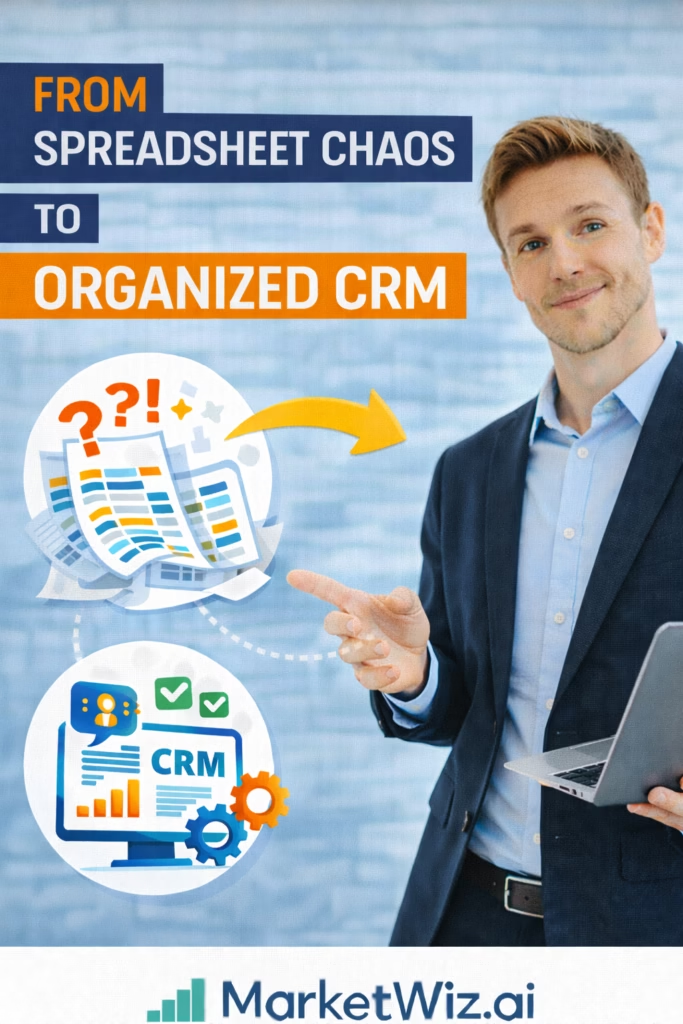
From Spreadsheet Chaos to Organized CRM

ChatGPT Image Dec 28 2025 09 47 16 AM
From Spreadsheet Chaos to Organized CRM — 2025 Playbook

From Spreadsheet Chaos to Organized CRM

From Spreadsheet Chaos to Organized CRM is a step-by-step migration system to clean your data, standardize fields, import correctly, and automate follow-up—so your CRM becomes your sales command center.

Quick Win Stack: Field Mapping Deduping Pipeline Stages Automation + Dashboards

Note: This is general operations guidance—not legal advice. Follow privacy rules and consent requirements when importing and messaging contacts.

Introduction

From Spreadsheet Chaos to Organized CRM is a journey almost every growing business takes. Spreadsheets are great for starting—but they eventually break because they’re not designed to run a sales process.

Here’s what spreadsheet chaos usually looks like:

  • Multiple tabs, multiple versions, and nobody knows which one is “right.”
  • Leads get forgotten because there’s no real follow-up system.
  • Notes are scattered and inconsistent, so handoffs are messy.
  • Reporting is guesswork (“How many leads did we actually close?”).

A CRM fixes this by making your pipeline visual, your next steps automatic, and your data structured—so conversion rates increase and sales becomes predictable.

Expanded Table of Contents

1) Why spreadsheets fail at sales operations

Spreadsheets fail because they do not enforce structure or behavior. A CRM does.

SpreadsheetsCRMs
Manual updates (easy to forget)Automated updates + reminders
No standard fields (messy notes)Structured fields + dropdowns
No pipeline visibilityVisual stages and forecasting
Hard to assign ownershipClear lead owner and tasks
Reporting is slow and inaccurateDashboards in real-time

Outcome: A CRM turns “data storage” into “revenue operations.”

2) CRM migration prep: what to decide before you import

Before you move a single row, make these decisions. This is what prevents chaos.

Define your pipeline

  • What stages do leads move through?
  • What qualifies a lead to advance?
  • What does “Won” and “Lost” mean?

Define ownership + follow-up rules

  • Who owns new leads?
  • How fast must you respond?
  • What follow-up cadence should happen by default?

Common mistake: importing first and deciding later. That creates a dirty CRM that nobody trusts.

3) Data cleanup checklist (before you touch the CRM)

Your CRM will not fix messy data—it will amplify it. Clean the spreadsheet first.

Cleanup checklist

  • Remove duplicates: same person or company listed multiple times.
  • Standardize names: consistent casing and formatting.
  • Split combined fields: “Name + Company” should become separate columns.
  • Normalize phone numbers: consistent format like (###) ###-####.
  • Normalize addresses: separate street/city/state/zip when possible.
  • Validate emails: remove invalid formats, placeholders, and typos.
  • Define statuses: replace random notes like “maybe” with standardized statuses.

Golden rule: If a field can be a dropdown in the CRM, don’t keep it as free text in the spreadsheet.

4) Field mapping: translating spreadsheets into CRM fields

This is the core of going from spreadsheet chaos to organized CRM. You must map columns to CRM fields intentionally.

Spreadsheet ColumnCRM FieldTypeNotes
First NameFirst NameTextRequired
Last NameLast NameTextRequired if possible
CompanyCompanyTextUse for B2B; optional for local
PhonePhonePhoneStandardize format before import
EmailEmailEmailValidate before import
SourceLead SourceDropdownGoogle, Facebook, Referral, etc.
StatusLifecycle StageDropdownNew, Contacted, Qualified, Won, Lost
NotesNotesLong textKeep but don’t rely on it for reporting
Next StepNext TaskTask/DateConvert “next step” into tasks when possible

Tip: Create 5–10 custom CRM fields that match how your business sells. Don’t settle for generic fields if they don’t reflect your process.

5) Pipeline stages that make your CRM usable

If your pipeline stages are wrong, everything is wrong. Keep them tied to actions.

Example pipeline (works for many businesses)

  • New Inquiry (uncontacted)
  • Contacted (2-way connection started)
  • Qualified (fit + intent confirmed)
  • Estimate/Proposal Sent
  • Follow-Up / Decision Pending
  • Booked / Scheduled
  • Won
  • Lost (with reason)

Best practice: Define what has to happen for a lead to move to the next stage. That reduces “pipeline fiction.”

6) Import strategy: phased rollout to avoid messy data

Don’t import everything at once. Use a phased import so you can validate and fix issues early.

Phase 1: Active leads only

  • Import leads that are in progress (last 30–90 days).
  • Assign owners and create next tasks.
  • Validate fields and pipeline behavior.

Phase 2: Past customers + closed deals

  • Import customers for future upsells, referrals, and retention.
  • Tag customer type and services purchased.

Phase 3: Long-tail old leads (optional)

  • Import only if you have a plan to nurture them.
  • Otherwise, store them in an “archive” list so they don’t pollute the pipeline.

Key point: The CRM should reflect reality, not history. Import only what supports action.

7) Automations that eliminate lead leakage

Automation is the reason you move from spreadsheets to a CRM. Build these immediately:

New lead automation

  • Assign owner
  • Create immediate follow-up task
  • Send instant acknowledgment message (if appropriate)
  • Start short follow-up sequence if no response

Stale lead automation

  • If no activity 7 days → reminder task
  • If no activity 14 days → move to nurture stage
  • If no activity 30 days → archive or long-term drip
Simple routing rule:
If Lead Source = “High Intent” (calls, quote forms, DM with urgency)
→ mark as Priority
→ alert owner
→ create task due in 15 minutes

Result: The CRM becomes self-updating and self-enforcing—no more manual spreadsheet chasing.

8) Dashboards & KPIs to build immediately

Must-have dashboards:
• New leads by source (weekly)
• Response time (median + % within SLA)
• Pipeline value (by stage)
• Conversion rates (stage-to-stage)
• Follow-up task completion rate
• Win/loss reasons (monthly)
• Forecast (expected revenue)

Important: If your team doesn’t look at dashboards, simplify them. A dashboard should answer one question quickly.

9) CRM SOP: how to keep it clean (forever)

CRMs get messy because there’s no enforcement. Use a simple SOP:

Daily rules

  • No lead without an owner.
  • No lead without a lifecycle stage.
  • No active lead without a next task and due date.
  • All calls/notes logged same day.

Weekly hygiene checklist (30 minutes)

  • Find leads with no next task → assign tasks
  • Find stalled deals → follow-up or move stages
  • Fix missing sources and tags
  • Review duplicates

CRM health metric: % of active leads with a next task. Aim for 90%+.

10) 30–60–90 day rollout plan

Days 1–30 (Foundation)

  1. Define pipeline stages and lead ownership rules.
  2. Clean the spreadsheet and standardize fields.
  3. Map fields and import active leads only.
  4. Build basic automations (new lead + stale lead reminders).

Days 31–60 (Consistency)

  1. Train the team on lifecycle stages and task rules.
  2. Add qualification fields and win/loss reasons.
  3. Build dashboards and review weekly.
  4. Import customers and closed deals for retention/referrals.

Days 61–90 (Optimization)

  1. Add scoring or priority routing for high-intent leads.
  2. Refine automation and follow-up sequences.
  3. Improve attribution and channel reporting.
  4. Document the CRM SOP so it stays clean long-term.

11) 25 Frequently Asked Questions

1) What does “From Spreadsheet Chaos to Organized CRM” mean?

It means moving from unstructured spreadsheets to a CRM with clear fields, stages, tasks, automation, and reporting.

2) Why do spreadsheets stop working for sales?

They don’t enforce ownership, follow-up, or consistent stages—so leads get lost and reporting is unreliable.

3) What should I do before importing?

Clean your spreadsheet, standardize data, define pipeline stages, and map fields.

4) Should I import all old leads?

Not at first. Import active leads first, then customers, then optional long-tail leads with a nurture plan.

5) What’s the biggest CRM migration mistake?

Importing messy data without deduping and field mapping.

6) How do I dedupe leads?

Use email, phone, and company as primary keys; standardize formatting before import.

7) What fields are required in a CRM?

Owner, stage, source, last activity, next task, and a basic qualification field set.

8) What pipeline stages should I use?

Stages based on actions: New → Contacted → Qualified → Proposal → Follow-Up → Won/Lost.

9) What should I track for reporting?

Source, response time, conversion rates, pipeline value, and win/loss reasons.

10) How do I keep the CRM from getting messy again?

Use required fields, dropdowns, automation, and a weekly hygiene checklist.

11) Should I use free-text notes for everything?

No. Notes are helpful, but key insights should be in structured fields.

12) How many custom fields should I create?

Start with 5–10 fields that match your sales process and qualification needs.

13) What automations should I set up first?

New lead assignment + task creation + stale lead reminders + basic follow-up sequence.

14) Do I need lead scoring right away?

No—get stages and tasks working first, then add scoring.

15) How do I train my team?

Train on stages, task rules, and “if it’s not in the CRM, it didn’t happen.”

16) How do I handle multiple lead sources?

Use a dropdown for source and separate field for campaign details or UTMs.

17) What’s the best “health metric” for a CRM?

% of active leads with a next task and due date.

18) What’s the best way to reduce lead leakage?

Require next tasks and automate reminders for inactive leads.

19) Should every lead have an owner?

Yes—unowned leads are lost leads.

20) How do I handle inbound DMs or Marketplace leads?

Log them as leads with a source tag and a follow-up sequence so they don’t disappear.

21) What if my spreadsheet has inconsistent statuses?

Create a mapping table and standardize into a short list of lifecycle stages.

22) How do I handle “cold” leads?

Keep them in a nurture stage, not in the main pipeline that sales works daily.

23) What dashboards should I build first?

New leads by source, response time, pipeline value, and conversion rates.

24) How often should I review CRM performance?

Weekly for hygiene and pipeline; monthly for win/loss analysis and optimization.

25) What’s the fastest ROI from a CRM?

Faster response times and consistent follow-up—those usually increase conversions immediately.

12) 25 Extra Keywords

  1. From Spreadsheet Chaos to Organized CRM
  2. spreadsheet to CRM migration
  3. CRM import checklist
  4. CRM field mapping template
  5. dedupe leads before import
  6. sales pipeline setup
  7. CRM pipeline stages
  8. CRM data cleanup
  9. lead ownership in CRM
  10. CRM follow up automation
  11. CRM task management
  12. speed to lead CRM tracking
  13. CRM dashboard KPIs
  14. win loss reason tracking
  15. CRM lifecycle stages
  16. CRM data hygiene SOP
  17. CRM deduplication rules
  18. CRM automation triggers
  19. import customers into CRM
  20. sales operations workflow
  21. CRM reporting setup
  22. stale lead reminders
  23. organized CRM system
  24. clean CRM database
  25. CRM rollout plan

© 2025 Your Brand. All Rights Reserved.
General information only—follow applicable privacy, consent, and platform policies when importing contacts and messaging leads.

From Spreadsheet Chaos to Organized CRM Read More »

Success Story: Franchisee Became Top Performer

ChatGPT Image Dec 28 2025 09 47 08 AM
Success Story: Franchisee Became Top Performer — 2025 Playbook

Success Story: Franchisee Became Top Performer

Success Story: Franchisee Became Top Performer breaks down the exact moves that turned one location from “getting by” to “top performer”—by fixing speed-to-lead, building trust with reviews, improving local visibility, and making booking effortless.

Quick Win Stack: Instant Response Reviews + Proof GBP + Local SEO Instant Booking

Note: This is general marketing and operations guidance—not legal advice. Follow franchise brand guidelines, privacy rules, and advertising policies.

Introduction

Success Story: Franchisee Became Top Performer is not a “motivational” story—it’s a practical breakdown of what changed, why it worked, and how any franchise location can copy the same framework.

This case study focuses on the most common franchise problem:

  • Corporate provides a brand, a product, and sometimes leads…
  • But local execution determines whether you become average or dominate your territory.

The location in this story didn’t win by spending the most. They won by building a repeatable system that:

  • Captures every inquiry (no missed calls and dead ends)
  • Responds fast (speed-to-lead)
  • Builds trust instantly (reviews + proof)
  • Makes booking easy (less friction)
  • Follows up consistently (no lead left behind)

Outcome: More booked appointments, higher close rate, and a path to top performer status.

Expanded Table of Contents

1) The “before” picture: why average franchise locations plateau

Many franchise locations get stuck in a familiar pattern:

  • Leads come in inconsistently
  • Calls are missed during busy hours
  • Follow-up depends on whoever is free
  • Online reviews trickle in randomly
  • Website/landing pages don’t convert well

This creates a silent ceiling. Even if you’re excellent at the service, your local market experiences you as:

  • Hard to reach (slow response)
  • Hard to trust (not enough proof)
  • Hard to book (too much friction)

In other words: the business is good, but the conversion system is weak.

2) The turning point: the 4 leaks that were fixed first

The franchisee did not try to “do everything.” They fixed four leaks that create the biggest lift quickly:

LeakWhat it looked likeFix
Missed callsBusy = lost leadsMissed-call text + instant next step
Slow follow-upHours later responseAuto-reply + speed-to-lead standard
Not enough proofDecent work, little social proofReview engine + proof library
Booking frictionPhone tag and “let me call you back”Instant booking page + calendar rules

Result: leads stopped slipping through cracks, and booked appointments increased without increasing ad spend.

3) The top-performer playbook (step-by-step)

Step 1: Define the “one conversion event”

The franchisee focused the entire funnel on one thing: book the consult/estimate. Everything else supported that.

Step 2: Make the next step obvious everywhere

They standardized one CTA across:

  • Website header buttons
  • Google Business Profile
  • Social profiles
  • Follow-up texts
  • Ads and landing pages

Simple rule: the customer should never wonder “what do I do next?”

Step 3: Implement a speed-to-lead SLA

They set a response standard:

  • Under 5 minutes during business hours
  • Instant auto-response after hours with a booking link

Step 4: Create a “proof library” and use it constantly

Instead of hoping visitors find proof, they placed proof next to CTAs:

  • Google reviews and rating
  • Before/after photos
  • Short customer quotes
  • “What’s included” clarity

Step 5: Build a review engine (not a one-off ask)

They automated review requests after the “happy moment”:

  • Job completed → thank-you text
  • Review link + friendly prompt
  • Every review received a professional reply

Step 6: Add instant booking rules to protect the schedule

Instant bookings worked because they added boundaries:

  • Buffers between appointments
  • Service area qualification
  • Limit on same-day scheduling
  • Pre-qualifying questions

Step 7: Fix the “no-show problem” with confirmations

They used a simple confirmation flow:

  • Instant confirmation
  • Reminder day before
  • “Reply YES to confirm”
  • Reschedule link included

Step 8: Retarget warm leads to book

Most prospects don’t book on the first visit. Retargeting brought them back to the booking page with proof and a direct CTA.

Key takeaway: Top performance wasn’t about more marketing. It was about a better conversion system.

4) The systems that made results repeatable

System A: Lead capture + routing

  • Missed-call text
  • After-hours auto-response
  • Single booking link
  • Lead source tracking

System B: Booking + confirmations

  • Calendar rules and buffers
  • Pre-qualifying questions
  • Instant confirmation
  • Reminders + reschedule link

System C: Trust + proof engine

  • Proof library (photos, testimonials)
  • Review request workflow
  • Review responses with service/location language
  • Proof blocks on pages and ads

System D: Follow-up and reactivation

  • Short follow-up sequences
  • “Still need help?” reactivation
  • Offer clarity (options, timelines)
  • Retargeting warm visitors

Why this worked: It removed randomness. The system produced consistent outcomes even on busy days.

5) Copy/paste scripts used to convert more leads

Missed-call text (recover lost leads)

Hey! Sorry we missed your call — we can help.
What are you looking for, and what city are you in?
You can also grab a time here (30 seconds): [booking link]

Fast first reply (DM or form)

Thanks for reaching out! Quick question so I can point you the right way:
1) What service do you need?
2) What’s your city?
3) When were you hoping to schedule?
If you want, you can book instantly here: [booking link]

Price objection (no pressure)

Totally fair. Pricing depends on [1–2 key factors].
If you tell me [factor], I can give you a realistic range.
Or you can book a quick consult and we’ll confirm exact pricing: [booking link]

Confirmation + no-show prevention

Perfect — you’re booked for [day/time].
Reply YES to confirm, and we’ll see you then.
Need to reschedule? Use this link: [link]

6) The top-performer scorecard (KPIs)

Response KPIs
• Speed-to-lead (minutes)
• % leads responded to within 5 minutes
• Missed call recovery rate

Booking KPIs
• Lead → booked appointment rate
• Show rate (no-shows)
• Time-to-book (hours/days)

Trust KPIs
• Review velocity (new reviews per week/month)
• Rating trend
• Proof engagement (CTA clicks after proof sections)

Revenue KPIs
• Close rate
• Revenue per booked appointment
• Cost per booked appointment (if ads)

North Star: more booked appointments + higher show rate + higher close rate.

7) 30–60–90 day rollout plan

Days 1–30 (Fix speed + booking)

  1. Launch missed-call text + booking link.
  2. Standardize one CTA across all channels.
  3. Set a speed-to-lead standard (under 5 minutes).
  4. Build a basic proof block (reviews + before/after) near CTAs.
  5. Track booked rate and show rate.

Days 31–60 (Scale trust)

  1. Launch review request workflow after each completed job.
  2. Add FAQ + process + pricing signals to landing pages.
  3. Improve follow-up sequences for non-booked leads.
  4. Add reminders and reschedule flow to reduce no-shows.

Days 61–90 (Optimize + dominate)

  1. Analyze conversion drop-off points and fix them.
  2. Add retargeting to bring warm traffic back to booking.
  3. Build a “proof library” and refresh content weekly.
  4. Document SOPs so every team member follows the same system.

8) 25 Frequently Asked Questions

1) What is this success story about?

It’s a playbook-style case study showing how a franchisee improved response time, trust, and booking flow to become a top performer.

2) What changed first?

Speed-to-lead and booking friction. They made it easy to schedule instantly and ensured every lead got a fast response.

3) Why is speed-to-lead so important?

Because buyers contact multiple businesses and often book the first credible, responsive option.

4) Can this work without increasing ad spend?

Yes. Conversion improvements often increase results from the same traffic and lead volume.

5) What is a missed-call text?

An automatic SMS sent when you miss a call that provides a next step, usually a booking link.

6) What’s the best CTA for franchises?

Usually “Check Availability” or “Book Now,” depending on the offer and service type.

7) Do instant booking systems create scheduling chaos?

Not if you use rules: buffers, lead time, caps per day, and service-area filters.

8) How do reviews impact performance?

Reviews increase trust, click-through, and conversion—especially in local markets.

9) How many reviews should a location aim for?

There’s no universal number, but steady growth and competitive parity in your market matters.

10) Should franchisees respond to reviews?

Yes. Review responses reinforce credibility and add local relevance.

11) What if corporate controls the website?

You can still optimize local landing pages, GBP, follow-up systems, and reviews for your location.

12) What pages matter most for conversion?

Service pages and landing pages with clear CTAs, proof, and process details.

13) What is a proof library?

A collection of photos, testimonials, reviews, and results you can use across pages and ads.

14) How do you reduce no-shows?

Confirmations, reminders, and easy rescheduling paths.

15) Should you require deposits?

Sometimes, depending on the industry and market. Make terms clear and transparent.

16) What follow-up cadence works?

Immediate reply, then 1–3 follow-ups over a week for non-responders.

17) What is retargeting and why use it?

Retargeting shows ads to warm visitors who didn’t book, bringing them back to convert.

18) What KPIs matter most?

Speed-to-lead, booked rate, show rate, close rate, and review velocity.

19) How fast should you respond to leads?

Under 5 minutes during business hours is a strong benchmark.

20) Can this work for multi-unit owners?

Yes. Systems scale well across multiple locations when standardized.

21) What if leads are low-quality?

Add qualifiers and clarity: service area, timelines, and fit questions.

22) How do you prevent staff from “forgetting” follow-ups?

Use automated sequences and a simple tracking system.

23) What’s the biggest mistake franchisees make with leads?

Slow response and inconsistent follow-up.

24) How quickly can you see improvement?

Often within weeks once missed-call recovery and booking are implemented.

25) What’s the fastest improvement today?

Implement missed-call texts + a booking link and standardize your CTA everywhere.

9) 25 Extra Keywords

  1. Success Story: Franchisee Became Top Performer
  2. franchisee success story
  3. top performing franchisee
  4. franchise marketing case study
  5. franchise lead generation
  6. speed to lead franchise
  7. missed call text automation
  8. instant booking for franchises
  9. local SEO for franchises
  10. Google Business Profile for franchises
  11. review engine for franchises
  12. increase booked appointments
  13. reduce no shows
  14. franchise conversion system
  15. franchise sales funnel
  16. franchise location growth
  17. multi unit franchise marketing
  18. franchise lead follow up
  19. franchise booking workflow
  20. franchise proof strategy
  21. franchise retargeting strategy
  22. franchise KPI scorecard
  23. franchise business transformation
  24. franchise marketing SOP
  25. franchise performance improvement

© 2025 Your Brand. All Rights Reserved.
General information only—follow franchise brand guidelines, privacy rules, and advertising policies.

Success Story: Franchisee Became Top Performer Read More »

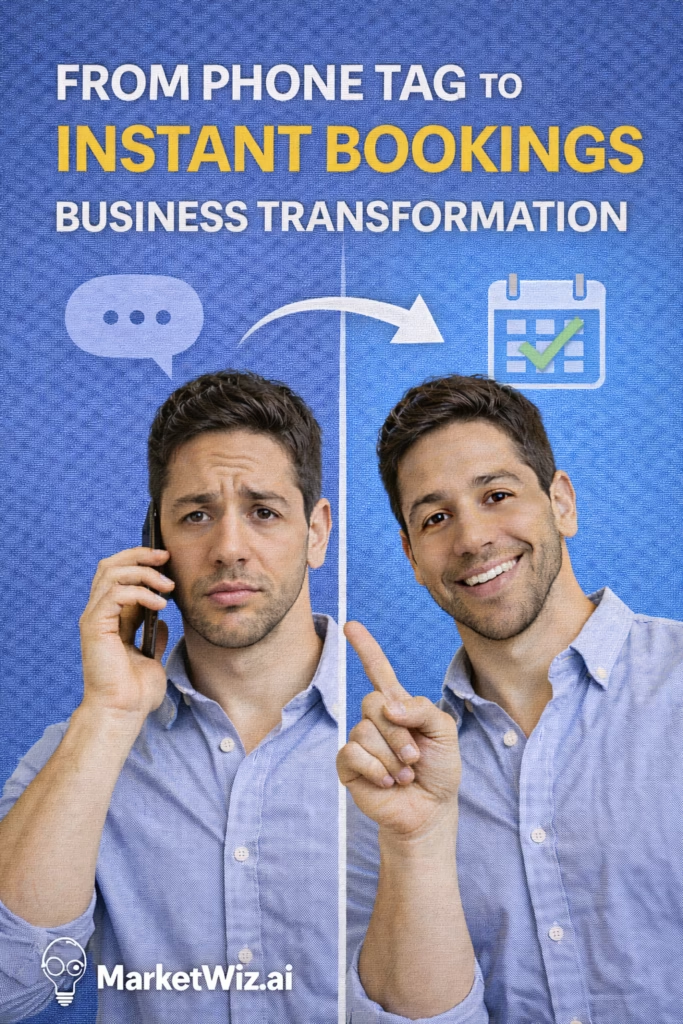
From Phone Tag to Instant Bookings: Business Transformation

ChatGPT Image Dec 28 2025 09 47 06 AM
From Phone Tag to Instant Bookings: Business Transformation — 2025 Playbook

From Phone Tag to Instant Bookings: Business Transformation

From Phone Tag to Instant Bookings: Business Transformation is a step-by-step blueprint to stop missing opportunities, respond instantly, and convert more inbound leads into scheduled appointments—without hiring a full-time admin.

Quick Win Stack: Speed-to-Lead SMS + Call Routing Online Booking Auto Follow-Up

Note: This is general operations/marketing guidance—not legal advice. Follow privacy, consent, and messaging laws in your region.

Introduction

From Phone Tag to Instant Bookings: Business Transformation solves one of the biggest hidden revenue leaks in local business: missed calls and slow follow-up.

Phone tag feels harmless—until you realize what it costs:

  • Customers contact 2–6 businesses at once.
  • The first credible business to respond often wins.
  • Even a great service loses deals if the response is slow.

The fix isn’t “work harder.” It’s to build a simple conversion system where every inquiry gets an instant response, every lead sees a clear next step, and every warm prospect gets followed up automatically.

Goal: More booked appointments, less admin time, fewer missed leads, and faster revenue.

Expanded Table of Contents

1) Why phone tag kills conversions

Phone tag is not just inconvenient—it creates uncertainty. Buyers interpret silence as:

  • “They’re too busy.”
  • “They won’t be responsive after I pay.”
  • “This might be risky.”

Phone tag also slows down your pipeline:

  • Lead comes in → you miss it → you call back → they miss it → momentum dies.
  • Lead asks a question → you respond hours later → they already booked someone else.

Instant bookings remove uncertainty by giving prospects a clear, immediate path forward.

2) The instant booking system: capture → qualify → schedule → confirm

The best systems feel simple to the customer but are structured behind the scenes. Use this four-stage model:

StageGoalWhat it needs
CaptureNever lose an inquiryCall routing, missed-call text, forms, DM auto-reply
QualifyFilter + prioritize3–6 key questions, service area check, urgency
ScheduleBook the appointmentCalendar link, rules, buffers, availability
ConfirmReduce no-showsConfirmations, reminders, prep instructions

Reality check: “Instant booking” doesn’t mean “anything, anytime.” It means the customer can move forward instantly within your rules.

3) The transformation steps (from chaos to booked)

1) Define the one “bookable event” you want

Most businesses try to book too many things. Start with one: estimate, consultation, demo, inspection, or call.

2) Put one primary CTA everywhere

Website, GBP, social profiles, ads, and follow-ups should all point to the same action: Book now or Check availability.

3) Build a booking page that answers objections

Your booking page should include: what they get, who it’s for, service area, pricing signals, and proof.

4) Add booking rules (buffers, hours, and boundaries)

Instant bookings must protect your schedule:

  • Buffer time between appointments
  • Max bookings per day
  • Lead time (e.g., cannot book within 2 hours)
  • Service area qualification

5) Replace missed calls with a missed-call text

When you miss a call, the lead should instantly receive a helpful SMS with a booking link.

Outcome: missed calls become booked appointments.

6) Use a 3–6 question pre-qualifier

Keep it short. Ask only what affects scheduling and pricing.

7) Create an “instant confirmation” message

Immediately confirm the appointment and explain what happens next.

8) Add reminders + prep instructions

No-shows drop when people know what to expect and how to prepare.

9) Add a reschedule path (instead of losing the lead)

Make it easy to reschedule via link—reduces ghosting and saves time.

10) Add post-appointment follow-up

Follow-up turns appointments into closed deals. Include next step options and proof.

11) Retarget warm traffic to the booking page

Visitors who didn’t book are still warm. Retarget them with proof + “book now” CTA.

12) Track the booking funnel end-to-end

You can’t improve what you don’t measure. Track lead source → booking → show rate → close rate.

4) Booking flows that work for real-world local businesses

Flow A: Missed call → booked

  1. Customer calls
  2. Missed-call text triggers instantly
  3. Text includes booking link + 1 question
  4. Customer books
  5. Confirmation + reminders reduce no-show

Flow B: Form/DM → qualify → book

  1. Customer submits form or DMs
  2. Auto-reply confirms + asks 3 questions
  3. Customer answers
  4. System routes to booking link (or team)
  5. Appointment booked + confirmed

Choose one flow first. Perfect it. Then add the next.

5) Copy/paste scripts for calls, SMS, and no-show prevention

Missed call text (instant)

Hey! Sorry we missed your call — I can help fast.
What are you looking for help with?
You can also grab a time here (takes 30 seconds): [booking link]

Pre-qualifying question set (choose 3–6)

1) What service do you need?
2) What’s your address or city?
3) When do you want this done?
4) Is this residential or commercial?
5) Any photos you can share?
6) What’s the best time for an appointment?

Booking confirmation text

Perfect — you’re booked for [day/time].
Next step: we’ll [what happens next] and you’ll get a reminder before we arrive.
If anything changes, you can reschedule here: [link]

No-show prevention reminder (day before)

Quick reminder: we’re scheduled for [day/time].
Reply YES to confirm — or reschedule here if needed: [link]

Post-appointment follow-up (close the loop)

Thanks again for your time today. Want to move forward?
Option A: [next step]
Option B: [next step]
Reply A or B and I’ll take care of the rest.

Compliance tip: Use clear opt-in language when required and respect “STOP” requests.

6) Checklist: what your booking system must include

Customer-facing essentials

  • Clear booking page and CTA
  • Instant confirmation
  • Reminders and prep instructions
  • Easy reschedule/cancel path
  • Trust signals (reviews, proof, process)

Business-facing essentials

  • Routing rules and service area filters
  • Calendar buffers and hours
  • Lead source tracking
  • Follow-up sequences for no-response leads
  • Reporting: booked, show rate, close rate

7) KPIs to measure the transformation

Speed KPIs
• Speed-to-lead (minutes)
• % leads contacted within 5 minutes
• Missed call recovery rate

Booking KPIs
• Lead → booked appointment rate
• Show rate (no-show rate)
• Time-to-book (hours/days)

Revenue KPIs
• Close rate
• Revenue per booked appointment
• Cost per booked appointment (if ads)

Quality KPIs
• Lead quality score
• Cancellation rate
• Customer satisfaction / reviews

North Star: Higher booked rate + higher show rate + less time spent chasing people.

8) 30–60–90 day rollout plan

Days 1–30 (Stop the bleeding)

  1. Pick one bookable appointment type.
  2. Create a booking page + calendar rules.
  3. Launch missed-call text + booking link.
  4. Set up instant confirmation + reminders.
  5. Track booked rate + show rate.

Days 31–60 (Qualify + improve quality)

  1. Add pre-qualifying questions.
  2. Add proof blocks and objection handling to booking page.
  3. Add reschedule and “confirm by reply” flows.
  4. Start retargeting warm traffic to booking.

Days 61–90 (Scale + optimize)

  1. Optimize based on KPIs (where leads drop off).
  2. Add post-appointment close sequence.
  3. Retarget past leads and reactivation campaigns.
  4. Document SOPs so the system stays consistent.

9) 25 Frequently Asked Questions

1) What does “From Phone Tag to Instant Bookings” mean?

It means converting slow back-and-forth calls into a system that captures and schedules appointments immediately with automated follow-up.

2) Do customers actually want to book instantly?

Many do—especially when they’re high intent. Others prefer a quick text. Your system should offer both.

3) What is speed-to-lead?

How quickly you respond to a new inquiry. Faster response usually increases conversion.

4) What’s the simplest booking setup?

A booking page + scheduling link + missed-call text + confirmations.

5) How do I stop missing calls?

You won’t stop every missed call, but you can automatically recover them with instant SMS and booking links.

6) Should I use SMS follow-up?

Often yes. SMS is fast and convenient for most customers.

7) What should my booking page include?

What they get, service area, proof, process, timeline, and an obvious CTA.

8) How many questions should I ask before booking?

Keep it to 3–6. Only ask what affects scheduling and pricing.

9) How do I reduce no-shows?

Use confirmations, reminders, easy rescheduling, and clear expectations.

10) Do instant bookings work for high-ticket services?

Yes, especially for the first step (inspection/consultation). Control quality with qualifiers.

11) Should I require deposits?

Sometimes, depending on your market. Be transparent and clear about terms.

12) What’s the best CTA text?

Outcome-based CTAs like “Check Availability,” “Book Now,” or “Get My Quote.”

13) What if my schedule is unpredictable?

Use buffers, limited availability blocks, and manual approval for certain appointment types.

14) Should I allow same-day bookings?

Only if you can fulfill them reliably. Otherwise require lead time.

15) Can I do this without a CRM?

Yes, but a simple CRM helps track follow-ups and outcomes.

16) How do I track lead source?

Use UTMs, call tracking, and booking form fields that capture source/intent.

17) What if leads ask for pricing first?

Provide pricing signals or ranges and offer a quick booking for a precise quote.

18) Should I retarget website visitors?

Yes. Warm visitors are cheaper to convert than cold traffic.

19) How long does it take to see results?

Often within weeks—because you’re fixing response and follow-up, not waiting on SEO.

20) What’s a good booked appointment rate?

It varies by industry, but improving speed-to-lead usually increases it quickly.

21) What’s a good show rate?

High show rates come from clear confirmation and reminders. If no-shows are high, fix expectations.

22) What if I get low-quality bookings?

Add qualifiers: service area, budget signals, and problem fit questions.

23) How do I handle after-hours leads?

Use an after-hours auto-reply with a booking link and next steps.

24) What’s the biggest mistake in booking systems?

Making booking too hard or not following up after the appointment.

25) What’s the fastest improvement I can make today?

Add a missed-call text that sends a booking link and one qualifying question.

10) 25 Extra Keywords

  1. From Phone Tag to Instant Bookings: Business Transformation
  2. instant booking system
  3. stop missing calls
  4. speed to lead
  5. lead response automation
  6. online scheduling for local business
  7. appointment booking funnel
  8. missed call text automation
  9. SMS follow up for leads
  10. local business lead conversion
  11. increase booked appointments
  12. reduce no shows
  13. booking confirmation system
  14. calendar booking rules
  15. pre qualification questions
  16. lead nurturing sequence
  17. retargeting to booking page
  18. booking page copy
  19. conversion system for local services
  20. automated appointment reminders
  21. business operations automation
  22. inbound lead routing
  23. call and SMS routing
  24. appointment booking KPIs
  25. local business transformation

© 2025 Your Brand. All Rights Reserved.
General information only—follow privacy, consent, and messaging laws in your region.

From Phone Tag to Instant Bookings: Business Transformation Read More »

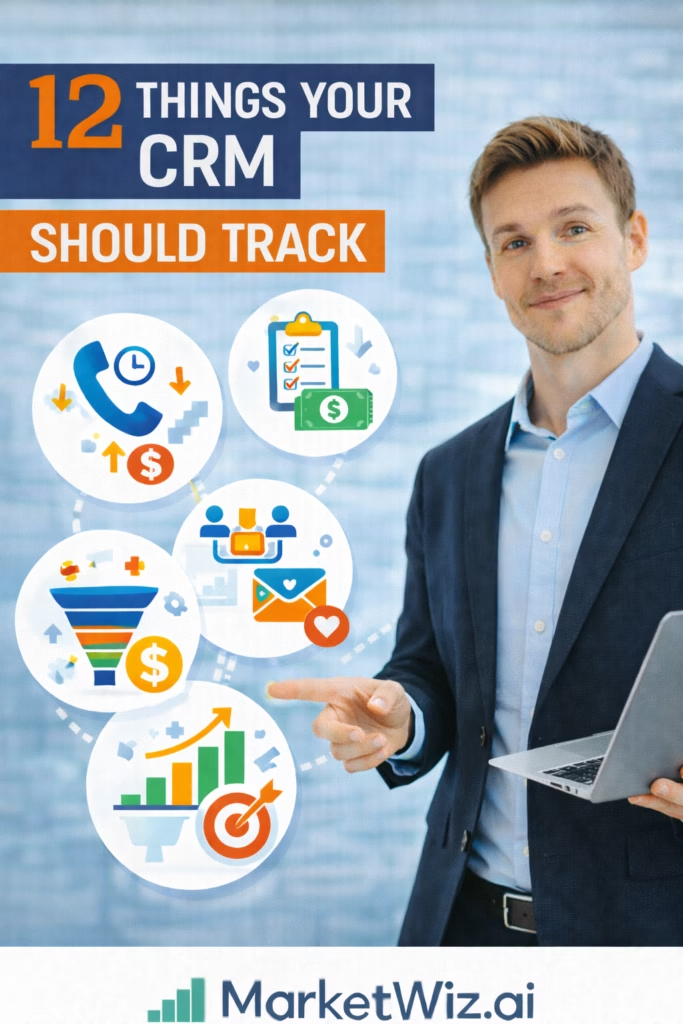
12 Things Your CRM Should Track

ChatGPT Image Dec 27 2025 10 20 11 AM
12 Things Your CRM Should Track — 2025 Playbook

12 Things Your CRM Should Track

12 Things Your CRM Should Track turns your CRM into a decision engine—so nothing slips through the cracks, your team follows up faster, and revenue becomes predictable.

Quick Win Stack: Lifecycle + Next Task Speed-to-Lead Pipeline Value Attribution

Note: This is general CRM and operations guidance—not legal advice. Follow privacy rules and platform policies when tracking data and messaging leads.

Introduction

12 Things Your CRM Should Track is about one goal: fewer missed opportunities. Most CRMs fail for a simple reason—teams track contact info, but not the decision data.

Decision data answers questions like:

  • Where did this lead come from?
  • What stage are they in right now?
  • What happens next—and who owns it?
  • How fast did we respond?
  • What’s the value of this opportunity?

When your CRM tracks the right fields and updates them consistently, it becomes the “single source of truth” for sales, marketing, and customer success.

Expanded Table of Contents

1) Why most CRMs fail (and how tracking fixes it)

Most businesses buy a CRM hoping it will “organize everything.” Then they only track basic contact info—so the CRM becomes a database instead of a workflow.

12 Things Your CRM Should Track fixes that by tracking the fields that drive action:

  • Visibility: You always know what’s happening in the pipeline.
  • Accountability: Every lead has an owner and next task.
  • Speed: You measure response time and stop lead leakage.
  • Learning: Win/loss reasons and attribution improve marketing and sales.

Rule of thumb: If a field doesn’t change a decision, it’s probably not a “must track.”

2) The 12 Things Your CRM Should Track

1) Lead Source (with UTM or channel detail)

Track where the lead actually came from (Google, Facebook, Marketplace, referral, email, organic, paid). Without this, you can’t scale what works.

Field tip: Use a dropdown + a separate field for campaign (UTM or ad name).

2) Lifecycle Stage

The CRM must show where the lead is in your process: New Lead → Contacted → Qualified → Estimate/Proposal → Negotiation → Won/Lost.

Common mistake: stages that are too vague. Make stages reflect real actions.

3) Lead Owner (Who is responsible?)

If a lead doesn’t have an owner, it’s a “no one’s job” lead. Assign ownership instantly.

4) First Response Time (Speed-to-lead)

Track the time from inquiry to first human/meaningful response. This is one of the biggest conversion levers in most businesses.

5) Last Activity Date (recency)

Recency shows who is active and who is stale. It also powers automation like reminders and follow-ups.

6) Next Task + Due Date

This is the field that prevents lost deals. If there’s no next task, the lead is effectively abandoned.

Examples:
• Call lead (today 3pm)
• Send quote (tomorrow)
• Follow up after estimate (Friday)
• Confirm appointment (1 hour before)

7) Qualification Data (fit + intent)

Track the minimum info that determines if this is a good opportunity.

  • Fit: location/service area, industry, budget range, property type, etc.
  • Intent: timeline, urgency, requested pricing, booking behavior.

8) Opportunity Value (estimated deal size)

Pipeline without value is just a list. Estimated value helps forecast revenue and prioritize.

9) Stage Conversion Rates (by stage and channel)

Track how many leads move from stage to stage. This reveals exactly where your process leaks.

Example: “Contacted → Qualified” rate by lead source.

10) Win/Loss Reason (structured categories)

If you don’t know why you win and lose, you can’t improve reliably.

  • Price
  • Timing
  • Competitor

12 Things Your CRM Should Track Read More »

7 Ways to Turn Inquiries into Sales

ChatGPT Image Dec 27 2025 10 09 09 AM
7 Ways to Turn Inquiries into Sales — 2025 Playbook

7 Ways to Turn Inquiries into Sales

7 Ways to Turn Inquiries into Sales is a simple conversion system: respond fast, qualify smart, reduce friction, build trust, and follow up until “maybe” becomes “booked.”

Quick Win Stack: Speed-to-Lead One Clear Next Step Objection Scripts Follow-Up Automation

Note: This is general sales and marketing guidance—not legal advice. Follow platform policies and applicable consent/privacy rules for SMS/email.

Introduction

7 Ways to Turn Inquiries into Sales starts with a hard truth: most inquiries don’t convert because nobody follows up properly. Not because the offer is bad—because the process is inconsistent.

Inquiries are fragile. They have momentum for a short window. If you respond late, ask confusing questions, or leave the next step unclear, the lead goes cold—or buys from whoever was faster.

This playbook gives you a repeatable system to convert more inbound inquiries into booked appointments, deposits, and closed deals.

Expanded Table of Contents

1) Why inquiries don’t turn into sales

Most businesses lose inquiries for predictable reasons:

  • Slow response: the lead books elsewhere.
  • No clear next step: the lead doesn’t know what to do.
  • Too many questions: it feels like work.
  • Price too early: no context or value—so it feels expensive.
  • Weak follow-up: one message and done.

Fix: Build a process that turns “inquiry” into “appointment” fast—then use proof and follow-up to close.

2) Way #1: Respond in minutes (speed-to-lead)

Speed wins because inquiries have momentum. The fastest responder often gets the sale—even with similar pricing.

Set a response SLA

  • 0–5 minutes: ideal
  • 5–15 minutes: still strong
  • 1+ hour: conversion drops sharply

Instant first reply template

Hey {Name} — thanks for reaching out 👋
Quick question so I can help fast:
Is this for {Option A} or {Option B}?
And what’s your timeline—today, this week, or later?

Tip: If you can’t respond immediately, send a fast “we got you” message and set an expectation (“I’ll reply in 20 minutes”).

3) Way #2: Ask 2–3 qualifying questions (not 12)

Qualification isn’t an interrogation—it’s a shortcut to the right quote and the right next step.

The “3-question” qualification framework

  • What: What are you looking for / which service / which product?
  • Where: Location / delivery area / project site?
  • When: Timeline (today, this week, this month)?

Why it works: You gather enough info to price/route correctly without creating friction.

4) Way #3: Give one clear next step

Most leads go cold because they don’t know what happens next. Your job is to make the next step obvious and easy.

Inquiry TypeBest Next StepMessage Example
High intent (“How much? When can you start?”)Book call / schedule estimate“Perfect—best next step is a quick 10-min call. Want today or tomorrow?”
Medium intent (“I’m comparing options.”)Send proof + ask one question“Totally—here are 2 quick examples. What matters most: price, speed, or quality?”
Low intent (“Just looking.”)Nurture + gentle CTA“No pressure—want a quick guide to options/pricing ranges?”

Rule: Every response should end with a question or a link that moves the conversation forward.

5) Way #4: Use proof early (before price)

If you give price without value context, you invite comparison shopping. Proof makes price feel justified.

Proof you can use in the first 2 messages

  • Before/after photos
  • Short testimonial quote (one sentence)
  • Case study snapshot (result + timeframe)
  • Process credibility (checklist, warranty, guarantees)
Proof drop example:
“Here are 2 quick examples of recent work/results.
If you tell me your {goal/timeline}, I’ll recommend the best option + accurate pricing.”

Tip: “Proof first” doesn’t mean “no price.” It means “price with context.”

6) Way #5: Handle objections with scripts

Objections are normal. Most aren’t real “no’s”—they’re uncertainty. Use simple scripts that clarify and reduce risk.

Objection: “It’s too expensive.”

I hear you. Quick question—are you comparing on the lowest price,
or the best value for {speed/quality/warranty}?

If budget is the main factor, I can show you a lower-cost option.
If you want the best long-term result, I’ll recommend the package most customers choose.

Objection: “I need to think about it.”

Totally fair. What are you deciding between?
(Price, timing, or whether it’s the right fit?)

If you tell me that, I can send the exact info that makes the decision easy.

Objection: “Can you just send pricing?”

Yes—happy to. Pricing depends on {2 variables}.
If you tell me {variable 1} and {variable 2}, I’ll send a tight range + the best option.

Best practice: Convert objections into a question. Questions keep the deal alive.

7) Way #6: Follow up automatically (without being annoying)

The sale is often in the follow-up. But your follow-up has to be helpful—not needy.

A simple 7-touch follow-up cadence (3–7 days)

Touch 1 (0–5 min): Confirm + qualify
Touch 2 (2–3 hrs): Proof + next step
Touch 3 (Next day): Quick check + one question
Touch 4 (Day 2): Objection handler + option A/B
Touch 5 (Day 3): Social proof + “what matters most?”
Touch 6 (Day 5): “Still interested or should I close this out?”
Touch 7 (Day 7): Final helpful resource + open loop

Important: If you’re using SMS, make sure you have the appropriate consent and an easy way to stop messages where required.

8) Way #7: Reduce friction (booking + payment)

Even interested leads stall when the process feels slow or complicated. Remove friction with:

Friction reducers

  • One-click scheduling link
  • Simple estimate form (minimum fields)
  • Clear availability windows
  • Deposit/payment link (when appropriate)

“Book it now” template

Awesome — quickest next step is to grab a time here:
{Booking Link}

If nothing fits, tell me your best 2 windows and I’ll make it work.

Rule: If someone is ready to buy, your process should let them act in under 60 seconds.

9) KPIs & dashboards that prove it’s working

Core Conversion KPIs
• Inquiry → reply rate
• Inquiry → booked appointment rate
• Appointment → close rate

Speed KPIs
• Median first response time
• % replied within 5 minutes

Follow-Up KPIs
• Avg touches per conversion
• Conversions after touch #2 (proves follow-up matters)

Quality KPIs
• Disqualified rate (protects time)
• Refund/cancel rate (process + expectation quality)

If your response time drops and your booked rate rises, your “7 Ways to Turn Inquiries into Sales” system is working.

10) 30–60–90 day rollout plan

Days 1–30 (Foundation)

  1. Set your response SLA and create 3 quick-reply templates.
  2. Define your 3 qualification questions.
  3. Build 5 proof assets (before/after, testimonials, mini case studies).
  4. Create one booking link or “next step” path.

Days 31–60 (Consistency)

  1. Implement a 7-touch follow-up cadence (manual or automated).
  2. Write scripts for top 5 objections.
  3. Track response time + booked rate weekly.
  4. Improve routing (hot leads get priority).

Days 61–90 (Optimization)

  1. Refine scripts based on real conversations.
  2. Add time-saving automation (tags, reminders, nurture sequences).
  3. Split-test two CTAs (book vs call vs DM).
  4. Document the process as an SOP.

11) 25 Frequently Asked Questions

1) What are 7 Ways to Turn Inquiries into Sales?

They’re a set of conversion tactics that improve response speed, qualification, trust, follow-up, and booking so more inquiries become customers.

2) What’s the #1 factor for converting inquiries?

Fast response time combined with a clear next step.

3) How fast should I respond?

Within minutes when possible. The first 5–15 minutes are the highest-value window.

4) What should my first message say?

Thank them, ask 1–2 quick questions, and set a next step.

5) Should I send price right away?

Not without context. Share proof and clarify what they need so you can price accurately.

6) How many questions should I ask?

Usually 2–3 is enough to route and quote.

7) What if the lead stops replying?

Follow up with helpful messages and a “close the loop” option.

8) How many follow-ups are normal?

Multiple touches over 3–7 days is typical. Some leads convert after touch #4 or #5.

9) What’s the best follow-up style?

Helpful, specific, and low pressure.

10) How do I avoid sounding pushy?

Offer options, ask questions, and provide resources.

11) What’s a good “next step” CTA?

Booking link, quick call, estimate request, or a simple “choose A/B” option.

12) How do I handle “too expensive”?

Reframe with value, offer options, and confirm what they care about most.

13) What if they say they’re “just looking”?

Send a short guide or proof and keep the conversation open.

14) What proof should I send?

Before/after, a short testimonial, and one result snapshot are usually enough.

15) Should I call leads?

If they’re high intent or asked for fast help, yes. Calls can close faster than text alone.

16) What’s the best channel for follow-up?

Use the channel they started with, then add a second channel if needed.

17) Can automation help?

Yes—especially for follow-ups, reminders, and routing hot leads.

18) What’s a “fast lane” lead?

A lead showing urgency + fit. They should get immediate priority.

19) How do I reduce no-shows?

Confirmations, reminders, and clear expectations.

20) What’s the best way to qualify quickly?

Ask what/where/when and confirm they’re in your service area or ICP.

21) What if the lead asks for something you don’t offer?

Clarify and route to the closest option—or disqualify politely.

22) How do I track inquiry conversion?

Track inquiry → reply → booked → close.

23) What’s a good booked rate?

It varies by industry; focus on improving response time and follow-up consistency.

24) What’s the biggest mistake businesses make?

Not following up and not giving a clear next step.

25) What’s the fastest improvement I can make today?

Write 3 response templates, implement a 7-touch follow-up, and add proof to message #2.

12) 25 Extra Keywords

  1. 7 Ways to Turn Inquiries into Sales
  2. convert leads into customers
  3. inbound lead conversion
  4. lead response time SLA
  5. speed to lead best practices
  6. sales follow up automation
  7. lead follow up sequences
  8. appointment setting scripts
  9. sales objection handling scripts
  10. turn inquiries into appointments
  11. increase booking rate
  12. sales messaging templates
  13. follow up cadence
  14. reduce lead leakage
  15. conversion rate optimization sales
  16. lead qualification questions
  17. fast lane lead routing
  18. DM to sale process
  19. sales pipeline conversion tips
  20. close more inbound leads
  21. improve reply rate
  22. reduce no response leads
  23. frictionless booking flow
  24. trust building proof assets
  25. sales KPI dashboard

© 2025 Your Brand. All Rights Reserved.
General information only—follow applicable consent, privacy, and platform policies when messaging leads.

7 Ways to Turn Inquiries into Sales Read More »

10 Questions Your Website Must Answer

ChatGPT Image Dec 27 2025 10 09 05 AM
10 Questions Your Website Must Answer — 2025 Playbook

10 Questions Your Website Must Answer

10 Questions Your Website Must Answer is a conversion blueprint to turn visitors into leads by answering the exact questions buyers ask (often silently) before they trust you enough to click, call, or book.

Quick Win Stack: Clarity Proof Process Easy Next Step

Note: This is general marketing guidance—not legal advice. Follow privacy, consent, and advertising rules for your region.

Introduction

10 Questions Your Website Must Answer is the fastest way to diagnose why a website gets traffic but doesn’t generate enough leads.

When visitors arrive, they don’t read like a book. They scan. They’re deciding in seconds whether to stay, whether you’re credible, and whether it’s worth reaching out.

And they’re asking questions—usually silently:

  • “Is this for me?”
  • “Can I trust them?”
  • “What happens if I take the next step?”

If your website doesn’t answer these questions quickly and clearly, visitors leave—even if your service is excellent.

Goal: Answer the right questions in the right order so the next step feels obvious and safe.

Expanded Table of Contents

1) Why websites don’t convert (even with good traffic)

Most low-converting websites aren’t “bad designs.” They’re missing clarity and trust in key moments.

The most common conversion killers:

  • Vague messaging: visitors can’t tell what you do quickly.
  • No differentiation: you look like everyone else.
  • No proof: visitors can’t verify quality or legitimacy.
  • Hidden pricing: visitors can’t estimate affordability.
  • Unclear process: the next step feels risky or time-consuming.
  • Friction: forms are long, CTAs are weak, mobile UX is rough.

Fixing these usually increases leads without increasing traffic.

2) The conversion order: Clarity → Trust → Action

Visitors convert when you answer their questions in the right order.

StageVisitor questionYour website must show
Clarity“Is this for me?”What you do, who it’s for, outcomes
Trust“Can I trust you?”Proof, reviews, process, policies
Action“What do I do next?”One obvious CTA + easy contact/booking

Rule: If you skip trust, action doesn’t happen. If you skip clarity, they never reach trust.

3) 10 Questions Your Website Must Answer

1) What do you do—exactly?

This must be obvious in 3 seconds. Not a mission statement—your service, clearly stated.

Test: If a stranger lands on your site, can they describe your offer in one sentence?

2) Who is this for?

Visitors want to know if you serve their situation: homeowners, businesses, specific locations, specific needs.

3) What problem do you solve (and what outcome do I get)?

Sell the result, not just the service. Explain the before → after transformation.

4) Why should I choose you over alternatives?

Most websites list generic benefits (“quality,” “great service”). Differentiation must be specific.

Examples: “Same-week scheduling,” “Upfront pricing,” “3-year warranty,” “Photos before/after,” “24/7 response.”

5) Can I trust you?

Trust is proof: reviews, ratings, testimonials, licenses (if applicable), years in business, case studies, and real photos.

6) How much does it cost (or what is the price range)?

Even if you can’t show exact pricing, give ranges, starting prices, or “what affects pricing” so buyers can self-qualify.

If you avoid price entirely: you often attract low-intent leads and lose high-intent ones.

7) How does it work (what happens next)?

Explain the process in 3–5 steps. Predictability reduces anxiety and increases conversion.

8) How long will it take (timeline + availability)?

Local buyers care about timing as much as cost. Add scheduling expectations.

Example: “Quotes within 24 hours. Typical scheduling: 3–7 days.”

9) What happens if something goes wrong (policies, warranty, guarantees)?

This is “risk reversal.” Clear policies signal legitimacy and reduce fear.

10) How do I contact you (and how fast will you respond)?

Make contact easy: call, form, chat, booking—then set response expectations.

Example: “We respond within 5–15 minutes during business hours.”

Pro tip: Your homepage should answer #1, #2, and #10 above the fold. Service pages should answer all 10.

4) Copy/paste templates (headlines, proof, CTAs, process)

Homepage hero template (clarity + CTA)

Headline: [Primary Service] in [City/Area] — Done Right, Without the Headaches
Subheadline: Transparent pricing, clear timelines, and fast scheduling.
Primary CTA: Get My Quote / Check Availability
Secondary microcopy: No spam. No pressure. We reply fast.

Differentiation block template

Why choose us:
• [Specific differentiator #1]
• [Specific differentiator #2]
• [Specific differentiator #3]
• [Guarantee / warranty / policy clarity]

Proof block template

Trusted by customers in [City/Area]
★★★★★ [Rating] from [#] reviews
“[Short, specific testimonial quote]” — [Name/Initial], [City]

3-step process template

How it works:
1) Tell us what you need (60 seconds)
2) We confirm details + give clear next steps
3) You get [result] with honest communication

CTA button text examples

• Get My Quote
• Check Availability
• Book a Free Consultation
• See Pricing Options
• Start in 60 Seconds

5) Page-by-page checklist (homepage, service pages, landing pages)

Homepage checklist

  • Clear “what you do” headline above the fold
  • Service area / audience visible
  • One primary CTA repeated 2–4 times
  • Proof near CTA (reviews, trust badges)
  • Short “how it works” section

Service page checklist

  • Service + location in headline
  • Outcomes and benefits clearly listed
  • Pricing signals or “what affects pricing”
  • FAQs and objections answered
  • Process + timeline + policies

Landing page rule: Every section should either increase clarity, increase trust, or reduce friction.

6) KPIs to measure improvement

Conversion KPIs
• Conversion rate (visitors → lead)
• CTA click-through rate
• Form start vs form submit rate
• Booking rate (if scheduling is used)

Trust + Quality KPIs
• Lead-to-reply rate
• Lead-to-booked rate
• Close rate (if tracked)
• Bounce rate and time on page

North Star: More leads + higher lead quality + faster time-to-book.

7) 30–60–90 day rollout plan

Days 1–30 (Clarity + CTA)

  1. Rewrite homepage hero to answer Q1, Q2, Q10.
  2. Choose one primary CTA and standardize it site-wide.
  3. Add proof near CTAs (reviews, testimonials, numbers).
  4. Shorten forms and improve mobile experience.
  5. Add a simple 3-step process section.

Days 31–60 (Trust + objections)

  1. Add pricing signals and “what affects pricing.”
  2. Add FAQs that match real sales questions.
  3. Add policy/warranty/risk-reversal clarity.
  4. Build one strong page per core service.

Days 61–90 (Optimization)

  1. A/B test CTA language and hero messaging.
  2. Improve proof: case studies, before/after, videos.
  3. Track lead quality by source and by page.
  4. Create an ongoing website messaging SOP.

8) 25 Frequently Asked Questions

1) What are 10 Questions Your Website Must Answer?

They’re the core buyer questions that drive clarity, trust, and action—covering what you do, who it’s for, proof, pricing, process, timeline, policies, and contact.

2) Why does my website get traffic but no leads?

Usually unclear messaging, weak trust signals, or too much friction (forms, CTAs, mobile UX).

3) What should my homepage answer first?

What you do, who it’s for, and what to do next—above the fold.

4) Should I list pricing?

If possible, yes. If not, provide ranges or explain what affects cost.

5) What’s the best CTA?

Outcome-based CTAs like “Get My Quote,” “Check Availability,” or “Book a Consultation.”

6) How many CTAs should a page have?

One primary CTA repeated in multiple places is usually best.

7) What trust signals matter most?

Reviews, testimonials, proof photos, clear process, and transparent policies.

8) Where should reviews be placed?

Near CTAs and before conversion points like forms and booking sections.

9) What if my business is new and has few reviews?

Use proof alternatives: before/after, credentials, guarantees, transparent process, and start a review system immediately.

10) Do I need a “how it works” section?

Yes. Predictable process reduces risk and increases conversions.

11) What’s risk reversal?

Policies or guarantees that reduce buyer fear (warranty clarity, inspection windows, cancellation policies).

12) How long should my homepage be?

Long enough to build trust and answer objections, but scannable and well-structured.

13) Does design matter more than copy?

Both matter, but clarity of messaging often improves conversions faster than design upgrades.

14) Should I use chat?

Chat can capture leads that won’t fill forms—if response is fast and helpful.

15) Should I add scheduling?

If you sell appointments or calls, scheduling reduces friction and improves lead-to-booked rate.

16) What should happen after form submission?

Instant confirmation, clear next steps, and fast follow-up.

17) How do I reduce low-quality leads?

Clarify who you serve, add qualifiers, and set expectations clearly.

18) What’s the best structure for a service page?

Service overview → benefits → proof → process → pricing signals → FAQs → CTA.

19) Should I have one page per service?

Yes—this matches search intent and helps conversions.

20) What’s the biggest website mistake?

Vague messaging and no proof near the CTA.

21) How do I know what questions buyers ask?

Look at sales calls, DMs, email replies, and common objections. Build your site around real questions.

22) Are FAQs good for conversion?

Yes—FAQs reduce hesitation and improve trust, especially for high-ticket services.

23) Should I add a team/about section?

Yes—identity signals improve trust. Keep it short and proof-based.

24) What metrics should I track?

Conversion rate, CTA clicks, form completion, booking rate, and lead quality outcomes.

25) What’s the fastest improvement I can make today?

Rewrite the hero for clarity, add a strong CTA, and place proof right next to it.

9) 25 Extra Keywords

  1. 10 Questions Your Website Must Answer
  2. website must answer questions
  3. website conversion checklist
  4. website messaging strategy
  5. improve website conversions
  6. increase website leads
  7. website trust signals
  8. proof elements for website
  9. best CTA for websites
  10. website copywriting for leads
  11. homepage messaging template
  12. service page structure
  13. landing page copy tips
  14. pricing signals on website
  15. how it works section website
  16. risk reversal marketing
  17. website FAQs for conversion
  18. reduce website bounce rate
  19. increase form submissions
  20. mobile website conversion
  21. conversion rate optimization
  22. local business website tips
  23. lead generation website
  24. website CTA examples
  25. turn visitors into leads

© 2025 Your Brand. All Rights Reserved.
General information only—follow privacy, consent, and advertising rules for your region.

10 Questions Your Website Must Answer Read More »

8 Ways to Make Your Business Searchable

ChatGPT Image Dec 27 2025 10 09 03 AM
8 Ways to Make Your Business Searchable — 2025 Playbook

8 Ways to Make Your Business Searchable

8 Ways to Make Your Business Searchable is a practical local SEO blueprint to help customers find you faster—on Google Search, Google Maps, and social search—so more clicks turn into calls, bookings, and sales.

Quick Win Stack: GBP Optimization NAP Consistency Reviews Service Pages

Note: This is general marketing guidance—not legal advice. Follow platform policies and local advertising rules for your industry.

Introduction

8 Ways to Make Your Business Searchable is about one simple truth: if customers can’t find you, they can’t buy from you.

In 2025, “search” is bigger than Google. People discover businesses through:

  • Google Search (service + city queries)
  • Google Maps (near me + category)
  • Social search (TikTok, Instagram, YouTube “how-to” and local recommendations)
  • Directories (Apple Maps, Yelp, Bing, Nextdoor, industry directories)

Your job is to build a consistent “discovery footprint” so your business shows up everywhere your customers look.

Goal: Increase impressions → increase clicks → increase calls/bookings → increase revenue.

Expanded Table of Contents

1) What “searchable” actually means in 2025

Being searchable means your business appears when the right person searches the right intent phrase at the right time.

That depends on three things:

  • Relevance: Does your business match the search?
  • Distance: Are you within the service area?
  • Prominence: Do you look trusted and established?

Important: You don’t need to “rank for everything.” You need to rank for the searches that lead to money: your core services + your service area.

2) The discoverability foundation: intent + trust + consistency

Local search visibility improves when you build a consistent footprint across platforms and match the exact language customers use.

FoundationWhat it meansHow to improve it
Intent MatchYour pages and profile match what customers searchService pages + keywords + categories
Trust SignalsReviews, proof, credibility, transparencyReview velocity + proof content + policies
ConsistencySame business info everywhere (NAP)Listings + citations + profile completeness

Shortcut: If you optimize your Google Business Profile + website service pages + reviews, you’ll become searchable faster than most competitors.

3) 8 Ways to Make Your Business Searchable

1) Optimize your Google Business Profile (GBP) like a sales page

Your GBP is often your “first website.” Many customers decide before they ever click your site.

  • Choose the most accurate primary category
  • Add secondary categories that match your services
  • Fill out every field: services, hours, attributes, description
  • Add photos weekly (or at least monthly)
  • Publish posts consistently

Quick win: Add service keywords naturally in your description, services, and posts—without stuffing.

2) Fix NAP consistency (Name, Address, Phone)

NAP consistency is the “plumbing” of local SEO. If your name or phone number changes across listings, it creates trust and ranking issues.

  • Use the exact same business name format everywhere
  • Use one primary phone number (preferably tracked)
  • Match your address formatting consistently
  • Ensure your website footer matches your GBP

Common problem: Old phone numbers and duplicate listings reduce visibility.

3) Build core local citations (and remove duplicates)

Citations are mentions of your business across directories. They help Google trust that you’re real and established.

Focus on quality, not quantity:

  • Apple Maps, Bing Places, Yelp
  • Facebook Page, Nextdoor (if relevant)
  • Industry directories for your niche
  • Local chamber/community directories (if credible)

Tip: Duplicates can hurt. Clean them up and standardize your info.

4) Collect reviews strategically (and respond to every one)

Reviews are a major “prominence” signal. But the key is not just volume—it’s velocity, quality, and relevance.

  • Ask after the “happy moment” (job finished, delivery complete)
  • Use a short SMS/email request
  • Ask customers to mention the service and city naturally
  • Respond to reviews with service and location language

Best practice: Aim for steady review flow, not a one-time burst.

5) Create service pages that match how customers search

Your website needs pages that match local search intent. One generic “Services” page usually isn’t enough.

Build one page per core service:

  • Service overview (what it is)
  • Who it’s for + problems it solves
  • Process steps
  • Pricing ranges (if possible)
  • FAQs + proof + CTA

Important: Each service page should have a clear CTA: “Get a Quote” / “Check Availability.”

6) Add local relevance with location signals (without spammy pages)

Local businesses win by proving they serve the area. You can do that without creating dozens of thin city pages.

  • Add service area cities on relevant pages
  • Create 3–10 strong “location pages” only for top markets
  • Use real photos, testimonials, and project examples in those areas
  • Embed a map (when appropriate)

Rule: Only build a location page if you can make it genuinely useful.

7) Add structured data (schema) to help Google understand you

Schema helps search engines interpret your business, services, and page content.

  • LocalBusiness schema (core business info)
  • Service schema (for service pages)
  • FAQ schema (for FAQ sections)
  • Review schema (where appropriate and compliant)

Bonus: Schema can improve rich results and click-through rates.

8) Publish content that captures “problem-aware” searches

Many customers don’t search your service name. They search the problem.

Examples:

  • “Why is my [thing] doing [problem]?”
  • “How much does [service] cost in [city]?”
  • “Best [service] near me”
  • “[Service] vs [alternative]”

Content goal: Earn clicks early, then convert with a strong CTA and trust signals.

4) Copy/paste blueprints (GBP, pages, review requests)

GBP business description template (copy/paste)

[Business Name] helps customers in [City/Area] with [Core Service 1], [Core Service 2], and [Core Service 3].
We’re known for [1–2 trust traits: fast response, transparent pricing, quality workmanship, etc.].

How it works:
1) Request a quote
2) We confirm details and timeline
3) We deliver the service with clear communication

Want to get started? Click “Call” or “Request a quote” and we’ll reply quickly.

Service page headline + CTA template

Headline: [Service] in [City/Area] — Fast, Trusted, and Done Right
Subheadline: Get a clear quote and next steps in under 2 minutes.
CTA Button: Get My Quote / Check Availability

Review request SMS template

Hey [Name] — thanks again for choosing us! If you have 30 seconds, would you leave a quick Google review?
It really helps local customers find us. Here’s the link: [link]
(If you mention what we helped with, that’s amazing — thank you!)

Review response template (adds local relevance)

Thank you, [Name]! We’re glad we could help with [service] in [City/Area].
We appreciate your trust and look forward to helping again.

5) Local SEO checklist

Profile + listings checklist

  • GBP complete: categories, services, description, hours
  • Consistent NAP everywhere
  • Major directories claimed
  • Duplicates removed
  • Photos + posts added regularly

Website checklist

  • One page per core service
  • Clear CTAs + contact options
  • Testimonials/proof near CTAs
  • FAQs added to service pages
  • Schema implemented (LocalBusiness, FAQ, Service)

Quick audit question: If someone searches “best [service] near me,” do you look more trustworthy than your competitors?

6) KPIs to measure search visibility

Google Business Profile KPIs
• Searches (direct + discovery)
• Views (Search and Maps)
• Actions: calls, website clicks, direction requests
• Photo views vs competitors
• Review volume + rating trend

Website SEO KPIs
• Organic clicks and impressions
• Rankings for service + city queries
• Conversion rate (organic visitors → lead)
• Page engagement (time, scroll, CTA clicks)

Lead KPIs
• Calls / form submits from organic and Maps
• Lead-to-booked rate
• Close rate (if tracked)

North Star: More “actions” (calls, direction requests, quote requests) from search—not just more impressions.

7) 30–60–90 day rollout plan

Days 1–30 (Foundation)

  1. Optimize GBP: categories, services, description, photos, posts.
  2. Fix NAP consistency across your website and key listings.
  3. Claim core directories and remove duplicates.
  4. Create or upgrade top service pages with clear CTAs and proof.
  5. Start review requests: aim for steady weekly flow.

Days 31–60 (Expansion)

  1. Add 2–5 additional service pages for your main revenue drivers.
  2. Add FAQs and schema to service pages.
  3. Publish 4–8 content posts targeting problem-based searches.
  4. Improve internal linking: homepage → services → contact/booking.

Days 61–90 (Optimization)

  1. Review GBP insights and double down on winning services/areas.
  2. Refresh photos and add proof-based posts.
  3. Create a small set of strong location pages (only if useful).
  4. Track which keywords/pages produce actual leads and bookings.

Outcome: Your business becomes consistently discoverable across Maps, Search, and directory ecosystems.

8) 25 Frequently Asked Questions

1) What are 8 Ways to Make Your Business Searchable?

They include GBP optimization, NAP consistency, local citations, reviews, service pages, location signals, schema, and content targeting real search intent.

2) What does “searchable” mean for a local business?

It means you show up when customers search for your service in your area, and your listing/page looks trusted enough to earn the click.

3) What is local SEO?

Local SEO is the process of improving visibility in location-based results like Google Maps and “near me” searches.

4) What is a Google Business Profile?

Google Business Profile is your business listing on Google Search and Maps with reviews, photos, services, and contact actions.

5) Which matters more: website SEO or GBP?

For many local businesses, GBP is the fastest visibility win, while the website helps you rank for more queries and convert better.

6) How long does local SEO take?

Some wins happen in weeks (GBP, reviews, listings), while competitive rankings can take months.

7) What is NAP consistency?

NAP consistency means your Name, Address, and Phone are identical across listings and your website.

8) Do citations still matter?

Yes. They support trust and consistency, especially for new or growing businesses.

9) How many reviews do I need?

There’s no magic number. Aim for steady review growth and high quality, especially compared to top competitors.

10) Should I ask customers to mention the city in reviews?

You can encourage them to mention the service and area naturally, but avoid overly scripted requests.

11) Do I need one page per service?

Usually yes. Specific service pages match search intent better than one generic services page.

12) Should I create pages for every city?

No. Create location pages only when you can make them genuinely useful and unique.

13) What is schema?

Schema is structured data that helps search engines understand your business and your page content.

14) Does schema guarantee higher rankings?

No, but it can improve understanding, eligibility for rich results, and click-through rates.

15) What content should local businesses publish?

Content that answers problems, pricing questions, comparisons, and “best service near me” intent.

16) Does social media help search?

Indirectly. It increases branded searches and trust signals, and social platforms are search engines themselves.

17) What are “service area” keywords?

Keywords that combine your service with a city/region: “roof repair in [City]” or “best painter near [City].”

18) How do I get into the Google Map Pack?

Optimize GBP, earn reviews, build citations, improve relevance, and strengthen prominence signals.

19) What is prominence?

Prominence is how trusted and established you appear—reviews, mentions, engagement, and consistent presence.

20) What should I track?

GBP actions, website organic conversions, review growth, and which pages generate qualified leads.

21) Are keywords still important in 2025?

Yes, but intent and clarity matter more than stuffing. Match how customers phrase searches.

22) Should I list pricing on my site?

If possible, ranges can improve trust and reduce low-quality leads.

23) What’s the biggest local SEO mistake?

Inconsistent listings and a weak website that doesn’t match what customers search.

24) What’s the fastest improvement I can make today?

Complete your GBP, fix NAP consistency, and request reviews from your last 10 satisfied customers.

25) Can I become searchable without ads?

Yes. Local SEO can generate consistent leads organically, though ads can accelerate results.

9) 25 Extra Keywords

  1. 8 Ways to Make Your Business Searchable
  2. make your business searchable
  3. get found on Google
  4. local SEO tips
  5. Google Business Profile optimization
  6. rank on Google Maps
  7. local search visibility
  8. increase Google Maps leads
  9. NAP consistency
  10. local citations
  11. best local directories
  12. get more Google reviews
  13. review strategy for local business
  14. service page SEO
  15. location page SEO
  16. local business schema
  17. FAQ schema
  18. LocalBusiness schema
  19. small business SEO
  20. SEO for local services
  21. how to show up in map pack
  22. improve local rankings
  23. local SEO checklist
  24. social search optimization
  25. content strategy for local SEO

© 2025 Your Brand. All Rights Reserved.
General information only—follow platform policies and local advertising rules for your industry.

8 Ways to Make Your Business Searchable Read More »