
Market Wiz AI

Uncategorized

Facebook Marketplace SEO: How to Rank #1 in Local Searches
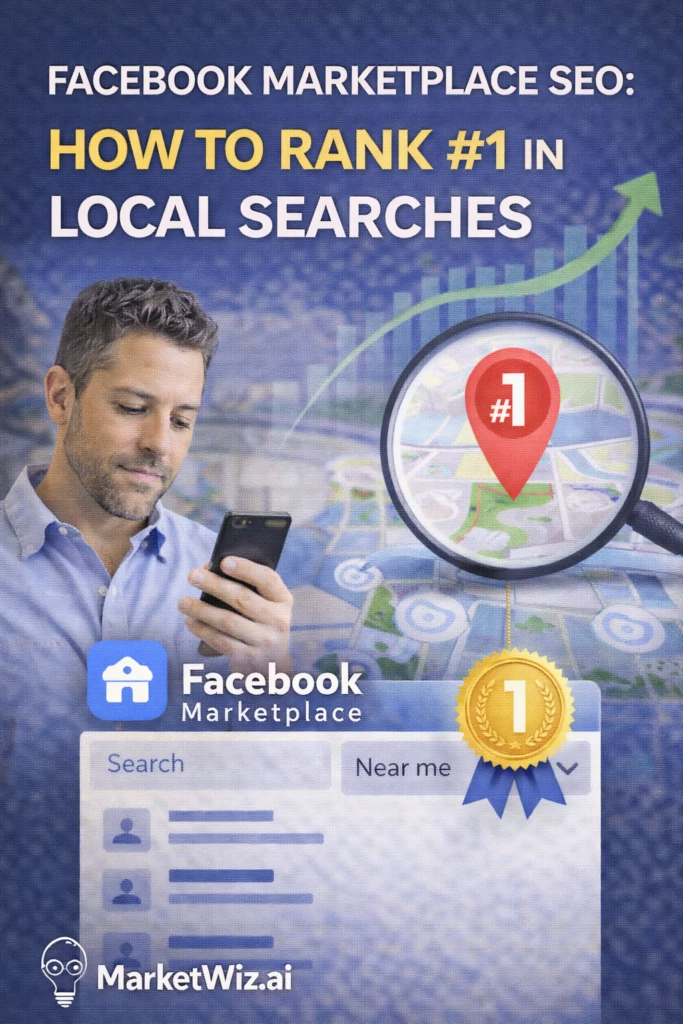
ChatGPT Image Jan 3 2026 12 52 38 PM
Facebook Marketplace SEO: How to Rank #1 in Local Searches — 2025 Playbook

Facebook Marketplace SEO: How to Rank #1 in Local Searches

Facebook Marketplace SEO: How to Rank #1 in Local Searches is a step-by-step ranking playbook for getting more views and messages by optimizing keywords, location, freshness, photos, pricing, engagement signals, and response speed.

Marketplace Ranking Stack: Keyword Title Match Correct Category Location Accuracy Freshness Engagement Fast Replies

Note: Always follow Facebook’s Commerce Policies and Marketplace rules. Avoid spammy reposting, misleading claims, prohibited items, and duplicate content patterns that can trigger limits.

Introduction

Facebook Marketplace SEO: How to Rank #1 in Local Searches matters because Marketplace isn’t just “post and hope.” Facebook uses ranking signals—just like a search engine—to decide which listings show up first for buyers near you.

If your listing is stuck with low views, it’s usually not because the product is bad. It’s because your listing is missing one or more ranking signals:

  • Keyword match (title relevance)
  • Location confidence (buyers near you)
  • Freshness (new/renewed posts)
  • Engagement (clicks, saves, messages)
  • Seller trust (profile signals + responsiveness)

This playbook breaks down Marketplace SEO the same way we’d break down Google ranking—only simpler, faster, and more actionable.

Expanded Table of Contents

1) How Marketplace rankings work (simple model)

Facebook Marketplace SEO can be simplified into one ranking equation:

Ranking = Relevance × Location × Freshness × Engagement × Trust

If you want to rank #1 in local searches, you don’t need to “hack” anything—you just need to increase each multiplier.

Ranking factorWhat Facebook wantsWhat you should do
RelevanceListings that match the search termUse buyer keywords in the title
LocationListings close to the buyerSet accurate location + target nearby cities
FreshnessNew or recently renewed inventoryRenew/repost on a schedule
EngagementListings people click, save, messageImprove photos, price, and CTA
TrustReliable sellers with good behaviorFast response, clean profile, consistency

Goal: Build a listing that gets clicked more than competitors, answered faster than competitors, and renewed more consistently than competitors.

2) Keyword strategy: titles that rank

Facebook Marketplace SEO: How to Rank #1 in Local Searches starts with one thing: the title.

The #1 title rule

Put the buyer’s keyword first — then add the differentiator.

High-ranking title formula

[Primary Keyword] + [Model/Type] + [Top Benefit] + [Local Intent Hook]

Examples:

  • “Memory Foam Mattress — New, Delivered Today (Rochester)”
  • “Sectional Sofa — Like New, Smoke-Free Home (Pickup Today)”
  • “15 Acres Land — Owner Financing, Build Ready (Near Waverly)”
  • “Portable Wellness Device — Clean, Tested, Pickup Today”

What NOT to do

  • Overstuffing keywords (looks spammy)
  • All caps, excessive punctuation, weird symbols
  • Vague titles (“Great deal!!!”)
  • Titles that hide the actual item/service

Marketplace SEO tip: If the keyword isn’t in the title, you’re relying on Facebook to guess what you’re selling. Don’t.

3) Category strategy: why the wrong category kills views

Category is Marketplace’s “index.” If you pick the wrong category, you’ll rank poorly even with a great title.

Category rules that help you rank

  • Choose the most specific category available
  • Match category to buyer intent (not seller convenience)
  • Don’t “category hop” daily; it can look unstable

Quick test: Search your keyword. Look at what category the top listings are using. That’s your baseline.

4) Location SEO: showing up “near me”

Marketplace is local by default. That means your location settings are not optional SEO—they’re core ranking.

Location ranking checklist

  • Use a real city/town (not vague region names)
  • Keep location consistent for each account/profile
  • Target nearby “search cities” by posting variations where allowed
  • Use location language in description naturally (not spam)

Local intent trick: Add a single “service/pickup area” line: “Serving: City A, City B, City C (pickup/delivery options).”

5) Freshness: renew vs repost (without getting flagged)

Freshness is one of the most underrated parts of Facebook Marketplace SEO: How to Rank #1 in Local Searches. Even great listings sink as they age.

Renewing vs reposting

ActionWhat it doesBest forRisk level
RenewRefreshes an existing listingSame inventory, same photosLow
RepostCreates a fresh new listingNew variations, new cities, new anglesMedium if repetitive

Safe freshness schedule (practical)

Daily: Reply fast + update availability
2–3x/week: Renew top performers (where allowed)
Weekly: Refresh photos or first image
Every 10–21 days: Repost with new title + new photo order + updated description

Anti-flag rule: Don’t repost identical listings with identical titles, photos, and descriptions in rapid cycles. Variation is safety.

6) Photo SEO: what images increase clicks

Photos are your CTR (click-through rate). CTR is an engagement signal. Engagement boosts ranking. That means photos are SEO.

Facebook Marketplace photo ranking rules

  • Use the clearest, most attractive photo as image #1
  • Show context (scale/room/hand-held) not just close-ups
  • Use 6–10 photos for higher ticket items
  • Include one “proof” photo (tag, receipt blur, packaging, serial label if safe)

Photo order formula

1) Hero shot (cleanest, clearest)
2) Angle #2 (shows size/shape)
3) Proof photo (condition/brand detail)
4) Close-up (texture/features)
5) Accessories/what’s included
6) Any flaw disclosure (builds trust)

Trust = ranking: Listings that look real and transparent get more clicks and messages. That behavior pushes you up.

7) Pricing psychology that boosts engagement

Price doesn’t just affect sales—it affects views. If your price is out of market, your listing gets ignored, engagement drops, and your rank falls.

Engagement-friendly pricing moves

  • Use “range anchors” in description (what it normally costs vs yours)
  • Offer 2 options (standard vs premium)
  • Use clean numbers ($149, $199) instead of messy numbers
  • When applicable: highlight delivery/pickup clarity

Pro move: Add a “today price” line that creates urgency without hype: “This week: $___ (while inventory lasts).”

8) Engagement signals that move you up fast

Marketplace rewards listings that get:

  • clicks
  • saves
  • shares
  • messages
  • profile visits

How to increase engagement without spam

Improve the “click”

  • strong photo #1
  • keyword-first title
  • clean pricing

Improve the “message”

  • clear availability
  • answer common questions in description
  • single simple CTA (“Message for pickup times.”)

Engagement flywheel: Better clicks → more messages → higher rank → more impressions → more clicks.

9) Response speed and scripts (ranking + conversions)

Facebook tracks responsiveness. Fast response is both a trust signal and a conversion signal.

Fast first reply script (copy/paste)

Hey! Yes, it’s available.
Quick question so I can help fast:
Are you looking for pickup today or delivery?
If you tell me your city and preferred time, I’ll confirm the next step.

Qualification script (prevents time-wasters)

Happy to help — two quick questions:
1) What city are you in?
2) When are you hoping to get it?
Then I can confirm the best option.

Ranking note: If you ignore messages or reply slowly, your listing often loses momentum fast.

10) Anti-flag rules: how to scale safely

Scaling Marketplace SEO is about consistency without looking like automation spam.

Anti-flag rules (practical)

  • Rotate creatives: change image order and hero image regularly
  • Rotate titles: same item, different buyer keyword angles
  • Rotate descriptions: keep facts consistent, vary phrasing
  • Don’t mass-duplicate the same listing across many cities simultaneously
  • Keep a stable profile: consistent identity, no sudden behavioral spikes

Safe variation rule: Maintain the same truth and product details, but vary the “angle”: delivery, condition, financing, availability, bundle, warranty, etc.

11) Copy/paste checklist for every listing

Marketplace SEO checklist

  • Keyword-first title
  • Correct category
  • Accurate location
  • Strong photo #1
  • 6–10 photos total
  • Clear price + what’s included
  • Availability and next step
  • Trust line (process/policies)

Freshness + engagement checklist

  • Renew schedule (2–3x/week)
  • Repost schedule (10–21 days)
  • Respond fast (minutes)
  • Update availability daily
  • Use 1 simple CTA
  • Rotate titles/images periodically
  • Track top performers

Execution tip: Marketplace SEO is a system. The best sellers win because they’re consistent.

12) KPIs: how to measure ranking improvements

Marketplace SEO KPIs
• Views per listing (daily/weekly)
• Saves per listing
• Messages per 100 views (conversion)
• Response time (minutes)
• Listing lifespan (how long it stays strong)

Channel KPIs
• Leads per day/week
• Cost per lead (if boosting/ads involved)
• Close rate (leads → sales)
• Revenue per listing / per category

North Star: Messages per 100 views + response time. If these improve, your rankings usually follow.

13) 30–60–90 day rollout plan

Days 1–30 (Foundation)

  1. Standardize listing template (title formula + description blocks).
  2. Fix category and location strategy.
  3. Create 3 title variations per product/service.
  4. Implement fast reply scripts and reduce response time.
  5. Track baseline KPIs: views, saves, messages.

Days 31–60 (Freshness + engagement)

  1. Set renew schedule for top listings.
  2. Start controlled reposting with variation.
  3. Improve photo sets and rotate hero images.
  4. Refine pricing and add clear “what’s included.”
  5. Identify top keywords from buyer messages and build titles around them.

Days 61–90 (Scale)

  1. Scale the best categories and best titles.
  2. Build a content bank of photo variations and description angles.
  3. Automate reporting and performance tracking.
  4. Create a compliance + anti-flag SOP.

End goal: A repeatable Marketplace SEO engine that keeps you near the top consistently.

14) 25 Frequently Asked Questions

1) What is Facebook Marketplace SEO?

Facebook Marketplace SEO is optimizing titles, categories, location, freshness, photos, engagement, and response speed to rank higher in local Marketplace searches.

2) How do you rank #1 in local searches?

Strong keyword titles, correct category, accurate location, consistent freshness (renew/repost), high engagement, and fast responses.

3) Does Marketplace use keywords?

Yes. Titles are the most important place for keyword matching.

4) How important is the category?

Very. Wrong category can reduce visibility dramatically.

5) How important is location?

Marketplace is local-first, so location is core ranking.

6) How often should I renew listings?

Where available, 2–3 times per week for top performers is a common starting point.

7) How often should I repost?

Every 10–21 days with variation (new title, new hero image, updated wording).

8) Will reposting get me flagged?

It can if you duplicate identical content too frequently. Use variation and spacing.

9) How many photos should I use?

Typically 6–10 for higher-ticket items; enough to answer questions before they ask.

10) Does photo order matter?

Yes. The first photo drives clicks, which drives rank.

11) Do videos help Marketplace ranking?

They can improve engagement, which can improve ranking.

12) Does response time affect ranking?

Fast responses improve trust and conversion, which supports ranking momentum.

13) What’s the best first reply message?

A short confirmation + 1–2 questions + next step (pickup/delivery/time).

14) How do I avoid low-quality leads?

Ask location and timeline early, and include requirements in your description.

15) Should I show price or say “message for price”?

Showing price is usually better for trust and filtering time-wasters.

16) What keywords should I use?

Buyer language: what they type (brand, type, size, location, delivery, financing).

17) Should I use emojis in titles?

Use sparingly. Too many can reduce professionalism and look spammy.

18) Does Marketplace punish duplicate listings?

Yes—especially when identical content is repeated aggressively.

19) Can I rank in multiple cities?

Yes, but do it carefully with variation and reasonable posting behavior.

20) What’s the biggest Marketplace SEO mistake?

Vague titles and inconsistent reposting that looks spammy.

21) What’s the fastest ranking improvement?

Fix title keywords and photo #1, then renew/repost with variation.

22) How do I track what’s working?

Views, saves, messages per 100 views, and response time.

23) Are reviews important on Marketplace?

Trust signals help engagement and conversions; strong trust tends to support ranking momentum.

24) Does pricing affect ranking?

Yes. Better engagement from competitive pricing can improve ranking.

25) What’s the simplest Marketplace SEO system?

3 title variations + strong photos + renew schedule + fast replies + controlled reposting.

15) 25 Extra Keywords

  1. Facebook Marketplace SEO: How to Rank #1 in Local Searches
  2. Facebook Marketplace SEO
  3. rank on Facebook Marketplace
  4. Facebook Marketplace local search
  5. Marketplace algorithm
  6. Marketplace listing optimization
  7. Marketplace title keywords
  8. Marketplace category strategy
  9. Marketplace location settings
  10. Marketplace renew listing
  11. Marketplace repost strategy
  12. Marketplace listing freshness
  13. Marketplace engagement signals
  14. Marketplace views increase
  15. Marketplace messages increase
  16. Marketplace photo optimization
  17. Marketplace response time
  18. Marketplace ranking factors
  19. Facebook Marketplace lead generation
  20. Marketplace anti-flagging
  21. Marketplace posting schedule
  22. Marketplace SEO checklist
  23. Marketplace conversion rate
  24. local Marketplace marketing
  25. how to sell faster on Marketplace

© 2025 Your Brand. All Rights Reserved.
General information only—follow Facebook policies and local regulations. Results vary based on category, competition, and execution.

Facebook Marketplace SEO: How to Rank #1 in Local Searches Read More »
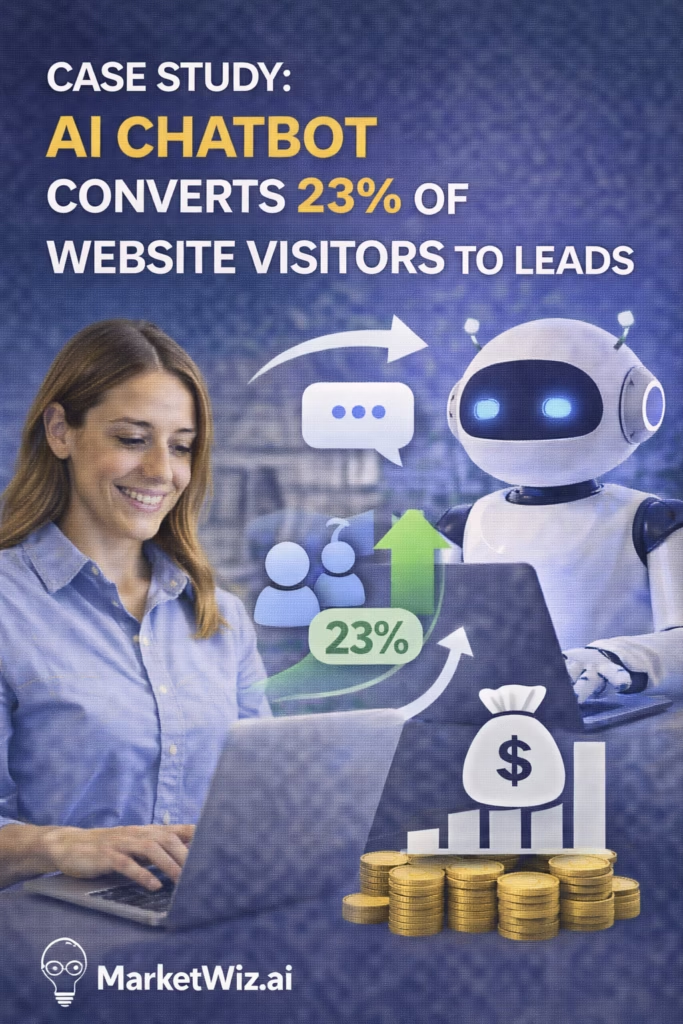
Case Study: AI Chatbot Converts 23% of Website Visitors to Leads

ChatGPT Image Jan 3 2026 12 52 35 PM
Case Study: AI Chatbot Converts 23% of Website Visitors to Leads — 2025 Playbook

Case Study: AI Chatbot Converts 23% of Website Visitors to Leads

Case Study: AI Chatbot Converts 23% of Website Visitors to Leads shows how an AI chat widget turned high-intent visitors into qualified leads by combining speed, clarity, trust, and frictionless capture.

Conversion Drivers: Instant Answers Qualification Trust Proof Simple Capture Fast Routing

Important: This is an anonymized, composite-style case study for educational purposes. Results depend on traffic intent, offer clarity, and setup quality.

Introduction

Case Study: AI Chatbot Converts 23% of Website Visitors to Leads is about one of the biggest missed opportunities in local business marketing:

  • Visitors land on your site…
  • They have a question…
  • No one answers fast…
  • They bounce and go to a competitor.

This business solved that problem by installing an AI chatbot that did four jobs extremely well:

  1. Answered questions instantly (so visitors didn’t leave)
  2. Qualified intent (so sales didn’t waste time)
  3. Captured contact info smoothly (without “form fatigue”)
  4. Routed leads to the right next step (booked call, quote request, or direct contact)

Result: A 23% visitor-to-lead conversion rate for high-intent traffic—while reducing manual inbox work and improving speed-to-lead.

Expanded Table of Contents

1) Case study snapshot (before/after)

Metric / behaviorBefore chatbotAfter chatbotWhat changed
Visitor engagementQuestions unanswered → bounceInstant answers → longer sessionsSpeed removed friction
Lead captureForm fatigue / low completionConversational captureChat felt easier than forms
Speed-to-leadHours (business hours only)Seconds (24/7)Always-on responses
Lead qualityMixed (lots of tire-kickers)Higher (qualified)Questions filtered low intent
Visitor-to-lead conversionLower baseline23%Offer + flow + trust + routing

Key takeaway: This wasn’t “magic AI.” It was smart conversion design delivered through chat.

2) Why 23% happened (and when it won’t)

A 23% visitor-to-lead rate is most realistic when traffic is high-intent. This case study’s traffic included:

  • branded searches (people already looking for the business)
  • service-specific pages (clear problem and clear solution)
  • local intent visitors (ready to contact someone nearby)

Four conditions that made 23% possible

1) Clear offer

Visitors immediately understood what they get and what happens next.

2) Fast answers

Questions were answered instantly—no waiting, no bouncing.

3) Trust proof

Reviews, guarantees, policies, and process were shown inside chat.

4) Low friction capture

Contact info was requested at the right time, not immediately.

When you won’t see 23%: cold traffic with unclear offers, weak landing pages, no proof, slow follow-up, or a chatbot that asks for contact info too early.

3) The exact chatbot setup

Placement

  • Sticky widget on all pages
  • High-priority triggers on “money pages” (service pages, pricing, contact)
  • Mobile-first layout and readable prompts

Goals

  • Primary: capture qualified leads and drive bookings
  • Secondary: reduce repetitive questions and manual inbox workload

Core promise shown in the widget

Example: “Get a fast quote + next available time slots in under 60 seconds.”

Design principle: The chatbot didn’t “chat.” It guided.

4) The conversation flow (step-by-step)

Step 1: Identify intent with one tap

Visitors chose one of 3–5 options. This reduced typing and increased engagement.

Hi — how can I help today?
1) Get pricing / a quote
2) Book an appointment
3) Ask a quick question
4) Service area / availability
5) Something else

Step 2: Ask 2–3 qualification questions (only if needed)

Great — quick questions so I can help fast:
• What city are you in?
• What do you need help with?
• When are you hoping to do this?

Step 3: Provide an immediate “mini result”

The bot gave something useful right away: a range, availability, or recommended next step.

Based on that, most projects fall in the $___–$___ range.
Want the fastest next step:
1) Get 2–3 time slots
2) Request a detailed quote
3) Talk to a human now

Step 4: Capture contact info at the right moment

Only after value was delivered did the bot ask for contact details.

Why it worked: Visitors felt helped first—then they were willing to share info.

5) Lead capture fields that increased completion

One reason this Case Study: AI Chatbot Converts 23% of Website Visitors to Leads worked is that the bot captured the minimum viable data:

FieldRequired?Why it mattered
NameOptionalLower friction; still useful when provided
Phone OR EmailRequired (choose one)Maximized completion while enabling follow-up
City / ZIPRequiredService area validation and routing
TimelineRequiredHigh intent indicator for prioritization
NotesOptionalExtra context when visitors want to share

What they avoided: asking for too much too soon (address, long form fields, multiple steps before any value).

6) Trust elements baked into the chat

The chatbot included micro-trust signals at decision points:

  • review count and star rating
  • simple process explanation (“what happens next”)
  • policies (response times, service area, guarantees)
  • proof moments (before/after, short testimonials)
Trust snippet example:
“You’ll get a confirmation + next steps. No pressure. Fast answers. Clear pricing ranges.”

Trust principle: People don’t convert when they’re confused or unsure. Trust elements remove doubt.

7) Routing rules and handoff to humans

Routing rules

  • High-intent leads (urgent timeline, high value) → immediate notification
  • Standard leads → CRM + follow-up sequence
  • Out-of-area → polite redirect + alternate option
  • Complex questions → handoff to a human

Handoff message (copy/paste)

Thanks — I’ve got your info.
I’m looping in a specialist now so you get the best answer.
If you prefer, you can also reply with your best callback time.

Important: A chatbot must know when to stop and hand off. That’s how you keep quality high.

8) Follow-up sequences (so leads don’t leak)

Even with a high conversion rate, follow-up matters. This case used a light cadence:

Day 0: Confirmation + next steps + booking link
Day 1: Quick check-in + offer 2–3 time slots
Day 3: Helpful tip + “want the fastest option?”
Day 7: Close-the-loop message
Weekly: Nurture for longer timelines

Follow-up principle: Most leads aren’t “no.” They’re “not yet.” Follow-up converts “not yet.”

9) A/B tests that improved conversion

Test 1: Widget headline

  • A: “Hi! How can we help?”
  • B: “Get pricing + next available time slots in 60 seconds”

Winner: Outcome-driven headline (B). It told visitors exactly what they get.

Test 2: Asking for contact info too early vs after value

  • A: contact info first
  • B: value first (range/availability), then contact info

Winner: Value first (B).

Test 3: 3 questions vs 5 questions

Fewer questions increased completion. Extra questions were asked only when needed.

Optimization mindset: Reduce friction. Increase clarity. Add trust at decision points.

10) KPIs and reporting

Chatbot KPIs
• Chat open rate (% visitors who open widget)
• Engagement rate (% who click an option or type)
• Visitor-to-lead conversion (% visitors who become leads)
• Lead-to-booking rate (% leads who book)

Quality KPIs
• Qualification completion rate
• Average response time (should be near-instant)
• Handoff rate to humans (too high = bot not helpful; too low = bot not cautious)

Revenue KPIs
• Cost per lead (if paid traffic)
• Cost per booking
• Revenue per booking / close rate

North Star: Visitor-to-lead conversion + lead-to-booking rate.

11) 30–60–90 day rollout plan

Days 1–30 (Install + baseline)

  1. Choose 3–5 visitor intents (quote, booking, questions, availability).
  2. Write the qualification questions and simple answers.
  3. Add value-first responses (ranges, process, next steps).
  4. Track baseline: open rate, engagement rate, conversion.

Days 31–60 (Trust + routing)

  1. Add trust elements: reviews, guarantees, process steps.
  2. Build routing rules and human handoff triggers.
  3. Install follow-up cadence for captured leads.
  4. Start A/B tests on widget headline and capture timing.

Days 61–90 (Optimization)

  1. Optimize questions (fewer required fields).
  2. Improve intent paths that underperform.
  3. Increase booking rate with time-slot offers.
  4. Document an SOP so it stays consistent.

End goal: A conversion system that captures leads 24/7 and routes them to bookings reliably.

12) 25 Frequently Asked Questions

1) What is this Case Study: AI Chatbot Converts 23% of Website Visitors to Leads?

It’s a breakdown of how an AI chatbot improved website conversion by capturing and qualifying leads with low friction.

2) Is 23% conversion possible for any website?

It’s most realistic with high-intent traffic and a clear offer. Cold traffic and vague offers will be lower.

3) What’s the fastest improvement a chatbot can create?

Instant answers and instant lead capture—especially after hours.

4) Do chatbots annoy visitors?

They can if they interrupt or ask too much. This case used helpful prompts and value-first responses.

5) Should I replace my contact form?

You can keep it, but chat can outperform forms for many visitors.

6) What questions should the bot ask?

City/ZIP, what they need, and timeline. Everything else should be optional or conditional.

7) When should the bot ask for contact info?

After it delivers value (range, availability, next steps), not immediately.

8) What trust elements help most?

Reviews, guarantees, clear process steps, and transparent expectations.

9) How do you keep the bot from making mistakes?

Use templates, approved answers, and escalation rules for unclear scenarios.

10) Should the bot offer booking links?

Yes—booking prompts can significantly increase conversion.

11) What if visitors want a human?

Offer a human handoff option early in the flow.

12) How do you route leads?

By intent, service area, timeline, and value level.

13) How do you measure success?

Visitor-to-lead conversion and lead-to-booking rate.

14) What’s a good open rate for the widget?

It varies, but improving the headline and placement typically increases it.

15) What’s the best widget headline style?

Outcome-driven: “Get pricing + time slots in 60 seconds.”

16) Does the chatbot need to be on every page?

Usually yes, but you can prioritize money pages with stronger triggers.

17) What about mobile users?

Mobile-first design matters: short prompts, tap options, minimal typing.

18) Can a chatbot increase lead quality?

Yes—qualification questions filter tire-kickers.

19) How do you avoid asking too many questions?

Ask only what you need to route and quote. Make the rest optional.

20) Should the bot show pricing ranges?

Ranges often reduce friction and increase trust when done clearly.

21) How important is follow-up?

Very. Follow-up converts “not yet” leads.

22) What follow-up cadence worked?

Day 0, Day 1, Day 3, Day 7, then weekly nurture.

23) What if my site traffic is low?

The bot still helps by capturing more of the traffic you already have.

24) What’s the biggest mistake with chatbots?

Making the bot feel pushy or asking for contact info before helping.

25) What’s the first thing to do if I want this result?

Define 3–5 visitor intents and write the value-first flow for each.

13) 25 Extra Keywords

  1. Case Study: AI Chatbot Converts 23% of Website Visitors to Leads
  2. AI chatbot lead generation
  3. website chatbot conversion rate
  4. chatbot converts visitors to leads
  5. AI lead capture chatbot
  6. conversational lead generation
  7. website chat widget conversion
  8. AI chatbot qualification flow
  9. chatbot lead capture fields
  10. reduce form abandonment
  11. increase website conversion rate
  12. speed to lead website chat
  13. after hours lead capture
  14. AI chatbot routing rules
  15. human handoff chatbot
  16. chatbot booking prompts
  17. AI appointment booking chatbot
  18. local business chatbot
  19. service business chatbot conversion
  20. chatbot trust signals
  21. chatbot A/B testing
  22. chatbot follow up sequence
  23. visitor to lead conversion
  24. 2025 chatbot case study
  25. AI website lead capture system

© 2025 Your Brand. All Rights Reserved.
General information only—results vary based on traffic quality, offer clarity, and implementation.

Case Study: AI Chatbot Converts 23% of Website Visitors to Leads Read More »

Future of Lead Generation: AI Predictions for 2026-2030

ChatGPT Image Jan 2 2026 11 15 45 AM
Future of Lead Generation: AI Predictions for 2026-2030

Future of Lead Generation: AI Predictions for 2026-2030

Future of Lead Generation: AI Predictions for 2026-2030 is your roadmap for what changes next—so your pipeline grows while competitors argue about tools.

Quick Win Stack: AI Agents First-Party Data Zero-Click Discovery Omnichannel Follow-Up

Note: These are strategic predictions and operational frameworks, not guarantees. Platform policies, privacy rules, and market conditions can change—adapt accordingly.

Introduction

Future of Lead Generation: AI Predictions for 2026-2030 starts with an uncomfortable truth: lead generation is no longer just “traffic in, form filled, sales calls out.”

From 2026 to 2030, the winning brands will treat lead gen like a decision engine:

  • AI handles the first mile: discovery, answers, pre-qualification, and scheduling.
  • Humans handle the last mile: trust, negotiation, nuance, and deal-making.
  • Data becomes the moat: first-party audiences, conversation histories, and outcome feedback loops.

This guide breaks down what will likely change, why it matters, and how to build a pipeline that keeps working even when channels shift.

Expanded Table of Contents

1) The 10 big shifts shaping the Future of Lead Generation: AI Predictions for 2026-2030

The Future of Lead Generation: AI Predictions for 2026-2030 isn’t a single “new channel.” It’s a stack of shifts happening at the same time:

Shift 1: Answers replace clicks

More buyers will get what they need without visiting your site—meaning your “lead gen surface area” expands beyond pages.

Shift 2: AI agents handle first contact

Fast, consistent, conversational follow-up becomes the default expectation.

Shift 3: Conversations become the new conversion

Lead capture moves from “forms” to “dialog.” Qualification becomes embedded in chat.

Shift 4: First-party data becomes the moat

Your own audience, messages, and outcomes matter more than rented reach.

Shift 5: Creative volume explodes

AI makes creating content easy. Distribution and differentiation become hard.

Shift 6: Personalization becomes offer-level

Not “Hi {Name},” but “Here’s the exact option for your ZIP, budget, and timeline.”

Shift 7: Proof beats persuasion

Case studies, reviews, and demos carry more weight than clever copy.

Shift 8: Platform constraints tighten

Spam patterns get punished faster. Systems must be compliant and human-like.

Shift 9: Measurement becomes probabilistic

Perfect attribution fades. You win by outcome loops, not pixel obsession.

Shift 10: Operational speed becomes the differentiator

Same offer + same budget + faster response often wins.

Bottom line: The Future of Lead Generation: AI Predictions for 2026-2030 rewards systems that turn attention into appointments quickly—across multiple surfaces.

2) Prediction map: what changes in 2026 vs 2028 vs 2030

These predictions are directional. The exact timing varies by industry, buyer behavior, and platform changes.

Time WindowWhat Becomes CommonWhat Stops WorkingWhat Winners Do
2026AI follow-up, better lead scoring, conversational forms, omnichannel routingSlow response, one-channel dependency, generic scriptsSpeed-to-lead + qualification + booking automation
2027–2028Agent-to-agent workflows, synthetic segmentation, dynamic offers by intent“Post and pray,” weak proof, inconsistent messagingFirst-party audience building + proof assets + outcome loops
2029–2030Answer-first discovery dominates; “website” becomes a reference libraryPixel-only measurement, funnel assumptions, static landing pagesDistributed presence + brand trust + conversion-by-conversation

Planning tip: Build for 2028 now. If you build for 2026 only, you’ll rebuild twice.

3) Zero-click discovery and “answer-first” lead gen

In the Future of Lead Generation: AI Predictions for 2026-2030, discovery increasingly happens where the buyer already is: search interfaces, maps, marketplaces, social feeds, and AI assistants.

What changes operationally

  • Your brand snippets matter (reviews, FAQs, pricing ranges, proof).
  • Your message response speed becomes part of “ranking,” even outside search.
  • Your offer clarity must fit in small spaces: 2 lines, 1 image, 1 CTA.

Answer-first content structure

1) One-sentence answer (clear + confident)
2) Proof (case study, review, numbers, before/after)
3) Next step (book / quote / tour / call)
4) Optional details (for people who want depth)

Rule: Make it easy to say “yes” without reading a novel.

4) AI agents become the new front desk (and SDR)

The Future of Lead Generation: AI Predictions for 2026-2030 will make “follow-up” less of a department and more of a system.

What AI agents will routinely handle

  • Instant first response
  • Qualification (ZIP, budget, timeline, preferences)
  • Scheduling (booking link + confirmations)
  • FAQ handling (pricing ranges, availability, process)
  • Nurture (weekly updates, new inventory, reminders)

What humans will still own

  • Complex objections and negotiation
  • High-ticket trust building
  • Edge cases and compliance-sensitive scenarios
  • Closing and relationship management

Implementation warning: AI agents that talk too much lower conversions. Short, question-based flows win.

“Good agent” conversation pattern

Lead: "Is it available?"
Agent: "Yes. Quick questions so I send the right options:
1) What city/ZIP?
2) Budget range?
3) Timeline? (ASAP / this week / this month)
Then I’ll send matches + next step."

5) Intent signals evolve: from clicks to conversations

From 2026–2030, intent isn’t just pages visited. In the Future of Lead Generation: AI Predictions for 2026-2030, intent becomes a blend of:

Behavioral intent

  • Multiple “availability” questions
  • Asking about timeline, financing, logistics
  • Booking interactions (calendar, call, application)

Language intent

  • Keywords like today, price, deposit, tour, quote
  • Preference clarity (neighborhood, size, features)
  • Objection patterns (price, trust, timing)

Simple intent scoring template (copy/paste)

INTENT SCORE (0–100)

+30 "ASAP / today / this week"
+25 Asked to schedule / tour / call
+15 Asked about price AND availability
+10 Provided budget range
+10 Provided location/ZIP
+10 Responded within 10 minutes

NEGATIVES
-20 "Just looking / browsing"
-15 No response after 2 follow-ups
-10 Outside service area / not ICP

Note: This is how the Future of Lead Generation: AI Predictions for 2026-2030 shifts from vanity tracking to revenue outcomes.

6) First-party data becomes the unfair advantage

The more platforms restrict tracking and targeting, the more valuable your own data becomes. In the Future of Lead Generation: AI Predictions for 2026-2030, first-party data is the moat.

What counts as first-party data

  • Your email/SMS list
  • Your inbound conversations and transcripts
  • Lead outcomes (booked, showed, closed, lost)
  • Preferences (ZIP, budget, timeline, product/service)
  • Content engagement inside your owned channels

How to build it fast

  • Offer a “best matches” list or weekly inventory updates
  • Use a conversational opt-in: “Want updates for your ZIP + budget?”
  • Use forms only after the lead is warmed by chat
  • Tag every conversation with structured fields (ZIP, budget, timeline)

Compliance note: Always follow consent rules and platform policies for SMS/email outreach.

7) Personalization at scale: dynamic offers, not dynamic names

In the Future of Lead Generation: AI Predictions for 2026-2030, personalization shifts from “merge tags” to “fit-based offers.”

What personalization really means

  • Send options for the lead’s exact ZIP cluster
  • Adjust the next step based on timeline (ASAP vs 90+ days)
  • Use proof relevant to their category (local service vs high-ticket)
  • Offer the right format (call, quote, walkthrough video, or quick checklist)

Dynamic next-step routing

Lead TypeBest Next StepAutomation Action
High intent (ASAP)Book call / tourFast-lane alert + booking link
Medium intent (30–90 days)Send 2–3 matches + nurtureShort sequence + weekly updates
Low intent (90+ days)Education + trust buildingMonthly value content + reminders
Poor fitPolite reroute/disqualifyOffer alternatives or close loop

Winner behavior: personalize the decision path, not the greeting.

8) Creative production explodes—distribution becomes the bottleneck

AI makes content creation cheap. That means from 2026–2030, the constraint becomes:

  • Placement strategy (where to show it)
  • Iteration speed (how fast you test)
  • Consistency (daily presence beats occasional bursts)

High-performance content loop

1) Create 10 variants (angles, hooks, visuals)
2) Distribute daily (multiple surfaces)
3) Measure replies + booked calls (not likes)
4) Keep winners, kill losers
5) Feed outcomes back into scripts + scoring

Trap: posting more content without better follow-up just creates more unconverted attention.

9) Trust signals: why proof beats persuasion

As AI-generated marketing increases, buyers become more skeptical. In the Future of Lead Generation: AI Predictions for 2026-2030, proof becomes the differentiator.

High-leverage proof assets

  • Before/after examples
  • Short case studies (problem → process → result)
  • Testimonials with specifics (time saved, leads gained)
  • Process transparency (what happens after you message)
  • Authority indicators (reviews, certifications, local presence)

Case study mini-template

1) Who it was for (industry + situation)
2) What changed (system or process)
3) Results (qualified leads, booked calls, revenue impact)
4) Timeline (how long it took)
5) What we did differently (the “why it worked”)

Rule: Buyers trust receipts more than rhetoric.

10) Measurement: privacy-first attribution and outcome loops

Attribution will remain imperfect. The Future of Lead Generation: AI Predictions for 2026-2030 favors teams that measure what matters:

What to measure weekly

Pipeline KPIs
• Inquiries
• Reply rate
• Qualified rate
• Booked calls
• Show rate
• Close rate

Speed KPIs
• Time-to-first-response
• Fast-lane response time

Quality KPIs
• % leads with ZIP + budget + timeline captured
• Ghost rate (no reply after 2 touches)
• False positives (hot leads that never convert)

The revenue feedback loop (the real advantage)

  • Tag closed-won leads with the signals they showed
  • Identify which scripts and routes produced booked calls
  • Adjust scoring weights monthly
  • Update follow-up sequences based on drop-off points

Translation: You don’t need perfect tracking to win—just faster learning than competitors.

11) Playbooks by business type (Local, B2B, Ecommerce)

Playbook A: Local services (home services, wellness, repairs)

  • Primary surfaces: Maps, marketplaces, local groups, short-form video
  • Primary conversion: call/quote booking
  • Core qualifier: ZIP + service + timeline
Local Service Fast Lane Script
“Got it — we can help.
What’s your ZIP code and what day are you trying to get this done?
If it’s urgent, I can get you a quick call slot today.”

Playbook B: B2B services (agency, software-like offers, consulting)

  • Primary surfaces: search/answers, LinkedIn-style environments, email, webinars
  • Primary conversion: booked demo/call
  • Core qualifier: role + size + budget + timeline
B2B Qualifier Script
“Happy to help — quick questions so I tailor the plan:
1) What industry + company size?
2) What’s your main goal (leads / sales / ops)?
3) What’s your timeline and budget range?
Then I’ll share the best-fit approach + next steps.”

Playbook C: Ecommerce / direct response

  • Primary surfaces: short-form video + creators + AI-targeted creative testing
  • Primary conversion: checkout
  • Core qualifier: product intent + objection handling
Ecom Objection Script
“Totally fair question.
What matters most to you: price, speed of delivery, or performance?
I’ll point you to the best option and show you proof.”

12) The 2026–2030 lead gen tech stack (simple version)

The Future of Lead Generation: AI Predictions for 2026-2030 doesn’t require 50 tools. It requires a clean system:

LayerPurposeMust-Have Features
DistributionGet in front of buyersMulti-surface posting, variation, scheduling
ConversationConvert interest into actionInstant replies, qualification, handoffs
CRMRouting + pipeline controlStages, tags, tasks, automation triggers
SchedulingBook appointmentsCalendar links, reminders, reschedule paths
MeasurementImprove outcomesKPIs, outcome tagging, feedback loops

Stack rule: If it doesn’t improve response time, qualification, or booking rate, it’s optional.

13) KPIs that matter (and vanity metrics to ignore)

Metrics that matter

  • Inquiry → Reply rate
  • Reply → Qualified rate
  • Qualified → Booked call/tour/quote
  • Booked → Show rate
  • Show → Close rate
  • Median time-to-first-response

Vanity metrics (use cautiously)

  • Impressions without replies
  • Clicks without conversations
  • Likes without bookings
  • Email opens (increasingly noisy)

Reality: From 2026–2030, many “visibility” metrics inflate while conversions stay flat. Follow the bookings.

14) SOP: Build a lead machine that survives channel changes

Here’s a resilient SOP aligned to the Future of Lead Generation: AI Predictions for 2026-2030:

Step 1: Define your qualification fields

  • Location/ZIP
  • Budget range
  • Timeline
  • Service/product fit

Step 2: Create tier-based routing

  • Fast lane: urgent + high fit → immediate action
  • Warm: fit but not urgent → nurture + soft outreach
  • Cold: low intent → automation only

Step 3: Build a 48-hour follow-up sequence

Most leads require multiple touches. Ensure the system follows up with simple questions and stops when appropriate.

Step 4: Add proof at the right moment

  • Before booking: short proof (review/case)
  • After booking: what to expect
  • After no-response: trust-building plus an easy choice question

Step 5: Run monthly feedback loop

  • Which signals predicted closed-won?
  • Which scripts led to bookings?
  • Where do leads drop off?

If you do nothing else: improve response speed and qualification capture. That’s the center of the Future of Lead Generation: AI Predictions for 2026-2030.

15) 30–60–90 day rollout plan

Days 1–30 (Foundation)

  1. Implement instant reply + qualifier questions (ZIP, budget, timeline).
  2. Set up CRM stages and routing rules (Cold/Warm/Hot/Fast Lane).
  3. Create a 48-hour follow-up sequence.
  4. Start tracking core KPIs (reply rate, qualified rate, bookings).

Days 31–60 (Stability)

  1. Add lead scoring (fit + intent).
  2. Build proof assets (3 mini case studies + review highlights).
  3. Expand distribution across 2–3 surfaces (not just one channel).
  4. Reduce false positives with negative scoring and better questions.

Days 61–90 (Optimization)

  1. Run monthly outcome feedback loop and adjust weights/scripts.
  2. Improve personalization (offer-level, not name-level).
  3. Build nurture lanes for 30–90 and 90+ day timelines.
  4. Document everything as an SOP for consistent execution.

Expected outcome: a pipeline that’s more stable, faster, and less dependent on any single channel.

16) 25 Frequently Asked Questions

1) What does Future of Lead Generation: AI Predictions for 2026-2030 mean?

It refers to how lead generation will evolve from 2026 to 2030 as AI agents, answer-first discovery, privacy shifts, and conversational funnels become standard.

2) Will AI replace human sales teams?

AI will automate large parts of qualification and scheduling, but humans will still handle trust, nuance, and closing complex deals.

3) What changes first: traffic or conversion?

Conversion changes first—because speed-to-lead, routing, and scripts improve immediately when automated well.

4) What is zero-click discovery?

When buyers get answers directly on platforms without visiting your website, shifting the focus to distributed presence and proof.

5) Do websites matter less in 2026–2030?

They still matter, but more as credibility and reference hubs rather than the only conversion point.

6) What’s the biggest lead gen advantage from 2026–2030?

First-party data plus fast, conversational follow-up that moves leads to booking quickly.

7) What does “conversational funnel” mean?

A funnel where the lead is qualified through chat and routed to the right next step (call, quote, tour) without friction.

8) What’s the biggest automation mistake?

Automating replies without routing leads to action (tasks, booking links, human escalation).

9) How fast should response times be?

Minutes when possible—especially for high-intent inquiries.

10) What should the first message include?

Confirm availability/helpfulness, ask 1–3 qualifier questions, and offer a next step.

11) Will paid ads still work?

Yes, but costs and competition can increase; conversion systems and creative iteration speed matter more than ever.

12) What is intent scoring?

Assigning points based on buyer signals (language, urgency, behavior) to route the best leads first.

13) What is negative scoring?

Subtracting points for low-fit or low-intent patterns to reduce false positives.

14) How do you reduce ghosting?

Respond faster, ask simpler questions, follow up with choice questions, and provide proof at key moments.

15) How many follow-ups are needed?

Often 2–4 touches over 48 hours for high-intent leads, plus longer nurture for slow timelines.

16) What will matter more: content volume or offer clarity?

Offer clarity and conversion systems. Content volume without follow-up is wasted attention.

17) How do small businesses compete with big budgets?

By being faster, more consistent, and more trustworthy locally, using proof and strong follow-up systems.

18) What’s the best channel in 2026–2030?

The best channel is the one you can execute consistently with strong conversion mechanics and rapid response.

19) What KPIs should I track?

Reply rate, qualified rate, bookings, show rate, close rate, and time-to-first-response.

20) What’s changing about personalization?

It becomes offer-level: matching ZIP, budget, timeline, and preferences to the right next step and proof.

21) What is first-party data?

Data you collect directly—lists, conversations, preferences, and outcomes—owned by you.

22) How do you build first-party data quickly?

Offer updates, best-match lists, and simple opt-ins during conversations, then tag preferences in your CRM.

23) Do AI agents create compliance risk?

They can if unmanaged. Use guardrails, keep messages short, and follow consent and platform policies.

24) How often should systems be updated?

Weekly KPI checks, monthly outcome reviews, and quarterly strategy adjustments.

25) What’s the main takeaway?

The Future of Lead Generation: AI Predictions for 2026-2030 rewards teams that build fast, conversational, proof-driven systems with first-party data and continuous learning loops.

17) 25 Extra Keywords

  1. Future of Lead Generation: AI Predictions for 2026-2030
  2. AI lead generation trends 2026
  3. AI lead generation 2030 forecast
  4. AI sales agents for lead gen
  5. conversational lead generation
  6. zero click lead generation
  7. answer first marketing strategy
  8. first party data lead generation
  9. privacy first attribution
  10. omnichannel lead follow up
  11. AI lead qualification script
  12. lead scoring with intent signals
  13. negative lead scoring rules
  14. speed to lead automation
  15. AI CRM automation
  16. pipeline routing automation
  17. reduce lead ghosting
  18. booked calls automation
  19. local lead generation AI
  20. marketplace lead generation
  21. AI content distribution strategy
  22. trust signals marketing
  23. case study driven lead gen
  24. conversion by conversation
  25. lead gen tech stack 2026

© 2026 Your Brand. All Rights Reserved.
General information only—confirm privacy, consent, and platform policies before implementing automated outreach, tracking, or messaging.

Future of Lead Generation: AI Predictions for 2026-2030 Read More »

7 AI Automation Mistakes That Are Costing You Leads

ChatGPT Image Jan 2 2026 11 15 27 AM
7 AI Automation Mistakes That Are Costing You Leads

7 AI Automation Mistakes That Are Costing You Leads

7 AI Automation Mistakes That Are Costing You Leads is the “silent leak” checklist—because most automation failures don’t look like errors… they look like lower reply rates, fewer bookings, and more ghosting.

Quick Win Stack: Speed-to-Lead Routing Rules Follow-Up Feedback Loop

Note: This is general marketing/operations guidance. Always confirm consent, privacy, and platform policies for your region and channels.

Introduction

7 AI Automation Mistakes That Are Costing You Leads isn’t about “AI not working.” Most of the time, AI is doing exactly what it was told—just inside a system that’s missing the 3 things conversion needs:

  • Speed (respond fast)
  • Clarity (ask the right questions)
  • Routing (move the best leads into the next step)

If your inquiry volume is steady but bookings are down, one (or more) of these mistakes is usually the reason.

Expanded Table of Contents

1) The “leak map”: where leads disappear

Leads usually leak in one of these places:

Leak #1: Response delay

A lead arrives… and waits. By the time you respond, they’ve messaged 3 competitors.

Leak #2: No next step

Your automation answers questions but never moves the lead to booking, call, or estimate.

Leak #3: Wrong lane

Hot leads get treated like cold leads—or cold leads get spammed like hot leads.

Leak #4: No follow-up

If they don’t reply immediately, the system goes silent and the lead dies.

Good automation doesn’t just “reply.” It routes, qualifies, and books.

2) Mistake #1: Slow speed-to-lead

If your system replies in 20 minutes, you’re already late in competitive niches.

What it looks like

  • Leads message once, then disappear
  • “Still available?” messages never turn into conversations
  • Bookings are inconsistent even though inquiries exist

Fix

  • Every inquiry triggers an instant first message (under 60 seconds)
  • Use short scripts that ask 1–3 simple questions
  • Offer a clear next step: call, quote, tour, application

Non-negotiable: the first reply should land fast and feel human.

3) Mistake #2: Broken routing (hot leads go nowhere)

Many systems reply correctly—but don’t escalate the right leads.

What it looks like

  • Hot leads ask “Can I see it today?” but never get scheduled
  • Leads answer your questions… and nothing happens
  • CRM shows a pile of “New” leads with no tasks

Fix

TriggerRuleAction
Timeline = ASAP / this weekHigh intentCreate task + notify + offer booking link
Budget matches rangeHigh fitSend best options + invite to call
Asked “available today?”Fast laneCall/SMS within minutes
Outside service areaLow fitReroute to low-touch or disqualify politely

Routing rule: scores are useless unless they trigger action.

4) Mistake #3: Generic scripts that don’t qualify

“Thanks for reaching out! How can I help?” feels polite—but it doesn’t move the deal forward.

What it looks like

  • Long conversations with no booking
  • Lots of “just curious” leads
  • Agents waste time answering the same questions

Fix: use a qualifier-first script

Thanks for reaching out — I can help fast.
Quick questions so I send the right info:

1) What city/ZIP are you in?
2) What budget range are you aiming for?
3) What timeline are you working with? (ASAP / this week / this month)

Once I have that, I’ll send the best options + next steps.

Why it works: it filters and guides the lead toward an appointment.

5) Mistake #4: Automation without follow-up sequences

Most leads don’t reply on message #1. If you don’t have follow-up, you’re paying for leads you never convert.

What it looks like

  • High “delivered” but low “replied”
  • Leads stop mid-conversation
  • No-shows and reschedules increase

Fix: 48-hour follow-up sequence (copy/paste)

Touch 1 (2–3 hours later):
“Quick check — are you looking for [Option A] or [Option B]?”

Touch 2 (next morning):
“I can send 2–3 best matches — what city/ZIP should I focus on?”

Touch 3 (same day afternoon):
“If timing changed, no worries — what timeline should I work with?”

Follow-up rule: every touch should ask an easy question or give a simple choice.

6) Mistake #5: Bad data and messy fields

Your AI can’t route correctly if the data is broken. Garbage fields = garbage automation.

What it looks like

  • Leads missing phone/email
  • Locations not captured consistently
  • Duplicates everywhere
  • Leads stuck because required fields are blank

Fix: enforce “minimum viable fields”

Required fields

  • Name
  • Channel/source
  • Location (ZIP/city)
  • Budget range
  • Timeline
  • Status/stage

Automation rules

  • If missing ZIP → ask ZIP before anything else
  • If missing budget → ask a range question
  • If duplicate → merge or suppress
  • If invalid data → route to manual review

Most important: standardize field names so every workflow speaks the same language.

7) Mistake #6: Over-automation (no guardrails)

Over-automation creates two problems: it feels robotic, and it causes compliance/risk issues when the system “guesses” too much.

What it looks like

  • AI sends long paragraphs that overwhelm leads
  • AI answers the wrong question confidently
  • AI keeps messaging when the lead clearly isn’t interested

Fix: guardrails

  • Keep replies short (2–5 lines)
  • Ask clarifying questions instead of guessing
  • Stop sequences when the lead says “no” or “not interested”
  • Escalate to human when there’s urgency or complex pricing

Rule: automate the repetitive, not the delicate.

8) Mistake #7: No feedback loop to revenue outcomes

This is the mistake that keeps teams stuck forever: the system never “learns” what closes.

What it looks like

  • You don’t know which messages create booked calls
  • Lead scoring weights never change
  • Marketing blames sales; sales blames lead quality

Fix: connect signals to outcomes

  • Tag closed-won leads with: source, keywords, script path, time-to-reply
  • Review top signals monthly and adjust routing/weights
  • Track where deals drop (stage leaks)

Automation without a feedback loop is just a fancy autoresponder.

9) Fix-it checklists (copy/paste)

Speed-to-lead checklist

  • First response under 60 seconds
  • First response includes 1–3 qualifier questions
  • Clear next step included (call/booking/quote)
  • Hot-lead triggers notify a human instantly

Routing checklist

  • Lead source captured
  • ZIP/city captured
  • Budget captured
  • Timeline captured
  • Score or tier assigned (Cold / Warm / Hot / Fast Lane)
  • Each tier has a defined next action

Follow-up checklist

  • 48-hour sequence exists
  • Every follow-up asks an easy question
  • Sequence stops on “no”
  • Reschedule/no-show reminders exist

10) KPIs to prove your automation is working

Conversion KPIs
• Inquiry → Reply rate
• Reply → Qualified rate
• Qualified → Booked call rate
• Booked call → Show rate
• Show → Close rate

Speed KPIs
• Median time-to-first-response
• Fast-lane response time (minutes)

Quality KPIs
• % of leads that answer ZIP + budget + timeline
• Ghost rate (no reply after 2 touches)
• Duplicate rate / invalid data rate

If these improve, you’re not just automating—you’re converting.

11) 30–60–90 day rollout plan

Days 1–30 (Stop the leaks)

  1. Fix speed-to-lead (instant reply + qualifier questions).
  2. Implement routing triggers for hot leads.
  3. Create a 48-hour follow-up sequence.
  4. Standardize minimum viable fields in your CRM.

Days 31–60 (Improve quality)

  1. Add lead scoring (fit + intent).
  2. Create tier-based scripts (Cold/Warm/Hot/Fast Lane).
  3. Reduce duplicates and improve data capture.
  4. Track KPIs weekly and adjust scripts.

Days 61–90 (Optimize like a machine)

  1. Implement a monthly revenue feedback review.
  2. Update scoring weights based on closed-won signals.
  3. Refine routing rules to reduce false positives.
  4. Document the system as an SOP so it stays consistent.

Outcome: more replies, more booked calls, fewer no-shows, and higher close rates.

12) 25 Frequently Asked Questions

1) What are the most common AI automation mistakes?

Slow response, broken routing, generic scripts, missing follow-up, bad data, over-automation, and no feedback loop.

2) What’s the fastest fix to get more leads?

Reduce time-to-first-response and add a qualification script that moves leads toward a next step.

3) Why does speed-to-lead matter so much?

Because the buyer is contacting multiple options; the first helpful responder often wins.

4) What’s “broken routing”?

When the system replies but fails to escalate qualified/high-intent leads to a booking or human follow-up.

5) How do I qualify leads automatically?

Ask for location, budget, and timeline early; score and route based on the answers.

6) Should AI handle every message?

No. Use guardrails and escalate complex or urgent cases to a human.

7) Why do generic scripts reduce replies?

They add friction. Specific questions and clear next steps increase response rates.

8) How many follow-ups should I run?

At least 2–4 touches over 48 hours for high-intent leads.

9) What’s the best follow-up style?

Short, question-based messages with simple choices.

10) How do I reduce ghosting?

Respond faster, ask fewer questions at once, and give clear next steps.

11) What data fields are essential?

Name, source, location, budget, timeline, and lifecycle stage.

12) How do duplicates hurt automation?

They trigger conflicting sequences and lower response quality and trust.

13) What’s a “feedback loop” in automation?

Using closed-won and closed-lost outcomes to refine scripts, scoring, and routing rules.

14) How often should I review automation performance?

Weekly for KPIs, monthly for revenue outcomes and scoring weight updates.

15) What KPIs matter most?

Reply rate, qualified rate, booked call rate, show rate, close rate, and response time.

16) Can AI increase lead volume by itself?

AI improves conversions and follow-up; lead volume still depends on distribution and demand.

17) How do I prevent over-automation?

Keep replies short, avoid guessing, stop sequences on “no,” and escalate when needed.

18) What’s the best first message?

A fast, friendly reply that asks location, budget, and timeline.

19) Should I use lead scoring?

Yes—scoring helps route hot leads and protect sales time.

20) What’s a “false positive” lead?

A lead that scores hot but never responds or never converts.

21) What’s a “false negative” lead?

A lead that was scored low but would have converted—usually due to missing signals.

22) How do I fix low reply rates?

Shorten messages, respond faster, ask better questions, and offer one clear next step.

23) How do I reduce no-shows?

Use reminders, confirmations, and a reschedule path with minimal friction.

24) How long does it take to see improvements?

Often within 7–14 days after fixing speed, routing, and follow-up.

25) What’s the main takeaway?

Automation should convert—not just respond. Fix speed, routing, scripts, follow-up, data, guardrails, and feedback loops.

13) 25 Extra Keywords

  1. 7 AI Automation Mistakes That Are Costing You Leads
  2. AI automation mistakes
  3. marketing automation mistakes
  4. lead generation automation errors
  5. speed to lead automation
  6. CRM routing automation
  7. AI chatbot conversion mistakes
  8. follow up automation sequences
  9. reduce lead ghosting
  10. automated lead qualification
  11. AI lead scoring framework
  12. workflow automation for sales
  13. automation guardrails
  14. over automation problems
  15. automation KPI dashboard
  16. improve reply rate automation
  17. booked call automation
  18. no show reduction automation
  19. lead lifecycle automation
  20. pipeline automation mistakes
  21. data quality for automation
  22. CRM field standardization
  23. revenue feedback loop automation
  24. automation SOP for leads
  25. AI sales assistant mistakes

© 2026 Your Brand. All Rights Reserved.
General information only—confirm privacy, consent, and platform policies before implementing automated tracking and messaging.

7 AI Automation Mistakes That Are Costing You Leads Read More »

AI vs Virtual Assistant: Cost Breakdown for Lead Generation

ChatGPT Image Jan 2 2026 11 15 15 AM
AI vs Virtual Assistant: Cost Breakdown for Lead Generation — 2025 Playbook

AI vs Virtual Assistant: Cost Breakdown for Lead Generation

AI vs Virtual Assistant: Cost Breakdown for Lead Generation compares real costs, hidden costs, and ROI—so you can choose the right system for posting, inbox handling, qualification, follow-up, and bookings.

Decision Snapshot: AI = volume + 24/7 VA = nuance + flexibility Best = hybrid

Note: Costs vary by country, skill level, tools, and lead volume. Use the break-even math in this article to plug in your numbers.

Introduction

AI vs Virtual Assistant: Cost Breakdown for Lead Generation is one of the most practical questions a business can ask because lead generation has two “cost centers”:

  • Production costs: creating and posting content, managing listings, formatting, and updates
  • Conversion costs: responding fast, qualifying leads, following up, and booking appointments

Both AI and a virtual assistant can do parts of this work. The best option depends on:

  • lead volume (low vs high)
  • coverage needs (business hours vs 24/7)
  • complexity (simple scripts vs nuanced conversation)
  • process maturity (clear SOPs vs messy improvisation)

Goal: Pick the system that gives you the lowest cost per qualified lead and the highest booking rate—without increasing management burden.

Expanded Table of Contents

1) What lead generation tasks are we comparing?

To compare AI vs Virtual Assistant: Cost Breakdown for Lead Generation fairly, we need to break lead gen into concrete tasks.

Lead gen taskWhat it involvesBest fit (usually)
Posting / distributioncreating listings, cross-posting, refreshing, updatesAI + automation
Inbox handlinganswer FAQs, availability, routing, basic supportAI (with human fallback)
Qualificationtimeline, budget, location, intent, next stepAI + VA (depends on complexity)
Follow-upcadences, reminders, re-engagementAI automation
Appointment bookingtime slots, confirmations, remindersAI + automation
Reportingweekly metrics, pipeline summariesAI + dashboards
Edge casesangry customers, unusual requests, negotiationVA / human

Key point: AI tends to win on repeatable tasks and 24/7 coverage. A VA tends to win on nuance, judgment, and exception handling.

2) True cost model: visible vs hidden costs

Visible costs (easy to see)

  • VA wages (hourly or monthly retainer)
  • AI software (automation platform subscriptions)
  • Tools (CRM, scheduling, messaging, tracking numbers)

Hidden costs (what people forget)

  • Training time: writing SOPs, onboarding, feedback loops
  • Management time: assigning work, reviewing output, correcting mistakes
  • Coverage gaps: nights/weekends (lost leads if response is slow)
  • Turnover risk: VA replacements and re-training cycles
  • Inconsistency: variable quality from human-only execution

Rule: The cheapest option on paper often becomes the most expensive when you include management time and lost leads.

3) Virtual assistant cost breakdown

A VA can be a great solution—especially when your process is unclear and you need a human to “figure it out.” But costs scale with workload and hours.

Typical VA cost components (monthly)

  • Base pay: hourly or retainer (varies widely by region/experience)
  • Hours needed: posting + inbox + follow-up + CRM updates
  • Management time: your time reviewing and guiding
  • Quality risk: mistakes, inconsistent tone, missed follow-ups

Where VAs shine

  • complex conversations and edge cases
  • tasks that require judgment (e.g., negotiation, special requests)
  • when you don’t have SOPs yet and need someone adaptable

Where VAs struggle

  • 24/7 responsiveness (coverage gaps)
  • high volume (cost rises linearly with hours)
  • perfect consistency (humans vary by day)

Hidden VA cost: If you respond slowly outside business hours, you lose the highest-intent leads—often the ones most likely to book.

4) AI automation cost breakdown

AI systems are “front-loaded.” You invest time building templates, rules, and workflows. After that, cost scales far better than human hours.

AI cost components (monthly)

  • Software subscriptions: automation + messaging + CRM (varies)
  • Setup effort: templates, SOPs, routing rules, follow-up sequences
  • Maintenance: weekly performance review and small adjustments
  • Escalation coverage: human for edge cases

Where AI shines

  • instant first replies (speed-to-lead)
  • repeatable qualification questions
  • follow-up sequences that never forget
  • reporting and data consistency
  • scaling without adding headcount

Where AI needs guardrails

  • complex negotiation or unusual scenarios
  • high-stakes compliance language (must be approved)
  • tone control (requires templates + constraints)

Most important AI advantage: speed-to-lead + follow-up consistency—two of the biggest drivers of booked appointments.

5) Side-by-side cost + capability comparison

CategoryVirtual AssistantAI Automation
Cost scalingLinear (more hours = more cost)Non-linear (more volume often same cost)
24/7 coverageHard (needs shifts)Easy (always on)
ConsistencyVariableHigh (templates + rules)
Nuance / judgmentHighMedium (needs escalation)
Speed-to-leadDepends on availabilityMinutes (automatic)
Setup timeLowerHigher (front-loaded)
Management timeOngoingLower after setup
Best useexceptions, relationship, closingrepetition, volume, follow-up

Decision shortcut: If you have high lead volume or need 24/7 response, AI wins quickly. If you have low volume and messy processes, a VA can be a faster start.

6) Break-even math (copy/paste formulas)

To compare AI vs Virtual Assistant: Cost Breakdown for Lead Generation in your business, use these simple formulas.

Formula A: Cost per lead handled

Cost Per Lead Handled = Monthly Cost / Leads Handled Per Month

Formula B: Cost per booked appointment

Cost Per Booking = Monthly Cost / Booked Appointments Per Month

Formula C: Break-even point (AI vs VA)

Break-Even Leads = (Monthly AI Cost - Monthly VA Cost) / (VA Cost Per Lead - AI Cost Per Lead)

Formula D: Value of speed-to-lead

Extra Bookings From Faster Response = (Leads * Booking Rate After) - (Leads * Booking Rate Before)
Extra Revenue = Extra Bookings * Average Profit Per Booking

What most businesses discover: The “value of speed-to-lead” alone often justifies AI, even before factoring time savings.

7) The best model for most businesses: hybrid

For most real businesses, the winner is not “AI or VA.” It’s a split:

AI handles

  • instant replies
  • qualification questions
  • follow-up cadences
  • routing + tagging
  • reporting

VA (or human) handles

  • edge cases + complaints
  • negotiation
  • VIP leads
  • closing calls
  • exceptions and special offers

Hybrid advantage: You get the cost scaling + 24/7 coverage of AI, with the nuance and relationship skills of a human.

8) Templates and SOPs (so either option works)

Lead qualification mini-SOP

Whether you use AI or a VA, these 4 questions increase booking rate:

  1. Location: “What city are you in?”
  2. Timeline: “When do you want this done?”
  3. Budget/fit: “What range are you aiming for?”
  4. Next step: “Want to book a quick call or get 2–3 time slots?”

Instant first reply (copy/paste)

Hey! Thanks for reaching out — happy to help.
Quick 3 questions so I can give the fastest, most accurate next step:
1) What city are you in?
2) What are you looking for (quick summary)?
3) When are you hoping to do this?

If you want, I can send the next 2–3 available time slots.

Follow-up cadence (simple and effective)

Day 0: Instant first reply + questions
Day 1: Quick check-in + time slots
Day 3: Value tip + ask one question
Day 7: Close-the-loop message
Weekly: Light nurture (for longer timelines)

Automation note: A follow-up system that never forgets is one of the fastest ways to lower cost per booking.

9) KPIs to track ROI

Core KPIs
• Speed-to-first-response (minutes)
• Reply rate (% who respond after first message)
• Qualification rate (% who answer key questions)
• Booking rate (% leads who book)
• Cost per booking

Secondary KPIs
• No-show rate
• Close rate (% booked → sold)
• Revenue per booked appointment
• Lead source mix (where winners come from)

Most important KPI stack: Response time → booking rate → cost per booking. If these improve, ROI improves.

10) 30–60–90 day rollout plan

Days 1–30 (Foundation)

  1. List all lead-gen tasks and pick the top 5 repetitive ones.
  2. Write scripts: first reply, price question, qualification, booking.
  3. Set your KPIs and track baseline for 2 weeks.
  4. If using a VA: train on SOPs and response standards.
  5. If using AI: build templates and routing rules.

Days 31–60 (Automation + measurement)

  1. Install follow-up sequences and booking prompts.
  2. Tag leads by source and track booking rates by channel.
  3. Improve response SLA (goal: minutes, not hours).
  4. Document what messages convert and standardize them.

Days 61–90 (Scale)

  1. Scale the channels with the highest booked-appointment rate.
  2. Add exception handling rules (handoff to human/VA).
  3. Reduce cost per booking with better qualification.
  4. Create a weekly “marketing ops review” ritual.

End goal: Lead gen runs as a system—predictable, measurable, and less dependent on human hours.

11) 25 Frequently Asked Questions

1) What is AI vs Virtual Assistant: Cost Breakdown for Lead Generation?

It’s a cost and ROI comparison between AI automation and hiring a VA for lead generation tasks.

2) Which is cheaper overall?

It depends on volume and coverage needs. AI often wins for high volume and 24/7 response; a VA can win for low volume and nuance.

3) What’s the biggest hidden cost of a VA?

Management time, training, and coverage gaps that cause lost leads.

4) What’s the biggest hidden cost of AI?

Setup time and the need for good templates and escalation rules.

5) Can AI fully replace a VA?

AI can replace many repetitive tasks, but humans still handle edge cases and closing best.

6) What tasks should AI handle first?

Instant first replies, qualification questions, follow-up, routing, and reporting.

7) What tasks should a VA handle?

Edge cases, negotiation, VIP leads, and tasks requiring judgment.

8) How do I compare ROI correctly?

Track cost per booking and the value of faster response time.

9) Does speed-to-lead really increase bookings?

In most lead-gen environments, faster response increases contact rate and booking rate.

10) What’s the best first reply structure?

Confirm help, ask 2–3 questions, and offer the next step (slots/call).

11) How do I avoid sounding robotic with AI?

Use short templates, controlled tone, and a personalized line based on the lead’s info.

12) What if my leads are complex?

Use AI for triage and hand off to a human/VA for detailed cases.

13) How do I calculate break-even?

Compare cost per lead handled and cost per booking, then model volume growth.

14) What metrics matter most?

Response time, booking rate, and cost per booking.

15) Can I start with a VA then switch to AI?

Yes. Many businesses do that once SOPs are defined and volume grows.

16) Can I start with AI then add a VA?

Yes. Add a VA to handle exceptions and high-value conversations.

17) Does AI reduce payroll risk?

It often does because software costs are more predictable than variable hourly labor.

18) What if I only get a few leads per week?

A VA can be sufficient, but AI can still help with after-hours coverage and follow-up consistency.

19) What about time zones?

AI provides consistent 24/7 coverage across time zones; VAs may require scheduling coverage.

20) How do I prevent AI mistakes?

Use constraints, pre-approved answers, and escalation rules for unclear cases.

21) What’s the best hybrid setup?

AI does triage + follow-up; a human closes and handles edge cases.

22) How do I keep lead tracking clean?

Require a lead source field, tags, and consistent intake questions.

23) Does automation increase lead quality?

Qualification scripts often improve quality because they filter tire-kickers early.

24) What’s the fastest win in this whole comparison?

Installing instant first replies and follow-up sequences.

25) What should I do first if I’m overwhelmed?

Write the first-reply + qualification script, then automate follow-up.

12) 25 Extra Keywords

  1. AI vs Virtual Assistant: Cost Breakdown for Lead Generation
  2. AI lead generation cost
  3. virtual assistant lead generation cost
  4. lead gen automation vs VA
  5. AI marketing automation pricing
  6. VA vs AI cost comparison
  7. automated lead response cost
  8. automated follow up cost
  9. speed to lead ROI
  10. lead qualification automation
  11. AI appointment setting cost
  12. virtual assistant appointment setter
  13. marketing automation cost breakdown
  14. cost per booking automation
  15. reduce cost per lead
  16. local business lead generation system
  17. AI vs human lead follow up
  18. CRM automation for leads
  19. sales funnel automation vs VA
  20. after hours lead response
  21. automated inbox management
  22. lead nurturing sequences
  23. 2025 lead generation ROI
  24. small business marketing automation
  25. hybrid AI and VA model

© 2025 Your Brand. All Rights Reserved.
General information only—costs and results vary by industry, market, and execution.

AI vs Virtual Assistant: Cost Breakdown for Lead Generation Read More »

Case Study: Business Owner Automated 90% of Marketing Tasks

ChatGPT Image Jan 2 2026 11 15 07 AM
Case Study: Business Owner Automated 90% of Marketing Tasks — 2025 Playbook

Case Study: Business Owner Automated 90% of Marketing Tasks

Case Study: Business Owner Automated 90% of Marketing Tasks reveals the system that replaced busywork with automation—so the owner focused on sales, offers, and customer experience (not posting, chasing, and reporting).

What Was Automated: Content Drafting Multi-Channel Posting Lead Response Follow-Up Reporting

Case study note: This is an anonymized, composite-style case study based on common local business workflows. Your results will vary by industry, offer, market demand, and consistency.

Introduction

Case Study: Business Owner Automated 90% of Marketing Tasks is for anyone who feels like marketing is a second full-time job:

  • posting across too many platforms
  • answering the same questions repeatedly
  • forgetting to follow up
  • losing leads after hours
  • spending hours pulling “what worked” reports

The big idea is simple: most marketing work is repeatable. Repeatable tasks should be systemized. Once the system exists:

  • you publish consistently without effort
  • leads get instant replies
  • follow-up runs automatically
  • you get weekly reporting without spreadsheets

Outcome: The owner automated roughly 90% of recurring marketing tasks in 90 days—cutting hours per week dramatically while increasing lead flow and improving response speed.

Expanded Table of Contents

1) Case study snapshot (before/after)

AreaBeforeAfterWhy it changed
Weekly marketing time10–20+ hours1–3 hours (mostly review)Automation replaced repeatable tasks
Posting consistencySporadicScheduled + predictableTemplates + auto-distribution
Speed-to-leadHours (after hours = next day)Minutes (24/7 coverage)Auto-replies + routing
Follow-upForgotten or inconsistentAutomatic cadenceTriggers + sequences
ReportingManual spreadsheetsWeekly auto-summaryDashboards + tags + KPIs

What changed the most: Not the “marketing ideas.” The operating system. The owner stopped doing marketing manually and started managing marketing as a machine.

2) What “90% automated” actually means

“Automated 90% of marketing tasks” does not mean “no humans ever.” It means the system handles routine actions automatically and only asks humans for:

  • approval on high-stakes content (brand, compliance, pricing changes)
  • edge cases (angry customers, special requests, VIP leads)
  • closing and relationship-building

The marketing task map (what got automated)

Content & publishing

  • drafting post variants from templates
  • formatting for each platform
  • auto-scheduling (calendar-based)
  • reposting evergreen winners
  • UTM link creation

Leads & follow-up

  • instant first replies
  • qualification questions
  • lead tagging + routing
  • follow-up sequences
  • appointment booking prompts

Reputation & trust

  • review request triggers after job completion
  • review link delivery + reminders
  • testimonial collection prompts

Reporting

  • weekly KPIs pulled automatically
  • top posts + top lead sources
  • response time and booking rate
  • simple “next actions” summary

Reality: The owner didn’t automate creativity. They automated repetition.

3) Baseline: what was broken before

Problem #1: Too many platforms, no consistent system

The business posted on multiple channels but without a calendar or repeatable process. Some weeks were active; others were silent. Algorithms don’t reward inconsistency.

Problem #2: Leads were leaking after hours

Messages came in evenings and weekends, but responses waited until the next day—when intent had already cooled.

Problem #3: No follow-up = lost revenue

Most “not yet” leads weren’t chased. The business relied on luck and memory instead of a system.

Problem #4: Reporting was too painful

Because reporting required manual effort, it rarely happened. And without visibility, nothing got optimized.

Diagnosis: The business didn’t need more marketing ideas. It needed marketing operations.

4) The automation system (overview)

Case Study: Business Owner Automated 90% of Marketing Tasks used a “hub and spoke” system:

  • Hub: one central source of truth (CRM/spreadsheet) where offers, services, FAQs, and assets live
  • Spokes: automated outputs (posts, listings, ads, messages, follow-ups, reports)

The 4 building blocks

1) Templates

Every post and ad followed proven structures (hook → proof → CTA).

2) Triggers

New lead, new message, new job complete, new week—each trigger runs an automation.

3) Routing

Leads go to the right place (inbox/CRM) with tags and priorities.

4) Reporting

A weekly summary shows what happened, what worked, and what to do next.

System principle: Humans should approve strategy. Automation should execute consistency.

5) The exact workflow (step-by-step)

Step 1: Build the “Offer Library”

The owner created a simple library of:

  • core services and prices/ranges
  • before/after photos and proof
  • top FAQs and objections
  • service areas and availability
  • primary CTA (call/text/book)

Step 2: Create content buckets (so you never “think of posts” again)

Content was generated from repeatable buckets:

Proof

Results, testimonials, before/after.

Education

FAQs, tips, “what to expect.”

Offer

Limited promos, bundles, seasonal hooks.

Trust

Process, guarantees, service standards.

Step 3: Auto-generate platform variations

One piece of content became multiple versions:

  • short caption for IG
  • long-form for Facebook
  • CTA-first for Marketplace listings
  • Google Business Profile post format

Step 4: Auto-respond + qualify new leads

Every new inquiry received an instant reply that:

  • confirmed availability
  • asked 2–3 qualification questions
  • offered the next step (booking/call)

Step 5: Follow-up automation

If a lead didn’t book, a gentle cadence ran automatically.

Step 6: Weekly reporting (auto)

A weekly report summarized:

  • lead volume + lead sources
  • response time
  • bookings and conversion rates
  • top-performing content
  • next actions for the owner

What the owner did weekly: review results, approve changes, and handle high-value leads. Everything else ran.

6) Templates used (posts, ads, landing pages)

Template A: Proof post (fast trust)

Hook:
[Result] in [timeframe] — here’s what changed.

Proof:
• Before/After or short story
• 1 testimonial line
• What was done (simple)

CTA:
Want the same result? Reply “QUOTE” and tell me your:
1) city
2) timeline
3) what you need done

Template B: FAQ post (lead magnet)

Question:
“Do I need [thing] before I [buy/book]?”

Answer:
Short, clear explanation (no fluff).

Next step:
If you want help, reply “HELP” and I’ll send the quickest option for your situation.

Template C: Offer post (high intent)

Headline:
This week only: [Offer]

Details:
• Who it’s for
• What’s included
• Why it matters

CTA:
Reply “BOOK” for the next available time slot.

Template principle: Most content is a wrapper around the same structure: hook → clarity → proof → CTA.

7) Lead response + follow-up scripts (copy/paste)

Script 1: Instant first reply (qualification + next step)

Hey! Thanks for reaching out — happy to help.
Quick 3 questions so I can give the right answer:
1) What city are you in?
2) What are you trying to get done?
3) When do you want it handled?

If you want, I can send the next 2–3 available time slots.

Script 2: Price question (without scaring them off)

Great question. Pricing depends on a couple details, but here’s the typical range:
$___–$___ based on [simple factors].
If you tell me your city + what you need, I’ll give a fast, accurate quote.

Script 3: Follow-up (Day 1)

Just checking in — do you still want help with this?
If you tell me your timeline, I can confirm the best option and next steps.

Script 4: Follow-up (Day 3 with value)

Quick tip that helps most people with [problem]:
[1–2 helpful lines]
Want me to look at your situation? Reply with your city + timeline.

Script 5: Close the loop (Day 7)

Last quick check-in — should I keep this open or close it out for now?
If you still want help, reply “OPEN” and I’ll send the next steps.

Why this works: It’s calm, specific, and makes the next step easy without pressure.

8) KPIs and reporting

In Case Study: Business Owner Automated 90% of Marketing Tasks, results were tracked with a small KPI stack:

Lead KPIs
• Leads per week
• Leads by channel (FB/IG/GBP/Marketplace/Website)
• Reply rate (% who respond after first message)

Speed KPIs
• Speed-to-first-response (minutes)
• Time-to-booking (hours/days)

Conversion KPIs
• Lead → booked appointment (%)
• Booked → closed (%)

Efficiency KPIs
• Hours spent per week on marketing
• Tasks automated vs manual
• Cost per lead (if running ads)

North Star KPI: Bookings per week at a consistent response time.

9) Common mistakes and how they avoided them

Mistake #1: Automating chaos

If your offers and messaging aren’t clear, automation just makes confusion faster. They solved this by standardizing templates first.

Mistake #2: Sounding robotic

They kept scripts short and added one personalized line per conversation (“Got it—based on your city…”).

Mistake #3: No human override

High-value leads and sensitive cases were routed to a human immediately.

Mistake #4: No measurement

Weekly KPIs kept the system honest and easy to optimize.

Golden rule: Automate execution, not accountability.

10) 30–60–90 day rollout plan

Days 1–30 (System foundation)

  1. Create your Offer Library (services, proof, FAQs, CTAs).
  2. Build 10–20 reusable templates (proof, FAQ, offer, trust).
  3. Set your first-reply and qualification scripts.
  4. Choose KPIs and start tracking baseline.

Days 31–60 (Automation + routing)

  1. Automate scheduling and multi-channel posting.
  2. Route every lead into one CRM/inbox with tagging.
  3. Install follow-up sequences (7–14 days).
  4. Add review-request automation after completion.

Days 61–90 (Optimize + scale)

  1. Identify your best-performing content and repost variants.
  2. Improve speed-to-lead targets (minutes, not hours).
  3. Scale the channels that produce bookings, not just messages.
  4. Document SOPs so the system runs without you.

Result you want: Marketing becomes a weekly review task, not a daily grind.

11) 25 Frequently Asked Questions

1) What is this Case Study: Business Owner Automated 90% of Marketing Tasks?

It’s a breakdown of how a business owner systemized and automated most repetitive marketing tasks while keeping quality high.

2) Does automating marketing make it less personal?

Not if you automate the repetitive parts and keep humans for high-touch moments and closing.

3) What does “90% automated” really mean?

It means most recurring tasks are handled by workflows: drafting, formatting, posting, replying, tagging, follow-ups, and reporting—with humans handling exceptions.

4) What tasks are easiest to automate first?

Posting schedules, first replies, lead tagging, follow-up reminders, and weekly reporting.

5) Do I need AI to do this?

AI helps with drafting and variants, but the foundation is templates and consistent workflows.

6) Will this work for any business?

Most local businesses benefit because they repeat the same offers, questions, and lead handling processes.

7) What’s the #1 KPI to track?

Bookings per week at a consistent response time.

8) How do you avoid sounding robotic?

Keep scripts short and add a personalized line based on the customer’s city, timeline, or needs.

9) Does fast response really matter?

Yes. Speed-to-lead is one of the strongest predictors of contact rate and bookings.

10) What if I miss messages at night?

Automation can send a helpful first reply and collect info so you can follow up quickly in the morning.

11) How long does it take to set up?

Many owners can install a foundational system within 30 days, then improve it over 60–90 days.

12) Do I need a CRM?

You need one place to track leads and follow-up. A simple CRM or organized spreadsheet can work initially.

13) How do you automate follow-up without annoying people?

Use short, helpful messages that offer next steps and include value (tips, options, availability).

14) What is a “content bucket”?

A repeatable post category like proof, FAQ, offer, or trust—so you never run out of content ideas.

15) Will automation increase lead volume?

It often does by increasing posting consistency and response speed.

16) How do you maintain quality control?

Use templates, approvals for important posts, and a weekly review process.

17) What’s the biggest mistake with automation?

Automating unclear offers or messy messaging. Fix clarity first, then automate.

18) How do you track lead sources?

Use required source fields, UTMs for links, and consistent tagging rules.

19) Does this replace a marketing team?

It reduces workload dramatically, but strategy and creative direction still matter.

20) Can a solo owner do this?

Yes—solo owners benefit the most because automation removes daily busywork.

21) What’s the best follow-up cadence?

Common: Day 0, Day 1, Day 3, Day 7, then weekly touches for longer timelines.

22) How do you automate review requests?

Trigger a message after completion with a direct link and a friendly ask.

23) Does posting more automatically mean more sales?

No—posting consistency helps, but conversion depends on offers, trust, and lead handling.

24) What’s the fastest win I can make today?

Install an instant first reply that asks 2–3 questions and offers the next step.

25) What’s the long-term benefit?

Marketing becomes a managed system—predictable, measurable, and far less stressful.

12) 25 Extra Keywords

  1. Case Study: Business Owner Automated 90% of Marketing Tasks
  2. marketing automation case study
  3. automate marketing tasks
  4. local business marketing automation
  5. AI marketing automation workflow
  6. automated lead response
  7. automated follow up sequences
  8. marketing operations system
  9. content automation for small business
  10. multi-channel posting automation
  11. website lead capture automation
  12. appointment booking automation
  13. automated review requests
  14. marketing reporting automation
  15. reduce marketing workload
  16. small business marketing SOP
  17. lead nurturing automation
  18. speed to lead automation
  19. CRM automation for small business
  20. marketing workflow templates
  21. automate social media posting
  22. automate marketplace listings
  23. AI follow up for leads
  24. marketing systems for business owners
  25. 2025 marketing automation strategy

© 2025 Your Brand. All Rights Reserved.
General information only—follow platform policies and applicable advertising/consumer rules for your region.

Case Study: Business Owner Automated 90% of Marketing Tasks Read More »

Case Study: Luxury Realtor Gets 40 Qualified Leads Per Month

ChatGPT Image Jan 1 2026 09 43 06 AM
Case Study: Luxury Realtor Gets 40 Qualified Leads Per Month

Case Study: Luxury Realtor Gets 40 Qualified Leads Per Month

Case Study: Luxury Realtor Gets 40 Qualified Leads Per Month shows the exact system used to turn high-end browsing into booked calls and scheduled tours—without relying on expensive portals alone.

Quick Win Stack: Daily Distribution 3-Question Qualifier Speed-to-Lead CRM Routing

Note: Results vary by market, inventory quality, and response time. This case study is presented as a proven framework you can adapt.

Introduction

Case Study: Luxury Realtor Gets 40 Qualified Leads Per Month is about one thing: building a pipeline you can predict.

The realtor in this case study didn’t “hack” their way to results. They implemented a simple system:

  • Consistent listing distribution (multiple cities, multiple angles)
  • Fast response (minutes, not hours)
  • Qualification that filters tire-kickers instantly
  • A CRM funnel that routes the right people into calls and tours

The outcome was a stable stream of qualified conversations that turned into appointments—month after month.

Expanded Table of Contents

1) Results snapshot (what changed)

MetricBeforeAfterWhy It Improved
Qualified leads / month8–1540+Daily distribution + qualification script
Reply-to-lead time2–6 hours< 5 minutesInstant routing + templates
Booked calls / month4–718–25Speed + next-step CTA
Showings scheduledLow/erraticConsistent weeklyFollow-up system reduced ghosting

Key insight: The jump came from operational discipline, not “better ads.”

2) Starting point: the problem before the fix

The realtor had strong listings and a premium brand—but lead flow was inconsistent.

Symptoms

  • Some weeks had plenty of inquiries, others were dead
  • Many leads were “nice” but not serious
  • Slow follow-up caused missed opportunities
  • Lead sources weren’t tracked consistently, so optimization was guesswork

Core problem: the realtor had marketing activity, but no system that turned interest into appointments.

3) Strategy overview (the system in 5 parts)

Part 1: Distribution engine

Post daily with multiple angles and city targeting to create consistent reach and message flow.

Part 2: Premium positioning

Luxury visuals + crisp copy that feels curated, not “classified.”

Part 3: Fast response

Instant reply templates + routing so leads never wait hours.

Part 4: Qualification script

3 questions that filter tire-kickers and confirm fit + timeline.

Part 5: CRM follow-up system

Simple pipeline stages with reminders, tags, and follow-up sequences.

Result: more inbound interest and less wasted time.

4) Distribution engine: how listings were pushed daily

Instead of relying on one channel, the realtor used consistent distribution that looked “local” in multiple micro-markets.

Daily cadence

  • 5–10 posts/day spread across morning, midday, and evening
  • Rotated neighborhoods and city clusters (not the same location every time)
  • Rotated hooks (new listing, price improvement, lifestyle angle, school zone angle)
  • Rotated image sets so posts didn’t look duplicated

Important: Luxury lead quality improves when content feels curated and specific—not mass-blasted.

5) Luxury positioning: making Marketplace-style posts feel premium

The realtor kept copy short and elegant, focused on lifestyle and clarity.

Premium copy structure

Headline:
[Neighborhood] Luxury Home — [Key Feature] — Private Showing Available

First 2 lines:
• 3–4 signature features (pool, views, chef’s kitchen, gated)
• One clear next step (private tour / call / qualification)

Close:
“Message me your preferred area + budget + timeline and I’ll send the best matches.”

Luxury rule: less hype, more certainty. The “right buyer” responds to calm confidence.

6) The 3-question qualifier script (copy/paste)

This is where “inquiries” became qualified leads.

Thanks for reaching out — happy to help.
Quick questions so I send the right homes:

1) What areas/neighborhoods are you considering?
2) What budget range are you aiming for?
3) What timeline are you working with? (0–30 / 30–90 / 90+ days)

Once I have that, I’ll send the best matches + availability for private showings.

Why it works: it’s simple, direct, and immediately filters casual browsing.

7) Speed-to-lead: why minutes mattered more than ad spend

The realtor treated fast response like a competitive weapon.

  • Instant response templates were always ready
  • Any qualified reply triggered a call invite
  • High-intent leads were contacted within minutes

Conversion reality: the first helpful responder often wins the appointment.

8) CRM funnel: stages, tags, and routing rules

Pipeline stages

StageDefinitionNext Action
New InquiryMessage receivedSend qualifier script
QualifiedArea + budget + timeline confirmedOffer call + send matches
Call BookedTime scheduledPre-call checklist + reminders
Tour ScheduledShowing setConfirm + send details
Offer / Under ContractActive dealTransaction steps
NurtureNot ready yetWeekly touch + new inventory

Key: every stage had a next action. No lead sat “stuck” without a process.

9) Lead scoring: what counted as “qualified”

Quality was not a vibe—it was a score.

QUALIFIED LEAD RULE (Luxury)

FIT (0–50)
+20 Target neighborhood/area match
+15 Budget is within target range
+10 Property type matches (single-family, condo, etc.)
+5  Financing readiness (cash/pre-approval/plan)

INTENT (0–50)
+20 Timeline is 0–90 days
+15 Requests private showing / availability
+10 Replies quickly + answers questions
+5  Asks about schools/commute/terms (real buyer questions)

Qualified = 70+ total

Outcome: fewer “wasted conversations” and more appointments with serious buyers.

10) Follow-up sequences that prevented ghosting

Luxury buyers ghost when the process feels pushy or disorganized. This follow-up stayed professional and low-friction.

48-hour follow-up sequence (simple)

Touch 1 (2–3 hours later):
“Quick check — are you looking in [Area A] or [Area B]?”

Touch 2 (next morning):
“I have 2 options that match your budget — want the photos here, or prefer a quick call?”

Touch 3 (same day afternoon):
“If timing changed, no worries — I can send new matches weekly. What timeline should I work with?”

Key: every follow-up asks a simple choice question to increase replies.

11) KPIs tracked weekly (what actually mattered)

Core KPIs
• Inquiries per week
• Qualified leads per week
• Calls booked per week
• Tours scheduled per week
• Close rate (monthly)

Quality KPIs
• Avg response time
• % of leads that answer all 3 qualifier questions
• Ghost rate (no reply after 2 touches)

Efficiency KPIs
• Time spent per qualified lead
• Touches per booked call

North Star: qualified leads and booked calls, not just messages.

12) Mistakes avoided (that kill luxury lead quality)

  • Too much hype: luxury buyers distrust “salesy” language.
  • Slow response: leads cool off quickly, especially in competitive markets.
  • No qualification: every hour spent on tire-kickers reduces capacity for serious clients.
  • Generic posts: luxury requires specificity (neighborhood, features, lifestyle).
  • No pipeline: leads leak when there’s no “next step” per stage.

Luxury rule: clarity and professionalism beat cleverness.

13) 30–60–90 day rollout plan

Days 1–30 (Build the machine)

  1. Create 10 listing angles (lifestyle hooks) and 5 premium title formats.
  2. Set daily distribution cadence (5–10 posts/day).
  3. Implement the 3-question qualifier script.
  4. Set CRM stages and response-time tracking.

Days 31–60 (Increase quality)

  1. Improve photo sets and hero images (CTR improvements).
  2. Add lead scoring and fast-lane routing for 70+ leads.
  3. Refine follow-up sequence to reduce ghosting.
  4. Track weekly KPIs and adjust posting angles.

Days 61–90 (Scale and stabilize)

  1. Scale city targeting and neighborhoods while maintaining variation.
  2. Standardize the SOP and train assistants/team.
  3. Automate reminders and nurture sequences for 90+ day timelines.
  4. Optimize based on close data and appointment outcomes.

Expected outcome: predictable monthly qualified lead flow and steady booked tours.

14) 25 Frequently Asked Questions

1) What made these leads “qualified”?

They matched target areas, confirmed a realistic budget, and provided a near-term timeline plus clear preferences.

2) How many inquiries did it take to get 40 qualified leads?

It varies, but qualification systems typically convert a portion of inquiries into qualified leads by filtering and guiding.

3) Did the realtor use expensive portals only?

No—consistent distribution and fast follow-up reduced reliance on a single portal.

4) What was the biggest lever?

Speed-to-lead combined with qualification scripts.

5) Why does luxury require different messaging?

Luxury buyers respond to clarity, professionalism, and trust signals more than hype.

6) How fast should replies be?

Minutes when possible—especially right after a listing or post goes live.

7) What should the first reply say?

Ask areas, budget, and timeline—then offer the next step (call or private showing).

8) How do you reduce tire-kickers?

Require the three qualifiers before sending full details or scheduling.

9) What if someone won’t share budget?

Offer ranges and ask what they’re comfortable with to narrow options.

10) How do you prevent ghosting?

Use short choice-based follow-ups and keep the next step simple.

11) What CRM stages are essential?

New Inquiry, Qualified, Call Booked, Tour Scheduled, Nurture, and Won.

12) How often should you post?

Steady daily distribution beats bursts.

13) What kind of content worked best?

Neighborhood-focused, lifestyle-driven posts with clear CTAs.

14) Do photos matter more than copy?

Photos drive clicks; copy drives conversions. You need both.

15) How do you track performance?

Track qualified rate, booked call rate, tour rate, and close rate weekly.

16) What’s a good qualification score threshold?

70+ on a 0–100 combined fit + intent score is a strong start.

17) Can this work in smaller markets?

Yes—quality varies, but systems still improve consistency and conversion.

18) What if inventory is limited?

Use the same system to capture buyers and route them into nurture until inventory matches appear.

19) What should the CTA be?

Ask for area + budget + timeline. It filters and accelerates.

20) How many follow-ups are recommended?

2–4 touches in 48 hours is a practical baseline for high-intent leads.

21) What’s the biggest mistake agents make?

Not responding fast and not having a structured pipeline.

22) Do luxury buyers prefer calls or texts?

Many will text first; offer a quick call once they’re qualified.

23) Should you send listings before qualification?

Send limited teasers, then qualify for full lists and tours.

24) How long until results stabilize?

Often 30–60 days of consistent execution to see stable lead flow.

25) What’s the main takeaway?

Luxury lead generation becomes predictable when distribution + speed + qualification + CRM routing work together.

15) 25 Extra Keywords

  1. Case Study: Luxury Realtor Gets 40 Qualified Leads Per Month
  2. luxury realtor lead generation
  3. qualified real estate leads
  4. luxury real estate marketing strategy
  5. real estate lead qualification scripts
  6. high end real estate leads
  7. real estate CRM pipeline stages
  8. speed to lead real estate
  9. booked calls for realtors
  10. real estate showing scheduling system
  11. reduce lead ghosting realtor
  12. real estate follow up sequence
  13. real estate lead scoring rubric
  14. luxury buyer qualification
  15. neighborhood marketing real estate
  16. private showing CTA
  17. luxury listing distribution
  18. facebook marketplace real estate leads
  19. multi channel real estate lead generation
  20. luxury property buyer pipeline
  21. realtor appointment booking
  22. real estate conversion tracking
  23. real estate nurture sequence
  24. high intent home buyer leads
  25. luxury realtor marketing playbook

© 2026 Your Brand. All Rights Reserved.
General information only. Results vary by market conditions, inventory, competition, and execution.

Case Study: Luxury Realtor Gets 40 Qualified Leads Per Month Read More »

Facebook Marketplace Real Estate Algorithm: How to Rank #1

ChatGPT Image Jan 1 2026 09 43 08 AM
Facebook Marketplace Real Estate Algorithm: How to Rank #1

Facebook Marketplace Real Estate Algorithm: How to Rank #1

Facebook Marketplace Real Estate Algorithm: How to Rank #1 is the practical playbook for getting more views, more messages, and better placement in Marketplace search—without relying on luck.

Quick Win Stack: Listing SEO Photo Strategy Posting Cadence Message Velocity

Note: Facebook does not publish a full algorithm. This guide is based on consistent Marketplace behavior patterns and what repeatedly correlates with higher reach.

Introduction

Facebook Marketplace Real Estate Algorithm: How to Rank #1 starts with one truth: Marketplace is an engagement marketplace, not just a classifieds board.

Marketplace doesn’t only ask, “Is this listing accurate?” It asks:

  • Do people click it when they see it?
  • Do they message, save, and share it?
  • Does the seller respond fast and keep conversations going?
  • Does the seller behave like a real human business—not spam?

If your posts create a fast burst of high-quality engagement—and your account stays healthy—Marketplace rewards you with more distribution.

Expanded Table of Contents

1) The Marketplace ranking model (in plain English)

Marketplace tries to show buyers the listings most likely to make them take action. That usually comes down to:

Relevance

Does your title/description match what the buyer searched? Do you include location and property keywords?

Click-through rate (CTR)

Do people click your listing when it appears? Photos + headline do most of this work.

Engagement

Saves, shares, messages, and time spent on the listing are “this is good” signals.

Seller performance

Fast replies, consistent posting, and healthy account behavior improve distribution.

Ranking formula (simple): Better listing + faster engagement + better seller behavior = more reach.

2) Account health: the foundation for ranking

Even the best listing can get buried if your account signals look risky or spammy.

Account health checklist

  • Complete profile (photo, bio, location)
  • Consistent activity (not bursts then silence)
  • Minimal rejected/removed listings
  • Variation in posts (not copy/paste duplicates)
  • Fast response rate to messages

Reality: Marketplace is sensitive to duplication patterns. If everything looks “templated spam,” reach drops.

3) Listing SEO: titles + keywords that rank

Marketplace search is keyword-driven. Your title should read like a buyer search query.

High-ranking real estate title formula

[Property Type] + [Beds/Baths or Acres] + [City/Area] + [Hook] + [Price/Financing]
Examples:
• 3BR Home for Rent — Tampa FL — Pet Friendly — $2,100/mo
• 10 Acres Land — Near Waverly TN — Owner Financing Available
• 2BR Condo — Downtown Austin — Walkable — New Remodel

Description keyword stacking (without spam)

  • Include location variants: city, nearby city, county
  • Include buyer-intent phrases: available now, showings, owner financing
  • Include property specifics: utilities, schools, access, zoning

Rule: Put your most important keywords in the first 2 lines—many buyers never expand the description.

4) Photo strategy: the CTR multiplier

Marketplace is visual. Photos drive clicks, and clicks drive distribution.

Best-performing photo stack

  1. Hero image: clearest “wow” shot first (front exterior, best room, best land angle)
  2. Proof image: map pin / lot outline / key amenity
  3. Detail images: kitchen/bath/bedrooms OR terrain/access/utilities
  4. Trust image: text overlay with “owner financing,” “available now,” “showings,” etc.

Avoid: blurry photos, duplicates, heavy watermarks, and image sets that look identical across posts.

5) Pricing signals: how “good deal” boosts reach

Marketplace rewards listings that appear to be a “good deal” for the category/location. You don’t need to be cheapest—but you do need to be clear.

  • Use realistic pricing for your market
  • Include financing terms if available (down payment / monthly)
  • Use price anchors (“was X, now Y”) only if accurate
  • Make the value obvious: upgrades, location, flexibility, speed

Tip: If you’re premium priced, your photos and first 2 lines must justify it instantly.

6) Posting cadence: how often to post (without getting limited)

Steady daily posting beats spikes. Start with a cadence you can sustain.

StageCadenceGoal
Starter3–5 listings/dayBuild account trust + consistent engagement
Growth6–15 listings/dayDominate top cities and improve testing
Scale15–30 listings/dayMulti-city coverage with variation and QC

Posting mistake: 40 listings in one hour. That pattern looks automated and can trigger limits.

7) City targeting: how to dominate multiple markets

Marketplace is local-first. To rank in multiple areas, rotate locations strategically.

City rotation plan (simple)

  • Pick 5 primary cities (highest buyer demand)
  • Pick 10 secondary cities (cheaper leads, less competition)
  • Rotate daily: 70% primary, 30% secondary

Tip: Create city-specific intros so posts feel local, not syndicated.

8) Freshness + renewals: stay visible longer

Marketplace favors new and recently edited listings. Your goal is to keep inventory “fresh” without looking spammy.

  • Edit headline + first paragraph weekly (not daily)
  • Swap hero image periodically
  • Rotate hooks: “available now,” “price drop,” “new photos,” “owner financing”
  • Remove dead listings to protect account health

Do not: repost identical content repeatedly. Variation matters.

9) Engagement loops: what to do in the first 60 minutes

The first hour often determines how far Marketplace pushes the listing.

First-hour checklist

  • Reply instantly to any message
  • Ask 2 qualification questions to keep conversation moving
  • Send 2–3 extra photos or details after first response
  • Invite a next step (showing time / call / application / terms)

Goal: create message velocity and meaningful back-and-forth quickly.

10) Message velocity: the fastest ranking lever

Messages are a strong “buyer intent” signal. When buyers message and you respond fast, the platform interprets that as relevance.

High-ranking reply script (copy/paste)

Thanks for reaching out — I can help fast.
Quick questions so I send the right details:
1) What ZIP/city are you in?
2) What timeline are you looking at? (ASAP / this week / this month)
3) What price range are you comfortable with?

Once I have that, I’ll send availability + next steps.

Tip: Your replies should be short, specific, and action-oriented. Endless paragraphs reduce response rate.

11) Avoiding limits: patterns that kill reach

Marketplace tends to reduce distribution when it detects “spam patterns.” Common triggers:

  • Copy/paste identical titles and descriptions
  • Posting too fast (high volume in short time)
  • Reusing the same image set repeatedly
  • Too many edits immediately after posting
  • Too many rejected listings in a short window

Fix: spread posts across the day, rotate creative sets, and vary the first 2 lines and title structure.

12) Shadow-limit recovery plan

If reach drops suddenly, treat it like account health recovery:

  1. Reduce posting volume for 3–5 days (focus on quality).
  2. Delete or archive any duplicate-looking listings.
  3. Improve variation (new photos, new headline sets).
  4. Increase response rate and message velocity.
  5. Post consistently at a sustainable cadence again.

Most important: stop the spam pattern first. Then rebuild trust with consistent quality.

13) Testing framework: improve ranking weekly

Marketplace rewards what buyers respond to. Run simple tests:

TestVersion AVersion BMeasure
Hero imageExterior/frontBest interior/featureClicks + messages
Title formatType + City + PriceType + Hook + CitySearch views
CTA“Message for details”“Send ZIP + timeline”Qualified leads
Offer framingPrice onlyPrice + termsMessage quality

Rule: Change one variable at a time, track results for 7 days, then keep winners.

14) 30–60–90 day rollout plan

Days 1–30 (Foundation)

  1. Build 5–10 headline templates and 3–5 photo sets per listing type.
  2. Implement a steady posting cadence (3–10/day).
  3. Deploy instant reply scripts and track response time.
  4. Track performance per city (views, messages, saves).

Days 31–60 (Optimization)

  1. Increase variation (new first paragraphs and hooks).
  2. Expand city rotation strategically (primary + secondary).
  3. Run weekly tests (hero image, titles, CTA).
  4. Reduce spam triggers (spacing posts, removing duplicates).

Days 61–90 (Scale)

  1. Scale volume carefully while preserving account health.
  2. Build dashboards to compare city and listing types.
  3. Standardize SOP for posting and messaging.
  4. Keep improving message velocity and qualified lead rate.

Outcome: consistent ranking gains + more inbound messages + better lead quality.

15) 25 Frequently Asked Questions

1) Can you really rank #1 on Facebook Marketplace?

You can significantly improve placement and visibility by optimizing keywords, engagement, response time, and account health.

2) What is the biggest ranking factor?

In practice, engagement after impressions—clicks, messages, saves—combined with fast seller response.

3) How important is the title?

Very. Marketplace search is keyword-driven and titles heavily influence relevance.

4) How many photos should I use?

Enough to build trust—typically 8–20 for real estate, with a strong hero image first.

5) Does posting more always help?

No. Posting too fast or too repetitively can reduce reach. Consistency beats spikes.

6) How fast should I respond?

As close to instantly as possible—especially in the first hour after posting.

7) Do saves and shares matter?

Yes—those are strong engagement signals that can increase distribution.

8) How do I improve lead quality?

Use a qualification script that asks ZIP/city, budget, and timeline in the first message.

9) Should I include financing terms?

If accurate, yes—terms can increase qualified messages and reduce tire-kickers.

10) What causes a shadow limit?

Spam patterns: duplicates, high-volume bursts, repeated images, and frequent rejections.

11) How do I recover reach?

Reduce volume, remove duplicates, increase variation, and rebuild engagement with consistent quality.

12) Is location targeting important?

Yes—Marketplace is local-first and location strongly affects who sees your listing.

13) Can I target multiple cities?

Yes—rotate cities with local intros and unique listing variations.

14) Does editing listings help?

Moderate edits can refresh a listing. Over-editing can look spammy.

15) What’s the best CTA?

Ask for ZIP + timeline. It filters tire-kickers and increases qualified conversations.

16) Should I reuse the same description?

No—rotate headline sets and first paragraphs to avoid duplicate patterns.

17) How do I increase clicks?

Better hero photos, clearer titles, and a strong hook in the first line.

18) What’s the best posting schedule?

A steady daily cadence spread across the day to avoid burst patterns.

19) Do I need a business page?

Not required, but credibility and trust signals can improve conversions.

20) What’s the best way to test improvements?

Change one variable at a time and track results for 7 days per test.

21) Does pricing affect ranking?

Yes—perceived deal quality influences buyer behavior, which influences distribution.

22) What should I avoid in images?

Heavy watermarking, duplicates, blurry photos, and “spammy” overlays.

23) How do I stop ghosting?

Respond fast, ask simple questions, and provide a clear next step.

24) How long does ranking improvement take?

Often 2–4 weeks of consistent posting and engagement improvements to see strong momentum.

25) What’s the main takeaway?

Ranking is earned through relevance, engagement, message velocity, and account health.

16) 25 Extra Keywords

  1. Facebook Marketplace Real Estate Algorithm: How to Rank #1
  2. facebook marketplace real estate algorithm
  3. rank higher on facebook marketplace
  4. marketplace seo for real estate
  5. facebook marketplace listing optimization
  6. facebook marketplace property listings
  7. facebook marketplace land listings
  8. facebook marketplace rental listings
  9. facebook marketplace search ranking
  10. best title keywords marketplace
  11. marketplace photo strategy
  12. posting cadence marketplace
  13. city targeting marketplace
  14. message velocity facebook marketplace
  15. increase marketplace views
  16. get more marketplace messages
  17. reduce marketplace ghosting
  18. avoid marketplace shadowban
  19. marketplace account health
  20. marketplace engagement signals
  21. marketplace CTR optimization
  22. marketplace listing refresh strategy
  23. real estate lead generation marketplace
  24. marketplace showings script
  25. facebook marketplace seo keywords

© 2026 Your Brand. All Rights Reserved.
General information only. Facebook Marketplace behavior varies by category, location, competition, and account status.

Facebook Marketplace Real Estate Algorithm: How to Rank #1 Read More »

Case Study: Real Estate Agent 3X’d Leads with Automated Listings

ChatGPT Image Jan 1 2026 09 42 56 AM
Case Study: Real Estate Agent 3X'd Leads with Automated Listings — 2025 Playbook

Case Study: Real Estate Agent 3X'd Leads with Automated Listings

Case Study: Real Estate Agent 3X'd Leads with Automated Listings shows the real system behind the headline: automated distribution + consistent templates + speed-to-lead + follow-up SOPs that turn inquiries into showings.

What Changed: More Distribution Better Listings Faster Replies Qualification SOP

Case study note: This is an anonymized, composite-style case study based on common agent workflows and outcomes. Your results will vary by market, inventory, price point, and follow-up execution.

Introduction

Case Study: Real Estate Agent 3X'd Leads with Automated Listings is for agents who feel stuck in the classic loop:

  • Posting listings manually
  • Getting inconsistent inquiry flow
  • Missing leads due to slow response
  • Spending time on low-quality messages

The core idea isn’t “post more.” It’s build a machine:

  • Automation ensures consistency and distribution.
  • Templates improve click-to-inquiry conversion.
  • Speed-to-lead increases contact rate.
  • Qualification + follow-up SOPs convert inquiries into showings.

Outcome: roughly 3X increase in inbound inquiry volume over a 90-day window, with higher “booked showing” yield because the system filtered tire-kickers early.

Expanded Table of Contents

1) Case study snapshot (before/after)

Case Study: Real Estate Agent 3X'd Leads with Automated Listings is easiest to understand as a “system upgrade” rather than a single tactic.

MetricBefore (manual)After (automated + SOP)Why it changed
Listings posted per weekInconsistent (1–3)Consistent (5–12)Automation removed friction
Inquiry volume (Level 1)Baseline~3XMore distribution + better hooks
Speed-to-first-responseHours (often)MinutesAuto-routing + notifications + scripts
Qualified inquiries (Level 2)LowHigherQualification questions up front
Booked showings / weekUnpredictableMore consistentFollow-up cadence + appointment push

Key insight: Automation increased reach and consistency, but the “conversion layer” (speed + qualification + follow-up) is what made the leads usable.

2) Baseline problems (what was broken)

Problem #1: Inconsistent distribution

When listings were posted manually, posting volume depended on time, energy, and memory. Some weeks were strong. Others were quiet. The algorithm never got a consistent signal.

Problem #2: Slow response (leads were leaking)

High-intent buyers message multiple sources. If the agent responded hours later, the lead often went cold—or booked a showing elsewhere.

Problem #3: Too many low-quality conversations

Without a qualification step, the inbox filled with “Is it available?” messages that didn’t convert into tours. This created burnout and inconsistency.

Problem #4: No tracking = no optimization

Because leads weren’t tagged by channel and tracked through the pipeline, “what worked” was based on vibes, not data.

Diagnosis: The agent didn’t have a lead generation problem. They had a system problem.

3) The strategy that created the 3X lift

Case Study: Real Estate Agent 3X'd Leads with Automated Listings used a 4-part strategy:

1) Automate distribution

More consistent posting across channels, more frequently, without manual effort.

2) Standardize the listing template

Every listing used the same conversion structure (hook → highlights → proof → next step).

3) Install a “speed-to-lead” system

Notifications + routing + first-reply scripts so response happens in minutes.

4) Add qualification + follow-up SOPs

Filter tire-kickers and consistently move qualified buyers to showings.

Why this works: You are improving both sides of the funnel—more inquiries in, and more showings out.

4) The automated listing workflow (step-by-step)

This is the exact “operating system” used in Case Study: Real Estate Agent 3X'd Leads with Automated Listings. You can replicate this with most modern CRMs + automation tools.

Step 1: Build a listing “source of truth”

Everything starts with a single structured listing record (spreadsheet/CRM):

  • Address / city / neighborhood
  • Price / beds / baths / sqft
  • Top 5 highlights
  • Showing availability window
  • Photo set + order (first image matters)
  • CTA + qualification questions
  • Tracking fields (source, campaign, UTM)

Step 2: Automated posting schedule

Listings were distributed on a schedule (rotating times) with refreshed copy variations to maintain visibility without constant manual edits.

Step 3: Response routing

All inbound messages were routed to:

  • a shared inbox (team visibility)
  • push notifications (speed)
  • lead records in CRM (tracking)

Step 4: Auto-first reply + qualification

The first reply was standardized and immediate, designed to convert curiosity into a showing.

Step 5: Follow-up cadence (non-negotiable)

If a lead didn’t book right away, the system triggered a follow-up sequence over 7–14 days with short, calm messages and tour options.

Workflow principle: Automation does the repetitive tasks. Humans do the relationship tasks.

5) The exact listing template used (copy/paste)

In Case Study: Real Estate Agent 3X'd Leads with Automated Listings, the listing template was engineered for two outcomes:

  • increase click-to-message rate
  • increase message-to-showing rate

Universal high-converting listing template

Headline:
[Best Benefit] + [Location Hook] + [Trust/Proof] 
(Example: "Renovated + Huge Yard | 7 Min to Downtown | New Roof & HVAC")

Price + Basics:
$____ | __ bed / __ bath | ____ sqft | [Neighborhood / City]

Top 5 Highlights:
• [Feature 1]
• [Feature 2]
• [Feature 3]
• [Feature 4]
• [Feature 5]

What You’ll Love:
1–2 short sentences that explain the lifestyle benefit.

Tour Info:
Showings available: [days/times]

Next Step (Reply With):
1) Best day/time to tour
2) Are you pre-approved (or want a quick lender intro)?
3) Any must-have features?

I’ll confirm availability and send tour options right away.

Why this template works: It answers the buyer’s questions before they ask and makes the next step obvious.

6) The response scripts that converted inquiries to showings

Script 1: Perfect first reply (fast + helpful)

Hey! Yes — it’s available.
Quick 3 questions so I can help fast:
1) Are you looking to buy in the next 0–3 months or 3–6+ months?
2) What area are you focused on?
3) Are you already pre-approved (or want a quick lender intro)?

If you want, I can send 2–3 tour times for this week.

Script 2: Convert “Is it available?” into a showing

Yes — still available.
Would you prefer to tour:
• Today after 5pm
• Tomorrow 12–2pm
• Saturday morning

Also, are you pre-approved (or should I connect you with a lender first)?

Script 3: Friendly qualification (filters tire-kickers)

Quick question so I don’t waste your time:
Are you looking for:
A) best deal
B) best condition
C) specific school zone

Reply A/B/C + your price range and I’ll send the best matches.

Script 4: Follow-up after no response (short + calm)

Just checking in — still interested in touring this one?
If you tell me your preferred day/time, I’ll confirm availability and lock it in.

Conversion rule: The job of messaging is to book the next step (showing/call), not to “close the deal” in chat.

7) KPIs + tracking (how results were measured)

To validate Case Study: Real Estate Agent 3X'd Leads with Automated Listings, the agent tracked outcomes at three levels:

Level 1: Inquiry volume (top of funnel)

• Inquiries per listing per week
• Inquiries by channel
• Click-to-message rate (where available)

Level 2: Lead quality (middle of funnel)

• % qualified within 24 hours
• % who answered financing question
• % who selected a tour time

Level 3: Pipeline outcomes (bottom of funnel)

• Booked showings per week
• Offers written
• Closings attributed to channel
• Cost per booked showing (if paid)

North Star KPI: Booked showings per 100 inquiries. This reveals whether your leads are “real” without guessing.

Attribution setup (simple + reliable)

  • Every lead has a required “Source” field (Marketplace, Zillow, Organic, Referral, etc.)
  • Every link uses UTMs (campaign + channel)
  • Every call uses tracking numbers when running campaigns
  • Every closed deal is tagged back to source (monthly review)

8) Lessons learned (what to copy, what to avoid)

What worked best

  • Consistency beats intensity: steady posting outperformed occasional bursts.
  • Speed-to-lead: faster first reply increased qualified conversations.
  • Qualification questions: reduced wasted time dramatically.
  • Tour slots: offering 2–3 options booked more showings than “let me know.”

What didn’t work (or was overrated)

  • Long sales pitches in messages (buyers want next steps)
  • Unstructured posting without a template
  • Trying to manage leads in multiple inboxes without routing
  • Scaling inquiry volume before follow-up was consistent

Most agents fail here: They scale top-of-funnel (more leads) before fixing middle-of-funnel (conversion).

9) 30–60–90 day rollout plan

Days 1–30 (Foundation)

  1. Create your listing “source of truth” record (one template).
  2. Standardize listing copy + photo order.
  3. Install instant reply + qualification scripts.
  4. Set a response SLA: under 5–15 minutes.
  5. Track baseline: inquiries → qualified → showings.

Days 31–60 (Automation + routing)

  1. Automate distribution schedule (consistent cadence).
  2. Route all leads into a single CRM inbox.
  3. Set follow-up cadence for non-booked leads (7–14 days).
  4. Add a “book a tour” link or system to reduce friction.

Days 61–90 (Optimization + scale)

  1. Analyze what copy hooks produce the most qualified replies.
  2. Refine scripts based on actual buyer questions.
  3. Scale the channels with best booked-showing rates.
  4. Document the SOP so it runs without you.

Scaling rule: You scale once your system can handle leads without delays.

10) 25 Frequently Asked Questions

1) What is this Case Study: Real Estate Agent 3X'd Leads with Automated Listings?

It’s a breakdown of how automated listing distribution and a conversion SOP increased inquiry volume and improved lead handling.

2) Was the 3X increase only from automation?

No. Automation increased distribution and consistency, while scripts + fast response + follow-up drove conversions.

3) How long did it take to see results?

Many agents see inquiry improvements quickly with consistent posting, but the full system effect typically builds over weeks.

4) What does “automated listings” mean?

It means using a system to distribute listing content consistently across channels without manual posting every time.

5) Which channels benefit most from automation?

Channels where consistency matters: marketplaces, social distribution, and multi-site listing promotion workflows.

6) What’s the #1 KPI to track?

Booked showings per 100 inquiries to measure both volume and quality.

7) How important is speed-to-lead?

Extremely important. Faster response improves contact rate and increases chances you book the showing.

8) How do you reduce tire-kickers?

Qualification questions in the first reply (timeline, location, financing) filter low-intent conversations fast.

9) Do scripts make you sound robotic?

Not if you write them in a human tone and personalize one line. Scripts provide consistency, not stiffness.

10) What’s the best first reply?

Confirm availability, ask 2–3 qualification questions, and offer tour slots.

11) Should you ask about pre-approval immediately?

Yes, in a helpful way—offer a lender intro if needed.

12) How many follow-ups should you do?

A simple cadence over 7–14 days is common, then weekly value touches for longer timelines.

13) What if someone doesn’t respond?

Send a short, calm message offering tour options and asking one easy question.

14) Does this work for buyers and sellers?

Yes. The structure applies to both, but scripts and offers should be tailored.

15) What’s the biggest mistake agents make with automation?

Scaling inquiry volume before they can respond and follow up consistently.

16) Do I need a big CRM?

No. You need a place to log leads, track source, and run follow-up reliably.

17) How do you track attribution?

Use UTMs, required “source” fields in CRM, and monthly closed-won source review.

18) What listing elements increased inquiries most?

Strong first image, benefit-driven headline, top highlights, and a clear next step (tour slots).

19) Does posting more always increase leads?

Not if your listings don’t convert. Quantity helps most when quality and response systems are in place.

20) Can a solo agent do this?

Yes. Automation and templates are especially helpful for solo agents because they reduce workload.

21) What’s the “conversion layer”?

Speed-to-lead, qualification, next-step booking, and follow-up cadence.

22) What if my market is slow?

You may need stronger hooks, better offers, and a longer nurture sequence, but the system still improves consistency.

23) Should I use video walkthroughs?

Yes. Video often increases trust and improves inquiry quality.

24) How do you avoid sounding salesy?

Be calm, specific, and helpful. Focus on next steps, not hype.

25) What’s the fastest improvement I can make today?

Install a fast first reply script with qualification questions and offer tour slots immediately.

11) 25 Extra Keywords

  1. Case Study: Real Estate Agent 3X'd Leads with Automated Listings
  2. real estate listing automation case study
  3. automated listings real estate
  4. automated listing distribution
  5. real estate lead generation automation
  6. speed to lead real estate
  7. real estate follow up SOP
  8. real estate inquiry scripts
  9. how to book more showings
  10. real estate lead qualification questions
  11. convert real estate inquiries
  12. real estate CRM automation
  13. real estate marketing workflow
  14. listing template that converts
  15. real estate messaging templates
  16. automation tools for realtors
  17. increase real estate leads
  18. automated posting real estate
  19. real estate lead routing
  20. real estate appointment setting
  21. showing scheduling system
  22. real estate pipeline KPIs
  23. lead tracking for agents
  24. real estate nurture sequence
  25. real estate marketing case study 2025

© 2025 Your Brand. All Rights Reserved.
General information only—follow brokerage, MLS, and platform policies for your region.

Case Study: Real Estate Agent 3X’d Leads with Automated Listings Read More »

Facebook Marketplace vs Zillow: Which Gets More Buyer Inquiries?

ChatGPT Image Jan 1 2026 09 43 00 AM
Facebook Marketplace vs Zillow: Which Gets More Buyer Inquiries? — 2025 Playbook

Facebook Marketplace vs Zillow: Which Gets More Buyer Inquiries?

Facebook Marketplace vs Zillow: Which Gets More Buyer Inquiries? is a practical 2025 breakdown of message volume, lead intent, and conversion—so you can choose the right channel for your listings and your workflow.

Quick Answer (Most Markets): Marketplace = More Messages Zillow = More Qualified Speed-to-Lead Wins Scripts Increase Showings

Note: This is general marketing guidance. Follow your brokerage, MLS, and platform advertising rules.

Introduction

Facebook Marketplace vs Zillow: Which Gets More Buyer Inquiries? sounds like a simple question, but “more inquiries” can mean two different things:

  • More messages (raw inquiry volume)
  • More qualified inquiries (buyers who tour, finance, and close)

In 2025, both platforms can produce leads—but they do it in different ways:

  • Facebook Marketplace is a massive discovery engine. The upside is volume and low friction. The downside is more “tire-kickers” and inconsistent intent.
  • Zillow is a dedicated real estate portal where users are often in “shopping mode” for homes. The upside is intent and structure. The downside is competition and, depending on your setup, higher acquisition cost.

Bottom line: Marketplace usually wins on raw inquiry volume. Zillow often wins on buyer seriousness. Your conversion system decides which one actually produces more showings and closed deals.

Expanded Table of Contents

1) Define “buyer inquiry” (so you’re not misled)

When people say “I got 50 inquiries,” they often mix apples and oranges. To compare Facebook Marketplace vs Zillow fairly, split inquiries into three levels:

Inquiry LevelWhat it looks likeWhat it meansHow to measure
Level 1: Message“Is this available?” / “Price?”Interest, not intentRaw messages
Level 2: QualifiedTimeline + location + financingTour potential% qualified within 24 hours
Level 3: ActionScheduled showing / call bookedPipeline movementBooked showings / consults

Critical point: Marketplace often produces more Level 1 messages. Zillow often produces a higher percentage of Level 2–3 inquiries. Your goal is not “more messages.” It’s more booked showings and pre-qualified buyer conversations.

2) Audience intent: browsing vs shopping

Intent is the hidden variable behind inquiry count.

Facebook Marketplace intent

  • Discovery browsing: people stumble into listings while scrolling
  • Low friction messaging: quick “Is it available?” taps
  • Higher noise: more casual questions, more ghosting
  • Huge audience: the top of funnel is massive

Zillow intent

  • Search behavior: users actively hunting homes
  • Comparison mode: lots of saved homes, alerts, filters
  • Higher seriousness: more buyers ready to tour
  • High competition: many agents chasing the same eyeballs

Rule of thumb: Marketplace = wider net, more conversations. Zillow = narrower net, more “I want to tour this week.”

3) Reach & demand signals (what the data suggests)

You don’t need perfect data to make a smart decision—you need reliable signals.

Zillow audience scale

Zillow reports very large platform usage figures in investor materials (e.g., average monthly unique users and total visits in recent quarters). :contentReference[oaicite:0]{index=0}

Facebook Marketplace scale

Facebook Marketplace is enormous, with hundreds of millions of monthly shoppers cited by third-party research based on Meta’s ecosystem metrics. :contentReference[oaicite:1]{index=1}

Important: Audience size does not equal inquiries for your listing. Local demand, pricing, photos, description clarity, and response speed matter more than global MAU.

4) Marketplace vs Zillow: inquiry volume vs quality (table)

CategoryFacebook MarketplaceZillowWinner (Typical)
Raw inquiry volumeOften higher (more casual messages)Often lower (more selective clicks)Marketplace
Buyer intentMixed; higher noiseGenerally higher; “home shopping mode”Zillow
Qualification rateLower unless you script itHigher due to context + filtersZillow
Speed-to-lead importanceExtremely high (messages decay fast)Very high (competition is intense)Tie
Cost to acquireOften low/organic (time cost is real)Often higher depending on placement/programDepends
Brand controlModerate (profile matters)Moderate (portal environment)Tie
Best forVolume + local attention + quick conversationsQualified home-shopping leadsUse both

Most accurate answer: Marketplace tends to generate more buyer inquiries as messages. Zillow tends to generate fewer but more qualified buyer inquiries. If your system is strong, you can make both profitable.

5) When Facebook Marketplace produces more inquiries

Marketplace tends to win inquiry volume when your listing matches “scroll behavior”—meaning it grabs attention fast and feels like a deal or an opportunity.

Marketplace wins when:

  • Price point is approachable (first-time buyers, smaller homes, entry-level)
  • Photos are high-contrast and clear (street view + best interior angle first)
  • Headline is benefit-driven (“Move-in ready + low taxes + new roof”)
  • You include “next steps” (how to schedule, what info you need)
  • You respond in minutes (Marketplace attention decays rapidly)

Marketplace inquiry multipliers

1) Deal framing

Use truthful “hook” angles: rate buydown options, price improvement, motivated seller, assumable loan (where applicable), or buyer incentives.

2) Local targeting

Rotate posting times and refresh listings. Use neighborhood keywords and common city search terms.

3) Instant qualification

Turn “Is this available?” into a tour by asking 2–3 questions immediately.

Marketplace trap: If you chase every message without qualifying, you get busy—not paid.

6) When Zillow produces more qualified inquiries

Zillow tends to win when buyers are actively searching and comparing homes using filters, saved searches, and alerts. That behavior usually correlates with higher intent.

Zillow wins when:

  • Property is in a high-demand search area where buyers already monitor listings daily
  • Listing data is complete (beds/baths, HOA, taxes, features, days on market context)
  • Buyers are ready to tour (weekend shopping, pre-approval in motion)
  • Photos + 3D/Video stand out compared to competing listings
  • You have a structured follow-up system (text + call + email cadence)

Zillow advantage: Buyers are already in the “housing mindset.” They’re less likely to be randomly browsing—and more likely to be comparing options seriously.

7) The conversion system that makes either channel win

If you want the honest answer to “which gets more buyer inquiries,” here it is:

The platform doesn’t decide. Your response system decides.

The 5-step inquiry-to-showing pipeline

  1. Instant reply: respond fast and confirm availability.
  2. Qualification: ask 2–3 questions (timeline, area, financing).
  3. Value: offer a relevant next step (tour slots + similar listings).
  4. Booking: move to a scheduled showing or 10-min call.
  5. Nurture: follow-up for 7–14 days if they don’t book immediately.

Speed-to-lead targets (practical)

  • Under 5 minutes: ideal for Marketplace and high-intent inbound
  • Under 15 minutes: acceptable in many markets
  • Over 1 hour: major conversion loss territory

Reality: The fastest responder often “wins” the lead—especially when buyers message multiple sources.

8) Listing/landing page template to increase inquiries

Whether it’s Facebook Marketplace or Zillow traffic, inquiries go up when your listing answers questions upfront and reduces uncertainty.

High-converting listing structure (copy/paste)

Headline:
[Benefit] + [Location Hook] + [Trust Signal] (example: "Move-In Ready | 5 Min to Downtown | New Roof")

Price + Basics:
$____ | __ bed / __ bath | ____ sqft | [Neighborhood/Area]

Top 5 Highlights:
• [Feature 1]
• [Feature 2]
• [Feature 3]
• [Feature 4]
• [Feature 5]

What’s Unique:
1–2 sentences explaining why this home is different (layout, upgrades, yard, schools, taxes, etc.)

Next Steps (CTA):
Want to tour? Reply with:
1) Your preferred day/time
2) Are you pre-approved (or want a quick lender intro)?
3) Any must-have features?

I’ll confirm availability and send the best tour options.

Why this works: it transforms “curiosity” into “action” by making the next step obvious and easy.

9) Copy/paste scripts to convert inquiries into showings

Script 1: The perfect first reply (Marketplace or Zillow)

Hey! Yes — it’s available.
Quick 3 questions so I can help fast:
1) Are you looking to buy in the next 0–3 months or 3–6+ months?
2) What area/neighborhood are you focused on?
3) Are you already pre-approved (or want a quick lender intro)?

If you want, I can send 2–3 tour times for this week.

Script 2: “Is this legit?” (trust objection)

Totally fair question.
Here’s how I keep it simple:
• Clear details and honest info
• I confirm tour times and steps in writing
• No surprises — I’ll answer questions directly
What day/time were you hoping to tour?

Script 3: Turn a low-effort “Is it available?” into a showing

Yes — still available.
Are you free to tour:
• Today after 5pm
• Tomorrow 12–2pm
• Saturday morning

Also, are you pre-approved (or should I connect you with a lender first)?

Script 4: Qualification without sounding pushy

Quick question so I don’t waste your time:
Are you looking for:
A) best deal in the area
B) best layout/condition
C) specific school zone

Tell me A/B/C and your price range and I’ll send the best matches.

Conversion rule: Don’t try to “sell the house” in chat. Sell the showing.

10) KPIs to track (so ROI is real)

If you don’t track, you’ll argue about vibes. Track these and you’ll know which platform truly wins.

Inquiry KPIs (per platform)
• Raw inquiries (Level 1)
• Qualified inquiries within 24 hours (Level 2)
• Booked showings / calls (Level 3)

Speed KPIs
• Speed-to-first-response (minutes)
• Follow-up completion rate (%)

Outcome KPIs
• Showings scheduled
• Offers written
• Deals closed (and source)
• Cost per showing / cost per close (if paid traffic)

North Star KPI: booked showings per 100 inquiries. This reveals “quality” without guessing.

11) 30–60–90 day rollout plan

Days 1–30 (Build the baseline)

  1. Pick 1–2 listing templates and standardize them.
  2. Implement the first-reply + qualification scripts.
  3. Set response SLA: under 5–15 minutes.
  4. Track: raw inquiries → qualified → showings.

Days 31–60 (Increase quality)

  1. Add stronger proof signals: reviews, recent transactions, process clarity.
  2. Improve photos and reorder the first 3 images for clicks.
  3. Add a follow-up cadence: Day 0, 1, 3, 7.
  4. Test a “tour slots” message vs “book a call” message.

Days 61–90 (Scale what works)

  1. Double down on the platform with the best booked-showing rate.
  2. Automate parts of response and routing (without losing personalization).
  3. Build a weekly reporting dashboard.
  4. Refine scripts based on which questions produce showings.

Scaling rule: Don’t scale inquiry volume until you can convert the inquiries you already get.

12) 25 Frequently Asked Questions

1) Facebook Marketplace vs Zillow: which gets more buyer inquiries?

Marketplace often produces more raw messages, while Zillow often produces more qualified inquiries. Your market and response speed decide the final outcome.

2) Why does Marketplace generate so many “Is it available?” messages?

Because Marketplace is designed for fast, low-friction messaging during browsing behavior.

3) Are Marketplace leads “bad”?

No—Marketplace leads can be great if you qualify quickly and move them to a scheduled showing or call.

4) Is Zillow better for serious buyers?

Often yes, because users are actively searching for homes and comparing options in a dedicated portal environment.

5) Which platform is better for first-time buyers?

Both can work. Marketplace can generate more casual inquiries, while Zillow may provide higher-intent shoppers.

6) Which platform is better for listings?

It depends on local shopping behavior, but portals often align well with listing search intent. Marketplace can still be effective with strong visuals and response speed.

7) What’s the best KPI to compare platforms?

Booked showings per 100 inquiries.

8) How fast should I respond?

As fast as possible. Under 5–15 minutes is a strong target for competitive markets.

9) How do I reduce tire-kickers on Marketplace?

Use qualification questions (timeline, location, pre-approval) and present tour slots quickly.

10) Should I post the same description on both platforms?

You can use the same structure, but tailor tone: Marketplace needs a hook fast; Zillow benefits from detailed completeness.

11) What photos should go first?

Start with your best exterior/front shot or the best “wow” interior shot, then kitchen, primary bedroom, and key upgrades.

12) How many photos should I use?

Use enough to answer questions before they ask—typically 12+ where possible for real estate.

13) Do videos help inquiries?

Yes. Short walkthroughs increase trust and can reduce low-quality questions.

14) What should my CTA be?

“Reply with your preferred day/time to tour” plus one qualification question.

15) Should I ask about pre-approval immediately?

Yes—but keep it friendly and helpful (offer a lender intro).

16) How do I track which platform closes deals?

Log source in your CRM, use UTMs for links, and track inquiries → showings → offers → closes by source.

17) What’s the biggest mistake with Marketplace?

Not responding fast and not qualifying—leading to lots of chat with few showings.

18) What’s the biggest mistake with Zillow?

Assuming intent will carry you—without a follow-up system and strong responsiveness.

19) Can I use both platforms effectively?

Yes. Many agents use Marketplace for volume and Zillow for intent, then run one consistent conversion system behind both.

20) Should I run ads?

Only if you can track ROI and respond fast. Organic plus strong follow-up often outperforms weak paid campaigns.

21) What’s the best follow-up cadence?

Day 0, Day 1, Day 3, Day 7, then weekly value touches for 4–8 weeks depending on timeline.

22) How do I handle ghosting?

Send a short, calm message offering two tour options and asking one simple question.

23) Do “deal” listings perform better on Marketplace?

Often yes. Marketplace is sensitive to price hooks and perceived value.

24) Do “luxury” listings work on Marketplace?

They can, but the inquiry mix may be noisier. High-end buyers often start in more specialized search environments.

25) What’s the fastest improvement I can make today?

Implement an instant reply + qualification script and offer tour slots in your first two messages.

13) 25 Extra Keywords

  1. Facebook Marketplace vs Zillow: Which Gets More Buyer Inquiries?
  2. Facebook Marketplace real estate leads
  3. Zillow buyer inquiry volume
  4. Facebook Marketplace home listings
  5. Zillow leads vs Facebook leads
  6. real estate lead generation 2025
  7. how to get more buyer inquiries
  8. increase real estate inquiries
  9. real estate lead qualification scripts
  10. Marketplace real estate conversion
  11. Zillow lead quality
  12. real estate speed to lead
  13. book more real estate showings
  14. real estate listing description template
  15. real estate inquiry follow up cadence
  16. how to convert Marketplace messages
  17. Zillow inquiry follow up scripts
  18. real estate lead tracking KPIs
  19. Marketplace vs portal leads
  20. best platforms for home buyer leads
  21. real estate lead nurturing
  22. real estate appointment setting scripts
  23. how to reduce tire kickers Marketplace
  24. real estate marketing channel comparison
  25. buyer inquiries vs qualified leads

© 2025 Your Brand. All Rights Reserved.
General information only—follow MLS, brokerage, and platform policies for your region.

Facebook Marketplace vs Zillow: Which Gets More Buyer Inquiries? Read More »