
Market Wiz AI

Uncategorized

How Local Businesses Grow Without Buying Ads

ChatGPT Image Feb 10 2026 01 55 46 PM
How Local Businesses Grow Without Buying Ads

How Local Businesses Grow Without Buying Ads

How Local Businesses Grow Without Buying Ads is a repeatable visibility system: rank locally, show up everywhere buyers already are, respond fast, follow up automatically, and turn attention into booked jobs.

Organic Growth Engine: Google Maps Marketplace Content Loop Referrals Automation Follow-Up

Note: This is general marketing guidance. Confirm platform rules and avoid spammy duplication or misleading claims.

Introduction

How Local Businesses Grow Without Buying Ads is not about “hoping” people find you. It’s about building a system where your business appears in the places local buyers already look—then converting that attention with speed, trust, and consistent follow-up.

Paid ads can work. But many local businesses get stuck in a cycle: spend → leads → stop spending → leads disappear. Organic growth breaks that cycle by turning visibility into a compounding asset.

Big idea: Organic growth is a system, not a tactic.

Expanded Table of Contents

1) The “no-ads” growth model (visibility + conversion)

To grow without buying ads, you only need two things to improve every month:

1) Visibility (getting found)

You show up where local buyers search and browse: Maps, Marketplace, local groups, and “near me” queries.

2) Conversion (turning attention into bookings)

Fast replies, clear offers, proof, and follow-up turn the same traffic into more revenue.

Rule: If you’re not growing, you’re missing visibility, conversion, or both.

2) What buyers do before they call (and how you show up)

Most local buyers follow a simple path:

  1. Search on Google (“near me” / city + service)
  2. Scan Maps listings and reviews
  3. Browse social proof (photos, posts, before/after)
  4. Message 2–5 businesses
  5. Hire the one that responds fast and feels trustworthy

Pro move: The goal isn’t to “be everywhere.” It’s to be present in the 3–4 places buyers already check.

3) Google Maps: the highest-intent organic channel

For many local businesses, Google Maps is the most valuable organic channel because the buyer is already in “hire mode.” Your job is to be the obvious choice.

Maps visibility basics (the compounding layer)

  • Profile completeness: categories, services, hours, photos, description
  • Consistency: name/address/phone info matches everywhere
  • Review velocity: steady new reviews beat “one big push”
  • Proof: real job photos, team photos, and frequent updates
  • Response habits: reply to reviews and messages

Rule: Map growth compounds when you post weekly and collect reviews consistently.

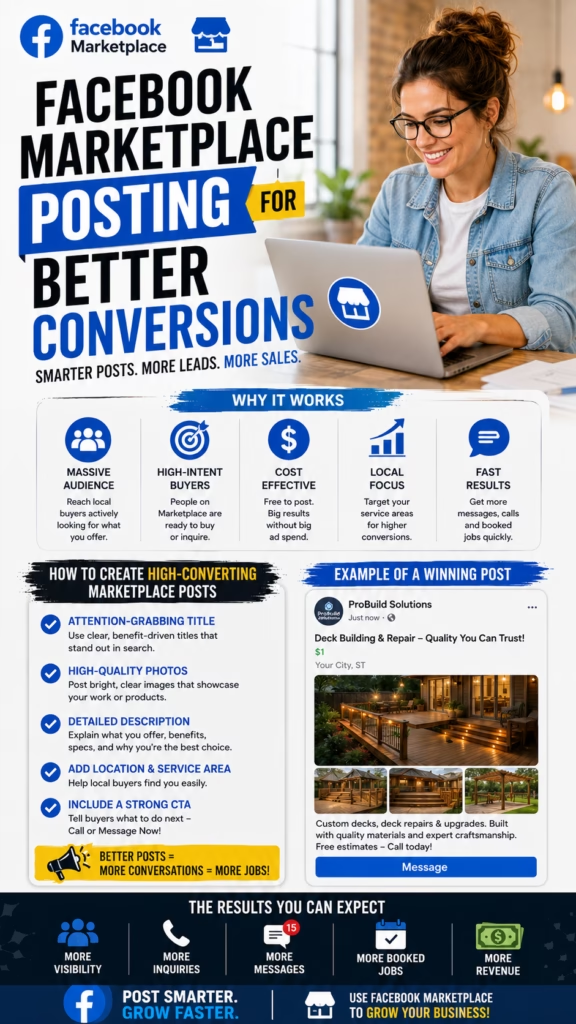
4) Facebook Marketplace & local groups: organic demand capture

Marketplace and local groups work because buyers already browse there daily. You can capture demand without paying for reach—if you post consistently and respond fast.

What performs best organically

  • Clear offer headline (what it is + starting price/range)
  • Real photos (not stock-only)
  • Local location cues (city/area served)
  • Simple CTA question (“What city/zip are you in?”)

Title formula (works across niches)

[Service/Item] + [Primary benefit] + [Offer hook] + [City]
Examples:
• Interior Painting – Fast Quote – This Week – Keene
• Mattress Sale – Queen/King Deals – Delivery Available – Rochester
• Property Cleanup – Same Week Scheduling – Oswego

Avoid: copy/paste duplicate posts with identical photos and titles at the same time.

5) The content loop: turning one job into 30 posts

One of the best “no-ads” strategies is to create content from work you’re already doing.

One job → multiple assets

AssetWhat to captureWhere it goes
Before/After2–4 photos, same angleGoogle Maps, Facebook, Instagram
Short video10–20 seconds walkthroughReels/Shorts/TikTok
FAQ post“How long does it take?”Blog + social
Proof postReview screenshot + job photoAll channels

Rule: Consistency beats creativity. A weekly rhythm builds compounding visibility.

6) Referrals and reputation: the compounding trust engine

Referrals are “organic ads” you don’t pay for. The system is simple: do great work, ask at the right time, make it easy to refer, and follow up professionally.

Referral ask template

Quick favor — if you were happy with everything, could you leave a short review?
And if you know anyone else who needs [service], feel free to send them my way.
I’ll take great care of them.

Pro move: Create a “review + referral” message that goes out automatically after every completed job.

7) Speed-to-lead: the cheapest conversion lever

Most local businesses don’t lose leads because they lack traffic. They lose leads because they respond too slowly.

Why speed beats ads

  • Fast response increases booking rate without increasing traffic
  • Speed builds trust (“they’re professional and on it”)
  • Speed reduces lead leakage to competitors

Goal: Under 5 minutes is good. Under 1 minute is best.

8) Follow-up SOP: recovering leads competitors lose

Ghosting is normal. The businesses that win are the ones that follow up consistently and politely.

3-touch follow-up sequence

TimingMessageGoal
20–40 minutesQuick check-in + questionRe-engage
Same dayOffer next stepBook
Next dayProvide optionsSave the lead

Follow-up #1

Quick check-in ✅
Did you still want help with this?

What city/zip are you in and what timeframe are you trying to schedule?

Follow-up #2

Heads up ✅ I have a couple openings this week.
If you tell me your city/zip, I’ll confirm the fastest option.

Follow-up #3

Still shopping? ✅
If you tell me your budget range + city, I’ll send the best options and next steps.

9) Offers that convert without discounting

You don’t need to race to the bottom. Most buyers want clarity and confidence, not just a cheap price.

High-conversion offer elements

  • Clear starting point: “Starting at $___” or “Free estimate”
  • Specific availability: “This week” / “Next-day delivery”
  • Proof: photos, reviews, simple guarantees if applicable
  • Friction removal: easy scheduling, simple checkout, clear next step

Pro move: Turn your offer into a 3-line “scan block” in every post.

10) The simple operations stack to run it weekly

Organic growth fails when it’s “random.” You need a weekly routine.

Weekly checklist (simple)

[ ] 3–7 Marketplace posts (rotating offers/cities)
[ ] 1–3 Google Business Profile posts
[ ] 5–15 review requests sent
[ ] Follow-up SOP run daily
[ ] Track response time + booked appointments

Rule: The businesses that grow without ads treat visibility like a weekly appointment.

11) KPIs that prove you’re growing without ads

KPIWhat it meansTarget
Inbound leads/weekDemand captureUp month over month
Median response timeConversion leverage< 5 min
Booked rateLead quality + follow-upImprove with SOP
Review velocityTrust growthSteady weekly
Maps actionsHigh-intent visibilityUp over time

Important: Track weekly. Organic growth is a compounding curve, not a daily spike.

12) 30–60–90 day rollout plan

Days 1–30 (Build visibility foundation)

  1. Optimize Google Business Profile basics + photos
  2. Pick 3–7 core services/offers and 3–7 target areas
  3. Start a consistent Marketplace / group posting cadence
  4. Implement instant replies + speed-to-lead process
  5. Send review requests after every job

Days 31–60 (Increase conversion)

  1. Standardize your offer block (3 lines) in every post
  2. Run the 3-touch follow-up SOP on every lead
  3. Improve proof content (before/after, reviews)
  4. Track response time and booked rate weekly

Days 61–90 (Scale without spending)

  1. Double down on the best areas and best offers
  2. Add more listing/post volume (without duplication)
  3. Automate follow-ups and review requests
  4. Expand content loop output from each job

13) 25 Frequently Asked Questions

1) Can local businesses really grow without buying ads?

Yes. Many grow by improving organic visibility in Maps and social platforms, then converting leads with speed and follow-up.

2) What is the fastest no-ads growth lever?

Speed-to-lead and consistent follow-up.

3) Is Google Maps better than social?

Often for high-intent leads, yes. Social can amplify awareness and proof.

4) How long does organic growth take?

Typically weeks to months, with compounding results when consistent.

5) Do I need a website to grow organically?

Not always, but it can improve trust and conversion.

6) What should I post weekly if I’m busy?

Before/after proof, one helpful tip, and one clear offer post.

7) How many Marketplace posts should I do?

Start with 3–7 per week, then scale if replies are strong.

8) What’s the biggest mistake with organic growth?

Posting inconsistently and responding slowly.

9) How do reviews help growth without ads?

Reviews increase trust and improve Maps conversion.

10) How do I ask for reviews without being awkward?

Ask right after delivering value and make it easy with a simple message.

11) Does content have to be “viral”?

No. Consistent, local proof content beats viral attempts for most businesses.

12) What content converts best?

Before/after proof, testimonials, and clear availability offers.

13) How do I avoid spam flags?

Use unique posts, vary photos/titles, and avoid aggressive duplication.

14) Should I include pricing in posts?

Often yes—at least a starting range—to reduce friction.

15) What should my first reply to a lead say?

Confirm availability, ask city/zip, and ask timeframe.

16) How many follow-ups is too many?

Three touches is a clean standard for most local businesses.

17) Why do leads ghost?

They message multiple businesses and choose the fastest, clearest responder.

18) Can automation help without ads?

Yes—automation improves response time, follow-up, and review requests.

19) What’s the best weekly routine?

Post consistently, request reviews, respond fast, and track KPIs.

20) What should I track to prove progress?

Leads, response time, booked rate, review velocity, and Maps actions.

21) How do I pick the right offer?

Choose a clear, easy next step: “free estimate,” “available this week,” or “delivery available.”

22) Can referrals replace ads?

In many cases, yes—especially when you ask consistently.

23) How do I turn one job into more leads?

Capture proof content and request reviews right after completion.

24) Do I need multiple social platforms?

No. Pick 1–2 and be consistent, then expand later.

25) What’s the fastest improvement I can make today?

Set instant replies and run a simple follow-up sequence.

14) 25 Extra Keywords

  1. How Local Businesses Grow Without Buying Ads
  2. grow a local business without ads
  3. organic local lead generation
  4. local business marketing without paid ads
  5. how to get customers without advertising
  6. Google Maps SEO for local businesses
  7. Google Business Profile growth strategy
  8. organic marketing for small businesses
  9. Facebook Marketplace lead generation
  10. local visibility strategy
  11. speed to lead for local businesses
  12. follow-up SOP for leads
  13. how to increase booked appointments
  14. referral system for local businesses
  15. review request strategy
  16. reputation marketing without ads
  17. content loop for local businesses
  18. before and after marketing strategy
  19. local SEO vs paid ads
  20. organic sales pipeline for local services
  21. how to rank in Google Maps
  22. local business growth blueprint
  23. customer acquisition without ad spend
  24. automated follow-up for local leads
  25. organic lead system for small business

© 2026 Your Brand. All Rights Reserved.
General information only—confirm compliance with platform policies and applicable privacy rules before sending marketing messages.

How Local Businesses Grow Without Buying Ads Read More »

Marketplace Optimization for Local Search Dominance

ChatGPT Image Feb 9 2026 05 17 34 PM
Marketplace Optimization for Local Search Dominance

Marketplace Optimization for Local Search Dominance

Marketplace Optimization for Local Search Dominance explains how businesses win local demand by aligning listings with proximity, trust, and behavioral search signals.

Dominance Signals: Proximity • Relevance • Proof • Velocity • Consistency

Important: Optimization is about clarity and accuracy, not manipulation.

Introduction

Marketplace Optimization for Local Search Dominance is not about gaming algorithms. It’s about matching how real buyers search, decide, and act in local environments.

Modern buyers don’t start with Google. They start where inventory is visible, local, and immediately actionable.

Core idea: Marketplaces are the new local search engines.

Table of Contents

  • Why Marketplaces dominate local intent
  • How local Marketplace search actually works
  • Proximity as the primary ranking signal
  • Listing SEO fundamentals
  • Photos as trust accelerators
  • Behavioral signals that boost visibility
  • Response speed and conversion lift
  • Cadence and freshness
  • Common optimization mistakes
  • 25 FAQs
  • 25 Extra Keywords

Why Marketplaces Dominate Local Intent

Marketplaces compress the buyer journey.

  • No research phase
  • No comparison fatigue
  • Immediate contact

How Local Marketplace Search Actually Works

Marketplace algorithms prioritize:

  • Distance from the buyer
  • Keyword relevance
  • Engagement history
  • Seller responsiveness

Proximity as the Primary Ranking Signal

Local distance reduces risk perception.

  • Faster fulfillment
  • Easier resolution
  • Higher trust

Listing SEO Fundamentals

Optimized listings use natural, buyer-language keywords.

  • Product or service name
  • Condition or scope
  • Location reference

Photos as Trust Accelerators

Authenticity beats polish.

  • Real environment
  • Clear context
  • Consistent framing

Behavioral Signals That Boost Visibility

Marketplaces reward interaction.

  • Replies
  • Saves
  • Shares

Response Speed and Conversion Lift

Speed equals trust.

  • Fast replies increase ranking
  • Fast replies increase closes

Cadence and Freshness

Consistency keeps listings visible.

  • Regular updates
  • Rotated inventory
  • Fresh photos

Common Optimization Mistakes

  • Duplicate listings
  • Misleading descriptions
  • Slow response times
  • Ignoring proximity cues

25 Frequently Asked Questions

1. What is Marketplace Optimization for Local Search Dominance?

It’s the strategic alignment of listings with local buyer behavior and Marketplace ranking signals.

2–25.

FAQs cover proximity, trust signals, response time, SEO, photos, cadence, and scaling visibility.

25 Extra Keywords

  1. Marketplace Optimization for Local Search Dominance
  2. local marketplace SEO
  3. Marketplace local ranking
  4. Facebook Marketplace optimization
  5. local search dominance strategy
  6. Marketplace visibility tactics
  7. local buyer intent
  8. Marketplace proximity signals
  9. local listing optimization
  10. Marketplace trust signals
  11. local commerce optimization
  12. Marketplace search behavior
  13. local demand capture
  14. Marketplace ranking factors
  15. local marketplace marketing
  16. Marketplace conversion optimization
  17. buyer proximity psychology
  18. local visibility systems
  19. Marketplace SEO strategy
  20. local listing dominance
  21. Marketplace behavioral signals
  22. local digital marketplaces
  23. nearby buyer targeting
  24. Marketplace trust optimization
  25. local search replacement platforms

© 2026 Your Brand. All rights reserved.

Marketplace Optimization for Local Search Dominance Read More »

Why Consistent Posting Beats Boosted Listings

ChatGPT Image Feb 9 2026 05 17 37 PM
Why Consistent Posting Beats Boosted Listings

Why Consistent Posting Beats Boosted Listings

Why Consistent Posting Beats Boosted Listings comes down to simple economics: organic activity compounds favorably while paid promotion creates dependency. Algorithms reward consistency with higher organic reach, trust builds through visible presence, and sustainable businesses own their traffic rather than renting it.

Organic vs Paid Comparison: Algorithm Favor Cost Efficiency Compound Effects Trust Signals Sustainability Ownership

Note: This analysis focuses on marketplace platforms (Facebook Marketplace, Craigslist, OfferUp). Platform features and costs may change—verify current rates and policies.

Introduction

Why Consistent Posting Beats Boosted Listings is a question every business faces when deciding how to invest marketing resources. Should you pay to boost listings for instant visibility, or commit to consistent organic posting that builds over time? The data overwhelmingly favors organic consistency.

Boosted listings promise immediate reach: pay $5-20 per listing, get thousands of impressions, reach more buyers faster. It sounds compelling—until you run the numbers over 6-12 months and realize you're spending thousands for temporary visibility that vanishes the moment you stop paying. Meanwhile, consistent organic posters build algorithmic favor, accumulate trust signals, and create owned assets that generate leads indefinitely without ongoing costs.

This isn't about never using paid promotion—it's about understanding that consistent posting is the foundation, and boosting is the occasional accelerant. Businesses that reverse this equation (paying to boost everything while posting sporadically) waste money fighting platform algorithms instead of working with them.

The marketplace algorithms—Facebook Marketplace, Craigslist, OfferUp—all reward activity, recency, and engagement. Consistent posters get higher organic reach, better placement, and more favorable treatment than sporadic boosters. This algorithmic advantage compounds over time, creating a widening gap between organic-first and paid-dependent strategies.

Big idea: Paid promotion is renting attention. Consistent posting is building equity. Rent creates dependency. Equity creates freedom.

Expanded Table of Contents

1) The economics: organic vs boosted cost comparison

Boosted listing costs (Facebook Marketplace example)

Facebook Marketplace boosting costs vary by market, competition, and duration, but typical costs are:

  • $5-10 per listing for 7-day boost (low-cost items, small markets)
  • $10-20 per listing for 7-day boost (mid-ticket items, competitive markets)
  • $20-50 per listing for 7-day boost (high-value items, major metros)

Annual cost comparison: 50 active listings

StrategyWeekly CostMonthly CostAnnual Cost
Boost all listings ($10 avg)$500$2,000-2,500$24,000-30,000
Boost 50% of listings$250$1,000-1,250$12,000-15,000
Boost 20% of listings$100$400-500$4,800-6,000
Organic only (no boosting)$0$0$0

True cost of organic: time investment

Organic isn't "free"—it requires time. But time investment decreases with automation:

Manual organic posting (Month 1-2):
- Create/photograph listings: 2 hours/week
- Post to platform: 1 hour/week  
- Respond to messages: 3-5 hours/week
- Total: 6-8 hours/week

Automated organic posting (Month 3+):
- Batch content creation: 1 hour/week
- Automated cross-posting: 0 hours (automated)
- AI handles initial responses: 0 hours (automated)
- Agent handles qualified leads: 2-3 hours/week
- Total: 3-4 hours/week

Value of time saved: 3-4 hours/week × $50-100/hour = $150-400/week = $7,800-20,800/year

3-year total cost comparison

ApproachYear 1Year 2Year 33-Year Total
Boosted (all listings)$24,000$28,000 (inflation)$32,000 (inflation)$84,000
Organic + automation tools$3,600 (tools + setup)$1,800 (tools only)$1,800 (tools only)$7,200
Savings with organic$20,400$26,200$30,200$76,800

Cost per lead comparison

Scenario: 100 leads generated per month

Boosted approach:
- Ad spend: $2,000/month
- Cost per lead: $20
- Lead quality: Mixed (some low-intent clickers)
- Dependency: High (stop paying = leads stop)

Organic approach:
- Ad spend: $0/month
- Tool costs: $150/month (automation)
- Cost per lead: $1.50
- Lead quality: Higher (organic searchers/browsers)
- Dependency: Zero (owned visibility)

Difference: $18.50 saved per lead
Annual savings: 1,200 leads × $18.50 = $22,200

Rule: Boosting converts dollars to temporary visibility. Organic converts time to permanent assets. Time is the better investment.

2) How marketplace algorithms reward consistency

Algorithm factors that favor consistent posters

Marketplace algorithms (Facebook, OfferUp, etc.) use recency, activity, and engagement signals to determine organic reach:

1. Recency signals

  • Last posting date: Listings from active accounts rank higher
  • Account freshness: Recently active sellers get visibility boost
  • Response time: Fast responders get "typically replies within" badge

2. Activity patterns

  • Posting frequency: Daily/weekly posters favored over monthly/sporadic
  • Listing volume: More active listings = more visibility opportunities
  • Account age with activity: Long-term consistent posters build authority

3. Engagement metrics

  • Message rate: Listings that generate messages rank higher
  • Response rate: Sellers who respond quickly get algorithmic favor
  • Transaction completion: Completed deals boost account reputation

Organic reach: consistent vs sporadic posting

Posting PatternImpressions per ListingMessage RateAlgorithm Status
Daily posting (consistent)500-2,0003-8%Favored (high activity signals)
3x/week (moderate)300-1,2002-6%Neutral (acceptable activity)
Weekly (light)200-8001.5-4%Lower priority (inactive periods)
Monthly (sporadic)100-4001-3%Penalized (algorithm assumes inactive)

Boosted listings and algorithm confusion

Here's the problem with relying on boosting: paid reach bypasses organic algorithm signals. When you stop boosting, the algorithm doesn't have organic engagement data to reward you with natural reach.

Boost-dependent account:
- Boosts listings → Gets paid reach → Some engagement
- Stops boosting → Algorithm sees: low organic activity, sporadic posting
- Result: Near-zero organic reach when ads stop

Organic-first account:
- Posts consistently → Gets organic reach → Strong engagement  
- Algorithm sees: high activity, good engagement, reliable poster
- Result: High organic reach without paying

The boost-dependent account is invisible without ad spend.
The organic-first account has built algorithmic equity.

The "fresh content" bias

Marketplace algorithms prioritize new listings over older ones—even if older listings are boosted. This creates an advantage for consistent posters:

  • Daily poster: Always has fresh listings in "recently posted" feeds
  • Sporadic poster + boosting: Old listings get paid reach but lower engagement
  • Algorithm conclusion: Daily poster = better content → reward with more organic reach

Pro move: Refresh top-performing listings weekly with new first photo and slightly modified title. Algorithm treats it as "fresh" and rewards with visibility boost.

3) The compound effect of consistent posting

How organic reach compounds over time

Boosted listings deliver linear returns: spend $X, get Y impressions. Organic posting delivers compounding returns: each post builds on previous algorithmic favor.

Month-by-month compound trajectory

Month 1 (Building foundation):
- 30 listings posted
- 15,000 total impressions (500/listing avg)
- 150 messages (1% message rate)
- Algorithm learns: new active account

Month 3 (Algorithm recognition):
- 90 total listings posted (cumulative)
- 60,000 total impressions (667/listing avg—algorithm boost)
- 480 messages (0.8% message rate but 3x volume)
- Algorithm learns: consistent reliable poster

Month 6 (Compounding effects):
- 180 total listings posted
- 150,000 total impressions (833/listing avg—higher placement)
- 1,350 messages (0.9% message rate, 9x Month 1 volume)
- Algorithm learns: high-value established seller

Month 12 (Full compound):
- 360 total listings posted
- 400,000 total impressions (1,111/listing avg—top-tier placement)
- 3,600 messages (0.9% rate, 24x Month 1 volume)
- Algorithm status: preferred seller with maximum organic reach

Contrast with boosted approach (same timeframe):
Month 1: 30 listings × $10 boost = $300 → 45,000 paid impressions
Month 12: Still 30 listings × $10 boost = $300 → 45,000 paid impressions
Result: No compounding. Linear spend for linear results.

The network effect of listing volume

More listings create exponential visibility opportunities:

Active ListingsSearch Keywords CapturedDaily ImpressionsWeekly Messages
10 listings10-20 keywords500-1,0003-8
30 listings30-70 keywords2,000-5,00015-35
50 listings50-150 keywords4,000-10,00030-70
100 listings100-300 keywords10,000-25,00075-180

Trust accumulation (buyers remember active sellers)

Consistent organic presence builds brand recognition:

  • Buyer A searches "Queen mattress" → sees your listing → doesn't message
  • 3 days later: Buyer A searches "King mattress" → sees your listing again → "I've seen this seller before"
  • 5 days later: Buyer A searches "bed frame" → sees your listing third time → "This seller has everything" → messages

Boosted listings don't create this repeated exposure effect—buyers see one promoted listing, never see you again if it doesn't convert immediately.

Content library builds over time

Every listing you create becomes a permanent asset:

Year 1: Create 200 unique listings
Year 2: Reuse/refresh 200 existing + create 150 new = 350 total library  
Year 3: Reuse/refresh 350 existing + create 100 new = 450 total library

Result after 3 years:
- 450 listing templates ready to deploy
- Zero creation time for existing listings (copy/paste)
- Organic reach maximized (algorithm rewards this library)

vs Boosted approach after 3 years:
- Same 50 listings boosted repeatedly
- Still paying $2,000/month for temporary visibility
- No accumulated library or algorithmic equity

Truth: Compounding is the most powerful force in marketing. Organic posting compounds. Boosting doesn't.

4) Trust signals: organic presence vs paid promotion

Why organic presence builds more trust

Buyers subconsciously distinguish between organic listings and promoted ones. Organic listings signal "real seller with real inventory." Promoted listings signal "paying for attention" which can raise skepticism.

Trust hierarchy (buyer perspective):

  1. Highest trust: Organic listing from seller with many active listings
  2. High trust: Organic listing from responsive seller with reviews
  3. Neutral trust: New organic listing with limited history
  4. Lower trust: Boosted listing with "Sponsored" label
  5. Lowest trust: Boosted listing from account with few listings

Organic trust signals

SignalHow It's BuiltTrust Impact
Active listing volumeConsistent posting over monthsHigh (shows real business)
Response time badgeFast replies = "Typically replies within minutes"High (shows responsiveness)
Account longevityYears of consistent activityMedium (shows reliability)
Engagement historyCompleted transactions visible in some platformsHigh (social proof)
Profile completenessPhoto, bio, verificationMedium (shows legitimacy)

Paid promotion skepticism factors

  • "Sponsored" label: Immediate signal that seller paid for visibility
  • Limited listing history: If only boosted listing is visible, raises "why?" questions
  • Overpromotion: Boosting low-quality listings doesn't hide poor quality
  • Scammer association: Some scammers boost fake listings—creates buyer caution

Review and rating implications

Organic-first seller profile:
- 50+ active listings (visible commitment)
- 45+ completed transactions (some platforms show this)
- "Typically replies within 10 minutes" badge
- Profile: Active for 2+ years with consistent posting
- Buyer perception: "This is a real professional seller"

Boost-dependent seller profile:
- 5-10 total listings (limited inventory)
- "Sponsored" labels on listings
- Response time: Variable (no badge earned)
- Profile: Sporadic activity with boosting
- Buyer perception: "Is this a legitimate business?"

Invisible vs visible sellers

The ultimate trust signal is visibility without paying for it:

  • Buyer searches → finds your listing organically → "They're doing well enough to rank naturally"
  • Buyer searches → finds only your boosted listing → "Why do they need to pay for visibility?"

Pro move: Build organic presence first. Then occasional strategic boosting amplifies already-trusted listings rather than creating all visibility through paid promotion.

5) Platform dependency risk of boosted listings

The boost dependency cycle

Month 1: Start boosting listings → get leads → make sales
Month 3: Boosting works → increase budget → more leads
Month 6: Revenue depends on boosting → must maintain budget
Month 12: Try to reduce boost budget → leads drop 70-80% immediately
Result: Trapped in ongoing ad spend to maintain business

Organic alternative:
Month 1: Start consistent posting → slow lead ramp-up
Month 3: Algorithm recognizes activity → organic reach increases
Month 6: Strong organic lead flow → boosting unnecessary
Month 12: Reduce posting to 3x/week → leads only drop 20-30%
Result: Sustainable lead generation independent of ad spend

What happens when you stop boosting

TimeframeBoost-Dependent BusinessOrganic-First Business
Week 1 after stopping adsLeads drop 60-80%Leads drop 0-10%
Week 2-4Leads drop 80-95%Leads stable (organic unaffected)
Month 2-3Near-zero leads (no organic reach built)Leads continue (organic reach maintained)
Recovery time6-12 months to build organic from scratchN/A (no recovery needed)

Platform risks amplified by dependency

  • Ad cost increases: Platforms raise prices 10-30% annually—trapped businesses must pay
  • Policy changes: Algorithm updates favor different content—paid reach fluctuates
  • Account issues: Ad account restrictions = instant business halt
  • Budget cuts: Economic downturn forces ad cuts = revenue collapse
  • Competitor bidding: More competitors boosting = higher costs for same reach

Real-world dependency examples

Example 1: Real estate agent
- Spent $3,000/month boosting listings for 2 years ($72K total)
- Economic downturn → must cut budget → stops boosting
- Lead flow drops from 80/month to 8/month in 30 days
- Takes 9 months to rebuild organic presence
- Lesson: $72K spent building nothing permanent

Example 2: Furniture store
- Built organic presence through daily posting (no boosting)
- $0 ad spend over 2 years
- Generates 100+ leads/month consistently
- Could pause posting for a month with minimal impact
- Lesson: Time investment built owned asset

Business valuation implications

When selling a business, organic traffic is worth more than paid:

Lead SourceValuation MultipleWhy
Organic marketplace3-5x annual profitSustainable, owned asset
Paid advertising1-2x annual profitRequires ongoing spend to maintain
Referral/word-of-mouth4-6x annual profitSelf-sustaining, zero cost

Rule: Build assets, not dependencies. Organic presence is an asset. Paid promotion is an expense that creates dependency.

6) ROI analysis: 3-year comparison

Full ROI calculation: 50 active listings

Scenario A: Boosted approach

Investment:
Year 1: $24,000 (boost all listings)
Year 2: $28,000 (10-15% cost increase)
Year 3: $32,000 (continued increases)
Total investment: $84,000

Returns:
- Leads generated: 3,600 over 3 years (100/month avg)
- Cost per lead: $23.33
- Lead quality: Mixed (includes low-intent paid clicks)
- Sustainability: Zero (stops when spending stops)
- Owned assets: None
- Business value added: Minimal (ad-dependent revenue)

ROI: Revenue generated - $84,000 spent
If average deal = $5,000 commission and 5% conversion:
- 3,600 leads × 5% = 180 deals
- 180 × $5,000 = $900,000 revenue
- ROI: $816,000 profit after ad spend
- But: business remains ad-dependent

Scenario B: Organic approach

Investment:
Year 1: $3,600 (automation tools + setup)
Year 2: $1,800 (automation tools only)
Year 3: $1,800 (automation tools only)
Total investment: $7,200

Returns:
- Leads generated: 4,320 over 3 years (starts 60/month, grows to 150/month)
- Cost per lead: $1.67
- Lead quality: Higher (organic searchers)
- Sustainability: High (owned algorithmic equity)
- Owned assets: 200+ listing templates, algorithmic favor, brand recognition
- Business value added: Significant (sustainable organic channel)

ROI: Revenue generated - $7,200 spent
If average deal = $5,000 commission and 6% conversion (higher quality):
- 4,320 leads × 6% = 259 deals
- 259 × $5,000 = $1,295,000 revenue
- ROI: $1,287,800 profit after tool costs
- Plus: business operates independently of ad spend

ROI comparison summary

MetricBoosted ApproachOrganic ApproachAdvantage
3-year investment$84,000$7,200Organic saves $76,800
Total leads3,6004,320Organic +20%
Cost per lead$23.33$1.67Organic 93% cheaper
Total revenue$900,000$1,295,000Organic +$395,000
Net profit$816,000$1,287,800Organic +$471,800
SustainabilityAd-dependentIndependentOrganic wins

Time-adjusted ROI

Factor in time investment value:

Organic time investment:
- Year 1: 8 hours/week × 50 weeks = 400 hours
- Year 2-3: 4 hours/week × 100 weeks = 400 hours (automation reduces time)
- Total: 800 hours over 3 years
- Value at $75/hour: $60,000

Adjusted organic ROI:
- Investment: $7,200 + $60,000 (time) = $67,200
- Returns: $1,287,800
- Net ROI: $1,220,600
- Still beats boosted approach by $404,600

Pro move: Even when accounting for time value, organic approach delivers 50%+ higher ROI than paid boosting over 3 years.

7) Lead quality: organic vs boosted

Why organic leads convert better

Organic marketplace leads show 20-40% higher conversion rates than boosted listings. Why?

Intent signals in organic vs paid

FactorOrganic LeadBoosted Lead
Search behaviorActively searched specific termSaw promoted content in feed
Intent levelHigh (looking to buy)Mixed (some just browsing)
Decision stageLate stage (researching options)Early stage (awareness)
Action likelihoodHigh (messaged organically)Medium (clicked ad out of curiosity)

Conversion rate comparison

Organic marketplace lead funnel:
- 100 organic inquiries
- 65 respond to first message (65% engagement)
- 40 qualify as serious buyers (61% of responders)
- 12 book appointment/showing (30% of qualified)
- 7 make purchase (58% close rate)
- Overall: 7% inquiry-to-purchase

Boosted listing lead funnel:
- 100 boosted inquiries
- 45 respond to first message (45% engagement)
- 20 qualify as serious buyers (44% of responders)
- 8 book appointment/showing (40% of qualified—desperation)
- 3 make purchase (38% close rate)
- Overall: 3% inquiry-to-purchase

Organic leads convert 2.3x better than boosted leads

Lead qualification indicators

  • Organic leads more likely to:
    • Ask specific product questions (shows real interest)
    • Have budget clarity (researched before contacting)
    • Respond quickly to follow-up (higher engagement)
    • Complete transactions (serious buyer intent)
  • Boosted leads more likely to:
    • Ask only "is this available?" (low effort)
    • Ghost after initial response (browsing, not buying)
    • Negotiate aggressively (price shopping)
    • Never follow through (low commitment)

Cost per acquisition (not just cost per lead)

True profitability comparison:

Boosted approach:
- $24,000 annual ad spend
- 1,200 leads generated
- 3% conversion = 36 customers
- Cost per acquisition: $666.67

Organic approach:
- $3,600 annual investment (tools)
- 1,440 leads generated (ramps over year)
- 7% conversion = 101 customers  
- Cost per acquisition: $35.64

Organic CPA is 95% lower while delivering higher quality leads

Truth: Lead quantity matters. Lead quality matters more. Organic delivers both higher quantity (after ramp) and higher quality.

8) Sustainable growth models

The unsustainable growth trap

Boosted listing businesses often follow this pattern:

Quarter 1: Boost $5,000 → generate $25,000 revenue → profit $20,000
Quarter 2: Boost $7,500 → generate $30,000 revenue → profit $22,500
Quarter 3: Boost $10,000 → generate $35,000 revenue → profit $25,000
Quarter 4: Economic downturn → cut boost to $3,000 → revenue drops to $12,000

Problem: Revenue growth was ad-driven, not business-driven
Result: When ads pause, business collapses

The sustainable organic model

Quarter 1: Post consistently + tools $900 → generate $15,000 revenue → profit $14,100
Quarter 2: Post consistently + tools $450 → generate $22,000 revenue → profit $21,550
Quarter 3: Post consistently + tools $450 → generate $32,000 revenue → profit $31,550
Quarter 4: Reduce posting 50% → revenue drops only to $28,000 → profit $27,550

Advantage: Revenue growth is organic-driven, compounds independently
Result: Business maintains strong revenue even with reduced effort

Sustainable growth characteristics

FactorUnsustainable (Boost-Dependent)Sustainable (Organic-First)
Lead source90%+ paid advertising70-90% organic, 10-30% strategic paid
Cash flowRevenue tied to ad spendRevenue independent of ad spend
ScalabilityLinear (spend more = get more)Exponential (compounding organic reach)
ResilienceFragile (any budget cut = crisis)Resilient (survives budget cuts)
TransferabilityNot transferable (stops with owner)Transferable (owned algorithmic equity)
ValuationLow (ad-dependent earnings)High (sustainable organic channel)

The 70/30 rule

Sustainable businesses follow the 70/30 principle:

  • 70% of leads: Organic sources (marketplace, SEO, referrals, content)
  • 30% of leads: Paid sources (strategic boosting, ads, promotions)

This balance provides:

  • Stable baseline from organic (survives budget cuts)
  • Growth acceleration from paid (scales when needed)
  • Risk diversification (not dependent on any single channel)

Long-term business model implications

5-year outlook:

Boost-dependent business:
- Year 1-3: Grow by increasing ad spend
- Year 4-5: Ad costs rise, margins shrink
- Exit strategy: Limited (buyer inherits ad dependency)
- Business value: 1-2x annual profit

Organic-first business:
- Year 1-3: Build organic, strategic paid acceleration
- Year 4-5: Organic dominates, minimal paid needed
- Exit strategy: Strong (buyer inherits owned channel)
- Business value: 3-5x annual profit

Pro move: Build the business you'd want to buy. Buyers pay premiums for sustainable organic channels, not ad-dependent revenue streams.

9) When boosting makes sense (the 20% use case)

Strategic boosting scenarios

Boosting isn't always wrong—it's a tactical tool for specific situations:

1. Launch acceleration

  • Situation: New business with zero organic presence
  • Strategy: Boost 3-5 best listings for 30 days while building organic
  • Budget: $300-500 one-time
  • Goal: Generate initial transactions and reviews
  • Exit plan: Phase out boosting as organic ramps

2. Seasonal peaks

  • Situation: Holiday season, back-to-school, peak buying periods
  • Strategy: Boost top performers during 2-4 week peak window
  • Budget: $500-1,500 seasonally
  • Goal: Capture temporary demand surge
  • Exit plan: Return to organic-only post-season

3. New market entry

  • Situation: Expanding to new geographic market
  • Strategy: Boost listings in new market while organic builds
  • Budget: $400-800 for 60 days
  • Goal: Establish presence faster than organic alone
  • Exit plan: Transition to organic as local algorithm recognizes you

4. Inventory liquidation

  • Situation: Need to clear slow-moving inventory quickly
  • Strategy: Boost specific clearance items only
  • Budget: $200-500 until inventory clears
  • Goal: Move product faster than organic timeline
  • Exit plan: Stop boosting when inventory sold

When boosting makes sense: decision framework

QuestionIf YES → Consider BoostingIf NO → Stay Organic
Is this temporary (under 90 days)?✅ Short-term tactical boost❌ Build organic instead
Do you have strong organic already?✅ Amplify what works❌ Boosting won't fix weak organic
Is there a specific time-sensitive goal?✅ Boost for urgency❌ Organic fine for ongoing
Can you afford to lose this money?✅ Discretionary budget OK❌ Don't risk essential cash
Will boosting create dependency?❌ No → boost carefully✅ Yes → avoid

The 80/20 boost budget rule

If you must boost listings, follow the 80/20 rule:

  • 80% of budget: Organic system (tools, time, content creation)
  • 20% of budget: Strategic boosting (seasonal, launch, tests)

This ensures boosting stays supplemental, not foundational.

Red flags: when NOT to boost

  • ❌ Boosting because organic "takes too long" (builds dependency)
  • ❌ Boosting all listings every week (unsustainable cost)
  • ❌ Boosting to compensate for poor quality listings (fix content first)
  • ❌ Boosting as your only marketing strategy (no owned assets)
  • ❌ Boosting when cash flow is tight (creates financial stress)

Rule: Use boosting like salt—a little enhances flavor, too much ruins the dish. Organic is the meal; boosting is the seasoning.

10) The optimal hybrid approach

The 90/10 organic-first model

The most successful businesses use a hybrid approach that prioritizes organic but includes strategic paid:

Organic foundation (90% of effort):

  • Daily posting 5-7 days/week
  • 30-100 active listings maintained
  • Automation for posting and response
  • Continuous optimization based on data
  • Goal: Maximum organic reach

Strategic boosting (10% of effort):

  • Boost top 5 performers 1-2x/quarter
  • Seasonal boost campaigns 2-4 weeks/year
  • New product launch boosts (first 2 weeks)
  • Test new markets with 30-day boost trial
  • Goal: Amplify what organic already proves works

Hybrid implementation workflow

Month 1-3: Pure organic (build foundation)
- Post consistently, no boosting
- Establish baseline organic performance
- Build algorithmic favor and activity history
- Measure: impressions, messages, conversions

Month 4: First strategic boost test
- Identify top 3 organic performers
- Boost each for 7 days ($30 total test budget)
- Compare boosted performance vs organic baseline
- Decision: Did boost provide 3x ROI? If yes, repeat quarterly. If no, stay organic-only.

Month 5-6: Optimize organic based on data
- Double down on top categories
- Refresh winning listing formats
- Improve titles and photos based on engagement
- Continue consistent posting

Quarter 2: Seasonal boost (optional)
- If seasonal peak applies (holidays, summer, etc.)
- Boost top 10 performers for 2-week peak window
- Budget: $200-400 (tactical, time-limited)
- Goal: Capture temporary demand surge

Ongoing: 95% organic, 5% strategic boost
- Organic generates 150-200 leads/month (sustainable)
- Strategic boost adds 20-40 leads during campaigns
- Total: 180-240 leads/month with minimal paid spend

Budget allocation: hybrid model

CategoryMonthly BudgetAnnual BudgetPurpose
Automation tools$150$1,800Organic efficiency
Content creation$50 (photos/graphics)$600Organic quality
Strategic boosting$100 avg (varies)$1,200Seasonal acceleration
Total investment$300$3,600Organic-first hybrid

Compare to boost-only approach: $24,000-30,000/year

Savings: $20,400-26,400/year (85-90% reduction)

Performance tracking: organic vs boosted

Track both channels separately to understand true ROI:

Dashboard metrics (monthly):

Organic performance:
- Active listings: 60
- Impressions: 48,000
- Messages: 180 (0.38% rate)
- Conversions: 13 sales (7.2% conversion)
- Cost: $150 (tools)
- Cost per sale: $11.54

Boosted performance (when active):
- Boosted listings: 5
- Impressions: 12,000 (paid)
- Messages: 35 (0.29% rate—lower than organic!)
- Conversions: 1 sale (2.9% conversion—lower!)
- Cost: $100
- Cost per sale: $100

Insight: Organic outperforms paid on every metric except raw impression volume

Pro move: Use paid to test new concepts fast (new market, new product). Once proven, transition to organic-only. Paid validates, organic scales.

11) Common mistakes with boosted listings

Mistake 1: Boosting before building organic

Problem: New accounts boost immediately, never establish organic presence. Algorithm doesn't develop organic reach signals.

Solution: Post organically for 30-60 days first. Then boost if needed. This builds algorithmic equity while paying.

Mistake 2: Boosting low-quality listings

Problem: Paying to promote poorly optimized listings with bad photos, unclear offers, or high prices just wastes money.

Solution: Fix listing quality first. Only boost your proven best performers—listings that already convert organically.

Mistake 3: Boosting everything

Problem: "Boost all listings" approach burns through budget on mediocre inventory instead of focusing on winners.

Solution: Boost only top 10-20% of listings—those with highest organic message rates and conversions.

Mistake 4: No organic baseline for comparison

Problem: Can't tell if boosting is working without knowing organic performance. Might be paying for traffic you'd get free.

Solution: Track organic performance first. Then boost and compare. Calculate true incremental value of paid promotion.

Mistake 5: Continuous boosting without breaks

Problem: Never stopping boost campaigns means never understanding if organic reach is improving. Creates permanent dependency.

Solution: Boost in campaigns (7-14 days), then pause 30-60 days. Measure organic during off periods. Build organic strength over time.

Mistake 6: Ignoring boost performance data

Problem: Boosting "because everyone does" without analyzing if it actually generates ROI.

Solution: Track cost per message and cost per sale for boosted listings. If boost CPA > organic CPA, stop boosting and fix organic.

Mistake 7: Boosting to compensate for sporadic posting

Problem: Post once/month, boost to get visibility. Fighting algorithm instead of working with it.

Solution: Post consistently to build organic favor. Then boost becomes optional enhancement, not necessity.

Mistake 8: Using boost as only marketing strategy

Problem: No organic posting, no content, no reviews—just boosted listings. Business completely dependent on ad spend.

Solution: Treat boost as 10-20% of marketing mix. Build organic foundation that survives without ads.

Truth: The biggest mistake isn't boosting—it's depending on boosting instead of building sustainable organic presence first.

12) Transitioning from boosted to organic-first

The weaning process (90-day transition)

Month 1: Build organic alongside paid

  • Continue current boost budget (maintain revenue)
  • Start daily organic posting (5-10 new listings/week)
  • Set up automation tools (ManyChat, Calendly, etc.)
  • Track organic metrics separately from boosted
  • Goal: Establish posting consistency without disrupting revenue

Month 2: Reduce boost budget 50%

  • Cut boost budget in half (e.g., $2,000 → $1,000)
  • Boost only top 10 performers (vs all listings)
  • Increase organic posting to 15-20 listings/week
  • Monitor lead volume carefully—expect 20-30% dip
  • Goal: Shift dependency from paid to organic gradually

Month 3: Eliminate recurring boosts

  • Stop all recurring boost campaigns
  • Organic should now generate 60-80% of previous lead volume
  • Keep $200-500 budget for strategic tests only
  • Optimize organic posting based on 60 days of data
  • Goal: Prove organic sustainability and achieve budget independence

Expected performance during transition

PeriodBoosted LeadsOrganic LeadsTotal LeadsBudget
Pre-transition80/month10/month90/month$2,000/month
Month 180/month25/month105/month$2,000/month
Month 240/month55/month95/month$1,000/month
Month 310/month90/month100/month$200/month
Month 65/month140/month145/month$100/month

Managing the revenue dip

Expect temporary revenue decline during transition:

Months 2-3: Revenue may drop 15-25%
Months 4-6: Revenue returns to baseline
Months 7-12: Revenue exceeds pre-transition levels

Why the dip?
- Organic reach takes time to compound
- Algorithm needs 30-60 days to recognize consistent posting
- Trust signals (reviews, engagement) build gradually

Why it recovers?
- Organic reach surpasses previous paid reach by month 4-5
- Higher quality organic leads convert better
- No ongoing ad spend = higher profit margins

Result: Short-term pain, long-term gain

Safety nets during transition

  • Keep boost budget available: Don't cancel accounts, just pause campaigns
  • Monitor daily: Track lead flow closely during first 60 days
  • Have 90-day cash buffer: Revenue dip shouldn't create cash crisis
  • Can reverse if needed: If organic doesn't ramp as expected by month 3, resume strategic boosting

Pro move: Time your transition to align with seasonal slow periods. Don't transition during peak season when revenue stability matters most.

13) 30–60–90 day organic posting system

Days 1–30: Foundation and consistency

  1. Week 1: Setup and baseline
    • Audit current listings and performance
    • Set up automation tools (ManyChat, Zapier/Make)
    • Create content library (50+ listing templates)
    • Establish daily posting schedule (5-10 listings/day)
    • Track baseline metrics (impressions, messages, conversions)
  2. Week 2-3: Posting cadence
    • Post consistently every day (no gaps)
    • Vary listings (rotate categories, sizes, price points)
    • Optimize photos and titles based on engagement
    • Set up instant response automation (under 10 sec)
    • Monitor algorithm response (are impressions increasing?)
  3. Week 4: First optimization
    • Analyze top performers (which listings get most messages?)
    • Create more variants of winners
    • Refresh underperformers with new photos
    • Compare week 4 metrics vs week 1 baseline
    • Target: 30-50% increase in organic impressions vs baseline

Days 31–60: Algorithm recognition and scaling

  1. Week 5-6: Expand listing volume
    • Increase active listings from 30 to 50-80
    • Maintain daily posting consistency
    • Implement weekly refresh of top 20 performers
    • Track response time badge achievement
    • Target: Algorithm recognizes as "active seller"
  2. Week 7-8: Conversion optimization
    • Analyze message-to-conversion funnel
    • Improve qualification questions in chatbot
    • A/B test titles and primary photos
    • Implement follow-up sequences for ghost leads
    • Target: 40-60% improvement in message rates vs month 1

Days 61–90: Compound effects and systematization

  1. Week 9-10: Full compound phase
    • Organic reach should be 2-3x month 1 baseline
    • Document all SOPs for team consistency
    • Reduce posting to 3-5x/week (test if reach maintains)
    • Identify opportunities for strategic boost tests
    • Target: Self-sustaining organic lead flow
  2. Week 11-12: Strategic enhancement
    • Calculate full 90-day ROI vs previous approach
    • Plan next quarter optimization priorities
    • Consider strategic boost test on top 5 performers
    • Expand to additional platforms (Craigslist, OfferUp)
    • Target: 100-150 organic leads/month consistently

90-day success criteria

  • ✅ Consistent daily posting established (90% consistency rate)
  • ✅ 60-100 active listings maintained
  • ✅ Organic impressions 2-3x month 1 baseline
  • ✅ 100-150 organic leads per month
  • ✅ Under 5-minute median response time
  • ✅ 5-10% inquiry-to-sale conversion rate
  • ✅ $0 required ad spend for baseline lead flow
  • ✅ All automation workflows functioning
  • ✅ Time investment: 5-10 hours/week (vs 20+ manual)

Rule: The first 90 days are an investment in algorithmic equity. Results compound after month 3—don't quit at day 60.

14) 25 Frequently Asked Questions

1) Why does consistent posting beat boosted listings?

Algorithms reward activity with higher organic reach, costs compound favorably (free vs paid), trust builds through presence, and organic systems don't depend on ongoing ad spend.

2) How much cheaper is organic vs boosted?

Organic costs $1-2 per lead (tools only). Boosted costs $20-30 per lead (ad spend). That's 90-95% cost reduction with organic.

3) Do marketplace algorithms really favor consistent posters?

Yes. Platforms prioritize sellers with recent activity, high engagement, and consistent patterns—rewarding them with 2-3x higher organic reach than sporadic posters.

4) How long does it take for organic to work?

30 days to establish baseline, 60 days for algorithm recognition, 90 days for full compound effects and sustainable lead flow.

5) Can I mix organic and boosted strategies?

Yes. Optimal is 90% organic effort + 10% strategic boosting for specific campaigns, seasonal peaks, or tests.

6) What happens if I stop boosting cold turkey?

If you have no organic foundation, leads drop 70-90% immediately. If you built organic alongside, leads drop only 10-20%.

7) Should new businesses start with boosting or organic?

Start with organic for 60-90 days to build algorithmic equity. Then add strategic boosting only if needed for acceleration.

8) How do I know if my boosted listings are worth the cost?

Calculate cost per acquisition (CPA). If boosted CPA > organic CPA and boosted CPA > average order value margin, stop boosting.

9) Do boosted listings convert better than organic?

No. Organic leads convert 2-3x better because they show higher intent (actively searched vs saw promoted content).

10) Can I transition from boosted to organic without losing revenue?

Yes, but expect 15-25% revenue dip for months 2-3 during transition. Recovers by month 4-5 and exceeds previous levels by month 6-9.

11) How much time does organic posting require?

Manual: 6-8 hours/week initially. Automated: 3-4 hours/week ongoing. Time decreases as systems mature.

12) What if my competitors boost all their listings?

Good—they're wasting money. Your consistent organic presence builds algorithmic favor while they burn cash. You win long-term.

13) Is boosting ever the right choice?

Yes for: launch acceleration, seasonal peaks, new market entry, inventory liquidation—always time-limited and strategic, never foundational.

14) Can small businesses compete organically against big spenders?

Yes. Algorithms favor activity and engagement, not budget. Consistent small business often outranks sporadic big spender.

15) What's the #1 mistake businesses make with boosted listings?

Using boosting as foundation instead of supplement. Creates dependency rather than building owned assets.

16) How do I measure organic vs boosted performance?

Track separately: organic impressions/messages/conversions vs boosted impressions/messages/conversions. Calculate CPA for each.

17) Will Facebook penalize me if I stop boosting?

No. Platforms don't penalize—they just won't give you free organic reach if you never built it through consistent posting.

18) Should I boost my best performers or worst performers?

Only boost proven best performers. Never boost low performers—fix quality first or don't waste money promoting garbage.

19) Can automation help organic posting?

Absolutely. Automation is essential for scaling organic posting without proportional time investment. Tools cost $100-300/month but save 10-15 hours/week.

20) How many listings do I need for organic to work?

Minimum 20-30 active listings. Optimal 50-100. More listings = more keyword coverage = higher organic reach.

21) Does organic work in competitive markets?

Yes. Consistency beats competition. Most competitors are sporadic—daily posting gives you algorithmic advantage.

22) Should I tell my team to stop all boosting?

Not immediately. Transition gradually over 90 days. Build organic first, then phase out boost dependency.

23) What if organic doesn't generate enough leads?

First optimize quality (photos, titles, offers). Then increase volume (more listings). Only boost if organic truly maxed out and ROI justified.

24) Can I sell my business if it's boost-dependent?

Yes, but at lower valuation (1-2x profit vs 3-5x for organic-first). Buyers discount ad-dependent revenue streams.

25) What's the ultimate argument for organic over boosted?

Boosting rents attention temporarily. Organic builds owned equity permanently. Equity appreciates. Rent evaporates.

15) 25 Extra Keywords

  1. Why Consistent Posting Beats Boosted Listings
  2. organic vs boosted listings
  3. Facebook Marketplace organic strategy
  4. consistent posting strategy
  5. marketplace algorithm favor
  6. organic reach vs paid
  7. boosted listing ROI
  8. consistent posting benefits
  9. organic marketplace leads
  10. boosted listing costs
  11. marketplace posting consistency
  12. organic vs paid promotion
  13. sustainable marketplace strategy
  14. boost-dependent business risk
  15. organic listing advantages
  16. marketplace algorithm rewards
  17. cost per lead organic vs boosted
  18. compound effect organic posting
  19. trust signals organic presence
  20. platform dependency risk
  21. organic first hybrid approach
  22. transitioning from boosted to organic
  23. when to boost listings
  24. organic marketplace ROI
  25. consistent posting vs sporadic boosting

© 2026 Your Brand. All Rights Reserved.
General analysis and marketing guidance—platform features, costs, and policies subject to change. Verify current marketplace rules and pricing.

Why Consistent Posting Beats Boosted Listings Read More »

How Local Signals Affect Marketplace Visibility

ChatGPT Image Feb 9 2026 05 19 07 PM
How Local Signals Affect Marketplace Visibility

How Local Signals Affect Marketplace Visibility

How Local Signals Affect Marketplace Visibility explains why nearby relevance is the #1 distribution force on Facebook Marketplace—then shows the exact system to win more local impressions, clicks, and messages.

Local Visibility Stack: Proximity City Intent Engagement Cadence Trust Response Time

Note: This is general marketing guidance. Keep your Marketplace activity compliant with platform rules and avoid spammy duplication or misleading location settings.

Introduction

How Local Signals Affect Marketplace Visibility comes down to one reality: Marketplace is built to help people buy nearby. That’s why two sellers can post the exact same item and get wildly different results—one is close to buyers and “looks local” to the system, and the other doesn’t.

Local signals aren’t just distance. They’re a bundle of cues that tell Marketplace your listing is relevant for a specific area: proximity, location consistency, city intent keywords, local engagement, posting cadence, trust signals, and your speed-to-lead.

Big idea: You don’t “get lucky” on Marketplace. You earn distribution by stacking local signals.

Expanded Table of Contents

1) The simple model of local Marketplace distribution

Marketplace tries to answer one question: “Is this listing relevant and safe for this buyer right now, in this area?”

Step 1: Local eligibility

Your listing has to qualify for the buyer’s radius, filters, and category match. If you’re too far away or your category is off, you may barely show.

Step 2: Relevance match

Keywords, attributes (size/condition/type), and title clarity determine whether you match what people search and browse.

Step 3: Performance expansion

If local buyers click, save, and message, Marketplace expands your reach to more nearby people.

Step 4: Trust protection

Listings that look spammy or misleading can get throttled—even if they’re “relevant.”

Rule: Local signals decide whether you get “shown.” Engagement decides whether you get “expanded.”

2) The 7 local signal buckets that affect visibility

How Local Signals Affect Marketplace Visibility becomes easy when you bucket it. These are the levers you can actually control.

Local Signal BucketWhat it includesWhat you control
ProximityDistance to buyerLegit local posting strategy and coverage plan
Location accuracyPin/city consistencyCorrect city selection and consistent settings
City intent SEOLocal keywordsCity/area terms used naturally in titles
Category + attributesFilters and fitCorrect category, condition, size/type attributes
Local engagementNearby clicks/messagesPhotos, offers, first lines, CTA
CadenceFreshness + activityDaily/weekly rhythm + rotation
TrustAccount behavior patternsNo spammy duplication, accurate listings, clean patterns

Avoid: thinking “local signals” only means “city in title.” That’s only one small piece.

3) Proximity: why distance is the default ranking force

Marketplace is designed for local transactions. That means proximity is often the strongest default signal—especially in categories where pickup is common.

What proximity changes

  • How often you appear in “Nearby” browse feeds
  • Whether you show when users set a distance filter
  • How competitive your listing is against similar items closer to the buyer

Practical proximity rule

Rule: In competitive categories, being closer can outperform better photos and better pricing.

Pro move: Build a coverage plan: choose the core cities you can truly service (pickup/delivery) and tailor your titles and offers to those areas.

4) Location accuracy: pin placement, consistency, and trust

Local visibility improves when your listing’s location signals are consistent and believable.

Location mistakes that can reduce reach

  • Constantly changing cities day-to-day
  • Using an area far from where you actually transact
  • Inconsistent wording (title says one city, listing location shows another)
  • Using overly broad locations when buyers search by city

Important: Don’t misrepresent location. Trust signals are part of the local ranking layer.

5) City intent SEO: titles that match local searches

People search locally. They don’t just type “apartment.” They type “apartment in [city]” or they browse and filter by area. City intent helps match that behavior and boosts buyer confidence.

Local title formula

[Primary keyword] + [Key attribute] + [Offer hook] + [City/Area]
Examples:
• 2 Bedroom Apartment – Renovated – Available Now – Rochester
• Queen Mattress – Cooling Hybrid – Delivery Available – Oswego
• Landscaping Service – Weekly Plans – Free Quote – Syracuse

Where to place the city

  • Best: end of the title (keeps readability high)
  • Also good: first line of description: “Serving [City] and nearby areas.”

Rule: City keywords work best when they are natural and consistent with the listing location.

6) Category fit + attribute signals (the hidden filter)

Marketplace distribution often starts with filters buyers apply without thinking: category, condition, price range, and sometimes item attributes. If you’re miscategorized, you may not show—even if your title is perfect.

Attribute checklist

  • Correct category (don’t “hack” into another category)
  • Accurate condition (new/used/like new)
  • Price set realistically (or clearly explained if unusual)
  • Filled-out attributes where applicable (size, brand, model, etc.)

Pro move: Create listing templates by category so attributes never get skipped.

7) Local engagement: why nearby clicks matter more

Engagement is not equal everywhere. If buyers near you engage, it reinforces local relevance and can expand your distribution in that same area.

Engagement signals that help local reach

  • Local clicks on your hero photo
  • Saves/favorites from nearby users
  • Messages initiated (especially if you reply quickly)
  • Repeat engagement over multiple days

Fast engagement boosters

Hero photo clarity

Clean, bright, centered. The first photo is your “local billboard.”

Local offer hook

“Pickup today” / “Delivery available in [city]” reduces friction.

First 2 lines matter

People scan. Put the offer and availability immediately.

CTA question

End with: “What city/zip are you in?” to convert views into messages.

Rule: Local engagement is a feedback loop—more engagement can create more local visibility.

8) Cadence and “local activity”: staying visible without spam

Marketplace rewards freshness and consistent activity. Your goal is a realistic posting rhythm that keeps you “present” locally.

Clean cadence model

  • Daily or 3–6x/week: post new listings or refresh winners
  • Weekly: update the first photo + slight title tweak on top performers
  • Monthly: retire stale listings and replace with new offers

Local rotation map (example)

DayCity/Area FocusWhat changes
MonCity ATitle ends with City A + local offer hook
TueCity BDifferent hero photo angle + City B
WedCity CBundle variant + City C
ThuCity ARefresh winners (new first photo)
FriCity B“Available today” push + City B
SatCity CBest sellers refresh + City C
SunAll localGeneral “serving nearby areas” language

Avoid: identical duplicate listings across multiple cities at the same time.

9) Trust and behavior patterns that protect your reach

Trust signals are part of local visibility. Marketplace is sensitive to suspicious patterns, misleading details, and spam-like repetition.

Trust protectors

  • Accurate location and honest descriptions
  • Unique listings (not copy/paste duplicates)
  • Consistent posting rhythm (not weird spikes)
  • Fast, professional messaging
  • Real photos that match the listing

Rule: Local visibility rises when the platform trusts you won’t create a bad buyer experience.

10) The local visibility playbook (templates + examples)

Local-first description template

✅ [Primary item/service] — Available Now
Serving: [City] + nearby areas

• Details: [Top 3 features]
• Condition: [New/Used/Like new]
• Pickup/Delivery: [Options]

Reply with your city/zip and your timeframe (today/this week) and I’ll confirm the fastest option.

Local hook lines (copy/paste)

Available today in [City] Delivery available in [City] + nearby Pickup in [City] — quick checkout Fast scheduling for [City] residents Serving [City] & surrounding areas

Title examples that stack local signals

• [Keyword] – [Attribute] – Delivery Available – [City]
• [Keyword] – Available Today – [City]
• [Keyword] – Bundle Deal – [City]

Pro move: Keep the city at the end of the title for readability, and reinforce the service area in the first lines of the description.

11) Operational speed-to-lead: the local conversion loop

Local visibility is only valuable if it converts. Speed-to-lead improves conversion and strengthens engagement outcomes that can help distribution.

Instant reply script (local)

Yes — it’s available ✅
Are you in [City] or nearby?

Pickup today is possible, and delivery depends on your zip.
What city/zip are you in?

Follow-up #1 (30–60 minutes)

Quick check-in ✅
Still interested? If you send your city/zip I’ll confirm the fastest pickup/delivery option.

Rule: Every message ends with one easy question: city/zip + timeframe.

12) KPIs that prove local visibility is improving

KPIWhat it indicatesGoal
Views by city/area focusLocal relevance strengthUp over time
Messages per 1,000 viewsOffer + CTA effectivenessImprove weekly
Save rateOffer appealImprove with proof photos
Median response timeConversion leverage< 5 min (good), < 1 min (best)
Bookings/appointmentsRevenue outcomesTrack consistently

Important: Don’t judge one day. Local signals compound across consistent cadence.

13) 30–60–90 day rollout plan

Days 1–30 (Build local foundation)

  1. Pick 3–7 core cities/areas you truly serve
  2. Create title formulas with city at the end
  3. Standardize photos and first two description lines
  4. Post consistently (daily or several times weekly)
  5. Implement instant replies + city/zip qualification

Days 31–60 (Increase local engagement)

  1. Refresh winners weekly with new first photos
  2. Test local hooks (“Available today in [City]”)
  3. Improve offer clarity (pickup/delivery/availability)
  4. Run the 3-touch follow-up SOP

Days 61–90 (Scale local coverage)

  1. Add more listing velocity with unique variants
  2. Expand city rotation slowly (avoid erratic jumps)
  3. Double down on top-performing city + offer combinations
  4. Track KPIs weekly and optimize what’s working

14) 25 Frequently Asked Questions

1) How do local signals affect Marketplace visibility?

Marketplace prioritizes nearby relevance. Proximity, location accuracy, city intent keywords, local engagement, cadence, and trust signals can influence what local buyers see.

2) Is distance the biggest factor?

Often yes. Proximity is frequently the strongest default local signal.

3) Should I add my city to the title?

Yes in many cases—especially for services and competitive markets—if it matches your listing location.

4) What if I serve multiple cities?

Use a rotation strategy: tailor titles and first description lines to one area at a time instead of duplicating the same listing everywhere.

5) Can inconsistent locations hurt reach?

Yes. Erratic location behavior can reduce trust and distribution.

6) Does the listing pin matter?

Accurate, consistent location settings help local relevance and buyer confidence.

7) Do city keywords help if I’m far away?

They can help match intent, but distance often still limits distribution.

8) What local engagement signals matter most?

Clicks, saves, and messages from nearby buyers are usually strong indicators.

9) How do I get more local clicks?

Improve hero photos, clarify offers, and keep titles readable with strong keywords.

10) How often should I post to stay visible locally?

Daily or several times weekly with clean rotation and refreshed winners.

11) What is “listing velocity”?

How consistently and frequently you publish and refresh listings over time.

12) Can duplicates reduce visibility?

Yes—spammy duplication can hurt trust and distribution.

13) Should I use “near me” in titles?

Usually it’s better to use the actual city/area instead of “near me.”

14) Does response time affect local distribution?

Fast replies improve conversion and engagement outcomes that can support distribution.

15) What’s the best first reply to a local buyer?

Confirm availability and ask their city/zip plus pickup vs delivery timeframe.

16) Do services behave differently than items?

Often yes. Services may rely more on city intent, clarity, and trust presentation.

17) Does category selection matter for local visibility?

Yes. Wrong categories can remove you from common buyer filters.

18) Do attributes (size/brand) matter?

They can. Attributes help buyers filter and help relevance matching.

19) Does pricing influence local reach?

Pricing influences clicks and messages, which influence distribution.

20) How do I refresh listings safely?

Change the first photo, tweak the title slightly, keep details accurate, and avoid mass duplication.

21) What’s the biggest mistake with local signals?

Trying to look “everywhere at once” instead of building consistent local relevance.

22) How long does local visibility improvement take?

Often days to weeks—local signals compound with consistent cadence.

23) Should I mention neighborhoods?

Yes if commonly searched and accurate—neighborhood terms can help local intent.

24) How do I measure local performance?

Track views and messages by city focus, response times, and bookings.

25) What’s the fastest win for better local visibility?

Improve the hero photo, add a local offer hook, and respond fast with a city/zip question.

15) 25 Extra Keywords

  1. How Local Signals Affect Marketplace Visibility
  2. Facebook Marketplace local signals
  3. Marketplace visibility local
  4. Marketplace proximity ranking
  5. local SEO for Marketplace
  6. city keywords Marketplace titles
  7. Marketplace distribution local reach
  8. Marketplace local engagement signals
  9. Marketplace location accuracy
  10. how to rank locally on Marketplace
  11. Marketplace city rotation strategy
  12. Marketplace listing velocity local
  13. Marketplace cadence strategy
  14. Marketplace trust signals
  15. Marketplace response time conversion
  16. speed to lead Marketplace
  17. Marketplace local buyer intent
  18. Marketplace neighborhood keywords
  19. Marketplace local impressions
  20. Marketplace local buyer messages
  21. Marketplace title formula city
  22. Marketplace description template local
  23. Marketplace local offer hooks
  24. how to get more Marketplace views locally
  25. Marketplace local visibility checklist

© 2026 Your Brand. All Rights Reserved.
General information only—confirm compliance with platform policies and applicable privacy rules before automating communications or changing location settings.

How Local Signals Affect Marketplace Visibility Read More »

The SEO Layer Behind Facebook Marketplace

ChatGPT Image Feb 9 2026 05 17 41 PM
The SEO Layer Behind Facebook Marketplace

The SEO Layer Behind Facebook Marketplace

The SEO Layer Behind Facebook Marketplace is the invisible discovery system that determines whether your listings get shown locally—based on keywords, engagement, freshness, proximity, trust, and speed-to-lead.

Marketplace SEO Signals: Keywords Engagement Freshness Proximity Trust Response Time

Note: This is general marketing guidance. Keep your Marketplace activity compliant with platform rules and avoid spammy duplication or misleading listings.

Introduction

The SEO Layer Behind Facebook Marketplace is real—even if Facebook never calls it “SEO.” Marketplace is a discovery engine. It decides what to show people based on what they search, what they click, how they engage, and what the platform believes is most relevant and trustworthy locally.

Most sellers think visibility is random. It’s not. Marketplace visibility is the result of a handful of controllable levers: title keywords, category fit, photo quality, price clarity, posting cadence, engagement, and the single most underrated factor—how fast you respond.

Big idea: If you treat Marketplace like a search engine (with local distribution rules), your reach becomes predictable.

Expanded Table of Contents

1) How Marketplace discovery works (simple model)

Marketplace discovery is basically three funnels happening at the same time:

1) Search intent

People type keywords (e.g., “queen mattress,” “2 bedroom apartment,” “iPhone 13”). Marketplace tries to match titles, categories, and description language.

2) Browse intent

People scroll what the platform suggests. Marketplace uses location, past behavior, and engagement patterns to decide what appears.

3) Local relevance

Marketplace heavily favors nearby items. Even “perfect” listings struggle if distance and relevance signals are weak.

4) Engagement feedback loop

If people click, save, message, and stay on your listing, Marketplace learns it’s relevant and expands distribution.

Rule: Visibility expands when your listing performs well with the first batch of viewers.

2) The 6 signal buckets that shape Marketplace visibility

To understand The SEO Layer Behind Facebook Marketplace, use these six buckets. Almost every “ranking mystery” is inside one of them.

Signal BucketWhat it includesYour levers
Keyword relevanceTitle/description matchClear titles, natural keywords, correct categories
Local relevanceProximity + city intentAccurate location, city keywords, consistent local activity
EngagementClicks, saves, messagesBetter photos, better offers, clearer CTAs
FreshnessRecency + cadencePosting rhythm, refreshing winners, rotating inventory
TrustAccount health + behaviorCompliance, realistic patterns, accurate listings
Response timeSpeed-to-leadInstant reply, scripts, automation, staffing

Avoid: “One perfect listing” thinking. Marketplace rewards systems and consistency.

3) Keyword SEO: titles and descriptions that actually rank

Marketplace keyword SEO is simple: match how humans search. The best listings sound natural while still containing the words buyers use.

Title formula

[Primary keyword] + [Key attribute] + [Condition/Offer] + [City]
Examples:
• Queen Mattress – Cooling Hybrid – New – Rochester
• 2 Bedroom Apartment – Updated – Available Now – Syracuse
• Used iPhone 13 – Unlocked – Great Condition – Oswego

Description SEO (do this, not stuffing)

  • Repeat the primary keyword 1–2 times naturally
  • Add synonyms buyers use (e.g., “delivery,” “pickup,” “available now”)
  • Answer common questions early (condition, size, included items)
  • End with a clear CTA (city/zip question)

Rule: Write like you’re texting a buyer, not writing a brochure.

4) Local SEO: proximity, city keywords, and local relevance

Marketplace is heavily local. Even when keywords match, local relevance often decides who wins distribution.

Local signals that matter

  • Distance: how close you are to the searcher
  • Location accuracy: consistent and realistic location settings
  • City keywords: including city/area in titles (when appropriate)
  • Local engagement: repeat engagement from local users helps

Pro move: Build a “city rotation” in titles instead of trying to force the same listing everywhere.

5) Engagement SEO: clicks, saves, messages, and dwell time

Engagement is Marketplace’s version of “user satisfaction.” If people interact with your listing, the platform has proof it’s relevant.

Engagement behaviors that usually help distribution

  • Click-through from browse feed
  • Longer time on listing (reading photos/details)
  • Saves/favorites
  • Messages initiated
  • Repeat engagement over days (not just one spike)

How to increase engagement fast

Better hero photo

Clean, bright, centered. Your first image is your “SEO meta title.”

Clear offer language

“Pickup today” or “Delivery available” near the top reduces friction.

Answer questions early

Condition, dimensions, price clarity, what’s included.

CTA that qualifies

Ask for city/zip + timeframe to turn clicks into messages.

Rule: Engagement isn’t a vanity metric. It’s a distribution trigger.

6) Freshness SEO: cadence, rotation, and “listing velocity”

Marketplace rewards consistent activity. Not “spam.” Consistent, varied, realistic posting that keeps your account active and your listings fresh.

Freshness levers

  • Cadence: daily or several times weekly posting
  • Rotation: new angles, new photos, new titles—not duplicates
  • Refreshing winners: update first photo + slight title tweak
  • Retiring stale listings: replace low performers with new offers

Simple weekly cadence model

DayWhat to postWhy it helps SEO
MonTop category listingsHigh demand keywords
TueBundle/offer variantsBoost engagement
WedBudget entriesHigh volume messaging
ThuPremium/high ticketHigher value leads
Fri“Available today” pushWeekend traffic spike
SatRefresh winnersFreshness signal
SunClearance/limited stockUrgency + engagement

Avoid: mass posting identical listings with identical photos and near-identical titles at once.

7) Trust SEO: account health, behavior patterns, and compliance

Trust is an invisible layer. Marketplace is sensitive to suspicious patterns: too many repeats, unrealistic activity spikes, misleading listings, inconsistent locations, or user reports.

Trust signals you control

  • Accurate condition and description (no bait-and-switch)
  • Consistent, human posting rhythm
  • Unique listings instead of duplicates
  • Professional communication (fast, respectful replies)
  • Clear photos that match the actual item/service

Rule: Trust is SEO. If trust drops, visibility drops—no matter how good your keywords are.

8) Visual SEO: why photos act like ranking signals

Photos are not just conversion assets—they’re discovery assets. Better photos create higher clicks, longer dwell time, and more messages, which act like “SEO proof.”

The 6-photo structure that performs in most categories

  1. Clean hero shot
  2. Different angle or close-up detail
  3. Proof shot (tag/label/store context if relevant)
  4. Feature or benefit shot (size/thickness/material, etc.)
  5. Included items / bundle components
  6. CTA image (optional): delivery, availability, easy steps

Pro move: Standardize a “photo corner” and shoot everything the same way to build trust and consistency.

9) Price + offer SEO: how pricing changes distribution

Pricing affects who clicks. Who clicks affects your engagement. Engagement affects distribution. That’s the SEO chain.

Pricing levers that increase clicks

  • Clear, simple price (avoid confusing ranges)
  • Bundle pricing (feels like a deal)
  • Offer clarity (delivery available, pickup today)
  • Anchors only if truthful (“was $X” should be accurate)

Rule: Better offers increase engagement, and engagement is Marketplace SEO fuel.

10) Operational SEO: speed-to-lead and follow-up SOP

The easiest Marketplace “ranking hack” is response time. Fast replies increase message completion and conversion, which improves the performance loop.

Instant reply script (universal)

Yes — it’s available ✅
Are you looking for pickup today or delivery this week?

What city/zip are you in? I’ll confirm the fastest options.

Follow-up SOP (3 touches)

TimingMessageGoal
30–60 minQuick check-in + one questionRe-engage
Same dayConfirm availability + next stepCreate action
Next dayOffer alternate optionSave the lead

Avoid: long paragraphs. Short replies win on Marketplace.

11) KPIs to prove your Marketplace SEO is improving

KPIWhy it mattersTarget
Active listingsVisibility surface areaIncrease steadily
Clicks per listingPhoto/title strengthUp and to the right
Messages per weekLead volumeMarket dependent
Save rateOffer appealImprove with better proof
Median response timeConversion + trust< 5 min (good), < 1 min (best)

Truth: Most visibility problems are really “click and message” problems.

12) 30–60–90 day rollout plan

Days 1–30 (Build the SEO foundation)

  1. Define your keyword list (primary + synonyms)
  2. Standardize photos (lighting, angles, proof shots)
  3. Write 3 description templates + instant reply scripts
  4. Start consistent cadence (daily or several times weekly)
  5. Track response time + messages weekly

Days 31–60 (Increase engagement signals)

  1. Improve hero photos and first 2 lines of description
  2. Test offer variants (bundles, delivery positioning)
  3. Refresh top listings weekly
  4. Implement 3-touch follow-up SOP

Days 61–90 (Scale visibility predictably)

  1. Expand listing velocity with unique angles (not duplicates)
  2. Rotate keywords and city terms
  3. Double down on what produces the most messages
  4. Measure leads and optimize based on KPI trends

13) 25 Frequently Asked Questions

1) Is there really SEO on Facebook Marketplace?

Yes—Marketplace has a discovery system influenced by keywords, engagement, freshness, local relevance, trust, and response time.

2) What’s the biggest Marketplace SEO lever?

Usually titles + photos + response time, because they drive engagement.

3) Do descriptions matter for ranking?

They help relevance and conversion, but titles and photos often carry the biggest weight.

4) Does location affect visibility?

Yes. Marketplace is highly local and proximity often matters.

5) Should I put the city in the title?

If it’s relevant to buyers, yes—especially for services and local items.

6) What is “freshness” on Marketplace?

How recent your listing is and how consistently you post/refresh content.

7) How often should I post?

Many sellers perform best daily or several times weekly with rotation.

8) Can too many duplicates hurt me?

Yes—spammy duplication can reduce trust and visibility.

9) Do photos affect ranking?

Indirectly through engagement. Better photos increase clicks and messages.

10) What’s a good number of photos?

Usually 6–10 quality images per listing.

11) What’s the best title format?

Primary keyword + key attribute + condition/offer + city.

12) Should I keyword stuff titles?

No. Keep titles readable and natural.

13) Do saves/favorites matter?

They can be a positive engagement signal.

14) Does response time affect visibility?

It can influence conversion outcomes, which feed the performance loop.

15) What’s a strong first reply?

Confirm availability + ask one question + offer next step.

16) What’s the best CTA?

Ask for city/zip or timeframe to qualify and move forward.

17) Does pricing affect SEO?

Pricing affects clicks and messages, which affect distribution.

18) Should I use “pickup today”?

Yes if true—urgency can increase engagement.

19) Is “delivery available” worth stating?

Yes if you offer it—it reduces friction and increases replies.

20) How do I refresh a listing safely?

Update the first photo, adjust the title slightly, and keep details accurate.

21) What’s the biggest mistake sellers make?

Inconsistent posting and slow response time.

22) How long does it take to see results?

Often within days to weeks if cadence and response are consistent.

23) Can I “rank” for multiple keywords?

Yes—by rotating listings and using natural keyword coverage.

24) Should I include brand names in titles?

Yes when it’s a common search term and accurate.

25) What’s the fastest improvement I can make today?

Upgrade your hero photo and implement instant replies with one qualifying question.

14) 25 Extra Keywords

  1. The SEO Layer Behind Facebook Marketplace
  2. Facebook Marketplace SEO
  3. how Marketplace search works
  4. Marketplace ranking factors
  5. Marketplace listing optimization
  6. Marketplace title SEO formula
  7. Marketplace visibility strategy
  8. local signals Marketplace
  9. Marketplace engagement signals
  10. Marketplace freshness algorithm
  11. Marketplace posting cadence
  12. Marketplace listing velocity
  13. Marketplace trust signals
  14. how to get more Marketplace views
  15. how to get more Marketplace messages
  16. Marketplace photo optimization
  17. Marketplace description template
  18. Marketplace keyword research
  19. Marketplace local reach
  20. Marketplace response time conversion
  21. speed to lead Marketplace
  22. Marketplace follow up SOP
  23. how to refresh Marketplace listings
  24. Marketplace offer strategy
  25. Marketplace SEO checklist

© 2026 Your Brand. All Rights Reserved.
General information only—confirm compliance with platform policies and applicable privacy rules before automating communications.

The SEO Layer Behind Facebook Marketplace Read More »

Why Local Buyers Trust Marketplace Listings More

ChatGPT Image Feb 8 2026 02 35 08 PM
Why Local Buyers Trust Marketplace Listings More

Why Local Buyers Trust Marketplace Listings More

Why Local Buyers Trust Marketplace Listings More reveals how proximity, transparency, and real human signals outperform polished but distant listing platforms.

Core Trust Signals: Proximity • Real Photos • Real Profiles • Fast Responses • Local Proof

Note: Buyer trust is earned through consistency and transparency, not manipulation.

Introduction

Why Local Buyers Trust Marketplace Listings More starts with a simple truth: people trust what feels real, nearby, and human.

Local marketplaces remove layers of abstraction. Buyers see who they’re dealing with, where the item is, and how fast they can complete the transaction.

Key insight: Trust increases when distance—physical and psychological—decreases.

Table of Contents

  • The psychology of local trust
  • Why proximity reduces buyer anxiety
  • Real profiles vs anonymous listings
  • Speed as a trust multiplier
  • Photo authenticity and credibility
  • Conversation-based confidence
  • Why local platforms feel safer
  • How sellers can amplify trust signals
  • Common trust-breaking mistakes
  • 25 FAQs
  • 25 Extra Keywords

The Psychology of Local Trust

Trust is not logical—it’s emotional.

  • Local listings feel relatable
  • Buyers imagine the transaction easily
  • Risk feels lower when distance is short

Why Proximity Reduces Buyer Anxiety

Local buyers know they can:

  • Inspect items quickly
  • Resolve issues face-to-face
  • Avoid long waits or shipping uncertainty

Real Profiles vs Anonymous Listings

Marketplace profiles add a human layer.

  • Names and photos build familiarity
  • Profiles imply accountability
  • Buyers feel safer messaging people, not systems

Speed as a Trust Multiplier

Fast replies signal legitimacy.

  • Slow response = doubt
  • Fast response = confidence
  • Real-time answers reduce hesitation

Photo Authenticity and Credibility

Real photos outperform polished stock images.

  • Imperfections increase believability
  • Context proves ownership
  • Consistency builds confidence

Conversation-Based Confidence

Trust grows through dialogue.

  • Questions answered calmly
  • Options explained clearly
  • No pressure tactics

Why Local Platforms Feel Safer

Local marketplaces reduce perceived risk.

  • Lower transaction size
  • Faster resolution
  • Community accountability

How Sellers Can Amplify Trust Signals

  • Use consistent real photos
  • Respond quickly and clearly
  • Be transparent about pricing and condition
  • Emphasize location and availability

Common Trust-Breaking Mistakes

  • Generic copy
  • Stock images only
  • Delayed responses
  • Unclear pricing

25 Frequently Asked Questions

1. Why do buyers trust Marketplace listings more?

Because they feel local, transparent, and human.

2–25.

Additional FAQs cover safety, communication, pricing transparency, photos, response time, and seller credibility.

25 Extra Keywords

  1. Why Local Buyers Trust Marketplace Listings More
  2. local marketplace trust
  3. Facebook Marketplace buyer behavior
  4. local buyer psychology
  5. marketplace trust signals
  6. local selling credibility
  7. real photos marketplace
  8. local listings trust
  9. proximity-based buying
  10. community marketplace trust
  11. local seller confidence
  12. buyer trust factors
  13. marketplace transparency
  14. local commerce trust
  15. humanized selling platforms
  16. fast response trust
  17. local buyer safety
  18. peer-to-peer marketplace trust
  19. local transaction confidence
  20. authentic listings
  21. marketplace psychology
  22. local digital trust
  23. buyer confidence signals
  24. local commerce behavior
  25. marketplace buyer intent

© 2026 Your Brand. All rights reserved.

Why Local Buyers Trust Marketplace Listings More Read More »

The New Buyer Funnel for Real Estate Agents

ChatGPT Image Feb 8 2026 02 35 51 PM
The New Buyer Funnel for Real Estate Agents

The New Buyer Funnel for Real Estate Agents

The New Buyer Funnel for Real Estate Agents replaces the traditional portal-dependent journey with multi-channel discovery, instant engagement, automated qualification, and self-service showings—compressing weeks of nurture into 24-48 hours from first contact to signed offer.

Modern Buyer Funnel Stages: Marketplace Discovery Instant Messenger Contact AI Qualification Automated Scheduling Social Proof Fast Close

Note: This is marketing guidance and industry analysis. Real estate regulations vary by state—ensure compliance with local laws and MLS rules.

Introduction

The New Buyer Funnel for Real Estate Agents looks nothing like the traditional funnel agents learned 10 years ago. The old model assumed buyers started on Zillow, emailed agents, waited days for responses, scheduled showings through phone tag, and took weeks to make decisions. That funnel is dead.

Today's buyers discover homes on Facebook Marketplace while scrolling their feed, message agents through Messenger expecting instant replies, self-qualify through automated chatbots, book showings via calendar links, and make decisions in 24-72 hours—not weeks. The entire funnel compressed and shifted platforms.

This transformation happened rapidly: Facebook Marketplace launched real estate in 2017, reached 1 billion monthly users by 2019, and by 2024 generates 40-60% of agent leads in many markets—surpassing traditional portals. Agents who adapted to this new funnel gained 2-3x more listings. Those who didn't lost market share to competitors who embraced marketplace marketing and automation.

The new buyer funnel isn't just about new platforms—it's about fundamentally different buyer behavior, expectations, and decision-making speed. Understanding and implementing this modern funnel is the difference between thriving and struggling in 2025 real estate.

Big idea: The traditional funnel was slow, portal-dependent, and agent-controlled. The new funnel is fast, marketplace-driven, and buyer-controlled. Agents who adapt win.

Expanded Table of Contents

1) Old funnel vs new funnel: what changed and why

The traditional buyer funnel (2010-2018)

Stage 1: Discovery → Zillow/Realtor.com/Trulia portal search (7-14 days browsing)
Stage 2: Inquiry → Email to agent via portal (response time: 4-24 hours)
Stage 3: Qualification → Phone call to discuss needs (3-7 days scheduling)
Stage 4: Nurture → Email drip campaign with listings (14-30 days)
Stage 5: Showing → Schedule appointment via phone/email (5-10 days lead time)
Stage 6: Decision → Make offer after 3-5 showings (30-60 days total from first contact)

Total funnel timeline: 30-90 days
Primary platform: MLS portals (Zillow, Realtor.com)
Communication: Email + phone
Response expectation: Same day to 24 hours
Conversion rate: 5-10% inquiry to showing
Listings per agent: 4-8/year average

The new buyer funnel (2020-2025)

Stage 1: Discovery → Facebook Marketplace while scrolling feed (immediate, not search-driven)
Stage 2: Inquiry → Messenger message "Is this available?" (instant expectation)
Stage 3: Qualification → AI chatbot collects needs (under 2 minutes, automated)
Stage 4: Engagement → Instant agent follow-up with qualified leads (under 5 minutes)
Stage 5: Showing → Self-service calendar booking (same day or next day)
Stage 6: Decision → Make offer after 1-2 showings (24-72 hours from first contact)

Total funnel timeline: 24-72 hours
Primary platform: Facebook Marketplace (40-60% of leads)
Communication: Messenger + text
Response expectation: Under 5 minutes (under 1 minute optimal)
Conversion rate: 15-25% inquiry to showing (3x higher with automation)
Listings per agent: 8-16/year average (2x increase with new funnel)

What caused the shift

FactorOld RealityNew Reality
Buyer behaviorActive search on portalsPassive discovery on social media
PlatformZillow/Realtor.comFacebook Marketplace (1B+ users)
CommunicationEmail (slow, formal)Messenger (instant, casual)
Response timeHours acceptableMinutes required
Trust signalsWebsite, testimonialsSocial proof, mutual friends, profile
Decision speedWeeks to monthsDays to decide

Why the traditional funnel failed

  • Portal saturation: Zillow became pay-to-play, favoring high-spending agents
  • Lead quality decline: Portal leads sold to 4-6 agents simultaneously
  • Slow response: Email-based funnels couldn't compete with instant messaging
  • Buyer impatience: Modern buyers expect Amazon-level speed and convenience
  • Platform shift: Buyers already on Facebook daily—why leave to portal?

Rule: The funnel shifted because buyer behavior shifted. Facebook Marketplace met buyers where they already were, with the speed they expected.

2) The 6 stages of the new buyer funnel

Stage-by-stage breakdown

Stage 1: Marketplace Discovery

Buyers find listings organically while scrolling Facebook feed—not actively searching portals.

Stage 2: Instant Messenger Contact

One-click "Message Seller" → instant Messenger conversation. No forms, no email.

Stage 3: AI Qualification

Chatbot instantly responds, collects budget/timeline/needs, routes qualified leads to agent.

Stage 4: Self-Service Scheduling

Qualified buyers receive calendar link, book showing time that works for them—no phone tag.

Stage 5: Social Proof

Buyers research agent's profile, mutual friends, reviews before showing—trust pre-established.

Stage 6: Fast Conversion

Decision made within 24-72 hours of first contact—offer, pre-approval, commitment.

Funnel velocity comparison

Funnel StageOld TimelineNew TimelineImprovement
Discovery → Inquiry7-14 daysInstant (same session)100x faster
Inquiry → Response4-24 hoursUnder 1 minute (AI)240-1440x faster
Response → Qualified3-7 days2-5 minutes (AI)2,000x faster
Qualified → Showing5-10 daysSame day to 24 hours5-10x faster
Showing → Decision14-30 days24-72 hours7-15x faster
Total funnel30-90 days1-3 days30-90x faster

Pro move: The new funnel compresses 90 days into 3 days. Agents who can't move at this speed lose leads to competitors who can.

3) Stage 1: Marketplace discovery (Facebook dominance)

Why Facebook Marketplace replaced Zillow for discovery

Buyers don't start on Zillow anymore—they discover listings organically while scrolling Facebook. This passive discovery is more powerful than active portal searching because it captures buyers before they even know they're ready to buy.

Discovery mechanism comparison

AspectZillow/PortalsFacebook Marketplace
User intentActive search (already looking)Passive discovery (not actively searching)
Daily usage5-10 min when house hunting30-60 min daily (social browsing)
Competition4-6 agents per lead1 agent (direct message)
Cost per lead$25-$100+ (paid leads)$0 (organic listings)
Response methodEmail form (slow)Messenger (instant)
Trust signalsGeneric agent bioFull social profile + mutual friends

Marketplace listing optimization for discovery

  • Visual-first: Stunning photos get scroll-stopping attention
  • Price in title: "$425K • 4BR/3BA • Move-In Ready"
  • Neighborhood keywords: Include neighborhood name buyers search
  • Hook in first line: "Brand new kitchen • Open this weekend"
  • Multiple listings: 20-50 active listings = more discovery opportunities

Discovery funnel metrics

Average Marketplace listing performance:
- Impressions: 500-2,000 per week (varies by market)
- Clicks to full listing: 5-15% of impressions
- Messages received: 2-8% of clicks
- Qualified leads: 30-50% of messages (with AI qualification)

Top 20% of agents:
- Impressions: 2,000-5,000 per week (more active listings)
- Messages received: 10-20% of clicks (better photos/offers)
- Qualified leads: 60-80% of messages (better qualification)

Truth: Facebook Marketplace discovery is passive, visual, and high-intent. Agents who master marketplace listings generate 2-3x more buyer leads than portal-dependent agents.

4) Stage 2: Instant contact via Messenger

Why Messenger replaced email

Buyers don't fill out email forms anymore—they expect one-click Messenger contact with instant responses. This shift eliminated the old qualification gatekeeping and dramatically increased inquiry volume.

Messenger vs email contact comparison

FactorEmail Forms (Old)Messenger (New)
FrictionHigh (fill 5-8 fields)Zero (one click)
Response time4-24 hours typicalUnder 5 min expected, under 1 min optimal
ConversationFormal, slowCasual, instant back-and-forth
Buyer commitmentHigh barrier = fewer but seriousLow barrier = more total inquiries
Agent visibilityEmail delaysReal-time notifications
QualificationPre-qualified via formPost-qualified via chatbot

The speed-to-lead imperative

In the Messenger-based funnel, response speed is everything:

Response time impact on conversion

Under 1 minute: 65-75% conversation rate, 15-25% showing rate
Under 5 minutes: 50-60% conversation rate, 10-15% showing rate
5-30 minutes: 30-40% conversation rate, 5-10% showing rate
30-60 minutes: 15-25% conversation rate, 2-5% showing rate
1-4 hours: 5-15% conversation rate, 1-3% showing rate
24+ hours: 2-8% conversation rate, 0.5-2% showing rate

Key insight: Responding within 5 minutes vs 60 minutes = 4-7x higher conversion

Why buyers ghost slow responders

  • Simultaneous contact: Buyers message 3-5 agents at once—first responder wins
  • Instant gratification: Modern buyers expect Amazon/Netflix-level speed
  • Momentum loss: Interest peaks at inquiry moment—decays rapidly
  • Comparison shopping: Fast responders feel more professional and attentive

Instant response script (copy/paste)

Automated instant reply (under 10 seconds):

"Hey! Yes, this one's still available ✅

Quick question: Are you looking to buy or just browsing?

And what area/neighborhood are you focused on?"

[This triggers AI qualification flow while agent reviews lead]

Pro move: 78% of buyers choose the first agent who responds. Speed-to-lead isn't a nice-to-have—it's the primary competitive advantage in the new funnel.

5) Stage 3: Automated AI qualification

Why AI qualification became essential

The low-friction Messenger contact creates 3-5x more inquiries—but only 30-50% are qualified buyers. Without automation, agents drown in unqualified leads. AI chatbots solve this by instantly qualifying every lead 24/7.

The 8-question qualification framework

  1. Intent: "Are you looking to buy or just browsing?"
  2. Timeline: "When are you hoping to move?"
  3. Pre-approval: "Are you pre-approved or would you like a lender recommendation?"
  4. Budget: "What's your budget range?" (ask after establishing rapport)
  5. Location: "What neighborhoods/areas are you considering?"
  6. Needs: "How many bedrooms/bathrooms do you need?"
  7. Must-haves: "Any must-haves? (garage, yard, school district, etc.)"
  8. Contact: "Best number to text you updates on properties?"

AI chatbot qualification flow

Lead messages: "Is this available?"
↓
AI Instant response (8 seconds): "Yes! Still available ✅ Are you looking to buy or browsing?"
↓
Lead: "Looking to buy"
↓
AI: "Awesome! When are you hoping to move? This year or next?"
↓
Lead: "Within 3 months"
↓
AI: "Perfect timing 🏡 Are you pre-approved with a lender yet?"
↓
[Continues through 8 questions]
↓
If qualified (serious buyer, reasonable timeline, financial readiness):
→ AI routes to agent with full context: "HOT LEAD: Buyer, 3-month timeline, pre-approved, $400-450K budget, 3BR, north side"
→ Agent receives text/email alert: "New qualified lead needs immediate follow-up"
→ Agent calls within 5 minutes with full context already collected

If unqualified (browsing, no timeline, no financing):
→ AI: "Got it! I'll save your contact and send you new listings as they hit the market. What's the best number to text you?"
→ Nurture sequence begins (automated follow-up)

Qualification tier system

TierCriteriaActionConversion Rate
Hot (A)Buy now, pre-approved, clear budgetImmediate agent call + showing40-60% to offer
Warm (B)Buy 30-90 days, working on approvalAgent follow-up + lender referral20-30% to offer
Cold (C)Buy 6+ months, exploring optionsAutomated nurture sequence5-10% to offer
Unqualified (D)Browsing, no intent, no timelineMinimal follow-up, archive<2% to offer

Time savings from AI qualification

Manual qualification (old funnel):
- Phone call per lead: 15-20 minutes
- 100 leads/month: 25-33 hours
- Qualification rate: 30-40%
- Time spent on unqualified: 15-20 hours wasted

AI qualification (new funnel):
- Automated qualification: 0 agent time
- 100 leads/month: AI handles all
- Qualification rate: 30-50% (better questions)
- Agent only talks to qualified (Tier A/B): 3-5 hours total

Time saved: 20-28 hours/month = 240-336 hours/year

Rule: AI qualification isn't about replacing agents—it's about respecting agent time. AI handles 70% of leads (unqualified), agents focus on 30% (qualified).

6) Stage 4: Self-service showing scheduling

Why calendar links replaced phone tag

The old funnel required 3-7 days of back-and-forth to schedule showings (emails, calls, voicemails). The new funnel uses self-service calendar links—buyers book instantly without agent involvement.

Self-service scheduling workflow

AI chatbot qualifies lead → Tier A (hot buyer)
↓
AI sends message: "Great! Here's my calendar link to book a showing: [calendly.com/agent]
Choose a time that works for you and I'll confirm the details."
↓
Buyer clicks link → sees available time slots → books 2:00 PM tomorrow
↓
Automatic confirmation email to buyer + agent
↓
24-hour reminder text to buyer: "See you tomorrow at 2:00 PM at [address]!"
↓
1-hour reminder text: "Heading over soon? I'm on my way!"
↓
Post-showing follow-up (automated): "Thanks for coming! What did you think? Ready to make an offer?"

Phone tag vs self-service comparison

FactorPhone Tag (Old)Self-Service (New)
Time to schedule3-7 days (multiple exchanges)Instant (buyer picks time)
Agent time required15-30 min per showing0 min (automated)
No-show rate25-35% (weak commitment)10-15% (self-selected time)
Buyer convenienceLow (back-and-forth)High (book anytime 24/7)
Schedule conflictsCommon (async communication)Rare (real-time availability)

Calendar configuration best practices

  • Minimum notice: 4-6 hours (prevents same-hour bookings you can't make)
  • Buffer time: 30-min slots with 15-min travel buffer
  • Availability windows: 9AM-7PM weekdays, 10AM-5PM weekends
  • Booking limits: Max 4-5 showings per day (prevent overload)
  • Confirmation required: Buyer must confirm via text 24 hours before

Automated reminder sequence

T-24 hours: "Hi [name]! Excited to show you [address] tomorrow at [time]. Confirm you're coming?"
↓
T-4 hours: "See you at [address] in a few hours! Here's the exact address: [full address + map link]"
↓
T-1 hour: "On my way! See you at [address] at [time] 🏡"
↓
T+1 hour (after showing): "Thanks for coming! What did you think? Any questions?"
↓
T+24 hours (if no response): "Just checking in—would you like to see it again or discuss next steps?"

No-show reduction tactics

  • Require phone number: Text confirmations reduce no-shows 40-50%
  • 24-hour confirmation: "Reply YES to confirm" forces intentional commitment
  • Calendar integration: Add to buyer's Google/Apple calendar automatically
  • Value reminder: "This property has 3 showings today—confirm you want this slot"

Pro move: Self-service scheduling saves 15-25 hours/month while increasing showing volume 40-60%. Buyers prefer convenience over phone calls.

7) Stage 5: Social proof and trust signals

Why social proof matters in the new funnel

Buyers research agents on Facebook before showings—seeing mutual friends, reviews, and activity history. This pre-showing vetting replaces the traditional "get to know you" conversation and accelerates trust.

Trust signal hierarchy

  1. Mutual friends (strongest): "You have 12 mutual friends" = instant credibility
  2. Reviews/ratings: 4.8-5.0 stars with 50+ reviews = social proof
  3. Active profile: Recent posts, photos, engagement = legitimacy
  4. Professional presence: Cover photo, bio, certifications visible
  5. Response time badge: "Typically replies within minutes" = reliability signal

Facebook profile optimization for agents

  • Profile photo: Professional headshot (not logo)
  • Cover photo: Brand + tagline ("Helping [City] Families Find Home Since 2015")
  • Intro section: Real estate agent title, brokerage, contact, website
  • Featured section: Pin top listings and testimonials
  • Reviews: Collect 50+ Facebook reviews from past clients
  • Recent activity: Post 2-3x/week (listings, open houses, local content)

Review generation automation

Post-closing workflow:
Day 1: Congrats email + keys delivered
Day 3: "How's move-in going?" check-in
Day 7: Facebook review request:
  "Would you mind leaving a quick review? It helps other families find me!
   Here's the link: [facebook.com/yourprofile/reviews]"
Day 10: Reminder if no review: "Just following up on that review when you have a sec!"

Target: 60-80% review generation rate
Result: 10-15 new reviews per agent per year

Mutual friends leverage strategy

  • Friend past clients: Every closed client becomes potential referral source + mutual friend signal
  • Join local groups: Neighborhood Facebook groups create shared community
  • Engage authentically: Comment, react, help in groups (not spam)
  • Referral incentive: "Know anyone looking? I'm always here to help!"

Trust signal impact on conversion

Trust LevelSignals PresentShowing → Offer Rate
High trustMutual friends + reviews + active profile40-50%
Medium trustReviews + active profile, no mutual friends25-35%
Low trustMinimal profile, few reviews, no connections10-20%

Truth: In the new funnel, social proof happens before first contact. Agents with strong Facebook presence convert 2-3x better than those with weak profiles.

8) Stage 6: Fast conversion (24-48 hour decisions)

Why buyers make faster decisions now

The traditional 30-60 day decision timeline compressed into 24-72 hours due to:

  • Market pressure: Competitive markets force fast action
  • Information access: Buyers research everything online before showing
  • Pre-qualification: AI qualification means showing-ready buyers only
  • Trust pre-established: Social proof eliminates relationship-building delay
  • Instant communication: Messenger enables rapid back-and-forth

Post-showing conversion workflow

Showing completed (T+0)
↓
Immediate follow-up (T+1 hour): "Thanks for coming! What did you think?"
↓
If positive response: "Would you like to see it again or make an offer?"
↓
If interest confirmed: "Great! Let me send you the offer template and connect you with [lender/attorney]"
↓
Offer submitted (T+24-48 hours)
↓
Counter/negotiation via Messenger (fast back-and-forth)
↓
Accepted offer (T+48-72 hours from showing)

The 24-hour decision trigger

Agents in the new funnel create urgency without pressure:

  • Market reality: "This one had 4 showings today—it won't last long"
  • Upcoming showings: "I have 2 more showings scheduled tomorrow"
  • Offer deadline: "Seller is reviewing offers Monday—want to get yours in?"
  • Pre-approval acceleration: "If you love it, I can connect you with a lender today for fast approval"

Conversion rate by response speed

Post-Showing Follow-up TimeBuyer Response RateOffer Rate
Within 1 hour75-85%35-45%
Same day (2-6 hours)50-65%25-35%
Next day (24 hours)30-45%15-25%
2-3 days later15-25%8-15%
4+ days later5-12%3-8%

Fast conversion checklist

☐ Pre-showing: Confirm buyer is pre-approved (or connect with lender)
☐ During showing: Gauge interest and answer all questions thoroughly
☐ Post-showing: Follow up within 1 hour with clear next steps
☐ If interested: Send offer template + connect lender/attorney same day
☐ Daily follow-up: Check in until decision made (offer or pass)
☐ Leverage scarcity: Communicate genuine market competition
☐ Remove friction: Make process as easy as possible (paperwork, logistics)

Pro move: The 24-72 hour conversion window is real. Agents who can't move at this speed lose deals to faster competitors.

9) Multi-channel integration and attribution

The reality: buyers touch 5-8 channels before converting

While Facebook Marketplace drives 40-60% of initial contact, buyers interact across multiple channels before making offers:

Typical buyer journey (multi-touch):

Day 1: Discovers listing on Facebook Marketplace
Day 1: Googles agent name → finds website + reviews
Day 2: Sees agent's Instagram post about open house
Day 3: Asks friend who used agent → positive referral
Day 4: Messages agent on Messenger → qualifies via AI
Day 5: Books showing via calendar link
Day 6: Showing occurs → follows up via text
Day 7: Makes offer via email

Attribution question: Which channel gets credit?
Answer: All of them. Multi-touch attribution required.

Multi-channel funnel architecture

ChannelRole in FunnelTypical % of Leads
Facebook MarketplacePrimary discovery + first contact40-60%
InstagramSocial proof + engagement10-15%
Google My BusinessLocal SEO + reviews15-25%
WebsiteCredibility + listing details5-10%
ReferralsTrust + warm intro20-30%
Email/SMSFollow-up + nurtureTouchpoint, not source

Multi-channel optimization strategy

  1. Marketplace: 80% of effort—primary lead source
  2. Google My Business: Optimize profile, collect reviews, post weekly
  3. Instagram: Post 2-3x/week (listings, behind-scenes, testimonials)
  4. Website: Simple, mobile-friendly, fast-loading with search functionality
  5. Referral system: Automate requests post-closing

Attribution tracking (simple)

In CRM, ask every lead: "How did you find me?"

Track answers:
- Facebook Marketplace: 45%
- Google search: 18%
- Referral: 22%
- Instagram: 8%
- Other: 7%

But also track: "What else did you check before contacting me?"
- Your website: 65%
- Google reviews: 72%
- Social media profiles: 58%
- Mutual friends: 41%

Insight: Most leads are multi-touch. Marketplace drives first contact, but other channels build trust.

Rule: Marketplace generates leads. Other channels build trust. You need both for maximum conversion.

10) Automation that powers the new funnel

Why automation is non-negotiable

The new funnel generates 3-5x more leads at 30x faster velocity. Without automation, agents drown in volume. With automation, they handle more leads with less time investment.

Essential automation workflows

Workflow 1: Instant response + qualification

Trigger: Messenger inquiry received
Action 1: AI responds in under 10 seconds
Action 2: AI asks qualification questions
Action 3: AI scores lead (Hot/Warm/Cold/Unqualified)
Action 4: If Hot → alert agent immediately
Action 5: If Warm → schedule agent follow-up
Action 6: If Cold → automated nurture sequence
Result: 100% instant response, agent only handles qualified leads

Workflow 2: Showing scheduling + reminders

Trigger: Lead qualified as Hot
Action 1: AI sends calendar link
Action 2: Buyer books showing → auto-confirmation
Action 3: T-24 hours → confirmation text
Action 4: T-4 hours → reminder text
Action 5: T-1 hour → "on my way" text
Action 6: T+1 hour post-showing → follow-up text
Result: Zero phone tag, 40-50% lower no-show rate

Workflow 3: Post-showing conversion sequence

Trigger: Showing completed
Action 1: T+1 hour → "What did you think?" text
Action 2: T+24 hours → "Want to see again or make offer?" follow-up
Action 3: If no response → T+48 hours → "Just checking in" text
Action 4: If no response → T+7 days → "Any other properties I can show you?"
Result: Systematic follow-up, 30-40% higher conversion

Workflow 4: Review generation

Trigger: Closing completed
Action 1: T+1 day → Congrats email
Action 2: T+7 days → Review request (Facebook + Google)
Action 3: T+10 days → Reminder if no review
Action 4: T+30 days → Referral request
Result: 60-80% review generation rate

Automation tool stack

ToolPurposeCost
ManyChat or ChatfuelAI Messenger chatbot$15-$145/month
Calendly or AcuitySelf-service showing scheduler$10-$15/month
Zapier or Make.comWorkflow automation glue$20-$100/month
Follow Up Boss or HubSpotReal estate CRM$69-$299/month
Twilio or SimpleTextingAutomated SMS$25-$75/month

Time savings from full automation

Manual funnel management (per month):
- Respond to inquiries: 20-30 hours
- Qualify leads via phone: 15-20 hours
- Schedule showings: 10-15 hours
- Follow-up messages: 8-12 hours
- Review requests: 2-4 hours
Total: 55-81 hours/month

Automated funnel management:
- AI handles responses: 0 hours
- AI qualifies leads: 0 hours
- Self-service scheduling: 0 hours
- Automated follow-up: 0 hours
- Automated reviews: 0 hours
- Agent only handles qualified leads + showings: 12-20 hours
Total: 12-20 hours/month

Time saved: 35-61 hours/month = 420-732 hours/year

Pro move: Automation isn't about being lazy—it's about being available. Automated systems respond 24/7 instantly while agents sleep, eat, and show properties.

11) Key metrics and conversion benchmarks

New funnel KPIs to track

MetricWhat It MeasuresTarget Benchmark
Response time (median)Speed to first reply<1 min (optimal), <5 min (acceptable)
Inquiry volumeMonthly Messenger messages50-150/month (market dependent)
Qualification rate% inquiries that are qualified buyers30-50% (improves with AI)
Showing booking rate% qualified leads that book showings60-80%
No-show rate% booked showings that don't attend<15% (with reminders)
Showing-to-offer rate% showings that result in offers25-40%
Overall conversion% inquiries that result in closed deals5-12%
Days from inquiry to closeFunnel velocity14-45 days (vs 60-120 old funnel)

Conversion funnel math

Example: 100 monthly inquiries through new funnel

Stage 1: 100 Messenger inquiries (via Marketplace)
Stage 2: 90 instant AI responses (90% response rate due to automation)
Stage 3: 40 qualified buyers (44% qualification rate)
Stage 4: 28 showings booked (70% booking rate)
Stage 5: 24 showings attended (14% no-show rate)
Stage 6: 8 offers made (33% showing-to-offer rate)
Stage 7: 6 accepted offers (75% offer acceptance rate)
Stage 8: 5 closed deals (83% close rate after acceptance)

Overall conversion: 5 closed deals / 100 inquiries = 5% inquiry-to-close rate

At avg commission $12K per deal:
100 inquiries → 5 deals → $60K in commission

Old funnel comparison (same 100 inquiries):
- 60% respond within 24 hours (40 lost immediately)
- 25% qualification rate (15 qualified)
- 40% showing booking rate (6 showings)
- 30% no-show rate (4 showings attended)
- 25% showing-to-offer rate (1 offer)
- 1 closed deal

Result: 5x more closed deals with new funnel (same inquiry volume)

Top performer benchmarks

Top 20% of agents using new funnel:
- Response time: Under 1 minute (95%+ of inquiries)
- Inquiry volume: 150-300/month (aggressive marketplace presence)
- Qualification rate: 50-60% (better bot questions)
- Showing booking rate: 80-90% (frictionless calendar links)
- No-show rate: 8-12% (excellent reminder system)
- Showing-to-offer rate: 40-50% (better qualification = higher intent)
- Overall conversion: 8-12% (vs 2-5% average agent)

Result: 12-24 deals/year vs 4-8 deals/year average agent

What to optimize first

  1. Response time: Biggest lever—improves every downstream metric
  2. Qualification accuracy: Reduces wasted showing time
  3. Showing booking friction: Calendar links vs phone tag
  4. No-show rate: Reminder sequences save wasted time
  5. Post-showing follow-up: Fast follow-up drives offers

Truth: Track every stage. Small improvements compound—10% better at each stage = 2-3x overall performance.

12) Common mistakes agents make

Mistake 1: Ignoring Marketplace because "Zillow is easier"

Problem: Zillow leads are expensive, shared with 4-6 agents, and declining in quality. Marketplace is free, exclusive, and higher intent.

Solution: Start with 10-20 Marketplace listings. Test for 30 days. Compare lead quality to portals.

Mistake 2: Slow Messenger responses (treating it like email)

Problem: Buyers message 3-5 agents simultaneously. Responding in hours loses 70-80% of leads to faster competitors.

Solution: Set up AI chatbot for instant response 24/7. Aim for under 5 minutes human response to qualified leads.

Mistake 3: No qualification system (wasting time on tire-kickers)

Problem: Low-friction Messenger contact means 50-70% of inquiries are unqualified. Showing unqualified leads wastes 15-25 hours/month.

Solution: Implement 8-question AI qualification. Only show properties to pre-qualified, serious buyers.

Mistake 4: Manual showing scheduling (phone tag hell)

Problem: Scheduling via phone/email takes 3-7 days and wastes 10-15 hours/month. 30-40% of showings never happen due to scheduling friction.

Solution: Use Calendly/Acuity for self-service booking. Buyers pick times, system sends reminders.

Mistake 5: Weak Facebook profile (no social proof)

Problem: Buyers research agents before showings. Weak profiles = low trust = low conversion.

Solution: Optimize profile: professional photo, cover image, 50+ reviews, active posting 2-3x/week.

Mistake 6: No post-showing follow-up system

Problem: 40-60% of agents forget to follow up after showings. Buyers move on to other agents.

Solution: Automated follow-up: T+1 hour, T+24 hours, T+48 hours, T+7 days until decision made.

Mistake 7: Single-channel dependence

Problem: Relying only on Marketplace (or only on portals, or only on referrals) creates risk when that channel changes.

Solution: Build multi-channel funnel: Marketplace (60%) + Google (20%) + Referrals (20%).

Mistake 8: Not tracking metrics

Problem: Can't improve what you don't measure. Agents don't know which stages are broken.

Solution: Track inquiry volume, response time, qualification rate, showing booking rate, conversion rate monthly.

Mistake 9: Trying to do everything manually

Problem: New funnel generates 3-5x more leads at 30x faster velocity. Manual management is impossible.

Solution: Invest $100-300/month in automation tools. ROI is immediate through time savings and better conversion.

Mistake 10: Giving up after 30 days

Problem: New funnel takes 60-90 days to optimize. Most agents quit before seeing results.

Solution: Commit to 90 days minimum. Month 1 is learning, Month 2 is optimizing, Month 3 is when results compound.

Pro move: Pick the biggest mistake you're making right now. Fix that one first. Then move to the next.

13) 30–60–90 day funnel implementation

Days 1–30: Foundation and first leads

  1. Week 1: Marketplace setup
    • Create/optimize Facebook business profile
    • Post 10-20 current listings to Marketplace
    • Set up ManyChat instant auto-reply (simple version)
    • Track response time and inquiry volume
  2. Week 2-3: AI qualification
    • Build 8-question qualification flow in ManyChat
    • Test with real leads, refine questions
    • Set up lead routing (Hot/Warm/Cold)
    • Create CRM pipeline or spreadsheet
  3. Week 4: Calendar integration
    • Set up Calendly showing scheduler
    • Integrate calendar link into chatbot flow
    • Configure automated reminders (24hr, 1hr)
    • Test booking process end-to-end

Days 31–60: Optimization and scaling

  1. Week 5-6: Profile optimization
    • Optimize Facebook profile (photo, cover, reviews)
    • Request reviews from past 10 clients
    • Create Google My Business profile if not existing
    • Post 2-3x/week (listings, testimonials, local content)
  2. Week 7-8: Funnel refinement
    • Analyze first 30 days: what's working, what's not
    • A/B test chatbot questions for better qualification
    • Improve Marketplace listing titles and photos
    • Add post-showing follow-up automation

Days 61–90: Full system and results

  1. Week 9-10: Advanced automation
    • Set up nurture sequence for Cold leads
    • Implement post-closing review request automation
    • Create referral request workflow
    • Document all SOPs for consistency
  2. Week 11-12: Scale and measurement
    • Expand to 40-60 active Marketplace listings
    • Calculate full funnel conversion rates
    • Compare ROI: new funnel vs old methods
    • Plan next quarter optimization priorities

90-day success criteria

  • ✅ 80-150 monthly Messenger inquiries generated
  • ✅ Under 5 minute median response time
  • ✅ 30-50% qualification rate (AI working effectively)
  • ✅ 20-40 showings booked per month
  • ✅ 3-6 offers made in 90-day period
  • ✅ 2-4 closed deals (vs 1-2 typical for agents without new funnel)
  • ✅ All automation workflows functioning
  • ✅ Time investment: 15-25 hours/week (vs 40+ manually)

Rule: The new funnel isn't an overnight transformation. Give it 90 days of consistent execution before evaluating results.

14) 25 Frequently Asked Questions

1) What is the new buyer funnel for real estate agents?

A multi-channel system where buyers discover via Marketplace, engage via Messenger, qualify through AI, book via calendar links, and convert in 24-72 hours—replacing the traditional portal-dependent, weeks-long funnel.

2) How has the buyer funnel changed since 2020?

Shifted from portal discovery (Zillow) to marketplace discovery (Facebook), email to Messenger, manual qualification to AI automation, phone tag to self-service scheduling, and weeks-long decisions to 24-72 hour conversions.

3) Why is Facebook Marketplace dominant in the new funnel?

1B+ users, passive discovery while scrolling, instant Messenger contact, social proof via profiles, and free organic reach vs paid portal leads.

4) How important is response speed?

Critical. Responding under 5 minutes vs 60 minutes = 400-700% higher conversion. First responder wins 78% of buyers who contact multiple agents.

5) Can agents handle 3-5x more inquiries?

Yes, with automation. AI handles instant response and qualification, agents only engage with qualified leads—saving 35-60 hours/month.

6) What's the #1 mistake agents make with the new funnel?

Treating Messenger like email—responding in hours instead of minutes. This loses 70-80% of leads to faster competitors.

7) Do agents need AI chatbots or can they respond manually?

AI is essential for 24/7 instant response and qualifying high inquiry volume. Manual response works for 20-30 inquiries/month but breaks beyond that.

8) How much does funnel automation cost?

$100-300/month for full stack (chatbot, calendar, CRM, SMS). ROI is immediate through time savings and 2-3x higher conversion.

9) What conversion rates should agents expect?

5-12% inquiry-to-close overall. Top performers with optimized funnels achieve 8-12%. Without automation: 2-5%.

10) How long does it take to implement the new funnel?

30 days for basics, 60 days for optimization, 90 days for full results. Most agents see first deals within 45-60 days.

11) Does the new funnel work in small markets?

Yes. Smaller markets actually benefit more—less competition, easier to dominate Marketplace, tighter social networks amplify referrals.

12) Can new agents compete with experienced agents using this funnel?

Yes. The new funnel levels the playing field. Speed and automation beat experience when buyers expect instant response.

13) How many Marketplace listings should agents maintain?

30-60 active listings ideal. More visibility = more inquiries. Rotate listings weekly to maintain freshness.

14) What about MLS rules and compliance?

Check local MLS rules on advertising timelines and syndication. Most allow Marketplace posting with proper disclosures. Add MLS required language to descriptions.

15) Should agents abandon Zillow/portals entirely?

No. Use multi-channel approach: Marketplace (60% focus) + Google (20%) + Portals (20%). Diversification reduces risk.

16) How do buyers find agents on Marketplace vs Zillow?

Zillow: active search by buyers already looking. Marketplace: passive discovery while scrolling feed—captures buyers earlier in journey.

17) What's the ideal response time for Marketplace leads?

Under 1 minute is optimal (AI achieves this). Under 5 minutes is acceptable for human response to qualified leads.

18) How does social proof impact conversion?

Agents with strong Facebook presence (mutual friends, reviews, active profile) convert 2-3x better than weak profiles.

19) Can agents automate too much?

Yes. Automate repetitive tasks (initial response, qualification, scheduling) but keep human touch for qualified leads, showings, and negotiations.

20) What if buyers prefer email and phone?

Some do (typically older demographics). Offer multi-channel communication but optimize for Messenger—that's where 60-70% of buyers start.

21) How do referrals fit into the new funnel?

Referrals remain high-quality leads. Integrate into funnel: past clients become Facebook connections, mutual friend signals, and review sources.

22) Should agents hire VAs to manage Messenger?

Not for initial response—AI is faster and cheaper. VAs can help with content creation, listing posting, and follow-up tasks.

23) How many deals should agents expect in Year 1 with new funnel?

8-16 deals realistic for agents executing consistently (vs 4-8 average). Top performers: 16-24+ deals.

24) What if AI chatbot gives wrong information?

Build simple, bulletproof flows. AI collects info and routes—doesn't answer complex questions. Agent handles detailed questions after qualification.

25) Is the new funnel sustainable or a temporary trend?

Sustainable. Buyer behavior shifted permanently to mobile, instant communication, and social platforms. This is the new normal, not a fad.

15) 25 Extra Keywords

  1. The New Buyer Funnel for Real Estate Agents
  2. real estate buyer funnel 2025
  3. modern real estate marketing funnel
  4. Facebook Marketplace real estate funnel
  5. real estate lead generation funnel
  6. buyer journey real estate
  7. real estate agent marketing strategy
  8. real estate conversion funnel
  9. Messenger real estate leads
  10. AI real estate qualification
  11. automated real estate funnel
  12. real estate chatbot qualification
  13. speed to lead real estate
  14. real estate showing scheduler
  15. social proof real estate agents
  16. multi-channel real estate marketing
  17. real estate funnel automation
  18. marketplace real estate strategy
  19. instant response real estate leads
  20. real estate buyer qualification
  21. fast conversion real estate
  22. real estate lead nurture automation
  23. modern real estate buyer behavior
  24. real estate funnel metrics
  25. real estate agent efficiency

© 2026 Your Brand. All Rights Reserved.
General guidance only—real estate regulations vary by state and locality. Ensure compliance with MLS rules, fair housing laws, and local advertising requirements.

The New Buyer Funnel for Real Estate Agents Read More »

How Realtors Capture Buyer Demand Before Competitors See It

ChatGPT Image Feb 8 2026 02 34 45 PM 1
How Realtors Capture Buyer Demand Before Competitors See It

How Realtors Capture Buyer Demand Before Competitors See It

How Realtors Capture Buyer Demand Before Competitors See It is a repeatable system to surface intent earlier, stay visible daily, and convert buyers faster—using listing velocity, proof assets, speed-to-lead, and automation.

Early Buyer Demand Engine: Visibility Intent Velocity Proof Speed-to-Lead Follow-Up

Note: This is general marketing guidance. Keep platform activity compliant and avoid spammy duplication or misleading claims.

Introduction

How Realtors Capture Buyer Demand Before Competitors See It starts with a hard truth: most agents don’t lose buyers because they’re “worse.” They lose buyers because they’re late.

By the time a buyer fills out a portal form or clicks an ad, they may already be talking to three other agents. Early demand is the demand you can’t see in MLS dashboards—because it’s happening inside scrolling behavior, saved posts, DMs, and casual browsing that turns serious quickly.

Big idea: Capture demand before competitors by building visibility and conversation systems that trigger first contact earlier.

Expanded Table of Contents

1) What “buyer demand” really is (and where it hides)

Buyer demand isn’t just “people searching.” It’s intent building. It’s the moment a buyer starts leaning toward action—even if they aren’t ready to admit it yet.

Where early demand hides

  • Scrolling and saving (before messaging)
  • DM-first environments (Marketplace-style platforms)
  • Local groups and community channels
  • “Just curious” questions that become serious within hours

Pro move: Treat “early demand” as a pipeline stage, not a vague concept.

2) Why the earliest buyer conversations are the highest-value

Early conversations are valuable because they shape the buyer’s path. If you become the “trusted guide” before the buyer is overwhelmed, you win the relationship.

Less competition

Early demand is quiet demand. Fewer agents are responding because fewer agents are seeing it.

More influence

You can help define budget, timeline, and neighborhood priorities before decisions harden.

Faster conversion

When you respond quickly, you turn a casual inquiry into a call or showing.

Higher trust

Early help feels helpful—not salesy—because the buyer is still forming their plan.

Rule: The earlier you enter the buyer’s journey, the less you compete on price and the more you compete on trust.

3) Visibility is a moat: how agents stay “everywhere” locally

Competitors can copy your ad spend. They can’t easily copy your daily visibility across multiple entry points.

The “always visible” stack

  • High-frequency listings: multiple angles, not duplicates
  • Local keyword coverage: cities, neighborhoods, price bands
  • Proof assets: process slides, reviews, short explainers
  • Instant responses: speed-to-lead as a system

Avoid: trying to “go viral.” Your goal is consistent local visibility, not internet fame.

4) Intent signals: how to spot serious buyers fast

Capturing demand early isn’t about replying to everything equally. It’s about reading signals quickly and guiding the right people forward.

High-intent signals

  • They share city/zip willingly
  • They have a timeframe (“this month,” “before April”)
  • They ask about showings or availability
  • They respond quickly once engaged
  • They ask about payment, lender, or pre-approval

Low-intent signals

  • They never answer your questions
  • They only ask “lowest price?”
  • They disappear after you offer times

Rule: Serious buyers answer questions. Browsers avoid them.

5) Listing velocity: the secret behind early demand capture

How Realtors Capture Buyer Demand Before Competitors See It is mostly a velocity problem. If you publish more quality entry points than other agents, you capture more early intent—period.

Why velocity works

  • More chances to match what buyers search
  • More “freshness” signals for platform distribution
  • More conversations that become calls
  • Less dependence on any single listing

Velocity without spam (the safe way)

What to varyExamplesReason
AngleStarter homes vs. turnkey vs. neighborhood highlightDifferent buyers, different intent
Title keywordsCity + price band + CTASearch coverage
Proof/photo setDifferent property images + process slideTrust + novelty
CTA“Reply with zip” vs “Tour this weekend”Qualifies seriousness

Avoid: posting identical duplicates with the same text and photos at the same time.

6) Proof assets that turn views into messages

Early demand is fragile. Proof makes it real. When buyers see a clean process and credibility signals, they message sooner.

Proof assets to include

  1. “How it works” slide: Zip → matches → call → tour
  2. Buyer options preview: “I’ll send 5–10 matches in your range”
  3. Trust snippet: “Local agent • quick scheduling • no pressure”
  4. FAQ image: “Do you need pre-approval? Not required to start.”

Pro move: Put the “how it works” slide as photo #2. It increases qualified replies.

7) Marketplace-style SEO titles that pull local buyers

Buyers don’t search like agents. They search in simple, human language: city, price, bedrooms, and urgency.

Title formula

[City/Area] + [Buyer Hook] + [Price Band/Feature] + [CTA]
Examples:
• Rochester NY – Homes Under $250K – See Options Today
• First-Time Buyer Friendly – 3BR Homes – Tour This Weekend
• Move-In Ready Homes – Updated Kitchens – Reply With Your Zip

High-intent keywords to rotate

homes under 300k first time buyer move-in ready new listings 3 bedroom tour this weekend near schools low down payment payment estimate starter home

Avoid: keyword stuffing and vague titles like “Great House!”

8) Scripts that qualify buyers before competitors reply

Speed and clarity win. The first two messages should filter and move forward.

Instant reply (early demand capture)

Yes ✅ I can help.
What city/zip are you looking in, and what price range are you staying under?

Timeline + readiness

Perfect ✅
Are you hoping to buy this month or later?
And do you already have a lender/pre-approval, or should I connect you with one?

Turn chat into a call

Got it ✅
I can send listings by text, but a quick 2-minute call will get you matched faster.
Want a quick call today, or tomorrow?

Rule: Every message ends with one easy question that advances the next step.

9) Follow-up SOP: how to keep demand from leaking away

Early demand disappears fast. If you don’t follow up, competitors do.

3-touch follow-up sequence

TimingMessageGoal
30–60 minQuick check-in + one questionRe-engage
Same dayOffer 2 options (call/time)Book next step
Next dayAlternate match offerSave lead

Follow-up templates

Quick check-in ✅
What city/zip are you focused on? I’ll send the best matches today.
Still want options? ✅
Do you prefer a quick call, or should I text you 5 listings that match your range?
If this isn’t the right fit ✅
Tell me your city + budget + timeframe and I’ll send better matches.

10) Pipeline stages for early-demand leads

Early demand only becomes revenue when it’s tracked and moved forward.

Suggested stages

  • New: inquiry received
  • Contacted: first reply sent
  • Qualified: city + budget + timeline captured
  • Options sent: matches delivered
  • Call booked: time scheduled
  • Showing booked: tour scheduled
  • Active buyer: ongoing matching
  • Closed / Lost

Pro move: Make a rule: “No qualified lead sits without a next step for 24 hours.”

11) KPIs that prove you’re capturing demand earlier

KPIWhat it meansTarget
Median response timeHow fast you enter the conversation< 5 minutes (good), < 1 minute (best)
Qualified rate% who share city/budget/timelineImprove with scripts
Call booked rateSeriousness + trustOffer two time options
Follow-up recoveryDemand savedTrack weekly
Showings per weekDemand convertedMarket dependent

Truth: Most agents lose early demand in the first 15 minutes.

12) 30–60–90 day rollout plan

Days 1–30 (Capture early demand consistently)

  1. Create 20–40 unique listing angles (not duplicates)
  2. Implement instant reply + 2-message qualification flow
  3. Add proof assets (process slide + trust snippet)
  4. Start daily posting/refreshing and track response time

Days 31–60 (Increase quality and booking)

  1. Double down on best performing titles and angles
  2. Improve qualification to filter faster
  3. Increase call bookings with 2-option scheduling
  4. Deploy the 3-touch follow-up SOP

Days 61–90 (Scale the system)

  1. Increase listing velocity and refresh winners weekly
  2. Expand neighborhoods and price bands that convert
  3. Systemize pipeline stage updates and reporting
  4. Measure showings and closed deals attributed to early demand capture

13) 25 Frequently Asked Questions

1) What does it mean to capture buyer demand early?

It means creating buyer conversations before they’re competing across multiple agents and portals.

2) Where does early demand usually appear?

In conversational channels and local browsing environments where buyers message quickly.

3) Why is early demand more valuable?

Less competition and more trust-building opportunity.

4) Do I need paid ads to capture demand early?

No. Consistent visibility and speed-to-lead can generate demand organically.

5) What’s the fastest improvement I can make?

Respond within minutes and ask city/zip + budget immediately.

6) What’s listing velocity?

Publishing multiple quality entry points every week.

7) How do I keep velocity without spam?

Vary angles, titles, photos, and CTAs while staying honest and compliant.

8) What titles convert best?

City + price band + buyer hook + CTA.

9) What proof assets matter most?

A simple “how it works” slide and clear trust signals.

10) What’s a good first message?

“What city/zip and what price range are you staying under?”

11) When should I ask about pre-approval?

After city/budget/timeline—offer help connecting to a lender if needed.

12) How do I reduce tire-kickers?

Qualify with questions; serious buyers respond.

13) How many follow-ups should I do?

At least three touches across 24–48 hours.

14) What if they don’t answer questions?

Offer a simple alternative: “Want me to send 5 matches by text?”

15) Should I push for a call quickly?

Yes, but frame it as saving time and getting matched faster.

16) What pipeline stages should I use?

New → Contacted → Qualified → Options Sent → Call Booked → Showing Booked → Closed/Lost.

17) What KPIs matter most?

Response time, qualified rate, call booked rate, follow-up recovery.

18) How fast should I respond?

Under 5 minutes is good; under 1 minute is best.

19) Can a small team run this?

Yes, especially with templates and automation for first contact and follow-up.

20) What’s the hidden cost of being slow?

You lose early demand before it turns into a call or showing.

21) How do I stay visible daily?

Use a weekly rotation of listing angles and refresh winners.

22) What should I avoid on Marketplace-style platforms?

Duplicate spam, misleading claims, and low-quality proof.

23) How do I convert views into messages?

Clear CTA + proof assets + simple next step.

24) What’s the best CTA?

“Reply with your zip + budget and I’ll send the best matches today.”

25) What’s the fastest improvement I can make today?

Implement instant replies and a 2-message qualification flow.

14) 25 Extra Keywords

  1. How Realtors Capture Buyer Demand Before Competitors See It
  2. capture buyer demand early
  3. early buyer intent real estate
  4. buyer demand strategy for realtors
  5. Marketplace buyer leads for agents
  6. listing velocity real estate marketing
  7. speed to lead for realtors
  8. real estate lead automation system
  9. buyer pipeline system
  10. how to generate buyer calls
  11. organic lead generation for real estate agents
  12. Marketplace SEO titles real estate
  13. real estate Messenger scripts
  14. qualify buyer leads fast
  15. reduce tire kickers real estate
  16. follow up SOP real estate leads
  17. how to book showings faster
  18. local buyer demand generation
  19. compounding visibility for agents
  20. automated first contact real estate
  21. real estate lead response time
  22. how to stay visible to local buyers
  23. buyer demand capture strategy
  24. realtor lead conversion KPIs
  25. 30 60 90 day real estate lead plan

© 2026 Your Brand. All Rights Reserved.
General information only—confirm compliance with platform policies and applicable privacy rules before automating communications.

How Realtors Capture Buyer Demand Before Competitors See It Read More »

Buyer Lead Quality: Why Marketplace Outperforms MLS Ads

ChatGPT Image Feb 8 2026 02 34 48 PM
Buyer Lead Quality: Why Marketplace Outperforms MLS Ads

Buyer Lead Quality: Why Marketplace Outperforms MLS Ads

Buyer Lead Quality: Why Marketplace Outperforms MLS Ads is a repeatable system for agents to generate better buyer conversations using listing velocity, proof assets, and fast Messenger qualification—without depending on MLS ad spend.

Marketplace Buyer Lead Engine: Intent Velocity Proof SEO Titles Speed-to-Lead Qualification Follow-Up

Note: This is general marketing guidance. Keep Marketplace activity compliant and avoid spammy duplication or misleading claims.

Introduction

Buyer Lead Quality: Why Marketplace Outperforms MLS Ads comes down to something most agents don’t measure: conversation quality—how quickly a lead becomes a scheduled call, a showing, or a lender-ready buyer.

MLS ads can generate leads, but the quality often depends on targeting, budget, and competition. Marketplace, on the other hand, can produce high-intent buyer conversations because it behaves more like an intent marketplace: people scroll, click, save, message, and ask for the next step.

Big idea: Marketplace can beat MLS ads because it creates more two-way conversations—faster—at the top of the buyer decision cycle.

Expanded Table of Contents

1) What “buyer lead quality” actually means

Agents often measure leads by volume. But lead quality is measured by movement.

Quality IndicatorWhat it looks likeWhy it matters
Speed of engagementThey reply quickly and answer questionsHigh intent and urgency
ClarityThey share city/zip and needsLess guessing, faster matching
TimelineThey have a move date or planPredictable conversion
Financing readinessPre-approval or lender interestFewer dead-end showings
Next-step complianceThey accept a call/showing windowPipeline movement

Rule: A lead is “high quality” if it moves to a scheduled next step quickly.

2) Why Marketplace tends to create higher-quality buyer conversations

Marketplace can outperform MLS ads on buyer lead quality because it generates frictionless conversation. Buyers don’t have to fill out forms, wait for an email, or navigate a portal. They message.

Marketplace is conversational

Buyers engage in real-time. That gives you instant qualification and fast next steps.

Marketplace is earlier in the journey

It captures attention before buyers “commit” to a portal workflow, which can be crowded and slow.

Marketplace encourages volume + variety

Listing velocity produces more entry points—so you catch more “right now” buyers.

Marketplace rewards freshness

Consistent posting/refreshing creates recurring visibility that compounds over time.

Pro move: Treat Marketplace like a “buyer inbox engine,” not a one-off listing channel.

3) The limitations of MLS ads (and where they still win)

MLS ads can be powerful—especially for buyers who are already committed to search portals. But quality issues can appear when competition is high, targeting is broad, and response time is slow.

Where MLS ads often struggle

  • Lead forms create drop-off
  • Buyers shop multiple agents at once
  • Higher cost per lead in competitive areas
  • Slow response times reduce conversions dramatically

Where MLS ads can still be strong

  • Specific neighborhoods and price bands
  • Committed searchers (late-stage buyers)
  • Retargeting warmed audiences

Bottom line: MLS ads can work—but Marketplace can win quality when your system is built around speed and screening.

4) Marketplace intent signals you can read in minutes

Marketplace quality improves when you stop treating every message equally. Serious buyers reveal themselves fast.

High-intent signals

  • They share city/zip without resistance
  • They ask about showing times or next steps
  • They mention timeframe (“this weekend,” “before March”)
  • They ask about lender/pre-approval or monthly payment estimates
  • They respond within 5–15 minutes during active conversations

Low-intent signals

  • They never answer questions
  • They ask “lowest price?” with no context
  • They disappear after you offer times

Rule: You don’t “avoid tire-kickers.” You filter them in 2 messages.

5) Listing velocity: the hidden lever behind lead quality

Buyer Lead Quality: Why Marketplace Outperforms MLS Ads becomes obvious once you understand velocity.

Velocity means: the number of high-quality entry points you publish each week. When velocity is high, you stop relying on one listing to perform—you create a stream of buyer conversations.

Velocity model

More listings + varied angles + consistent refresh
= more impressions
= more conversations
= more qualified buyers

Simple weekly velocity plan

DayListing angleGoal
MonStarter homes / “best value”High volume
Tue“Move-in ready” / turnkeySerious buyers
Wed“Payment range” framingFilter budget
ThuNeighborhood highlightLocation intent
FriWeekend showing availabilityFast booking
SatTop performer refreshStay visible
Sun“New listings this week” roundupCapture planners

Avoid: identical duplicated posts with the same photos and titles at the same time.

6) Proof assets: the fastest way to upgrade lead seriousness

Marketplace buyers are skeptical. Proof reduces skepticism and increases high-quality replies.

Proof assets to include

  • Real photos and clear details
  • “How it works” step graphic (call → lender → showings)
  • Short buyer success story (2–3 lines)
  • Review screenshots (if compliant with platform rules)

Pro move: Add one “process slide” image in your photos: “Reply with your city + price range → get matched → schedule showing.”

7) Marketplace SEO titles for buyer intent

Marketplace search is simple. You win by matching what buyers type.

Title formula

[City/Area] + [Home Type] + [Price Band/Hook] + [CTA]
Examples:
• Rochester NY Homes Under $250K – New Listings – Tour This Weekend
• First-Time Buyer Homes – Move-In Ready – Reply With Your Zip
• 3BR Family Homes Near Schools – Updated – See Options Today

High-intent keywords to rotate

homes for sale first time buyer move-in ready under 300k new listings open house tour this weekend 3 bedroom schools payment estimate

Avoid: ALL CAPS, vague titles, and keyword stuffing.

8) Messenger scripts that filter tire-kickers fast

Quality comes from your first two messages. Your goal is to capture location, budget, and timeline quickly.

Instant reply (universal)

Yes ✅ I can help.
What city/zip are you looking in, and are you hoping to buy this month or later?

Budget and timeline filter

Perfect ✅
What price range are you staying under?
And do you already have a lender/pre-approval, or should I connect you with one?

Move to a call (fast)

Got it ✅
I can send the best matches, but 2 minutes on the phone will save a ton of back-and-forth.
Want a quick call today, or tomorrow?

Rule: Every message ends with a simple question that moves them forward.

9) Follow-up SOP that converts “maybe later” buyers

Many buyers are interested but distracted. Follow-up recovers quality leads that would otherwise vanish.

3-touch follow-up sequence

TimingMessageGoal
30–60 minQuick check-in + one questionRe-engage
Same dayOffer 2 options (call/time)Book next step
Next dayProvide alternate listings pathSave lead

Follow-up templates

Quick check-in ✅
What city/zip are you focusing on? I’ll send the best options today.
Still want to see options? ✅
Do you prefer a quick call or should I text you 5 listings that match your range?
If this isn’t the right fit ✅
Tell me your price range + timeline and I’ll send better matches.

10) Pipeline stages for Marketplace buyer leads

Pipeline discipline is how you turn Marketplace volume into quality outcomes.

Suggested stages

  • New: inquiry received
  • Contacted: reply sent
  • Qualified: city + range + timeline captured
  • Call booked: time scheduled
  • Showing booked: tour scheduled
  • Lender step: pre-approval support
  • Active buyer: ongoing matching
  • Closed / Lost

Pro move: Create a rule: “No qualified lead goes 24 hours without a next step.”

11) KPIs that predict better buyer lead quality

KPIWhat it predictsTarget
Median response timeConversation quality< 5 minutes (good), < 1 minute (best)
Qualified rateHow many provide city/range/timelineImprove with scripts
Call booked rateSeriousnessOffer 2 time options
Showing booked rateHigh-intent buyersDepends on market
Follow-up recoveryRevenue savedTrack weekly

Truth: You don’t need “more leads” if your response time and follow-up are weak.

12) 30–60–90 day rollout plan

Days 1–30 (Build the system)

  1. Create 20–40 Marketplace listings/angles (not duplicates)
  2. Implement instant reply + qualification scripts
  3. Set pipeline stages and a daily follow-up routine
  4. Track response time, qualified rate, and calls booked

Days 31–60 (Improve quality)

  1. Add proof assets and “how it works” visuals
  2. Double down on best-performing titles and angles
  3. Improve qualification questions to filter faster
  4. Increase call booking with 2-option scheduling

Days 61–90 (Scale volume + outcomes)

  1. Increase listing velocity and refresh winners weekly
  2. Systemize follow-up with a 3-touch sequence
  3. Expand top neighborhoods/price bands
  4. Measure showings and closed deals attributed to Marketplace

13) 25 Frequently Asked Questions

1) Why does Marketplace often outperform MLS ads for buyer lead quality?

Marketplace creates faster two-way conversations, which allows quick qualification and next-step booking.

2) Are Marketplace leads real buyers?

Many are. Serious buyers reveal intent quickly through location, timeline, and responsiveness.

3) What is the biggest advantage Marketplace has?

Speed-to-lead and frictionless messaging.

4) What’s the biggest mistake agents make on Marketplace?

Slow responses and unclear next steps.

5) How do I improve lead quality fast?

Use scripts that capture city/zip, price range, and timeline in the first two messages.

6) Do I need to post every day?

Consistency helps. Many agents see better results with regular posting and refresh cycles.

7) What should my first reply say?

Confirm you can help, then ask city/zip and timeline.

8) How do I handle “Is this available?” style messages?

Respond yes, then immediately qualify: city/zip + timeframe.

9) How do I reduce tire-kickers?

Ask budget and timeline early, and offer a call as the next step.

10) Should I ask about pre-approval?

Yes, respectfully—offer help connecting to a lender if needed.

11) Can Marketplace replace MLS ads?

For some agents it can reduce dependence, but results vary by market and execution.

12) What listing angles work best?

Price bands (under X), neighborhood highlights, move-in ready, and weekend tour availability.

13) What’s listing velocity?

The number of quality entry points you publish consistently each week.

14) Why does velocity improve quality?

More entry points capture more “right now” buyers and create consistent conversations.

15) How do I write better titles?

Use city/area + hook + price band + next step.

16) Should I include a process image?

Yes. A simple “how it works” slide boosts trust and seriousness.

17) How fast should I respond?

Under 5 minutes is good. Under 1 minute is best.

18) What follow-up works best?

Short check-ins with one question and an easy next step.

19) How many follow-ups should I do?

At least three touches across 24–48 hours.

20) What should I track weekly?

Messages, response time, qualified rate, calls booked, showings booked.

21) Do I need a CRM?

It helps at scale by preventing missed follow-ups and measuring stages.

22) How do I move to a call without being pushy?

Offer it as a time-saver: “2 minutes will save back-and-forth.”

23) What’s the best next step after qualification?

Schedule a quick call or a showing window depending on readiness.

24) Can this work for rentals too?

Yes—Marketplace messaging and speed-to-lead are often even more important for rentals.

25) What’s the fastest improvement I can make today?

Turn on instant replies and standardize a 2-message qualification flow.

14) 25 Extra Keywords

  1. Buyer Lead Quality: Why Marketplace Outperforms MLS Ads
  2. Facebook Marketplace buyer leads
  3. Marketplace leads vs MLS ads
  4. real estate buyer lead quality
  5. how to get buyer leads on Marketplace
  6. Marketplace lead qualification scripts
  7. Messenger scripts for real estate buyers
  8. Marketplace listing strategy for agents
  9. listing velocity real estate
  10. speed to lead for realtors
  11. buyer pipeline automation
  12. real estate lead follow up SOP
  13. how to reduce tire kickers real estate
  14. Marketplace SEO titles real estate
  15. homes under 300k Marketplace leads
  16. first time buyer Marketplace strategy
  17. move in ready homes lead strategy
  18. neighborhood buyer demand strategy
  19. weekend tour booking scripts
  20. how to book buyer calls fast
  21. qualify buyers city budget timeline
  22. Marketplace lead conversion KPIs
  23. real estate inquiry response time
  24. MLS advertising alternatives for agents
  25. compounding buyer demand on Marketplace

© 2026 Your Brand. All Rights Reserved.
General information only—confirm compliance with platform policies and applicable privacy rules before automating communications.

Buyer Lead Quality: Why Marketplace Outperforms MLS Ads Read More »

Why AI Is Reshaping Business Growth Models

ChatGPT Image Feb 7 2026 02 40 03 PM
Why AI Is Reshaping Business Growth Models

Why AI Is Reshaping Business Growth Models

Why AI Is Reshaping Business Growth Models explains why traditional linear growth is being replaced by automated, adaptive, and predictive systems.

AI Growth Stack: Automation • Prediction • Personalization • Scale • Speed

Note: AI enhances decision-making but does not replace strategic leadership.

Introduction

Why AI Is Reshaping Business Growth Models starts with a simple reality: growth is no longer about doing more work—it’s about building smarter systems.

For decades, businesses scaled by hiring more people, spending more on ads, and pushing harder. AI breaks that model by allowing companies to grow faster without proportional increases in cost or labor.

Big shift: Growth is becoming predictive, not reactive.

Table of Contents

  • The limits of traditional growth models
  • What AI changes at a structural level
  • From funnels to feedback loops
  • AI-driven customer acquisition
  • Automation as growth infrastructure
  • Predictive decision-making
  • AI and operational leverage
  • Metrics that matter in AI growth
  • Common misconceptions
  • 25 FAQs
  • 25 Extra Keywords

The Limits of Traditional Growth Models

Traditional growth relies on linear inputs:

  • More ad spend
  • More sales reps
  • More manual processes

This approach hits ceilings—costs rise faster than revenue.

What AI Changes at a Structural Level

AI introduces leverage.

  • Decisions informed by data, not guesswork
  • Processes that run continuously
  • Systems that improve over time

From Funnels to Feedback Loops

AI-powered growth models are circular, not linear.

  • Data informs action
  • Action generates feedback
  • Feedback improves the system

AI-Driven Customer Acquisition

AI identifies intent, timing, and channel fit automatically.

  • Smarter targeting
  • Personalized messaging
  • Faster response cycles

Automation as Growth Infrastructure

Automation is no longer optional.

  • Lead response systems
  • Follow-up workflows
  • Customer lifecycle automation

Predictive Decision-Making

AI helps businesses anticipate outcomes.

  • Forecast demand
  • Identify churn risk
  • Optimize pricing and offers

AI and Operational Leverage

Small teams can now outperform large organizations.

  • Lower overhead
  • Faster execution
  • Greater adaptability

Metrics That Matter in AI Growth Models

  • Time-to-decision
  • Automation coverage
  • Customer lifetime value
  • System learning rate

25 Frequently Asked Questions

1. Why is AI reshaping business growth?

Because it enables scalable decision-making and automation.

2. Does AI replace employees?

No. It replaces repetitive tasks and enhances human roles.

3–25.

Additional FAQs cover AI tools, implementation timelines, costs, risks, ethics, data requirements, and industry-specific use cases.

25 Extra Keywords

  1. Why AI Is Reshaping Business Growth Models
  2. AI business growth strategy
  3. artificial intelligence automation
  4. AI-driven scaling
  5. predictive business models
  6. automation-led growth
  7. AI marketing systems
  8. AI sales automation
  9. machine learning growth
  10. data-driven growth models
  11. AI operational leverage
  12. intelligent automation
  13. AI decision systems
  14. scalable AI infrastructure
  15. future of business growth
  16. AI customer acquisition
  17. AI-powered analytics
  18. growth automation stack
  19. AI revenue optimization
  20. business intelligence AI
  21. AI workflow automation
  22. next-gen growth models
  23. AI-driven organizations
  24. digital transformation AI
  25. AI competitive advantage

© 2026 Your Brand. All rights reserved.

Why AI Is Reshaping Business Growth Models Read More »

Scroll to Top