
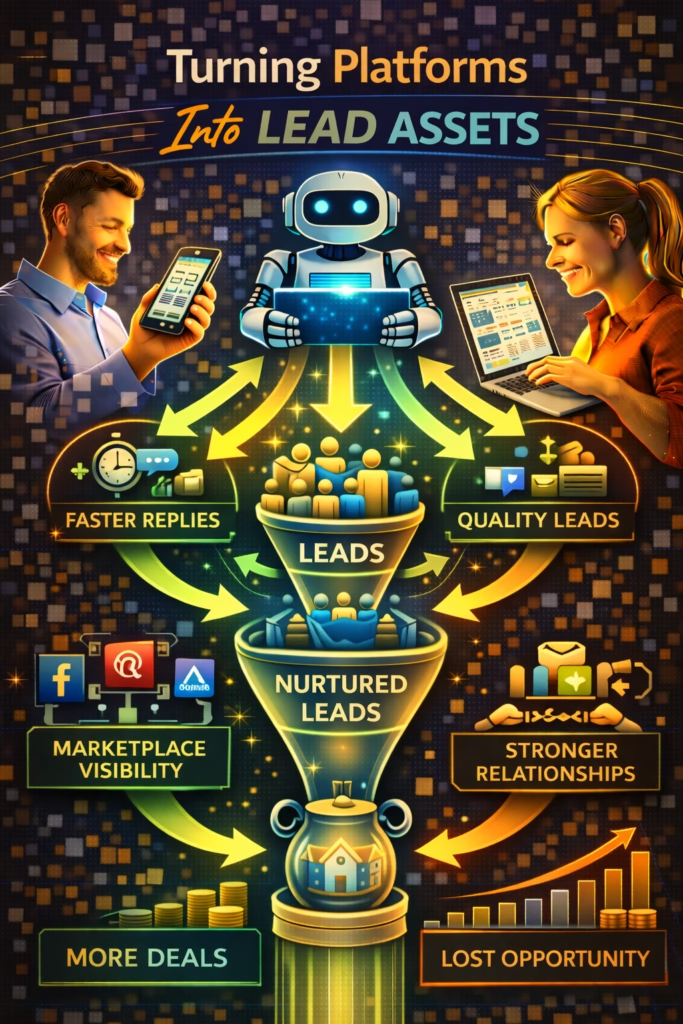
Turning Platforms Into Lead Assets
Turning Platforms Into Lead Assets is the blueprint for transforming “rented attention” into compounding lead systems—through consistent cadence, proof stacking, response speed, follow-up workflows, and compliant automation.
Note: This is general guidance. Follow each platform’s rules, keep claims truthful, avoid spam/duplication, and confirm compliance before automating messaging or posting.
Introduction
Turning Platforms Into Lead Assets starts with a mindset shift: you’re not “posting.” You’re building an asset.
Most businesses treat platforms like a slot machine. They post when they remember, run a promo when leads dip, and hope the algorithm smiles on them.
That approach creates spikes. Assets create compounding.
When you treat platforms as assets, every action has a job:
- Cadence creates stability and “freshness” signals.
- Proof builds trust and improves conversion rate.
- Response speed prevents lead drop-off.
- Follow-up turns inquiries into booked next steps.
- Retargeting captures the “not ready yet” buyers.
Big idea: You don’t need more platforms. You need a system that turns each platform into a lead-producing machine.
Expanded Table of Contents
- 1) What a “lead asset” actually is
- 2) The platform asset stack (visibility → proof → conversion)
- 3) Platform types: marketplace, local search, social, and messaging
- 4) Cadence systems that don’t collapse
- 5) Freshness loops: how recency compounds reach
- 6) Content rotation without duplication (anti-flag framework)
- 7) Proof stacking: the fastest way to improve conversion
- 8) Conversion workflows: from message to booked next step
- 9) Follow-up systems that recover “lost” leads
- 10) Compliant automation: what to automate and what not to
- 11) Retargeting layers: capturing buyers who aren’t ready
- 12) KPIs and dashboards for lead assets
- 13) 30–60–90 day rollout plan
- 14) 25 Frequently Asked Questions
- 15) 25 Extra Keywords
1) What a “lead asset” actually is
A lead asset is a channel component that produces inquiries predictably because it’s been built to compound over time.
Examples of lead assets
- An optimized marketplace listing library with rotating angles and photos
- A Google Business Profile with consistent posts, photos, and review momentum
- A short-form content library that produces inbound traffic weekly
- A follow-up workflow that converts old leads into appointments
- A retargeting audience that keeps your brand in front of intent buyers
Rule: If it only works when you “push,” it’s not an asset. If it works because you built a repeatable system, it is.
2) The platform asset stack (visibility → proof → conversion)
Turning Platforms Into Lead Assets is easiest when you use a simple stack:
| Layer | Goal | What you build |
|---|---|---|
| Visibility | Earn impressions and clicks | Cadence + keywords + thumbnails + variety |
| Proof | Increase trust and message rate | Reviews, real photos, results, social proof |
| Conversion | Turn leads into booked next steps | Fast response + scripts + follow-up SOP |
| Retention | Increase LTV and referrals | After-sale messaging + review asks + reactivation |
Rule: Most businesses chase visibility and ignore proof and conversion. The winners build the whole stack.
3) Platform types: marketplace, local search, social, and messaging
Not all platforms behave the same. Lead assets work when you match the system to the platform’s incentives.
Marketplaces
Incentive: recency + engagement + trust.
Assets: rotating listing library, fast replies, photo testing.
Local search (GBP / Maps)
Incentive: proximity + relevance + prominence.
Assets: reviews, photos, consistent posts, category alignment.
Social (TikTok/IG/FB)
Incentive: watch time + saves + shares.
Assets: repeatable short-form formats + content batching.
Messaging / CRM
Incentive: speed and follow-through.
Assets: scripts, routing, follow-up sequences, next-step booking.
Pro move: Build one platform into an asset first. Then replicate the system across platforms.
4) Cadence systems that don’t collapse
Cadence is the heartbeat of your lead asset. Without it, the platform assumes you’re inactive and stops distributing your content as often.
The “Minimum Viable Cadence” framework
- Daily: 5–20 minutes of response + follow-up
- Daily: 1–5 visibility actions (post/refresh/rotate)
- Weekly: 60 minutes batching + one A/B test
- Monthly: proof refresh (reviews, photos, top posts)
Daily cadence checklist (copy/paste)
[ ] Respond to new leads immediately
[ ] Follow up on open conversations (5–15)
[ ] Post/refresh 1–3 assets (with variation)
[ ] Upgrade 1 weak asset (photo/title/hook)
[ ] Capture 1 proof item (screenshot/review/before-after)
Rule: Small, sustainable daily cadence beats big bursts followed by silence.
5) Freshness loops: how recency compounds reach
Freshness is one of the most reliable platform incentives because it’s measurable and correlated with buyer satisfaction.
Freshness actions that are usually low-risk
- Rotate first photo (thumbnail testing)
- Rewrite title for clarity and intent
- Update first 1–2 lines (hook) to improve CTR
- Refresh proof (new photos, new reviews, new results)
- Replace stale assets with stronger variants
Avoid: rapid repetitive edits, duplicate reposting, or manipulative behavior. Keep changes meaningful and spaced out.
Pro move: Treat freshness like maintenance. A little consistent upkeep beats rebuilding everything every month.
6) Content rotation without duplication (anti-flag framework)
Consistency fails when businesses repeat the same content and trigger spam signals. You need a rotation system.
The 5-axis rotation checklist
- Angle: value / speed / premium / trust / convenience
- Thumbnail: 3–5 first-photo candidates
- Hook: 3–5 opening lines per offer
- Features: rotate benefit emphasis
- Timing: stagger time windows
Angle matrix (example)
| Angle | Hook | CTA |
|---|---|---|
| Value | “Strong option if you want quality without overspending.” | “What’s your budget range?” |
| Speed | “Available now—quick next steps.” | “Today or this week?” |
| Premium | “For buyers who want the best experience.” | “What matters most to you?” |
| Trust | “Real photos, transparent details.” | “What city/zip are you in?” |
| Convenience | “Simple process—fast answers.” | “Want the fastest option?” |
Rule: Posting more without rotation increases risk. Posting consistently with rotation increases reach.
7) Proof stacking: the fastest way to improve conversion
Proof is the most underrated lead asset lever. Proof turns skeptical buyers into quick “yes” decisions.
Proof stack components
- Real photos (not just stock)
- Reviews and testimonials
- Before/after examples
- Process transparency (what happens next)
- Outcome clarity (what the buyer gets)
Proof placement strategy
First impression
Use a strong thumbnail and a clarity-first hook.
Mid-scroll
Add proof bullets (reviews, results, guarantees if applicable).
Message stage
Send proof as a short screenshot or one-line testimonial at the right moment.
Close
Offer a simple next step with low friction.
Pro move: Build a “proof folder” and add to it weekly. Proof is an asset that compounds conversions.
8) Conversion workflows: from message to booked next step
A platform becomes a lead asset when it produces booked next steps, not just messages.
The conversion ladder
- Impression
- Click
- Scroll
- Message
- Fast reply
- Qualification
- Booked next step
Instant reply template (universal)
Yes — I can help ✅

What city/zip are you in, and are you looking to do this today or this week?
I’ll confirm the best next step.
Qualification questions (keep it simple)
- Where are you located?
- What’s your timeline (today/this week/this month)?
- What matters most: price, speed, or quality?
Rule: Keep conversion friction low. One question beats five paragraphs.
9) Follow-up systems that recover “lost” leads
Most leads don’t say “no.” They say nothing. Follow-up turns silence into sales.
Follow-up schedule (simple and effective)
| Time | Goal | Message |
|---|---|---|
| +2 hours | Keep momentum | “Just checking—do you want the fastest option today or this week?” |
| +24 hours | Recover intent | “Still want help with this? City/zip + timeline and I’ll line it up.” |
| +72 hours | Offer clarity | “If you tell me what matters most (price/speed/quality), I’ll recommend the best option.” |
| +7 days | Reactivation | “Last quick check—should I keep this open for you?” |
Pro move: Follow-up is not pressure. It’s service. Buyers get busy. Your job is to make it easy to continue.
10) Compliant automation: what to automate and what not to
Automation can strengthen your lead asset—if it stays compliant and human-like.
Automate (usually safe)
- Instant replies that ask one question
- Routing leads to the right person
- Follow-up reminders
- KPI tracking and reporting
- Template libraries for approved messaging
Be careful with
- Bulk messaging
- High-volume repetitive posting
- Anything that mimics spam patterns
- Claims you can’t support
Important: Always follow platform rules. Avoid spam-like patterns, keep messages truthful, and ensure automation enhances buyer experience.
11) Retargeting layers: capturing buyers who aren’t ready
Retargeting turns “not now” into “later.” It’s how platforms become long-term assets.
Retargeting asset examples
- Website visitor audiences
- Engaged video viewers
- Messenger/DM re-engagement audiences (where allowed)
- Email list reactivation sequences
Rule: Retargeting isn’t just ads. It’s any system that keeps you in the buyer’s world after the first touch.
12) KPIs and dashboards for lead assets
| KPI | What it measures | Target direction |
|---|---|---|
| Actions/day | Cadence stability | Stable |
| Active assets | Surface area | Up |
| Messages/day | Demand | Up |
| Messages per asset | Quality per unit | Up |
| Median response time | Speed-to-lead | Down |
| Booked next steps | Revenue predictor | Up |
| Lead leakage | Follow-up failure | Down |
| Flags/removals | Compliance risk | Down |
Pro move: Measure “booked next steps” weekly. It’s the KPI that turns platforms into predictable revenue.
13) 30–60–90 day rollout plan
Days 1–30 (Build the foundation)
- Choose one primary platform and build a baseline cadence
- Create 3–5 angles and 10–20 content variants
- Deploy instant reply + follow-up schedule
- Start KPI tracking (messages/day, response time, booked steps)
- Begin proof stacking weekly
Days 31–60 (Expand and optimize)
- Increase surface area with varied assets
- Run weekly A/B tests on thumbnails/titles/hooks
- Replace weak performers systematically
- Add retargeting or reactivation layer (if applicable)
Days 61–90 (Systemize and replicate)
- Document SOPs for posting, rotation, response, follow-up
- Automate low-risk steps (routing, reminders, reporting)
- Replicate the system to a second platform
- Double down on winners by angle/category/location
Rule: Platforms become assets when you build systems that compound—cadence + proof + conversion + follow-up.
14) 25 Frequently Asked Questions
1) What does “Turning Platforms Into Lead Assets” mean?
It means building repeatable systems on platforms so they produce leads consistently—rather than relying on one-off posts.
2) What is a lead asset?
A channel component that produces inquiries predictably: optimized profiles, listing libraries, content libraries, follow-up flows, and audiences.
3) Why do platforms outperform “campaigns” for many local businesses?
Because platforms can compound distribution via freshness, engagement, trust, and proof signals over time.
4) What’s the first platform I should turn into an asset?
The one where your buyers already have intent (often marketplaces or Google/Maps).
5) Do I need to be on every platform?
No—one strong asset beats five neglected channels.
6) What’s the most important lever for turning platforms into assets?
Consistency: stable cadence + fast response + follow-up.
7) How does posting cadence affect results?
Cadence strengthens freshness signals and keeps your inventory/content in circulation.
8) What is a freshness loop?
A cycle where consistent updates create engagement, which increases distribution, which creates more leads.
9) How do I avoid duplication and flags?
Rotate angles, photos, hooks, feature emphasis, and timing windows—while keeping everything truthful.
10) What matters more: volume or quality?
Quality per asset and response speed usually outperform raw volume.
11) How fast should I respond to leads?
Under 5 minutes is strong; under 1 minute is best.
12) What’s the best first reply?
Confirm help/availability and ask one question that advances the next step (city/zip + timeline).
13) Why is follow-up so important?
Most leads go silent, not “no.” Follow-up recovers sales you already paid for with effort.
14) What follow-up schedule works best?
2 hours, 24 hours, 72 hours, and 7 days is a simple, effective sequence.
15) What is proof stacking?
Collecting and deploying proof assets (reviews, photos, results) weekly to increase conversion.
16) Where should proof appear?
In thumbnails/photos, mid-scroll bullets, and in-message screenshots at the decision moment.
17) What should I automate?
Instant replies, routing, reminders, reporting, and templated follow-ups (where allowed).
18) What should I be cautious automating?
High-volume repetitive posting and bulk messaging—these can trigger spam signals or policy issues.
19) What are the best KPIs for lead assets?
Messages/day, response time, booked next steps, and messages per asset.
20) What KPI predicts revenue best?
Booked next steps (appointments, pickups, quotes), not views.
21) How long does it take to build a lead asset?
Often 30–90 days of consistent execution for compounding results.
22) Can lead assets work without paid ads?
Yes—organic systems can compound through consistency, proof, and conversion workflows.
23) Do I need new content daily?
No—rotate and refresh strategically. Consistent variety matters more than constant novelty.
24) How do I scale to more platforms?
Document SOPs and replicate the same cadence + rotation + response + follow-up system.
25) What’s the biggest mistake people make?
Treating platforms like a slot machine instead of building a lead asset system.
15) 25 Extra Keywords
- Turning Platforms Into Lead Assets
- platform lead assets
- marketplace lead asset system
- Facebook Marketplace lead generation
- social media lead system
- local SEO lead asset
- Google Business Profile lead asset
- compounding lead generation strategy
- freshness loop marketing
- posting cadence framework
- content rotation anti-flag
- avoid duplicate listing flags
- proof stacking strategy
- testimonial marketing system
- response speed lead conversion
- speed-to-lead marketplace
- follow-up SOP for leads
- lead leakage prevention
- booked next steps KPI
- messages per listing KPI
- organic lead asset blueprint
- retargeting layers for local business
- compliant marketing automation
- 2026 lead generation blueprint
- turn platforms into revenue system