
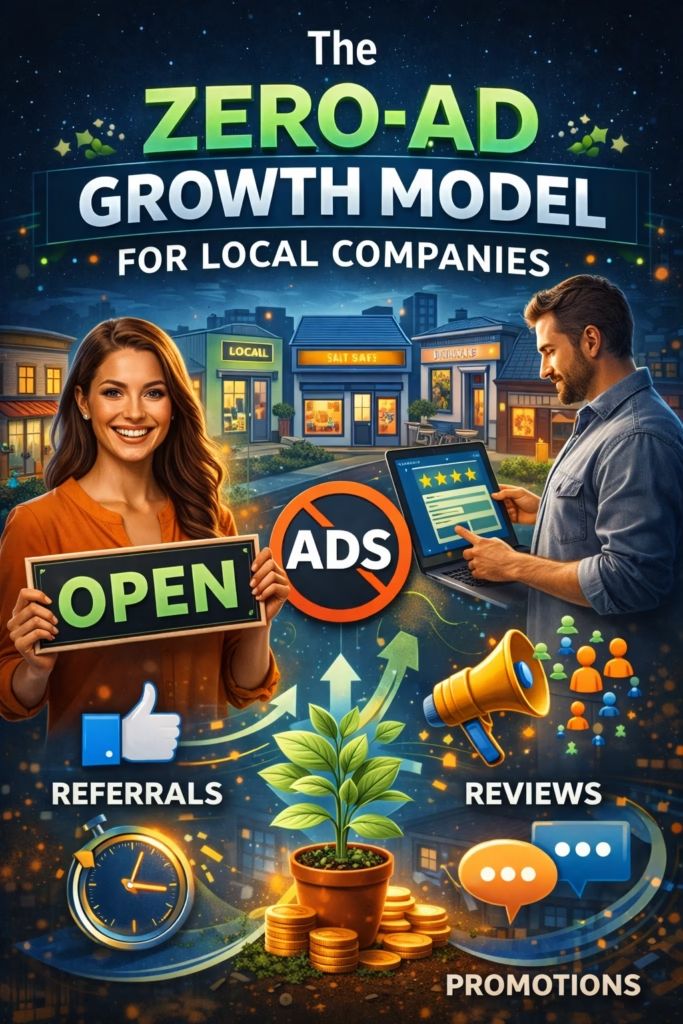
The Zero-Ad Growth Model for Local Companies
The Zero-Ad Growth Model for Local Companies builds sustainable business growth through owned marketing systems—marketplace automation, local SEO, content engines, and referral networks—instead of renting attention through paid ads that stop working the moment you stop paying.
Note: This is general marketing guidance. The Zero-Ad Model requires consistent execution and patience—results compound over time rather than arriving instantly like paid ads.
Introduction
The Zero-Ad Growth Model for Local Companies is built on a simple truth: paid advertising is rented attention. The moment you stop paying, the leads stop coming. For most local businesses, this creates a treadmill of dependency—constantly feeding ad platforms to stay visible.
The alternative is owned marketing: systems that generate leads organically through assets you control. Marketplace listings you post for free. Search rankings you earn through local SEO. Content that attracts customers month after month. Referral systems that turn happy customers into your sales team.
These owned systems require time and effort to build—but once established, they generate consistent leads without ongoing ad spend. A local contractor spending $3,000/month on Google Ads can redirect that budget into owned systems that eventually produce 2-3x the lead volume at zero ongoing cost.
This guide provides the complete framework local companies use to grow sustainably without paid advertising: the channels that work, the automation that scales them, the timelines to expect, and the ROI calculations that prove the model.
Big idea: Paid ads rent attention. Owned marketing systems own attention. The Zero-Ad Model builds assets that appreciate, not expenses that evaporate.
Expanded Table of Contents
- 1) Why paid ads fail local companies (the dependency trap)
- 2) The Zero-Ad Growth Model framework
- 3) Pillar 1: Marketplace automation (fastest ROI)
- 4) Pillar 2: Local SEO that ranks and converts
- 5) Pillar 3: Content systems that generate leads
- 6) Pillar 4: Referral engines that scale word-of-mouth
- 7) Pillar 5: Organic social media strategy
- 8) Automation that scales without headcount
- 9) Growth timeline and milestones
- 10) ROI analysis: zero-ad vs paid ads
- 11) How the pillars work together
- 12) Common mistakes and how to avoid them
- 13) 30–60–90 day implementation plan
- 14) 25 Frequently Asked Questions
- 15) 25 Extra Keywords
1) Why paid ads fail local companies (the dependency trap)
The paid advertising dependency cycle
Most local businesses start with paid ads because they deliver immediate results. But immediate results create long-term problems:
- Month 1: Spend $2,000 on Google/Facebook ads → generate 30 leads → close 5 customers
- Month 2: Same spend, same results (if lucky—often performance declines)
- Month 6: Try to reduce budget → lead volume drops proportionally → forced to maintain spend
- Year 2: Platform raises costs → now spending $3,000 for same 30 leads
- Year 3: Stop ads due to economic downturn → leads drop to zero instantly
The true cost of paid advertising
| Visible Costs | Hidden Costs | Opportunity Costs |
|---|---|---|
| Ad platform fees ($2-5K/month) | Management time (10-20 hrs/month) | Could have built owned assets instead |
| Agency fees (if outsourced) | Creative production costs | Brand equity never accumulates |
| Landing page tools | A/B testing infrastructure | Platform algorithm dependency |
| CRM and tracking | Dealing with poor-quality leads | Zero residual value when ads stop |
When paid ads make sense vs when they don't
Good use cases for paid ads:
- Launch promotions requiring immediate traffic
- Testing new markets or offerings quickly
- Seasonal businesses with compressed selling windows
- High-LTV businesses with strong margins (legal, medical, financial)
- Scale tactics after organic channels are maximized
Bad use cases for paid ads:
- Primary lead generation for businesses with thin margins
- Long-term brand building and authority
- Businesses with inconsistent cash flow
- Replacing fundamentals (bad product, poor service)
- Commodity services where ads just fuel price wars
Platform dependency risk
Real scenarios that eliminate ad-dependent businesses overnight:

- iOS privacy updates crater Facebook ad performance (2021)
- Google algorithm changes kill conversion rates (quarterly)
- Platform bans account for policy violation (often wrongly)
- Ad costs rise 30-50% in competitive markets
- Economic recession forces budget cuts → leads vanish
Truth: Paid ads are tools, not strategies. The Zero-Ad Model uses owned assets that survive platform changes, economic downturns, and algorithm updates.
2) The Zero-Ad Growth Model framework
The five pillars of zero-ad growth
Pillar 1: Marketplace Automation
ROI: Fastest (7-14 days to first leads). Free organic reach on Facebook Marketplace, Craigslist, OfferUp. Automate posting for consistent visibility.
Pillar 2: Local SEO
ROI: High (30-90 days). Rank for "[service] + [city]" searches. Permanent organic traffic from Google Maps and organic search.
Pillar 3: Content Systems
ROI: Compounding (90-180 days). Blog posts, videos, guides that rank and generate leads indefinitely with zero ongoing cost.
Pillar 4: Referral Engines
ROI: Highest LTV (immediate). Systematize word-of-mouth with automation. Referrals close 3-5x higher than cold leads.
Pillar 5: Organic Social
ROI: Brand building (60-120 days). Build authority and trust through consistent, valuable posts—without paying for reach.
Pillar 6: Automation Glue
ROI: Efficiency multiplier. Chatbots, workflows, and systems that scale all pillars without proportional time investment.
How the model compounds over time
| Timeline | Active Pillars | Monthly Leads | Monthly Ad Spend |
|---|---|---|---|
| Month 1 | Marketplace | 15-30 | $0 |
| Month 3 | Marketplace + Local SEO | 40-60 | $0 |
| Month 6 | All pillars active | 80-120 | $0 |
| Month 12 | All pillars optimized | 150-250 | $0 |
| Month 24 | Compounding effects | 300-500+ | $0 |
Required inputs (what you invest instead of ad dollars)
- Time: 10-20 hours/week initially, reducing to 5-10 hours/week with automation
- Tools: $100-300/month (automation, SEO tools, hosting)
- Patience: 90-180 days to full momentum (vs instant with ads)
- Consistency: must execute weekly, not sporadically
- Learning: skills in SEO, content, automation compound forever
Pro move: Don't try to build all pillars simultaneously. Prioritize Marketplace (fast wins) → Local SEO (high ROI) → Content (compounding) → Referral → Social.
3) Pillar 1: Marketplace automation (fastest ROI)
Why marketplace platforms are zero-ad gold
Facebook Marketplace, Craigslist, OfferUp, and Nextdoor combine local targeting, high buyer intent, and zero posting costs—making them the fastest-ROI channel for local businesses.
Marketplace platform comparison
| Platform | Audience | Posting Cost | Best For |
|---|---|---|---|
| Facebook Marketplace | 2B+ users, all demographics | Free | Most businesses, highest volume |
| Craigslist | 50M+ monthly, older demographic | Free (most categories) | Services, rentals, contractors |
| OfferUp | 20M+ monthly, mobile-first | Free | Retail, used goods, local services |
| Nextdoor | Hyperlocal neighborhoods | Free | Home services, contractors, local retail |
Marketplace automation workflow
Step 1: Build listing templates (10-20 core offerings)
Step 2: Create photo library (product/service photos)
Step 3: Set up posting automation (Zapier + spreadsheet or tool like Vendoo)
Step 4: Schedule daily/weekly posting cadence
Step 5: Implement AI chatbot for instant responses
Step 6: Track leads in CRM by source
Step 7: Optimize based on performance data

Result: 20-50 leads/month with 3-5 hours/week maintenance
Marketplace lead generation by industry
- Real estate: 50-200+ inquiries/month with consistent listing posting
- Home services (HVAC, plumbing, roofing): 30-80 leads/month
- Automotive (detailing, repair, sales): 40-100 leads/month
- Retail (furniture, appliances, mattresses): 100-300 inquiries/month
- Professional services (cleaning, landscaping): 25-60 leads/month
Automation tools for marketplace posting
| Tool | Platforms | Cost | Complexity |
|---|---|---|---|
| Zapier + Google Sheets | Facebook (via API limits) | $20-50/month | Medium |
| Vendoo | Multiple marketplaces | $30-50/month | Low |
| List Perfectly | Cross-posting tool | $15-30/month | Low |
| Manual batch posting | All platforms | $0 | Low (time-intensive) |
Truth: Marketplace is the fastest pillar to implement and the quickest to generate ROI. Start here while building other pillars.
4) Pillar 2: Local SEO that ranks and converts
Why local SEO beats paid search
Google Ads for "plumber near me" costs $15-50 per click. Ranking organically for the same search costs $0 per click and generates trust through third-party validation (Google ranking you = credibility signal).
The local SEO stack (priority order)
- Google Business Profile: The foundation. Optimize completely, post weekly, collect reviews religiously.
- NAP consistency: Name, Address, Phone identical across all citations (Yelp, Yellow Pages, industry directories).
- Service pages: Dedicated pages for "[Service] in [City]" (e.g., "HVAC Repair in Austin").
- Local backlinks: Links from local chambers, news sites, community organizations.
- Review generation: 4-5 star average with 50+ reviews signals authority to Google.
- Schema markup: LocalBusiness structured data helps Google understand your business.
Google Business Profile optimization checklist
✅ Complete every field (hours, services, attributes, description)
✅ Choose all relevant categories (primary + secondary)
✅ Upload 10+ high-quality photos (exterior, interior, team, work examples)
✅ Post weekly updates (services, offers, content)
✅ Respond to every review within 24 hours
✅ Use Google Posts for announcements
✅ Enable messaging (respond within 24 hours for ranking boost)
✅ Add products/services with descriptions and pricing
✅ Create Q&A section with common questions pre-answered
Service page SEO template
URL: /[service]-[city] (e.g., /hvac-repair-austin)

Title: [Service] in [City] | [Company Name]
Meta Description: Professional [Service] in [City]. [Key benefit]. [Social proof]. Call [Phone] for [Offer].

Content Structure:
- H1: [Service] in [City, State]
- Intro paragraph (150-200 words): What you do, who you serve, why choose you
- H2: Why Choose Us for [Service]
- H2: Our [Service] Process
- H2: Service Areas (list neighborhoods)
- H2: Pricing and Estimates
- H2: Customer Reviews
- H2: FAQ (5-10 questions)
- CTA: Phone, form, chat

Word count: 1,500-2,500 words (outrank competitors with depth)
Review generation automation
Workflow:
1. Job completed → trigger sent to automation
2. Wait 24 hours
3. Email: "Thanks for choosing us! How did we do?" + Google review link
4. If no review in 48 hours → SMS follow-up
5. If review left → Thank you email + referral request
6. If negative feedback → immediate manager alert + outreach

Result: 40-60% review conversion rate vs 5-10% without automation
Local SEO timeline and results
| Timeline | Actions | Results |
|---|---|---|
| Week 1-2 | GBP optimization, citation cleanup | Improved map pack visibility |
| Week 3-8 | Service pages published, review generation live | 10-20 organic leads/month |
| Week 9-16 | Local links acquired, content expansion | 30-50 organic leads/month |
| Month 6+ | Authority established, rankings solidified | 60-100+ organic leads/month |
Pro move: Focus on 3-5 core services in your primary city first. Dominate those rankings before expanding to adjacent cities or additional services.
5) Pillar 3: Content systems that generate leads
Why content marketing works for local businesses
Every piece of content you publish is a permanent asset that can rank in search engines and generate leads indefinitely. A single blog post written once can drive 10-50 leads per month for years—at zero ongoing cost.
High-ROI content types for local businesses
| Content Type | Time to Create | Lead Generation Potential | Longevity |
|---|---|---|---|
| How-to guides | 3-5 hours | High (solves specific problems) | 2-5 years |
| Local area guides | 2-4 hours | Medium (local SEO boost) | 3-5 years |
| Case studies/before-after | 1-3 hours | Very high (proof) | 1-3 years |
| Comparison posts | 2-4 hours | High (decision-stage buyers) | 2-4 years |
| FAQ posts | 1-2 hours | Medium (broad keywords) | 3-5 years |
| Cost/pricing guides | 2-3 hours | Very high (buyer intent) | 1-2 years (update annually) |
The content system (repeatable process)
- Research: Find questions customers ask (Google autocomplete, forums, sales calls)
- Outline: Structure answer comprehensively (1,500-2,500 words)
- Write: Create once or use AI to draft + human edit
- Optimize: Include target keyword, internal links, schema, images
- Publish: Add to website blog with proper SEO
- Promote: Share on social, email list, Google Business Post
- Track: Monitor rankings and traffic in Google Search Console
Content calendar template (12 posts = 1 year of content)
Q1: Foundation posts
1. "Ultimate Guide to [Service] in [City]"
2. "How Much Does [Service] Cost in [City]?"
3. "[Service] FAQ: Everything [City] Residents Ask"

Q2: Problem-solution posts
4. "5 Signs You Need [Service] in [City]"
5. "DIY vs Professional [Service]: What [City] Homeowners Should Know"
6. "How to Choose a [Service Provider] in [City]"

Q3: Local authority posts
7. "Best Neighborhoods in [City] for [Relevant Topic]"
8. "What [City] Homeowners Should Know About [Relevant Issue]"
9. "[Service] Mistakes [City] Residents Make (And How to Avoid Them)"

Q4: Case studies and seasonal
10. "Before & After: [Service] Projects in [City]"
11. "Preparing Your [Relevant Asset] for [Season] in [City]"
12. "2025 [Service] Trends [City] Homeowners Are Following"
Content ROI calculation
Single blog post economics:

Creation cost:
- 4 hours writing at $50/hour = $200 (or $0 if you write)
- One-time investment

Returns (conservative):
- Ranks for 5 keywords averaging 100 searches/month each
- 3% click-through rate = 15 visitors/month
- 10% conversion to lead = 1.5 leads/month
- Over 3 years: 54 leads
- At $50 cost per lead via ads: $2,700 value
- ROI: 1,350%

Portfolio effect:
- 12 posts/year = 18 leads/month by year-end
- 50 posts over 3 years = 75+ leads/month ongoing
Truth: Content is the ultimate compounding asset. Every piece you publish today generates leads forever—at zero marginal cost.
6) Pillar 4: Referral engines that scale word-of-mouth
Why referrals are the highest-value channel
- Higher close rate: 50-70% vs 10-30% for cold leads
- Higher LTV: Referred customers buy more and stay longer
- Zero acquisition cost: Comes from existing customer relationships
- Faster sales cycle: Pre-qualified and pre-sold by referrer
- Compounding effect: Referred customers also refer
The referral system (automation required)
Most businesses rely on passive referrals ("tell your friends!"). The Zero-Ad Model systemizes referrals with automation:
Referral automation workflow:
Step 1: Job completed → thank you email (day 1)
Step 2: Review request (day 2-3)
Step 3: If positive review → referral request email (day 7):
   "Glad we could help! Know anyone else who needs [service]?
    Send them our way and we'll take great care of them."
Step 4: Referral tracking (unique links or codes per customer)
Step 5: Referral thank you + incentive if applicable (gift card, discount)
Step 6: Referral follow-up and conversion

Result: 10-20% of happy customers refer 1-3 people
Referral incentive frameworks
| Incentive Type | Best For | Conversion |
|---|---|---|
| No incentive (pure ask) | High-satisfaction services | 5-10% |
| Discount on next service | Repeat-purchase businesses | 15-25% |
| Cash/gift card | One-time or infrequent services | 20-30% |
| Donation to charity | Purpose-driven brands | 10-20% |
| Exclusive access/VIP benefits | Premium/luxury services | 15-25% |
Referral sources beyond customers
- Strategic partners: Complementary businesses (e.g., realtors ↔ contractors)
- Past employees: Alumni network often refers back
- Vendors and suppliers: They work with your customers too
- Professional network: Industry associations, chambers of commerce
- Online communities: Neighborhood Facebook groups, Nextdoor, Reddit
Referral tracking and optimization
Key metrics to track:

- Referral request send rate (% of customers asked)
- Referral generation rate (% who actually refer)
- Referrals per referring customer (1.5-3 is strong)
- Referred lead close rate (should be 2-3x baseline)
- Referral channel breakdown (who refers most?)
- Time to referral (how long after service?)
Pro move: Make referring easy—personalized referral links, one-click sharing, pre-written messages customers can send.
8) Automation that scales without headcount
Why automation is the glue of the Zero-Ad Model
Without automation, the Zero-Ad Model requires 30-40 hours/week. With automation, it runs on 5-10 hours/week while generating better results.
Essential automation workflows
Workflow 1: Lead capture and instant response
Trigger: Lead inquiry (any source: marketplace, website, social, phone)

Actions:
1. Create contact in CRM
2. Send instant auto-response (chatbot or email)
3. Collect qualification info (budget, timeline, need)
4. Route to appropriate team member
5. Schedule follow-up tasks
6. Track lead source

Result: 100% lead capture, <10 second response time
Workflow 2: Review and referral engine
Trigger: Job marked complete in CRM

Actions:
Day 1: Thank you email
Day 2: Google review request
Day 7: Referral request (if positive review left)
Day 14: Case study request (if 5-star review)
Day 30: Re-engagement offer for repeat business

Result: 40-60% review rate, 10-20% referral rate
Workflow 3: Content distribution
Trigger: New blog post published

Actions:
1. Auto-post to Facebook page
2. Auto-post to LinkedIn company page
3. Share in Instagram Stories (manual or scheduled)
4. Create Google Business Post
5. Email to subscriber list
6. Save to content library for repurposing

Result: One piece of content reaches 5+ channels instantly
Automation tool stack (budget tiers)
| Budget | Tools | Monthly Cost | Capabilities |
|---|---|---|---|
| Starter | Zapier + ManyChat + Google Workspace | $50-100 | Basic workflows, chatbots, lead capture |
| Growth | Zapier Pro + HubSpot CRM + Buffer | $150-300 | Advanced automation, CRM, social scheduling |
| Scale | Make.com + HubSpot Pro + Later + custom integrations | $300-600 | Complex workflows, full marketing automation |
Time savings from automation
Manual vs automated time investment (per week):

Lead response: 8 hours → 1 hour (87% reduction)
Social posting: 5 hours → 30 minutes (90% reduction)
Review requests: 2 hours → 15 minutes (87% reduction)
Follow-up emails: 4 hours → 30 minutes (87% reduction)
Reporting: 2 hours → 30 minutes (75% reduction)

Total: 21 hours/week → 3.5 hours/week

Time saved: 17.5 hours/week = 70 hours/month = $3,500-$7,000/month of value
Pro move: Automate repetitive tasks first (lead response, review requests, social posting). Manual effort goes to high-value activities (sales calls, strategy, content creation).
9) Growth timeline and milestones
Realistic growth curve for Zero-Ad Model
| Timeframe | Focus | Expected Leads | Key Milestones |
|---|---|---|---|
| Month 1 | Marketplace setup + GBP optimization | 15-30/month | First marketplace leads within 7-14 days |
| Month 2-3 | Local SEO + content publishing begins | 30-50/month | First organic search leads, review system live |
| Month 4-6 | Content gaining traction + referral engine | 60-100/month | Multiple channels producing, automation refined |
| Month 7-12 | Optimization + scaling winners | 100-200/month | Sustainable lead flow, reduced time investment |
| Year 2 | Compounding effects + geographic expansion | 200-400/month | Model proven, can replicate for new locations |
The "hockey stick" inflection point
Most Zero-Ad implementations experience slow growth months 1-3, moderate growth months 4-6, then exponential growth months 7-12 as compounding effects kick in:
Month 1-3: Building foundation (slow)
- Setting up systems
- Publishing initial content
- Growing review count
- Establishing marketplace presence

Month 4-6: Early momentum (moderate)
- Some content starts ranking
- Reviews reaching critical mass (20-50)
- Marketplace volume increasing
- Referrals starting to trickle

Month 7-12: Compounding acceleration (fast)
- Multiple content pieces ranking page 1
- Reviews 50-100+ (authority signal)
- Marketplace listings mature and convert better
- Referrals generating more referrals
- All channels working together
Comparison: Zero-Ad vs Paid Ads timeline
| Timeline | Paid Ads | Zero-Ad Model |
|---|---|---|
| Week 1 | Leads start immediately | Setup and planning |
| Month 1 | Full lead flow (if budget sufficient) | 15-30 leads (marketplace only) |
| Month 3 | Same lead flow (or declining) | 40-60 leads (adding channels) |
| Month 6 | Same or increased costs for same leads | 80-120 leads (momentum building) |
| Month 12 | Still paying same or more per lead | 150-250 leads (compounding effects) |
| Stop spending? | Leads stop immediately | Leads continue growing (owned assets) |
Truth: Paid ads win month 1. Zero-Ad Model wins every month after month 6—and the gap widens over time.
10) ROI analysis: zero-ad vs paid ads
3-year cost comparison
| Approach | Year 1 Cost | Year 2 Cost | Year 3 Cost | Total 3-Year Cost |
|---|---|---|---|---|
| Paid Ads Only | $36,000 | $42,000 (inflation) | $48,000 (inflation) | $126,000 |
| Zero-Ad Model | $3,600 (tools + time) | $2,400 (maintenance) | $2,400 (maintenance) | $8,400 |
| Savings | $32,400 | $39,600 | $45,600 | $117,600 |
Lead volume comparison
Scenario: HVAC company in medium market

Paid Ads (Google + Facebook, $3K/month):
- Monthly spend: $3,000
- Leads per month: 40-60
- Cost per lead: $50-$75
- Year 1 leads: 600
- Year 2 leads: 600 (same, costs rising)
- Year 3 leads: 600 (same, costs rising)
- Stop ads: 0 leads next month

Zero-Ad Model:
- Monthly investment: $200 tools + 10 hrs/week
- Leads per month: 15-30 (Month 1), 80-120 (Month 6), 150-250 (Month 12)
- Cost per lead: $0 (after time investment)
- Year 1 leads: 1,000
- Year 2 leads: 2,400 (compounding)
- Year 3 leads: 3,000 (compounding)
- Stop effort: leads continue from owned assets
ROI by pillar (12-month projection)
| Pillar | Investment | Leads Generated | ROI |
|---|---|---|---|
| Marketplace | $600 (tools) + 150 hours | 400-600 | Infinite (free traffic) |
| Local SEO | $1,200 (tools) + 100 hours | 600-800 | 10-50x (vs paid search) |
| Content | $500 (hosting/tools) + 200 hours | 200-400 | Compounding forever |
| Referrals | $400 (automation) + 50 hours | 150-300 | Highest LTV, zero CAC |
| Social | $300 (scheduling tools) + 150 hours | 100-200 | Brand equity + awareness |
Breakeven analysis
When does Zero-Ad Model beat Paid Ads?

Setup cost:
- Month 1-3: $3,600 tools + time investment
- Paid ads same period: $9,000 (generating more leads)

Crossover point:
- Month 4-6: Zero-Ad lead volume matches paid ads
- Month 7+: Zero-Ad lead volume exceeds paid ads permanently

Financial breakeven:
- Paid ads: $36,000/year forever
- Zero-Ad: $8,400 year 1, $2,400/year maintenance
- Breakeven: Month 4
- Every month after: pure profit vs ongoing ad costs
Pro move: The ROI calculation doesn't include the enterprise value of owned assets. When you sell your business, owned marketing systems add 2-4x multiplier value. Paid ad dependency reduces valuation.
11) How the pillars work together
The synergy effect (1 + 1 = 3)
Each pillar amplifies the others when integrated properly:
Example integration flow:
Marketplace listing generates lead
→ Lead sees Google reviews while researching (Local SEO pillar)
→ Clicks blog post in organic search (Content pillar)
→ Books appointment via automated calendar link (Automation)
→ Job completed, review requested (Review system)
→ Happy customer refers friend (Referral pillar)
→ Friend sees Instagram before/after post (Social pillar)
→ Friend books, cycle repeats

Result: Each pillar increases conversion rate of other pillars
Multi-channel attribution
Leads rarely convert from single touchpoint. The Zero-Ad Model creates multiple "trust signals" across channels:
- First touch: Finds you via marketplace listing
- Research: Googles your name → sees website, reviews, blog content
- Social proof: Checks Facebook/Instagram → sees active presence
- Referral: Asks friend → friend confirms positive experience
- Conversion: Books because "everywhere I looked, you showed up"
Content → SEO → Marketplace → Referral cycle
1. Publish blog post targeting "[service] [city]"
2. Post ranks in Google (SEO)
3. Organic traffic visits site → some convert directly
4. Others find you on Marketplace after seeing brand name
5. Customers leave reviews mentioning content helpfulness
6. More reviews boost SEO rankings further
7. Happy customers refer, citing "found great info on your blog"
8. Referrals search your name → find content → convert faster
9. Cycle repeats and amplifies
Pillar priority by business type
| Business Type | Priority 1 | Priority 2 | Priority 3 |
|---|---|---|---|
| Retail/E-commerce | Marketplace | Social | Content |
| Home Services | Local SEO | Marketplace | Referrals |
| Professional Services | Content | Local SEO | Referrals |
| Real Estate | Marketplace | Social | Local SEO |
| Automotive | Marketplace | Local SEO | Content |
Truth: The Zero-Ad Model works because pillars reinforce each other. One channel makes the next channel more effective.
12) Common mistakes and how to avoid them
Mistake 1: Trying to build all pillars simultaneously
Problem: Spreading effort too thin leads to mediocre execution across all channels.
Solution: Build sequentially. Master Marketplace (2 weeks) → Local SEO (4-6 weeks) → Content (ongoing) → Referrals → Social.
Mistake 2: Abandoning too early (the "90-day quit")
Problem: Most businesses quit at 60-90 days, right before compounding effects accelerate.
Solution: Commit to 180 days minimum. Set milestone expectations to avoid discouragement.
Mistake 3: Inconsistent execution
Problem: Posting marketplace listings for 2 weeks, stopping for a month, restarting—kills momentum.
Solution: Batch work and use automation. Consistency beats intensity.
Mistake 4: Not tracking ROI
Problem: Can't prove what works without data. Leads to wrong optimization decisions.
Solution: Track leads by source from day 1. Use UTM parameters, unique phone numbers, or simple "How did you hear about us?" fields.
Mistake 5: Creating content without SEO
Problem: Writing blog posts that never rank because they ignore keyword research and optimization.
Solution: Target specific search terms. Optimize titles, headers, meta descriptions for SEO.
Mistake 6: Ignoring automation
Problem: Manual execution doesn't scale. Leads to burnout and inconsistency.
Solution: Invest $100-300/month in automation tools. ROI is immediate through time savings.
Mistake 7: Perfectionism
Problem: Waiting for "perfect" website, photos, or content means never launching.
Solution: Launch at 80% quality. Improve based on actual performance data.
Mistake 8: No call-to-action
Problem: Creating content or social posts without clear next steps for interested prospects.
Solution: Every piece of content needs CTA: call, book, download, message, etc.
Pro move: Audit your execution monthly using this checklist. Identify which pillars are stalling and why.
13) 30–60–90 day implementation plan
Days 1–30: Foundation and quick wins
- Week 1: Setup and strategy
- Audit current marketing (what's working, what's not)
- Choose 2 platforms for Marketplace (Facebook + Craigslist)
- Claim/optimize Google Business Profile
- Set up basic automation (ManyChat for instant responses)
- Create tracking system (simple spreadsheet or CRM)
- Week 2-3: Marketplace launch
- Create 15-20 marketplace listings
- Set up AI chatbot with instant responses
- Post daily to maintain visibility
- Track lead volume and response times
- Week 4: Local SEO foundation
- Complete GBP optimization (photos, services, posts)
- Fix NAP consistency across top 10 citations
- Launch review generation automation
- Publish first 2 service pages
Days 31–60: Building momentum
- Week 5-6: Content system launch
- Research 12 target keywords
- Write and publish 4 blog posts
- Set up Google Search Console for tracking
- Create content distribution workflow
- Week 7-8: Referral engine
- Build automated review request sequence
- Add referral request automation
- Create referral tracking system
- Reach out to strategic partners
Days 61–90: Optimization and scaling
- Week 9-10: Social presence
- Batch-create one month of social content
- Schedule posts across platforms
- Join relevant local community groups
- Engage 15 minutes daily
- Week 11-12: Analysis and refinement
- Analyze 90-day performance by channel
- Calculate lead volume and cost per lead
- Double down on top 2 performing channels
- Document SOPs for consistency
- Expand best-performing marketplace listings
- Publish 4 more blog posts targeting best keywords
90-day success criteria
- ✅ 60-100+ leads generated (across all channels)
- ✅ Marketplace posting automated or systemized
- ✅ Google Business Profile optimized with 15+ reviews
- ✅ 8-12 blog posts published and indexed
- ✅ Referral system generating 5-10 referrals
- ✅ Social presence active and consistent
- ✅ All pillars have automation in place
- ✅ Tracking system showing ROI by channel
Rule: This 90-day plan is aggressive but achievable with 10-15 hours/week. Adjust timeline if running solo vs with team support.
14) 25 Frequently Asked Questions
1) Can local companies really grow without paid advertising?
Yes. Thousands of local businesses generate consistent leads through marketplace automation, local SEO, content, and referrals—without ad spend.
2) How long does the Zero-Ad Model take to produce results?
Marketplace generates leads in 7-14 days. Local SEO shows results in 30-90 days. Full momentum builds over 3-6 months.
3) Is the Zero-Ad Model truly zero cost?
Zero ad spend. There are tool costs ($100-300/month) and time investment (10-20 hours/week initially).
4) What if I need leads immediately?
Use paid ads for immediate needs while simultaneously building Zero-Ad systems. Transition over 3-6 months.
5) Which pillar generates the fastest ROI?
Marketplace automation generates leads fastest (7-14 days) with lowest barrier to entry.
6) Can service businesses use marketplace platforms?
Yes. Home services, contractors, professionals, and B2B services all generate leads via marketplace platforms.
7) How much time does the Zero-Ad Model require?
15-20 hours/week initially. Reduces to 5-10 hours/week with automation and systemization.
8) Do I need technical skills?
No. Most activities are non-technical. Basic automation tools like Zapier are low-code. Outsource what you can't do.
9) What if my market is already saturated?
Most "saturated" markets have weak organic presence. Consistent execution beats competition that quits after 60 days.
10) Can this work for B2B companies?
Yes. Prioritize LinkedIn (organic), content marketing, referral partnerships, and local SEO over marketplace platforms.
11) Should I hire an agency?
Not initially. Learn the fundamentals yourself first. Then outsource specific tasks (content writing, technical SEO) while maintaining strategy.
12) How do I track ROI without ad platform analytics?
Simple tracking: "How did you hear about us?" field in forms, unique phone numbers per channel, or UTM parameters on links.
13) What if I don't have time to create content?
Outsource content writing ($50-150/post) or use AI to draft + human edit. Prioritize other pillars if content isn't feasible.
14) Can I use the Zero-Ad Model while still running ads?
Yes. Build owned assets while ads run. Gradually shift budget from ads to owned systems as they mature.
15) How important are reviews for local SEO?
Critical. 50+ reviews with 4+ star average significantly boosts rankings and conversion.
16) What's the biggest mistake businesses make?
Quitting at 60-90 days, right before compounding effects accelerate. Commit to 180 days minimum.
17) Can this work in small towns?
Yes. Lower competition makes Zero-Ad Model easier. Marketplace and local SEO dominate in small markets.
18) Do I need a website?
Helpful but not required for Marketplace and social. Essential for Local SEO and content pillars.
19) What's the difference between owned marketing and content marketing?
Content marketing is one pillar of owned marketing. Owned marketing includes all assets you control (marketplace, SEO, referrals, social).
20) How do I convince my boss/partners to try Zero-Ad?
Pilot alongside ads. Track leads by source. Let data prove the model over 90 days.
21) Can I scale to multiple locations?
Yes. Once proven in one location, replicate the playbook for expansion. Each location builds owned assets.
22) What automation tools are essential?
Zapier/Make (workflows), ManyChat (chatbots), Google Workspace (foundation), Buffer/Hootsuite (social scheduling), basic CRM.
23) How do I handle negative reviews?
Respond professionally within 24 hours. Address concern, offer resolution, show prospective customers you care about service.
24) Should I focus on quality or quantity of content?
Quality first. One excellent 2,000-word post outperforms ten shallow 300-word posts.
25) When should I add paid ads back into the mix?
When organic channels are maximized and you have budget to scale further. Use ads to amplify owned assets, not replace them.
15) 25 Extra Keywords
- The Zero-Ad Growth Model for Local Companies
- grow business without ads
- local business growth without advertising
- organic lead generation
- marketplace marketing strategy
- local SEO strategies
- owned marketing systems
- zero advertising budget growth
- alternative to paid advertising
- sustainable local business growth
- build business without ad spend
- local business organic marketing
- Facebook Marketplace business growth
- local SEO without ads
- content marketing for local businesses
- referral marketing systems
- organic social media strategy
- owned vs rented marketing
- local business automation
- marketplace automation local business
- zero-cost lead generation
- local business marketing without ads
- owned marketing assets
- organic growth framework
- local company growth strategy














7) Pillar 5: Organic social media strategy
Why organic social still works (without paying for reach)
Organic reach has declined—but engagement from followers, shares, and local community groups still drives awareness and trust at zero cost.
Platform prioritization for local businesses
Content mix for maximum organic reach
30% Educational 30% Behind-the-scenes 20% Customer stories 10% Promotional 10% Community/Local
Content types that generate engagement:
Organic social automation workflow
Community group strategy (local goldmine)
Local Facebook groups, Nextdoor neighborhoods, and community forums allow direct access to target customers—if you add value rather than spam.
How to leverage community groups:
Truth: Social media organic reach is low—but compounding trust and local community presence generates steady referrals and inbound interest.