
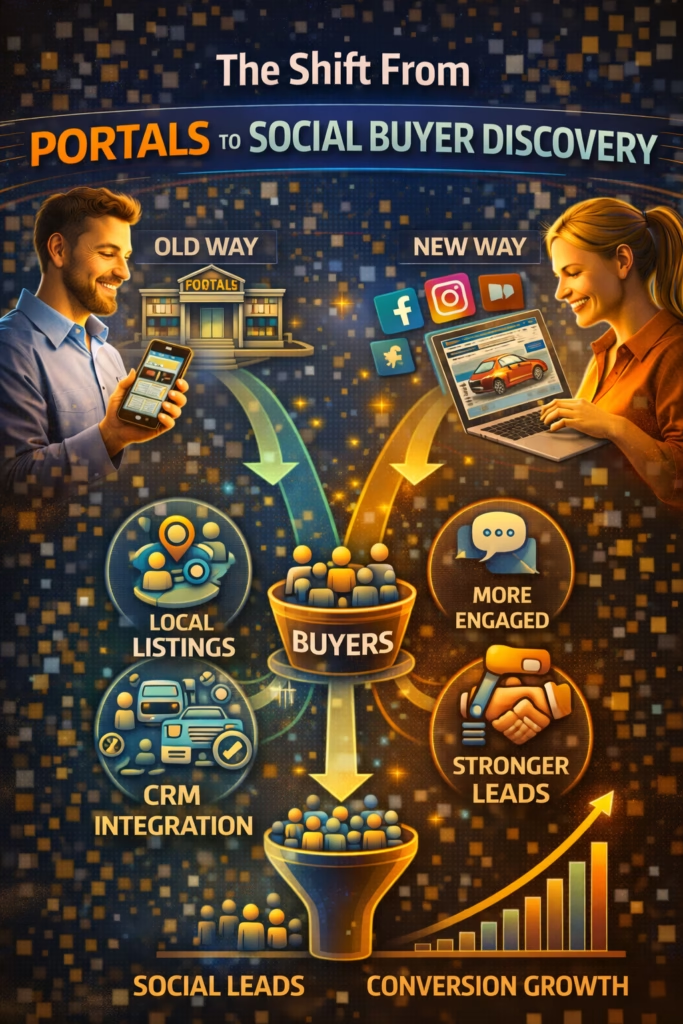
The Shift From Portals to Social Buyer Discovery
The Shift From Portals to Social Buyer Discovery explains why buyers increasingly discover products, rentals, and services inside social platforms—and how businesses turn that attention into predictable inbound leads.
Note: This is general guidance. Keep platform activity compliant with marketplace/social policies and avoid spammy duplication.
Introduction
The Shift From Portals to Social Buyer Discovery is not a trend—it’s a behavioral change.
For years, buyers relied on portals and directories: big websites where you search, filter, submit a form, and wait. Today, buyers increasingly discover what they want inside social feeds and marketplaces where browsing is effortless, proof is visual, and messaging is instant.
This matters because discovery shapes conversion. If buyers start on social, the businesses that win are the ones that build visibility and capture demand where discovery happens.
Big idea: Buyers didn’t stop searching—they changed where they search.
Expanded Table of Contents
- 1) Why buyers are shifting away from portals
- 2) Social-first discovery: how buying starts now
- 3) Algorithmic feeds vs portal search: what’s different
- 4) Marketplaces: the new “high-intent portal”
- 5) Proof content: the new trust requirement
- 6) Messaging funnels replace lead forms
- 7) Speed-to-lead becomes the conversion advantage
- 8) Offer clarity: why social buyers message faster
- 9) The visibility + capture system that wins
- 10) KPIs and benchmarks for social buyer discovery
- 11) 30–60–90 day rollout plan
- 12) 25 Frequently Asked Questions
- 13) 25 Extra Keywords
1) Why buyers are shifting away from portals
Portals aren’t “dead,” but the center of gravity has moved. Buyers are shifting because social platforms deliver three things portals struggle to match:
1) Faster discovery
Feeds and recommendations show options instantly—no long filtering process.
2) Visual proof
Photos, video, and real-world context help buyers validate quickly.
3) Frictionless action
Instead of forms, buyers message. Messaging is faster and feels lower commitment.
Rule: When friction drops, competition rises. Your system must respond faster than the market.
3) Algorithmic feeds vs portal search: what’s different
Portals are pull-based: buyers search and pull results. Social is push-based: platforms push options to buyers based on behavior.
| Portal Discovery | Social Discovery | What it means for you |
|---|---|---|
| Search intent starts first | Discovery happens mid-scroll | Your hook must work instantly |
| Text-heavy listings | Visual-first content | Photos/video matter more |
| Forms and calls | Messaging and DMs | Reply speed becomes the edge |
| One portal dominates | Multi-platform reality | Visibility must be distributed |
Rule: Social discovery rewards consistency more than perfection.
4) Marketplaces: the new “high-intent portal”
Marketplaces (like Facebook Marketplace) combine both worlds: social browsing and search intent. That’s why they produce high-intent leads.
Why marketplaces win intent
- Buyers search with urgent intent (“need it now”)
- Listings are local and action-ready
- Messaging is immediate
- Proof content reduces uncertainty
Avoid: treating marketplaces like a portal where you post once and wait. Marketplaces reward cadence.
5) Proof content: the new trust requirement
Social buyers see scams and low-quality posts constantly. Proof is the filter they use to decide who’s real.
Proof signals that increase messages
- Real photos (not only stock images)
- Context shots (subtle brand/store/worksite proof)
- Specific details (dimensions, availability windows, included items)
- Consistency (same tone, same style, repeatable structure)
Pro move: Add one “context proof” photo to every listing/post—enough to feel real, not spammy.
6) Messaging funnels replace lead forms
On portals, forms were the gateway. On social, messaging is the gateway—and buyers expect speed.
The messaging funnel
Message → Qualify → Offer Options → Book Next Step → Confirm → CloseInstant reply (universal)
Yes — I can help ✅
Are you looking to do this today or this week?

What city/zip are you in? I’ll confirm the fastest next step.
Rule: The first reply should collect timeline + location. Everything else comes after.
7) Speed-to-lead becomes the conversion advantage
Portals conditioned buyers to wait. Social conditioned buyers to move immediately. Whoever responds fastest often wins—not because they’re the best, but because they create momentum.
What speed communicates
- Reliability
- Professionalism
- Availability
Avoid: long, generic replies. Social buyers want fast clarity and next steps.
8) Offer clarity: why social buyers message faster
Social discovery is fast. Buyers message when the offer feels “easy.” Your offer should be understood in 10 seconds.
Offer clarity block (copy/paste)
✅ [Offer/Item/Service] — $___
✅ [Top 2 benefits / features]
✅ Availability: [today / this week]
✅ Next step: [pickup / delivery / appointment]

Reply with your city + timeline and I’ll confirm options.
Rule: Clarity creates action. Confusion creates scrolling.
9) The visibility + capture system that wins
To win social buyer discovery, you need two systems working together:
System A: Visibility
- Consistent cadence
- Keyword coverage
- Proof content
- Multiple platforms
System B: Capture
- Instant replies
- Qualification question
- Options-based next steps
- 3-touch follow-up SOP
Pro move: Most businesses try to scale visibility first. Scale capture first so you don’t leak leads.
10) KPIs and benchmarks for social buyer discovery
| KPI | What it measures | Target |
|---|---|---|
| Median response time | Speed-to-lead | < 5 min good, < 1 min best |
| Messages per week | Inbound lead volume | Upward trend |
| Qualified rate | Conversation quality | Upward trend |
| Booked rate | Real outcomes | Upward trend |
| Lead leakage | Unanswered/unfollowed leads | Near zero |
Rule: Social is “fast.” Your KPI focus should be speed and booking.
11) 30–60–90 day rollout plan
Days 1–30 (Fix capture)
- Deploy instant replies and routing coverage
- Implement the 3-touch follow-up SOP
- Standardize offer clarity blocks
- Track response time weekly
Days 31–60 (Build distributed visibility)
- Increase posting cadence responsibly
- Improve proof content and photo systems
- Rotate keyword-driven titles and hooks
- Measure which angles produce the most messages
Days 61–90 (Scale and optimize)
- Double down on top-performing offers
- Strengthen options-based scheduling
- Reduce lead leakage to near zero
- Optimize weekly using KPI trends
12) 25 Frequently Asked Questions
1) Why are buyers moving from portals to social discovery?
Because social platforms offer faster discovery, richer proof content, and frictionless messaging.
2) Are portals still relevant?
Yes, but social discovery increasingly drives the first touch and decision momentum.
3) What replaces portal lead forms?
Messaging funnels—DMs and marketplace messages with fast responses.
4) Why is messaging better for buyers?
It’s faster, lower commitment, and easy to compare multiple options.
5) What matters most in social buyer discovery?
Proof, clarity, and speed-to-lead.
6) What’s speed-to-lead?
How quickly you respond to an inquiry.
7) How fast should I respond?
Under 5 minutes is good; under 1 minute is best.
8) Why do buyers ghost on social?
They message multiple sellers and choose whoever responds best and fastest.
9) How do I reduce ghosting?
Use an options-based reply and a follow-up SOP.
10) What is a follow-up SOP?
A simple multi-touch sequence to re-engage leads at set times.
11) How many follow-ups should I send?
Three touches is a strong baseline.
12) What are proof signals?
Real photos, context, specifics, and consistent brand presence.
13) Should I use stock photos?
Use real photos as primary. Stock-only reduces trust.
14) What’s the best first reply?
Confirm availability and ask city + timeline.
15) What CTA works best?
“What city/zip are you in and is this for today or this week?”
16) Why do marketplaces produce high-intent leads?
Because buyers are searching with urgency and can message instantly.
17) Do I need to be on multiple platforms?
Often yes. Social discovery is distributed.
18) What’s the biggest mistake businesses make?
Scaling visibility without fixing capture systems.
19) How do I track performance?
Track response time, messages, qualified rate, booked rate, and close rate.
20) What matters more: content or systems?
Both, but systems keep leads from being wasted.
21) Can social discovery replace portals completely?
In some niches it can dominate, but many businesses benefit from both.
22) How do I avoid being flagged?
Use variation, avoid exact duplicates, and keep offers accurate.
23) How long to see consistent results?
Often 30–90 days with consistent cadence and fast follow-up.
24) What’s the long-term advantage of social discovery?
Compounding visibility and lower reliance on portal fees and paid ads.
25) What’s the fastest improvement I can make today?
Deploy instant replies and a 3-touch follow-up SOP.
13) 25 Extra Keywords
- The Shift From Portals to Social Buyer Discovery
- portals to social discovery
- social buyer discovery
- social first discovery
- marketplace lead generation
- Facebook Marketplace buyer discovery
- social platforms lead funnel
- messaging funnels replace forms
- DM lead generation
- speed to lead social
- instant reply scripts
- follow up SOP social leads
- proof signals social marketing
- trust signals in listings
- algorithmic feeds marketing
- distributed visibility strategy
- social demand generation
- social demand capture
- offer clarity social conversion
- how buyers discover on social
- replacing portals with marketplace
- organic leads without portals
- social conversion system
- 30 60 90 social rollout plan
- predictable inbound leads social














2) Social-first discovery: how buying starts now
Social-first discovery means buyers encounter offers while they’re already scrolling. They don’t always “search” first—they discover first, then validate and compare.
The new path
What social buyers do differently
Pro move: Treat every message as a “micro-interview” where the buyer is testing your reliability.