
The New Local Marketing Stack for SMBs
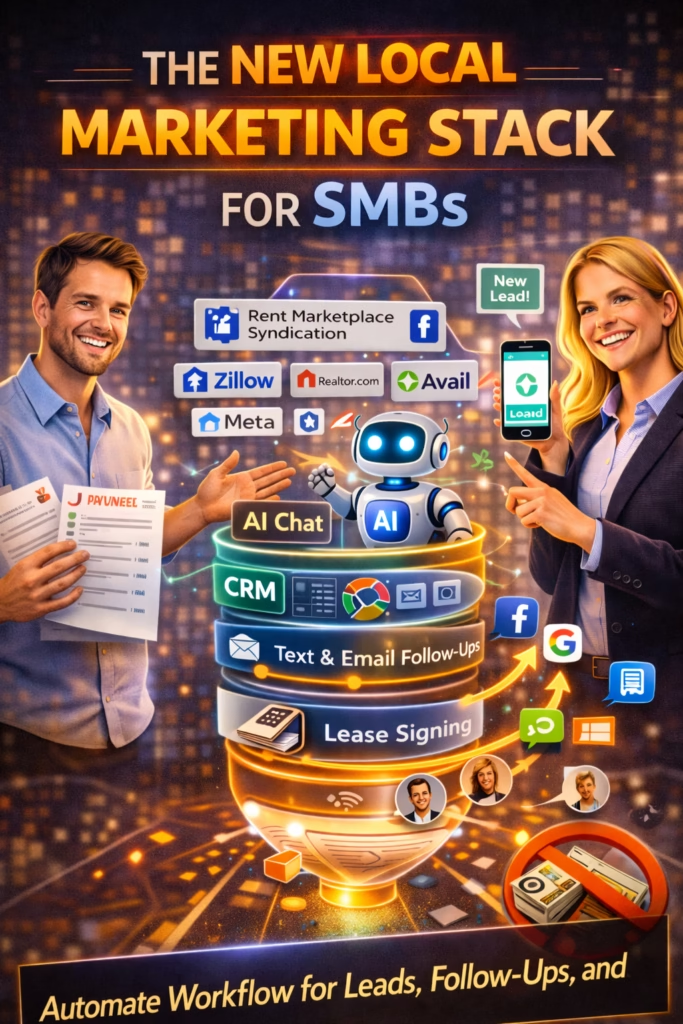
The New Local Marketing Stack for SMBs is the blueprint for generating consistent leads with a modern, lean stack that compounds: visibility, trust, speed-to-lead, and conversion—without chaos or guesswork.
Note: This is general guidance. Follow platform policies, avoid misleading claims, and keep messaging, reviews, and automation compliant with applicable laws and privacy rules.
Introduction
The New Local Marketing Stack for SMBs is the response to one hard reality:
Small businesses don’t lose because they lack effort. They lose because their marketing is fragmented.
They post sometimes. They run ads occasionally. They get a few reviews, then forget. They miss leads because they respond late. They switch tools every month. And the result is a pipeline that feels random.
The modern solution is not “more tactics.” It’s a stack—a small set of channels and systems that work together:
- Visibility so you show up when buyers search
- Proof so buyers trust you quickly
- Conversion so inquiries become appointments
- Automation so leads don’t leak while you’re busy
- Tracking so you can improve what’s working
Big idea: The stack turns local marketing from “random” into “reliable.”
Expanded Table of Contents
- 1) What the new local marketing stack is (and isn’t)
- 2) The 7 principles that make the stack work
- 3) The 6 layers of the new local marketing stack
- 4) Visibility layer: where local intent lives
- 5) Google Business Profile: the foundation asset
- 6) Local SEO pages: turning searches into calls
- 7) Proof layer: reviews, photos, and trust velocity
- 8) Content layer: short-form proof that compounds
- 9) Marketplace layer: fast demand capture (when relevant)
- 10) Conversion layer: scripts, offers, and next steps
- 11) Speed-to-lead: the new competitive advantage
- 12) Automation layer: stop lead leakage
- 13) Lightweight CRM: don’t lose follow-ups
- 14) Tracking dashboards: what to measure weekly
- 15) Budget tiers: lean, growth, and multi-location
- 16) Setup checklist: build the stack in 7 days
- 17) 30–60–90 day rollout plan
- 18) 25 Frequently Asked Questions
- 19) 25 Extra Keywords
1) What the new local marketing stack is (and isn’t)
The New Local Marketing Stack for SMBs is a lean set of channels + systems that work together to produce predictable leads.
What it is
- A repeatable weekly routine
- A set of owned assets (profiles, proof, pages)
- A conversion system that protects leads from slow response
- A simple way to track results and improve monthly
What it is not
- Buying random tools and hoping it works
- Posting every day forever just to “stay visible”
- Depending on paid ads as the only fuel source
- Complicated analytics that no one maintains
Pro move: A stack is not a list of tools. It’s a sequence: attract → prove → convert → follow up → measure.
2) The 7 principles that make the stack work
- Intent beats attention: show up where people are already searching.
- Proof beats persuasion: reviews + real photos reduce friction.
- Speed beats spend: fast follow-up wins leads you didn’t pay for.
- Clarity beats creativity: buyers act when the next step is obvious.
- Consistency beats bursts: steady activity compounds visibility.
- Systems beat talent: SOPs create reliable outcomes.
- Tracking beats guessing: weekly metrics prevent wasted effort.
Rule: If you can’t maintain it weekly, it’s not part of your stack.
3) The 6 layers of the new local marketing stack
| Layer | Purpose | Examples |
|---|---|---|
| Visibility | Get discovered by intent | GBP, local SEO, directories |
| Proof | Build trust fast | Reviews, photos, testimonials |
| Content | Compound proof + demand | Short-form, before/after, FAQs |
| Conversion | Turn inquiries into bookings | Offers, scripts, next-step flow |
| Automation | Stop lead leakage | Instant replies, reminders, follow-up |
| Tracking | Improve monthly | Dashboards, KPIs, QA checks |
Pro move: Add layers in order. Most SMBs try to automate before they have clarity and proof.
4) Visibility layer: where local intent lives
Local marketing is not about “being everywhere.” It’s about showing up where buyers already look:
- Google Maps / “near me” searches
- Local organic search (service + city)
- Marketplaces (for retail and many local service categories)
- Local groups / communities (when done responsibly)
Rule: Local intent channels convert better than broad reach channels.
5) Google Business Profile: the foundation asset
Google Business Profile is the highest leverage part of The New Local Marketing Stack for SMBs because it captures demand that already exists.
GBP setup essentials
- Correct category + services
- Strong photo library (real, updated)
- Review cadence (steady requests)
- Quick replies (calls/messages)
- Weekly posting routine (light but consistent)
GBP weekly SOP (20–30 minutes)
[ ] Add 5–10 new photos
[ ] Publish 1 post (offer/proof/update)
[ ] Ask 5 customers for reviews
[ ] Reply to all reviews
[ ] Check Q&A and messages
Pro move: Treat photos like inventory. Fresh photos keep profiles active and trustworthy.
6) Local SEO pages: turning searches into calls
Local SEO pages turn “service + city” searches into conversions when done with clarity and proof.
What a local page needs
- Clear headline: what you do + where
- Proof: photos, reviews, short testimonials
- Specific services + FAQs
- Fast contact options (call/text/form)
- Trust signals: licensing/insurance (if applicable), process transparency
Local page structure template
H1: [Service] in [City]
Intro: who it’s for + outcome
Proof: photos + reviews
Services: bullets
Process: 3 steps
FAQ: 8–12
CTA: call/text + short form
Rule: The best local pages answer objections quickly and make the next step obvious.
7) Proof layer: reviews, photos, and trust velocity
Proof is the difference between “a click” and “a booked appointment.” In the new stack, proof is a system—not a one-time effort.
Proof assets that convert
- Real photos (before/after or inventory)
- Google reviews (steady cadence)
- Short testimonials (1–2 lines)
- Process transparency (“here’s what happens next”)
Weekly proof habit
[ ] Capture 3–5 new photos
[ ] Save 1 customer quote/testimonial
[ ] Request 5 reviews
[ ] Create 1 proof post from the best result
Pro move: Proof replaces discounting. When trust is high, price sensitivity drops.
8) Content layer: short-form proof that compounds
You don’t need to post daily. You need a repeatable loop that turns normal work into proof.
The 3-post weekly loop
| Post type | What to show | Why it works |
|---|---|---|
| Proof | before/after or result | instant trust |
| FAQ | answer one common question | reduces objections |
| Update | availability, inventory, seasonal tip | keeps you current |
Rule: Content is a sales asset. Keep it clear, real, and useful.
9) Marketplace layer: fast demand capture (when relevant)
Marketplaces can be a major part of The New Local Marketing Stack for SMBs for retail and many local service categories because they produce fast feedback loops.
Marketplace growth is built on
- Variety: multiple angles and listings
- Freshness: steady cadence
- Strong thumbnails: click-through wins
- Fast replies: speed-to-lead closes the loop
Avoid: Identical duplicate posting. Rotate photos, angles, hooks, and timing responsibly.
10) Conversion layer: scripts, offers, and next steps
Visibility creates inquiries. Conversion turns inquiries into scheduled work.
Conversion basics
- One clear offer
- One simple next step
- One question CTA
- Short scripts that sound human
Universal CTA question
What city/zip are you in, and are you looking for today or this week?Pro move: Ask one question at a time. Multi-question messages reduce reply rate.
11) Speed-to-lead: the new competitive advantage
Speed-to-lead is one of the highest leverage parts of The New Local Marketing Stack for SMBs because it costs nothing and wins leads others lose.
Instant reply template
Yes — I can help ✅
What city/zip are you in and are you trying to do this today or this week?

If you share a quick detail, I’ll confirm the fastest next step.
Speed SOP
[ ] Reply within 5 minutes whenever possible
[ ] Ask one qualifying question
[ ] Offer a next step (schedule/quote/pickup time)
[ ] Confirm the plan in one message
Rule: If response speed is slow, every channel becomes expensive—even “free” ones.
12) Automation layer: stop lead leakage
Automation in the new stack is not about spamming. It’s about protecting leads when you’re busy.
Automation that helps (and stays safe)
- Instant “we got your message” reply
- Follow-up reminders for unbooked leads
- Appointment confirmations
- Review request after completion
Important: Keep automation compliant and human. Avoid aggressive sequences and misleading claims.
13) Lightweight CRM: don’t lose follow-ups
You don’t need an enterprise CRM. You need a place where leads can’t disappear.
Minimum fields
Name | Phone/Email | Source | Need | Status | Next Step | Follow-up Date | NotesPro move: Track “next step” for every lead. Leads die in the gap between messages.
14) Tracking dashboards: what to measure weekly
| KPI | What it measures | Target direction |
|---|---|---|
| Leads by source | Channel performance | Stable / Up |
| Median response time | Lead leakage risk | Down |
| Booked next steps | Pipeline health | Up |
| Close rate | Offer + trust quality | Up |
| Revenue per lead | Lead quality | Up |
| Review velocity | Trust growth | Up |
Rule: Weekly tracking beats monthly panic.
15) Budget tiers: lean, growth, and multi-location
The new stack is flexible. You can run it lean or invest in speed and content production.
| Tier | Monthly tools budget | Best for | What you get |
|---|---|---|---|
| Lean | $0–$150 | Solo SMB | GBP + basic tracking + manual follow-up + simple content loop |
| Growth | $150–$750 | Busy teams | Automation + lightweight CRM + better content throughput + faster response coverage |
| Multi-location | $750–$2,500+ | Operators across cities | Standardized SOPs, dashboards per market, scalable proof/content, response coverage |
Pro move: Spend on anything that improves speed-to-lead and proof production. Those are the two biggest multipliers.
16) Setup checklist: build the stack in 7 days
Day 1: Offer + scripts
- Write your one-sentence offer
- Create your instant reply
- Create your one-question CTA
Day 2: Proof library
- Collect 25–50 real photos
- Collect 5 testimonials or customer quotes
Day 3: GBP cleanup
- Update categories, services, photos
- Create review request process
Day 4: Local page or landing page
- Create a clean page with proof + CTA
- Add FAQs and process
Day 5: Marketplace setup (if relevant)
- Create varied listings with strong thumbnails
- Stagger posting schedule
Day 6: Tracking dashboard
- Set up a simple lead tracker
- Define status stages
Day 7: SOPs + weekly rhythm
- Document daily/weekly tasks
- Assign responsibilities
- Set the first review and proof targets
Rule: Setup is a sprint. Maintenance is the moat.
17) 30–60–90 day rollout plan
Days 1–30 (Stabilize)
- Execute GBP weekly routine
- Launch proof + FAQ + update content loop
- Deploy instant reply + simple follow-up
- Track response time and booked next steps
Days 31–60 (Grow)
- Increase proof production
- Improve conversion scripts and CTAs
- Add partnerships and referral routine
- Expand local pages by city/service
Days 61–90 (Scale)
- Standardize SOPs
- Build dashboards per market
- Automate reminders and review requests
- Double down on best sources
Pro move: Measure weekly, optimize monthly, and commit for 90 days. That’s where compounding shows up.
18) 25 Frequently Asked Questions
1) What is the new local marketing stack for SMBs?
A lean set of channels and systems that work together: GBP, local SEO, reviews, proof content, speed-to-lead, follow-up, tracking, and SOPs.
2) Why do I need a stack instead of tactics?
A stack compounds visibility, trust, and conversion. Tactics create inconsistent results and wasted effort.
3) What is the fastest local channel?
Often GBP and marketplaces because they capture active intent—combined with fast replies.
4) Do I need paid ads in the stack?
No. Ads can be optional accelerators once your organic conversion is proven.
5) What matters most in GBP?
Correct category, fresh photos, review cadence, and responsiveness.
6) How often should I add photos?
Weekly is strong. Consistent updates help trust and activity signals.
7) What’s the best way to get reviews?
Ask consistently after every successful job, using a direct link and a short request.
8) Do I need a website?
A website helps, but a clean landing page or strong GBP can work to start.
9) What should a local SEO page include?
Clear headline, proof, service bullets, process steps, FAQs, and a strong CTA.
10) How does short-form content help locally?
It builds proof and trust and keeps you current without heavy production.
11) How often should I post content?
3 times per week is enough for most SMBs if you stay consistent.
12) Should I use marketplaces?
Yes if your niche fits. They can be a fast demand capture channel.
13) How do I avoid duplicate flags on marketplaces?
Use truthful variety: rotate photos, hooks, titles, angles, and timing.
14) What is speed-to-lead?
How quickly you respond after an inquiry. Faster responses increase bookings.
15) What response time should I target?
Under 5 minutes is strong. Under 1 minute is best when possible.
16) What’s the best CTA question?
“What city/zip are you in, and are you looking for today or this week?”
17) What automation is safe and helpful?
Instant replies, follow-up reminders, appointment confirmations, and review requests—kept human and compliant.
18) Do I need a CRM?
Not necessarily. Start with a sheet, then upgrade when follow-ups become hard to manage.
19) What should I track weekly?
Leads by source, response time, booked next steps, close rate, review velocity.
20) How do partnerships fit in?
Partners can send warm leads consistently. Make it simple for them to refer.
21) How do referrals fit in?
Referrals compound and convert well. You need a consistent ask routine.
22) What’s the biggest mistake SMBs make?
Inconsistency—doing a burst of effort and then stopping.
23) How long until results improve?
Often within 30–90 days of consistent execution, depending on competition.
24) What’s the most leverage upgrade?
Speed-to-lead + proof production. Those two multipliers lift every channel.
25) What’s the simplest way to start this week?
Clean GBP, start weekly review requests, build an instant reply script, and post proof consistently.
19) 25 Extra Keywords
- The New Local Marketing Stack for SMBs
- local marketing stack for SMBs
- small business local marketing stack
- local lead generation stack
- Google Business Profile marketing stack
- GBP optimization for SMBs
- local SEO stack 2026
- local SEO pages for small business
- review generation system SMB
- reputation management for local business
- speed to lead local marketing
- instant reply system for leads
- follow-up automation for SMBs
- lightweight CRM for small business
- marketing dashboard for SMBs
- local marketing SOPs
- short form content for local business
- before and after marketing strategy
- Facebook Marketplace lead generation
- Craigslist marketing for small business
- OfferUp marketing strategy
- partnership marketing local
- referral system for SMB
- local marketing stack checklist
- 2025 2026 local marketing strategy