
The Future of Lead Generation: AI Trends for 2026–2030
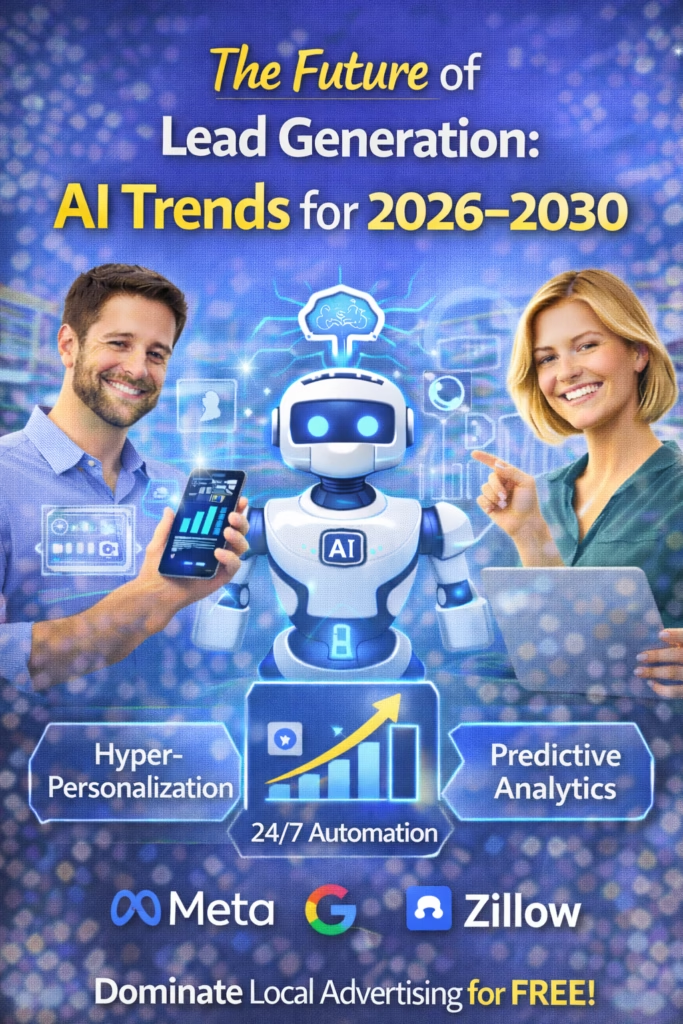
The Future of Lead Generation: AI Trends for 2026–2030 is a practical forecast of what’s changing next—AI agents, omnichannel automation, AI search discovery, first-party data, and conversion systems that run 24/7.
Note: This is general marketing guidance and trend analysis, not legal advice. If you use SMS/email/voice outreach, confirm consent requirements and applicable regulations in your region.
Introduction
The Future of Lead Generation: AI Trends for 2026–2030 is not a “cool tech” article. It’s a business survival guide. Over the next few years, lead generation will shift from campaigns to systems. Instead of launching ads and hoping, businesses will run always-on automation that captures, qualifies, and follows up across every channel in real time.
What’s driving the shift? Three forces hitting at once:
- Buyer behavior: People expect instant answers, not callbacks tomorrow.
- Channel changes: More discovery is happening inside platforms, marketplaces, and AI-powered search.
- Automation maturity: AI agents can now handle repetitive lead tasks reliably—when designed correctly.
Thesis: The winners in 2026–2030 won’t be the best advertisers. They’ll be the best responders.
Expanded Table of Contents
- 1) The biggest shift: campaigns → conversation systems
- 2) Trend #1: AI agents become the front desk for every business
- 3) Trend #2: Conversation-first funnels replace traditional landing pages
- 4) Trend #3: Omnichannel follow-up becomes non-negotiable
- 5) Trend #4: AI search + answer engines change discovery
- 6) Trend #5: First-party data becomes the new competitive moat
- 7) Trend #6: Speed-to-lead becomes the #1 conversion multiplier
- 8) Trend #7: Content shifts from “creative” to proof + utility
- 9) Trend #8: Synthetic content grows—trust signals matter more
- 10) Trend #9: Attribution gets messier, so KPI discipline wins
- 11) Trend #10: Compliance and consent become growth constraints
- 12) The 2026–2030 lead gen playbook (what to implement now)
- 13) The modern lead generation stack (simple, scalable)
- 14) KPIs that will matter most (2026–2030)
- 15) 30–60–90 day rollout plan
- 16) 25 FAQs
- 17) 25 extra keywords
1) The Biggest Shift: Campaigns → Conversation Systems
Traditional lead gen is campaign-driven: run ads → collect forms → call leads → chase no-shows. The future is system-driven: buyers message you everywhere, and a conversation engine handles the first 80% automatically.
Old model
- Traffic-first mindset
- Forms and “we’ll call you”
- Manual follow-up
- Slow response
New model (2026–2030)
- Conversion-first mindset
- Messaging + booking
- Automated follow-up sequences
- Instant response 24/7
Translation: The businesses that respond fastest and follow up consistently will win—regardless of channel.
2) Trend #1: AI Agents Become the Front Desk for Every Business
AI agents are evolving from “chat widgets” into full front-desk systems: they answer questions, qualify leads, route hot inquiries, schedule appointments, and run follow-up—without breaks.
What AI agents will do reliably
- Answer FAQs instantly (pricing range, availability, service area)
- Collect qualification info (city, timeline, budget, intent)
- Offer next steps (book a call, request quote, reserve inventory)
- Run polite follow-up sequences
- Route high-intent leads to a human in real time
Best practice: AI handles repetitive steps; humans close and handle exceptions.
3) Trend #2: Conversation-First Funnels Replace Traditional Landing Pages
Forms are friction. In many categories, messaging converts better because it feels personal and immediate. Expect “tap to message” funnels to dominate for local services, retail, and high-velocity sales.
Conversation-first funnel structure
Ad / Listing / Profile → Message → Qualify → Book → Confirm → Follow-UpSimple reason: Buyers want answers now. Messaging gives them that instantly.
4) Trend #3: Omnichannel Follow-Up Becomes Non-Negotiable
From 2026–2030, buyers will jump between channels: platform DMs, SMS, email, calls, and AI search. Businesses that only follow up in one place will leak leads.
What omnichannel follow-up looks like
- DM reply inside the platform
- Optional SMS follow-up (with proper consent)
- Email nurture for longer decisions
- Appointment reminders and confirmations
Note: Follow-up must be consent-aware and respectful to avoid compliance issues and spam complaints.
5) Trend #4: AI Search + Answer Engines Change Discovery
Discovery is shifting from “search results lists” to “answers.” Buyers will increasingly ask AI assistants: “Who’s the best [service] near me?” and “What should I buy?”
What this changes for lead gen
- Trust and authority matter more than keyword tricks
- Structured content (FAQs, schema, clear service pages) becomes more valuable
- Reviews, citations, and proof become ranking signals across systems
Action: Publish helpful pages that answer real buyer questions and showcase proof.
6) Trend #5: First-Party Data Becomes the New Competitive Moat
As tracking gets harder and platforms change rules, first-party data (your own list) becomes the most stable growth asset.
First-party data to build now
- Lead database with tags (intent, timeline, product/service interest)
- Past customer list for reactivation
- Review list and proof library (photos, testimonials, case studies)
- FAQ + objection library (used by agents and sales)
Moat: If your list and systems are strong, channel shifts become less scary.
7) Trend #6: Speed-to-Lead Becomes the #1 Conversion Multiplier
In 2026–2030, the “best marketer” often wins because they respond first. Speed-to-lead multiplies conversion without buying more traffic.
| Lead situation | What wins | Why |
|---|---|---|
| New inbound inquiry | Instant reply | Intent is highest right now |
| After-hours message | Auto-reply + morning follow-up | Prevents lead from going cold |
| Missed call | Instant text-back | Recovers lost leads |
Rule: If you’re slow, you’re invisible—even if you have traffic.
8) Trend #7: Content Shifts From “Creative” to Proof + Utility
AI will make it easy to create content. That means generic content becomes worthless. The winners will publish proof and utility:
- Before/after results
- Pricing ranges and expectations
- “What to do next” guides
- Local credibility and real customer stories
Future-proof content: Real-world proof is harder to fake and easier to trust.
9) Trend #8: Synthetic Content Grows—Trust Signals Matter More
As synthetic content floods feeds, trust becomes the differentiator. Expect buyers to rely more on:
- Reviews and review velocity
- Verified photos and consistent brand presence
- Transparent policies (refunds, warranties, delivery, timelines)
- Clear identification (business details, location/service area)
Trust is the new targeting: The more credible you look, the cheaper your leads become.
10) Trend #9: Attribution Gets Messier, So KPI Discipline Wins
Attribution will keep getting harder because buyers touch many channels before converting. Instead of perfect attribution, focus on operational KPIs that predict growth.
Operational KPIs that predict results
- Response time
- Contact rate
- Appointment set rate
- Show rate
- Close rate
- Review velocity
Why this works: These metrics are controllable and compound over time.
11) Trend #10: Compliance and Consent Become Growth Constraints
As automation scales, regulators and platforms will increasingly enforce consent, disclosure, and spam controls. Growth will favor businesses that build consent-based systems and keep messaging respectful.
Compliance-safe principles
- Get permission for SMS/email follow-up
- Provide easy opt-outs
- Limit message frequency
- Keep language human and helpful
- Document your process and policies
Reminder: This is not legal advice—confirm rules in your jurisdiction.
12) The 2026–2030 Lead Gen Playbook (What to Implement Now)
If you want to win the next five years, build a system that captures and converts leads regardless of channel shifts.
The “always-on” lead engine
- Visibility: show up where intent exists (local search, marketplaces, social)
- Trust: proof library (reviews, photos, results)
- Response: instant reply + missed-call text-back
- Qualification: city + timeline + intent
- Follow-up: 7–14 day sequence
- Booking: simple scheduling with confirmations
- Measurement: weekly KPI review
Most businesses don’t need more “ads.” They need a conversion engine.
13) The Modern Lead Generation Stack (Simple, Scalable)
| Layer | Purpose | Examples |
|---|---|---|
| Capture | Collect leads from every channel | Forms, DMs, calls, email |
| Response | Instant reply everywhere | AI agent, canned replies |
| Qualification | Sort hot vs warm leads | 3-question qualifier |
| Follow-up | Prevent ghosting | 7–14 day sequence |
| Booking | Convert to appointment | Calendar links + reminders |
| Reporting | Improve weekly | KPI dashboard |
Rule: Keep it simple. Complexity kills consistency.
14) KPIs That Will Matter Most (2026–2030)
| KPI | Why it matters | How to improve |
|---|---|---|
| Response time | Conversion multiplier | Instant reply + routing |
| Contact rate | Script effectiveness | Shorter, clearer messaging |
| Appointment set rate | Next-step clarity | Two-option booking ask |
| Show rate | Quality + trust | Confirmations + reminders |
| Close rate | Offer strength | Better proof and framing |
| Review velocity | Trust and local ranking | Weekly review requests |
Focus: Small improvements in these KPIs can double results without doubling spend.
15) 30–60–90 Day Rollout Plan
Days 1–30 (Install the conversion engine)
- Set instant reply on every channel
- Enable missed-call text-back
- Launch a 7-day follow-up sequence
- Create a proof library (photos, reviews, wins)
- Start tracking response time and contact rate
Days 31–60 (Improve quality + booking)
- Add qualification and routing rules
- Standardize booking scripts and confirmations
- Publish FAQ pages and proof posts consistently
- Run reactivation to past customers/leads (consent-aware)
Days 61–90 (Scale what works)
- Expand channels (marketplaces, local search, short-form content)
- Optimize scripts based on objections
- Build dashboards and SOPs
- Increase volume once conversion is strong
Want a done-for-you AI lead response engine?
16) 25 Frequently Asked Questions
1) What is the biggest AI trend in lead generation for 2026–2030?
Conversation-first funnels powered by AI agents that respond instantly, qualify leads, and follow up consistently.
2) Will AI replace sales teams?
AI will handle repetitive steps; humans will focus on closing and complex trust-building.
3) What should businesses do now to prepare?
Build first-party data, install instant response + follow-up, and improve proof/trust signals.
4) Why are conversation funnels growing?
They reduce friction and match buyer expectations for instant answers.
5) What is an AI agent in lead generation?
An automated assistant that can respond, qualify, route, schedule, and follow up.
6) What is omnichannel lead gen?
Capturing and following up across multiple channels—DMs, SMS, email, calls—based on buyer behavior.
7) What is first-party data?
Your own lead and customer information collected with permission—more stable than rented audiences.
8) Why is first-party data important?
It protects you from platform changes and makes your marketing more efficient.
9) How does AI change follow-up?
AI makes consistent, polite follow-up easy—capturing leads that would otherwise ghost.
10) What’s the most important KPI?
Response time—because it multiplies conversion without increasing traffic.
11) Will ads still matter?
Yes, but conversion systems will determine who gets the best ROI.
12) How does AI search affect lead generation?
More discovery happens through answers; structured content and proof become crucial.
13) What content will perform best in 2026–2030?
Proof and utility: real results, FAQs, pricing clarity, and “next step” guidance.
14) Will synthetic content hurt marketing?
It can flood channels, so trust signals become even more important.
15) How do you build trust at scale?
Consistent proof posts, reviews, transparent policies, and fast helpful responses.
16) What industries benefit most from AI lead gen?
Local services, retail, real estate, automotive, and any business with inbound inquiries.
17) How do you prevent AI responses from feeling robotic?
Keep messages short, vary phrasing, ask one question, and use real business details.
18) What’s the biggest risk with AI automation?
Compliance and spam risk if consent isn’t handled properly.
19) What does compliance-safe follow-up mean?
Consent-based messaging, opt-outs, frequency controls, and respectful tone.
20) How long until automation shows results?
Many businesses see improvements quickly once response time and follow-up are fixed.
21) Should small businesses adopt AI now?
Yes—start with instant reply and follow-up automation for immediate impact.
22) What is the best “first automation”?
Missed-call text-back and instant reply on inbound messages.
23) What’s the best way to scale in 2026–2030?
Fix conversion first, then increase traffic and channel volume.
24) What’s changing about attribution?
Journeys are multi-touch and harder to track, so operational KPIs become more important.
25) What’s the simplest roadmap?
Install response + follow-up, build proof, track KPIs weekly, then scale channels.
17) 25 Extra Keywords
- The Future of Lead Generation: AI Trends for 2026–2030
- AI lead generation trends
- AI marketing trends 2026
- AI sales automation
- AI agents for lead generation
- conversational marketing funnel
- conversation first lead gen
- omnichannel marketing automation
- AI lead response system
- automated follow up sequences
- speed to lead automation
- first party data strategy
- AI search optimization
- answer engine optimization
- future of local lead generation
- AI CRM workflows
- automation for small business leads
- lead nurturing automation
- sales funnel automation 2026
- marketing attribution trends
- trust signals in AI marketing
- compliance safe automation
- AI customer service lead gen
- future of inbound marketing
- 2026 2030 marketing automation trends













