
The End of Reactive Lead Management
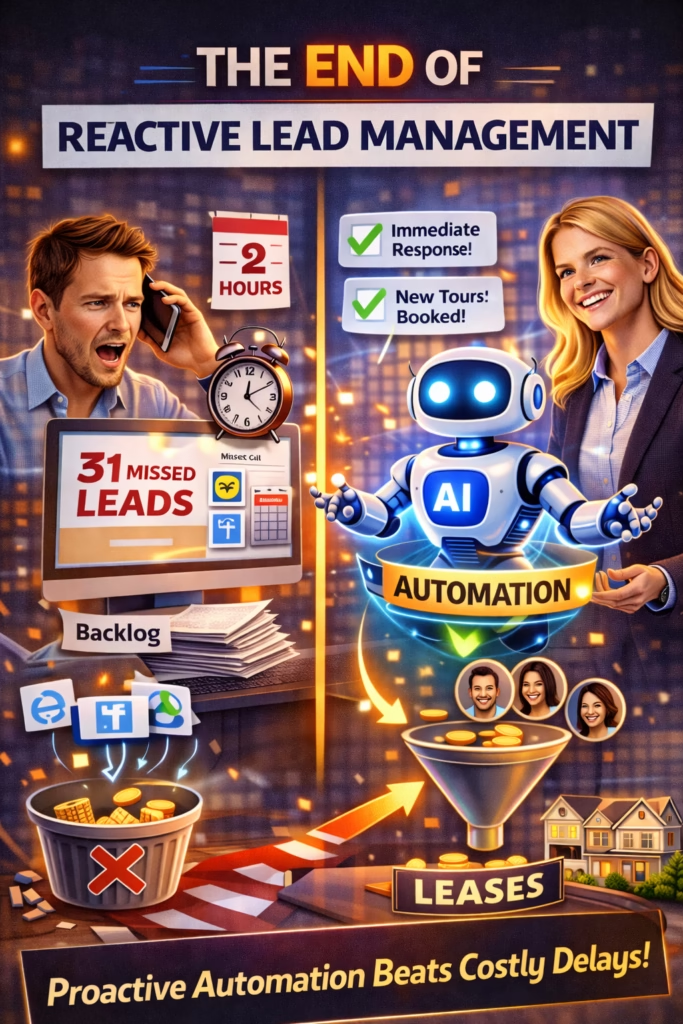
The End of Reactive Lead Management is the blueprint for replacing inbox chaos with a proactive lead system—built on instant replies, qualification, routing, follow-up SOPs, pipeline stages, and KPI loops that prevent lead leakage.
Note: This is general guidance. Keep claims accurate and comply with platform policies, consent/privacy rules, and any applicable marketing regulations for your region and industry.
Introduction
The End of Reactive Lead Management isn’t a slogan. It’s a market reality.
In 2026, the businesses that win don’t “work harder” inside their inbox. They build systems that respond instantly, qualify leads automatically, and keep every opportunity moving—even when the owner is asleep, on a job site, or in meetings.
Reactive lead management is what happens when your entire revenue engine depends on:
- Someone noticing a message
- Someone having time to respond
- Someone remembering to follow up
Big idea: If your process depends on memory, your growth will always be capped.
Expanded Table of Contents
- 1) What reactive lead management is (and why it fails)
- 2) Lead leakage: where revenue disappears
- 3) Speed-to-lead and the new response-time standard
- 4) The proactive lead system model
- 5) Capture: unify leads across channels
- 6) Instant replies: scripts that move the lead forward
- 7) Qualification: one question that changes everything
- 8) Routing: treat high-intent leads differently
- 9) Follow-up SOP: where the hidden money lives
- 10) Pipeline stages and SLAs
- 11) Automation guardrails and compliance basics
- 12) KPIs that prove the system is working
- 13) 30–60–90 day rollout plan
- 14) 25 Frequently Asked Questions
- 15) 25 Extra Keywords
1) What reactive lead management is (and why it fails)
Reactive lead management means your “system” is essentially: wait for leads → react when you can.
Common symptoms
- Messages sit for hours (or overnight)
- Someone replies, but doesn’t ask a next-step question
- Follow-up depends on memory
- Leads are scattered across platforms
- No one can answer “How many are in the pipeline?”
Reality: Competitive markets don’t punish you for being bad. They punish you for being slow and inconsistent.
2) Lead leakage: where revenue disappears
Lead leakage is the gap between inbound demand and closed revenue. It’s usually caused by delays and inconsistency—not lack of leads.
The five biggest leakage points
1) Slow first response
Leads message multiple businesses. The fast responder wins the conversation.
2) No qualification
If you don’t capture city/timeline/budget, you can’t guide the next step.
3) No next step
Helpful answers are not a process. You must ask a question.
4) No follow-up
Quiet leads often convert with one more touch.
Rule: Don’t measure “leads.” Measure “booked next steps.” That’s where revenue begins.
3) Speed-to-lead and the new response-time standard
Speed-to-lead is the simplest upgrade with the biggest impact—because most competitors are still slow.
What “good” looks like
| Response time | Meaning | Typical outcome |
|---|---|---|
| < 1 minute | Best-in-class | Highest conversation share |
| < 5 minutes | Strong | Competitive conversion |
| 15–60 minutes | Weak | Leads drift to others |
| Hours+ | Reactive | High leakage |
Instant reply template (universal)
Yes — I can help ✅
Quick question so I send the right options:

Are you looking to do this today or this week?
Pro move: Ask one question. Do not send paragraphs. Keep the lead replying.
4) The proactive lead system model
The proactive model is simple: every lead is captured, replied to, qualified, routed, followed up, and tracked—without relying on memory.
Proactive lead system pillars
Capture
Unify leads from all sources into one view.
Instant reply
Respond immediately with a question that moves the lead forward.
Qualification
Collect the minimum info needed to propose a next step.
Routing
Send high-intent leads to humans faster.
Follow-up
Recover quiet leads with consistent SOP touches.
Tracking
Measure booked next steps and optimize weekly.
Rule: If the system runs when you’re busy, it’s real. If it stops, it’s still reactive.
5) Capture: unify leads across channels
Reactive management is usually a channel problem: DMs on one platform, calls on another, forms in email, and notes in someone’s head.
Capture checklist
- Every channel routes into one pipeline (CRM, sheet, or inbox that’s actually monitored)
- Every lead has a timestamp, source, and status
- Every lead has an owner (human or automation)
Minimum lead fields
- Name (if available)
- Source (FB/CL/OfferUp/Google/Website/etc.)
- City/Zip
- Timeline (today / this week / later)
- Need (service/product)
- Status (New / Qualified / Booked / Closed / Lost)
Common trap: “We’ll add it later.” If it’s not captured immediately, it’s often lost.
6) Instant replies: scripts that move the lead forward
Instant replies are the difference between “inquiry” and “conversation.” The goal is not to answer everything—it’s to get the next message.
Instant reply (generic)
Yes — it’s available ✅
Are you looking to do this today or this week?
Instant reply (service business)
Yes — we can help ✅
What city are you in, and are you looking for today or this week?
Instant reply (inventory)
Yes — still available ✅
What city are you in? I’ll confirm the fastest pickup/delivery options.
Rule: Your first reply should always end with a question.
7) Qualification: one question that changes everything
Qualification is how you stop wasting time and start booking next steps. You don’t need 12 questions. You need one that creates motion.
The highest leverage qualification question
“Are you looking to do this today or this week?”
Two-question qualification (when needed)
1) What city/zip are you in?
2) Is it today, this week, or later?
Avoid: Asking for everything up front. Leads drop when the process feels like homework.
8) Routing: treat high-intent leads differently
Routing prevents your best leads from being handled like “just another message.” High-intent leads deserve immediate human attention.
High-intent signals
- “Can I pay today?” / “When can I come now?”
- “I need this today.”
- “What’s the address?” / “Can you send invoice?”
- They answer quickly and clearly
Routing rules (simple)
- High intent → notify human within 1 minute
- Medium intent → automation qualifies and proposes next step
- Low intent → nurture and collect basics
Handoff summary (copy/paste)
Lead summary ✅
- Source: ______
- City/Zip: ______
- Timeline: ______
- Need: ______
- Best next step: ______
9) Follow-up SOP: where the hidden money lives
Follow-up is the line between “we got a lot of inquiries” and “we closed a lot of deals.” Reactive businesses do it randomly. Systems do it consistently.
3-touch follow-up SOP
| Timing | Message | Goal |
|---|---|---|
| 20–40 min | Quick check + question | Restart |
| Same day | Options + next step | Book |
| Next day | Alternate option | Save |
Follow-up #1
Quick check-in ✅
Did you still want to move forward?

What city are you in, and is it today or this week?
Follow-up #2
I can send options ✅
Reply with your city + timeline and I’ll confirm the fastest next step.
Follow-up #3
Still shopping? ✅
Tell me your budget + must-haves and I’ll point you to the best fit.
Pro move: Make the follow-up feel helpful, not desperate—always include a question.
10) Pipeline stages and SLAs
Reactive lead management collapses because nobody knows what stage a lead is in. Pipelines make it visible. SLAs make it consistent.
Pipeline stages (simple)
- New → first message received
- Qualified → city + timeline captured
- Options Sent → pricing/availability/next step provided
- Booked → appointment/pickup/call scheduled
- Closed → paid and completed
- Lost → no response after SOP
Response-time SLAs
| SLA | Standard | Why it matters |
|---|---|---|
| First reply | < 5 minutes | Wins the conversation |
| Qualified follow-up | < 15 minutes | Maintains momentum |
| Booked confirmation | Immediate | Reduces drop-off |
Rule: A pipeline without SLAs becomes reactive again. Speed must be enforceable.
11) Automation guardrails and compliance basics
Automation should create consistency and protect trust—not create spam risk.
Guardrails that keep automation safe
- Keep claims accurate (no false urgency or guarantees)
- Respect platform messaging limits and rules
- Use human escalation for sensitive or complex situations
- Store only necessary lead info and handle it responsibly
Reminder: If you market via text/email, confirm consent requirements and local regulations. Keep opt-out pathways where required.
12) KPIs that prove the system is working
| KPI | What it means | Target direction |
|---|---|---|
| Median response time | Speed-to-lead | Down |
| Qualified rate | Leads with city/timeline captured | Up |
| Booked rate | Leads that schedule a next step | Up |
| Follow-up recovery | Leads saved by SOP | Up |
| Close rate | Booked → closed | Up |
Best KPI: Booked next steps. If that’s rising, revenue follows.
13) 30–60–90 day rollout plan
Days 1–30 (Stop the bleeding)
- Install instant replies on all channels
- Deploy 3-touch follow-up SOP
- Define pipeline stages and response-time SLAs
- Begin weekly KPI tracking
Days 31–60 (Build the engine)
- Unify capture across channels into one pipeline
- Implement routing for high-intent leads
- Standardize scripts and handoff summaries
- Optimize based on KPI trends
Days 61–90 (Scale and compound)
- Increase surface area (more listing/content entry points)
- Automate weekly reporting and action plans
- Retire weak scripts and double down on best performers
- Document SOPs for team consistency
Rule: Install → measure → optimize → scale. Systems beat hustle every time.
14) 25 Frequently Asked Questions
1) What is reactive lead management?
Handling leads only when they show up—replying late and relying on memory instead of a system.
2) Why is reactive lead management a problem?
It creates slow responses, inconsistent follow-up, and high lead leakage.
3) What replaces reactive lead management?
A proactive lead system: instant replies, qualification, routing, follow-up SOPs, pipeline tracking.
4) What is lead leakage?
The gap between inbound inquiries and booked next steps or closed revenue.
5) What is speed-to-lead?
How quickly you respond after a lead contacts you.
6) What response time should I target?
Under 5 minutes is strong; under 1 minute is best-in-class for messages.
7) Do instant replies feel robotic?
Not if they’re short, helpful, and end with a simple question.
8) What’s the best first message?
Confirm availability and ask a timeline question.
9) What’s the best qualification question?
“Are you looking to do this today or this week?”
10) Should I ask multiple questions at once?
Usually no—one at a time keeps the lead replying.
11) What is lead routing?
Sorting leads by intent and escalating high-intent leads quickly.
12) What are high-intent signals?
“Today,” “ready now,” “can I pay,” “where are you located,” rapid replies.
13) What is a follow-up SOP?
A consistent sequence of messages for non-responders.
14) How many follow-ups should I send?
Three touches is a strong baseline.
15) What should follow-ups say?
Short check-in + a question that creates a next step.
16) What is a pipeline?
Stages that show where each lead is in the process.
17) Why do pipelines matter?
They prevent leads from being forgotten and make performance measurable.
18) What is an SLA in lead management?
A response-time standard you commit to and enforce.
19) What KPIs matter most?
Response time, qualified rate, booked rate, follow-up recovery, close rate.
20) What KPI predicts revenue best?
Booked next steps.
21) Will automation reduce ad spend?
Often yes—because you convert more of your existing demand.
22) Is automation safe on platforms?
It can be, if you follow rules, avoid spam, and keep messages accurate.
23) What should be escalated to humans?
Negotiations, complex requests, complaints, and sensitive issues.
24) How quickly can results improve?
Speed-to-lead and follow-up often improve results immediately.
25) What’s the fastest improvement today?
Install instant replies that ask a question and deploy a follow-up SOP.
15) 25 Extra Keywords
- The End of Reactive Lead Management
- reactive lead management
- proactive lead system
- lead response automation
- speed to lead
- instant reply scripts
- automated follow up
- follow up SOP leads
- lead routing workflow
- pipeline management
- booked appointment KPI
- reduce lead leakage
- lead conversion system
- inbox management automation
- lead qualification scripts
- response time SLA
- automated sales process
- CRM pipeline stages
- high intent lead routing
- sales automation for small business
- marketing automation workflows
- local lead management system
- convert more leads without ads
- 2026 lead management blueprint
- prevent missed leads