
The Automation Shift Reshaping Lead Generation
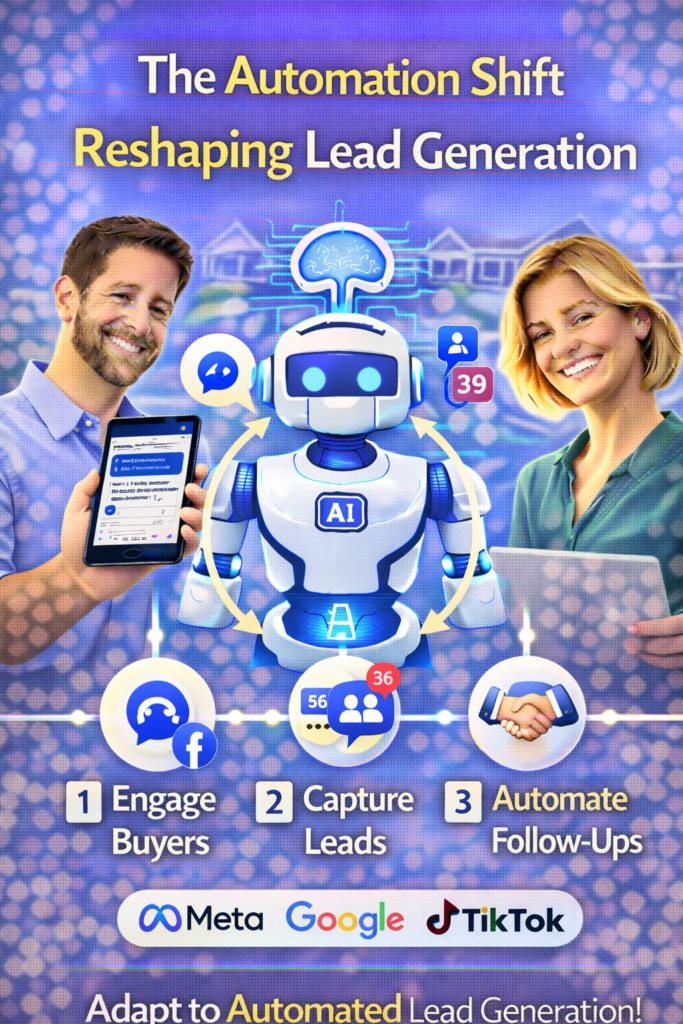
The Automation Shift Reshaping Lead Generation is the move from slow, manual lead handling to systems that capture, respond, qualify, and follow up automatically—across every channel where customers show intent.
Note: This is general guidance. Follow platform policies, privacy laws, and messaging consent requirements. Use disclosures where appropriate and avoid spammy duplication.
Introduction
The Automation Shift Reshaping Lead Generation is happening because buyer behavior changed first. People now expect answers immediately, they compare options across multiple tabs and apps, and they choose whoever responds with clarity and confidence.
That means lead generation isn’t only about getting clicks anymore. It’s about what happens after the click: response time, follow-up, and routing. The winners are building systems that behave like a full-time team—without requiring full-time headcount.
Big idea: Automation doesn’t “create demand.” It captures demand while it’s still hot.
Expanded Table of Contents
- 1) What the automation shift actually is
- 2) Why the shift accelerated in 2025–2026
- 3) The 6 conversion leaks automation fixes
- 4) The modern lead-gen stack: capture → reply → qualify → route → follow-up
- 5) AI first contact: the new front desk for every business
- 6) Routing rules that prevent lead waste
- 7) Automated follow-up sequences (without being spammy)
- 8) Copy/paste scripts for speed + professionalism
- 9) Compliance basics and trust signals
- 10) KPIs that prove automation is working
- 11) 30–60–90 day rollout plan
- 12) 25 Frequently Asked Questions
- 13) 25 Extra Keywords
1) What the automation shift actually is
The automation shift is the transition from manual lead handling to systemized lead handling.
Old lead gen (manual)
- Ads generate inquiries
- Someone replies “when they can”
- Leads sit in inboxes
- Follow-up is inconsistent
- Booked leads depend on busy humans
New lead gen (automated)
- Multiple channels capture leads
- Instant reply happens 24/7
- AI qualifies and routes
- Follow-up runs on schedule
- Booking is the default next step
Key point: Automation turns “random leads” into a predictable pipeline.
2) Why the shift accelerated in 2025–2026
Three forces pushed automation from “nice-to-have” to “default”:
- Shorter attention windows: leads disappear faster when unanswered.
- More channels: prospects message from wherever they discovered you.
- Rising competition: more offers, more ads, and more noise.
Translation: You don’t just need more leads. You need better lead handling.
3) The 6 conversion leaks automation fixes
Most businesses don’t have a lead problem—they have a process leak.
| Leak | What it looks like | Automation fix |
|---|---|---|
| Slow reply | Hours pass before first response | Instant first contact (AI or autoresponder) |
| No qualification | Wasted time on bad-fit leads | 3-question qualification flow |
| No routing | Leads sit in the wrong inbox | Rules-based routing (sales/support/booking) |
| Inconsistent follow-up | Prospects ghost and vanish | Scheduled follow-up sequence |
| No next step | Conversation stays vague | Default CTA: book, call, or quote |
| No tracking | “Not sure what works” | Pipeline stages + KPI dashboard |
Reality: If you fix reply speed and follow-up consistency, conversion usually improves without touching ad spend.
4) The modern lead-gen stack: capture → reply → qualify → route → follow-up
Automation works when you treat lead generation as a chain—not a single tactic.
1) Capture
Website forms, chat, Marketplace, Google messages, SMS, inbound calls.
2) Instant reply
Immediate confirmation + one question so the lead stays engaged.
3) Qualification
Need + location + timeline (keep it simple).
4) Routing
Send leads to the correct team or next step automatically.
5) Follow-up
Short, helpful touchpoints that recover ghost leads.
6) Booking
Convert “interest” into an appointment or confirmed next action.
Rule: If any step is missing, the system leaks revenue.
5) AI first contact: the new front desk for every business
AI first contact is the single biggest shift because it removes the most expensive bottleneck: human availability.
What AI should do on first contact
- Reply instantly in a natural voice
- Ask 1–3 key questions
- Provide accurate next steps
- Route to booking, quote, or human handoff
Pro move: AI should behave like a great receptionist—brief, confident, and helpful.
What AI should NOT do
- Guess on policy, legal, or sensitive topics
- Over-ask (long intake forms in chat)
- Sound spammy or overly salesy
- Trap customers in loops
6) Routing rules that prevent lead waste
Routing is where automation becomes a competitive advantage.
Simple routing rules (starter)
| If the lead says… | Route to… | Automation action |
|---|---|---|
| “How much?” | Sales / quoting | Ask 2 qualifiers + offer consult |
| “Can I book?” | Scheduling | Offer time windows + confirm details |
| “Support / issue” | Support | Collect order/account basics + ticket |
| Complex case | Human specialist | Collect summary + handoff |
Rule: Every conversation should move forward within 2 messages.
7) Automated follow-up sequences (without being spammy)
The best follow-up is short, helpful, and option-based. Automation makes it consistent.
3-touch follow-up sequence
| Timing | Message purpose | Example tone |
|---|---|---|
| 20–40 minutes | Re-open the conversation | Quick check-in + one question |
| Same day | Offer next step | Booking options or quote path |
| Next day | Provide alternate | Another option / time slot / resource |
Avoid: daily nagging texts. Keep it respectful and stop when asked.
8) Copy/paste scripts for speed + professionalism
Universal first reply
Hey! I can help ✅
Quick question so I send the right info:
What city/zip are you in, and are you looking to do this (A) today, (B) this week, or (C) later?
Pricing without friction
Totally ✅ Pricing depends on a couple quick details.
1) What exactly do you need?
2) What city/zip are you in?

Reply with those and I’ll send the best options.
Booking CTA
Perfect ✅ Want to book it?
Do you prefer:
1) Today/Tomorrow
2) This weekend
3) Next week

Reply 1/2/3 and I’ll send time options.
Follow-up #1
Quick check-in ✅
Did you still want help with this?

What city/zip are you in so I can confirm the best next step?
9) Compliance basics and trust signals
Automation increases volume, which makes trust even more important.
Trust signals that improve response rates
- Clear business name and hours
- Transparent pricing ranges (when possible)
- Simple opt-out language for SMS
- Accurate service area boundaries
- Human handoff option (“Want a call from the team?”)
Reminder: Consent rules vary by channel and region. Use compliant messaging practices and record opt-ins where required.
10) KPIs that prove automation is working
| KPI | What it measures | Why it matters |
|---|---|---|
| First response time | Speed | Main predictor of conversion |
| Qualification rate | Lead clarity | Shows script performance |
| Booking rate | Pipeline progress | Turns chats into revenue |
| Follow-up recovery | Ghost reduction | Measures “saved leads” |
| Handoff completion | Team execution | Prevents automation drop-offs |
Truth: The easiest win is “instant reply + simple routing.” Everything else compounds from there.
11) 30–60–90 day rollout plan
Days 1–30 (Stop missing leads)
- Choose your highest-intent channel
- Deploy an instant reply with 1–3 qualifiers
- Create routing rules (book/quote/support/handoff)
- Turn on a 3-touch follow-up sequence
- Track response time weekly
Days 31–60 (Improve conversion)
- Refine scripts based on where prospects drop
- Add objection blocks (price, timing, trust)
- Standardize pipeline stages for the team
- Improve booking UX (clear time windows)
Days 61–90 (Scale)
- Expand to additional channels
- Build advanced qualification for high-ticket leads
- Measure outcomes by channel
- Run a weekly optimization loop
12) 25 Frequently Asked Questions
1) What is the automation shift reshaping lead generation?
It’s the move to systems that capture, respond, qualify, route, and follow up automatically across channels.
2) Why does automation increase conversions?
It improves speed-to-lead, consistency, and follow-up—reducing missed opportunities.
3) Does automation replace sales teams?
No. It handles repetitive steps and routes leads; humans still close and handle complexity.
4) What’s the biggest win?
Instant first response.
5) What are the main parts of an automated lead system?
Capture, instant reply, qualification, routing, follow-up, and booking.
6) What questions should automation ask first?
Need, city/zip, and timeline.
7) How many questions is too many?
More than 3–4 in chat is usually too much.
8) What channels benefit most?
Messenger/Marketplace, SMS, website chat, Google messages, and inbound calls.
9) Can automation handle pricing questions?
Yes—often by collecting a couple details and providing a range or next-step consult.
10) Can automation book appointments?
Yes, when connected to scheduling rules.
11) What is lead routing?
Automatically sending each lead to the correct next step or team.
12) Why do leads get wasted without routing?
They sit in the wrong inbox or are handled too late.
13) What’s the best follow-up sequence?
3 touches: 20–40 minutes, same day, next day—short and helpful.
14) How do I avoid sounding spammy?
Use natural language, fewer messages, and stop when asked.
15) Should I disclose automation?
Use disclosures where required and keep transparency when appropriate.
16) What are good trust signals?
Clear hours, service areas, accurate information, and easy human handoff.
17) What’s the most common failure point?
Handoffs—automation collects details but humans respond too slowly.
18) How do I fix handoffs?
Set a team SLA and include a lead summary in every handoff.
19) What KPI matters most?
First response time.
20) What’s a good response time target?
Seconds to under 1 minute is excellent; under 5 minutes is good.
21) Do I need more ad spend after automation?
Often no—conversion improvements can create growth without increasing spend.
22) Can automation help small businesses?
Yes—especially if you can’t respond instantly 24/7.
23) Can automation work for high-ticket offers?
Yes—qualification and routing are especially valuable for high-ticket leads.
24) What should be automated first?
Instant reply and qualification on your highest-intent channel.
25) What’s the fastest improvement I can make today?
Deploy an instant reply that asks city/zip + timeline and offers a clear next step.
13) 25 Extra Keywords
- The Automation Shift Reshaping Lead Generation
- automation reshaping lead generation
- automated lead generation systems
- AI lead generation automation
- speed to lead automation
- automated follow up sequences
- lead routing automation
- automated appointment booking
- AI first contact system
- automated customer messaging
- 24/7 lead response automation
- AI sales assistant for leads
- automated lead qualification
- CRM automation for inbound leads
- messaging automation for businesses
- SMS automation for lead conversion
- website chat automation strategy
- Facebook Messenger lead automation
- Facebook Marketplace automation
- reduce missed leads with automation
- pipeline automation for sales
- automated lead nurture workflow
- lead conversion process automation
- AI customer service automation
- book more appointments with automation













