
Small Business Growth Without Paid Media
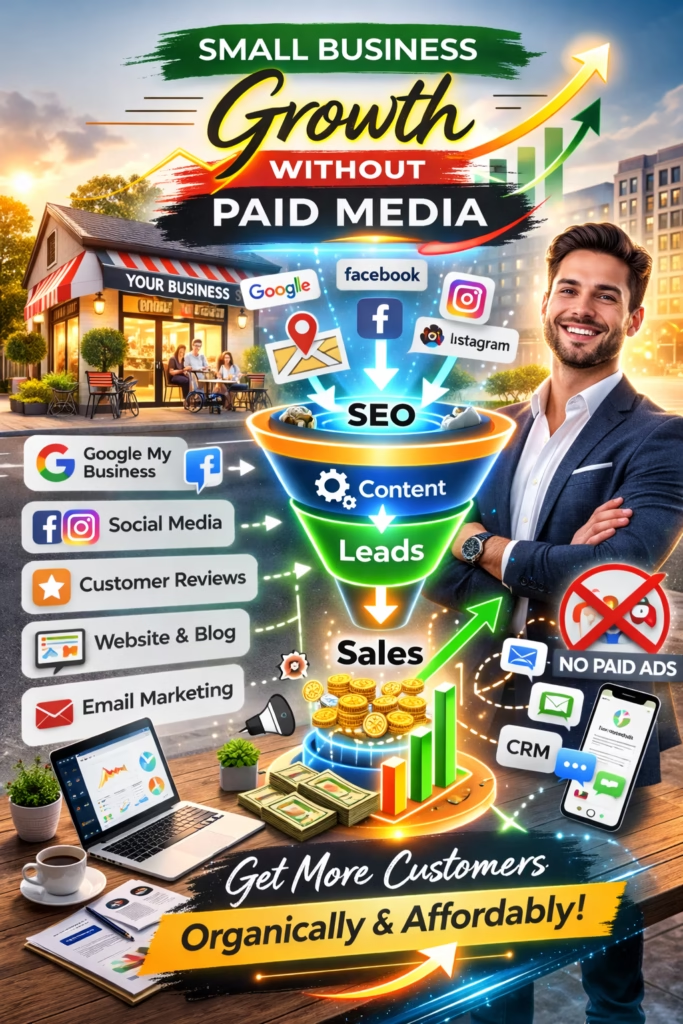
Small Business Growth Without Paid Media is the blueprint for building a lead engine that compounds—using organic visibility, proof, speed-to-lead, and systems—without relying on monthly ad spend.
Note: This is general guidance. Follow platform rules, avoid misleading claims, and keep outreach/review requests compliant with applicable laws and policies.
Introduction
Small Business Growth Without Paid Media is not about “never spending a dollar.” It’s about not needing ads to survive.
When your business depends on paid media, growth feels fragile. If costs rise, leads drop. If ads pause, revenue slows. Organic growth fixes that by building a system that keeps producing even when you’re not buying attention.
In 2025–2026, local growth is dominated by a handful of forces:
- Intent channels: people searching for help right now (Maps, local SEO, marketplaces)
- Proof signals: reviews, photos, and reputation velocity
- Speed-to-lead: how fast you respond and guide the next step
- Consistency: small weekly actions that compound
The good news: you don’t need a huge team to win. You need the right stack, a weekly routine, and a simple measurement system.
Big idea: Organic growth is not a tactic. It’s a workflow.
Expanded Table of Contents
- 1) What “Small Business Growth Without Paid Media” really means
- 2) Why paid media feels like a trap for SMBs
- 3) The organic growth stack (2025–2026)
- 4) Google Business Profile: the organic demand capture machine
- 5) Review velocity: the trust multiplier
- 6) Local SEO pages: turning searches into calls
- 7) Proof content: make your work sell itself
- 8) Marketplaces: optional but powerful (when relevant)
- 9) Partnerships: the hidden organic lead source
- 10) Referrals: the compounding growth loop
- 11) Speed-to-lead: the unfair advantage
- 12) Follow-up: most “lost leads” are just unmanaged
- 13) SOPs: the system that makes organic scalable
- 14) KPIs: what to measure weekly
- 15) 30–60–90 day rollout plan
- 16) 25 Frequently Asked Questions
- 17) 25 Extra Keywords
1) What “Small Business Growth Without Paid Media” really means
Small Business Growth Without Paid Media means you can consistently produce leads and revenue without depending on ads as your main fuel source.
It does not mean
- Never spending money on marketing
- Refusing all tools or automation
- Posting nonstop on social media
It does mean
- Owning your demand capture channels (Maps + SEO)
- Building proof systems (reviews + photos)
- Converting leads with speed-to-lead
- Creating a weekly routine that compounds
Pro move: The goal is “ads optional.” Not “ads forbidden.”
2) Why paid media feels like a trap for SMBs
Paid media can work, but for many SMBs it creates a fragile system:
- Costs rise: CPCs go up, margins go down
- Learning curves are steep: creative, targeting, landing pages, tracking
- Stop spending = stop leads
- Inconsistent ops: slow response + weak follow-up wastes spend
Rule: Ads amplify what’s already working. If your organic conversion is weak, ads magnify the leak.
When ads become safer
- You have a proven offer
- You respond fast
- You have proof and a clean conversion flow
- You can measure booked jobs, not just clicks
3) The organic growth stack (2025–2026)
This is the modern foundation for Small Business Growth Without Paid Media:
| Layer | Goal | What to build |
|---|---|---|
| Demand Capture | Show up for local intent | GBP + local SEO pages |
| Trust | Remove buyer hesitation | Reviews + proof photos |
| Proof Distribution | Stay current and visible | Short-form proof + posts |
| Conversion | Turn inquiries into bookings | Scripts + one-question CTA |
| Retention + Referrals | Compound growth | Follow-up + referral loops |
| Tracking | Improve weekly | KPI dashboard + SOPs |
Pro move: A stack is a sequence. Build it in order: capture → trust → convert → follow up → measure.
4) Google Business Profile: the organic demand capture machine
For local businesses, Google Business Profile is often the highest leverage asset because it captures people who are already searching.
GBP essentials (non-negotiable)
- Correct primary category + accurate services
- Consistent name, address, phone (NAP)
- Fresh photos weekly
- Clear service areas (if applicable)
- Fast response to calls/messages
GBP weekly routine (20–30 minutes)
[ ] Add 5–10 new real photos
[ ] Publish 1 post (proof / offer / update)
[ ] Ask 5 customers for reviews
[ ] Reply to every review
[ ] Check Q&A and messages
Rule: Most SMBs don’t lose because they’re not good. They lose because their GBP looks inactive.
5) Review velocity: the trust multiplier
Review velocity is how consistently you earn reviews over time. It matters because buyers (and platforms) trust businesses that look active and proven.
What review velocity does
Boosts trust
Buyers choose the business that looks safest. Reviews reduce risk.
Improves conversion
More inquiries turn into booked jobs when proof is strong.
Supports visibility
Active profiles tend to perform better than stale ones.
Raises pricing power
Strong proof reduces price sensitivity.
Review request script (simple + effective)
Hey [Name] — quick favor 🙏
If you were happy with the experience, could you leave us a quick Google review?
It helps local customers find us. Here’s the link: [link]
Thank you!
Important: Don’t gate or manipulate reviews. Ask consistently and keep it honest.
6) Local SEO pages: turning searches into calls
Local SEO wins when your pages do two things well: answer intent and reduce objections fast.
Local page must-haves
- Clear H1: service + city
- Proof block: reviews + photos
- Service bullets: what you do (and don’t)
- Process: 3 steps to the next result
- FAQ: real objections answered
- CTA: call/text/form, with a single next step
Local landing page blueprint
H1: [Service] in [City]
Intro: who you help + outcome
Proof: 3 reviews + 6 photos
Services: bullets
Process: 3 steps
FAQ: 8–12 questions
CTA: call/text + short form
Rule: Your local page is your closer. Treat it like a salesperson.
7) Proof content: make your work sell itself
Proof content is not “influencer content.” It’s evidence.
Proof content that converts
- Before/after photos
- Short walkthrough videos (10–30 seconds)
- Customer quotes and testimonials
- Behind-the-scenes process clips
- FAQ clips (answer one question on camera)
The 3-post weekly loop (simple + sustainable)
| Post | What to show | Outcome |
|---|---|---|
| Proof | result / before-after | trust |
| FAQ | one objection answered | clarity |
| Update | availability / seasonal tip | freshness |
Pro move: Proof content builds your “organic close rate.” The better you prove, the less you persuade.
8) Marketplaces: optional but powerful (when relevant)
For many SMB categories (retail, home services, local delivery, certain repairs), marketplaces can produce fast results because buyers are already browsing with intent.
Marketplace success pillars
- Variety: multiple angles, offers, and listings
- Freshness: steady cadence you can sustain
- Thumbnails: first photo wins the scroll
- Speed-to-lead: quick replies win inquiries
Avoid: Posting identical duplicates. Rotate photos, hooks, and angles while staying truthful and compliant.
9) Partnerships: the hidden organic lead source
Partnerships are one of the most underused strategies in Small Business Growth Without Paid Media.
Best partners are adjacent, not competing
- A painter partners with a realtor, contractor, or property manager
- A mattress store partners with movers, chiropractors, or apartment communities
- A landscaper partners with pool companies or fence installers
Partnership pitch template
Hey [Name] — quick idea.
We both serve the same local customers, just at different steps.
If we send each other a few referrals each month, both businesses win.
Want to test it for 30 days and track results?
Rule: Partnerships work when you make referrals frictionless and trackable.
10) Referrals: the compounding growth loop
Referrals are the most “paid-media-proof” lead source because they come pre-trusted.
Referral loop SOP
[ ] Ask at the moment of success (right after a great outcome)
[ ] Make it easy: “If you know someone who needs help, text me their name.”
[ ] Thank them quickly
[ ] Track referrals weekly
[ ] Follow up with the referred lead within 5 minutes
Referral ask script
Glad you’re happy with everything 🙌
If you know anyone else who needs help, I can take care of them too.
Want to text me their name/number and I’ll reach out politely?
Pro move: Referral requests fail when they feel like marketing. Make it about helping their friend.
11) Speed-to-lead: the unfair advantage
Most businesses lose leads because they reply too late. Organic channels are “free,” but only if you can convert the leads you already receive.
Instant reply (universal)
Yes — I can help ✅
What city/zip are you in, and are you looking for today or this week?

If you share one detail, I’ll confirm the fastest next step.
Why speed-to-lead increases growth without ads
- More inquiries become booked jobs
- More booked jobs generate reviews
- More reviews increase Maps conversion
- More conversion increases organic visibility and referral momentum
Rule: Fast response is the multiplier that makes every organic channel stronger.
12) Follow-up: most “lost leads” are just unmanaged
Leads often don’t say “no.” They just disappear because they got busy, got distracted, or are waiting for clarity.
Follow-up timing sequence (simple)
T+2 hours: quick check-in
Next day: offer a next step
3 days: “still looking?” message
7 days: final polite check-in
Follow-up scripts
T+2 hours: Just checking — do you want to schedule this for today or later this week?
Next day: I have an opening [day/time]. Want me to lock it in?
3 days: Still looking for help with this, or did you get it handled?
7 days: No worries either way — if you need anything later, just reply here.
Pro move: Follow-up is not pressure. It’s clarity.
13) SOPs: the system that makes organic scalable
Organic marketing fails when it’s “someone’s job when they have time.” SOPs turn it into a routine.
Minimum SOP list
- Weekly GBP routine
- Review request workflow
- Proof capture workflow (photos/video)
- Instant reply + follow-up scripts
- Weekly KPI review
Weekly organic routine (60 minutes total)
Mon: Update GBP (photos + post) (20 min)
Wed: Ask for reviews + reply to reviews (15 min)
Fri: Post proof + update your page/FAQ (25 min)
Rule: A simple routine you keep beats a perfect plan you abandon.
14) KPIs: what to measure weekly
| KPI | What it measures | Target direction |
|---|---|---|
| Leads by source | Channel performance | Stable / Up |
| Booked next steps | Pipeline health | Up |
| Close rate | Offer + trust strength | Up |
| Median response time | Lead leakage | Down |
| Review velocity | Trust growth | Up |
| Proof outputs/week | Content consistency | Stable / Up |
Pro move: Track “booked next steps” weekly. That metric predicts revenue better than views.
15) 30–60–90 day rollout plan
Days 1–30 (Stabilize)
- Fix/optimize GBP and add fresh photos weekly
- Start consistent review requests (5/week)
- Create 1 strong local landing page (service + city)
- Deploy instant reply + follow-up sequence
- Track leads by source + response time
Days 31–60 (Grow)
- Add 2–4 additional local pages (services/cities)
- Run the 3-post proof loop weekly
- Launch 3–5 partnerships with adjacent businesses
- Improve scripts and close rate
Days 61–90 (Compound)
- Standardize SOPs
- Increase proof production (photos/videos)
- Double down on best sources
- Expand referral loop and track outcomes
Rule: Organic growth compounds when trust, consistency, and conversion improve together.
16) 25 Frequently Asked Questions
1) Can a small business grow without paid media?
Yes. Small Business Growth Without Paid Media works by building an organic stack: GBP, reviews, local SEO, proof content, partnerships, referrals, and fast response systems.
2) What is the fastest organic channel for local businesses?
Google Business Profile (Maps) is often the fastest because it captures existing intent. Marketplaces can also be fast when relevant.
3) What matters more than posting every day?
Consistency, proof, and response speed. A small weekly routine can outperform daily bursts followed by silence.
4) How do I get more leads without ads?
Improve GBP, grow reviews steadily, build local SEO pages, publish proof content weekly, and respond fast with strong follow-up.
5) Do I need a website to grow organically?
A website helps, but a clean landing page plus a strong GBP can be enough to start.
6) How many reviews do I need?
There’s no single number, but steady review velocity matters. Consistency builds trust and conversion over time.
7) How do I increase review velocity safely?
Ask every satisfied customer, make it easy with a link, and reply to reviews. Avoid manipulation.
8) What’s the best way to rank in Google Maps?
Strong relevance (categories/services), trustworthy proof (reviews/photos), and ongoing profile activity help performance.
9) What should I post on my GBP?
Proof posts, offers, updates, and seasonal tips—kept simple and consistent.
10) How often should I add photos?
Weekly is strong. Fresh photos improve trust and keep your profile active.
11) What is proof content?
Photos, videos, testimonials, and results that show real outcomes and reduce buyer hesitation.
12) Do social media followers matter for local growth?
Followers can help, but local intent + proof + conversion matters more than vanity metrics.
13) Are partnerships really effective?
Yes. Adjacent partners can send warm leads consistently with very low cost.
14) What’s the best partnership strategy?
Pick adjacent businesses, propose a 30-day test, make referrals easy, and track results.
15) How do I generate more referrals?
Ask at the moment of success, keep it casual, and make the referral action simple.
16) What is speed-to-lead?
How fast you respond to new inquiries. Faster response increases bookings dramatically.
17) What response time should I aim for?
Under 5 minutes is strong; under 1 minute is best when possible.
18) What’s the best CTA question?
“What city/zip are you in, and are you looking for today or this week?”
19) Why do leads go cold?
Slow response, unclear next steps, and weak follow-up. Many “lost leads” are just unmanaged.
20) How many follow-ups should I send?
A simple 2-hour, next-day, 3-day, and 7-day sequence is often enough.
21) Do I need a CRM?
You need a place to track leads and next steps. A spreadsheet works until volume increases.
22) What KPI matters most?
Booked next steps. It predicts revenue better than views or clicks.
23) How long does organic growth take?
Many businesses see improvements within 30–90 days of consistent execution.
24) When should I use paid ads?
When your organic conversion is strong and you can handle lead volume with fast response and follow-up.
25) What’s the biggest mistake SMBs make?
Inconsistent routines and slow response times. Organic wins come from steady compounding.
17) 25 Extra Keywords
- Small Business Growth Without Paid Media
- small business growth without paid media
- organic small business growth
- grow a small business without ads
- local marketing without ads
- free lead generation for small business
- Google Business Profile growth strategy
- Google Maps marketing without ads
- local SEO growth strategy
- service business growth without ads
- how to get more customers organically
- review velocity strategy
- get more Google reviews ethically
- proof content marketing for local business
- before and after marketing strategy
- speed to lead system
- follow up system for leads
- partnership marketing for local businesses
- referral system for small business
- organic lead generation system
- local business growth plan 2026
- small business marketing SOPs
- how to grow without Facebook ads
- how to grow without Google ads
- organic local marketing stack