
Organic Lead Systems for Small Businesses
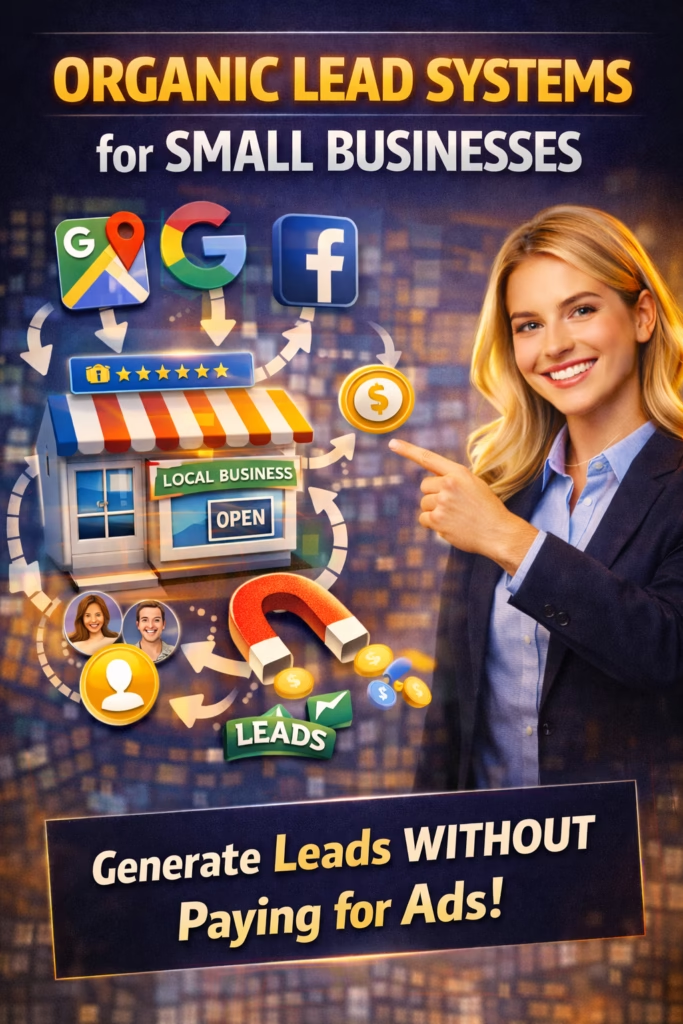
Organic Lead Systems for Small Businesses is a repeatable way to generate inbound calls and messages—without depending on paid ads—using visibility, trust, listing velocity, and fast follow-up.
Note: This is general marketing guidance. Keep platform activity compliant and avoid spammy duplication.
Introduction
Organic Lead Systems for Small Businesses are the fastest way to build predictable demand without living on a treadmill of paid ads. Ads can work—but the moment you stop paying, the faucet turns off.
Organic lead systems are different. They turn platforms you already have into an inbound engine that compounds: your Google presence strengthens, your listings keep generating messages, and your follow-up system converts leads while you’re busy (or sleeping).
Big idea: Paid ads rent attention. Organic systems own attention.
Expanded Table of Contents
- 1) What “organic lead systems” actually mean
- 2) The 4 pillars: visibility, trust, speed, follow-up
- 3) Demand capture vs demand creation (know the difference)
- 4) Facebook Marketplace: the underpriced visibility channel
- 5) Google Business Profile + Maps: compounding local demand
- 6) Content flywheel: short-form that feeds search and trust
- 7) Offers that convert (without sounding salesy)
- 8) Automation that increases leads without increasing spam
- 9) First-response scripts and qualification flows
- 10) Follow-up SOP that recovers ghost leads
- 11) KPIs that predict 50–200+ leads/month
- 12) 30–60–90 day rollout plan
- 13) 25 Frequently Asked Questions
- 14) 25 Extra Keywords
1) What “organic lead systems” actually mean
Organic Lead Systems for Small Businesses are repeatable processes that generate inbound leads from existing demand—without paying for each click.
That includes:
- Search demand: Google Maps and local search (“near me” traffic)
- Marketplace demand: Facebook Marketplace browsing + search
- Social demand: short-form video and community distribution
- Referral demand: reviews, shares, and word-of-mouth loops
System definition: A lead system is only real when it works even on a busy week—because it’s process-driven, not personality-driven.
2) The 4 pillars: visibility, trust, speed, follow-up
Almost every organic lead engine is built on four controllable levers:
1) Visibility
Prospects can find you easily in the places they already search: Maps, Marketplace, community feeds.
2) Trust
They believe you’re real: proof photos, reviews, clear info, and consistency.
3) Speed-to-lead
Fast replies win. Most buyers contact multiple businesses at once.
4) Follow-up
Most revenue lives in follow-up. Ghosting isn’t rejection—it’s competition.
Reality check: If you have visibility but no speed, you leak money. If you have speed but no trust, you attract low-quality leads.
3) Demand capture vs demand creation (know the difference)
Small businesses waste time when they confuse these two categories:
| Type | What it means | Examples |
|---|---|---|
| Demand capture | People already want it and are looking now | Google Maps, Marketplace search, “near me” keywords |
| Demand creation | You introduce a problem/solution and build awareness | Content strategy, education posts, community presence |
Shortcut: Start with demand capture first (fast wins). Then use content to compound trust and raise lead quality.
4) Facebook Marketplace: the underpriced visibility channel
Marketplace is not just for used items. It’s an attention marketplace where local buyers browse with intent—and where consistent listing velocity can create daily inbound messages.
Why Marketplace works for small businesses
- It’s local by default
- It rewards freshness (consistent activity wins)
- It favors clear keywords + credible photos
- It converts fast when you respond quickly
Marketplace listing velocity (simple framework)
Goal: 15–60+ active listings (depending on niche + market)
Cadence: post/refresh 3–8 listings per day OR 4–7 days/week
Rule: rotate photos + titles + offers (avoid identical duplication)
Compliance note: Scale with variety, accuracy, and real proof—don’t copy/paste identical posts everywhere.
5) Google Business Profile + Maps: compounding local demand
Google Maps is the highest-intent lead source for most local businesses because people search when they’re ready to buy.
The local Maps compounding loop
- Optimize your Google Business Profile (services, categories, photos, hours)
- Collect consistent reviews (with real keywords naturally)
- Post updates and photos weekly
- Answer Q&A and messages fast
- Track calls, direction requests, and keyword growth
Maps advantage: Every improvement compounds, because Google rewards consistency and relevance over time.
6) Content flywheel: short-form that feeds search and trust
Content is how you make organic leads higher quality. People don’t just want a provider—they want proof.
3 content types that drive inbound leads
1) Proof content
Before/after, walkthroughs, results, delivered projects, real customers.
2) Decision content
“How to choose,” “what it costs,” “what to avoid,” “what to expect.”
3) Local content
City-specific posts, neighborhood cues, local FAQs, availability updates.
Flywheel: One short-form video can become: Marketplace listing proof, Google post, IG reel, TikTok, and a blog section.
7) Offers that convert (without sounding salesy)
Your offer is the “why message now.” Great organic systems make the next step obvious.
Offer clarity checklist
- What is it? (service/product)
- Who is it for? (buyer type)
- What happens next? (estimate, showing, delivery, consultation)
- How fast can it happen? (availability)
- What proof exists? (photos, reviews, credentials)
High-converting hooks (rotate)
Available this week Same-day options Free estimate Fast turnaround Local delivery Clear pricing Limited slots
Rule: Only claim what you can deliver. Organic systems rely on trust.
8) Automation that increases leads without increasing spam
Automation works when it reduces delay, not when it creates duplication.
Best places to automate
- Instant first reply: qualify leads immediately
- Follow-up sequence: recover ghost leads
- Routing: send leads to the right person/team
- Tracking: tags for city, offer, platform, outcome
Simple rule: Automate response and follow-up first. Then automate posting only if you can maintain variation and accuracy.
9) First-response scripts and qualification flows
Organic lead systems win because they respond faster than competitors—and they ask one easy question that moves the lead forward.
Universal instant reply
Yes — I can help ✅
What city/zip are you in, and are you trying to do this this week or later?

I’ll confirm the fastest options.
Price question (without losing the lead)
Totally ✅ Pricing depends on a couple details.
What city are you in, and what’s the rough timeframe (ASAP / this week / later)?

I’ll send the best option first.
Qualification checklist
[ ] City/zip
[ ] Timeline
[ ] Budget range (optional)
[ ] Key requirement (size, scope, bedrooms, etc.)
[ ] Next step (estimate, showing, pickup, delivery)
10) Follow-up SOP that recovers ghost leads
Most leads don’t say “no.” They get distracted or they go with whoever made it easiest. Follow-up is where organic systems become predictable.
3-touch follow-up sequence
| Timing | Message | Goal |
|---|---|---|
| 20–40 min | Quick check-in + question | Re-engage |
| Same day | Availability + options | Create action |
| Next day | Alternate option | Save lead |
Follow-up #1
Quick check-in ✅
Do you still want to move forward?

What city/zip are you in? I’ll confirm the fastest option.
Follow-up #2
Heads up ✅ I have a couple openings.
If you want it, I can lock in the next slot.

What city are you in?
Follow-up #3 (alternate)
Still shopping? ✅
If this isn’t the perfect fit, tell me your city + budget and I’ll send a better option.
11) KPIs that predict 50–200+ leads/month
| KPI | What it means | Target |
|---|---|---|
| Visibility outputs | # of listings/posts/photos per week | Consistent, sustainable rhythm |
| Messages/week | Inbound lead volume | Up month over month |
| Median response time | Conversion leverage | < 5 min (good), < 1 min (best) |
| Booked rate | Appointments/showings/quotes set | Improve with scripts |
| Close rate | Sales from booked | Track weekly |
Truth: Most businesses don’t need more traffic. They need less leakage.
12) 30–60–90 day rollout plan
Days 1–30 (Build the foundation)
- Set up your offer clarity (what, who, next step, availability)
- Build 15–40 Marketplace listings (varied titles and proof photos)
- Optimize Google Business Profile basics + photos
- Install instant reply + qualification question
- Track response time and messages weekly
Days 31–60 (Increase conversion)
- Identify top-performing listings/offers and replicate variants
- Add the 3-touch follow-up SOP
- Publish weekly proof content (short-form)
- Collect reviews consistently
Days 61–90 (Scale predictably)
- Increase listing velocity while maintaining variation
- Expand to nearby cities/areas (if relevant)
- Systemize lead routing + tracking
- Measure booked rate and optimize offers weekly
13) 25 Frequently Asked Questions
1) What are Organic Lead Systems for Small Businesses?
They’re repeatable processes that generate inbound leads using platforms like Marketplace, Google Maps, and content—without paying for each click.
2) Do organic lead systems work in every niche?
Most local niches can generate organic leads, but the best channels vary by buyer intent and search behavior.
3) Which channel produces the fastest organic leads?
Marketplace often produces faster leads, while Google Maps compounds strongly over time.
4) How fast can I get leads without ads?
You can often get leads within days using Marketplace + fast replies; Maps and content typically compound over 30–90 days.
5) Do I need a website?
No, but a website can increase trust and conversion—especially for higher-ticket services.
6) What matters most for organic conversion?
Trust, clarity, speed-to-lead, and follow-up.
7) How important is response time?
Extremely. Fast replies can double conversions without changing traffic.
8) What’s a good response time target?
Under 5 minutes is good; under 1 minute is best.
9) Why do leads ghost?
They contact multiple businesses and choose the one that responds fastest and makes the next step easiest.
10) What is a follow-up SOP?
A structured sequence of messages that recovers leads who didn’t respond the first time.
11) How many follow-ups should I send?
Three is a strong baseline: 20–40 minutes, same day, next day.
12) What should my first reply say?
Confirm you can help, ask city/zip, and ask timeframe.
13) Do reviews matter for organic leads?
Yes—especially on Google. Reviews boost trust and local ranking signals.
14) How do I get more reviews?
Ask consistently after successful outcomes and make it easy (one link, simple ask).
15) What content works best?
Proof content, decision content, and local content.
16) Do I need to post daily content?
No. Consistency matters more than volume. Start with weekly.
17) What is listing velocity?
A consistent rhythm of new and refreshed listings that keeps you visible.
18) How do I avoid spammy duplication on Marketplace?
Rotate photos, titles, offers, and timing. Keep listings accurate and varied.
19) Can automation help organic lead systems?
Yes—especially for instant replies, routing, follow-up, and tracking.
20) Does automation increase risk on platforms?
It can if it causes repetitive posting patterns. Use automation for speed and consistency, not duplication.
21) What KPIs should I track?
Messages/week, response time, booked rate, close rate, and output consistency.
22) What’s the biggest mistake with organic lead generation?
Inconsistent activity and slow response time.
23) How do I improve lead quality organically?
Increase proof, improve offer clarity, and use content that pre-qualifies prospects.
24) Is paid advertising still useful?
Yes, but it works best when layered on top of a strong organic foundation.
25) What’s the fastest improvement I can make today?
Implement instant replies + a follow-up sequence, and improve your first photo/title clarity.
14) 25 Extra Keywords
- Organic Lead Systems for Small Businesses
- organic lead generation system
- small business marketing without ads
- how to get leads organically
- inbound lead generation for local businesses
- Facebook Marketplace lead generation
- Marketplace listing velocity strategy
- Facebook Marketplace SEO strategy
- Google Business Profile lead system
- Google Maps SEO for small business
- local SEO lead generation
- how to rank in Google Maps
- organic customer acquisition
- automation for lead follow-up
- speed to lead system
- follow-up SOP for leads
- lead conversion scripts
- how to reduce lead ghosting
- local business lead funnel
- inbound marketing system for small business
- how to get more calls without ads
- how to get more messages without ads
- content flywheel for local business
- organic lead tracking KPIs
- 30 60 90 day lead generation plan













