
OfferUp Lead Generation Explained for Small Businesses
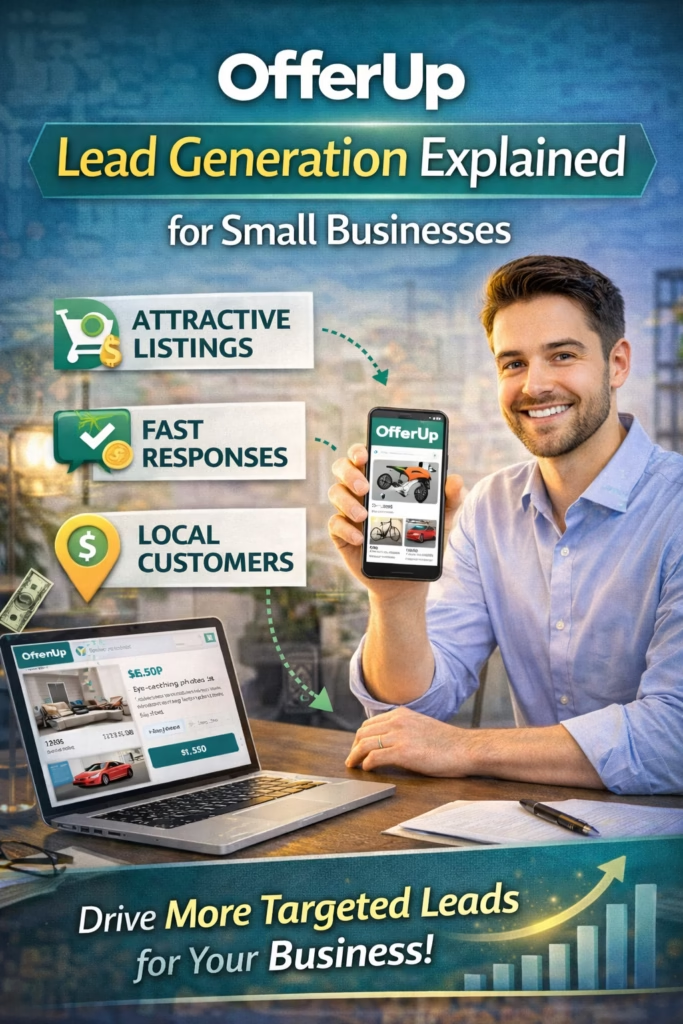
OfferUp Lead Generation Explained for Small Businesses shows how small businesses use OfferUp to create local buyer messages, product inquiries, pickup conversations, and real sales opportunities through stronger listings, better photos, clearer trust signals, and faster lead handling.
Introduction
OfferUp Lead Generation Explained for Small Businesses is one of the most practical topics for local businesses trying to create more direct buyer activity without depending entirely on expensive traditional advertising. Many small businesses overlook OfferUp because they think of it as just a consumer resale app. In reality, it can be a valuable local lead generation channel when used strategically.
The difference between random marketplace activity and useful lead generation usually comes down to execution. Small businesses that get steady results from OfferUp do not just upload items and wait. They use stronger titles, better photos, clear pricing, stronger descriptions, local trust signals, and faster replies. They understand that the platform works best when each listing is designed to convert local interest into a real conversation.
OfferUp lead generation works best when small businesses treat listings like lead assets, not just casual posts.
This matters because OfferUp users often browse with real intent. They are looking for nearby products, good deals, fast communication, simple pickup, and convenient local options. That means the intent is already present. The main question is whether the small business listing is strong enough to capture it.
For mattress stores, furniture retailers, appliance sellers, home goods businesses, wellness brands, equipment dealers, and other local sellers, OfferUp can support a repeatable flow of local buyer inquiries. The businesses that perform best are usually using a simple but consistent system focused on visibility, trust, value, and response speed.
Main idea: Small businesses use OfferUp for lead generation by combining strong listings, better presentation, local trust, fast response, and organized follow-up into a repeatable local inquiry system.
Table of Contents
- 1) Why OfferUp can generate leads for small businesses
- 2) What OfferUp lead generation actually means
- 3) The difference between random posts and a real lead system
- 4) Titles that support stronger lead flow
- 5) Photos and presentation that increase response
- 6) Listing structure that improves lead quality
- 7) Pricing and offer positioning
- 8) Trust signals that help small businesses win
- 9) Local relevance and buyer comfort
- 10) Response speed and protecting lead value
- 11) Follow-up and recovering warm leads
- 12) Common mistakes that block OfferUp lead generation
- 13) A practical OfferUp workflow for small businesses
- 14) Final thoughts
- 15) FAQs
- 16) Extra keywords
1) Why OfferUp Can Generate Leads for Small Businesses
OfferUp can generate leads for small businesses because it is built around local discovery and convenience. Users often visit the platform already looking for products they can buy nearby, compare quickly, and ask about directly. That makes it useful for businesses that want real local buyer activity rather than passive impressions.
Lead generation on OfferUp does not require national reach. It requires enough visibility in front of nearby people who are already interested in the kind of product being shown. That is why the platform can work so well for smaller businesses. It favors local fit more than huge scale.
OfferUp supports lead generation because it has:
- Local-first browsing behavior
- Product-focused discovery
- Mobile-friendly communication
- Practical buyer intent
- Convenience-driven comparison behavior
When small businesses match that behavior well, OfferUp can become a steady source of local inquiries and sales conversations.
2) What OfferUp Lead Generation Actually Means
OfferUp lead generation means using marketplace visibility to create real local buyer conversations. A lead is not just a view or a casual scroll. A real lead is a message, question, offer, availability request, pickup discussion, or product inquiry that signals meaningful buying interest.
This is important because many businesses confuse traffic with results. A listing can get noticed without producing useful action. The goal is not just to be seen. The goal is to create responses that move closer to a sale.
A strong OfferUp lead is a local conversation with intent, not just passive marketplace activity.
Once that becomes clear, it is easier for a small business to build listings that attract stronger responses instead of weak curiosity.
3) The Difference Between Random Posts and a Real Lead System
A random OfferUp post is just a listing. A real lead generation system is a chain of actions designed to create repeated local buyer opportunities. The difference is not only how often the business posts. It is how well the business structures the listing and handles the response process.
Random posting:
upload an item
wait for messages
reply whenever possible

Lead system:
use stronger titles
show better photos
price clearly
build trust fast
reply quickly
follow up reliably
track what works
Small businesses that generate stronger lead flow usually work much closer to the second model. They are not just listing products. They are building a process that improves discovery, trust, response, and recovery together.
A real OfferUp lead system works better because it reduces the number of ways a local buyer can lose confidence or move on.
4) Titles That Support Stronger Lead Flow
The title is the first major driver of discovery. It influences whether the right local person taps on the listing at all. Small businesses that get stronger lead flow usually use titles that are clear, useful, and specific rather than vague or generic.
A strong title often follows this pattern:
[Product] + [Important Detail] + [Useful Buyer Hook]Examples:
- Queen Mattress Set – Local Delivery Available
- Sectional Sofa – Clean Condition and Fast Pickup
- Dining Table Set – Solid Wood and Great Shape
- Adjustable Bed Base – Ready This Week
- Home Wellness Device – Excellent Condition
These titles work because they help the buyer understand what is being offered and why it may be worth asking about right now. That improves the quality of the click and the likelihood of response.
Weak titles often reduce lead quality before the buyer even opens the listing.
5) Photos and Presentation That Increase Response
Photos are one of the biggest conversion levers on OfferUp. Buyers often decide how seriously to take a listing within seconds of seeing the visual presentation. If the photos feel dark, blurry, messy, or generic, the listing loses trust immediately. Better photos help the small business look more legitimate and the product look more worth asking about.
Good OfferUp visuals often help show:
- The item is real
- The condition is visible
- The seller feels legitimate
- The product is available now
- The offer is worth messaging about
Lead generation improves when the listing looks real, useful, and trustworthy at first glance.
For many small businesses, better photos alone can improve the rate at which views become messages.
6) Listing Structure That Improves Lead Quality
Once the title and photos get the click, the description has to convert interest into confidence. Most OfferUp users scan quickly rather than reading every line carefully. That means the listing should make the main details obvious within seconds.
A strong OfferUp listing usually includes:
- A clear opening summary
- Main product details
- Condition, size, or useful specifications
- Pickup or delivery context
- A simple next step
This structure matters because it lowers uncertainty. A buyer who understands the item, the value, and how to respond is much more likely to send a message. That is what helps lead flow become more consistent.
Lead quality improves when listings make the offer and the next step feel easy to understand.
7) Pricing and Offer Positioning
Pricing affects both trust and action. Buyers use price to judge whether the offer feels reasonable and worth asking about. A price that feels confusing or disconnected from the quality of the listing can slow down lead flow. A price that feels clear and understandable can increase both clicks and messages.
This does not always mean the business must be the cheapest. It means the offer should feel like it makes sense. Strong positioning may come from value, convenience, condition, delivery options, bundle value, or local availability.
Small businesses generate better OfferUp leads when buyers can understand the value quickly.
Price and positioning work together. The listing should help the buyer feel that this option is worth contacting now.
8) Trust Signals That Help Small Businesses Win
Trust matters because OfferUp buyers are constantly judging risk. They want to know whether the listing is real, whether the seller is legitimate, and whether reaching out is worth their time. Strong trust signals help small businesses compete well, even against larger sellers.
Important trust signals include:
- Real photos
- Honest and clear descriptions
- Reasonable pricing
- Professional wording
- Local availability
- Consistent activity
These elements matter because trust affects whether the buyer messages now, later, or not at all. Listings that build trust fast usually generate more useful lead activity from the same amount of traffic.
Small businesses often win on OfferUp when they look clearer, more responsive, and more trustworthy than nearby alternatives.
9) Local Relevance and Buyer Comfort
OfferUp is most powerful when the listing feels clearly local. Buyers are often searching for nearby options that feel practical, current, and easy to act on. Small businesses that emphasize local convenience often create stronger lead flow because the buyer feels less friction.
Local relevance can show up through pickup information, delivery details, neighborhood language, nearby references, or wording that makes the listing feel grounded in a real market. This helps the buyer feel more comfortable reaching out.
Buyer comfort increases when the listing feels nearby, legitimate, and easy to act on.
That is one reason marketplace lead generation often depends more on trust and convenience than on flashy branding alone.
10) Response Speed and Protecting Lead Value
OfferUp inquiries move fast. Buyers may message multiple sellers in a short period, especially when comparing local options. That means response speed plays a major role in whether the small business captures the opportunity or loses it to someone else.
Thanks for reaching out.
Yes, this is available.
Would you like pickup details, delivery info, or more product information?
This kind of response works because it is quick, clear, and easy to continue. It protects the value of the lead while the buyer is still engaged.
Slow response is one of the easiest ways for a small business to lose strong OfferUp leads.
11) Follow-Up and Recovering Warm Leads
Not every OfferUp lead becomes a sale right away. Some buyers pause, compare, or get distracted. That is why follow-up matters. A healthy lead generation system includes recovery, not just first contact. Some of today’s sales come from yesterday’s unfinished conversations.
Follow-up helps:
- Recover warm buyer interest
- Restart paused conversations
- Clarify unanswered questions
- Improve the total value of existing traffic
This matters because lead generation is not only about getting new inquiries. It is also about handling recent interest more effectively.
A strong OfferUp lead system includes both new conversations and recovered opportunities.
12) Common Mistakes That Block OfferUp Lead Generation
Most small businesses fail to create steady OfferUp lead flow because they weaken the process in predictable ways. They use poor photos, weak titles, vague descriptions, confusing prices, or slow reply habits. Then they assume the platform is inconsistent when the real issue is listing quality and follow-through.
Common mistakes include:
- Generic titles
- Low-quality photos
- Weak descriptions
- Confusing pricing
- Poor trust signals
- Slow replies
- No follow-up process
Big mistake: expecting serious local leads from listings that do not look serious enough to trust or easy enough to respond to.
Fixing those weak points often improves lead flow much faster than posting more often without improving quality.
13) A Practical OfferUp Workflow for Small Businesses
If a business wants to apply OfferUp Lead Generation Explained for Small Businesses in a practical way, the simplest path is to use a repeatable workflow.
Step 1: Choose products with strong local demand
Step 2: Write titles that attract the right clicks
Step 3: Use real photos that show quality and condition
Step 4: Create clear, trust-building descriptions
Step 5: Position pricing clearly and reasonably
Step 6: Make the next step simple
Step 7: Reply quickly to every serious inquiry
Step 8: Follow up on warm leads that go quiet
This workflow works because it improves discovery, trust, response, and recovery together. It turns OfferUp into a repeatable local lead channel rather than a random posting habit.
Small businesses get stronger OfferUp leads when the platform becomes a repeatable operating process instead of an occasional experiment.
14) Final Thoughts
OfferUp Lead Generation Explained for Small Businesses comes down to visibility, trust, clarity, and speed. OfferUp still contains strong local demand, but that demand only becomes useful when the listing is structured to capture it. Serious lead flow is usually not random. It is the result of repeated good execution.
Small businesses that perform best on OfferUp usually follow the same pattern. They use better titles. They show stronger photos. They explain the value clearly. They build trust fast. They respond quickly. And they follow up well. Those habits are what make OfferUp feel like a real lead source instead of just another marketplace app.
Final takeaway: Small businesses use OfferUp for lead generation by building a system that supports local discovery, local trust, fast response, and repeatable follow-through.
15) FAQs
1) How does OfferUp lead generation work for small businesses?
It works by combining local visibility, strong listings, better visuals, trust signals, and fast response into a repeatable local inquiry system.
2) Why can OfferUp generate leads for small businesses?
Because many users browse the platform with real local buying intent and want nearby products, value, and quick communication.
3) What types of small businesses use OfferUp effectively?
Mattress stores, furniture businesses, appliance sellers, home goods retailers, equipment dealers, wellness brands, and other product-based local businesses often use it effectively.
4) What makes OfferUp lead generation consistent instead of random?
Consistency usually comes from stronger titles, better photos, clear pricing, useful descriptions, faster replies, and organized follow-up.
5) What is the biggest mistake small businesses make on OfferUp?
One of the biggest mistakes is posting weak generic listings and expecting serious buyer interest without improving the listing quality.
6) Do titles matter for OfferUp lead generation?
Yes. Titles strongly affect whether the right local buyer notices and opens the listing.
7) What kind of title works best?
A title that is clear, specific, and useful usually works best because it attracts more relevant clicks.
8) Do photos matter that much?
Yes. Photos are one of the strongest trust and conversion factors on OfferUp.
9) Why do trust signals matter?
Because buyers often hesitate if the listing feels vague, unrealistic, or poorly presented.
10) Does pricing affect lead flow?
Yes. Pricing affects both trust and response quality because buyers judge value quickly.
11) How important is local relevance?
Very important. OfferUp works best when the buyer feels the listing is clearly nearby and accessible.
12) Why is response speed part of the system?
Because good buyer interest can disappear quickly if another seller responds first.
13) Does follow-up help improve results?
Yes. Some sales come from recovering warm conversations that did not close immediately.
14) Can small businesses get leads without paid ads on OfferUp?
Yes. Many businesses still generate organic local buyer interest through stronger listings and better execution.
15) Does lead flow mean the same number every day?
No. It means there is a repeatable pattern of useful local inquiry activity rather than only occasional random messages.
16) What weakens OfferUp lead generation most?
Weak titles, bad photos, poor descriptions, unclear pricing, slow replies, and no follow-up all weaken lead flow.
17) Should every listing look the same?
No. The system can stay strong, but the wording and angle should fit each product and market.
18) Can smaller businesses compete well on OfferUp?
Yes. Smaller businesses often compete very well when they are clearer, faster, and more trustworthy than nearby alternatives.
19) What should businesses measure on OfferUp?
They should track inquiry volume, reply speed, lead quality, pickup conversations, sales, and follow-up results.
20) Is OfferUp only good for discounted products?
No. It can support value-based offers too, as long as the listing clearly communicates why the offer is worth asking about.
21) Can repeated activity improve results?
Yes. Staying active and consistent can improve visibility, familiarity, and inquiry opportunity over time.
22) Does local trust affect buyer behavior?
Yes. Buyers are much more likely to message when the listing feels real, nearby, and legitimate.
23) What is the main purpose of an OfferUp lead system?
The main purpose is to turn local product discovery into recurring buyer messages and sales opportunities through repeatable execution.
24) Is OfferUp success more about traffic or process?
It is about both, but process usually determines whether traffic becomes useful lead flow.
25) What is the core principle behind OfferUp lead generation?
The core principle is that repeatable local lead results come from repeatable local listing quality and follow-through.
16) Extra Keywords
- OfferUp Lead Generation Explained for Small Businesses
- OfferUp lead generation
- OfferUp for small businesses
- OfferUp marketing
- local business leads
- OfferUp listing strategy
- OfferUp buyer inquiries
- OfferUp local visibility
- OfferUp small business sales
- OfferUp messages from buyers
- OfferUp product inquiries
- OfferUp trust signals
- OfferUp fast response strategy
- OfferUp local conversion
- OfferUp daily buyer messages
- OfferUp recurring local leads
- OfferUp marketplace strategy
- OfferUp local customer flow
- OfferUp buyer intent platform
- OfferUp local business growth
- OfferUp follow-up system
- OfferUp listing workflow
- OfferUp dependable inquiry source
- OfferUp sales opportunities
- OfferUp local lead system