
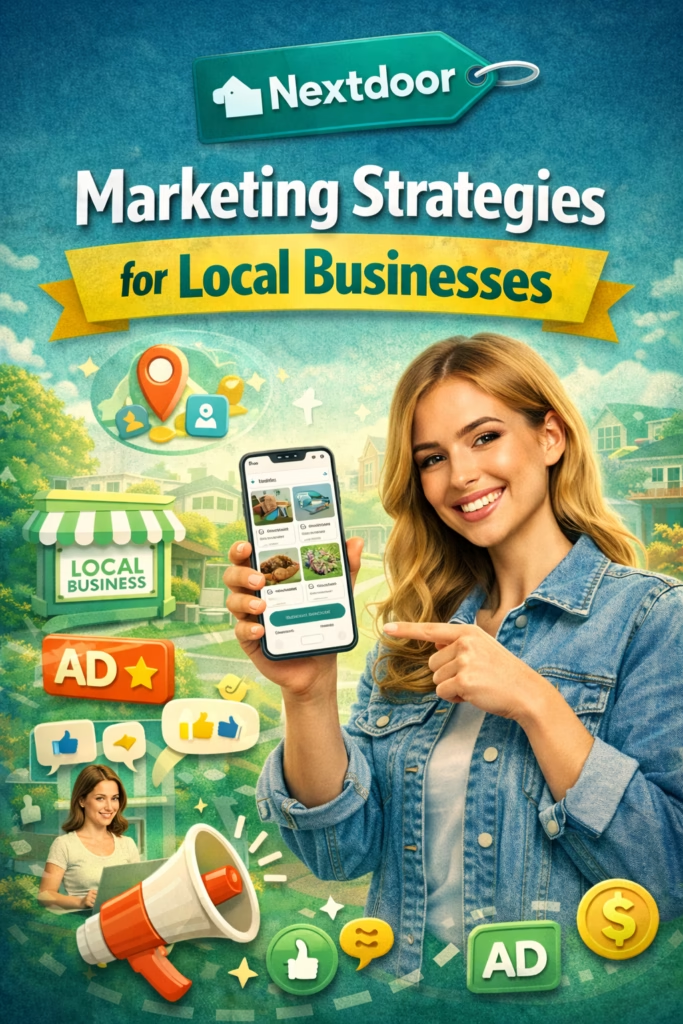
Nextdoor Marketing Strategies for Local Businesses
Nextdoor Marketing Strategies for Local Businesses is the blueprint for building neighborhood trust, local visibility, referral momentum, and reliable inquiries by showing up helpfully and consistently where nearby residents already connect.
Note: This is general guidance. Follow platform policies, avoid misleading claims, and keep all neighborhood-facing communication respectful, accurate, and genuinely useful.
Introduction
Nextdoor Marketing Strategies for Local Businesses begin with a simple shift in perspective:
Nextdoor is not just another social channel. It is a neighborhood-trust channel.
That difference matters. On many platforms, businesses compete for broad attention. On Nextdoor, businesses compete for local comfort, credibility, and relevance. People are not only asking, “Who offers this?” They are also asking, “Who feels nearby, helpful, and trustworthy enough to contact?”
That is why Nextdoor can be so valuable for local businesses. It gives you access to neighborhood-level awareness that can turn into direct inquiries, recommendations, repeat visibility, and booked next steps. But it only works well when the business shows up the right way.
Big idea: The strongest Nextdoor strategies feel more like trusted neighborhood presence than traditional advertising.
Expanded Table of Contents
- 1) Why Nextdoor matters for local businesses
- 2) How Nextdoor differs from search, social, and marketplace platforms
- 3) The neighborhood trust economy
- 4) Business presence setup that supports credibility
- 5) Offer design that fits neighborhood intent
- 6) Content and post strategies that attract real local responses
- 7) Recommendations, mentions, and neighborhood proof
- 8) Local relevance and service-area clarity
- 9) Cadence: how to stay visible without becoming noise
- 10) Speed-to-lead and its effect on trust
- 11) Follow-up systems for Nextdoor leads
- 12) Why small local businesses often have an edge
- 13) KPI dashboard for Nextdoor marketing
- 14) 30–60–90 day rollout plan
- 15) 25 Frequently Asked Questions
- 16) 25 Extra Keywords
1) Why Nextdoor matters for local businesses
Nextdoor matters because local buying decisions are often shaped by trust, convenience, and neighborhood familiarity—not just exposure.
| Local business challenge | How Nextdoor helps | Why it matters |
|---|---|---|
| Need for neighborhood visibility | Puts your business inside local conversation spaces | Improves familiarity |
| Need for trust | Supports recommendations and local proof | Improves response quality |
| Need for relevant leads | Keeps your messaging close to real service areas | Improves fit and close rate |
| Need for low-friction engagement | Encourages direct comments, replies, and local inquiry flow | Speeds up conversations |
Rule: Nextdoor works best where local trust is part of the buying process.
2) How Nextdoor differs from search, social, and marketplace platforms
Each local channel has a different buyer mindset. Nextdoor sits in a unique position because it combines neighborhood familiarity with local need.
| Channel | Main mindset | Primary conversion driver |
|---|---|---|
| Search | Compare options by relevance and ranking | Intent + reviews + website clarity |
| Social media | Scroll and discover | Creative + interruption power |
| Marketplace | Browse and message quickly | Photos + clarity + speed |
| Nextdoor | Look for nearby, useful, trusted options | Neighborhood trust + relevance + recommendations |
Pro move: Use Nextdoor when trust and locality matter more than broad reach.
3) The neighborhood trust economy
Nextdoor is driven by trust more than raw exposure. Businesses succeed when they feel like known, useful local options rather than generic advertisers.
Trust signals that matter on Nextdoor
- Clear local service positioning
- Respectful, helpful tone
- Fast and thoughtful replies
- Visible neighborhood relevance
- Consistent presence over time
Rule: On Nextdoor, trust is not the bonus. It is the mechanism.
4) Business presence setup that supports credibility
Your business presence should make it immediately obvious what you do, who nearby you help, and how neighbors can contact you.
Presence essentials
- Clear business name and category
- Specific service area language
- Simple, understandable description
- Consistent, clean visuals
- Straightforward next-step language
Simple positioning formula
[What you do] + [Who nearby you help] + [Why people choose you] + [Easy next step]Pro move: Your presence should answer the question, “Why would a nearby resident feel comfortable contacting this business?”
5) Offer design that fits neighborhood intent
Offers on Nextdoor perform best when they feel practical, local, and easy to respond to.
Strong Nextdoor offer patterns
- Quick help this week
- Easy scheduling for nearby residents
- Simple consultations or estimates
- Neighborhood-specific convenience
- Helpful local availability updates
Offer formula
[What you offer] + [Why it helps nearby people now] + [Who it's for] + [Simple next step]Rule: Neighborhood offers should feel useful first and promotional second.
6) Content and post strategies that attract real local responses
Good Nextdoor content should feel relevant enough that a neighbor stops and thinks, “This actually applies to my area or situation.”
Helpful post structure
Hook: Neighborhood-specific relevance
Line 1: What is available or what problem you help solve
Line 2: Why nearby people care now
Details: 3–5 short practical points
CTA: What area are you in, and are you looking for help this week?
Content angles that often work well
- Seasonal local needs
- Availability updates
- Practical tips with a service tie-in
- Common neighborhood pain points
- Simple offers with fast next steps
Pro move: On Nextdoor, useful content usually earns more trust than flashy content.
7) Recommendations, mentions, and neighborhood proof
Recommendations and neighborhood mentions often carry more weight on Nextdoor than polished creative. They feel closer to word-of-mouth than traditional promotion.
Why neighborhood proof matters
- It reduces risk for the buyer
- It reinforces local familiarity
- It can improve lead quality
- It compounds over time through repeated neighborhood exposure
Rule: Strong Nextdoor marketing creates a recommendation-friendly presence, not just a visible one.
8) Local relevance and service-area clarity
Businesses generate stronger Nextdoor results when their messaging feels clearly connected to nearby neighborhoods and practical timing.
Local relevance signals
- Neighborhood or area mentions
- Specific local service coverage
- Pickup, visit, consultation, or availability windows
- Questions that ask where the resident is located
Simple local CTA
What area are you in, and are you looking for help today or this week?Pro move: The more your message sounds like it belongs in that neighborhood, the stronger the fit.
9) Cadence: how to stay visible without becoming noise
Nextdoor requires balance. Too little activity and the business disappears. Too much hard promotion and the business feels intrusive.
Healthy cadence
- Consistent helpful presence
- Steady neighborhood-relevant posting
- Measured promotional tone
- Fast reply behavior
Unhealthy cadence
- Long silence followed by bursts
- Repeated hard-sell posting
- Generic, non-local messaging
- Slow or inconsistent replies
Rule: On Nextdoor, consistency builds trust faster than intensity.
10) Speed-to-lead and its effect on trust
Fast response is not just operational. On Nextdoor, it becomes part of the trust signal itself.
Instant reply template
Yes — happy to help ✅

Quick question so I point you the right way:
What area are you in, and are you looking for help today or this week?
Why response speed matters
- It shows the business is active and dependable
- It preserves local decision momentum
- It makes the interaction feel more personal
- It improves the chance of a booked next step
Pro move: On neighborhood platforms, responsiveness becomes reputation.
11) Follow-up systems for Nextdoor leads
Not every neighborhood lead converts immediately. Helpful follow-up keeps your business in the resident’s decision set without feeling pushy.
Simple follow-up sequence
Day 0: Instant reply + one local/timing question
Day 1: “Still looking for help this week?”
Day 3: “Want me to send the best option for your area?”
Day 5: “Would a quick call, visit, or details first help most?”
Day 7: “No worries if timing changed — want me to keep an eye out?”
Rule: Neighborhood follow-up should sound helpful, not overly sales-driven.
12) Why small local businesses often have an edge
Nextdoor can be especially strong for smaller local businesses because it rewards proximity, familiarity, responsiveness, and authenticity.
Small-business advantages
- More personal tone
- More flexible messaging
- Faster local replies
- Stronger neighborhood fit
- Higher perceived accountability
Best insight: On Nextdoor, the business that feels closest and easiest to trust often beats the business that feels biggest.
13) KPI dashboard for Nextdoor marketing
| KPI | What it measures | Target direction |
|---|---|---|
| Inquiries/week | Neighborhood lead volume | Up |
| Qualified rate | Lead fit and seriousness | Up |
| Median response time | Speed-to-lead | Down |
| Booked next steps | Revenue predictor | Up |
| Recommendation / mention momentum | Neighborhood proof | Up |
| Follow-up recovery rate | Recovered missed opportunities | Up |
Rule: Strong Nextdoor marketing should improve both trust-based signals and action-based signals over time.
14) 30–60–90 day rollout plan
Days 1–30 (Build the foundation)
- Clarify your neighborhood-facing offer
- Improve your business presence and local description
- Create simple, useful post formats
- Install fast reply templates
- Track inquiries and booked next steps
Days 31–60 (Build consistency)
- Maintain steady local posting cadence
- Improve neighborhood-specific wording
- Use follow-up to recover good leads
- Refine which content angles produce the best inquiries
Days 61–90 (Scale neighborhood momentum)
- Document the best-performing post and reply patterns
- Expand intelligently across service areas where appropriate
- Review KPI dashboards weekly
- Double down on trust signals generating the most booked next steps
Rule: Nextdoor marketing scales best when trust, relevance, and speed are managed like a system.
15) 25 Frequently Asked Questions
1) Can local businesses really use Nextdoor as a serious marketing channel?
Yes, especially when neighborhood trust is part of the buying decision.
2) Why does Nextdoor marketing work differently from other platforms?
Because it is driven by neighborhood trust, recommendations, and local relevance.
3) What is the fastest way to improve Nextdoor marketing performance?
Clarify the offer, make it more neighborhood-specific, post useful content, and reply faster.
4) What kind of businesses do well on Nextdoor?
Local services, home improvement, repair, real estate, wellness, and appointment-based businesses.
5) Why is trust so important on Nextdoor?
Because people often want a nearby business that feels familiar and safe to contact.
6) What should my business presence focus on first?
Clarity, neighborhood fit, and an easy next step.
7) What kind of offers perform best?
Practical, timely, neighborhood-relevant offers that are easy to respond to.
8) What should a strong CTA sound like?
“What area are you in, and are you looking for help today or this week?”
9) Why does local specificity matter?
Because it makes your business feel more relevant and more trustworthy to nearby residents.
10) How often should I post on Nextdoor?
Consistently enough to stay visible, but not so much that you feel noisy or over-promotional.
11) What is bad cadence on Nextdoor?
Long silence, sudden bursts, repeated promotion, and generic posts with no neighborhood fit.
12) Why does response speed matter?
Because it strengthens trust and keeps local decision momentum alive.
13) What response time should I target?
Under 5 minutes is strong; under 1 minute is ideal when possible.
14) What is a booked next step?
An appointment, estimate, call, visit, or another clear movement toward business.
15) Why track booked next steps?
Because they show whether visibility and trust are turning into real pipeline.
16) Why do recommendations matter so much here?
Because neighborhood proof strongly influences local buying confidence.
17) How should follow-up sound?
Helpful, neighborly, short, and easy to respond to.
18) Can small businesses beat larger competitors on Nextdoor?
Yes, often through authenticity, local fit, and faster replies.
19) What is the biggest mistake businesses make?
Acting like generic advertisers instead of trusted neighborhood options.
20) What should I test first?
Offer wording, local specificity, and reply structure.
21) How long until results improve?
Often within a few weeks, with stronger gains over 30–90 days.
22) Is Nextdoor more relationship-driven than reach-driven?
Yes, and that is one reason it works differently.
23) Should I send people to my website immediately?
Only when it helps. Too much friction can slow down neighborhood lead conversion.
24) What is the simplest place to start?
Clarify your local offer, improve your profile presence, and reply quickly to every inquiry.
25) What is the main goal of Nextdoor marketing?
To become the trusted local business people think of when they are ready to act.
16) 25 Extra Keywords
- Nextdoor Marketing Strategies for Local Businesses
- Nextdoor marketing
- local business Nextdoor strategy
- neighborhood marketing
- Nextdoor lead generation
- Nextdoor local visibility
- Nextdoor referral marketing
- local trust marketing
- neighborhood trust strategy
- hyperlocal business marketing
- Nextdoor neighborhood leads
- Nextdoor booked next steps
- Nextdoor response speed
- local recommendation marketing
- Nextdoor follow-up system
- neighborhood proof strategy
- local business neighborhood presence
- trust-based lead generation
- Nextdoor service area marketing
- small business neighborhood growth
- 2026 Nextdoor marketing blueprint
- generate leads on Nextdoor
- local neighborhood visibility strategy
- Nextdoor business growth strategy
- community-based local marketing