
Multi-Channel Marketing Without Advertising Costs
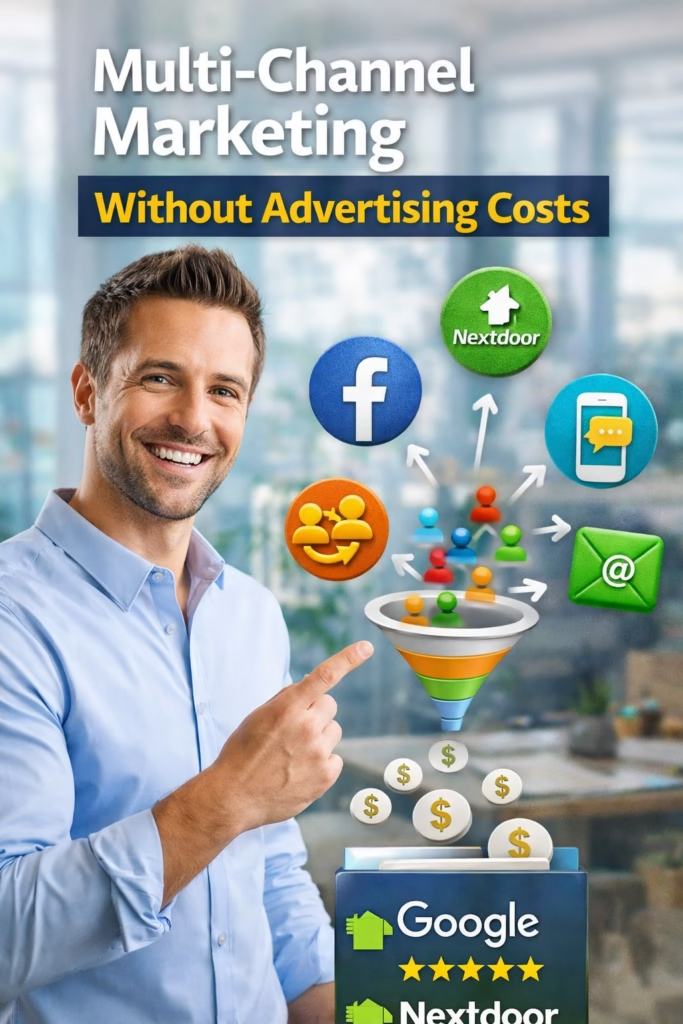
Multi-Channel Marketing Without Advertising Costs explains how businesses grow by combining multiple organic channels like marketplaces, local SEO, referrals, community platforms, email, and content into one coordinated system that creates leads and sales without depending on paid ads.
Note: This is general guidance. Keep all marketing truthful, useful, platform-appropriate, and aligned with applicable privacy, messaging, and platform rules.
Introduction
Multi-Channel Marketing Without Advertising Costs is built on a simple but powerful idea: businesses do not need to rely entirely on paid ads to grow.
You do not need one expensive channel when you can build several organic channels that work together.
Many businesses fall into the same trap. They think customer acquisition begins and ends with ad spend. If paid ads perform, the business grows. If paid ads get expensive, unstable, or inconsistent, the growth slows down. That approach makes the business dependent on one lever it does not fully control. Multi-channel marketing without advertising costs is the alternative.
Instead of relying only on paid visibility, the business builds organic visibility in several places at once. That can include Craigslist, Facebook Marketplace, OfferUp, Nextdoor, Google Business Profile, local SEO content, referrals, reviews, email follow-up, short-form content, direct community presence, and customer reactivation systems. None of those channels has to carry the whole weight alone. The power comes from coordination.
That coordination matters because every organic channel has strengths and weaknesses. Craigslist may create practical local inquiries. Google Business Profile may create local search visibility. Nextdoor may strengthen neighborhood trust. Referrals may create warm leads. Email may help recover old leads and reactivate customers. Organic content may help the business get discovered over time. When those channels support one another, the business becomes far less dependent on any single source of traffic.
This kind of strategy is especially useful for local businesses and practical service categories where trust, visibility, and consistency matter more than flashy branding. It is also useful for businesses that want stronger margins, lower customer acquisition risk, and more durable growth systems. A business that learns to create leads without needing to buy every click becomes harder to disrupt and easier to scale sustainably.
Big idea: Multi-channel marketing without advertising costs works when businesses combine several organic visibility, trust, and follow-up systems into one repeatable customer acquisition engine.
Expanded Table of Contents
- 1) Why multi-channel organic marketing works
- 2) Why growth without ad costs matters
- 3) The core free channels businesses can use
- 4) Marketplace channels and practical lead capture
- 5) Local SEO and Google Business Profile
- 6) Community and neighborhood channels
- 7) Referral and recommendation channels
- 8) Organic content channels and trust-building
- 9) Email, reactivation, and follow-up channels
- 10) Keeping the message consistent across channels
- 11) The operational system behind organic growth
- 12) How to measure multi-channel success
- 13) Common mistakes in no-cost multi-channel marketing
- 14) How businesses scale what works
- 15) 30–60–90 day rollout plan
- 16) 25 Frequently Asked Questions
- 17) 25 Extra Keywords
1) Why multi-channel organic marketing works
Multi-channel organic marketing works because customers do not discover businesses in only one place. Some find a company through search. Others through community platforms. Others through marketplaces. Others through a recommendation. Others through follow-up after an earlier inquiry. When the business is present in several relevant places, discovery becomes more consistent.
This also improves trust. A company that appears in multiple places often feels more established and more credible than one that appears only once. If a customer sees the business on Google, then sees a useful post on a marketplace, then notices a recommendation on Nextdoor, the combined effect can be much stronger than any single exposure alone.
| Why multi-channel helps | What it changes | Business benefit |
|---|---|---|
| More visibility sources | Less dependence on one channel | Lower acquisition risk |
| More trust touchpoints | Stronger perceived credibility | Better conversion potential |
| More discovery paths | More ways to generate leads | Higher opportunity volume |
| More reuse of assets | Better efficiency | Lower marketing cost |
Rule: Multi-channel marketing works because customers discover, compare, and trust businesses through more than one path.
2) Why growth without ad costs matters
Growth without advertising costs matters because paid advertising can become unstable, expensive, and difficult to rely on as the only customer acquisition method. A business that must pay for every lead is often more fragile than one that can generate leads organically.
No-cost marketing does not mean no effort. It means effort is invested into assets and systems that keep working without requiring constant ad spend. Reviews, recommendations, content, organic listings, SEO pages, customer follow-up, and referral systems can all keep producing value long after they are created.
Benefits of low-cost growth systems
- Stronger margins
- Lower dependence on ad platforms
- More stable long-term acquisition
- Greater control over growth assets
Weaknesses of ad-only dependence
- Cost volatility
- Platform dependence
- Lower resilience
- Growth slows when spend stops
Pro move: The goal is not to avoid all spending forever. The goal is to avoid needing paid ads just to stay alive.
3) The core free channels businesses can use
Different businesses will choose different organic channels, but most strong no-cost systems pull from a similar list of options. The key is choosing channels that match where the customer already looks and how trust is built in that category.
Core organic channels often include
- Craigslist
- Facebook Marketplace
- OfferUp
- Nextdoor
- Google Business Profile
- Local SEO content
- Referrals and recommendations
- Email follow-up and reactivation
- Organic short-form social content
- Customer review systems
Rule: The best channel mix is the one that matches customer behavior, not the one that looks trendy.
4) Marketplace channels and practical lead capture
Marketplaces like Craigslist, Facebook Marketplace, and OfferUp can create practical local visibility without paid advertising. These channels often work best for businesses that can communicate clear offers, useful local relevance, and fast next steps.
Marketplace channels are strong because users often arrive with intent. They may be looking for something specific, nearby, and actionable. That makes these channels especially useful for service businesses, local retail, used inventory, and practical local offers.
Why marketplaces matter
- They create practical local exposure
- They can produce direct inquiries fast
- They support multiple listing variations
- They help capture local demand without ad spend
Rule: Marketplaces are powerful in no-cost marketing because they capture practical demand already happening in the local market.
5) Local SEO and Google Business Profile
Google Business Profile and local SEO are among the most valuable no-cost channels because they help the business show up when customers are already searching. This is different from interruption marketing. The demand already exists. The job is to become visible and trustworthy inside that demand.
Why local SEO matters
- Improves discovery in local search
- Creates ongoing traffic without paying per click
- Strengthens trust with reviews and local presence
- Supports long-term visibility
Google Business Profile helps by improving
- Map visibility
- Review credibility
- Local action opportunities
- Call and website visit potential
Pro move: Local SEO is one of the few channels that can keep working while the business is asleep because search demand keeps happening.
6) Community and neighborhood channels
Community channels like Nextdoor help businesses build a different kind of visibility: local familiarity and trust. These channels are especially useful when neighborhood recommendations, nearby comfort level, and word-of-mouth matter heavily.
Why community channels work
- They strengthen trust
- They support recommendations
- They make the business feel local
- They can create warm neighborhood leads
For many service businesses, community channels can be one of the strongest unpaid lead sources because trust and proximity are often the deciding factors.
Rule: Community channels matter because local trust can outperform raw reach in many buying decisions.
7) Referral and recommendation channels
Referrals are one of the most powerful no-cost channels because they often create warmer, faster-moving leads. A referral already carries trust. The business does not have to create credibility from zero.
Strong referral systems often include
- Asking satisfied customers consistently
- Making it easy to recommend the business
- Following up after successful outcomes
- Using reviews and recommendations visibly
Businesses often underuse referrals because they do not systematize them. But referrals become much stronger when the business actively designs for them instead of waiting passively.
Rule: Referrals are stronger when they are treated as a system, not a lucky bonus.
8) Organic content channels and trust-building
Content helps businesses grow organically because it builds trust and visibility over time. That content can take the form of blog posts, local educational content, short-form videos, FAQs, before-and-after examples, or useful platform-native posts.
Why content matters in no-cost marketing
- Builds authority
- Supports discovery
- Creates reusable assets
- Improves trust before contact
Helpful content types
- Local service explanations
- Problem-solution articles
- Short-form video tips
- Customer proof and examples
- Neighborhood-relevant educational posts
Useful content makes the business easier to trust before the customer ever reaches out.
9) Email, reactivation, and follow-up channels
Email is one of the most overlooked no-cost marketing channels. While it may not always create the first touch, it often helps convert leads that did not act immediately and reactivate past customers who are already familiar with the business.
Email and follow-up can support
- Lead nurturing
- Customer reminders
- Seasonal offers
- Past-customer reactivation
- Ongoing visibility without ad spend
Simple follow-up sequence
Day 0: Fast first reply
Day 1: Check if they still need help
Day 3: Offer the best next step
Day 5: Share a useful reminder or offer
Day 7: Close politely while leaving the door open
Rule: Follow-up channels increase the value of every organic lead source because not every lead converts immediately.
10) Keeping the message consistent across channels
One of the keys to multi-channel marketing is message consistency. The business should not sound identical everywhere, but the core offer, core trust signals, and core positioning should feel connected across channels.
What should stay consistent
- Core offer
- Main trust signals
- Business identity
- Main call to action
What should adapt by platform
- Tone
- Length
- Visual style
- Post structure
- Audience framing
Rule: Strong multi-channel marketing feels consistent in value but adapted in delivery.
11) The operational system behind organic growth
No-cost marketing still requires systems. Without an operational backbone, the business spreads too thin, misses leads, replies too slowly, or fails to follow up. The channels only work well when the operations behind them are strong.
What the operational system should include
- Simple posting schedules
- Saved reply templates
- Follow-up workflows
- Content reuse across channels
- Weekly review rhythm
Organic growth fails less from lack of channels and more from lack of follow-through.
12) How to measure multi-channel success
Without ad dashboards, businesses still need measurement. The right KPIs help determine whether the organic channel mix is producing real business value.
| KPI | What it measures | Target direction |
|---|---|---|
| Inquiries by channel | Lead volume source mix | Clearer over time |
| Qualified lead rate | Lead quality | Up |
| Median response time | Speed-to-lead | Down |
| Booked next steps | Pipeline creation | Up |
| Close rate | Revenue conversion | Up |
| Review/referral growth | Trust engine strength | Up |
| Top-performing channels | Channel efficiency | Clearer over time |
Rule: The best multi-channel strategy is the one that turns multiple organic touchpoints into qualified local pipeline.
13) Common mistakes in no-cost multi-channel marketing
The biggest mistake is trying to be everywhere without a system. When the business spreads too thin, quality drops, reply speed slows, and consistency disappears. Another common mistake is copying the same exact content everywhere without adapting it to the platform.
Common mistakes
- Too many channels at once
- No follow-up workflow
- Weak response speed
- No measurement discipline
- Generic content reused without adaptation
Avoid: trying to win every channel at once before building a repeatable operating rhythm.
Rule: Multi-channel works best when a business builds depth before chasing total breadth.
14) How businesses scale what works
Scaling a no-cost strategy is about repeating proven patterns, not adding random activity. That means documenting winning titles, post formats, offers, reply templates, review requests, and reactivation messages.
What scaling usually includes
- Documenting best-performing posts
- Reusing strong offers and CTAs
- Keeping reply templates ready
- Expanding only what already works
- Reviewing performance regularly
Scaling works best when the business expands proven assets instead of adding random marketing activity.
15) 30–60–90 day rollout plan
Days 1–30: Build the foundation
- Choose 3 to 5 core organic channels
- Strengthen profile and listing quality across those channels
- Set up review, referral, and follow-up basics
- Create simple content and posting SOPs
- Track inquiries and booked next steps
Days 31–60: Improve coordination
- Reuse strong content across channels intelligently
- Test offers, titles, and local CTAs
- Improve response speed and follow-up consistency
- Review which channels produce better lead quality
Days 61–90: Scale what works
- Document best-performing channel tactics
- Expand the strongest organic patterns
- Review KPIs weekly
- Double down on trust-building channels producing real customers
Rule: Multi-channel organic growth becomes powerful when small repeatable systems start reinforcing each other.
16) 25 Frequently Asked Questions
1) What is multi-channel marketing without advertising costs?
It is a strategy where businesses use several organic channels together to create leads and sales without paying for ads.
2) Can businesses really grow without paid advertising?
Yes. Many businesses can grow through local SEO, marketplaces, referrals, community platforms, email, and organic content.
3) Why does multi-channel work better than one channel?
Because it creates more ways for customers to find and trust the business.
4) What are the best free channels for local businesses?
Google Business Profile, Craigslist, Facebook Marketplace, OfferUp, Nextdoor, referrals, email, and local SEO are often strong options.
5) What is the biggest benefit of marketing without ad costs?
Stronger long-term acquisition without depending entirely on paid spend.
6) Does local SEO count as no-cost marketing?
Yes. It is one of the most valuable no-cost channels because it builds search visibility over time.
7) Can Craigslist be part of this strategy?
Yes. Craigslist can create practical local inquiries without paid ads.
8) Can Facebook Marketplace work organically?
Yes. Organic Marketplace listings can generate visibility and leads when maintained well.
9) Does Nextdoor help with organic growth?
Yes. It can help create trust, recommendations, and neighborhood leads.
10) Why does follow-up matter so much?
Because many organic leads do not convert on the first contact.
11) What role do referrals play?
They create warm leads without needing new ad spend.
12) Can email still help?
Yes. Email is useful for nurture, reactivation, and reminders.
13) Do businesses need content to grow organically?
Usually yes, because content builds trust, visibility, and discoverability.
14) What kinds of businesses benefit most?
Many local service businesses, retailers, contractors, movers, wellness providers, and practical local companies benefit strongly.
15) Can one person manage a multi-channel strategy?
Yes, with templates, SOPs, content reuse, and disciplined scheduling.
16) Why is consistency important?
Because trust builds faster when the business appears active and reliable across multiple places.
17) Should the business use the exact same message everywhere?
No. The core offer should stay consistent, but delivery should match the platform.
18) What is the biggest mistake in this strategy?
Spreading too thin without a real system for replies, follow-up, and measurement.
19) How should businesses choose channels?
By focusing on where their customers already look and where trust is actually built in that category.
20) Can organic channels create real sales?
Yes. They can create calls, bookings, visits, and closed deals when executed well.
21) How should success be measured?
Track inquiries, qualified leads, response time, booked next steps, close rate, reviews, referrals, and channel performance.
22) Is reputation management part of no-cost marketing?
Yes. Reviews and recommendations are major trust drivers in organic growth.
23) How quickly can this start working?
Often within a few weeks for early traction, with stronger results over 30 to 90 days.
24) Should winning tactics be documented?
Yes. Documentation makes the system easier to repeat and scale.
25) What is the main lesson behind multi-channel marketing without advertising costs?
That businesses can build real growth without paid ads when they combine trust, visibility, consistency, useful content, and strong follow-through.
17) 25 Extra Keywords
- Multi-Channel Marketing Without Advertising Costs
- organic marketing strategy
- free marketing channels
- multi-channel organic marketing
- local business marketing without ads
- no ad spend marketing
- lead generation without paid ads
- free customer acquisition
- organic local SEO strategy
- Google Business Profile marketing
- Craigslist organic leads
- Facebook Marketplace organic marketing
- OfferUp lead generation
- Nextdoor local marketing
- referral marketing system
- email reactivation marketing
- organic content marketing
- local review strategy
- community-based marketing
- organic trust-building marketing
- 2026 organic marketing strategy
- local business growth without ads
- multi-channel lead system
- organic customer pipeline
- marketing without paid advertising