

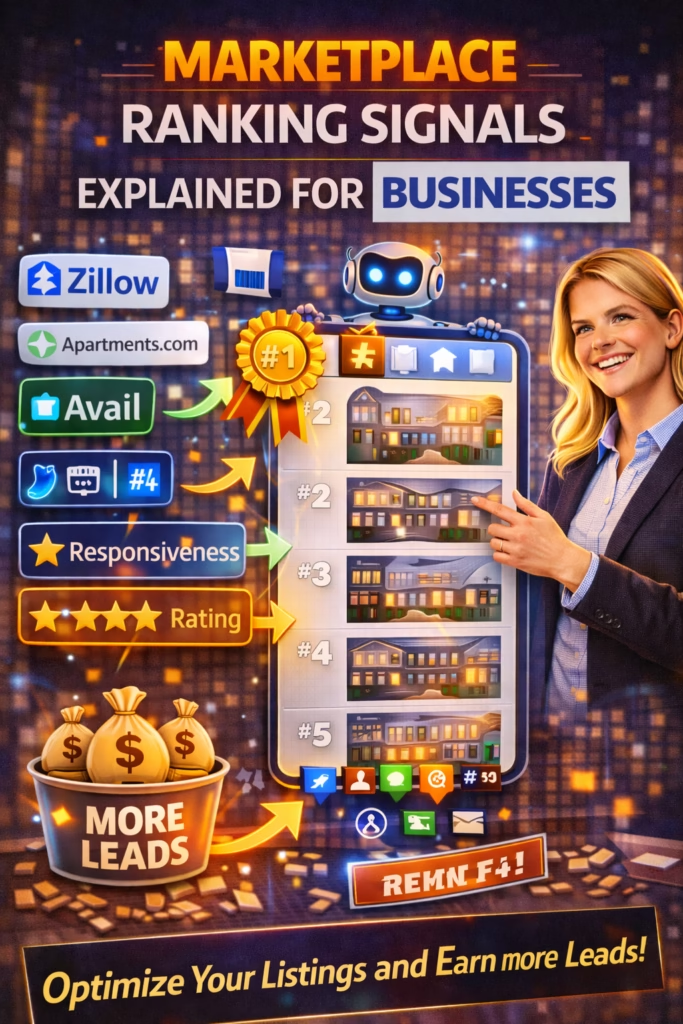
Marketplace Ranking Signals Explained for Businesses
Marketplace Ranking Signals Explained for Businesses is the blueprint for earning consistent visibility—by optimizing freshness, engagement, relevance, seller trust, response speed, listing quality, and compliance.
Note: This is general guidance. Follow platform rules, avoid misleading claims, rotate content responsibly, and do not spam duplicate listings.
Introduction
Marketplace Ranking Signals Explained for Businesses exists for one reason: most businesses think marketplaces are “random.” They’re not.
Marketplaces are ranking systems. They’re designed to show buyers what they’re most likely to click, message, and complete a transaction with—while filtering out spam and low-trust sellers.
So if your listings disappear, it’s rarely because the platform “hates you.” It’s usually because one of the core signals is weak:
- Your listings aren’t fresh enough
- Your content doesn’t earn engagement
- Your seller profile lacks trust signals
- Your response time is slow
- Your listings look duplicative or policy-risky
Big idea: Marketplaces reward what buyers trust and interact with—and suppress what looks repetitive, misleading, or low-performing.
Expanded Table of Contents
- 1) How marketplace ranking generally works
- 2) The ranking signal map (what matters most)
- 3) Freshness signals: posting cadence and recency
- 4) Engagement signals: clicks, saves, shares, messages
- 5) Relevance signals: matching intent and keywords
- 6) Trust signals: seller reputation and account health
- 7) Content quality signals: photos, clarity, and completeness
- 8) Pricing & offer clarity signals
- 9) Location & delivery signals
- 10) Variety vs duplicates: the anti-flag framework
- 11) Response speed signals and conversion behavior
- 12) A/B testing plan: prove what boosts rank
- 13) KPIs to track ranking improvements
- 14) 30–60–90 day rollout plan
- 15) 25 Frequently Asked Questions
- 16) 25 Extra Keywords
1) How marketplace ranking generally works
Marketplaces typically rank listings based on one core objective:
Show buyers the listings most likely to lead to a successful outcome (click → message → transaction) with low risk.
In plain language
- Relevance: does the listing match what the buyer wants?
- Performance: do buyers click/message/save it?
- Trust: does the seller behave like a real business/person?
- Freshness: is it active and recent?
- Safety/compliance: does it look spammy or policy-risky?
Rule: Ranking is a prediction engine. Your job is to create signals that make the platform confident your listing will convert without issues.
2) The ranking signal map (what matters most)
Different marketplaces weigh signals differently, but these buckets are consistently important.
| Signal bucket | What it means | What you can control |
|---|---|---|
| Freshness | Recency + consistent activity | Cadence, refresh, rotation |
| Engagement | Clicks, saves, messages | Photos, titles, hooks |
| Relevance | Match buyer intent | Keywords, categories, details |
| Trust | Seller reliability | Response rate, profile, behavior |
| Conversion behavior | Message → next step | Scripts, speed, follow-up |
| Compliance | Low spam risk | Variety, honesty, policy fit |
Pro move: The fastest path to ranking improvements is usually: freshness + engagement + response speed.
3) Freshness signals: posting cadence and recency
Freshness is one of the strongest marketplace signals because it’s easy for platforms to measure and easy for buyers to feel.
Freshness shows up as
- New listings posted consistently
- Existing listings refreshed (where allowed)
- Updated photos, titles, and details
- Active seller behavior without spam patterns
Cadence framework (safe + scalable)
- Daily: post/refresh a small number of varied listings
- Weekly: update top performers (new first photo + title tweak)
- Monthly: retire stale listings; replace with new angles
Avoid: “Burst posting” 30 near-identical listings then disappearing. That looks like spam behavior and often underperforms.
4) Engagement signals: clicks, saves, shares, messages
Engagement is the platform’s feedback loop. If buyers click and message your listing, the marketplace learns that your listing belongs higher.
Engagement signals you can influence
- Thumbnail click (your first photo wins or loses the scroll)
- Title clarity (buyers understand in 1 second)
- Detail scan (pricing, availability, options)
- Message rate (your hook triggers questions)
High-performing listing structure
✅ Clear title (what it is + key hook)
✅ Clean first photo (bright, centered, real)
✅ Price clarity (truthful, no bait)
✅ Fast options (pickup/delivery/appointment)
✅ One question CTA (city + timeline)
Rule: If you want more rank, earn more messages—but do it with clarity, not tricks.
5) Relevance signals: matching intent and keywords
Relevance is how marketplaces decide if your listing should show for a search or a buyer profile.
Relevance is driven by
- Title keywords (what buyers actually type)
- Category accuracy
- Description detail (features, condition, included items)
- Attributes and tags (size, brand, color, etc.)
Keyword strategy (business-friendly)
| Keyword type | Example | Where to use |
|---|---|---|
| Exact item/service | “sectional sofa” / “interior painting” | Title + first line |
| Buyer intent | “delivery available” / “same-week scheduling” | Title or bullet list |
| Problem/benefit | “back pain relief” / “stain blocking primer” | Description |
| Location | City/area keywords | Where allowed + description |
Pro move: Write listings for humans, then make sure the words humans use are present. Keyword stuffing hurts readability and can look spammy.
6) Trust signals: seller reputation and account health
Marketplaces protect buyers. Sellers who look reliable tend to earn more distribution.
Trust signals typically include
- Consistent response behavior (fast replies, low ghosting)
- Low dispute/negative interaction patterns
- Stable account activity (not “new + spammy”)
- Profile completeness (basic credibility)
- Listing honesty (no misleading claims)
Rule: A marketplace would rather show a slightly worse deal from a trusted seller than a “perfect deal” from a risky-looking seller.
7) Content quality signals: photos, clarity, and completeness
Good content increases engagement and reduces refunds, disputes, and bad experiences—so platforms reward it.
Photo quality checklist
- Bright lighting
- Clean background
- Centered product/service outcome
- Multiple angles
- Close-ups of details/condition
- Context photo (subtle proof it’s real)
Listing clarity checklist
[ ] What it is (simple)
[ ] What’s included
[ ] Condition (truthful)
[ ] Price (clear)
[ ] Options (delivery/pickup/appointment)
[ ] Next step (one question CTA)
Pro move: Add one line that signals legitimacy: “Happy to answer questions—tell me your city and timeline.”
8) Pricing & offer clarity signals
Buyers hate bait. Platforms hate bait more—because bait creates negative outcomes.
What pricing clarity looks like
- One real price or an honest range
- No hidden “must qualify” hooks in the first line
- Terms explained simply (if financing is offered, be clear)
Offer block (copy/paste)
✅ Price: $____ (or $____–$____ depending on options)
✅ Availability: (today/this week)
✅ Next step: Reply with your city + timeline
Avoid: $1 placeholder pricing unless the platform/vertical expects it and you explain it clearly. It often attracts low-quality clicks and can reduce trust.
9) Location & delivery signals
Marketplaces are proximity-driven. Location relevance matters because it predicts purchase likelihood.
Location optimization (safe + effective)
- Use accurate location settings
- Be consistent with service areas
- Offer delivery where possible (and state it clearly)
- Include “near” landmarks only if truthful and allowed
Rule: The platform wants to show nearby listings that convert quickly. Help it by making location and options obvious.
10) Variety vs duplicates: the anti-flag framework
Most visibility issues come from “duplicate patterns.” Marketplaces attempt to suppress repetitive, near-identical content—even if your intent is legitimate.
What “variety” actually means
- Different titles (different intent angle)
- Different first photos (different thumbnail)
- Different opening paragraph (different hook)
- Different feature emphasis (different buyer objection)
- Different posting times (avoid burst patterns)
Safe rotation example (same product/service, different angle)
| Angle | Title example | First line example |
|---|---|---|
| Value | “Best Value ___ (Delivery Available)” | “Solid option if you want quality without overspending.” |
| Speed | “Available Today — ___ Ready” | “Fast pickup/delivery options—reply with your city.” |
| Premium | “Premium ___ (Upgraded)” | “For buyers who want comfort/quality first.” |
| Trust | “Real Photos — ___ (Clean Condition)” | “Transparent details + quick answers.” |
Important: Do not spam duplicates. Rotate responsibly, keep details accurate, and follow platform rules.
11) Response speed signals and conversion behavior
Speed-to-lead is a hidden ranking accelerator. If your listings generate messages that get fast replies, marketplaces often see better outcomes and may reward distribution.
Instant reply script (universal)
Yes — it’s available ✅
Are you looking to do this today or this week?

What city/zip are you in? I’ll confirm the fastest options.
Why this works
- Confirms availability (reduces uncertainty)
- Asks one question (keeps replies high)
- Captures location + timeline (qualifies)
- Moves toward a next step (conversion)
Rule: Ranking improves when the platform sees “click → message → helpful reply → action.”
12) A/B testing plan: prove what boosts rank
You don’t need complex analytics to test marketplace ranking improvements. You need controlled experiments.
What to test first
- First photo (thumbnail)
- Title hook (value vs speed vs premium)
- Price presentation (single vs range)
- CTA line (city/timeline question)
Simple test rules
- Change one variable at a time
- Run for 3–7 days (or a consistent view window)
- Track messages per view (or messages per day if views are hidden)
- Keep the winner, then test the next variable
Pro move: Most gains come from first photo + title clarity, not rewriting the entire description.
13) KPIs to track ranking improvements
| KPI | What it indicates | Target direction |
|---|---|---|
| Active listings/assets | Surface area | Up |
| Messages per day/week | Visibility + engagement | Up |
| Message-to-next-step rate | Conversion | Up |
| Median response time | Speed-to-lead | Down |
| Listing removals/flags | Compliance risk | Down |
Rule: If messages rise while flags stay low and response time improves, you’re building positive ranking momentum.
14) 30–60–90 day rollout plan
Days 1–30 (Fix the fundamentals)
- Standardize photo order and listing clarity
- Deploy instant replies + one-question CTA
- Start a consistent cadence (small daily activity)
- Rotate 3–5 angles per offer/product category
- Track messages/day and response time
Days 31–60 (Increase surface area safely)
- Scale listings with variety (titles/photos/hooks)
- Refresh top performers weekly
- Retire weak performers and replace with new angles
- Run simple A/B tests on thumbnails and titles
Days 61–90 (Compound with systems)
- Formalize SOPs (posting, messaging, follow-up, QA)
- Increase speed-to-lead with automation where appropriate
- Double down on best categories/angles
- Track booked next steps and closes (not just messages)
Pro move: Don’t chase “viral.” Chase consistency + compliance + conversion.
15) 25 Frequently Asked Questions
1) What are marketplace ranking signals?
Signals are measurable factors that influence how your listings appear in search and feeds—freshness, engagement, relevance, trust, and compliance.
2) Do marketplaces use algorithms like search engines?
Yes. They rank listings based on predicted outcomes and risk reduction.
3) What’s the fastest way to improve visibility?
Improve freshness with consistent cadence, increase engagement with better photos/titles, and reduce lead leakage with faster replies.
4) Does posting more always help?
Not if it creates duplicates. More variety helps; more duplication hurts.
5) What is freshness?
Recency and consistent seller activity, including posting and safe refreshing.
6) What engagement matters most?
Clicks and messages are usually the strongest indicators of buyer interest.
7) How do I improve engagement?
Use a clean first photo, clear title, truthful pricing, and a simple next step.
8) What is relevance in a marketplace?
How well your title, category, and details match buyer intent and searches.
9) Should I stuff keywords?
No—write for humans and include natural keywords buyers use.
10) What trust signals matter?
Response behavior, account stability, accurate listings, and low disputes.
11) Does response time affect rank?
It can—faster responses often improve outcomes and reduce lead leakage.
12) What response time should I target?
Under 5 minutes is strong; under 1 minute is best.
13) What’s the best first message script?
Confirm availability, ask timeline, ask city/zip, offer options.
14) Why do listings get suppressed?
Often due to duplication patterns, low engagement, or compliance risk signals.
15) What’s the biggest duplication mistake?
Posting near-identical titles, photos, and descriptions repeatedly in short windows.
16) How do I rotate content safely?
Change angle, title, first photo, hook line, and feature emphasis while keeping details truthful.
17) Does price affect ranking?
Pricing clarity affects trust and engagement, which can affect distribution indirectly.
18) Should I use $1 placeholder pricing?
Usually avoid it unless it’s normal for your category and you explain it clearly.
19) Does location matter?
Yes—marketplaces are proximity-driven. Accurate locations often perform better.
20) What should I test first?
First photo and title hook. Those drive the most engagement impact.
21) How long do tests take?
Usually 3–7 days per variable, depending on inquiry volume.
22) What KPIs should I track?
Active listings, messages, response time, next-step rate, and flags/removals.
23) What KPI predicts revenue best?
Booked next steps (appointments/pickups/deliveries), not just messages.
24) Can businesses rank without paid ads?
Yes—organic visibility is driven by performance and trust signals.
25) What’s the biggest long-term advantage?
A consistent, compliant posting + messaging system that compounds visibility and conversions.
16) 25 Extra Keywords
- Marketplace Ranking Signals Explained for Businesses
- marketplace ranking signals
- Facebook Marketplace ranking
- marketplace SEO
- listing ranking factors
- marketplace algorithm explained
- optimize marketplace listings
- increase marketplace visibility
- marketplace freshness signals
- marketplace engagement signals
- seller trust signals marketplace
- response time marketplace ranking
- anti-flag duplicate listing strategy
- marketplace posting cadence
- marketplace listing photo strategy
- best marketplace titles
- marketplace keyword strategy
- marketplace listing relevance
- marketplace offer positioning
- location relevance marketplace
- marketplace A/B testing plan
- messages per listing KPI
- marketplace conversion optimization
- marketplace compliance best practices
- 2026 marketplace marketing strategy













