
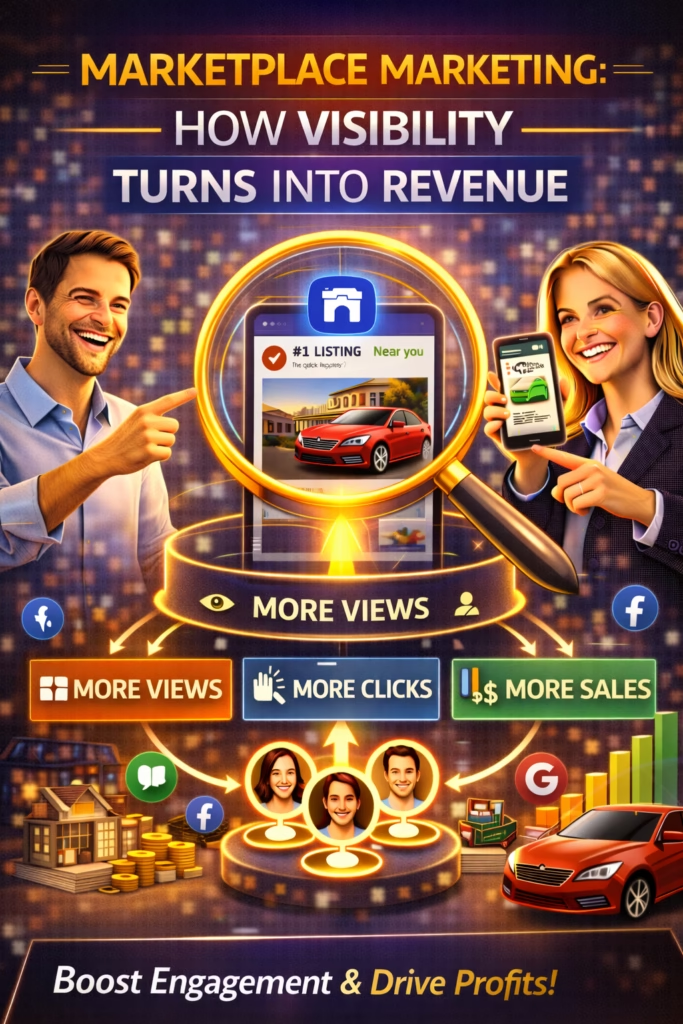
Marketing: How Visibility Turns Into Revenue
Marketing: How Visibility Turns Into Revenue is the blueprint for understanding how attention becomes action, how action becomes pipeline, and how pipeline becomes real business growth.
Note: This is general guidance. Revenue outcomes depend on offer quality, market demand, execution, and compliance with platform, privacy, and advertising rules.
Introduction
Marketing: How Visibility Turns Into Revenue starts with a mistake many businesses make: they confuse attention with success.
Visibility is not revenue. Visibility is the first step that makes revenue possible.
A business can get traffic, reach, views, impressions, clicks, and even messages—and still struggle to grow. Why? Because visibility only becomes valuable when it enters a system that converts interest into action.
That system usually includes:
- A clear offer
- A compelling first impression
- Trust that lowers buyer hesitation
- Fast response speed
- Follow-up that keeps momentum alive
- A measurable next step such as a call, appointment, quote, visit, or purchase
Big idea: Great marketing is not just about getting seen. It is about building the bridge from visibility to revenue.
Expanded Table of Contents
- 1) What “visibility turns into revenue” really means
- 2) The attention economy: why visibility matters first
- 3) Why visibility often fails to create revenue
- 4) The revenue bridge: the stages between attention and money
- 5) Offer clarity: why buyers must understand the value fast
- 6) Trust signals: why credibility changes conversion
- 7) Clicks and conversations: the first measurable sign of monetizable visibility
- 8) Speed-to-lead: how response time changes revenue outcomes
- 9) Qualification: how better filtering increases revenue quality
- 10) Follow-up: the hidden multiplier of marketing ROI
- 11) Why local visibility often converts faster than broad visibility
- 12) Systems and SOPs: how revenue becomes repeatable
- 13) KPI dashboard: how to measure visibility-to-revenue performance
- 14) 30–60–90 day rollout plan
- 15) 25 Frequently Asked Questions
- 16) 25 Extra Keywords
1) What “visibility turns into revenue” really means
Visibility turns into revenue when attention moves through a conversion system instead of disappearing at the top of the funnel.
That usually means this sequence
- Buyer sees the offer
- Buyer clicks or messages
- Buyer feels enough trust to continue
- Business replies quickly
- Buyer reaches a qualified next step
- Next step becomes a sale, appointment, or purchase
Visibility creates opportunity. Systems create revenue.
2) The attention economy: why visibility matters first
Before a buyer can trust you, compare you, or buy from you, they need to notice you. That is why visibility matters in every business model.
| If there is no visibility... | What happens | Business result |
|---|---|---|
| No impressions | No clicks or inquiries | No pipeline |
| No attention | No brand recall | Low demand |
| No discovery | Only existing referrals find you | Growth stalls |
Rule: Revenue starts with visibility because buyers cannot purchase what they never see.
3) Why visibility often fails to create revenue
Many businesses do get attention. They simply fail to convert it.
Common reasons visibility fails
- The offer is unclear
- The first impression is weak
- The listing, ad, or page feels untrustworthy
- Response time is too slow
- No follow-up system exists
- Leads are not qualified or routed well
Visibility without a conversion structure is expensive noise.
4) The revenue bridge: the stages between attention and money
Revenue is rarely created in one jump. It is created by moving a buyer across a bridge of micro-decisions.
Stage 1: Attention
The buyer notices your offer.
Stage 2: Interest
The buyer clicks, opens, or messages.
Stage 3: Trust
The buyer feels you are real and relevant.
Stage 4: Action
The buyer books, buys, calls, or visits.
Rule: Better marketing reduces the friction between each stage.
5) Offer clarity: why buyers must understand the value fast
A business loses revenue when visibility reaches the wrong people—or when the right people cannot quickly understand the offer.
Clear offers answer these fast
- What is this?
- Who is it for?
- Why should I care?
- What makes it better or easier?
- What should I do next?
Pro move: The shorter the buyer attention span, the more valuable clarity becomes.
6) Trust signals: why credibility changes conversion
Trust is one of the strongest filters between visibility and revenue. Buyers do not act only because they noticed you. They act because they believe moving forward feels safe and worthwhile.
Trust signals include
- Real visuals and proof
- Consistent messaging
- Clear details and expectations
- Believable pricing or positioning
- Fast and professional responses
Rule: Trust shortens the time between visibility and action.
7) Clicks and conversations: the first measurable sign of monetizable visibility
One of the earliest signs that visibility is becoming useful is when it creates measurable action: clicks, saves, messages, calls, or site visits.
| Top-of-funnel metric | What it means | Revenue relevance |
|---|---|---|
| Impressions | People saw it | Low by itself |
| Clicks | Interest started | Moderate |
| Messages / calls | Intent is forming | High |
| Booked next steps | Pipeline exists | Very high |
Clicks matter because they are proof that visibility is not just passive. It is interactive.
8) Speed-to-lead: how response time changes revenue outcomes
Speed-to-lead is one of the most underappreciated revenue drivers in marketing. A buyer who is interested now may not be interested an hour from now.
Why speed matters
- It captures warm intent
- It reduces lead leakage
- It improves conversion from inquiry to appointment
- It can raise revenue without increasing visibility at all
| Reply speed | Buyer impression | Likely revenue effect |
|---|---|---|
| Under 1 minute | Professional, available | Strong conversion odds |
| Under 5 minutes | Still competitive | Good conversion odds |
| 30+ minutes | Momentum drops | Revenue loss increases |
Rule: Faster response often increases revenue more cheaply than increasing traffic.
9) Qualification: how better filtering increases revenue quality
Not every lead deserves the same amount of attention. Qualification helps businesses spend their time on the highest-probability opportunities.
Simple qualification questions
- What city/zip are you in?
- Are you looking for today, this week, or later?
- What specifically are you looking for help with?
- Do you want the fastest option or the best-fit option?
Qualification improves revenue by protecting time, increasing close rates, and making follow-up smarter.
10) Follow-up: the hidden multiplier of marketing ROI
Follow-up is one of the clearest examples of how visibility turns into revenue. Many buyers do not say no. They pause.
Why follow-up multiplies ROI
- It recovers warm leads already paid for or already earned
- It reduces waste from slow decision-makers
- It keeps pipeline value from disappearing
Simple follow-up cadence
- +2–4 hours: quick check-in
- Next day: offer a simple next step
- Day 3–5: final helpful nudge
Rule: Follow-up increases revenue from the same visibility you already earned.
11) Why local visibility often converts faster than broad visibility
Local visibility often turns into revenue faster because the buyer’s path is shorter. The buyer is nearby, the offer feels relevant, and the next step can happen quickly.
Why local visibility converts well
- Lower trust barrier
- Faster logistics
- Stronger urgency
- More natural next steps like visits, calls, estimates, or pickups
Local marketing often wins because the distance between visibility and action is smaller.
12) Systems and SOPs: how revenue becomes repeatable
Revenue becomes reliable when the business no longer depends on memory, mood, or improvisation.
Core systems that make revenue repeatable
- Visibility system (posting, ads, search, discovery)
- Conversion system (landing pages, listings, message flows)
- Response system (speed-to-lead)
- Follow-up system (timed check-ins)
- Reporting system (KPIs and weekly reviews)
Pro move: Revenue scales faster when the path from visibility to booked next step is documented and trainable.
13) KPI dashboard: how to measure visibility-to-revenue performance
| KPI | What it measures | Target direction |
|---|---|---|
| Impressions / reach | Visibility volume | Up |
| Click-through rate | Attention quality | Up |
| Messages / inquiries | Intent formation | Up |
| Median first reply time | Lead capture speed | Down |
| Qualified lead rate | Revenue quality | Up |
| Booked next steps | Pipeline creation | Up |
| Close rate | Revenue conversion quality | Up |
| Revenue per lead | Efficiency of visibility | Up |
Rule: The clearest proof that visibility is becoming revenue is a rise in booked next steps, close rate, and revenue per lead—not just impressions.
14) 30–60–90 day rollout plan
Days 1–30 (Clarify the bridge)
- Clarify the offer and next-step CTA
- Improve the first impression across channels
- Deploy faster response handling
- Track visibility, clicks, and inquiries
- Standardize trust-first messaging
Days 31–60 (Reduce leakage)
- Launch follow-up sequences
- Improve qualification questions
- Track booked next steps weekly
- Identify where visibility is being wasted
- Replace weak conversion steps
Days 61–90 (Scale what converts)
- Document SOPs for visibility, response, and follow-up
- Scale channels or listings with strongest revenue efficiency
- Track revenue per lead and close rate
- Review KPI dashboard weekly and optimize
Rule: Marketing matures when visibility is managed like pipeline, not vanity.
15) 25 Frequently Asked Questions
1) What does it mean for visibility to turn into revenue?
It means attention moves into clicks, conversations, trust, booked next steps, and purchases.
2) Why do some businesses get lots of visibility but little revenue?
Because they lack a conversion system, strong offer clarity, trust, speed, or follow-up.
3) What is the fastest way to improve revenue from visibility?
Improve the first conversion step: better first impression, faster replies, and clearer CTA.
4) Is visibility still important if my conversion rate is weak?
Yes, but weak conversion means you are wasting part of that visibility.
5) What is the most important bridge between visibility and revenue?
The first conversion action, such as a click, message, call, or inquiry.
6) Why does offer clarity matter so much?
Because confused buyers rarely convert, even if they notice you.
7) What are trust signals in marketing?
Proof elements like real visuals, consistent messaging, believable positioning, and fast responses.
8) Do clicks always mean revenue is improving?
No, but they are a useful sign that attention is becoming active interest.
9) Why does response speed affect revenue?
Because warm buyers often lose momentum quickly if the business responds too slowly.
10) How fast should I reply to leads?
Under 5 minutes is strong; under 1 minute is ideal.
11) What is a qualified lead?
A lead that matches the right location, timing, need, or budget to realistically become revenue.
12) Why does qualification matter?
It protects time and improves close rate by focusing on the best opportunities.
13) How does follow-up improve marketing ROI?
It recovers leads that were already earned but would otherwise go cold.
14) How many follow-ups should I send?
Usually 2–3 respectful follow-ups over a few days.
15) What is a booked next step?
An appointment, estimate, call, visit, test drive, or any scheduled move toward revenue.
16) Which KPI matters most?
Booked next steps and revenue per lead are two of the most useful.
17) What is revenue per lead?
The average value produced by each lead source or conversion path.
18) Why does local visibility often convert better?
Because the buyer can act faster and trust the offer more easily when it feels nearby and relevant.
19) Can I increase revenue without increasing visibility?
Yes. Better conversion and follow-up can create more revenue from the same visibility.
20) What is the biggest visibility mistake businesses make?
Treating impressions like success instead of tracking what happens after the impression.
21) What systems should every business document?
Visibility, conversion, response, follow-up, and reporting systems.
22) How long until visibility improvements show up in revenue?
It varies, but often the fastest gains come from speed-to-lead and follow-up changes.
23) What should I improve first?
The first impression and the first response step.
24) Does branding matter in this process?
Yes. Strong branding can improve trust and make visibility more valuable over time.
25) What is the ultimate goal of marketing visibility?
To reliably create qualified demand that becomes measurable revenue.
16) 25 Extra Keywords
- Marketing: How Visibility Turns Into Revenue
- visibility turns into revenue
- marketing visibility strategy
- visibility to revenue funnel
- lead generation visibility
- revenue from visibility
- attention to action marketing
- trust signals marketing
- speed to lead revenue
- qualified lead conversion
- follow up marketing ROI
- booked next steps KPI
- revenue per lead KPI
- marketing conversion system
- visibility to pipeline
- local visibility conversion
- first impression marketing strategy
- marketing attention economy
- revenue efficiency marketing
- lead capture system
- conversion bridge strategy
- 2026 marketing revenue strategy
- better marketing ROI system
- turn traffic into revenue
- repeatable revenue marketing