

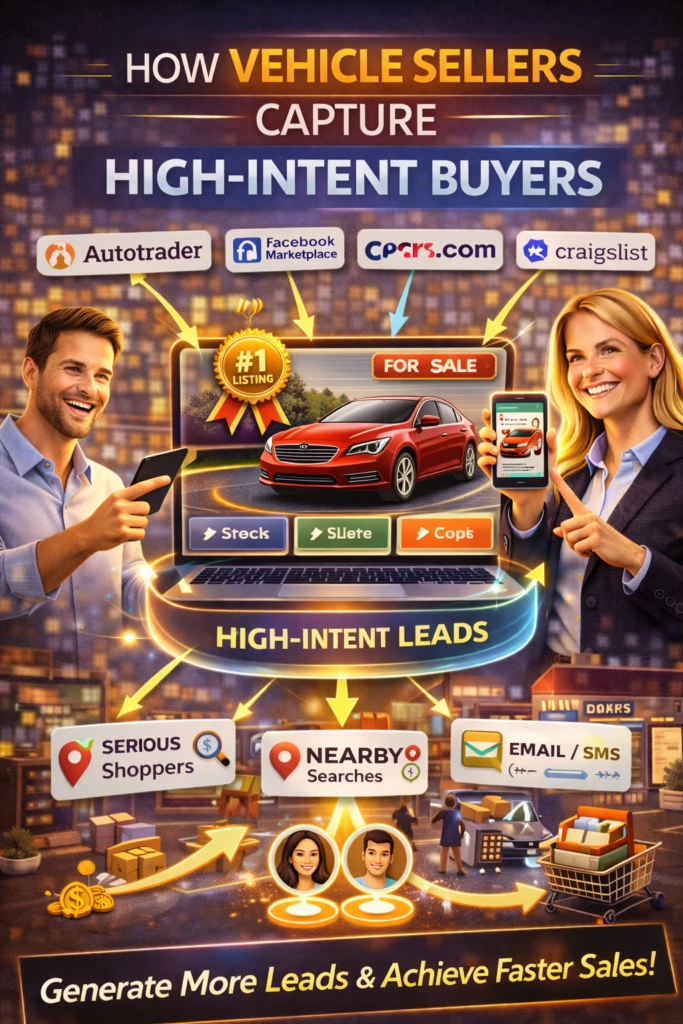
How Vehicle Sellers Capture High-Intent Buyers
How Vehicle Sellers Capture High-Intent Buyers is the blueprint for turning marketplace views into serious inquiries—by using proof-first listings, built-in screening, and fast appointment-setting responses.
Note: This is general guidance. Keep details truthful, follow platform rules, and avoid spam/duplicate patterns.
Introduction
How Vehicle Sellers Capture High-Intent Buyers comes down to one simple truth:
High-intent buyers are not “found.” They are created—by the signals your listing sends.
Most vehicle sellers focus on “getting more messages.” But that’s the wrong goal. You want more serious messages.
High-intent buyers behave differently than tire-kickers:
- They ask fewer questions, but their questions are specific.
- They want confirmation, not persuasion.
- They move quickly if trust is high and next steps are clear.
Big idea: Your listing should do pre-qualification for you—before the first message arrives.
Expanded Table of Contents
- 1) What “high-intent” means in vehicle sales
- 2) Why most vehicle inquiries are low-intent
- 3) The modern vehicle buyer journey (2025–2026)
- 4) The proof stack that filters tire-kickers
- 5) Photo system: the 20-shot set that converts
- 6) Title framework that attracts serious buyers
- 7) Pricing strategy to increase serious messages
- 8) Description structure that screens buyers
- 9) The screening CTA that upgrades lead quality
- 10) Response scripts that book appointments
- 11) Follow-up SOP for non-responders
- 12) Variety vs duplicates: anti-flag posting system
- 13) KPIs for high-intent lead flow
- 14) 30–60–90 day rollout plan
- 15) 25 Frequently Asked Questions
- 16) 25 Extra Keywords
1) What “high-intent” means in vehicle sales
A high-intent vehicle buyer is actively moving toward purchase and is messaging to confirm:
- Availability
- Condition details that affect trust
- Price expectations
- Timing for viewing/test drive
- Financing/trade options (if applicable)
High-intent is “ready to act,” not “curious to browse.”
| Message type | Intent level | How you handle it |
|---|---|---|
| “Is this available?” | Medium | Confirm + ask time/location |
| “Can I see it today after 5?” | High | Offer 2 time slots |
| “What’s your lowest?” | Low–Medium | Re-anchor value + ask timeline |
| “Any issues? Clean title? Miles?” | High | Answer directly + book viewing |
Rule: High-intent buyers want certainty, not a long conversation.
2) Why most vehicle inquiries are low-intent
Vehicle marketplaces produce a lot of messages because the barrier to ask is low. Low-intent messages happen when:
- Listings are vague, creating “information fishing”
- Photos don’t build trust, causing more probing questions
- Price feels unrealistic, attracting bargain hunters only
- Next steps aren’t clear, so buyers poke instead of book
Pro move: You reduce low-intent messages by adding clarity and proof—so only serious buyers bother to message.
3) The modern vehicle buyer journey (2025–2026)
Buyers don’t “start at dealerships” anymore. They start in feeds and local search.
What buyers do in order
- Scan thumbnails (fast elimination)
- Open listings (trust check)
- Compare 3–10 options (price/condition)
- Message top 2–3 (availability + next step)
- Choose the fastest path to certainty (appointment/test drive)
Rule: Your listing is competing with a grid of alternatives. Win the trust check quickly.
4) The proof stack that filters tire-kickers
Proof stack = the bundle of trust signals that makes serious buyers comfortable and discourages low-intent poking.
Proof stack checklist (use what applies)
- Clear, consistent photos of key areas (interior/exterior)
- Odometer photo (if appropriate)
- VIN visible (or “VIN available on request”)
- Clean title status / lien status (truthful)
- Known issues disclosed (short and direct)
- Maintenance highlights (if true)
- Availability statement (“Available now / appointment required”)
Important: Do not claim inspections, warranties, “certified,” or mechanical guarantees unless you truly provide them.
Pro move: The best proof stack doesn’t “sell.” It reduces uncertainty.
5) Photo system: the 20-shot set that converts
High-intent leads start with trust. Trust starts with photos.
The 20-shot set (simple, repeatable)
- Front 3/4 exterior
- Rear 3/4 exterior
- Driver side
- Passenger side
- Front close-up (grille/headlights)
- Rear close-up (taillights)
- Wheels/tires
- Windshield + hood
- Driver seat + dash
- Passenger seat
- Rear seats
- Steering wheel close-up
- Center console / infotainment
- Instrument cluster / odometer
- Trunk/cargo area
- Engine bay
- VIN plate (or keep ready to send)
- Any notable feature (sunroof, 3rd row, etc.)
- Any honest flaw (if present)
- Bonus “context” photo (parking lot, lot sign, or neutral background)
Rule: Show enough that serious buyers don’t need to “investigate” in DMs.
6) Title framework that attracts serious buyers
Your title should answer: “What is it, why should I click, and what makes it a fit?”
High-intent title formula
[Year] [Make] [Model] — [Trim/Key Feature] | [Miles] mi | [Clean Title / Title Status if true]Examples (generic)
- 2016 Toyota Camry — Reliable Daily Driver | 92k mi | Ready Now
- 2018 Ford F-150 — 4x4 Crew Cab | 110k mi | Strong Runner
- 2020 Honda CR-V — Great on Gas | 58k mi | Available Today
Pro move: Use buyer language: “reliable,” “ready now,” “great on gas,” “family space,” “4x4,” “tow.”
7) Pricing strategy to increase serious messages
Price affects lead quality as much as volume.
Three pricing positions (choose intentionally)
| Position | What it attracts | Best for |
|---|---|---|
| Below market | High volume, mixed quality | Fast move / urgent sale |
| At market | Balanced, more serious | Healthy daily lead flow |
| Above market | Lower volume, more “proof required” | Exceptional condition / upgrades |
How to reduce “lowest price?” messages
- Anchor value with proof and clarity
- State “priced fairly for condition” (if true)
- Offer next step instead of arguing price
Rule: Clarity reduces negotiation spam.
8) Description structure that screens buyers
Your description should do three jobs: build trust, answer objections, and move to the next step.
High-intent description template
Real photos + clear details ✅

Basics:
• Year/Make/Model:
• Miles:
• Title status:
• Location:

Highlights:
• [2–5 true highlights]
• [1–2 comfort/utility highlights]

Condition (truthful):
• Runs/drives:
• Known issues (if any):
• Maintenance notes (if known):

Next step:
Message your city/zip + the best time today/this week to see it.
Pro move: Put “known issues” in plain language. Serious buyers respect honesty.
9) The screening CTA that upgrades lead quality
A screening CTA filters low intent and pulls high intent forward.
Best screening CTA (simple)
What city/zip are you in, and are you looking to see it today or this week?Optional add-ons (use if relevant)
- “Do you prefer morning or evening?”
- “Are you paying cash or exploring financing?”
- “Do you have a trade-in?”
Rule: High-intent buyers answer questions. Low-intent buyers disappear.
10) Response scripts that book appointments
Response speed is critical, but structure matters too. Your goal is booking.
Instant reply (universal)
Yes — it’s available ✅
What city/zip are you in, and are you looking to see it today or this week?
Appointment-setting reply
Perfect ✅
I can do [Time Option A] or [Time Option B]. Which works better?
(If you share your zip, I’ll confirm the best meeting spot.)
“Lowest price?” reply (quality-preserving)
I priced it fairly for the condition and what’s included ✅
If you’re serious, when could you come see it—today or this week?
Avoid: Long back-and-forth debates. Offer two time slots and move forward.
11) Follow-up SOP for non-responders
Most serious buyers message multiple sellers. Follow-up brings them back—without being pushy.
Follow-up cadence
- +15–60 minutes: short nudge
- Next day: availability + time windows
- 48–72 hours: final check-in
Follow-up templates
Quick check — still interested? I can do a quick viewing today or tomorrow.Still available ✅ If you share your zip, I’ll confirm the easiest time window.Rule: Follow-up should reduce friction, not increase pressure.
12) Variety vs duplicates: anti-flag posting system
If you’re posting regularly, variety keeps your activity compliant and your reach stable.
Variety checklist
- Rotate first photo (thumbnail test)
- Change title angle (reliability vs utility vs economy)
- Change first 2 lines (trust hook vs availability hook)
- Change feature emphasis (safety vs space vs mpg)
- Change posting windows (morning vs evening)
Important: Avoid posting identical duplicates. Keep everything truthful and consistent with the actual vehicle.
13) KPIs for high-intent lead flow
| KPI | What it measures | Target direction |
|---|---|---|
| Messages/day | Demand | Up |
| High-intent ratio | % of messages that answer your CTA | Up |
| Median response time | Lead leakage | Down |
| Appointments booked | Conversion momentum | Up |
| Show rate | Appointment quality | Up |
| Flags/removals | Compliance risk | Down |
Pro move: Track “high-intent ratio” by counting how many leads answer time + zip.
14) 30–60–90 day rollout plan
Days 1–30 (Build proof + stability)
- Adopt the 20-shot photo system
- Standardize title + description template
- Deploy screening CTA in every listing
- Use instant reply scripts
- Track response time + appointments booked
Days 31–60 (Improve lead quality)
- Test 3 thumbnail options
- Test 3 title angles (economy, reliability, utility)
- Refine pricing position (below/at/above market)
- Build follow-up cadence for no-replies
Days 61–90 (Systemize and scale)
- Document SOPs for listing creation + messaging
- Build a dashboard for high-intent ratio
- Double down on the best photo + title winners
- Reduce low-quality messages by improving proof stack
Rule: High-intent buyers show up when your listing reduces uncertainty and makes next steps effortless.
15) 25 Frequently Asked Questions
1) What is a high-intent vehicle buyer?
Someone ready to purchase soon who messages to confirm key details and schedule next steps.
2) How do I attract serious buyers on marketplaces?
Use proof-first listings, clear titles/prices, screening CTA questions, and fast appointment-setting replies.
3) Do better photos increase high-intent messages?
Yes—photos raise trust and reduce low-quality “fishing” questions.
4) What photo matters most?
The first photo (thumbnail) because it drives clicks.
5) How many photos should I include?
Enough to remove doubt—typically 15–25 quality images.
6) Should I show flaws?
Yes, if present—honest disclosure builds trust with serious buyers.
7) What title structure works best?
Year + make/model + key benefit + miles + availability/fit.
8) How do I reduce “What’s your lowest?” messages?
Add proof and clarity, then pivot to a viewing time question.
9) What’s the best CTA question?
“What city/zip are you in, and are you looking to see it today or this week?”
10) Why does location/zip matter?
It signals seriousness and helps you coordinate a real appointment.
11) How fast should I reply?
Under 5 minutes is strong; under 1 minute is ideal.
12) What should I say first?
Confirm availability, then ask the CTA question.
13) How do I book more appointments?
Offer two time windows and ask which works.
14) Do I need financing language?
Only if relevant—keep it truthful and simple.
15) Should I mention trade-ins?
If you accept trades, yes—this can increase serious inquiries.
16) How do I handle no-shows?
Confirm the day-of and offer a specific meetup plan.
17) How many follow-ups should I send?
Usually 2–3 polite follow-ups over 72 hours.
18) What if a buyer asks for a report or inspection?
Only provide what you can verify and offer a viewing next.
19) How do I avoid duplicate listing issues?
Rotate photos, angles, hooks, and posting windows while staying truthful.
20) Does posting more always help?
No—quality and variety matter more than volume.
21) What KPI matters most?
Appointments booked and show rate, not just messages.
22) What is “high-intent ratio”?
The percentage of leads who answer your screening CTA (zip + timeline).
23) How long until results improve?
Often within 1–2 weeks, with compounding gains over 30–90 days.
24) Can I do this without paid ads?
Yes—organic performance improves with proof, clarity, and fast replies.
25) What’s the biggest mistake sellers make?
Vague listings and slow response times.
16) 25 Extra Keywords
- How Vehicle Sellers Capture High-Intent Buyers
- vehicle sellers high intent buyers
- high intent car leads
- Facebook Marketplace vehicle leads
- used car buyer messages
- car listing optimization
- best photos for selling a car
- vehicle listing proof stack
- screening CTA for car buyers
- how to get serious buyers
- reduce tire kicker messages
- appointment setting for car sales
- speed to lead vehicle sales
- vehicle marketplace response scripts
- pricing strategy for car listings
- best title for selling a car
- vehicle description template
- increase vehicle inquiries
- high quality car buyer leads
- avoid duplicate listing flags
- marketplace posting variety system
- vehicle sales follow up SOP
- organic car lead generation
- 2026 vehicle marketplace strategy
- turn messages into test drives













