
How Technology Removes Growth Bottlenecks
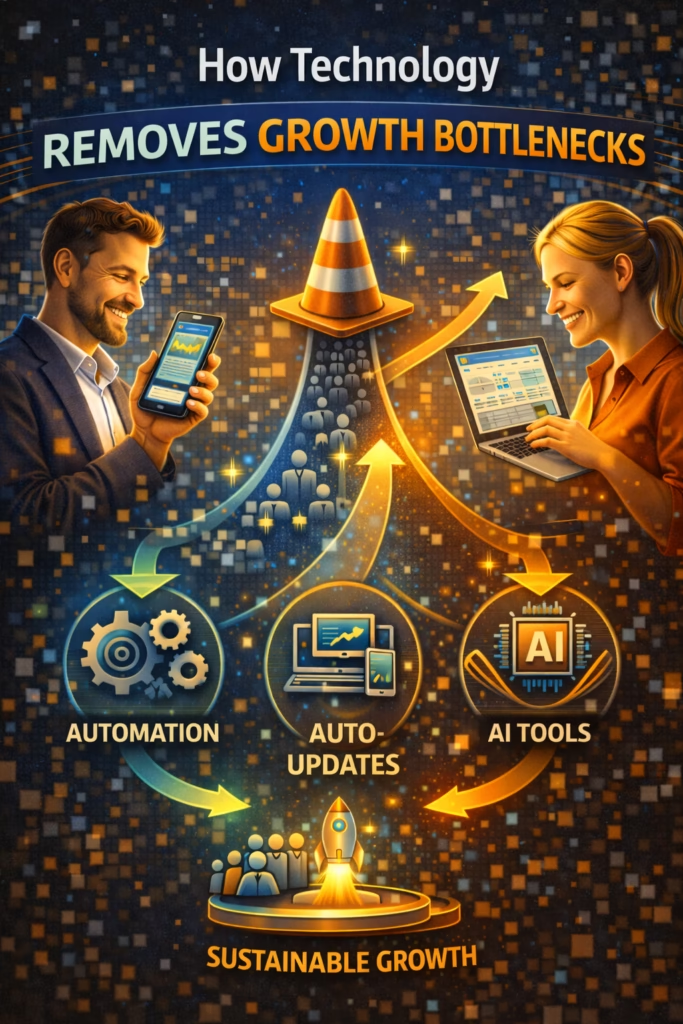
How Technology Removes Growth Bottlenecks is the modern playbook for scaling without chaos—by removing the constraints that slow leads, stall follow-up, break operations, and cap revenue.
Note: This is general guidance. Keep claims accurate, follow platform policies, and implement automation responsibly to avoid spam or compliance issues.
Introduction
How Technology Removes Growth Bottlenecks isn’t about buying more tools. It’s about removing constraints—one by one—so your marketing, sales, and operations can scale without breaking.
Most businesses don’t stop growing because demand disappears. They stop growing because a single bottleneck becomes the ceiling:
- Leads arrive… but response time is slow
- Messages come in… but follow-up is inconsistent
- Listings exist… but visibility is sporadic
- Sales happen… but tracking is unclear
- Operations get busy… and everything becomes reactive
Big idea: Growth is constrained by the tightest bottleneck—technology removes bottlenecks by making performance consistent.
Expanded Table of Contents
- 1) The 7 bottlenecks that cap growth
- 2) Bottleneck #1: slow response time
- 3) Bottleneck #2: inconsistent visibility
- 4) Bottleneck #3: manual follow-up and lead leakage
- 5) Bottleneck #4: poor qualification and wasted conversations
- 6) Bottleneck #5: weak handoffs between marketing and sales
- 7) Bottleneck #6: no tracking, no truth
- 8) Bottleneck #7: operational chaos and capacity
- 9) The bottleneck removal stack: what to implement in order
- 10) KPIs that prove bottlenecks are gone
- 11) 30–60–90 day rollout plan
- 12) 25 Frequently Asked Questions
- 13) 25 Extra Keywords
1) The 7 bottlenecks that cap growth
Most “growth problems” are actually bottleneck problems. These seven show up in almost every local business, service brand, or Marketplace-driven lead machine.
| Bottleneck | Symptoms | What fixes it |
|---|---|---|
| 1) Slow response time | Missed leads, ghosting, low conversion | Instant replies + routing |
| 2) Inconsistent visibility | Lead spikes then droughts | Cadence + automation |
| 3) Manual follow-up | Leads fall through cracks | SOPs + reminders |
| 4) Poor qualification | Wasted chats, wrong-fit buyers | Scripts + forms + tags |
| 5) Weak handoffs | No one owns the lead | Pipeline + assignments |
| 6) No tracking | Guesswork decisions | Dashboards + KPIs |
| 7) Ops chaos | Capacity caps growth | Scheduling + automation |
Rule: Fix bottlenecks in order. Speed and visibility come first because they create the raw material: conversations.
2) Bottleneck #1: slow response time
Speed-to-lead is the easiest bottleneck to fix and often the highest ROI. If you respond late, someone else gets the buyer.
Technology fixes speed with
- Instant reply templates
- Auto-routing to the right team member
- Notifications and escalation rules
- After-hours coverage (handoff or assistant)
Instant reply (universal)
Yes — it’s available ✅
Are you looking to do this today or this week?

What city/zip are you in? I’ll confirm the fastest options.
Pro move: Don’t ask five questions. Ask one question that qualifies timeline + location, then move to scheduling.
3) Bottleneck #2: inconsistent visibility
Many businesses think they have a “lead problem.” They actually have a consistency problem.
What inconsistency looks like
- Posting only when someone remembers
- No templates, so everything takes too long
- Stale listings that never get refreshed
- No structured variation, so posting feels risky
Technology fixes visibility with
- Templates for titles/descriptions/offers
- Scheduled posting cadence
- Queue-based publishing
- Variation rules that avoid spam duplication
Rule: Visibility compounds when cadence is stable.
4) Bottleneck #3: manual follow-up and lead leakage
Lead leakage is silent. You don’t feel it—you just wonder why sales aren’t higher.
Technology fixes follow-up with
- Reminder prompts when leads go quiet
- Short follow-up sequences (3-touch SOP)
- Reusable scripts by lead type
- Calendar scheduling links and confirmations
3-touch follow-up SOP (copy/paste)
| Timing | Message | Goal |
|---|---|---|
| 20–40 min | Quick check-in + next step | Re-engage |
| Same day | Availability + options | Create action |
| Next day | Alternate option | Save the lead |
Quick check-in ✅
Did you still want this?

Tell me your city and whether you want today or this week, and I’ll confirm options.
Pro move: Follow-up is where “free money” lives—because it converts leads you already paid for (time or effort).
5) Bottleneck #4: poor qualification and wasted conversations
High lead volume can still fail if qualification is weak. You end up chatting with people who will never buy.
Technology fixes qualification with
- One-question qualification scripts
- Tags and pipeline stages
- Simple intake forms for serious buyers
- Automated “choose your option” prompts
Qualification question (universal)
“What city are you in, and are you looking for today or this week?”
Once you have those two, you can route the lead to the correct next step.
6) Bottleneck #5: weak handoffs between marketing and sales
When leads come from multiple places (Marketplace, social DMs, calls, forms), handoffs break unless ownership is clear.
Technology fixes handoffs with
- Assigned ownership (who is responsible)
- Central inbox or CRM routing
- Pipeline stage definitions
- Escalation rules (if no reply in X minutes)
Simple pipeline stages
- New
- Qualified
- Options Sent
- Booked
- Closed
- Lost
7) Bottleneck #6: no tracking, no truth
If you can’t measure it, you can’t improve it. Without tracking, your business runs on guesses.
Technology fixes tracking with
- Message volume by listing/offer
- Response time tracking
- Booked rate and close rate
- Lead source attribution (where it came from)
Pro move: Track “booked next steps” weekly. It’s the clearest signal of future revenue.
8) Bottleneck #7: operational chaos and capacity
When systems work, operations become the new ceiling. Tech removes pressure by standardizing what happens after the lead arrives.
Technology fixes ops with
- Scheduling automation and reminders
- Standard operating procedures (SOPs)
- Task assignment and checklists
- Templates for common customer questions
Rule: Don’t scale lead volume until your “booked → delivered/served” workflow is stable.
9) The bottleneck removal stack: what to implement in order
If you want predictable growth, implement this in order:
- Speed-to-lead: instant replies + routing
- Follow-up SOP: 3-touch sequence
- Cadence: consistent posting/refreshing
- Proof system: photos, transparency, trust signals
- Qualification: one-question filters + tags
- Pipeline: ownership, stages, handoffs
- Dashboards: KPIs and weekly optimization
Rule: Don’t add complexity until the basics are consistently executed.
10) KPIs that prove bottlenecks are gone
| KPI | What it measures | Target |
|---|---|---|
| Median response time | Speed-to-lead | < 5 min good, < 1 min best |
| Qualified rate | Lead quality | Improves with scripts |
| Booked rate | Pipeline strength | Improves with options |
| Close rate | Revenue conversion | Improves with follow-up |
| Lead source mix | Channel stability | Diversify over time |
Pro move: If response time improves and booked rate improves, revenue follows—even if lead volume stays the same.
11) 30–60–90 day rollout plan
Days 1–30 (Remove speed + follow-up bottlenecks)
- Deploy instant replies and routing
- Implement 3-touch follow-up SOP
- Define pipeline stages and ownership
- Start weekly tracking dashboard
Days 31–60 (Remove visibility + qualification bottlenecks)
- Build posting cadence and templates
- Standardize proof photo system
- Deploy one-question qualification filters
- Improve booked next steps workflow
Days 61–90 (Remove ops + tracking bottlenecks)
- Automate scheduling and reminders
- Standardize SOPs for team execution
- Optimize based on KPIs (response, booked, close)
- Scale volume responsibly once ops is stable
12) 25 Frequently Asked Questions
1) What are growth bottlenecks?
Constraints that prevent scaling—like slow response, inconsistent visibility, manual follow-up, weak tracking, or limited operational capacity.
2) How does technology remove growth bottlenecks?
By improving consistency: faster replies, automated follow-up, stable posting cadence, clear pipelines, and dashboards.
3) What’s the fastest bottleneck to fix?
Speed-to-lead. Instant replies can boost conversion immediately.
4) What’s the second fastest?
Follow-up. A short SOP recovers ghost leads and increases closes.
5) Why does slow response time hurt so much?
Because buyers message multiple providers. The fastest responder gets the appointment.
6) Do I need a CRM?
Not always, but you need a pipeline and a way to track ownership and stages.
7) How do I qualify leads quickly?
Ask one question that reveals timeline and location (or budget/intent).
8) How many follow-ups should I send?
Three touches is a strong baseline.
9) What KPIs matter most?
Response time, booked rate, and close rate.
10) Why is visibility a bottleneck?
Because inconsistent posting creates lead droughts.
11) How do I create consistent visibility?
Templates + cadence + responsible automation.
12) What is “lead leakage”?
Leads that stop responding because no follow-up system existed.
13) Can automation replace humans?
Automation supports humans by handling repetitive work and keeping systems consistent.
14) How do I prevent operational overload?
Standardize scheduling, SOPs, and handoffs before scaling lead volume.
15) What’s a pipeline stage?
A step that shows where a lead is in your process (New, Qualified, Booked, Closed).
16) How do I assign lead ownership?
Route leads to one person responsible for moving it to the next stage.
17) What’s the best “next step” in messaging?
Booking an appointment, pickup, or call—something scheduled.
18) Why do businesses stall at the same revenue level?
Because the same bottleneck remains unaddressed.
19) What does “systems-first growth” mean?
Fixing constraints before scaling volume so growth doesn’t break operations.
20) Does more traffic solve bottlenecks?
No—more traffic often makes bottlenecks worse.
21) How do I know which bottleneck is the main one?
Look for the tightest constraint: response time, follow-up, visibility cadence, or capacity.
22) What’s the best first step today?
Deploy instant replies and a follow-up SOP.
23) How long until results show?
Often within weeks for conversion improvements; 60–90 days for compounding systems.
24) Will this work in any niche?
The bottleneck framework applies broadly. The exact templates and offers vary by niche.
25) What’s the biggest mistake with technology?
Adding tools without fixing the workflow. Systems first, tools second.
13) 25 Extra Keywords
- How Technology Removes Growth Bottlenecks
- growth bottlenecks
- remove growth bottlenecks with technology
- business growth automation
- speed to lead improvement
- follow up SOP system
- lead leakage prevention
- pipeline stages for leads
- automated lead qualification
- operations automation
- workflow standardization
- posting cadence automation
- marketplace automation strategy
- organic lead engine system
- how to scale without ads
- KPI dashboard for sales
- response time KPI
- booked appointment rate
- close rate optimization
- lead routing system
- customer inquiry automation
- local marketing systems
- technology for scaling business
- remove operational bottlenecks
- systems-first growth framework













