
How Small Businesses Generate Local Demand With Marketplace
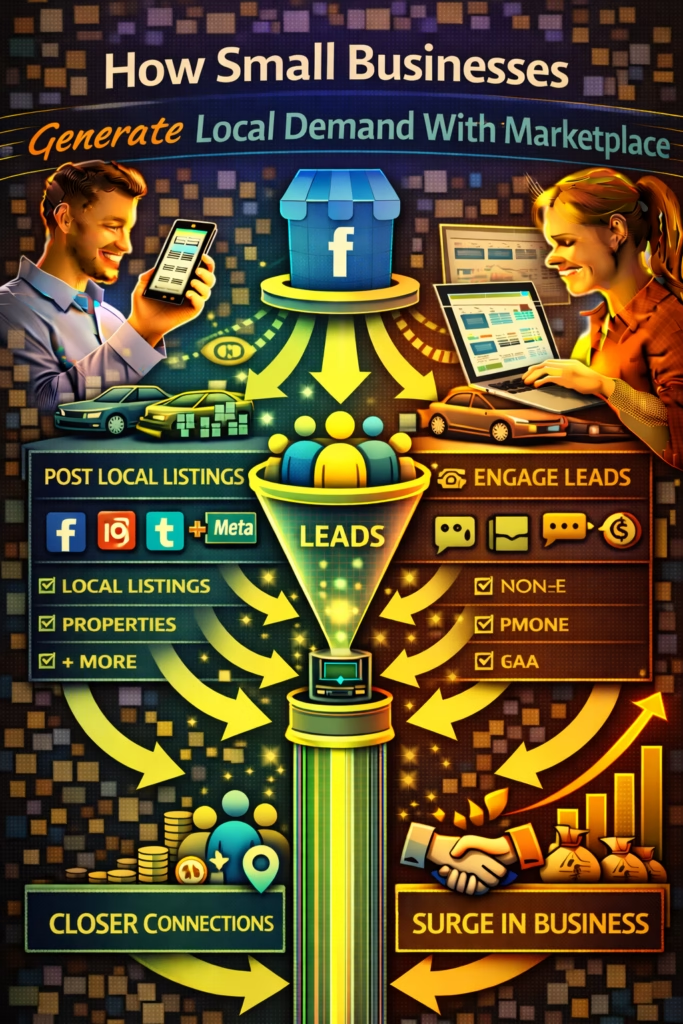
How Small Businesses Generate Local Demand With Marketplace is the blueprint for turning local browsing behavior into steady inquiries, booked next steps, and real sales through better listings, faster response, and smarter workflow systems.
Note: This is general guidance. Follow platform rules, avoid misleading claims, and keep all marketplace activity truthful, respectful, and compliant.
Introduction
How Small Businesses Generate Local Demand With Marketplace starts with an advantage many small businesses overlook:
You do not need a huge ad budget to create local demand if you can show up clearly, consistently, and quickly where local buyers are already browsing.
That is what marketplace platforms offer. They create an environment where nearby customers compare options, check photos, read a few details, and send a message if something feels relevant. For small businesses, that can be a huge opportunity because it reduces the need for complicated funnels, expensive creative, and slow website journeys.
The businesses that win are not always the largest. They are often the clearest, fastest, and most consistent.
Big idea: Small businesses generate local demand on Marketplace by turning simple listings into local trust-and-response engines.
Expanded Table of Contents
- 1) Why Marketplace works so well for small businesses
- 2) What local demand actually means
- 3) Offer clarity: the first driver of local demand
- 4) Listing structure that gets local buyers to message
- 5) First-photo strategy: how small businesses win the scroll
- 6) Titles and opening lines that create action
- 7) Local relevance and service-area positioning
- 8) Cadence: how to create steady local visibility
- 9) Rotation systems that keep listings fresh without duplicate risk
- 10) Speed-to-lead: why response time shapes demand
- 11) Follow-up systems that turn interest into appointments and sales
- 12) Why small businesses can beat larger competitors
- 13) KPI dashboard for local demand generation
- 14) 30–60–90 day rollout plan
- 15) 25 Frequently Asked Questions
- 16) 25 Extra Keywords
1) Why Marketplace works so well for small businesses
Marketplace is effective for small businesses because it gives them access to local attention without forcing them to outspend larger competitors.
| Challenge small businesses face | How Marketplace helps | Why that matters |
|---|---|---|
| Limited ad budget | Organic discovery can drive leads | Less dependence on paid media |
| Lower brand awareness | Buyers compare offers directly | Clear listings can outperform bigger brands |
| Small team size | Direct messaging shortens the funnel | Less wasted effort per lead |
| Need for local leads fast | Marketplace attracts nearby, action-oriented buyers | Faster path to appointments and sales |
Rule: Marketplace gives small businesses a chance to compete on clarity and speed instead of size alone.
2) What local demand actually means
Local demand is not just nearby traffic. It is nearby traffic with a reason to act.
Local demand usually means
- Someone in your service area looking right now or soon
- Someone comparing nearby options
- Someone who wants a practical next step like a call, quote, visit, pickup, or appointment
- Someone who values convenience and response speed
Pro move: Write every listing as if the buyer is comparing you with three nearby competitors in the same moment.
3) Offer clarity: the first driver of local demand
Small businesses generate stronger local demand when the offer is instantly understandable.
Simple offer formula
[What you offer] + [Who it helps] + [Why it matters now] + [Easy next step]Examples
- Retail: “Available now with local pickup or delivery. Message your zip for options.”
- Service: “Fast estimates this week. Send your city and what you need done.”
- Real estate: “Tour times available this week. Message your area and timeline.”
- Automotive: “Local options available now. Send budget + zip for best fit.”
Rule: If the offer is vague, the local demand stays vague too.
4) Listing structure that gets local buyers to message
A strong marketplace listing should move the buyer from browsing to messaging with as little friction as possible.
Recommended listing structure
Title: [What it is] + [Hook] + [Local/Option]
Line 1: Real photos + clear details ✅
Line 2: Why it helps / why buyers choose it
Bullets: 5–7 quick facts, features, timing, or service details
CTA: What city/zip are you in and are you looking for today or this week?
Why this works
- The title wins the scan
- The opening lines build trust
- The bullets reduce uncertainty
- The CTA turns passive attention into a lead
Rule: The listing should make it easier to message than to keep scrolling.
5) First-photo strategy: how small businesses win the scroll
The first photo is the biggest attention lever a small business controls. If it is weak, traffic falls before the title ever matters.
What strong first photos do
- Make the offer obvious fast
- Look real and trustworthy
- Separate you from weaker local competition
- Increase clicks and messages
First-photo testing SOP
[ ] Choose 3 strong thumbnail options
[ ] Run each for 3–7 days
[ ] Track messages/day or messages per listing
[ ] Keep the winner
[ ] Rotate again monthly
Pro move: Small businesses often win with more authentic and clearer images than bigger competitors using generic creative.
6) Titles and opening lines that create action
Titles create click intent. Opening lines create message intent.
Title formula
[What it is] + [Benefit or Hook] + [Local or Timing Option]Opening-line examples
- Clarity: “Real photos + clear details ✅”
- Trust: “Simple process, transparent details, quick replies.”
- Local: “Helping nearby buyers with fast scheduling and easy next steps.”
- Speed: “Available this week—message your zip for fastest options.”
Rule: Small businesses usually win more local demand with clarity than with hype.
7) Local relevance and service-area positioning
Marketplace demand improves when buyers feel the listing is clearly relevant to their area and situation.
Local relevance signals to include
- City, neighborhood, or service area references
- Pickup, delivery, scheduling, or visit options
- Nearby timing language like today or this week when true
- Questions that ask for city or zip
Simple local CTA
What city/zip are you in, and are you looking for today or this week?Pro move: Buyers respond better when the listing feels nearby, practical, and easy to act on.
8) Cadence: how to create steady local visibility
Small businesses do not need huge volume. They need a stable rhythm that signals activity and reliability.
Solo owner cadence
- 2–5 actions per day
- 1 weekly listing cleanup session
- 1 monthly review of top and bottom performers
Small team cadence
- 10–20 actions per day across listings
- Daily QA checks
- Weekly photo/title testing
Rule: Steady visibility creates steadier demand than random posting bursts.
9) Rotation systems that keep listings fresh without duplicate risk
Freshness matters, but spam-like duplication creates risk. Rotation is how small businesses stay visible safely.
What to rotate
- First photo
- Title angle
- Opening lines
- Feature emphasis
- Posting windows
Healthy rotation checklist
[ ] New thumbnail
[ ] Different buyer-intent angle
[ ] Updated opening line
[ ] Clear CTA
[ ] Meaningful spacing
[ ] Truthful details stay consistent
Avoid: identical duplicate posts, near-copy reposts, and tiny edits meant only to bypass moderation or fatigue.
Rule: Freshness should come from meaningful variation, not repetition.
10) Speed-to-lead: why response time shapes demand
Local demand is highly time-sensitive. Small businesses can win more often simply by responding faster than larger competitors.
Instant reply template
Yes — I can help ✅

Quick question so I send the best option:
Are you looking for today or this week?

What city/zip are you in?
Why this matters
- The buyer is still actively deciding
- The buyer may be messaging multiple options
- The fastest useful response often wins the lead
Pro move: One small-business advantage is speed. Use it.
11) Follow-up systems that turn interest into appointments and sales
Many local buyers do not move on the first message. Consistent follow-up turns more interest into booked next steps.
Simple 7-day follow-up sequence
Day 0: Instant reply + one question
Day 1: “Still looking for this week?”
Day 3: “Want me to send the best options for your area?”
Day 5: “Would you prefer a quick call, visit, or details first?”
Day 7: “No worries if timing changed — want me to keep an eye out?”
Rule: Follow-up should feel helpful, not pushy.
12) Why small businesses can beat larger competitors
Small businesses often assume larger competitors dominate Marketplace. In reality, smaller businesses often win because they are more personal, faster, and clearer.
Small-business advantages
- Faster reply times
- More authentic local presentation
- Greater flexibility in messaging
- Less brand bureaucracy
- Ability to adjust weekly
Best insight: On Marketplace, buyers often choose the option that feels easiest to trust and easiest to reach—not always the largest brand.
13) KPI dashboard for local demand generation
| KPI | What it measures | Target direction |
|---|---|---|
| Messages/day | Local demand volume | Up |
| Messages per listing | Listing quality | Up |
| Median response time | Speed-to-lead | Down |
| Booked next steps | Revenue predictor | Up |
| Follow-up recovery rate | Recovered missed demand | Up |
| Flags/removals | Compliance risk | Down |
| Active listings | Surface area | Stable/Up |
Rule: If you only track one true revenue metric, track booked next steps.
14) 30–60–90 day rollout plan
Days 1–30 (Build the foundation)
- Clarify the offer and local CTA
- Improve first photos and titles
- Set a sustainable posting cadence
- Deploy instant replies
- Start tracking messages and booked next steps
Days 31–60 (Create consistency)
- Build a rotation library for photos, titles, and hooks
- Install follow-up templates
- Refresh top listings weekly
- Retire weak performers and replace them
Days 61–90 (Scale the system)
- Document SOPs for posting, response, and follow-up
- Expand successful angles across categories or service areas
- Optimize weekly using KPI reviews
- Double down on the listings producing the most booked next steps
Rule: Small businesses generate local demand best when their process is simple, repeatable, and fast.
15) 25 Frequently Asked Questions
1) How do small businesses generate local demand with Marketplace?
By using clear, local listings, strong photos, quick responses, and consistent follow-up.
2) Why is Marketplace effective for small businesses?
Because it gives access to local buyers without requiring the same spend as many ad channels.
3) What is the fastest way for a small business to improve Marketplace results?
Improve the first photo, title, opening lines, and response speed.
4) What does local demand mean?
Nearby buyers with a real reason to act soon.
5) Why does first-photo quality matter so much?
It controls whether buyers stop scrolling and click.
6) What should the title include?
What the offer is, why it matters, and a local or timing-based hook.
7) What should the first line say?
Something trust-building and clear, such as “Real photos + clear details ✅”
8) What CTA works best?
“What city/zip are you in and are you looking for today or this week?”
9) How often should a small business post?
On a consistent schedule it can actually maintain.
10) What is listing rotation?
Refreshing photos, titles, hooks, and timing without reposting duplicates.
11) How do I avoid duplicate issues?
Use meaningful variation instead of copy-paste repetition.
12) Why does response speed matter so much?
Because local buyers often compare several businesses at the same time.
13) What response time should I aim for?
Under 5 minutes is strong; under 1 minute is ideal when possible.
14) What is a booked next step?
An appointment, quote, visit, pickup, delivery slot, or call.
15) Why track booked next steps instead of only messages?
Because booked next steps predict revenue better than message count alone.
16) Can one person run this system?
Yes, if the workflow is realistic and documented.
17) Can a small business beat a larger competitor on Marketplace?
Yes, especially through clearer listings and faster replies.
18) What is the biggest small-business advantage on Marketplace?
Speed and authenticity.
19) What should I test first?
First photos, then titles, then opening lines.
20) How long until results improve?
Often within 1–2 weeks, with stronger gains over 30–90 days.
21) What is the biggest mistake small businesses make?
Posting inconsistently and replying too slowly.
22) Does local language help?
Yes. Local references often improve relevance and trust.
23) Should I send leads to my website first?
Only when it helps. Too much friction can lower conversion.
24) What is the best mindset for Marketplace?
Treat each listing like a mini local landing page.
25) What is the simplest place to start?
Upgrade the first image, rewrite the title, and install a fast reply process.
16) 25 Extra Keywords
- How Small Businesses Generate Local Demand With Marketplace
- small business marketplace leads
- local demand with Marketplace
- Facebook Marketplace local demand
- marketplace lead generation for small business
- local buyer traffic
- marketplace listing strategy
- speed to lead
- small business local leads
- marketplace first photo strategy
- marketplace title optimization
- local service area Marketplace
- marketplace trust signals
- marketplace booked next steps
- messages per listing KPI
- local demand generation strategy
- small business Marketplace sales
- marketplace posting cadence
- listing rotation strategy
- anti-flag Marketplace framework
- organic local lead generation
- small business marketing without ads
- 2026 Marketplace marketing strategy
- turn Marketplace into local lead engine
- small business lead system