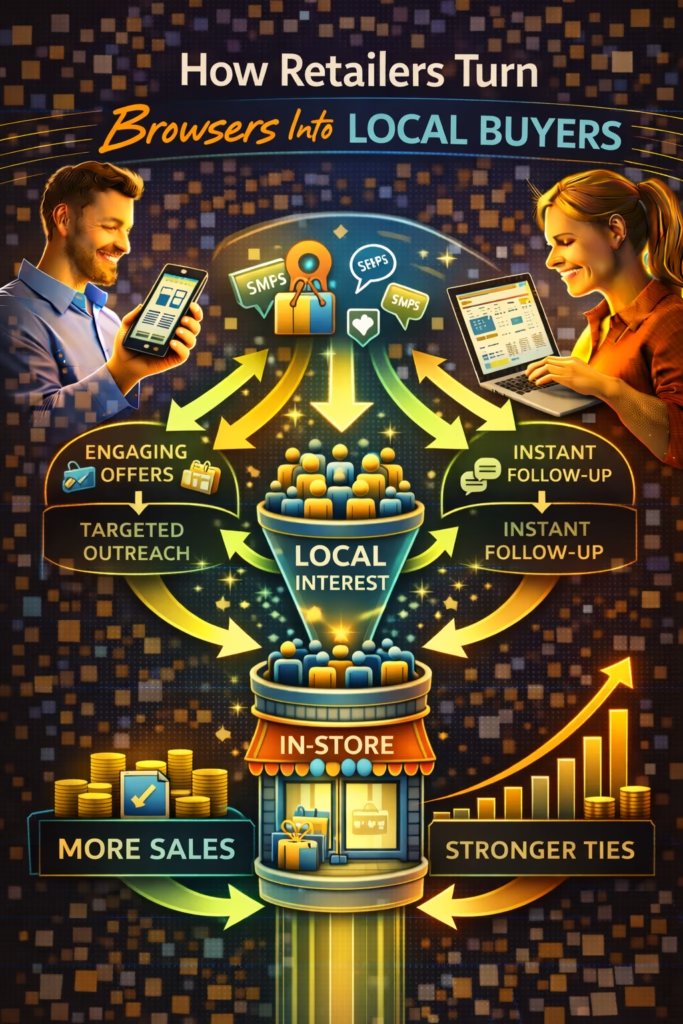
How Retailers Turn Browsers Into Local Buyers
How Retailers Turn Browsers Into Local Buyers is the blueprint for converting online attention into in-store revenue—by using trust, clarity, speed-to-lead, and a frictionless “next step” system.
Note: This is general guidance. Follow platform policies, keep claims truthful, and avoid spam/duplication. Confirm compliance before automating messages or posting at scale.
Introduction
How Retailers Turn Browsers Into Local Buyers comes down to one reality most retailers ignore:
Browsers aren’t low intent. They’re high intent with low trust and high friction.
People browse because it’s safe. Buying is risky. They worry about price, availability, scams, wasted time, poor quality, and confusing processes. If your listing, profile, and first message don’t remove that risk quickly, they drift away—even if they genuinely want what you sell.
This guide gives you a conversion system that works across marketplaces, social, and local search. The goal is simple:
Turn views → messages → booked next steps → local purchases.
Expanded Table of Contents
- 1) Why browsers don’t buy (and what they’re really thinking)
- 2) The local trust equation: how buyers decide fast
- 3) Clarity sells: the listing framework that removes friction
- 4) Proof stacking: the fastest conversion multiplier
- 5) Offer framing: how retailers win without racing to the bottom
- 6) Speed-to-lead: the #1 leak in local retail sales
- 7) Message flow that books appointments (scripts included)
- 8) Turning messages into visits: the 3-option booking method
- 9) Follow-up that feels helpful (not pushy)
- 10) Inventory presentation: how to show choices without overwhelming
- 11) Compliant automation: what to automate and what not to
- 12) KPIs that predict local sales
- 13) 30–60–90 day rollout plan
- 14) 25 Frequently Asked Questions
- 15) 25 Extra Keywords
1) Why browsers don’t buy (and what they’re really thinking)
Most retailers think “browsers are just window shoppers.” But most browsers are actually shoppers who haven’t been convinced you’re the safest, easiest option yet.
The 6 silent objections behind browsing
1) “Is this real?”
They worry about scams, bait-and-switch, or outdated listings.
2) “Is it worth my time?”
They fear long drives, wasted visits, or unclear availability.
3) “Will they respond?”
They’ve been ignored before. Slow replies kill intent.
4) “What’s the total price?”
Hidden fees, unclear terms, confusing financing = friction.
5) “Will I regret it?”
No proof, no reviews, no reassurance = uncertainty.
6) “Is there a better option?”
If you don’t control the comparison, competitors will.
Goal: Your content and messaging should answer these objections before the buyer asks.
2) The local trust equation: how buyers decide fast
Local buyers decide quickly when trust is high and friction is low.
The trust equation
Local Purchase Likelihood = (Clarity + Proof + Responsiveness) − Friction
| What increases trust | What decreases trust | What reduces friction |
|---|---|---|
| Real photos | Stock-only images | Simple next step |
| Reviews/testimonials | No proof | Clear hours/location |
| Transparent pricing | Hidden fees | 3 appointment options |
| Fast replies | Delayed replies | Short answers + scripts |
Pro move: Don’t “sell harder.” Make buying feel safer and simpler.
3) Clarity sells: the listing framework that removes friction
Clarity is the conversion engine. The best listings remove questions faster than the buyer can form them.
The high-converting retail listing structure
- First photo: clean, real, well-lit, shows the item clearly
- Title: product + local benefit + key option (delivery/financing)
- First line: “Real photos + available now ✅” (or truthful equivalent)
- Bullets: 5–7 benefits (not specs overload)
- Local trust: location, hours, pickup/delivery options
- Next step CTA: one question (city/zip + timeline)
Copy/paste listing template
Title: [Product] + [Local Hook] + [Option]
First line: Real photos + clear details ✅

Highlights:
• [Benefit #1]
• [Benefit #2]
• [Benefit #3]
• [Option: delivery / setup / financing if available]
• [Local reassurance: showroom pickup / same-day options if true]

Next step:
What city/zip are you in, and are you looking for today or this week?
Rule: The best retail listings feel like a helpful salesperson—not a messy warehouse.
4) Proof stacking: the fastest conversion multiplier
Proof makes buyers feel safe. If your proof is weak, your price becomes the only argument—and that’s a losing game.
Proof assets retailers should collect weekly
- Customer reviews (screenshots or linkable proof)
- “In-store” photos (clean, real environment)
- Delivery/setup photos (if applicable)
- Short testimonial clips (10–20 seconds)
- Before/after (space upgrades, room setups, etc.)
Proof placement map
| Stage | Where proof goes | Why it works |
|---|---|---|
| Scroll | Photo set + bullets | Reduces uncertainty |
| Message | 1 proof screenshot | Builds instant trust |
| Appointment | Map/location + hours | Removes friction |
Pro move: Keep a “Proof Folder” and drop in 3 new items per week. Proof compounds conversion.
5) Offer framing: how retailers win without racing to the bottom
Retailers lose when they try to “discount their way” into trust. Instead, build an offer that feels safe and easy.
The 5 retail offer pillars
Clarity
Clear price, availability, and options.
Convenience
Delivery, pickup, setup, flexible timing (if true).
Confidence
Reviews, real photos, transparent process.
Comparison control
Explain why your option is safer/better.
Next step simplicity
One clear action: book a visit or get a quote.
Offer language that converts (without hype)
- “Real photos + available options today.”
- “Quick answers—tell me your zip and timeline.”
- “We’ll make this simple—here are your fastest next steps.”
Rule: Don’t sell price. Sell safety + simplicity + speed.
6) Speed-to-lead: the #1 leak in local retail sales
If you improve only one thing, improve response speed.
Why response speed matters
- Intent is highest in the first minutes after a message
- Buyers contact multiple sellers at once
- Fast replies create trust and momentum
Response targets
| Time | Outcome |
|---|---|
| < 1 minute | Best: highest conversion |
| < 5 minutes | Strong: competitive advantage |
| > 30 minutes | High leakage risk |
Pro move: A fast reply with one question beats a long pitch sent late.
7) Message flow that books appointments (scripts included)
Retail conversion messaging should do three things: confirm, qualify, and offer a next step.
Universal instant reply
Yes — I can help ✅

What city/zip are you in, and are you looking for today or this week?
I’ll confirm the best options.
When they ask “Is this still available?”
Yes — available ✅
What city/zip are you in, and are you looking for today or this week?
When they ask “What’s your best price?”
Totally fair question.
If you tell me your zip + timeline (today/this week), I’ll confirm the best option and the fastest next step.
When they go silent after your reply
Quick check — do you want the fastest option today, or are you shopping for later this week?
What zip are you in?
Rule: Keep it short. One question. One next step.
8) Turning messages into visits: the 3-option booking method
Retailers win when they offer structured options that feel easy to say “yes” to.
3-option booking message (copy/paste)
Perfect — quickest next step is a quick visit/pickup option.

Which works best?
1) Today (late afternoon)
2) Tomorrow (morning)
3) This weekend

Send your preferred option + your zip and I’ll lock it in.
Why this works
- Reduces decision fatigue
- Creates momentum
- Turns browsing into action
Pro move: “Options” convert better than “Let me know when you want to come by.”
9) Follow-up that feels helpful (not pushy)
Follow-up is a service: it keeps the buyer from restarting the search.
Follow-up schedule
| When | Message | Goal |
|---|---|---|
| +2 hours | “Do you want the fastest option today or this week?” | Recover intent |
| +24 hours | “Want me to recommend the best option for your budget?” | Offer help |
| +72 hours | “If you tell me zip + timeline, I’ll line it up.” | Reduce friction |
| +7 days | “Should I keep this open for you?” | Reactivation |
Rule: Follow-up should move the buyer forward, not guilt them.
10) Inventory presentation: how to show choices without overwhelming
Too many choices kills local conversion. Your job is to guide the buyer to the best fit.
The “3 choices” inventory method
- Good: best value option
- Better: most popular option
- Best: premium upgrade option
Message template for 3 choices
Based on what most local buyers want, here are 3 solid options:

1) Good (best value): [Option]
2) Better (most popular): [Option]
3) Best (premium upgrade): [Option]

Which direction fits you best — value, most popular, or premium?
Pro move: Help them choose. Don’t dump a catalog in chat.
11) Compliant automation: what to automate and what not to
Automation can protect response speed and prevent lead leakage—if it stays compliant and buyer-friendly.
Automate (usually safe)
- Instant reply asking city/zip + timeline
- Lead routing to staff
- Follow-up reminders
- Daily KPI reporting
Be careful with
- Bulk repetitive messaging
- Spam-like posting patterns
- Misleading urgency or claims
Important: Always follow platform rules and local regulations. Keep automation helpful, truthful, and respectful.
12) KPIs that predict local sales
| KPI | What it measures | Target direction |
|---|---|---|
| Views → messages rate | Listing clarity + offer strength | Up |
| Median response time | Speed-to-lead | Down |
| Messages → booked steps | Script effectiveness | Up |
| Booked steps → purchases | In-store close quality | Up |
| Follow-up recovery rate | Saved “lost” leads | Up |
| Refunds/complaints | Expectation alignment | Down |
Rule: Track booked next steps weekly. That’s where local revenue is created.
13) 30–60–90 day rollout plan
Days 1–30 (Fix leakage + build trust)
- Improve first photos + titles for clarity
- Deploy instant replies and response targets
- Implement 3-option booking method
- Start follow-up schedule
- Build proof folder (3 proof assets/week)
Days 31–60 (Increase conversion throughput)
- Standardize scripts across team
- Rotate offer angles (value/speed/premium/trust)
- Introduce 3-choice inventory guidance
- Run weekly A/B tests (thumbnail + hook)
Days 61–90 (Systemize and scale)
- Document SOPs (posting, messaging, follow-up)
- Automate reminders + reporting
- Replicate system to second platform
- Optimize based on KPI trends weekly
Pro move: Don’t chase more leads until your conversion system is tight. Fix leakage first.
14) 25 Frequently Asked Questions
1) What does “How Retailers Turn Browsers Into Local Buyers” mean?
It means building a repeatable system that moves people from viewing to messaging to booking a next step and buying locally.
2) Why do most browsers never become buyers?
Because trust is low and friction is high: unclear details, weak proof, slow response, and no clear next step.
3) What is the fastest way to turn a browser into a buyer?
Clarity + fast response + one-question CTA + simple appointment options.
4) Do local buyers care more about trust or price?
Trust often decides the sale—especially for higher-ticket purchases.
5) How important is response speed for retail leads?
It’s critical. The first minutes are when intent is highest.
6) What should my first reply say?
Confirm help/availability and ask city/zip + timeline.
7) What’s the best CTA for retailers?
“What zip are you in, and are you looking for today or this week?”
8) How do I get more messages from views?
Improve first photo, title clarity, proof, and simplify the offer.
9) Are real photos better than stock photos?
Yes—real photos build trust and improve conversion.
10) What proof converts fastest?
Reviews, real in-store photos, and simple outcome proof.
11) How do I follow up without being pushy?
Offer help and reduce friction with one clear question.
12) What follow-up timing works best?
2 hours, 24 hours, 72 hours, and 7 days.
13) What if they only ask “price”?
Answer briefly, then ask zip + timeline to move to a next step.
14) How do I book more appointments?
Use the 3-option booking method instead of open-ended invites.
15) What is the 3-option booking method?
Offer three time windows and ask them to choose one.
16) How do I avoid overwhelming buyers with inventory?
Show only 3 choices: good, better, best.
17) What’s the biggest leak in local retail conversion?
Slow responses and no follow-up system.
18) How do I improve conversion without discounting?
Increase proof, clarity, convenience, and next-step simplicity.
19) What KPIs matter most?
Views-to-messages, response time, messages-to-booked steps, booked steps-to-sales.
20) What KPI predicts revenue best?
Booked next steps.
21) How long does it take to see results?
Often within 1–2 weeks, with compounding over 30–90 days.
22) Can this work without paid ads?
Yes—organic conversion systems can drive local sales consistently.
23) Should I automate messages?
Automate low-risk items like instant replies and reminders where allowed.
24) What should I not automate?
Spam-like bulk messaging or repetitive posting patterns.
25) What’s the simplest improvement I can make today?
Reply faster and ask one question that moves the sale forward.
15) 25 Extra Keywords
- How Retailers Turn Browsers Into Local Buyers
- turn browsers into local buyers
- local retail lead conversion
- retail conversion system
- convert marketplace leads to sales
- turn messages into appointments
- speed to lead retail
- retail follow up scripts
- local buyer psychology
- in store appointment booking
- how to convert online shoppers locally
- retail trust signals
- proof stacking for retailers
- high converting retail listings
- marketplace conversion tips
- Facebook Marketplace retail strategy
- Google Business Profile conversion
- local store marketing system
- reduce lead leakage retail
- message scripts for retailers
- turn views into buyers
- convert browsers into customers
- local retail marketing 2026
- retail sales follow up process
- booked next steps KPI