
How Property Managers Reduce Vacancy Rates Using Automation
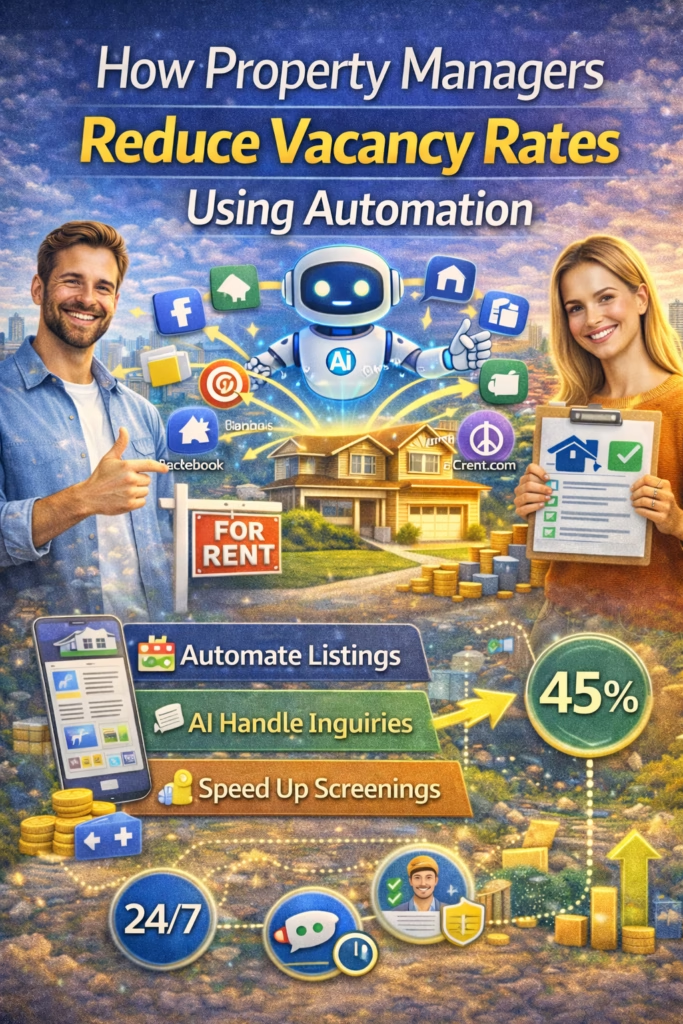
How Property Managers Reduce Vacancy Rates Using Automation is your 2025 playbook for cutting vacancy days using multi-site listings, instant responses, automated follow-up, screening workflows, scheduling systems, and KPI-driven improvements.
Note: This is general marketing guidance. If you use SMS/email outreach, confirm consent requirements and applicable privacy rules.
Introduction
How Property Managers Reduce Vacancy Rates Using Automation is not about “finding a magic website.” In most markets, demand exists. The problem is operational: slow response time, inconsistent follow-up, poor listing distribution, and a leasing pipeline that stalls out.
Automation reduces vacancy rates by fixing the entire journey from listing visibility to lead response to showing booked to application submitted to lease signed. Instead of relying on someone remembering to post, reply, or follow up, the system handles it consistently—every day.
Big idea: You don’t need more leads. You need better conversion from inquiry → showing → application → approval → lease.
Expanded Table of Contents
- 1) The 5 principles that reduce vacancy rates
- 2) #1 Standardize your listing “source of truth”
- 3) #2 Multi-site listing distribution (reach renters everywhere)
- 4) #3 Speed-to-lead: instant response wins in 2025
- 5) #4 Automated follow-up sequences that book showings
- 6) #5 Screening workflows that reduce wasted time
- 7) #6 Lead scoring: prioritize the best renters first
- 8) #7 Scheduling automation: the two-window method
- 9) #8 Application acceleration: reduce drop-off
- 10) #9 Listing refresh cadence: stay visible weekly
- 11) #10 Improve inquiry quality with better copy
- 12) #11 Photo + video upgrades that lift conversion
- 13) #12 KPI tracking: measure vacancy reduction
- 14) #13 Troubleshooting: fix bottlenecks fast
- 15) #14 Build a repeatable Vacancy Reduction SOP
- 16) #15 Weekly routines that keep units full
- 17) Copy/paste checklists
- 18) 30–60–90 day rollout plan
- 19) 25 Frequently Asked Questions
- 20) 25 Extra Keywords
1) The 5 principles that reduce vacancy rates
Vacancy reduction is predictable when you follow these principles consistently:
Principle 1: Distribution creates demand capture
Renters don’t search one place. Multi-site presence reduces vacancy days.
Principle 2: Speed-to-lead multiplies conversion
Many renters choose the first manager who confirms a showing and next steps.
Principle 3: Follow-up recovers “lost” renters
Automation ensures every lead gets a consistent sequence until they book or opt out.
Principle 4: Screening protects time
Pre-qualification reduces no-shows and wasted showings.
Principle 5: Application friction is a vacancy tax
Every extra step increases drop-off. Make applying easy and clear.
Shortcut: Multi-site + instant response + follow-up + screening + easy applications.
2) #1 Standardize your listing “source of truth”
Automation fails when listing details are scattered across sticky notes, spreadsheets, and different team members’ memory. The fastest property management teams start with a single “source of truth” for each unit.
What your source of truth should include
- Address (or cross-streets), unit number, neighborhood
- Rent, deposit, fees, utilities, lease term
- Availability date, showing policy, lockbox instructions
- Pet policy (types/weights/fees)
- Requirements (income, screening, occupancy limits)
- Photo set + video link
- Application link + document checklist
Why it matters: Your ads, replies, and follow-ups stay consistent across every platform.
3) #2 Multi-site listing distribution (reach renters everywhere)
Property managers reduce vacancy rates by distributing each listing across multiple channels and refreshing visibility weekly. The goal is not to “post once.” The goal is to be seen repeatedly where renters already are.
Multi-site distribution checklist
- Core rental marketplaces (market-dependent)
- Facebook Marketplace (high volume in many cities)
- Craigslist (still high intent in many regions)
- Local community groups (helpful, not spammy)
- Your website landing page (for tracking + SEO)
Quick win: Use the same headline, photo order, and requirements across every platform.
4) #3 Speed-to-lead: instant response wins in 2025
Vacancy rate is often a response-time problem disguised as a marketing problem. When your first response is late, you lose the showing—and the renter—and the unit stays vacant.
| Response time | Typical outcome | Automation fix |
|---|---|---|
| 1–5 minutes | Highest showing conversion | Instant reply + routing |
| 15–60 minutes | Medium conversion | Alerts + templates |
| Same day | Low conversion | Follow-up sequence |
| Next day | Mostly lost | 24/7 auto-response |
Instant reply template (copy/paste)
Thanks for reaching out! 👋 Yes, it’s available.

Quick questions so I can schedule you:
1) Move-in date you want?
2) Number of occupants (adults/children)?
3) Any pets? (type/weight)
4) Best number to text?

After you reply, I’ll send 2 showing time options.
Rule: Instant reply should collect info and create momentum toward a showing.
5) #4 Automated follow-up sequences that book showings
Most renters don’t reply to the first message—not because they’re bad leads, but because they’re busy and messaging multiple listings. Follow-up is where vacancy rates are won.
Simple follow-up sequence (copy/paste framework)
Day 0: Availability + 4 questions + showings
Day 1: “Still looking?” + two showing windows
Day 3: Requirements + application link
Day 7: “Want to see it this week?” + two windows
Day 14: Close-the-loop message
Close-the-loop message
Just checking in — do you still want to schedule a showing for this unit?
If yes, reply with your move-in date and I’ll send the next steps.
Best practice: Keep follow-ups short, respectful, and helpful.
6) #5 Screening workflows that reduce wasted time
Automation reduces vacancy rates when you stop booking showings for people who can’t qualify. A consistent pre-screen saves hours and increases application quality.
Pre-screen questions (copy/paste)
To confirm it’s a fit:
• Desired move-in date?
• Number of occupants?
• Any pets? (type/weight)
• Monthly household income range?
• Any evictions in the last 7 years?

If this looks good, I’ll send showing options.
Note: Keep screening consistent and comply with applicable fair housing rules and local regulations.
7) #6 Lead scoring: prioritize the best renters first
When your inbox is busy, automation should help you prioritize. Lead scoring routes the best candidates to immediate human follow-up while automation handles lower priority leads politely.
| Signal | Score | Why it matters |
|---|---|---|
| Move-in within 14 days | +15 | Urgency |
| Shares full details (pets/occupants/income) | +10 | Seriousness |
| Books a showing quickly | +10 | High intent |
| Requests application | +10 | Close to lease |
| No response after 2 touches | -10 | Lower priority |
Action: Leads above 25 points get a human response within 15 minutes.
8) #7 Scheduling automation: the two-window method
Scheduling delays create vacancy days. The simplest fix is offering two windows and confirming quickly. Automation can send these options immediately after screening.
Two-window scheduling template
I can do showings:
Option A: [Day] between [Time–Time]
Option B: [Day] between [Time–Time]

Which works better? I’ll confirm the exact time.
Confirmation message
Perfect — you’re set for [Day] at [Time]. Please reply “CONFIRMED”.
I’ll send address and entry instructions next.
Why it works: It reduces back-and-forth and locks a commitment.
9) #8 Application acceleration: reduce drop-off
The moment a renter is qualified, send the application link with clear requirements and a short checklist. Automation prevents “I’ll do it later” from becoming “never.”
Application link message (copy/paste)
Great — here are the next steps:
1) Apply here: (link)
2) Requirements: (income/credit/pets/occupancy)
3) Upload: ID + proof of income (pay stubs or equivalent)

Once submitted, we review and update you within [timeframe].
Document checklist (copy/paste)
[ ] Photo ID
[ ] Proof of income (last 2–4 pay stubs or equivalent)
[ ] Contact info for current/previous landlord (if applicable)
[ ] Pet details (if applicable)
Pro move: Send an automatic reminder 12–24 hours after the link if incomplete.
10) #9 Listing refresh cadence: stay visible weekly
Vacancy rates drop when your listings are refreshed consistently. Most platforms reward activity and recency. Automation helps you refresh listings without manual effort.
Refresh cadence rules
- Weekly: refresh headline + first photo
- Weekly: repost or bump (platform-dependent)
- Every 3–7 days: add a new photo or video clip
- When needed: adjust pricing based on KPI signals
Reality: “Post once and wait” increases vacancy time.
11) #10 Improve inquiry quality with better copy
Better copy reduces low-quality inquiries and improves showing conversion. Your listing should answer the most common questions before renters ask.
High-performing rental listing structure
Headline: [Beds/Baths] in [Neighborhood] — [Top Feature]
Price: $X/month | Deposit: $Y | Available: [Date]

Highlights:
• Feature 1
• Feature 2
• Feature 3

Requirements (summary):
• Income guideline
• Pet policy
• Smoking policy
• Occupancy limits

To schedule: Message your move-in date + occupants + pets.
Quick win: Put “how to schedule” at the end of the first paragraph.
12) #11 Photo + video upgrades that lift conversion
Listings with better visuals get more inquiries and better renters. A simple video walkthrough builds trust and reduces “is it still available?” messages.
| Asset | Minimum requirement | Why it matters |
|---|---|---|
| Photos | 10–20 clear images | Higher inquiry volume |
| Walkthrough clip | 20–40 seconds | Higher showing conversion |
| Floor plan (optional) | Simple layout | Reduces uncertainty |
Best practice: Lead with the best “wow” photo first (kitchen/living/curb appeal).
13) #12 KPI tracking: measure vacancy reduction
Automation works when you measure. Track leading indicators weekly so vacancy rates go down month after month.
| KPI | What it tells you | If low, fix this |
|---|---|---|
| Time to first response | Speed-to-lead | Instant reply + routing |
| Inquiry → showing rate | Script + scheduling effectiveness | Two-window method + screening |
| Showing → application rate | Fit + clarity | Requirements + next steps |
| Application completion | Friction | Document checklist + reminders |
| Days vacant | Overall performance | Distribution + conversion bottleneck |
Weekly rule: Pick one KPI to improve for the next 7 days.
14) #13 Troubleshooting: fix bottlenecks fast
When vacancy days rise, it’s almost always one of a few bottlenecks. Use this table to diagnose and fix quickly.
| Problem | Likely cause | Automation fix |
|---|---|---|
| Low inquiries | Weak photos / wrong headline / limited distribution | Refresh listing + expand platforms |
| Many inquiries, few showings | Slow response / no scheduling structure | Instant reply + two-window scheduling |
| Many showings, few applications | Requirements mismatch / unclear next steps | Pre-screen + application checklist |
| Applications started, not completed | Friction / missing docs | Doc checklist + reminders |
| High no-show rate | No confirmation / weak reminders | Confirmation + day-of reminder |
Fast fix: If you have inquiries but low showings, your response time is the first thing to fix.
15) #14 Build a repeatable Vacancy Reduction SOP
Vacancy reduction becomes predictable when you document the workflow and run it the same way for every unit. Automation makes it easier, but SOPs make it durable.
Vacancy Reduction SOP outline
- Listing source-of-truth template
- Distribution and refresh schedule
- Instant response templates
- Follow-up sequence rules
- Pre-screen questions
- Scheduling scripts and reminders
- Application link + doc checklist
- KPI review cadence
Outcome: Faster leasing with less manual effort and fewer missed leads.
16) #15 Weekly routines that keep units full
The best property managers treat leasing as a weekly system, not a scramble. This is the routine that keeps vacancy rates low.
Weekly routine (60 minutes)
[ ] Refresh all active listings (headline + first photo)
[ ] Check response time KPI (and fix routing)
[ ] Follow up with all open leads
[ ] Confirm showings for next 3 days
[ ] Send application links to qualified leads
[ ] Review inquiry→showing and showing→application
Monthly routine (2–3 hours)
[ ] Audit platform performance by market
[ ] Update scripts based on objections
[ ] Improve screening workflow
[ ] Replace weak photos on underperforming units
[ ] Review vacancy-day trends and adjust process
Compounding: Small weekly improvements reduce vacancy rates month after month.
17) Copy/paste free marketing checklists
Vacancy reduction checklist (per unit)
[ ] Source-of-truth completed (rent, deposit, availability, requirements)
[ ] 10–20 photos + 20–40s walkthrough clip
[ ] Listings published across multiple platforms
[ ] Instant reply enabled (move-in, occupants, pets, contact)
[ ] Follow-up sequence activated
[ ] Pre-screen questions set
[ ] Two-window scheduling templates ready
[ ] Application link + document checklist ready
[ ] KPI tracking started
Daily leasing checklist (10 minutes)
[ ] Verify instant replies were sent
[ ] Confirm showings and send reminders
[ ] Send application links to qualified leads
[ ] Follow up with non-responders
[ ] Update pipeline status for every lead
18) 30–60–90 day rollout plan
Days 1–30 (Immediate vacancy reduction)
- Create a source-of-truth template for every unit
- Enable instant response + missed-call text back
- Deploy follow-up sequences for all new inquiries
- Implement pre-screen questions + two-window scheduling
- Start KPI tracking (response time + showing bookings)
Days 31–60 (Compounding)
- Expand listing distribution and refresh cadence
- Add lead scoring and priority rules
- Improve listing copy to increase inquiry quality
- Reduce no-shows with confirmations and reminders
- Accelerate applications with doc checklists and reminders
Days 61–90 (Systemize + scale)
- Document Vacancy Reduction SOP
- Train team on scripts, escalation, and routing
- Build weekly KPI review and improvement cadence
- Scale automation across the portfolio
- Optimize based on vacancy-day trends and bottlenecks
Result: Lower vacancy rates, fewer missed inquiries, and a faster leasing pipeline.
19) 25 Frequently Asked Questions
1) How do property managers reduce vacancy rates using automation?
By automating listing distribution, responding instantly, following up consistently, screening leads, scheduling showings, and accelerating applications.
2) What’s the fastest lever to reduce vacancy days?
Speed-to-lead. Instant response often increases showings without increasing traffic.
3) Does automation reduce staff workload?
Yes. It reduces repetitive messaging and ensures no leads fall through cracks.
4) What should an automated first reply include?
Availability confirmation, 3–4 screening questions, and a promise of showing options.
5) How many follow-ups should I run?
4–6 touches over two weeks is common if the messages are helpful and not spammy.
6) How can I reduce no-shows?
Require confirmation and send day-of reminders.
7) Should I include requirements in the listing?
Yes. It improves inquiry quality and reduces wasted time.
8) What KPIs matter most for vacancy reduction?
Time to first response, inquiry→showing rate, showing→application rate, and days vacant.
9) How often should listings be refreshed?
Weekly is a strong baseline in many markets.
10) Does automation help with multi-site posting?
Yes. It helps maintain consistent listing details and refresh cadence across platforms.
11) How do I improve inquiry quality?
Use better photos, clear requirements, and a direct scheduling CTA.
12) What’s the best way to schedule showings?
Offer two time windows and confirm quickly.
13) How do I improve application completion?
Send clear steps, requirements, and a document checklist plus reminders.
14) Do video walkthroughs help?
Yes. They build trust and reduce repetitive questions.
15) Is lead scoring useful for property management?
Yes. It prioritizes urgent and qualified renters for faster leasing.
16) Can automation increase lead volume?
Often yes indirectly because refreshed listings and faster response increase visibility and conversion.
17) What’s the best first screening question?
Move-in date—urgency matters for vacancy fill speed.
18) How do I handle after-hours inquiries?
Use instant reply to capture info and offer next-day showing windows.
19) Does automation help prevent missed leads?
Yes. It ensures every inquiry gets an immediate response and follow-up.
20) What’s the biggest mistake property managers make?
Responding too slowly and assuming renters will wait.
21) Should I use templates for messages?
Yes. Templates keep replies consistent and reduce manual work.
22) How do I make listings more credible?
Use real photos, a walkthrough clip, clear details, and professional communication.
23) Can automation help with compliance?
It helps keep processes consistent, but you must still follow applicable laws and policies.
24) How quickly can I see results?
Speed-to-lead improvements can work immediately; distribution and optimization compound over weeks.
25) What makes vacancy reduction sustainable?
A documented SOP, consistent automation, and weekly KPI-driven improvements.
20) 25 Extra Keywords
- How Property Managers Reduce Vacancy Rates Using Automation
- property management automation
- reduce vacancy rate property management
- reduce vacancy days
- leasing automation workflow
- rental listing automation
- multi site rental posting
- AI leasing assistant
- automated rental lead follow up
- instant reply rental inquiries
- rental lead scoring
- tenant screening workflow
- showing scheduling automation
- rental application automation
- how to lease units faster
- property manager lead generation
- vacancy reduction SOP
- inquiry to showing conversion
- showing to application conversion
- application completion reminders
- Facebook Marketplace rental leads
- Craigslist rental marketing
- rental marketing automation 2025
- 30 60 90 leasing plan
- property management KPI tracking