
How One Company Built a Lead Engine Without Ads
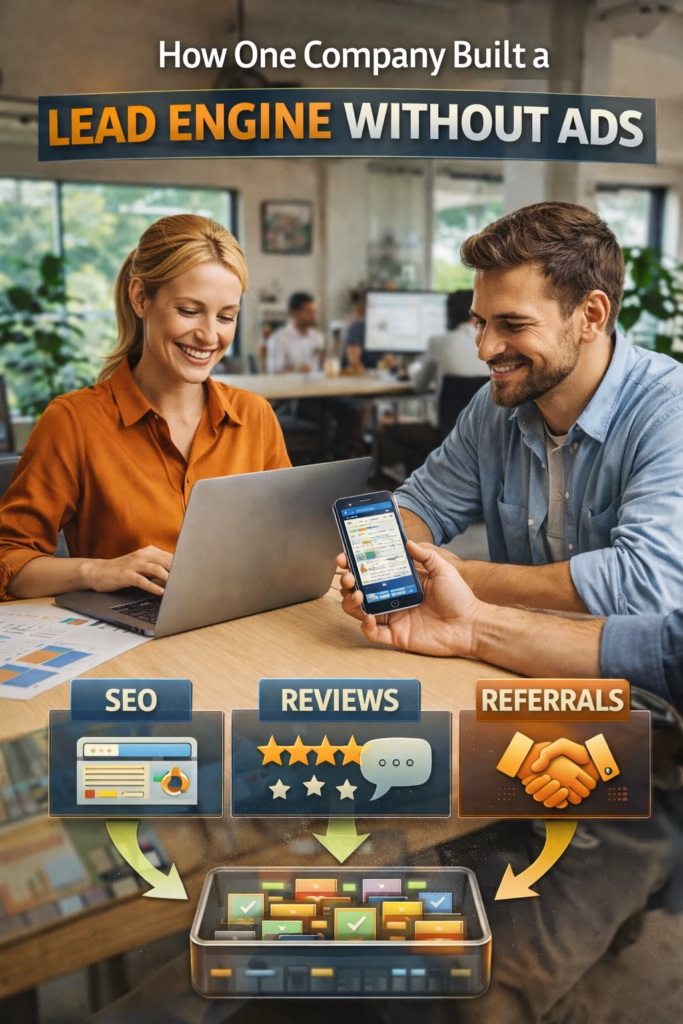
How One Company Built a Lead Engine Without Ads is the blueprint for organic lead generation at scale—built on a Marketplace-first listing system, proof-based content, daily cadence, instant replies, and relentless follow-up.
Note: This is general guidance. Keep all listings accurate, avoid misleading claims, and follow platform rules. Rotate content responsibly and don’t spam duplicates.
Introduction
How One Company Built a Lead Engine Without Ads starts with the exact opposite of what most businesses do. Instead of spending money to “buy traffic,” they built a system that made traffic show up every day—organically—because their listings matched real buyer behavior.
Here’s the shift: paid campaigns rent attention. Organic lead engines own attention through consistency, surface area, and trust.
That doesn’t mean “never run ads.” It means ads stop being the foundation. They become optional fuel.
Big idea: A real lead engine is not a campaign. It’s a daily system that compounds.
Expanded Table of Contents
- 1) What a lead engine without ads actually is
- 2) The mindset shift: campaigns vs systems
- 3) Why marketplaces and social feeds beat paid traffic
- 4) The surface area strategy: win with volume + variety
- 5) Proof-based content: the trust layer that converts
- 6) Offer positioning that triggers inbound messages
- 7) Cadence: the daily rhythm that compounds
- 8) Speed-to-lead: how instant replies double conversions
- 9) Follow-up SOP: where the “hidden revenue” lives
- 10) Pipeline + tracking: prevent lead leakage
- 11) KPIs that prove the engine is working
- 12) 30–60–90 day rollout plan
- 13) 25 Frequently Asked Questions
- 14) 25 Extra Keywords
1) What a lead engine without ads actually is
A lead engine without ads is a system that produces inbound leads predictably without buying impressions. It relies on four pillars:
1) Visibility surface area
More quality listings/content assets across keywords and buyer intents.
2) Proof + trust
Real photos, transparency, credibility signals, consistent details.
3) Conversion speed
Instant replies, scripts, one-question qualification, clear next steps.
4) Follow-up
A short SOP that recovers “ghosts” and closes more of the same leads.
Pro move: Paid ads often hide broken conversion. Organic forces you to build a clean system because every message matters.
2) The mindset shift: campaigns vs systems
Most companies think in campaigns:
- Launch something
- Spend money
- Measure leads
- Stop when budget stops
The company in this story thought in systems:
- Build repeatable listing templates
- Create a daily cadence
- Standardize proof photos
- Deploy instant replies + follow-up
- Track KPIs weekly
Rule: If the leads stop when you stop “doing a thing,” it wasn’t an engine—it was a push.
3) Why marketplaces and social feeds beat paid traffic
Marketplaces and social platforms are where demand already exists. People aren’t being interrupted—they’re searching and browsing on purpose.
| Source | Buyer mindset | Friction | Result |
|---|---|---|---|
| Paid ads | Interrupted | High (landing pages, forms) | Lower intent, slower |
| Marketplace/social | Shopping | Low (tap-to-message) | Higher intent, faster |
| Local search | Need-driven | Medium (calls/website) | High trust if optimized |
Important: Social platforms reward consistency and responsiveness. If you disappear for 10 days, you lose momentum.
4) The surface area strategy: win with volume + variety
The company didn’t “post one listing and hope.” They created surface area across buyer intents.
Surface area means
- Multiple listings for multiple keywords
- Multiple offers for multiple budgets
- Multiple angles for multiple objections
Example surface-area map
| Intent | Listing angle | What it catches |
|---|---|---|
| Price-focused | “Best value / budget option” | Deal hunters |
| Payment-focused | “Easy payments / financing” | Monthly shoppers |
| Urgency | “Available today / fast delivery” | Immediate buyers |
| Quality | “Premium / upgraded” | Higher-ticket buyers |
| Trust | “Proof photos / transparent details” | Skeptical buyers |
Rule: If you want more leads, don’t just post “more.” Post more variety.
5) Proof-based content: the trust layer that converts
Proof is what separates organic engines from spam. The company built a “proof system” that made every listing feel real and credible.
Proof system checklist
- Clean, bright hero photo
- Multiple angles (complete coverage)
- Close-ups that prove condition
- Context photo (subtle brand/store presence)
- Transparent notes (condition, terms, timelines)
Pro move: Add one “trust line” in every listing: “Happy to answer questions—tell me your city and timeline.”
6) Offer positioning that triggers inbound messages
The engine worked because the offer was easy to understand. No confusion. No bait. No weird hoops.
Offer clarity rules
- One clear price or a truthful range
- One clear next step (pickup/delivery/appointment)
- One credibility line (proof, availability, transparency)
Offer blocks (copy/paste)
✅ Price: $____
✅ Available: (today/this week)
✅ Options: (pickup / delivery / appointment)
✅ Reply with your city for fastest options
Avoid: “Too good to be true” pricing with hidden conditions. That increases spam flags and decreases closes.
7) Cadence: the daily rhythm that compounds
The company’s advantage wasn’t a viral post. It was daily consistency.
The simple cadence model
- Daily: post or refresh a set number of listings (varied)
- Weekly: refresh top performers with new first photo + title tweak
- Monthly: retire stale listings and replace with fresh angles
Rule: Don’t “batch post and disappear.” Engines require presence.
8) Speed-to-lead: how instant replies double conversions
Speed is the multiplier. Organic leads are time-sensitive. If you respond late, they’ve already booked elsewhere.
Instant reply (universal)
Yes — it’s available ✅
Are you looking to do this today or this week?

What city/zip are you in? I’ll confirm the fastest options.
Qualification question (the engine’s secret)
Every reply ended with one question that moved the lead forward:
“What city are you in, and are you looking for today or this week?”
Rule: If you don’t ask a question, the conversation stalls.
9) Follow-up SOP: where the “hidden revenue” lives
The company didn’t just answer messages. They followed up with a short, consistent SOP that recovered leads competitors lost.
3-touch follow-up sequence
| Timing | Message | Goal |
|---|---|---|
| 20–40 min | Quick check-in + next step | Re-engage |
| Same day | Availability + options | Create action |
| Next day | Alternate option | Save the lead |
Follow-up #1
Quick check-in ✅
Did you still want this?

Tell me your city and whether you want today or this week, and I’ll confirm options.
Follow-up #2
Heads up ✅ We’ve had a few people asking about it today.
If you want it, reply with your city and I’ll confirm the fastest next step.
Follow-up #3
Still shopping? ✅
If this isn’t perfect, tell me your budget + must-haves and I’ll send the best match.
10) Pipeline + tracking: prevent lead leakage
Once inbound starts working, chaos kills performance. The company used a simple pipeline to keep every lead moving.
Pipeline stages
- New → first message received
- Qualified → city + timeline captured
- Options sent → price/terms/next step offered
- Booked → appointment/pickup/delivery scheduled
- Closed → paid and completed
- Lost → no response after SOP
Weekly tracking checklist
[ ] # of active listings/content assets
[ ] # of inbound messages
[ ] median response time
[ ] # booked next steps (appointments/pickups)
[ ] # closed sales
[ ] top 5 listing angles by leads
Pro move: Don’t measure “leads.” Measure “booked next steps.” That predicts revenue.
11) KPIs that prove the engine is working
| KPI | What it means | Target |
|---|---|---|
| Active assets | Visibility surface area | Consistent growth |
| Inbound messages/week | Lead flow | Steady increase |
| Median response time | Conversion leverage | < 5 min good, < 1 min best |
| Qualified rate | City + timeline captured | Improve with scripts |
| Booked rate | Next steps scheduled | Improve with options |
Truth: Most “organic doesn’t work” stories are actually “we stopped being consistent” stories.
12) 30–60–90 day rollout plan
Days 1–30 (Build the foundation)
- Create listing templates and proof photo checklist
- Build the first batch of 30–50 assets/listings (varied angles)
- Implement instant replies + follow-up SOP
- Post/refresh consistently
- Track response time and booked next steps weekly
Days 31–60 (Convert more of the same leads)
- Identify top performers and replicate variants
- Improve titles and first photos for clarity
- Test 2–3 offer hooks (financing, bundles, urgency)
- Standardize pipeline for team use
Days 61–90 (Scale and compound)
- Increase surface area (more listings/content assets)
- Increase speed-to-lead with automation where appropriate
- Double down on best angles and retire weak ones
- Measure booked next steps and optimize weekly
13) 25 Frequently Asked Questions
1) What does it mean to build a lead engine without ads?
It means building a repeatable organic system that generates inbound messages consistently through visibility, proof, cadence, fast replies, and follow-up.
2) Can a company really get leads without paid advertising?
Yes—especially through marketplaces, local search, and consistent organic posting systems.
3) What’s the biggest advantage of organic leads?
They compound over time and reduce dependence on ad spend.
4) What’s the biggest disadvantage?
They require consistency and systems, not one-time effort.
5) What channels work best for a no-ads lead engine?
Marketplaces, local SEO, social content, and direct messaging systems.
6) What matters most in the listings?
Proof photos, clear offers, and a simple next step.
7) How often should I post?
Consistently—daily or several times per week depending on capacity.
8) What’s speed-to-lead?
How fast you respond after a lead messages you.
9) What response time should I target?
Under 5 minutes is good; under 1 minute is best.
10) Why do leads ghost?
They’re messaging multiple sellers. If you don’t create a next step, they move on.
11) What’s the simplest qualification question?
“What city are you in, and are you looking for today or this week?”
12) What should my first message say?
Confirm availability, ask a timeline, ask city, offer options.
13) Does follow-up really matter?
Yes—follow-up often recovers the highest ROI leads.
14) How many follow-ups should I send?
Three touches is a strong baseline.
15) What’s the biggest mistake companies make?
Inconsistent posting and slow replies.
16) Do I need automation?
Not required, but automation can improve speed and consistency.
17) What should I track weekly?
Active assets, inbound messages, response time, booked next steps, and closes.
18) What KPI predicts revenue best?
Booked next steps (appointments/pickups/deliveries).
19) How do I scale without getting flagged?
Rotate content responsibly, avoid identical duplicates, keep details accurate.
20) Should I use stock photos?
Real photos convert better and build trust.
21) How long does it take to work?
Many systems produce signals in 2–4 weeks and compound over 60–90 days.
22) Can organic replace paid ads completely?
In some businesses, yes. In others, paid becomes an optional amplifier.
23) What offer converts best?
The one that’s clear, credible, and easy to act on.
24) How do I improve lead quality?
Better proof, clearer offers, and tighter qualification questions.
25) What’s the fastest improvement today?
Set instant replies and deploy a 3-touch follow-up SOP.
14) 25 Extra Keywords
- How One Company Built a Lead Engine Without Ads
- lead engine without ads
- organic lead generation system
- leads without paid campaigns
- Marketplace lead engine
- Facebook Marketplace lead generation
- organic lead funnel
- local marketing without ads
- free traffic lead system
- listing cadence strategy
- proof photos for leads
- offer positioning for inbound leads
- instant reply scripts
- follow up SOP leads
- reduce ghosting leads
- pipeline tracking for leads
- booked appointments lead engine
- organic marketing system 2026
- how to get leads organically
- lead conversion without ads
- speed to lead strategy
- marketplace driven marketing
- content surface area strategy
- compounding traffic strategy
- high intent inbound leads













