
How Local Businesses Grow Without Buying Ads
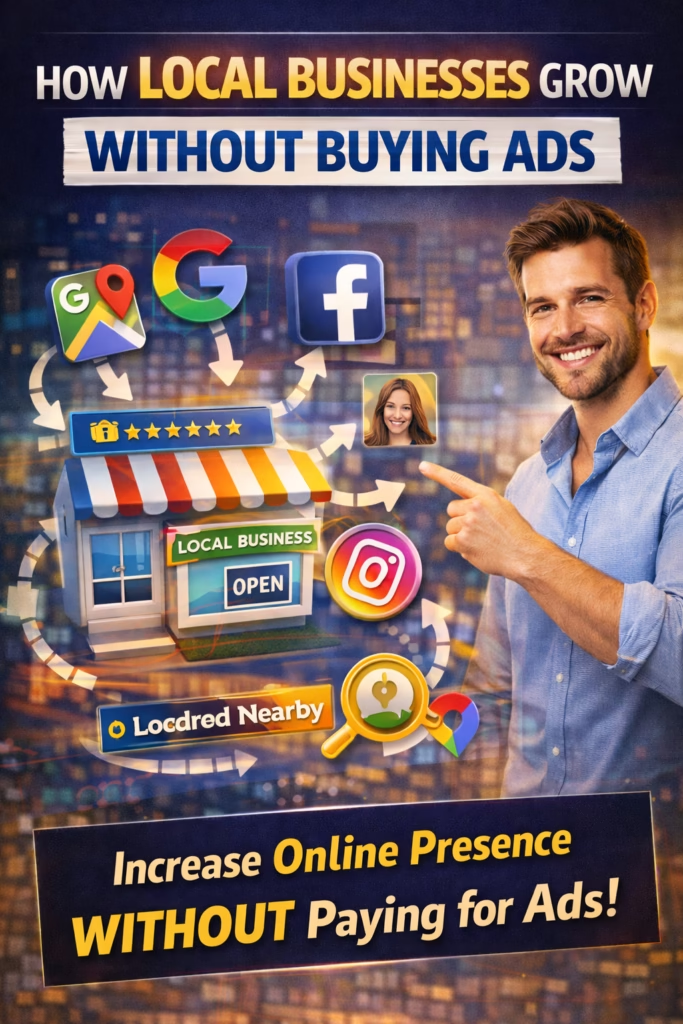
How Local Businesses Grow Without Buying Ads is a repeatable visibility system: rank locally, show up everywhere buyers already are, respond fast, follow up automatically, and turn attention into booked jobs.
Note: This is general marketing guidance. Confirm platform rules and avoid spammy duplication or misleading claims.
Introduction
How Local Businesses Grow Without Buying Ads is not about “hoping” people find you. It’s about building a system where your business appears in the places local buyers already look—then converting that attention with speed, trust, and consistent follow-up.
Paid ads can work. But many local businesses get stuck in a cycle: spend → leads → stop spending → leads disappear. Organic growth breaks that cycle by turning visibility into a compounding asset.
Big idea: Organic growth is a system, not a tactic.
Expanded Table of Contents
- 1) The “no-ads” growth model (visibility + conversion)
- 2) What buyers do before they call (and how you show up)
- 3) Google Maps: the highest-intent organic channel
- 4) Facebook Marketplace & local groups: organic demand capture
- 5) The content loop: turning one job into 30 posts
- 6) Referrals and reputation: the compounding trust engine
- 7) Speed-to-lead: the cheapest conversion lever
- 8) Follow-up SOP: recovering leads competitors lose
- 9) Offers that convert without discounting
- 10) The simple operations stack to run it weekly
- 11) KPIs that prove you’re growing without ads
- 12) 30–60–90 day rollout plan
- 13) 25 Frequently Asked Questions
- 14) 25 Extra Keywords
1) The “no-ads” growth model (visibility + conversion)
To grow without buying ads, you only need two things to improve every month:
1) Visibility (getting found)
You show up where local buyers search and browse: Maps, Marketplace, local groups, and “near me” queries.
2) Conversion (turning attention into bookings)
Fast replies, clear offers, proof, and follow-up turn the same traffic into more revenue.
Rule: If you’re not growing, you’re missing visibility, conversion, or both.
2) What buyers do before they call (and how you show up)
Most local buyers follow a simple path:
- Search on Google (“near me” / city + service)
- Scan Maps listings and reviews
- Browse social proof (photos, posts, before/after)
- Message 2–5 businesses
- Hire the one that responds fast and feels trustworthy
Pro move: The goal isn’t to “be everywhere.” It’s to be present in the 3–4 places buyers already check.
3) Google Maps: the highest-intent organic channel
For many local businesses, Google Maps is the most valuable organic channel because the buyer is already in “hire mode.” Your job is to be the obvious choice.
Maps visibility basics (the compounding layer)
- Profile completeness: categories, services, hours, photos, description
- Consistency: name/address/phone info matches everywhere
- Review velocity: steady new reviews beat “one big push”
- Proof: real job photos, team photos, and frequent updates
- Response habits: reply to reviews and messages
Rule: Map growth compounds when you post weekly and collect reviews consistently.
4) Facebook Marketplace & local groups: organic demand capture
Marketplace and local groups work because buyers already browse there daily. You can capture demand without paying for reach—if you post consistently and respond fast.
What performs best organically
- Clear offer headline (what it is + starting price/range)
- Real photos (not stock-only)
- Local location cues (city/area served)
- Simple CTA question (“What city/zip are you in?”)
Title formula (works across niches)
[Service/Item] + [Primary benefit] + [Offer hook] + [City]
Examples:
• Interior Painting – Fast Quote – This Week – Keene
• Mattress Sale – Queen/King Deals – Delivery Available – Rochester
• Property Cleanup – Same Week Scheduling – Oswego
Avoid: copy/paste duplicate posts with identical photos and titles at the same time.
5) The content loop: turning one job into 30 posts
One of the best “no-ads” strategies is to create content from work you’re already doing.
One job → multiple assets
| Asset | What to capture | Where it goes |
|---|---|---|
| Before/After | 2–4 photos, same angle | Google Maps, Facebook, Instagram |
| Short video | 10–20 seconds walkthrough | Reels/Shorts/TikTok |
| FAQ post | “How long does it take?” | Blog + social |
| Proof post | Review screenshot + job photo | All channels |
Rule: Consistency beats creativity. A weekly rhythm builds compounding visibility.
6) Referrals and reputation: the compounding trust engine
Referrals are “organic ads” you don’t pay for. The system is simple: do great work, ask at the right time, make it easy to refer, and follow up professionally.
Referral ask template
Quick favor — if you were happy with everything, could you leave a short review?
And if you know anyone else who needs [service], feel free to send them my way.
I’ll take great care of them.
Pro move: Create a “review + referral” message that goes out automatically after every completed job.
7) Speed-to-lead: the cheapest conversion lever
Most local businesses don’t lose leads because they lack traffic. They lose leads because they respond too slowly.
Why speed beats ads
- Fast response increases booking rate without increasing traffic
- Speed builds trust (“they’re professional and on it”)
- Speed reduces lead leakage to competitors
Goal: Under 5 minutes is good. Under 1 minute is best.
8) Follow-up SOP: recovering leads competitors lose
Ghosting is normal. The businesses that win are the ones that follow up consistently and politely.
3-touch follow-up sequence
| Timing | Message | Goal |
|---|---|---|
| 20–40 minutes | Quick check-in + question | Re-engage |
| Same day | Offer next step | Book |
| Next day | Provide options | Save the lead |
Follow-up #1
Quick check-in ✅
Did you still want help with this?

What city/zip are you in and what timeframe are you trying to schedule?
Follow-up #2
Heads up ✅ I have a couple openings this week.
If you tell me your city/zip, I’ll confirm the fastest option.
Follow-up #3
Still shopping? ✅
If you tell me your budget range + city, I’ll send the best options and next steps.
9) Offers that convert without discounting
You don’t need to race to the bottom. Most buyers want clarity and confidence, not just a cheap price.
High-conversion offer elements
- Clear starting point: “Starting at $___” or “Free estimate”
- Specific availability: “This week” / “Next-day delivery”
- Proof: photos, reviews, simple guarantees if applicable
- Friction removal: easy scheduling, simple checkout, clear next step
Pro move: Turn your offer into a 3-line “scan block” in every post.
10) The simple operations stack to run it weekly
Organic growth fails when it’s “random.” You need a weekly routine.
Weekly checklist (simple)
[ ] 3–7 Marketplace posts (rotating offers/cities)
[ ] 1–3 Google Business Profile posts
[ ] 5–15 review requests sent
[ ] Follow-up SOP run daily
[ ] Track response time + booked appointments
Rule: The businesses that grow without ads treat visibility like a weekly appointment.
11) KPIs that prove you’re growing without ads
| KPI | What it means | Target |
|---|---|---|
| Inbound leads/week | Demand capture | Up month over month |
| Median response time | Conversion leverage | < 5 min |
| Booked rate | Lead quality + follow-up | Improve with SOP |
| Review velocity | Trust growth | Steady weekly |
| Maps actions | High-intent visibility | Up over time |
Important: Track weekly. Organic growth is a compounding curve, not a daily spike.
12) 30–60–90 day rollout plan
Days 1–30 (Build visibility foundation)
- Optimize Google Business Profile basics + photos
- Pick 3–7 core services/offers and 3–7 target areas
- Start a consistent Marketplace / group posting cadence
- Implement instant replies + speed-to-lead process
- Send review requests after every job
Days 31–60 (Increase conversion)
- Standardize your offer block (3 lines) in every post
- Run the 3-touch follow-up SOP on every lead
- Improve proof content (before/after, reviews)
- Track response time and booked rate weekly
Days 61–90 (Scale without spending)
- Double down on the best areas and best offers
- Add more listing/post volume (without duplication)
- Automate follow-ups and review requests
- Expand content loop output from each job
13) 25 Frequently Asked Questions
1) Can local businesses really grow without buying ads?
Yes. Many grow by improving organic visibility in Maps and social platforms, then converting leads with speed and follow-up.
2) What is the fastest no-ads growth lever?
Speed-to-lead and consistent follow-up.
3) Is Google Maps better than social?
Often for high-intent leads, yes. Social can amplify awareness and proof.
4) How long does organic growth take?
Typically weeks to months, with compounding results when consistent.
5) Do I need a website to grow organically?
Not always, but it can improve trust and conversion.
6) What should I post weekly if I’m busy?
Before/after proof, one helpful tip, and one clear offer post.
7) How many Marketplace posts should I do?
Start with 3–7 per week, then scale if replies are strong.
8) What’s the biggest mistake with organic growth?
Posting inconsistently and responding slowly.
9) How do reviews help growth without ads?
Reviews increase trust and improve Maps conversion.
10) How do I ask for reviews without being awkward?
Ask right after delivering value and make it easy with a simple message.
11) Does content have to be “viral”?
No. Consistent, local proof content beats viral attempts for most businesses.
12) What content converts best?
Before/after proof, testimonials, and clear availability offers.
13) How do I avoid spam flags?
Use unique posts, vary photos/titles, and avoid aggressive duplication.
14) Should I include pricing in posts?
Often yes—at least a starting range—to reduce friction.
15) What should my first reply to a lead say?
Confirm availability, ask city/zip, and ask timeframe.
16) How many follow-ups is too many?
Three touches is a clean standard for most local businesses.
17) Why do leads ghost?
They message multiple businesses and choose the fastest, clearest responder.
18) Can automation help without ads?
Yes—automation improves response time, follow-up, and review requests.
19) What’s the best weekly routine?
Post consistently, request reviews, respond fast, and track KPIs.
20) What should I track to prove progress?
Leads, response time, booked rate, review velocity, and Maps actions.
21) How do I pick the right offer?
Choose a clear, easy next step: “free estimate,” “available this week,” or “delivery available.”
22) Can referrals replace ads?
In many cases, yes—especially when you ask consistently.
23) How do I turn one job into more leads?
Capture proof content and request reviews right after completion.
24) Do I need multiple social platforms?
No. Pick 1–2 and be consistent, then expand later.
25) What’s the fastest improvement I can make today?
Set instant replies and run a simple follow-up sequence.
14) 25 Extra Keywords
- How Local Businesses Grow Without Buying Ads
- grow a local business without ads
- organic local lead generation
- local business marketing without paid ads
- how to get customers without advertising
- Google Maps SEO for local businesses
- Google Business Profile growth strategy
- organic marketing for small businesses
- Facebook Marketplace lead generation
- local visibility strategy
- speed to lead for local businesses
- follow-up SOP for leads
- how to increase booked appointments
- referral system for local businesses
- review request strategy
- reputation marketing without ads
- content loop for local businesses
- before and after marketing strategy
- local SEO vs paid ads
- organic sales pipeline for local services
- how to rank in Google Maps
- local business growth blueprint
- customer acquisition without ad spend
- automated follow-up for local leads
- organic lead system for small business













