
How Businesses Rank Higher on Google Maps in 2025
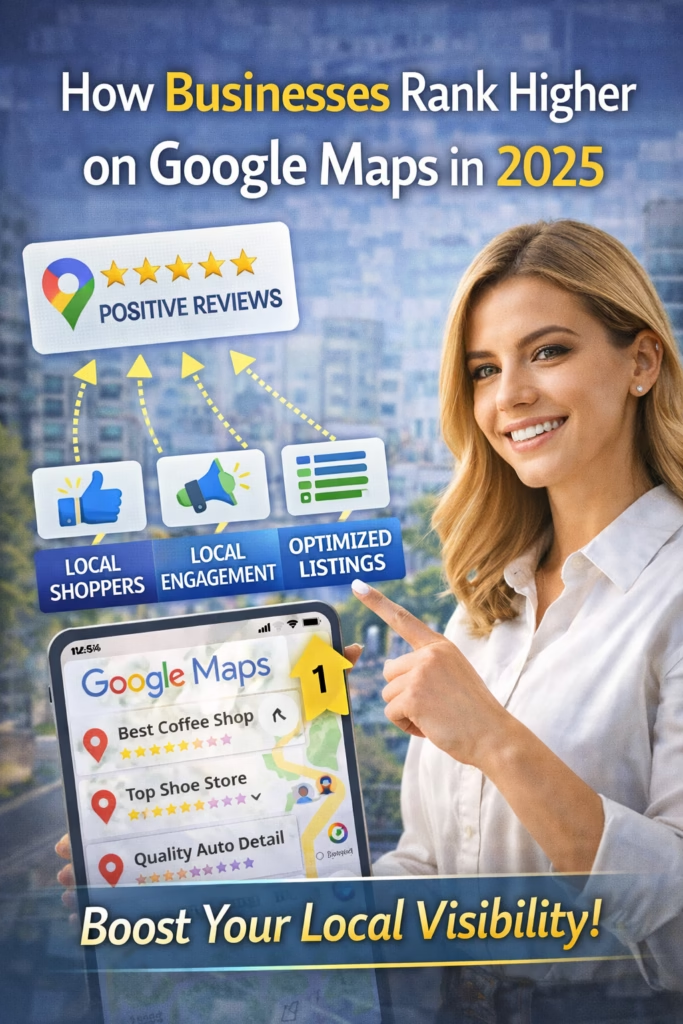
How Businesses Rank Higher on Google Maps in 2025 explains how local businesses improve visibility in Google Maps by strengthening Google Business Profile signals, local trust, review activity, website relevance, and ongoing local SEO performance.
Introduction
How Businesses Rank Higher on Google Maps in 2025 is one of the most important local marketing questions for service businesses, retailers, contractors, wellness providers, real estate businesses, and any company that depends on local discovery. Google Maps visibility is no longer just a bonus. For many local businesses, it is one of the main ways customers decide who to call, visit, or compare first.
Ranking well on Google Maps is not about one trick. It is about building the right combination of local relevance, trust, completeness, prominence, and activity. Businesses often assume that simply claiming a Google Business Profile is enough. It is not. Strong Maps performance comes from how well the business aligns its profile, its reviews, its website, and its local authority with what customers are actually searching for.
Google Maps rankings improve when a business makes it easy for Google to understand what it does, where it serves, and why customers trust it.
This is especially important in competitive local markets. Businesses are no longer just competing on proximity. They are competing on clarity, completeness, category fit, reputation, review quality, local website relevance, and how consistently they maintain their online presence. A stronger local business presence creates stronger Maps performance over time.
The businesses that rank best usually treat Google Maps as an ongoing local SEO asset, not a one-time setup. They improve their profile details, ask for reviews consistently, publish stronger local website content, keep their business information accurate, and continue giving Google better reasons to trust and surface them in local results.
Main idea: Businesses rank higher on Google Maps when profile quality, review strength, local relevance, and trust signals work together as one local SEO system.
Table of Contents
- 1) How Google Maps rankings actually work
- 2) Why Google Business Profile matters so much
- 3) Choosing the right primary and secondary categories
- 4) Profile completeness and accuracy
- 5) Reviews, recency, and reputation signals
- 6) Photos, updates, and profile activity
- 7) Website signals that support Maps rankings
- 8) Local landing pages and city relevance
- 9) Citations, consistency, and trust
- 10) Behavioral signals and conversion quality
- 11) Common mistakes that hold businesses back
- 12) Measuring progress in Google Maps SEO
- 13) A practical Google Maps ranking framework
- 14) Final thoughts
- 15) FAQs
- 16) Extra keywords
1) How Google Maps Rankings Actually Work
Google Maps rankings are shaped by how well a business matches local search intent. At a high level, strong Maps visibility depends on three core ideas: relevance, distance, and prominence. Relevance is how closely the business matches the search. Distance is how close it is to the searcher or the location involved. Prominence is how strong and trusted the business appears online.
That means a business improves Maps rankings when it strengthens all three areas instead of only focusing on one. It needs to describe itself clearly, choose the right categories, keep accurate information, build review strength, and develop broader local trust signals through its website and online presence.
At a practical level, Google Maps rewards businesses that are:
- Clearly relevant to the search
- Accurately represented
- Locally trusted
- Review-rich and active
- Well-supported by local website and citation signals
Maps rankings are not random. They reflect how strong the local business presence is as a whole.
2) Why Google Business Profile Matters So Much
Google Business Profile is one of the most important foundations of Google Maps SEO because it is the primary entity Google uses to understand and display a local business. If the profile is incomplete, vague, or weakly maintained, ranking potential usually suffers.
A strong profile helps Google understand what the business offers, where it operates, what makes it relevant, and what customers think about it. That means profile quality influences both ranking and conversion.
Your Google Business Profile is not just a listing. It is one of the strongest ranking and trust assets in local search.
Businesses that rank higher on Google Maps usually take profile optimization seriously. They fill in the important fields accurately, use the right categories, maintain hours and services, upload quality photos, and keep the profile active over time.
3) Choosing the Right Primary and Secondary Categories
Category selection is one of the most important relevance signals in Google Maps. The primary category tells Google the main identity of the business. Secondary categories help provide supporting context for related services. If the categories are wrong or too broad, the business may struggle to rank for the searches that matter most.
The best category strategy usually starts with asking one question: what is the main service or product this business most wants to rank for? That answer should often guide the primary category. Secondary categories should support other major offerings without diluting the profile.
Weak category targeting can undermine relevance even if the business is otherwise well optimized.
Businesses often improve Maps rankings significantly when they choose categories more strategically instead of using generic or mismatched ones.
4) Profile Completeness and Accuracy
Google Maps performance improves when the profile is complete, accurate, and aligned with the real-world business. Incomplete or inconsistent information weakens both trust and relevance. Google wants to show businesses it can confidently understand and verify.
Important profile details often include:
- Correct business name
- Accurate address or service-area setup
- Phone number
- Website link
- Hours of operation
- Service descriptions
- Attributes and amenities where relevant
These details matter because they help Google match the business to the right searches and help customers trust that the listing is reliable.
Maps rankings improve when the profile is both complete and accurate, not just filled out halfway.
5) Reviews, Recency, and Reputation Signals
Reviews are one of the strongest trust and prominence signals in local search. Businesses that earn more high-quality reviews, continue generating fresh reviews, and respond appropriately often create stronger ranking conditions over time. Reviews help Google understand both customer satisfaction and business activity.
Review strength is not only about total count. It also includes:
- Review recency
- Review diversity over time
- Review quality and detail
- Steady review generation
- Active response management
A strong review profile improves both local trust and local ranking momentum.
Businesses that rank higher on Google Maps usually do not treat reviews like a passive bonus. They build consistent systems for asking, earning, and responding to them.
6) Photos, Updates, and Profile Activity
Google Business Profile activity helps support freshness, engagement, and completeness. While profile activity alone does not replace stronger ranking factors, active businesses often look more relevant and more trustworthy. This can influence both visibility strength and customer behavior.
Useful profile activity may include:
- Uploading real photos regularly
- Keeping hours updated
- Adding service details
- Publishing profile updates where appropriate
- Maintaining accurate links and contact data
Photos are especially valuable because they improve trust and customer engagement. A profile with strong visuals often converts better once it ranks, and stronger engagement can reinforce overall local performance.
Ongoing profile activity supports the impression that the business is current, credible, and active.
7) Website Signals That Support Maps Rankings
Google Maps rankings are not driven by the profile alone. The website behind the profile matters too. A strong local website helps confirm relevance, authority, and trust. When the website clearly supports the same services, locations, and business identity shown on the Business Profile, Maps performance usually strengthens.
Helpful website signals often include:
- Service pages aligned with key offerings
- Clear geographic relevance
- Strong on-page local SEO
- Fast, usable site experience
- Trust-building content
- Internal linking to important local pages
Google Maps rankings improve when the website reinforces what the Business Profile claims.
The profile and the website should work together as one local relevance system rather than acting like separate assets.
8) Local Landing Pages and City Relevance
For businesses serving multiple cities or neighborhoods, local landing pages can help strengthen geographic relevance. These pages should not be thin duplicates. They should provide useful, location-specific information that supports how the business serves that area.
Good local pages often include:
- City or service-area references
- Relevant services in that location
- Practical customer information
- Local proof or examples
- Clear calls to action
These pages can support Maps rankings by making geographic relevance clearer to both users and search engines. They also help with organic local search beyond Maps.
Thin, duplicated city pages usually weaken strategy instead of strengthening it.
9) Citations, Consistency, and Trust
Business information consistency still matters in local SEO. When a business’s name, address, phone number, and other details are consistent across trusted sources, it strengthens trust and reduces ambiguity. Inconsistent business information can create confusion for both users and search systems.
That means businesses should pay attention to how their information appears across directories, platforms, local listings, and their own website. Consistency helps reinforce legitimacy and stability.
Consistency supports:
- Better entity trust
- Clearer local identity
- Less conflicting data
- Stronger overall local SEO foundation
While citations alone do not guarantee rankings, they support the broader trust picture that helps Maps performance.
10) Behavioral Signals and Conversion Quality
Google wants to surface businesses that satisfy local users. That means customer behavior matters. A profile that earns clicks, calls, direction requests, website visits, and engagement is often a stronger local asset than one that gets ignored. The ranking system and the conversion system influence one another more than many businesses realize.
That is why Maps SEO should not be separated from conversion quality. A stronger profile not only ranks better. It also wins more customer action once seen. Better photos, better reviews, better service descriptions, and stronger relevance improve both visibility and conversion behavior.
Ranking higher matters, but converting once visible matters just as much.
Businesses that improve profile quality often benefit from both stronger rankings and better lead quality from the traffic they already earn.
11) Common Mistakes That Hold Businesses Back
Many businesses underperform on Google Maps because they treat local SEO as a one-time setup instead of an ongoing process. They claim the profile, add minimal information, and then stop. Others choose weak categories, ignore reviews, let business info become outdated, or fail to strengthen their website.
Common mistakes include:
- Weak category choices
- Incomplete profile setup
- Inaccurate hours or contact info
- No review strategy
- Poor website local relevance
- Weak local landing pages
- Inconsistent business information across the web
- No ongoing profile activity
Big mistake: Expecting strong Google Maps rankings from a weak local presence.
12) Measuring Progress in Google Maps SEO
Businesses should measure more than one ranking screenshot when evaluating Google Maps performance. Strong local SEO tracking looks at both visibility and real customer action. Progress may include better ranking range, more profile actions, stronger review trends, and better quality local inquiries.
Useful signals to track include:
- Map pack visibility for core searches
- Calls and direction requests
- Website clicks from the profile
- Review growth and recency
- Engagement with photos and profile elements
- Organic rankings for local service pages
Tracking these signals helps businesses see whether Maps optimization is improving not just visibility, but actual local business outcomes.
Maps SEO should be measured by better local business performance, not just better position alone.
13) A Practical Google Maps Ranking Framework
If a business wants to apply How Businesses Rank Higher on Google Maps in 2025 in a practical way, the easiest path is to use a repeatable framework.
Step 1: Claim and fully optimize the Google Business Profile
Step 2: Choose the strongest primary and secondary categories
Step 3: Keep hours, services, and business details accurate
Step 4: Build a consistent review generation and response system
Step 5: Add strong photos and keep the profile active
Step 6: Strengthen local website pages and service relevance
Step 7: Improve local trust through consistent business information
Step 8: Track rankings, profile actions, and inquiry quality
Step 9: Continue optimizing instead of treating Maps SEO as finished
This framework works because Google Maps performance is cumulative. Small local improvements across the profile, website, reviews, and trust signals often create stronger visibility over time.
Businesses rank higher on Google Maps when they build local SEO strength across every important local touchpoint, not just one.
14) Final Thoughts
How Businesses Rank Higher on Google Maps in 2025 comes down to building a stronger overall local presence. Google wants to show businesses that are relevant, accurate, trusted, and helpful for the local searcher. That means ranking well is not about gaming the system. It is about creating a business presence that genuinely deserves stronger local visibility.
The businesses that win on Google Maps usually do the fundamentals better and more consistently than competitors. They optimize their profiles fully, choose categories carefully, earn reviews steadily, publish stronger local website content, keep their information accurate, and treat local SEO as an ongoing growth system.
Final takeaway: Businesses rank higher on Google Maps when profile strength, review momentum, local website relevance, and trust signals all work together as one local SEO strategy.
15) FAQs
1) How do businesses rank higher on Google Maps in 2025?
They rank higher by improving profile quality, category targeting, reviews, local website relevance, and broader trust signals.
2) What are the main Google Maps ranking factors?
The main ideas are relevance, distance, and prominence, supported by profile quality, reviews, and local SEO signals.
3) Does Google Business Profile optimization matter a lot?
Yes. It is one of the most important local visibility assets for Google Maps performance.
4) Why do categories matter so much?
Because categories help Google understand what the business is most relevant for in local search.
5) Should businesses use both primary and secondary categories?
Yes. The primary category should reflect the main ranking goal, while secondary categories support additional service relevance.
6) Do reviews help rankings?
Yes. Reviews support both prominence and customer trust, which can improve Maps performance and conversion.
7) Does review recency matter?
Yes. Fresh review activity often signals that the business is active and relevant.
8) Do responses to reviews matter?
They can help reinforce profile activity and customer trust, which supports stronger local performance overall.
9) Do photos help Google Maps rankings?
They help strengthen profile completeness and customer engagement, which can support better performance and conversions.
10) Should businesses keep their profile updated?
Yes. Accurate hours, services, and details help both rankings and customer trust.
11) Does the website affect Maps rankings?
Yes. A strong local website helps confirm relevance, authority, and service-area clarity.
12) Are local landing pages useful?
Yes, when they are unique, useful, and genuinely relevant to the areas served.
13) Do citations still matter?
Yes. Consistent business information across trusted sources helps reinforce legitimacy and local trust.
14) What is the biggest Maps SEO mistake?
One of the biggest mistakes is treating the profile like a one-time setup rather than an ongoing local SEO asset.
15) Can weak categories hurt rankings?
Yes. Poor category targeting can reduce relevance and weaken local visibility.
16) Does customer behavior matter too?
Yes. Profiles that attract clicks, calls, and engagement often perform better overall.
17) Is proximity the only thing that matters?
No. Distance matters, but stronger relevance and prominence signals can improve performance within the area a business can rank.
18) Can service-area businesses rank well on Google Maps?
Yes. They still need a strong profile, clear services, strong reviews, and good local website support.
19) How long does Maps SEO take?
It varies, but meaningful improvement usually comes from steady work over time rather than instant changes.
20) What should businesses track?
They should track ranking visibility, calls, clicks, direction requests, reviews, and inquiry quality.
21) Does Google Maps SEO help lead generation?
Absolutely. Better Maps visibility often leads directly to more local calls, visits, and inquiries.
22) Should businesses publish updates on their profile?
Keeping the profile active can support freshness and customer engagement, which strengthens the overall asset.
23) Do inaccurate hours hurt rankings?
They can hurt trust and user satisfaction, which undermines local performance.
24) What is the main goal of Google Maps optimization?
The main goal is to make the business easier for Google to understand and easier for local customers to trust and choose.
25) What is the core principle behind ranking higher on Google Maps?
The core principle is that stronger local relevance, stronger trust, and stronger prominence create stronger Maps visibility.
16) Extra Keywords
- How Businesses Rank Higher on Google Maps in 2025
- rank higher on Google Maps
- Google Maps SEO
- Google Business Profile optimization
- local SEO
- Google Maps ranking factors
- local business marketing
- Google Maps local ranking
- Google Business Profile SEO
- Google Maps visibility
- local SEO strategy
- Google reviews and Maps rankings
- local landing pages SEO
- Google Maps review strategy
- Maps SEO for small business
- Google Business Profile categories
- local search prominence
- Maps SEO website signals
- Google Business Profile photos
- local citation consistency
- Google Maps trust signals
- local service area SEO
- rank in local pack
- Google Maps lead generation
- local search visibility 2025