
How Businesses Build Self-Sustaining Lead Systems
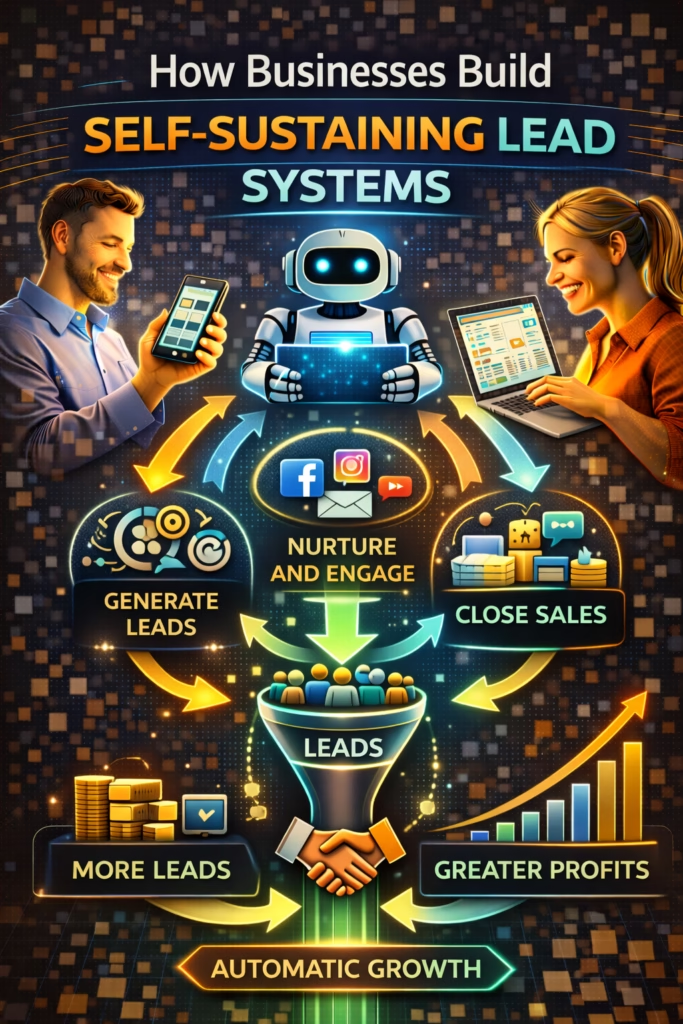
How Businesses Build Self-Sustaining Lead Systems is a flywheel approach: compounding distribution channels + clear offers + proof + automation that turns interest into booked conversations.
Note: This is general marketing guidance. Keep your outreach compliant with platform rules and applicable privacy/consent requirements.
Introduction
How Businesses Build Self-Sustaining Lead Systems starts with a mindset shift: lead generation is not a campaign. It’s infrastructure.
Campaigns are temporary. You launch, you spend, you get a spike, you stop, and everything drops. Infrastructure is different. Infrastructure keeps working because it compounds—through repetition, proof, and distribution.
The best businesses don’t rely on a single channel. They build a lead ecosystem where each part strengthens the others: better offers create more conversions; more conversions create more reviews; more reviews improve local visibility; better visibility produces more inbound; and automation ensures the inbound becomes conversations—without constant manual effort.
Big idea: A self-sustaining lead system is built once, then improved forever.
Expanded Table of Contents
- 1) What “self-sustaining” actually means
- 2) The lead flywheel model (compounding growth)
- 3) Offer engineering: make “yes” easy
- 4) Proof assets: the trust engine that compounds
- 5) Distribution channels that compound over time
- 6) Marketplace-driven inbound as a volume layer
- 7) Local SEO as the long-term foundation
- 8) Speed-to-lead automation: protect every opportunity
- 9) Follow-up SOPs that recover lost leads
- 10) CRM stages, tags, and lead ownership
- 11) KPIs that prove the system is compounding
- 12) 30–60–90 day rollout plan
- 13) 25 Frequently Asked Questions
- 14) 25 Extra Keywords
1) What “self-sustaining” actually means
A self-sustaining lead system is not “free leads forever.” It’s a system where effort creates assets that keep paying off.
Self-sustaining means:
- You generate leads even when you’re not actively spending more
- Your conversions improve because proof accumulates
- Your response and follow-up are consistent (no lead leakage)
- Your channels reinforce each other (compounding)
Reality: You still work. But the work shifts from “panic posting” to “system tuning.”
2) The lead flywheel model (compounding growth)
How Businesses Build Self-Sustaining Lead Systems is best explained as a flywheel:
1) Offer
Make the value obvious and the next step easy.
2) Proof
Show real outcomes: reviews, photos, numbers, testimonials.
3) Distribution
Publish consistently across channels that compound over time.
4) Speed + Follow-Up
Convert interest into conversations with automation.
5) Outcomes
Every sale becomes proof that makes the next sale easier.
Rule: If your system isn’t creating proof, it can’t compound.
3) Offer engineering: make “yes” easy
Most lead systems fail because the offer is vague. People don’t inquire when they’re confused.
Offer clarity checklist
- Who it’s for: the buyer should identify instantly
- What they get: outcome-based, not feature-based
- How it works: simple steps
- Timeline: when they can expect results
- Next step: book / call / message (one clear action)
Offer positioning template
✅ [Outcome] for [Specific Buyer]
✅ [Key proof or differentiator]
✅ [Fast next step] (book/call/message)
✅ [Low-friction detail] (pricing range / availability / delivery / same-day)
Pro move: Your offer should answer “Why you?” in one sentence.
4) Proof assets: the trust engine that compounds
Proof is the compounding layer of a self-sustaining system. Proof reduces skepticism and increases conversion.
High-performing proof assets
- Reviews and screenshots (with permission where needed)
- Before/after examples
- Short “customer outcome” stories
- Local proof: location, team, storefront, fleet, signage
- FAQs answered publicly (turn objections into content)
Rule: Every week, add at least one new proof asset to the system.
5) Distribution channels that compound over time
Self-sustaining lead systems use channels that continue producing after the post is published.
Compounding channels
| Channel | Why it compounds | Best use |
|---|---|---|
| Local SEO / Google Business Profile | Rankings + reviews accumulate | High-intent local buyers |
| Marketplaces | High inbound volume + search | Immediate inquiries |
| YouTube / Shorts | Search + algorithm distribution | Proof and trust |
| Email list | Owned audience | Repeat/referral loops |
| Referral engine | Word-of-mouth compounds | High-quality leads |
Avoid: relying on a single channel. Self-sustaining means multi-channel reinforcement.
6) Marketplace-driven inbound as a volume layer
Marketplaces are a powerful volume layer because shoppers already have intent. But they can overwhelm teams without automation.
Marketplace listing system (simple)
- Rotate offers weekly (keep it fresh)
- Use proof photos and clear titles
- Respond instantly with a qualifier question
- Offer next-step options (booking windows)
- Follow up with a 3-touch sequence
Instant reply (copy/paste)
Yes — it’s available ✅
Quick question: are you trying to do this today or this week?

What city/zip are you in? I’ll confirm the fastest options.
7) Local SEO as the long-term foundation
Local SEO is the most “self-sustaining” channel because it compounds with time and proof.
The local SEO compounding loop
- More customers → more reviews
- More reviews → better ranking
- Better ranking → more calls
- More calls → more customers
Weekly local SEO habits
- Post proof content (photos, short updates)
- Request reviews from recent customers
- Answer Q&A publicly
- Track calls/messages and top keywords
Rule: Local SEO is slow at first, then becomes your cheapest leads.
8) Speed-to-lead automation: protect every opportunity
Speed-to-lead is what turns distribution into results. Without it, leads leak.
What to automate first
- Instant reply (under 60 seconds)
- One-question qualification
- Routing by intent
- Follow-up cadence
Target: Under 5 minutes response. Under 1 minute is best.
9) Follow-up SOPs that recover lost leads
Follow-up makes your system self-sustaining because it converts leads you already paid for (time or money).
3-touch follow-up sequence
| Timing | Message | Goal |
|---|---|---|
| 20–40 minutes | Quick check-in | Re-engage |
| Same day | Offer options | Book |
| Next day | Alternate option | Save |
#1 Quick check-in ✅
Did you still want to move forward?
Are you trying to do this today or this week?

#2 Options ✅
Which works better:
A) Today 4–6
B) Tomorrow 12–2
C) Saturday 10–12

#3 Alternate ✅
If that one isn’t perfect, tell me your budget + timeline and I’ll send a better match.
10) CRM stages, tags, and lead ownership
Systems sustain when nothing is invisible. CRM stages create visibility.
Pipeline stages
- New
- Qualified
- Options Sent
- Booked
- Closed
- Lost
Tags that improve routing
Hot Warm Cold Needs Financing Needs Delivery Price Shopper
Rule: Every lead has an owner and a next step.
11) KPIs that prove the system is compounding
| KPI | What it indicates | Target direction |
|---|---|---|
| Response time | Lead protection | Downward |
| Booked rate | Conversion health | Upward |
| Follow-up recovery | Revenue saved | Upward |
| Review velocity | Local SEO compounding | Upward |
| Organic share of leads | Self-sustaining progress | Upward |
Rule: If your organic share is rising, your system is becoming self-sustaining.
12) 30–60–90 day rollout plan
Days 1–30 (Install the system)
- Clarify offer and create proof assets
- Deploy instant reply + one-question qualification
- Launch follow-up SOP (3-touch)
- Set CRM stages and lead ownership rules
- Start weekly local proof posting
Days 31–60 (Increase conversion)
- Refine scripts based on objections
- Improve routing and next-step options
- Expand distribution across marketplaces + content
- Increase review velocity with a request process
Days 61–90 (Make it self-sustaining)
- Double down on compounding channels
- Measure organic share of leads
- Build weekly reporting and accountability
- Scale what works and retire what doesn’t
Outcome: A system that produces leads consistently—even when you’re not “running a campaign.”
13) 25 Frequently Asked Questions
1) What is a self-sustaining lead system?
A repeatable flywheel that generates and converts leads using compounding channels plus automation for response and follow-up.
2) How long does it take to build one?
Many businesses see improvements within 30–90 days, with compounding benefits over time.
3) Do self-sustaining lead systems mean “free leads”?
No. It means effort turns into assets that keep producing over time.
4) What’s the biggest reason lead systems fail?
Lead leakage: slow response and inconsistent follow-up.
5) What’s the fastest win?
Instant reply automation + one qualifier question.
6) Which channels compound best?
Local SEO, reviews, content platforms, marketplaces, and referrals.
7) What role do marketplaces play?
They provide high volume inbound inquiries that can convert quickly with fast replies.
8) How do we avoid spam on marketplaces?
Rotate unique listings, vary photos/titles, and keep inventory accurate.
9) Why is local SEO self-sustaining?
Because rankings and reviews accumulate and keep producing calls.
10) What proof assets matter most?
Reviews, real photos, outcomes, and case-style stories.
11) What KPI shows compounding?
Rising organic share of total leads.
12) How do we qualify leads efficiently?
Ask one question at a time: timeline or location.
13) How many follow-ups should we use?
Three touches is a strong baseline.
14) How do we prevent leads from slipping through?
CRM stages + lead ownership + automation.
15) Can small businesses do this?
Yes—small businesses benefit the most because they can’t hire huge teams.
16) Do we still need ads?
Ads can help, but conversion systems should be installed first.
17) How do referrals fit in?
Referrals are a compounding channel that grows as outcomes grow.
18) What’s the best weekly habit?
Add proof: post, review requests, Q&A answers.
19) What’s the biggest implementation mistake?
Overly complex scripts and too many questions.
20) How do we keep it consistent?
Document SOPs and automate the repetitive parts.
21) How do we track attribution?
Ask “How did you find us?” and tag source in the CRM.
22) Can automation handle objections?
Simple objections, yes; complex ones should route to humans.
23) What’s the best next step after automation?
Increase distribution and proof generation.
24) What does “lead flywheel” mean?
A system where outcomes create proof that increases future conversions.
25) What’s the simplest win today?
Instant reply + timeline question + options-based next step.
14) 25 Extra Keywords
- How Businesses Build Self-Sustaining Lead Systems
- self sustaining lead generation system
- predictable lead system
- lead generation flywheel
- compounding lead channels
- marketplace lead system
- local SEO lead system
- automation for lead response
- speed to lead automation
- AI inbox triage
- automated lead qualification
- lead routing automation
- follow up SOP for leads
- reduce lead leakage
- increase booked appointments
- organic lead generation system
- reputation engine for leads
- review velocity strategy
- content velocity for leads
- CRM stages for lead tracking
- lead ownership process
- referral loop marketing
- marketing system that compounds
- lead system without ads
- 24/7 lead conversion automation













