
How Businesses Build a Complete Local Lead Engine
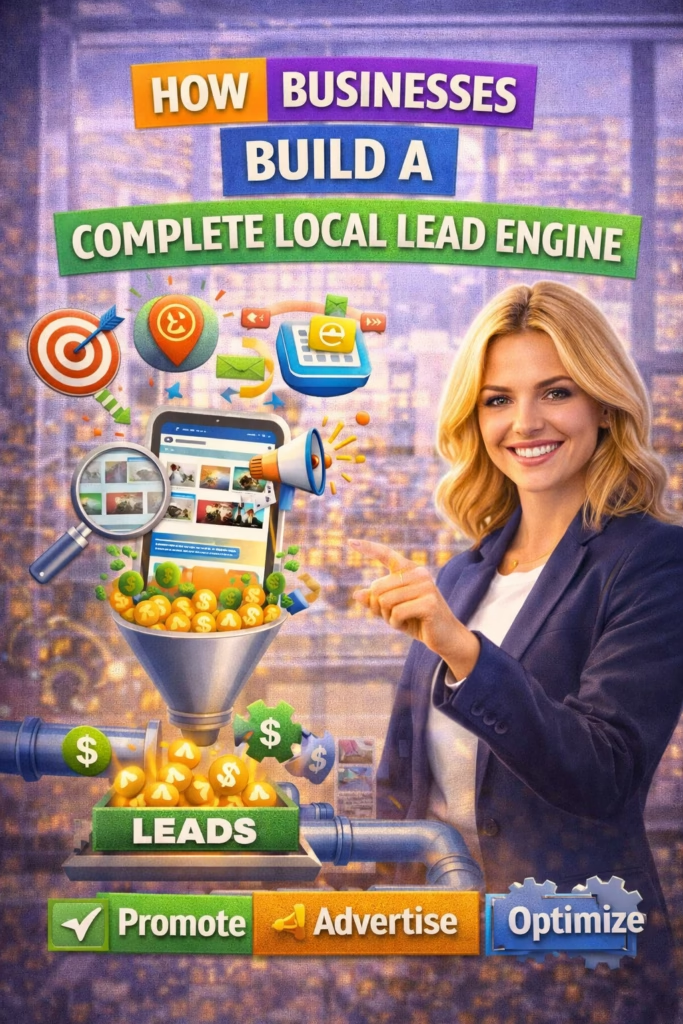
How Businesses Build a Complete Local Lead Engine is the blueprint for turning local visibility into predictable conversations, qualified leads, booked next steps, and long-term customer growth.
Note: This is general guidance. Follow platform rules, use accurate claims and pricing, and build your local lead engine around transparent, compliant marketing and communication practices.
Introduction
How Businesses Build a Complete Local Lead Engine starts with one important shift in thinking:
Local growth does not come from isolated tactics. It comes from a connected system.
Many businesses say they want more leads, but what they really have is a collection of disconnected activities. Maybe they post on Marketplace sometimes, run a few ads, update their Google profile once in a while, and hope inbound messages keep coming. That is not a lead engine. That is scattered effort.
A complete local lead engine is different. It connects all the parts that matter:
- How buyers discover you
- How they judge your offer quickly
- How they contact you
- How fast you respond
- How you follow up
- How you move the conversation toward a sale, appointment, or estimate
Big idea: A complete local lead engine is not one channel. It is a system that helps every channel work together.
Expanded Table of Contents
- 1) What a complete local lead engine really is
- 2) Why most local businesses struggle with lead consistency
- 3) The 5 core stages of a local lead engine
- 4) The visibility layer: where local discovery begins
- 5) The offer layer: what buyers need to understand immediately
- 6) The trust layer: how businesses reduce hesitation
- 7) The lead capture layer: how conversations actually start
- 8) The speed-to-lead layer: why response time changes everything
- 9) The follow-up layer: how businesses recover missed revenue
- 10) The conversion layer: moving leads into estimates, visits, and sales
- 11) How channels work together inside a local lead engine
- 12) SOPs, automation, and making the engine repeatable
- 13) KPI dashboard: how to measure a local lead engine
- 14) 30–60–90 day rollout plan
- 15) 25 Frequently Asked Questions
- 16) 25 Extra Keywords
1) What a complete local lead engine really is
A complete local lead engine is a connected system that reliably turns local demand into conversations and turns those conversations into business outcomes.
Those outcomes often include
- Calls
- Texts
- Messages
- Estimate requests
- Store visits
- Booked appointments
- Closed sales
A lead engine is not one tactic that works occasionally. It is a repeatable process that creates demand consistently.
2) Why most local businesses struggle with lead consistency
Most local businesses do not have a traffic problem first. They have a systems problem.
| Common problem | What it causes | Result |
|---|---|---|
| Weak first impressions | Low click and message rates | Weak lead flow |
| Slow replies | Lost warm leads | Wasted demand |
| No follow-up | Paused buyers disappear | Lost revenue |
| No tracking | No clear optimization path | Random decisions |
Rule: Lead inconsistency usually means the engine is incomplete, not that demand does not exist.
3) The 5 core stages of a local lead engine
A complete local lead engine usually has five stages:
- Visibility: buyers discover the business or offer
- Interest: buyers click, open, or message
- Trust: buyers feel the business is real and relevant
- Action: buyers ask for the next step
- Conversion: the lead becomes an estimate, appointment, visit, or sale
If one stage is weak, the whole engine slows down.
4) The visibility layer: where local discovery begins
The engine starts with visibility. Buyers cannot act on a business they do not discover.
Local visibility often comes from
- Marketplace listings
- Google Business visibility
- Local SEO presence
- Social posts and local content
- Referral traffic
- Paid local campaigns
Rule: The lead engine begins wherever the buyer first notices the business.
5) The offer layer: what buyers need to understand immediately
Once visibility is earned, the next job is clarity. Buyers need to understand the offer fast.
Strong offers answer these quickly
- What is this?
- Who is it for?
- Why should I care?
- What makes this easier or better?
- What should I do next?
Offer clarity is what turns local visibility into actual local interest.
6) The trust layer: how businesses reduce hesitation
Trust is the filter between attention and inquiry. Without trust, visibility becomes wasted traffic.
Strong trust signals include
- Real photos
- Clear titles and descriptions
- Believable pricing or offer framing
- Before-and-after examples or proof
- Helpful and fast responses
Trust-first hooks
Real photos + clear details ✅Available now — what city/zip are you in?Fast local options available this week.Rule: A strong lead engine reduces perceived risk early.
7) The lead capture layer: how conversations actually start
Lead capture is the point where the buyer becomes an active lead. The business must make this step easy.
Lead capture usually happens through
- Messages
- Calls
- Texts
- Estimate requests
- Forms
- Store visit requests
Best simple CTA
What city/zip are you in, and are you looking for today or this week?The easier it is to reply, the better the engine captures demand.
8) The speed-to-lead layer: why response time changes everything
Many local businesses lose leads simply because the first response happens too late. Speed-to-lead is one of the strongest multipliers in the engine.
| Reply speed | Buyer impression | Engine effect |
|---|---|---|
| Under 1 minute | Active and reliable | Strong lead capture |
| Under 5 minutes | Still competitive | Good conversion odds |
| 30+ minutes | Momentum fades | Lead leakage rises |
| Hours later | Buyer may move on | Engine efficiency drops |
Fast-reply template
Yes — we can help ✅

What city/zip are you in, and are you looking for today or this week?
Rule: A local lead engine gets stronger when response time gets shorter.
9) The follow-up layer: how businesses recover missed revenue
Not every lead moves forward immediately. Many strong opportunities are lost because there is no follow-up system.
Simple follow-up cadence
- +2–4 hours: quick check-in
- Next day: offer the next step again
- Day 3–5: final helpful nudge
Follow-up example
Quick check — are you still looking, or should I close this out?
If you want, I can send the fastest option for your area.
Avoid: aggressive pressure. Helpful follow-up keeps trust intact while recovering more of the pipeline.
10) The conversion layer: moving leads into estimates, visits, and sales
The engine is only complete when leads are intentionally moved toward a concrete next step.
Next steps often include
- Estimate or quote request
- Phone consultation
- In-store visit
- Pickup or delivery scheduling
- Appointment booking
- Direct purchase
The lead engine should not stop at conversation. It should create movement.
11) How channels work together inside a local lead engine
A complete local lead engine usually does not rely on one source alone. It combines multiple channels so they support one another.
| Channel | Main role in the engine |
|---|---|
| Marketplace | Fast local discovery and messaging |
| Google Business / SEO | Search-driven validation and discovery |
| Social platforms | Brand familiarity and extra reach |
| Website | Validation, detail, forms, and trust support |
| Follow-up tools | Lead recovery and conversion support |
Rule: The strongest local lead engines use channels differently but connect them tightly.
12) SOPs, automation, and making the engine repeatable
A lead engine becomes dependable when it no longer relies on memory or improvisation. That is where SOPs and automation matter.
What should be systemized
- Image and title standards
- Offer framing templates
- Fast response workflows
- Lead qualification questions
- Follow-up cadence
- KPI reviews
The goal is not just to get leads. It is to make lead generation repeatable.
13) KPI dashboard: how to measure a local lead engine
| KPI | What it measures | Target direction |
|---|---|---|
| Messages/day | Lead flow volume | Up |
| Messages per listing / source | Channel efficiency | Up |
| Median first reply time | Lead capture speed | Down |
| Qualified lead rate | Lead quality | Up |
| Booked next steps | Pipeline movement | Up |
| Recovery rate | Follow-up effectiveness | Up |
| Closed sales / jobs | Revenue output | Up |
Rule: A complete lead engine is measured by how reliably it turns attention into booked next steps and revenue.
14) 30–60–90 day rollout plan
Days 1–30 (Build the foundation)
- Clarify the core offer and local target area
- Improve first impressions across active channels
- Set up fast-reply workflows
- Track messages/day and reply speed
- Add trust-first templates to listings and replies
Days 31–60 (Connect the engine)
- Standardize lead capture and qualification
- Launch follow-up workflows
- Improve channel-specific listing structures
- Track booked next steps weekly
- Retire weak-performing formats
Days 61–90 (Optimize and scale)
- Document SOPs across the engine
- Expand top-performing channels and offers
- Review KPI dashboard weekly
- Optimize toward better lead quality and conversion efficiency
Businesses build a complete local lead engine by connecting every stage of the buyer journey into one system.
15) 25 Frequently Asked Questions
1) What is a complete local lead engine?
A system that attracts, captures, qualifies, follows up with, and converts local demand into real customers.
2) Why do businesses need a complete local lead engine instead of random marketing?
Because random marketing creates inconsistent results, while a connected system creates repeatability.
3) What is the fastest way to start building a local lead engine?
Clarify the offer, improve first impressions, set up fast replies, and add follow-up workflows.
4) What are the 5 core stages of a local lead engine?
Visibility, interest, trust, action, and conversion.
5) What role does visibility play?
It creates the first opportunity for local buyers to notice the business.
6) Why is offer clarity important?
Because buyers act faster when they understand the offer quickly.
7) What are trust signals?
Real photos, clear details, believable wording, proof, and fast helpful replies.
8) Why does lead capture matter?
Because interest only becomes a lead once the buyer actually starts a conversation.
9) What CTA works best?
“What city/zip are you in, and are you looking for today or this week?”
10) Why does speed-to-lead matter so much?
Because warm local intent cools quickly if the business responds too slowly.
11) How fast should businesses reply?
Under 5 minutes is strong; under 1 minute is ideal.
12) Does follow-up really affect revenue?
Yes. Many leads pause rather than disappear, so follow-up recovers real revenue opportunities.
13) What is the conversion layer?
The part of the engine that moves leads into estimates, visits, appointments, or purchases.
14) Should a lead engine use multiple channels?
Yes. The strongest engines connect channels so they support one another.
15) What role does Marketplace play?
Fast local discovery and low-friction conversations.
16) What role does Google or SEO play?
Search-based discovery and validation.
17) What role does the website play?
Validation, detail, trust support, and deeper conversion.
18) Why are SOPs important?
They make the lead engine repeatable instead of dependent on memory.
19) What KPI matters most?
Booked next steps, because they connect the engine to real pipeline movement.
20) What is messages/day?
A measure of total lead conversation volume.
21) What is qualified lead rate?
A measure of how many leads are serious, relevant, and likely to convert.
22) What is the biggest mistake businesses make?
They treat marketing and lead handling as separate tasks instead of one connected system.
23) How long until a lead engine starts improving results?
Often within days to weeks once clarity, speed, and follow-up improve.
24) What should a business improve first?
First impressions, offer clarity, reply speed, and follow-up.
25) What makes a local lead engine “complete”?
When it covers discovery, trust, capture, follow-up, and conversion in one repeatable process.
16) 25 Extra Keywords
- How Businesses Build a Complete Local Lead Engine
- local lead engine
- local lead generation system
- complete lead engine
- local customer acquisition
- marketplace lead generation
- local business growth strategy
- speed to lead local business
- local trust signals marketing
- lead capture system local
- follow-up workflow local leads
- booked next steps KPI
- qualified lead rate local
- messages per source KPI
- local conversion engine
- local visibility to revenue
- marketplace and google lead engine
- local sales pipeline system
- repeatable lead generation system
- 2026 local lead strategy
- local service lead engine
- local retail lead engine
- lead engine SOPs
- local business automation workflow
- complete customer acquisition system