
How Automation Turned Inquiries Into Revenue at Scale
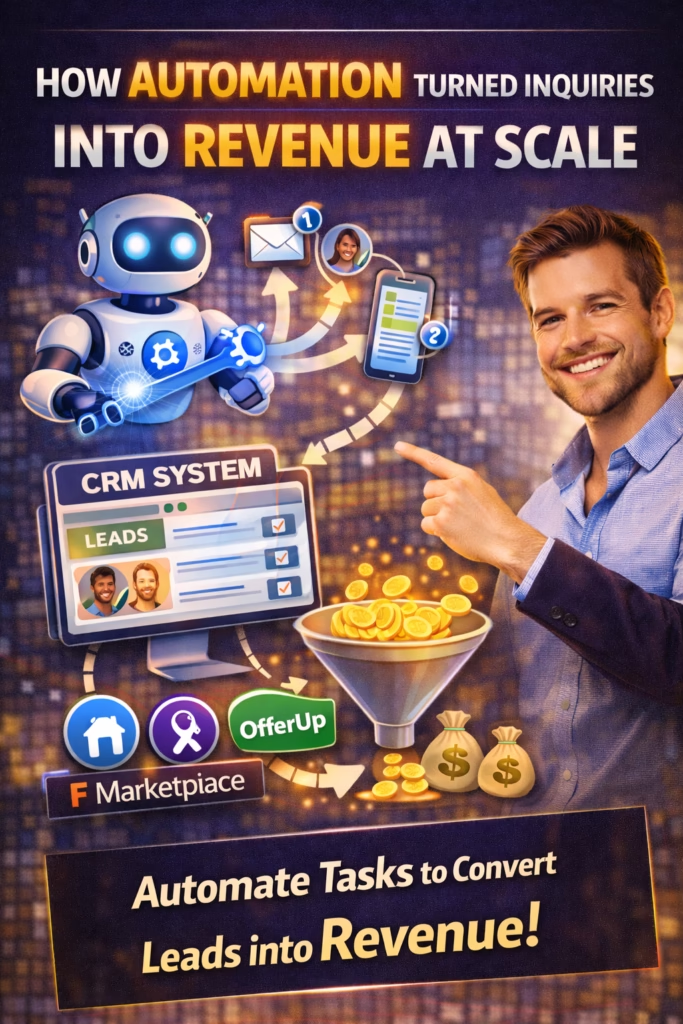
How Automation Turned Inquiries Into Revenue at Scale is the blueprint for turning inbound messages into booked next steps and predictable revenue—using speed-to-lead, routing, follow-up automation, and pipeline discipline.
Note: This is general guidance. Keep all outreach accurate, honor opt-outs, and follow platform rules and privacy requirements. Avoid spammy duplication and misleading claims.
Introduction
How Automation Turned Inquiries Into Revenue at Scale begins with a painful reality: most businesses don’t have a lead problem—they have a response problem.
They get inquiries… and then:
- Messages sit unanswered for hours.
- “I’ll reply later” becomes “they bought from someone else.”
- Follow-ups are inconsistent (or never happen).
- Hot leads get mixed with low-intent leads in one giant inbox.
- No one knows what to do next, so conversations drift and die.
Automation solves this—not by sending more messages, but by building a system that moves every inquiry forward.
Big idea: Revenue at scale comes from booked next steps—and booked next steps come from speed, clarity, and consistent follow-up.
Expanded Table of Contents
- 1) What “inquiry → revenue automation” actually means
- 2) The shift: from answering messages to running a conversion system
- 3) Where revenue leaks: the 7 most common breakdowns
- 4) The automation architecture: components that create predictable revenue
- 5) Speed-to-lead: instant replies that feel human
- 6) Smart routing: send the right lead to the right next step
- 7) Qualification automation: capture city, timeline, and intent
- 8) Follow-up sequences: where “hidden revenue” is recovered
- 9) Scheduling + confirmations: turn interest into a commitment
- 10) Pipeline + tracking: turn chaos into clarity
- 11) KPIs and attribution: prove what’s working
- 12) 30–60–90 day rollout plan
- 13) 25 Frequently Asked Questions
- 14) 25 Extra Keywords
1) What “inquiry → revenue automation” actually means
How Automation Turned Inquiries Into Revenue at Scale is about converting inbound attention into measurable outcomes.
Inquiry automation is a system that:
1) Responds instantly
Every lead gets an immediate, helpful reply that sets direction.
2) Captures key info
City/zip, timeline, and intent are collected with minimal friction.
3) Routes the lead
Hot leads are escalated; others get nurtured with follow-up.
4) Books a next step
Scheduling, pickup/delivery, consult call, or quote—locked in.
Important: Automation isn’t “set it and forget it.” It’s “set it, monitor it, improve it.”
2) The shift: from answering messages to running a conversion system
Most teams treat inquiries like “customer service.” A message arrives, and someone replies when they can.
But high-performing teams treat inquiries like a pipeline:
- Every inquiry has a status.
- Every status has a next action.
- Every next action has a trigger (time-based or behavior-based).
- Every trigger is tracked.
Rule: If you can’t see your next-step count, you can’t reliably predict revenue.
Campaign mindset vs system mindset
| Campaign mindset | System mindset |
|---|---|
| “We got 200 inquiries.” | “We booked 62 next steps and closed 19.” |
| “Our inbox is busy.” | “Our response time is under 2 minutes.” |
| “We’ll follow up later.” | “Follow-up runs automatically at 20–40 min / same day / next day.” |
| “Sales is inconsistent.” | “The SOP is consistent, so outcomes are consistent.” |
3) Where revenue leaks: the 7 most common breakdowns
Before building automation, the company mapped where money was leaking out of the funnel. They found seven predictable failures:
- Slow response: The lead buys from the first fast responder.
- No qualification: The team wastes time on low-intent leads.
- No clear next step: The conversation stays “informational.”
- No follow-up: Most “ghosts” are unrecaptured revenue.
- No routing: Hot leads get buried under everything else.
- No pipeline visibility: Leads vanish in DMs and text threads.
- No attribution: The team can’t see which sources create revenue.
Reality check: If you fix only slow response + follow-up, you can often increase revenue without generating a single new inquiry.
4) The automation architecture: components that create predictable revenue
How Automation Turned Inquiries Into Revenue at Scale is built on a simple architecture you can implement in layers. The company used a “stack” of behaviors, not a single tool.
Core components
Instant reply layer
Always-on acknowledgement + a one-question qualification prompt.
Routing layer
Rules that decide: nurture, escalate, or book.
Follow-up layer
Time-based sequences that recover leads consistently.
Scheduling layer
Low-friction booking with confirmations and reminders.
Pipeline layer
Status tracking so no lead disappears.
Measurement layer
KPIs and attribution: what happened, where, and why.
Pro move: Design automation around one goal: increase booked next steps. Everything else is secondary.
5) Speed-to-lead: instant replies that feel human
Speed is the multiplier. It’s also the easiest win because it doesn’t require more staff—only better systems.
What an instant reply must do
- Confirm the message was received
- Set direction (ask one forward-moving question)
- Reduce friction (make it easy to answer)
- Set expectations if after-hours
Universal instant reply (copy/paste)
Yes — got it ✅

Quick question so I can point you to the fastest option:
What city/zip are you in, and are you looking to do this today or this week?
After-hours variant
Got your message ✅

We’re currently away from the phone, but I can line everything up for you.
What city/zip are you in, and is this for today or this week?

I’ll reply first thing with the best next step.
Rule: Every automation ends with a question. Questions create momentum.
6) Smart routing: send the right lead to the right next step
The company realized that “one inbox” creates one outcome: chaos. Routing creates clarity.
Routing rules that work in almost any industry
| Signal | Interpretation | Route to |
|---|---|---|
| “Can I come today?” | High urgency | Immediate human escalation + booking |
| Shares zip + timeline | Qualified baseline | Options + scheduling link |
| Asks only price | Early-stage shopper | Clarify offer + qualify + nurture |
| Multiple questions | High intent but uncertain | Human handoff after short answers |
| No response after reply | Ghost risk | Follow-up sequence |
Pro move: Route by “next action,” not by “who’s available.” Availability changes; the system should not.
7) Qualification automation: capture city, timeline, and intent
Qualification isn’t interrogation. It’s simply collecting the minimum info required to recommend the correct next step.
The 3 fields that unlock conversion
- Location: city/zip (routing + logistics)
- Timeline: today/this week/this month (urgency)
- Intent: info / compare / ready to book (actionability)
One-question branching (simple + powerful)
Perfect — what city/zip are you in, and are you looking for today or this week?Second question (only after they answer)
Got it ✅
Do you want the fastest option, the best value option, or the premium option?
Rule: Ask fewer questions, not more. Every extra question lowers reply rate.
Why this works
Leads don’t want to be “sold.” They want to be guided. Qualification questions are guidance disguised as customer service.
8) Follow-up sequences: where the “hidden revenue” is recovered
Most teams stop after one reply. The company didn’t. They built a follow-up SOP that recovered leads automatically and politely.
Baseline 3-touch sequence (24 hours)
| Timing | Message type | Goal |
|---|---|---|
| 20–40 minutes | Helpful check-in | Restart the conversation |
| Same day | Options + next step | Push to booking |
| Next day | Alternate option | Save the lead |
Follow-up #1 (20–40 minutes)
Quick check-in ✅
Did you still want help with this?

Reply with your city/zip + whether you want today or this week and I’ll send the fastest next step.
Follow-up #2 (same day)
Heads up ✅ I can line this up for you if you want it.

What city/zip are you in, and is this for today or this week?
I’ll send the best option + next step.
Follow-up #3 (next day)
Still shopping? ✅
If this isn’t the perfect fit, tell me your budget + must-haves and I’ll point you to the best match.
Compliance: Always honor opt-outs. Avoid excessive follow-ups. Keep messages relevant and helpful.
Optional “Day 7 reactivation” (for longer buying cycles)
Quick update ✅
If you’re still considering this, I can send the best current option.

Want something budget-friendly, fastest, or premium?
9) Scheduling + confirmations: turn interest into a commitment
Inquiry is interest. Scheduling is commitment. The company made scheduling frictionless and used confirmations to reduce no-shows.
The scheduling rule
Don’t wait for the lead to ask to book. Offer booking after qualification—every time.
Scheduling prompt (copy/paste)
Perfect ✅
Fastest next step: grab a time that works for you.
Once you pick a slot, I’ll confirm everything and you’ll be set.
Confirmation message
Confirmed ✅ You’re all set.

If anything changes, reply “reschedule” and I’ll send options.
Reminder message (short + calm)
Reminder ✅
Looking forward to it. Reply “here” when you’re on the way (or “reschedule” if needed).
Rule: Reminders should reduce anxiety, not create pressure.
10) Pipeline + tracking: turn chaos into clarity
Automation fails without a pipeline. Why? Because you can’t automate what you can’t categorize.
Simple pipeline stages (works in any business)
- New → inquiry received
- Responded → first reply sent
- Qualified → city + timeline captured
- Options Sent → offer/choices provided
- Booked → appointment / pickup / delivery / call scheduled
- Completed → served / delivered / quote completed
- Closed → paid / contract signed / sale won
- Lost → unresponsive after SOP or opted out
What “pipeline discipline” looks like
Every lead has a status
No “floating” conversations. No invisible maybes.
Every status has a next action
Next action is a message, a call, or a booking link—always.
Every next action has a trigger
Time-based triggers ensure follow-up happens even when busy.
Every trigger is measured
KPIs show if the system is improving or slipping.
Weekly tracking checklist
[ ] inbound inquiries by source
[ ] median response time
[ ] % inquiries that became qualified
[ ] % qualified that became booked
[ ] show rate / completion rate
[ ] close rate
[ ] revenue per booked next step
[ ] top objections and best replies
11) KPIs and attribution: prove what’s working
How Automation Turned Inquiries Into Revenue at Scale works best when you track the right numbers. Not vanity metrics—conversion metrics.
| KPI | What it measures | Why it matters |
|---|---|---|
| Inbound inquiries | Demand volume | Top-of-funnel capacity |
| Median response time | Speed-to-lead | Predicts booking rate |
| Qualified rate | Lead clarity | Reduces wasted effort |
| Booked next steps | Commitment | Best leading indicator of revenue |
| Show/completion rate | Follow-through | Improves revenue without more leads |
| Close rate | Sales effectiveness | Final conversion health |
| Time-to-book | Funnel efficiency | Shorter cycles scale better |
| Revenue per lead/source | Attribution | Shows where to focus |
Attribution that’s actually useful
Attribution doesn’t have to be complicated. Start with:
- Source tag on each lead (marketplace, website, call, referral)
- Status timestamps (inquiry received, responded, booked, closed)
- Outcome (won/lost + reason)
Pro move: Track “lost reason” and fix the top one first. The fastest growth often comes from removing one bottleneck.
12) 30–60–90 day rollout plan
Days 1–30 (Stop the bleeding)
- Define pipeline stages and required fields (city, timeline, intent).
- Deploy instant replies across channels (within policy limits).
- Implement the baseline 3-touch follow-up sequence.
- Create 10–15 approved reply templates for common questions.
- Start tracking response time + booked next steps weekly.
Days 31–60 (Increase booking rate)
- Add routing rules (hot leads → human, others → nurture).
- Add scheduling prompts + confirmations + reminders.
- Refine qualification questions to reduce back-and-forth.
- Standardize a “handoff moment” for high-intent leads.
- Review conversations weekly and improve top 5 templates.
Days 61–90 (Scale and optimize)
- Expand automation coverage to all inquiry sources (calls, forms, DMs).
- Add attribution and improve reporting (source → booked → closed).
- Introduce a day-7 reactivation for longer buying cycles.
- Retire weak scripts and double down on high-performing ones.
- Set targets: response time, qualified rate, booked rate, close rate.
Truth: If you run this plan with discipline, your existing inquiry volume often produces significantly more revenue without generating a single new lead source.
13) 25 Frequently Asked Questions
1) What does it mean to turn inquiries into revenue with automation?
It means using instant replies, routing, follow-up sequences, scheduling, and pipeline tracking to convert inbound inquiries into booked next steps and closed sales consistently.
2) What is speed-to-lead?
Speed-to-lead is how fast you respond after someone reaches out. Faster response times typically produce higher booking and close rates because buyers choose the quickest competent option.
3) Do I need a CRM to automate follow-up?
A CRM helps, but the core requirement is a trackable workflow: statuses, triggers, and a consistent follow-up SOP that runs when people don’t respond.
4) What’s the first automation I should implement?
Instant replies plus a 3-touch follow-up sequence. This reduces lead leakage immediately.
5) How do I automate without sounding robotic?
Keep messages short, helpful, and question-based. Personalize with city/timeline, and hand off high-intent leads to a human quickly.
6) What is lead leakage?
Lead leakage is revenue loss from unanswered inquiries, slow responses, missed follow-ups, and untracked conversations that never reach a next step.
7) What counts as a “booked next step”?
An appointment, consult call, pickup/delivery slot, site visit, quote appointment, or any scheduled commitment that moves beyond messaging.
8) How many follow-ups should I send?
Three touches in the first 24 hours is a strong baseline. Add a day-7 reactivation for longer buying cycles if appropriate.
9) Which channels are easiest to automate?
SMS, email, missed-call text back, web chat, and internal task reminders. Some marketplaces restrict automation—follow policies carefully.
10) What should my first message say?
Confirm receipt/availability, ask city and timeline, and offer a clear next step such as options or scheduling.
11) How do I qualify leads automatically?
Use one question to capture city/zip and timeline, then one follow-up question for intent or preference (fastest/value/premium).
12) How do I route leads to the right person?
Create rules based on urgency, location, category, and business hours. Escalate hot leads; nurture the rest.
13) How do I handle after-hours inquiries?
Send an instant reply that sets expectations, captures city/timeline, and offers a scheduling link or next-step promise.
14) Can automation improve close rate?
Yes. It improves response speed, increases follow-up consistency, and boosts booked next steps—all of which increase closes.
15) What KPIs should I track?
Inbound inquiries, response time, qualified rate, booked rate, show rate, close rate, time-to-book, and revenue per lead/source.
16) How do I measure ROI from automation?
Compare booked next steps and closed revenue before vs after automation while monitoring response time and follow-up completion.
17) What response time should I aim for?
Under 5 minutes is strong. Under 1 minute is elite. Instant replies help you hit this consistently.
18) Should I use AI to reply to leads?
AI can draft responses and handle FAQs, but use guardrails, avoid unsupported claims, and hand off high-intent leads to a human quickly.
19) How do I prevent automations from getting flagged?
Follow platform policies, avoid spammy duplication, throttle follow-ups, keep messages helpful, and honor opt-outs.
20) What follow-up timing works best?
20–40 minutes, later same day, and next day is a proven baseline. Keep it helpful, not pushy.
21) How do I reduce no-shows?
Send confirmations and reminders with a simple reschedule option, and set expectations clearly.
22) What should be automated vs handled manually?
Automate speed-to-lead, qualification prompts, reminders, and follow-up. Handle negotiation, complex objections, and high-ticket closing manually or with supervised support.
23) Do I need integrations to start?
No. Start with templates and a basic pipeline. Integrations make it scalable, but SOP clarity matters most.
24) How long until results show up?
Response speed improves immediately. Booking improvements often appear within 2–4 weeks, and compounding gains show over 60–90 days.
25) What’s the biggest mistake businesses make with automation?
Automating messages without defining a pipeline and next-step rules. Automation must move leads toward booking—not just “reply.”
14) 25 Extra Keywords
- How Automation Turned Inquiries Into Revenue at Scale
- inquiry to revenue automation
- lead conversion automation system
- speed to lead automation
- instant reply automation
- follow up sequence for leads
- lead nurturing automation
- appointment setting automation
- booking rate optimization
- CRM workflow automation
- pipeline automation sales
- lead routing automation
- after hours lead response
- missed call text back automation
- sales follow up SOP
- reduce lead leakage
- convert inbound inquiries
- increase booked appointments
- time to book KPI
- lead response time KPI
- revenue attribution tracking
- automated qualification questions
- AI assisted sales replies
- scalable customer inquiry system
- predictable revenue system 2026













