
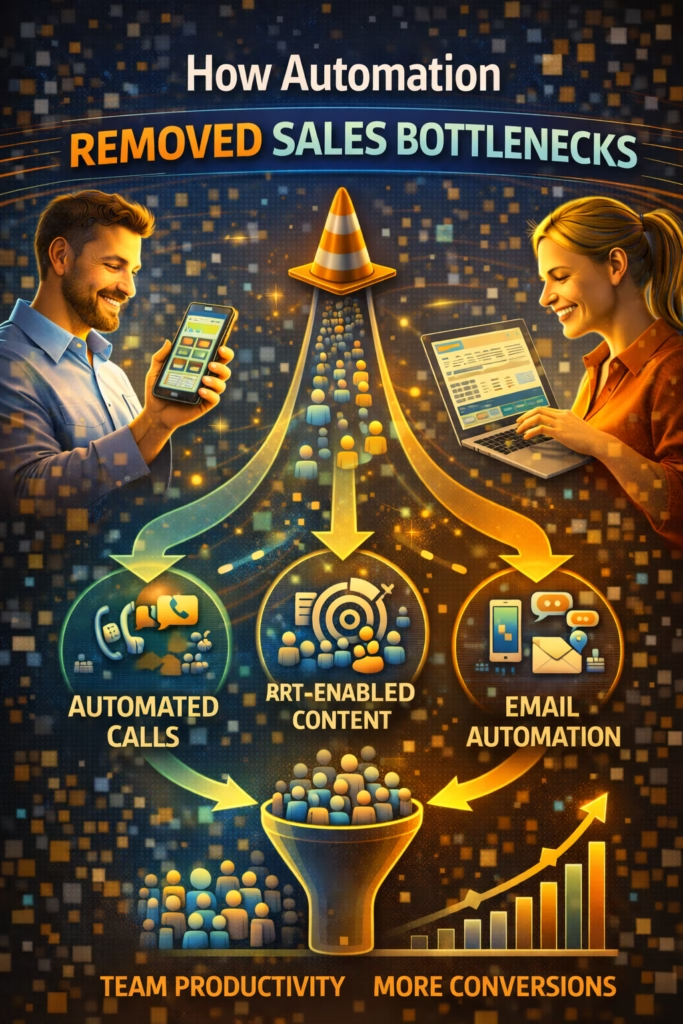
How Automation Removed Sales Bottlenecks
How Automation Removed Sales Bottlenecks is the system for turning inbound interest into booked next steps—without missed leads, slow replies, or inconsistent follow-up.
Note: This is general guidance. Confirm compliance with platform policies, privacy rules, and consent requirements before automating messaging or outreach.
Introduction
How Automation Removed Sales Bottlenecks starts with an uncomfortable truth: most “sales problems” are actually process problems.
Leads don’t stop converting because they aren’t interested. They stop converting because the system fails them:
- They wait hours for a response
- They never get a follow-up
- They get routed to the wrong person
- They’re forced through friction (forms, long calls, unclear next steps)
- No one owns the lead, so it falls through the cracks
Automation fixes these bottlenecks by making your best process happen every time.
Big idea: Automation doesn’t “make sales.” It removes the friction that kills sales.
Expanded Table of Contents
- 1) The 7 most common sales bottlenecks
- 2) How to diagnose bottlenecks in 30 minutes
- 3) Automation #1: speed-to-lead (instant response)
- 4) Automation #2: routing (right person, right time)
- 5) Automation #3: qualification (protect capacity)
- 6) Automation #4: follow-up SOP (recover revenue)
- 7) Automation #5: pipeline stages + ownership
- 8) Automation #6: handoffs and scheduling
- 9) Automation #7: reporting and KPI feedback loops
- 10) Copy/paste scripts and templates
- 11) KPIs to prove bottlenecks are gone
- 12) 30–60–90 day rollout plan
- 13) 25 Frequently Asked Questions
- 14) 25 Extra Keywords
1) The 7 most common sales bottlenecks
Most businesses experience the same bottlenecks—regardless of industry.
1) Slow response time
Leads go cold fast. If response time is slow, conversion collapses.
2) Missed leads
Messages arrive after hours, during busy shifts, or to the wrong inbox.
3) Inconsistent follow-up
Most buyers need more than one touch to move forward.
4) Manual qualification
Sales time gets wasted answering the same questions repeatedly.
5) No pipeline ownership
If no one owns the lead, no one closes it.
6) Unclear next steps
Even interested leads stall when the process is vague.
7) No feedback loop
Without KPIs, teams can’t tell what’s working or breaking.
Rule: Fix bottlenecks before buying more traffic. Otherwise you just pay to leak leads faster.
2) How to diagnose bottlenecks in 30 minutes
You can identify where sales break down quickly by checking four numbers:
| Metric | What to check | What it indicates |
|---|---|---|
| Median response time | Average time to first reply | Speed-to-lead bottleneck |
| Lead-to-qualify rate | % that provide city/timeline/budget | Script + clarity issues |
| Qualify-to-booked rate | % that schedule next step | Offer/options issues |
| Booked-to-close rate | % that buy/commit | Process/trust/value issues |
Pro move: If response time is the worst number, fix it first. It’s the highest leverage bottleneck.
3) Automation #1: speed-to-lead (instant response)
Speed-to-lead is the conversion multiplier. Automation removes the delay by sending an instant first reply and collecting the minimum needed info.
Instant reply (universal)
Yes — I can help ✅
Are you looking to do this today or this week?

What city/zip are you in? I’ll confirm the fastest next step.
Why this works
- Confirms availability instantly
- Asks one qualifying question (timeline)
- Collects location for routing and options
Rule: The first reply is not a pitch. It’s a qualifier + next-step trigger.
4) Automation #2: routing (right person, right time)
Routing automation prevents leads from going to the wrong inbox or being ignored during busy hours.
Common routing rules
- Route by city/zip (territory-based)
- Route by product/service category
- Route by lead urgency (today vs this week)
- Route by business hours (after-hours queue)
Avoid: “everyone sees everything.” It creates confusion and missed ownership.
5) Automation #3: qualification (protect capacity)
Qualification automation reduces wasted time by collecting the essentials and tagging leads before a human touches them.
Minimum viable qualification (MVQ)
- Timeline: today / this week / later
- Location: city/zip
- Need: what they want (simple label)
- Budget: optional, depending on industry
One-question qualifier (copy/paste)
Perfect ✅ What city are you in, and are you looking to do this today or this week?Pro move: Route “today” leads to fastest-response coverage first.
6) Automation #4: follow-up SOP (recover revenue)
Most sales teams lose the majority of leads to silence—not rejection. Follow-up automation prevents that.
3-touch follow-up SOP
| Timing | Message | Goal |
|---|---|---|
| 20–40 minutes | Quick check-in + question | Re-engage |
| Same day | Availability + options | Create action |
| Next day | Alternate option | Save lead |
Follow-up #1
Quick check-in ✅
Did you still want to move forward?

Tell me your city and whether you want today or this week, and I’ll confirm options.
Follow-up #2
Heads up ✅ We’ve had a few inquiries today.
If you want the fastest option, tell me your city and I’ll confirm availability.
Follow-up #3
Still shopping? ✅
If this isn’t the perfect fit, tell me your budget + timeline and I’ll send a better option.
Rule: Follow-up is not nagging when it offers helpful options.
7) Automation #5: pipeline stages + ownership
Automation becomes powerful when every lead is automatically categorized and assigned.
Pipeline stages
- New
- Qualified
- Options Sent
- Booked
- Closed
- Lost
Ownership rules
- Every stage has a responsible person
- Every lead has a next action (and due time)
- No lead stays “New” for more than X minutes
Avoid: leaving leads unassigned. That’s how automation still “fails.”
8) Automation #6: handoffs and scheduling
Friction kills sales. Scheduling automation turns interest into commitments.
Options-based scheduling (copy/paste)
Perfect ✅ I can do:
• Today: __:__ / __:__
• Tomorrow: __:__ / __:__

Which works best? And what city are you in?
Confirmation message
Booked ✅
You’re set for (day/time). If anything changes, reply here and we’ll adjust.
Rule: “Book the next step” is the moment your conversion becomes real.
9) Automation #7: reporting and KPI feedback loops
Reporting automation creates a weekly feedback loop so the system improves instead of drifting.
Weekly KPI snapshot
[ ] # of inbound leads
[ ] Median response time
[ ] % qualified
[ ] % booked
[ ] % closed
[ ] Top 3 sources
[ ] Top 3 bottlenecks observed
Pro move: If response time or booked rate slips, fix ops before scaling traffic.
10) Copy/paste scripts and templates
Universal first reply
Yes — I can help ✅
Are you looking to do this today or this week?
What city/zip are you in?
“What’s the price?” reply
Yep ✅ It’s $___.
Are you looking for today or this week—and what city are you in?
“Lowest price?” reply
I can help ✅
Is your priority the lowest price or the best overall value?
Tell me your city + timeline and I’ll send the best match.
Close to booking
Perfect ✅
Would you rather do today or tomorrow? I can send two time options.
11) KPIs to prove bottlenecks are gone
| KPI | Target | Why it matters |
|---|---|---|
| Median response time | < 5 min (good), < 1 min (best) | Highest leverage conversion lever |
| Qualified rate | Rising trend weekly | Proof scripts are working |
| Booked rate | Rising trend weekly | Demand capture strength |
| Lead leakage (unanswered) | Near zero | Automation is doing its job |
| Close rate | Stable or rising | Revenue impact |
Truth: Automation wins when it makes your best process happen every time.
12) 30–60–90 day rollout plan
Days 1–30 (Eliminate the biggest leak: speed + follow-up)
- Deploy instant replies with MVQ questions
- Implement 3-touch follow-up SOP
- Create routing rules (city/zip + urgency)
- Track response time + booked rate weekly
Days 31–60 (Standardize qualification + pipeline)
- Implement pipeline stages with ownership
- Add tags (urgency, budget, category)
- Build options-based scheduling templates
- Reduce manual repetitive Q&A with scripted replies
Days 61–90 (Scale responsibly + optimize)
- Expand volume once lead leakage is near zero
- Optimize weekly based on KPI trends
- Improve proof and offer clarity to raise close rate
- Strengthen coverage for peak inquiry windows
13) 25 Frequently Asked Questions
1) What sales bottlenecks does automation remove first?
Slow response time, missed leads, and inconsistent follow-up.
2) Does automation replace sales people?
No. It replaces repetitive tasks and improves consistency so sales people can focus on closing.
3) What is speed-to-lead automation?
Instant responses that confirm availability and collect key info immediately.
4) Why do leads go cold?
Slow replies and unclear next steps cause buyers to choose someone else.
5) What is lead routing?
Automatically sending leads to the correct person based on rules like city, urgency, or category.
6) What is MVQ?
Minimum viable qualification: timeline, location, and need.
7) How many follow-ups should I send?
Three touches is a strong baseline.
8) Is follow-up annoying?
Not when it’s helpful and offers options.
9) What is lead leakage?
Leads lost due to no reply, no follow-up, or no owner.
10) What pipeline stages should I use?
New, Qualified, Options Sent, Booked, Closed, Lost.
11) What’s the most important KPI?
Median response time is often the highest leverage metric.
12) How do I improve booked rate?
Use options-based scheduling and make the next step obvious.
13) How do I handle “lowest price?”
Use a value vs budget question and offer options.
14) Can automation increase close rate?
Yes—by improving speed, consistency, and follow-up.
15) What should the first reply include?
Availability + one qualifying question + a next step.
16) What’s the biggest automation mistake?
Automating before fixing clarity and ownership.
17) Do I need a CRM?
Not required, but pipeline tracking is essential.
18) What if my team is small?
Automation helps the most when capacity is limited.
19) How do I know automation works?
Response time drops, booked rate rises, lead leakage falls.
20) What’s the fastest win I can do today?
Deploy instant replies and a 3-touch follow-up SOP.
21) Can automation work across industries?
Yes—the systems are universal, the scripts change by niche.
22) What should not be automated?
Claims you can’t verify, misleading offers, or spam duplication.
23) How long until results?
Often immediate improvements in response and follow-up; compounding results in 60–90 days.
24) What if leads come in after hours?
Use after-hours automation to acknowledge and queue for morning routing.
25) What’s the goal of automation?
To remove friction, reduce lead leakage, and make conversion predictable.
14) 25 Extra Keywords
- How Automation Removed Sales Bottlenecks
- sales bottlenecks automation
- automation for sales
- speed to lead automation
- instant reply automation
- automated lead routing
- lead qualification automation
- automated follow up SOP
- reduce lead leakage
- pipeline stages automation
- sales pipeline automation
- booked appointment automation
- options based scheduling
- sales conversion systems
- predictable sales system
- sales process automation
- messaging funnel automation
- CRM workflow automation
- lead management automation
- after hours lead response
- sales KPI reporting
- median response time improvement
- follow up message templates
- 30 60 90 day rollout plan
- automation improves close rate