

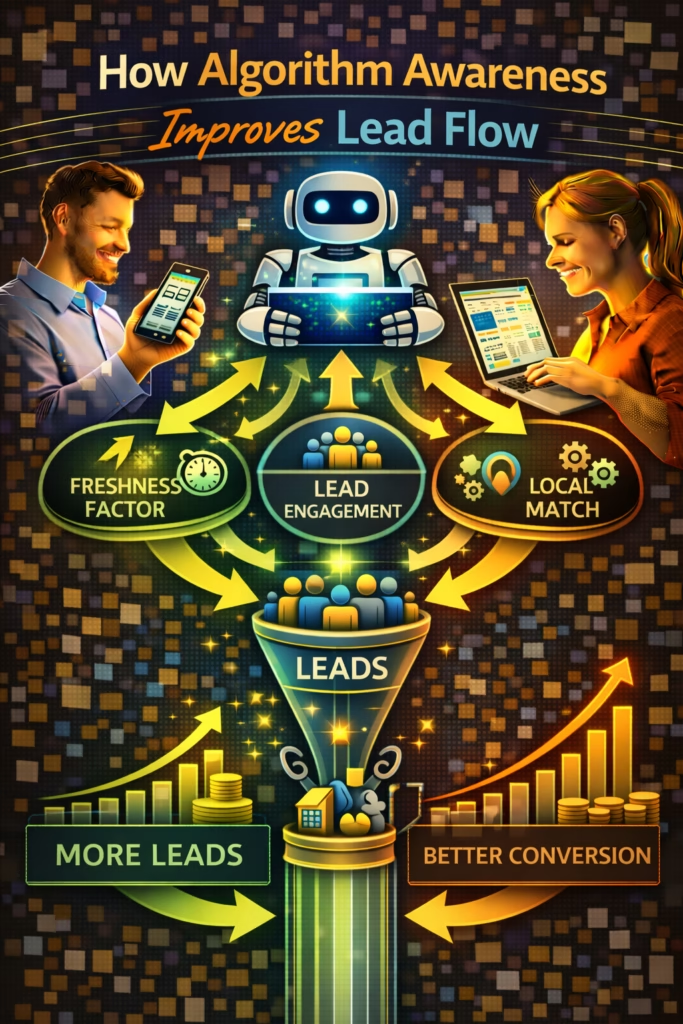
How Algorithm Awareness Improves Lead Flow
How Algorithm Awareness Improves Lead Flow is the blueprint for turning “guessing” into a system—by aligning your listings and behavior with the signals marketplaces reward.
Note: This is general guidance. Follow platform rules, keep details truthful, and avoid duplication, spam, or engagement manipulation.
Introduction
How Algorithm Awareness Improves Lead Flow starts with a simple observation:
Most sellers don’t have a “lead problem.” They have a signal problem.
When a marketplace decides what to show buyers, it’s not flipping a coin. It’s evaluating signals—things it can measure quickly and trust over time.
Algorithm awareness means you stop treating lead flow like luck. Instead, you build a repeatable system that improves the signals that generate exposure—then you let the exposure turn into messages, and messages turn into booked next steps.
Big idea: The algorithm doesn’t “reward sellers.” It rewards listings that buyers click, message, and complete transactions with—without creating risk.
Expanded Table of Contents
- 1) What algorithm awareness really means
- 2) The core signals that shape exposure
- 3) The lead flow model: impression → message → booked step
- 4) Relevance: matching buyer intent the algorithm can detect
- 5) Click-to-message performance (thumb + title + hook)
- 6) Freshness: why consistent activity beats bursts
- 7) Engagement loops that increase distribution
- 8) Anti-flag variety: scale without duplication
- 9) Response speed: the conversion multiplier
- 10) Testing plan: stop guessing and prove it
- 11) KPIs that track algorithm-aware growth
- 12) 30–60–90 day rollout plan
- 13) 25 Frequently Asked Questions
- 14) 25 Extra Keywords
1) What algorithm awareness really means
Algorithm awareness is not about “gaming” a platform. It’s about understanding how platforms reduce risk and maximize buyer satisfaction.
When sellers say “the algorithm hates me,” it usually means:
- buyers aren’t clicking their listing (weak thumbnail/title), or
- buyers click but don’t message (weak offer/hook), or
- buyers message but don’t convert (slow response, unclear next step), or
- the account triggers suppression (duplication, spam patterns, policy risk).
Rule: Algorithm awareness is “signal literacy.” You learn what matters, then you build around it.
2) The core signals that shape exposure
Most marketplaces evaluate a similar set of signals. You don’t need insider secrets—you need alignment.
| Signal | What it indicates | What you can do |
|---|---|---|
| Relevance | Matches buyer intent | Clear keyword + category + accurate details |
| CTR (click-through) | Thumbnail/title wins scroll | Test first photo and title clarity |
| Message rate | High intent | Offer stack + simple CTA question |
| Freshness | Listing is current | Consistent cadence + meaningful updates |
| Response speed | Seller reliability | Instant replies + follow-up loop |
| Account health | Safety/trust | Avoid duplicates, keep claims truthful, reduce removals |
Pro move: Treat these signals like levers. Improve one lever at a time, measure the result, and keep what works.
3) The lead flow model: impression → message → booked step
Lead flow is not a mystery. It’s a funnel with measurable steps:
- Impression: buyer sees your listing
- Click: buyer opens it
- Scroll: buyer reviews photos/details
- Message: buyer asks about it
- Reply: you respond and guide the next step
- Booked step: pickup/delivery/appointment scheduled
Rule: The best KPI is booked next steps. Everything upstream should support it.
4) Relevance: matching buyer intent the algorithm can detect
Relevance is the algorithm’s first filter. If your listing is unclear, it can’t match it correctly.
Intent mapping (simple)
| Intent | What buyers care about | What your listing should emphasize |
|---|---|---|
| Value | Price-to-quality | “Best value,” honest condition, clear pricing |
| Speed | Availability now | “Available today,” fast pickup/delivery |
| Premium | Quality experience | Upgrades, comfort, warranty/brand proof (if true) |
| Trust | Legit seller | Real photos, transparent details, simple next step |
| Fit | Will it work for me? | Dimensions, compatibility, use-case bullets |
Pro move: Create multiple truthful angles for the same category. That increases surface area without duplicating.
5) Click-to-message performance (thumb + title + hook)
If you want algorithm-aware lead flow, you must win the scroll—then win the message.
The three-part “click-to-message” stack
1) First photo
Clear, real, bright, simple composition. The photo is the advertisement.
2) Title clarity
Say what it is, add one hook, add one option (availability/pickup/delivery).
3) First two lines
Confirm legitimacy, provide one offer, then ask a question.
Message CTA
One question: city/zip + timeline. Simple and fast.
Clarity upgrade template
Title: [What it is] + [Hook] + [Option]
Line 1: Real photos + clear details ✅
Line 2: One offer (availability/pickup/delivery/financing) ✅
CTA: What city/zip are you in and are you looking for today or this week?
Rule: A better thumbnail can outperform doubling your posting volume.
6) Freshness: why consistent activity beats bursts
Many sellers confuse “activity” with “spikes.” Algorithms tend to reward stability because stability predicts a better buyer experience.
Freshness behaviors that help
- Posting new, varied listings consistently
- Meaningful updates (new photos, clearer titles, updated availability)
- Steady messaging and response behavior
Freshness behaviors that hurt
- Burst posting followed by silence
- Reposting duplicates
- Constant micro-edits that look manipulative
Pro move: Build a sustainable rhythm: small daily action beats occasional huge output.
7) Engagement loops that increase distribution
Engagement isn’t just “likes.” On marketplaces, the strongest engagement is buyer intent:
- Clicks
- Saves
- Messages
- Conversations that reach a next step
Engagement loop
- Better thumbnail → more clicks
- Clear info → more scrolling
- Offer + CTA → more messages
- Fast reply → more conversions
- Better outcomes → better distribution over time
Rule: Optimize for messages and booked steps, not vanity metrics.
8) Anti-flag variety: scale without duplication
The fastest way to lose lead flow is to look like spam. The solution is variety that stays truthful.
Variety rotation checklist
- Different angle (value/speed/premium/trust/fit)
- Different first photo and photo order
- Different hook line (first 1–2 sentences)
- Different bullet emphasis (dimensions, comfort, delivery, proof)
- Different posting windows
Important: Avoid identical duplicates. Rotate responsibly and follow platform rules.
Fast “angle library” (examples)
“Solid option if you want quality without overspending.”
“Available now—fast pickup/delivery options.”
“Real photos + transparent details.”
“Ideal for [use-case]—see size details below.”
“For buyers who want the best experience.”
“Options available—ask what fits your budget.”
9) Response speed: the conversion multiplier
Response speed is an algorithm-aware decision because it improves outcomes. Better outcomes reinforce distribution over time.
Instant reply (universal)
Yes — it’s available ✅
What city/zip are you in, and are you looking for today or this week?
I’ll confirm the fastest options.
Follow-up loop (simple)
Checking back—did you still want to set up a time?
If yes, what day works best and what city/zip are you in?
Rule: If you can’t respond fast, your posting effort leaks leads.
10) Testing plan: stop guessing and prove it
Algorithm awareness becomes powerful when you test and measure.
Test order (highest impact first)
- First photo
- Title clarity
- First two lines (hook)
- CTA question
- Posting time window
Simple test process
1) Change one variable
2) Run 3–7 days
3) Track messages/day + booked next steps
4) Keep the winner
5) Repeat weekly
Pro move: Don’t test everything at once. One change at a time is how you find the real lever.
11) KPIs that track algorithm-aware growth
| KPI | What it measures | Target direction |
|---|---|---|
| Active listings | Surface area | Up |
| Messages/day | Exposure + intent | Up |
| Messages per listing | Listing quality | Up |
| Median response time | Speed-to-lead | Down |
| Booked next steps | Revenue predictor | Up |
| Flags/removals | Compliance risk | Down |
Rule: If messages are rising but booked steps are flat, your response flow needs work.
12) 30–60–90 day rollout plan
Days 1–30 (Fix signals)
- Upgrade first photo + title on top listings
- Deploy instant replies and CTA question
- Stop duplication patterns and build variety angles
- Start KPI tracking (messages/day, response time)
- Run first weekly A/B test (thumbnail)
Days 31–60 (Build rhythm)
- Set a sustainable daily cadence
- Expand surface area with varied listings
- Refresh top performers weekly (meaningful changes only)
- Implement follow-up loop for inactive leads
Days 61–90 (Compound)
- Document SOPs for posting, QA, and responses
- Double down on winning angles
- Retire low performers and replace with improved variants
- Review KPIs weekly and optimize the bottleneck
Pro move: Each month, your baseline improves because your system improves—not because you “got lucky.”
13) 25 Frequently Asked Questions
1) What is algorithm awareness in marketplace selling?
Understanding what platforms reward (CTR, messages, response speed, freshness, account health) and building around those signals.
2) Does understanding the algorithm really increase leads?
Yes—because it changes your actions toward what improves click-to-message performance and conversion.
3) What is the fastest algorithm-aware change to improve lead flow?
Upgrade the first photo and title, then respond faster.
4) What signals matter most for exposure?
Relevance, click-through, message rate, freshness, response speed, and account health.
5) Is posting more always better?
No—consistent cadence and variety matter more than raw volume.
6) What is click-to-message performance?
How well your listing turns impressions into clicks and clicks into messages.
7) Why does the first photo matter so much?
It drives CTR, and CTR drives engagement and distribution.
8) What should a good marketplace title include?
What it is + one hook + one option (pickup/delivery/availability).
9) Do keywords matter?
Yes, but clarity matters more than stuffing. Use natural keywords in the title and first line.
10) Do hashtags improve exposure?
Often they don’t meaningfully help. Focus on title clarity and real intent matching.
11) What is freshness?
Recency and consistent activity that signals listings are current and reliable.
12) Do edits increase exposure?
Meaningful edits can help; constant micro-edits can hurt.
13) What causes suppression or lower reach?
Low CTR, low message rate, slow replies, duplication patterns, and policy-risk behavior.
14) What causes listings to get flagged?
Duplicates, misleading claims, spam patterns, and violations of platform rules.
15) What is “variety” in posting?
Different angles, photos, hooks, and emphasis while staying truthful.
16) How can I scale without duplicates?
Rotate angle, first photo, hook line, and feature emphasis with spaced cadence.
17) How does response speed improve lead flow?
It reduces lead leakage and increases booked next steps.
18) What response time should I aim for?
Under 5 minutes is strong; under 1 minute is best.
19) What’s the best CTA?
One question: city/zip + timeline (today or this week).
20) What KPI should I track first?
Messages/day and median response time.
21) What KPI predicts revenue best?
Booked next steps (appointments, pickup, delivery schedules).
22) How long until changes show results?
Often within 1–2 weeks, compounding across 30–90 days.
23) Should I use stock photos?
Real photos generally build more trust and convert better.
24) Can algorithm awareness help without paid ads?
Yes—organic lead flow is driven by freshness, engagement, and trust signals.
25) What’s the biggest mistake sellers make?
Guessing—then reacting emotionally instead of testing and measuring.
14) 25 Extra Keywords
- How Algorithm Awareness Improves Lead Flow
- algorithm awareness lead flow
- marketplace algorithm lead generation
- Facebook Marketplace lead flow
- increase marketplace messages
- marketplace visibility system
- marketplace engagement signals
- click to message optimization
- thumbnail strategy marketplace
- best marketplace listing title
- marketplace freshness strategy
- posting cadence marketplace
- anti-flag posting framework
- avoid duplicate listing flags
- marketplace response speed
- speed to lead marketplace
- marketplace conversion optimization
- messages per listing KPI
- booked next steps KPI
- organic marketplace lead generation
- marketplace listing optimization checklist
- how to get more marketplace views
- marketplace algorithm signals 2026
- improve marketplace exposure
- marketplace lead flow blueprint













