
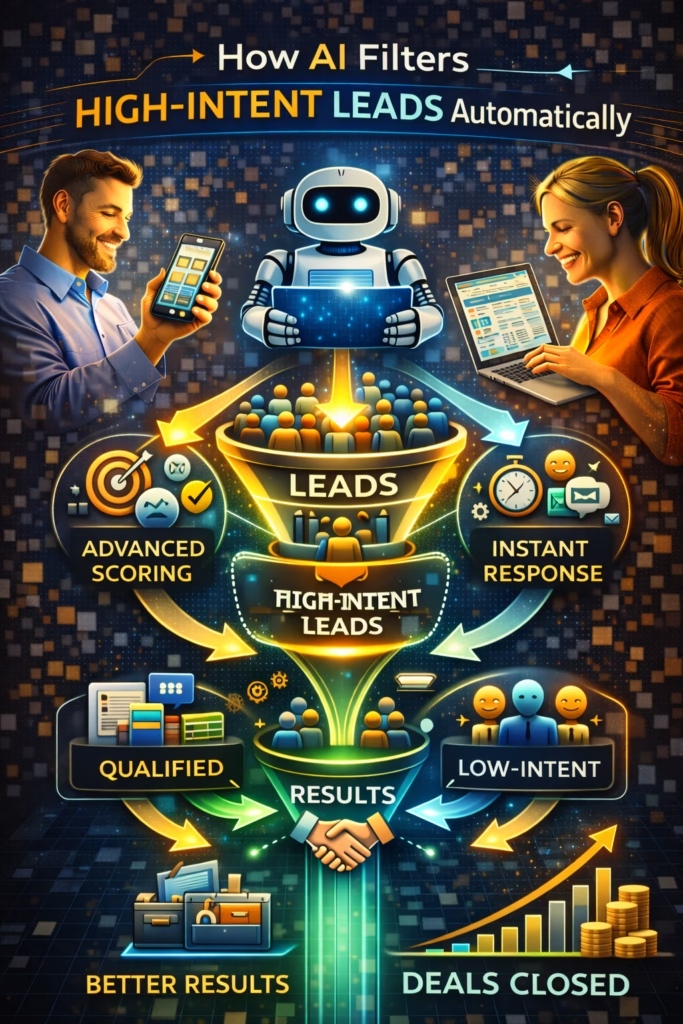
How AI Filters High-Intent Leads Automatically
How AI Filters High-Intent Leads Automatically is a practical system for prioritizing the buyers who are most likely to convert—by detecting intent signals, scoring conversations, and routing hot leads to the fastest next step.
Note: This is general guidance. Ensure automated messaging follows platform rules and applicable privacy/consent requirements.
Introduction
How AI Filters High-Intent Leads Automatically matters because most lead systems treat every inquiry the same. That’s the problem.
In the real world, some leads are ready to buy now and others are just browsing. When your team spends the same effort on both, response times slow down, hot leads cool off, and revenue becomes unpredictable.
AI filtering fixes this by triaging conversations in real time—prioritizing “ready-to-act” leads, asking a single qualifying question, and routing the best opportunities to the fastest next step.
Big idea: You don’t need more leads. You need to recognize the best leads faster.
Expanded Table of Contents
- 1) What “high-intent” really means
- 2) The intent signals AI looks for
- 3) Lead scoring: simple frameworks that work
- 4) Conversation-based filtering (the fastest method)
- 5) Routing logic: where hot leads should go
- 6) Filtering low-quality leads and time-wasters
- 7) Marketplace inquiry triage (Is this available?)
- 8) Follow-up automation that surfaces intent
- 9) CRM tags, stages, and reporting
- 10) KPIs that prove the system is working
- 11) 30–60–90 day rollout plan
- 12) 25 Frequently Asked Questions
- 13) 25 Extra Keywords
1) What “high-intent” really means
High intent isn’t a vibe. It’s behavior. A high-intent lead signals they are close to taking a next step.
Examples of high-intent behavior
- Asks about availability (“Can I get this today?”)
- Asks about price or total cost
- Asks about timing (“How soon can you deliver / schedule?”)
- Asks about requirements (“What do I need to qualify?”)
- Provides location (“I’m in __ zip”) without being asked
- Requests next steps (“How do I book?”)
Rule: High intent = the lead is moving toward action, not just asking generic questions.
2) The intent signals AI looks for
AI can detect intent using message content, timing, and behavior.
Signal categories
Message signals
Keywords and phrases indicating purchase readiness: “today,” “deposit,” “delivery,” “tour,” “financing,” “available,” “application,” “down payment.”
Specificity signals
Leads who give details (zip, budget, timeframe) are usually higher intent than vague inquiries.
Speed signals
Fast replies and quick back-and-forth typically indicate a hotter lead.
Friction signals
Repetitive “lowest price?” without specifics often indicates low intent or negotiation-only behavior.
Reminder: Don’t assume low intent means “bad.” It often means “needs nurture.”
3) Lead scoring: simple frameworks that work
You don’t need a complex scoring model to win. You need a consistent one.
Simple 0–10 score model
| Signal | Points | Why it matters |
|---|---|---|
| Provides timeline (today/this week) | +3 | Near-term action increases conversion |
| Provides location/zip | +2 | Removes friction for scheduling/availability |
| Asks about next steps | +3 | Shows readiness to commit |
| Asks about price/total cost | +2 | Moves conversation toward decision |
| Vague “is this available?” only | +1 | Light intent, needs qualification |
| No response after follow-up | -2 | Cooling signal |
Routing threshold: Score 7–10 = hot (priority), 4–6 = warm (nurture), 0–3 = cold (automated follow-up).
4) Conversation-based filtering (the fastest method)
The most effective filter is a single qualifying question that reveals intent.
Best one-question intent filters
- Timeline filter: “Are you trying to do this today, this week, or later?”
- Location filter: “What city/zip are you in?”
- Budget filter: “What range are you trying to stay under?”
Pro move: The lead who answers with specifics becomes high-intent automatically.
Instant reply that filters intent
Yes — it’s available ✅
Quick question: are you looking to move forward today or this week?

If you tell me your city/zip, I’ll confirm the fastest options.
5) Routing logic: where hot leads should go
Filtering matters only if routing is fast. High-intent leads should hit the most conversion-focused path immediately.
| Lead Type | Definition | Route | Next Step |
|---|---|---|---|
| Hot | Timeline + specifics | Priority queue | Offer options + booking windows |
| Warm | Interested but unsure | Nurture path | Send best options + ask preference |
| Cold | Vague / unresponsive | Automated follow-up | Short nudges + alternate option |
Rule: Hot leads get options. Warm leads get clarity. Cold leads get nurture.
6) Filtering low-quality leads and time-wasters
AI filtering protects staff time by identifying patterns that often don’t convert.
Common low-quality patterns
- Only asks “lowest price?” and ignores follow-up questions
- Never provides location or timeline
- Long negotiation with no next step
- Spam messages or repeated copy/paste
Important: Don’t “reject” these leads. Move them into a low-priority nurture path so hot leads don’t suffer.
7) Marketplace inquiry triage (Is this available?)
Marketplace leads are often high volume and low context. The fastest win is to turn a generic inquiry into a specific one.
Best Marketplace triage reply
Yes — it’s available ✅
Are you looking for pickup/delivery today or later this week?

What city/zip are you in? I’ll confirm the fastest options.
How AI identifies high intent from Marketplace
- Mentions today or this week
- Asks about delivery or financing
- Provides zip or time availability
- Requests a call or wants to book
Rule: The second message determines intent more than the first.
8) Follow-up automation that surfaces intent
Follow-up is not just recovery—it’s filtering. People who respond to follow-up with specifics are high intent.
3-touch follow-up sequence
| Timing | Message | Filter Goal |
|---|---|---|
| 20–40 min | Short check-in + one question | Trigger a specific reply |
| Same day | Offer options | Prompt scheduling |
| Next day | Alternate option | Reveal preference |
Follow-up templates
#1 Quick check-in ✅
Did you still want to move forward?
If yes, are you trying to do this today or this week?

#2 Options ✅
Which works better:
A) Today 4–6
B) Tomorrow 12–2
C) Saturday 10–12
Reply A/B/C.

#3 Alternate ✅
If that one isn’t perfect, tell me your budget + timeline and I’ll send a better match.
9) CRM tags, stages, and reporting
Filtering only matters if you can see it. Tag leads so the team always knows priority.
Recommended tags
Hot (7–10) Warm (4–6) Cold (0–3) Price Shopper Needs Financing Needs Delivery Tour/Appointment Requested
Minimum pipeline stages
- New
- Qualified
- Options Sent
- Booked
- Closed
- Lost
Rule: Hot leads should never sit in “New” without an owner.
10) KPIs that prove the system is working
| KPI | Meaning | Target direction |
|---|---|---|
| Median response time | Speed-to-lead strength | Downward (< 5 min good, < 1 min best) |
| % leads tagged Hot | High-intent identification | Stable/understood |
| Hot lead booked rate | Conversion on best leads | Upward |
| Follow-up recovery | Ghosts converted to replies | Upward |
| Staff time per booked lead | Efficiency | Downward |
Pro move: Compare booked rate for Hot vs Warm leads. The gap proves filtering value.
11) 30–60–90 day rollout plan
Days 1–30 (Deploy filtering)
- Define intent signals (timeline, location, next step)
- Deploy one-question qualification across channels
- Implement a simple 0–10 scoring model
- Tag leads Hot/Warm/Cold automatically
Days 31–60 (Improve routing and bookings)
- Route Hot leads to priority queue
- Use options-based booking scripts for Hot leads
- Refine low-quality filtering into nurture paths
- Measure Hot lead booked rate weekly
Days 61–90 (Scale and optimize)
- Expand scoring rules using objections and outcomes
- Improve follow-up sequences by segment
- Build weekly reporting and accountability
- Optimize staffing based on lead priority distribution
Outcome: Faster conversion on best leads, fewer missed opportunities, and less time wasted on low-intent threads.
12) 25 Frequently Asked Questions
1) What is a high-intent lead?
A lead close to action—asking about timing, price, next steps, or providing details like zip and availability.
2) How does AI filter high-intent leads automatically?
By detecting intent signals, scoring leads, asking one qualifier question, and routing hot leads to priority next steps.
3) What’s the best intent signal?
Timeline. “Today” or “this week” usually indicates high intent.
4) What’s the best qualifier question?
“Are you looking to do this today, this week, or later?”
5) How do I score leads simply?
Use a 0–10 model with points for timeline, location, and next-step language.
6) Do low-intent leads matter?
Yes, but they should go to nurture so hot leads get priority.
7) Can AI filtering work on marketplaces?
Yes—especially by converting “Is this available?” into a timeline/location response.
8) How do I prevent staff burnout?
Prioritize hot leads and automate low-intent handling.
9) What’s the role of follow-up in filtering?
Follow-up reveals which leads are real by triggering specific replies.
10) How many follow-ups should I use?
Three touches is a strong baseline.
11) How do I avoid sounding spammy?
Use short messages with options and one question.
12) What tags should I use?
Hot/Warm/Cold plus key needs like financing, delivery, or appointment requested.
13) What’s the most important KPI?
Hot lead booked rate and response time.
14) Should AI automatically book appointments?
It can offer options and schedule, but confirm availability before promising specifics.
15) What’s the biggest mistake with lead scoring?
Making it too complex and never using it for routing.
16) How do I handle “lowest price?” leads?
Ask whether they want lowest price or best fit, then request budget and timeline.
17) Can AI reduce missed leads?
Yes—by responding instantly and following up consistently.
18) How do I keep warm leads moving?
Send best options and ask preference, then offer booking windows.
19) How do I reduce ghosting?
Use options-based scheduling and follow-up cadence.
20) Does AI filtering replace humans?
No—it helps humans focus on the highest-value conversations.
21) How soon can I see results?
Often within weeks as response time drops and routing improves.
22) What channels benefit most?
Marketplaces, inbound calls/texts, and high-volume inbox channels.
23) How do I measure success?
Compare booked rate and close rate before vs after filtering.
24) What’s the fastest improvement today?
Deploy an instant reply that asks timeline and location.
25) What’s the long-term benefit?
Predictable conversion, better staff efficiency, and more revenue from the same traffic.
13) 25 Extra Keywords
- How AI Filters High-Intent Leads Automatically
- AI lead filtering
- high intent leads
- AI lead scoring
- automated qualification
- conversation based lead scoring
- lead triage automation
- marketplace inquiry triage
- intent signals in messages
- lead scoring framework
- hot lead routing
- warm lead nurture sequence
- low quality lead filtering
- reduce time wasters leads
- speed to lead prioritization
- AI qualification scripts
- follow up automation leads
- CRM tags for lead intent
- lead priority queue
- booked rate optimization
- lead conversion efficiency
- automated appointment booking options
- intent based routing
- predictable lead conversion
- AI managed lead pipeline













