
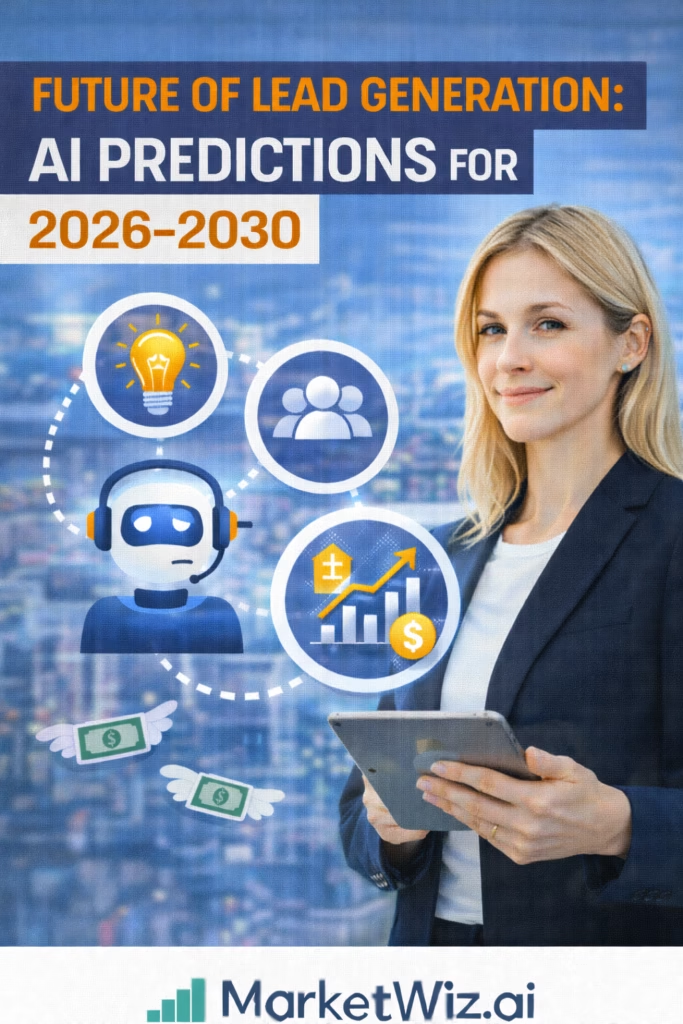
Future of Lead Generation: AI Predictions for 2026-2030
Future of Lead Generation: AI Predictions for 2026-2030 is your roadmap for what changes next—so your pipeline grows while competitors argue about tools.
Note: These are strategic predictions and operational frameworks, not guarantees. Platform policies, privacy rules, and market conditions can change—adapt accordingly.
Introduction
Future of Lead Generation: AI Predictions for 2026-2030 starts with an uncomfortable truth: lead generation is no longer just “traffic in, form filled, sales calls out.”
From 2026 to 2030, the winning brands will treat lead gen like a decision engine:
- AI handles the first mile: discovery, answers, pre-qualification, and scheduling.
- Humans handle the last mile: trust, negotiation, nuance, and deal-making.
- Data becomes the moat: first-party audiences, conversation histories, and outcome feedback loops.
This guide breaks down what will likely change, why it matters, and how to build a pipeline that keeps working even when channels shift.
Expanded Table of Contents
- 1) The 10 big shifts shaping the Future of Lead Generation: AI Predictions for 2026-2030
- 2) Prediction map: what changes in 2026 vs 2028 vs 2030
- 3) Zero-click discovery and “answer-first” lead gen
- 4) AI agents become the new front desk (and SDR)
- 5) Intent signals evolve: from clicks to conversations
- 6) First-party data becomes the unfair advantage
- 7) Personalization at scale: dynamic offers, not dynamic names
- 8) Creative production explodes—distribution becomes the bottleneck
- 9) Trust signals: why proof beats persuasion
- 10) Measurement: privacy-first attribution and outcome loops
- 11) Playbooks by business type (Local, B2B, Ecommerce)
- 12) The 2026–2030 lead gen tech stack (simple version)
- 13) KPIs that matter (and vanity metrics to ignore)
- 14) SOP: Build a lead machine that survives channel changes
- 15) 30–60–90 day rollout plan
- 16) 25 Frequently Asked Questions
- 17) 25 Extra Keywords
1) The 10 big shifts shaping the Future of Lead Generation: AI Predictions for 2026-2030
The Future of Lead Generation: AI Predictions for 2026-2030 isn’t a single “new channel.” It’s a stack of shifts happening at the same time:
Shift 1: Answers replace clicks
More buyers will get what they need without visiting your site—meaning your “lead gen surface area” expands beyond pages.
Shift 2: AI agents handle first contact
Fast, consistent, conversational follow-up becomes the default expectation.
Shift 3: Conversations become the new conversion
Lead capture moves from “forms” to “dialog.” Qualification becomes embedded in chat.
Shift 4: First-party data becomes the moat
Your own audience, messages, and outcomes matter more than rented reach.
Shift 5: Creative volume explodes
AI makes creating content easy. Distribution and differentiation become hard.
Shift 6: Personalization becomes offer-level
Not “Hi {Name},” but “Here’s the exact option for your ZIP, budget, and timeline.”
Shift 7: Proof beats persuasion
Case studies, reviews, and demos carry more weight than clever copy.
Shift 8: Platform constraints tighten
Spam patterns get punished faster. Systems must be compliant and human-like.
Shift 9: Measurement becomes probabilistic
Perfect attribution fades. You win by outcome loops, not pixel obsession.
Shift 10: Operational speed becomes the differentiator
Same offer + same budget + faster response often wins.
Bottom line: The Future of Lead Generation: AI Predictions for 2026-2030 rewards systems that turn attention into appointments quickly—across multiple surfaces.
2) Prediction map: what changes in 2026 vs 2028 vs 2030
These predictions are directional. The exact timing varies by industry, buyer behavior, and platform changes.
| Time Window | What Becomes Common | What Stops Working | What Winners Do |
|---|---|---|---|
| 2026 | AI follow-up, better lead scoring, conversational forms, omnichannel routing | Slow response, one-channel dependency, generic scripts | Speed-to-lead + qualification + booking automation |
| 2027–2028 | Agent-to-agent workflows, synthetic segmentation, dynamic offers by intent | “Post and pray,” weak proof, inconsistent messaging | First-party audience building + proof assets + outcome loops |
| 2029–2030 | Answer-first discovery dominates; “website” becomes a reference library | Pixel-only measurement, funnel assumptions, static landing pages | Distributed presence + brand trust + conversion-by-conversation |
Planning tip: Build for 2028 now. If you build for 2026 only, you’ll rebuild twice.
3) Zero-click discovery and “answer-first” lead gen
In the Future of Lead Generation: AI Predictions for 2026-2030, discovery increasingly happens where the buyer already is: search interfaces, maps, marketplaces, social feeds, and AI assistants.
What changes operationally
- Your brand snippets matter (reviews, FAQs, pricing ranges, proof).
- Your message response speed becomes part of “ranking,” even outside search.
- Your offer clarity must fit in small spaces: 2 lines, 1 image, 1 CTA.
Answer-first content structure
1) One-sentence answer (clear + confident)
2) Proof (case study, review, numbers, before/after)
3) Next step (book / quote / tour / call)
4) Optional details (for people who want depth)
Rule: Make it easy to say “yes” without reading a novel.
4) AI agents become the new front desk (and SDR)
The Future of Lead Generation: AI Predictions for 2026-2030 will make “follow-up” less of a department and more of a system.
What AI agents will routinely handle
- Instant first response
- Qualification (ZIP, budget, timeline, preferences)
- Scheduling (booking link + confirmations)
- FAQ handling (pricing ranges, availability, process)
- Nurture (weekly updates, new inventory, reminders)
What humans will still own
- Complex objections and negotiation
- High-ticket trust building
- Edge cases and compliance-sensitive scenarios
- Closing and relationship management
Implementation warning: AI agents that talk too much lower conversions. Short, question-based flows win.
“Good agent” conversation pattern
Lead: "Is it available?"
Agent: "Yes. Quick questions so I send the right options:
1) What city/ZIP?
2) Budget range?
3) Timeline? (ASAP / this week / this month)
Then I’ll send matches + next step."
5) Intent signals evolve: from clicks to conversations
From 2026–2030, intent isn’t just pages visited. In the Future of Lead Generation: AI Predictions for 2026-2030, intent becomes a blend of:
Behavioral intent
- Multiple “availability” questions
- Asking about timeline, financing, logistics
- Booking interactions (calendar, call, application)
Language intent
- Keywords like today, price, deposit, tour, quote
- Preference clarity (neighborhood, size, features)
- Objection patterns (price, trust, timing)
Simple intent scoring template (copy/paste)
INTENT SCORE (0–100)

+30 "ASAP / today / this week"
+25 Asked to schedule / tour / call
+15 Asked about price AND availability
+10 Provided budget range
+10 Provided location/ZIP
+10 Responded within 10 minutes

NEGATIVES
-20 "Just looking / browsing"
-15 No response after 2 follow-ups
-10 Outside service area / not ICP
Note: This is how the Future of Lead Generation: AI Predictions for 2026-2030 shifts from vanity tracking to revenue outcomes.
6) First-party data becomes the unfair advantage
The more platforms restrict tracking and targeting, the more valuable your own data becomes. In the Future of Lead Generation: AI Predictions for 2026-2030, first-party data is the moat.
What counts as first-party data
- Your email/SMS list
- Your inbound conversations and transcripts
- Lead outcomes (booked, showed, closed, lost)
- Preferences (ZIP, budget, timeline, product/service)
- Content engagement inside your owned channels
How to build it fast
- Offer a “best matches” list or weekly inventory updates
- Use a conversational opt-in: “Want updates for your ZIP + budget?”
- Use forms only after the lead is warmed by chat
- Tag every conversation with structured fields (ZIP, budget, timeline)
Compliance note: Always follow consent rules and platform policies for SMS/email outreach.
7) Personalization at scale: dynamic offers, not dynamic names
In the Future of Lead Generation: AI Predictions for 2026-2030, personalization shifts from “merge tags” to “fit-based offers.”
What personalization really means
- Send options for the lead’s exact ZIP cluster
- Adjust the next step based on timeline (ASAP vs 90+ days)
- Use proof relevant to their category (local service vs high-ticket)
- Offer the right format (call, quote, walkthrough video, or quick checklist)
Dynamic next-step routing
| Lead Type | Best Next Step | Automation Action |
|---|---|---|
| High intent (ASAP) | Book call / tour | Fast-lane alert + booking link |
| Medium intent (30–90 days) | Send 2–3 matches + nurture | Short sequence + weekly updates |
| Low intent (90+ days) | Education + trust building | Monthly value content + reminders |
| Poor fit | Polite reroute/disqualify | Offer alternatives or close loop |
Winner behavior: personalize the decision path, not the greeting.
8) Creative production explodes—distribution becomes the bottleneck
AI makes content creation cheap. That means from 2026–2030, the constraint becomes:
- Placement strategy (where to show it)
- Iteration speed (how fast you test)
- Consistency (daily presence beats occasional bursts)
High-performance content loop
1) Create 10 variants (angles, hooks, visuals)
2) Distribute daily (multiple surfaces)
3) Measure replies + booked calls (not likes)
4) Keep winners, kill losers
5) Feed outcomes back into scripts + scoring
Trap: posting more content without better follow-up just creates more unconverted attention.
9) Trust signals: why proof beats persuasion
As AI-generated marketing increases, buyers become more skeptical. In the Future of Lead Generation: AI Predictions for 2026-2030, proof becomes the differentiator.
High-leverage proof assets
- Before/after examples
- Short case studies (problem → process → result)
- Testimonials with specifics (time saved, leads gained)
- Process transparency (what happens after you message)
- Authority indicators (reviews, certifications, local presence)
Case study mini-template
1) Who it was for (industry + situation)
2) What changed (system or process)
3) Results (qualified leads, booked calls, revenue impact)
4) Timeline (how long it took)
5) What we did differently (the “why it worked”)
Rule: Buyers trust receipts more than rhetoric.
10) Measurement: privacy-first attribution and outcome loops
Attribution will remain imperfect. The Future of Lead Generation: AI Predictions for 2026-2030 favors teams that measure what matters:
What to measure weekly
Pipeline KPIs
• Inquiries
• Reply rate
• Qualified rate
• Booked calls
• Show rate
• Close rate

Speed KPIs
• Time-to-first-response
• Fast-lane response time

Quality KPIs
• % leads with ZIP + budget + timeline captured
• Ghost rate (no reply after 2 touches)
• False positives (hot leads that never convert)
The revenue feedback loop (the real advantage)
- Tag closed-won leads with the signals they showed
- Identify which scripts and routes produced booked calls
- Adjust scoring weights monthly
- Update follow-up sequences based on drop-off points
Translation: You don’t need perfect tracking to win—just faster learning than competitors.
11) Playbooks by business type (Local, B2B, Ecommerce)
Playbook A: Local services (home services, wellness, repairs)
- Primary surfaces: Maps, marketplaces, local groups, short-form video
- Primary conversion: call/quote booking
- Core qualifier: ZIP + service + timeline
Local Service Fast Lane Script
“Got it — we can help.
What’s your ZIP code and what day are you trying to get this done?
If it’s urgent, I can get you a quick call slot today.”
Playbook B: B2B services (agency, software-like offers, consulting)
- Primary surfaces: search/answers, LinkedIn-style environments, email, webinars
- Primary conversion: booked demo/call
- Core qualifier: role + size + budget + timeline
B2B Qualifier Script
“Happy to help — quick questions so I tailor the plan:
1) What industry + company size?
2) What’s your main goal (leads / sales / ops)?
3) What’s your timeline and budget range?
Then I’ll share the best-fit approach + next steps.”
Playbook C: Ecommerce / direct response
- Primary surfaces: short-form video + creators + AI-targeted creative testing
- Primary conversion: checkout
- Core qualifier: product intent + objection handling
Ecom Objection Script
“Totally fair question.
What matters most to you: price, speed of delivery, or performance?
I’ll point you to the best option and show you proof.”
12) The 2026–2030 lead gen tech stack (simple version)
The Future of Lead Generation: AI Predictions for 2026-2030 doesn’t require 50 tools. It requires a clean system:
| Layer | Purpose | Must-Have Features |
|---|---|---|
| Distribution | Get in front of buyers | Multi-surface posting, variation, scheduling |
| Conversation | Convert interest into action | Instant replies, qualification, handoffs |
| CRM | Routing + pipeline control | Stages, tags, tasks, automation triggers |
| Scheduling | Book appointments | Calendar links, reminders, reschedule paths |
| Measurement | Improve outcomes | KPIs, outcome tagging, feedback loops |
Stack rule: If it doesn’t improve response time, qualification, or booking rate, it’s optional.
13) KPIs that matter (and vanity metrics to ignore)
Metrics that matter
- Inquiry → Reply rate
- Reply → Qualified rate
- Qualified → Booked call/tour/quote
- Booked → Show rate
- Show → Close rate
- Median time-to-first-response
Vanity metrics (use cautiously)
- Impressions without replies
- Clicks without conversations
- Likes without bookings
- Email opens (increasingly noisy)
Reality: From 2026–2030, many “visibility” metrics inflate while conversions stay flat. Follow the bookings.
14) SOP: Build a lead machine that survives channel changes
Here’s a resilient SOP aligned to the Future of Lead Generation: AI Predictions for 2026-2030:
Step 1: Define your qualification fields
- Location/ZIP
- Budget range
- Timeline
- Service/product fit
Step 2: Create tier-based routing
- Fast lane: urgent + high fit → immediate action
- Warm: fit but not urgent → nurture + soft outreach
- Cold: low intent → automation only
Step 3: Build a 48-hour follow-up sequence
Most leads require multiple touches. Ensure the system follows up with simple questions and stops when appropriate.
Step 4: Add proof at the right moment
- Before booking: short proof (review/case)
- After booking: what to expect
- After no-response: trust-building plus an easy choice question
Step 5: Run monthly feedback loop
- Which signals predicted closed-won?
- Which scripts led to bookings?
- Where do leads drop off?
If you do nothing else: improve response speed and qualification capture. That’s the center of the Future of Lead Generation: AI Predictions for 2026-2030.
15) 30–60–90 day rollout plan
Days 1–30 (Foundation)
- Implement instant reply + qualifier questions (ZIP, budget, timeline).
- Set up CRM stages and routing rules (Cold/Warm/Hot/Fast Lane).
- Create a 48-hour follow-up sequence.
- Start tracking core KPIs (reply rate, qualified rate, bookings).
Days 31–60 (Stability)
- Add lead scoring (fit + intent).
- Build proof assets (3 mini case studies + review highlights).
- Expand distribution across 2–3 surfaces (not just one channel).
- Reduce false positives with negative scoring and better questions.
Days 61–90 (Optimization)
- Run monthly outcome feedback loop and adjust weights/scripts.
- Improve personalization (offer-level, not name-level).
- Build nurture lanes for 30–90 and 90+ day timelines.
- Document everything as an SOP for consistent execution.
Expected outcome: a pipeline that’s more stable, faster, and less dependent on any single channel.
16) 25 Frequently Asked Questions
1) What does Future of Lead Generation: AI Predictions for 2026-2030 mean?
It refers to how lead generation will evolve from 2026 to 2030 as AI agents, answer-first discovery, privacy shifts, and conversational funnels become standard.
2) Will AI replace human sales teams?
AI will automate large parts of qualification and scheduling, but humans will still handle trust, nuance, and closing complex deals.
3) What changes first: traffic or conversion?
Conversion changes first—because speed-to-lead, routing, and scripts improve immediately when automated well.
4) What is zero-click discovery?
When buyers get answers directly on platforms without visiting your website, shifting the focus to distributed presence and proof.
5) Do websites matter less in 2026–2030?
They still matter, but more as credibility and reference hubs rather than the only conversion point.
6) What’s the biggest lead gen advantage from 2026–2030?
First-party data plus fast, conversational follow-up that moves leads to booking quickly.
7) What does “conversational funnel” mean?
A funnel where the lead is qualified through chat and routed to the right next step (call, quote, tour) without friction.
8) What’s the biggest automation mistake?
Automating replies without routing leads to action (tasks, booking links, human escalation).
9) How fast should response times be?
Minutes when possible—especially for high-intent inquiries.
10) What should the first message include?
Confirm availability/helpfulness, ask 1–3 qualifier questions, and offer a next step.
11) Will paid ads still work?
Yes, but costs and competition can increase; conversion systems and creative iteration speed matter more than ever.
12) What is intent scoring?
Assigning points based on buyer signals (language, urgency, behavior) to route the best leads first.
13) What is negative scoring?
Subtracting points for low-fit or low-intent patterns to reduce false positives.
14) How do you reduce ghosting?
Respond faster, ask simpler questions, follow up with choice questions, and provide proof at key moments.
15) How many follow-ups are needed?
Often 2–4 touches over 48 hours for high-intent leads, plus longer nurture for slow timelines.
16) What will matter more: content volume or offer clarity?
Offer clarity and conversion systems. Content volume without follow-up is wasted attention.
17) How do small businesses compete with big budgets?
By being faster, more consistent, and more trustworthy locally, using proof and strong follow-up systems.
18) What’s the best channel in 2026–2030?
The best channel is the one you can execute consistently with strong conversion mechanics and rapid response.
19) What KPIs should I track?
Reply rate, qualified rate, bookings, show rate, close rate, and time-to-first-response.
20) What’s changing about personalization?
It becomes offer-level: matching ZIP, budget, timeline, and preferences to the right next step and proof.
21) What is first-party data?
Data you collect directly—lists, conversations, preferences, and outcomes—owned by you.
22) How do you build first-party data quickly?
Offer updates, best-match lists, and simple opt-ins during conversations, then tag preferences in your CRM.
23) Do AI agents create compliance risk?
They can if unmanaged. Use guardrails, keep messages short, and follow consent and platform policies.
24) How often should systems be updated?
Weekly KPI checks, monthly outcome reviews, and quarterly strategy adjustments.
25) What’s the main takeaway?
The Future of Lead Generation: AI Predictions for 2026-2030 rewards teams that build fast, conversational, proof-driven systems with first-party data and continuous learning loops.
17) 25 Extra Keywords
- Future of Lead Generation: AI Predictions for 2026-2030
- AI lead generation trends 2026
- AI lead generation 2030 forecast
- AI sales agents for lead gen
- conversational lead generation
- zero click lead generation
- answer first marketing strategy
- first party data lead generation
- privacy first attribution
- omnichannel lead follow up
- AI lead qualification script
- lead scoring with intent signals
- negative lead scoring rules
- speed to lead automation
- AI CRM automation
- pipeline routing automation
- reduce lead ghosting
- booked calls automation
- local lead generation AI
- marketplace lead generation
- AI content distribution strategy
- trust signals marketing
- case study driven lead gen
- conversion by conversation
- lead gen tech stack 2026













