

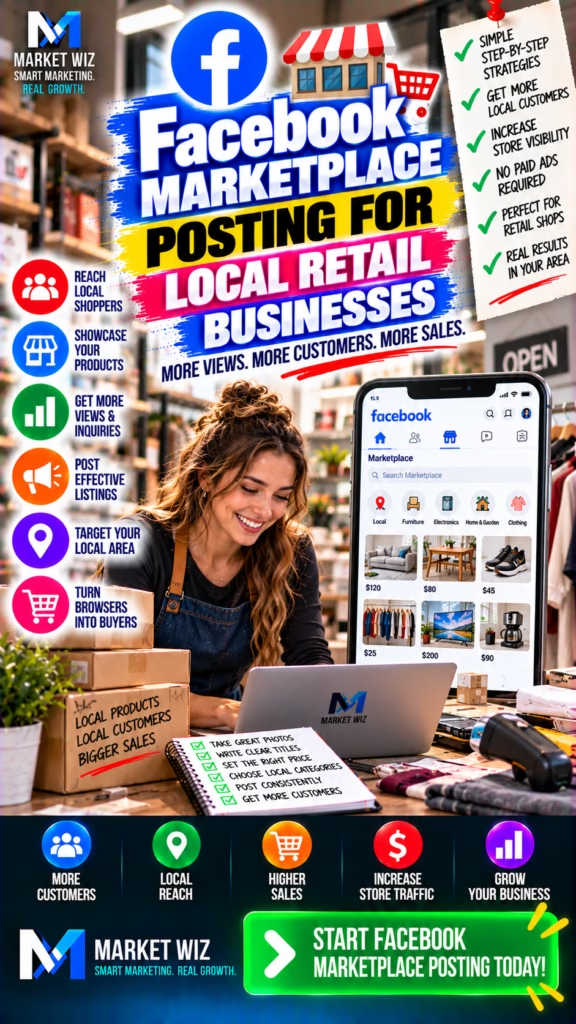
Facebook Marketplace Posting for Local Retail Businesses
Facebook Marketplace can give local retailers another way to put real products in front of nearby shoppers who are already browsing, comparing prices, evaluating inventory, and deciding where to buy. Strong results depend on more than simply publishing listings. Retailers need accurate inventory, compelling product presentation, local relevance, fast response, organized qualification, consistent follow-up, sales tracking, and a strategy that connects Marketplace visibility to measurable business growth.
Why Facebook Marketplace Matters for Local Retail Businesses
Local retail has changed.
Consumers no longer discover products only by driving past a storefront, seeing a newspaper advertisement, receiving a flyer, or searching for a traditional retail website.
Product discovery happens across multiple digital environments.
Shoppers search Google.
They browse social media.
They watch short-form videos.
They check reviews.
They compare local sellers.
And many consumers browse Facebook Marketplace when they are looking for products available in or around their local market.
For eligible local retailers, this can create an important opportunity.
Instead of waiting for every customer to discover the store first, the retailer can potentially place relevant inventory where shoppers are already browsing products.
The product can become the first point of discovery.
The customer sees the item.
They review the price.
They examine the images.
They read the details.
They decide whether the offer is relevant.
Then they may begin a conversation with the seller.
For local retailers, the real opportunity is bigger than simply creating more listings. A well-organized Marketplace strategy can connect product discovery with lead response, qualification, store visits, appointments, sales, follow-up, Google Maps visibility, SEO, social media, CRM tracking, and measurable customer acquisition.
1. Use Marketplace to Expand Local Product Discovery
One of the biggest challenges for a local retailer is making nearby customers aware of current inventory.
A store may have hundreds or thousands of products.
Yet only a small percentage of the local market may know those products are available.
Traditional marketing often promotes the business itself.
Marketplace can create another approach by allowing individual eligible products to become discovery points.
A shopper may not begin by searching for the retailer.
They may begin by looking for a sectional sofa.
A dining table.
A refrigerator.
A mattress.
A desk.
A patio set.
A piece of equipment.
Or another specific product.
When a retailer's eligible inventory appears during that browsing process, the product can introduce the shopper to the business.
2. Choose the Right Retail Products to Promote
A strong Marketplace strategy does not necessarily require treating every item in inventory equally.
Retailers should identify products with the strongest combination of customer demand, availability, margin, visual appeal, competitive pricing, and local sales potential.
Some inventory may generate substantial attention but poor sales.
Other products may generate fewer messages but much stronger purchasing intent.
The goal is not simply to maximize listing count.
The goal is to create commercially useful visibility.
High-Demand Inventory
Prioritize eligible products that match what consumers in the local market are actively looking to purchase.
Strong Visual Products
Products that can be clearly understood through photography may be particularly suitable for a visual shopping environment.
Available Inventory
Promoting merchandise that is actually available helps reduce wasted conversations and customer frustration.
Profitable Opportunities
Consider margin, sales potential, customer value, and conversion instead of evaluating products only by message volume.
3. Keep Marketplace Inventory Accurate
Inventory accuracy is one of the foundations of effective retail Marketplace marketing.
A customer who sees a product expects the listing to represent a genuine purchasing opportunity.
If the item has already sold, the price changed, the configuration is different, or the product is no longer available, the inquiry may become wasted effort for both the shopper and the retailer.
This problem becomes more significant as listing volume grows.
A retailer with five products can manually remember inventory changes more easily than a retailer managing hundreds of items across multiple locations.
Larger campaigns need processes.
Retailers should maintain a reliable source of truth for product name, SKU or model, price, availability, location, condition, specifications, images, and status.
Accurate inventory improves customer experience and protects the efficiency of the sales team.
4. Write Product Titles That Make Sense Immediately
Marketplace shoppers often scan quickly.
A title should help the right person understand what is being offered without requiring unnecessary interpretation.
The most useful title structure depends on the product.
A furniture listing may benefit from the product type, material, style, size, or configuration.
An appliance listing may benefit from the brand, model, appliance type, size, or condition.
Other retail categories may have different defining attributes.
The important principle is clarity.
Avoid filling titles with unnecessary language that does not help the shopper understand the product.
Strong titles support relevance.
Relevant visibility is more valuable than empty attention.
5. Use Product Photography That Builds Buyer Confidence
Product photography can determine whether a shopper stops scrolling.
Local retailers should treat Marketplace images as part of the sales process.
The primary image should clearly show the product.
Additional images can show alternative angles, details, features, scale, materials, condition, accessories, packaging, or relevant configurations.
Images should accurately represent what the customer is considering.
This is especially important for products where appearance strongly influences the purchase decision.
Furniture shoppers want to understand style.
Appliance shoppers may want to see controls and condition.
Home improvement shoppers may want to understand size and construction.
Good images reduce uncertainty before the conversation begins.
6. Write Retail Descriptions That Answer Buying Questions
A Marketplace description should help the shopper decide whether the product is worth pursuing.
It should not merely repeat the title.
Useful descriptions can explain dimensions, material, color, condition, model information, included components, relevant features, availability, pickup information, delivery information where applicable, and other legitimate details.
The best information depends on the category.
A mattress listing requires different details from a refrigerator.
A dining set requires different details from outdoor equipment.
Retailers should think about the questions customers repeatedly ask in the store or over the phone.
Those questions can help shape stronger listing descriptions.
7. Use Clear and Accurate Marketplace Pricing
Pricing plays an important qualification role.
A shopper needs enough information to determine whether the offer matches their expectations.
Inaccurate or confusing pricing can generate conversations that were unlikely to convert from the beginning.
That consumes employee time and can frustrate potential customers.
Retailers should make sure pricing accurately reflects the advertised product and legitimate offer.
If a promotion, financing structure, discount, or other pricing condition applies, the retailer should ensure the presentation is accurate and compliant with applicable requirements.
Better retail marketing qualifies before the sale. Accurate product information, realistic images, useful specifications, transparent pricing, and correct location details help shoppers determine fit before consuming sales-team time.
8. Make Marketplace Listings Relevant to the Local Market
Local retailers have an important advantage.
They can connect digital product discovery with a real local transaction.
Depending on the business model, a shopper may be able to visit a showroom, pick up a product, arrange delivery, speak with a local salesperson, compare alternatives, or complete a purchase nearby.
The listing should make relevant geographic information clear.
A shopper should not have to exchange multiple messages simply to discover that the retailer is far outside a practical purchasing area.
Geographic clarity improves qualification.
9. Turn Marketplace Interest Into Retail Store Traffic
For brick-and-mortar retailers, a Marketplace inquiry is not always the final objective.
The larger objective may be getting a qualified customer into the store.
This is especially valuable when shoppers benefit from seeing the product in person.
A furniture shopper may want to sit on a sofa.
A mattress shopper may want to compare comfort levels.
An appliance shopper may want to compare several models.
A customer who originally contacts the retailer about one product may ultimately purchase another.
Marketplace can therefore function as a discovery and lead-generation channel that introduces local shoppers to a broader retail inventory.
10. Respond Quickly to Local Retail Inquiries
Response speed matters because retail shoppers have options.
They may contact multiple sellers.
They may compare several products.
They may be planning to buy the same day.
A retailer that waits too long can lose a customer who was ready to purchase.
Businesses should create a dependable process for monitoring and handling Marketplace inquiries.
That process may involve assigning responsibility to specific team members, creating notifications, organizing common product information, and establishing a clear path for qualified customers.
Better response management helps the retailer extract more value from visibility it already has.
11. Qualify Retail Marketplace Leads Efficiently
Not every inquiry requires the same amount of sales effort.
A retailer can use a simple qualification process to determine what the shopper needs and what should happen next.
| Qualification Area | Useful Information | Business Benefit |
|---|---|---|
| Product | Which exact product or category interests the shopper? | Routes the customer toward the correct inventory |
| Location | Can the shopper realistically visit, pick up, or receive the item? | Reduces geographic mismatch |
| Budget | Does the customer understand the relevant price range? | Improves sales efficiency |
| Timing | Is the shopper buying now or researching for later? | Improves lead prioritization |
| Next Step | Should the customer visit, call, schedule, purchase, or review alternatives? | Creates momentum toward the transaction |
12. Use Alternative Inventory to Save More Retail Leads
A major advantage local retailers have over individual sellers is inventory depth.
The exact product a customer asks about may not always be the only product capable of solving their need.
Perhaps they want a sectional but the original model is unavailable.
The retailer may have three comparable sectionals.
Perhaps the requested refrigerator is outside the customer's budget.
Another model may fit.
Perhaps the customer needs a different size.
The store may have an alternative.
A strong Marketplace response process should therefore avoid treating every inquiry as a one-product conversation.
The real opportunity is understanding what the shopper wants and matching that need with appropriate available inventory.
13. Move Qualified Marketplace Leads Into a CRM
Retailers can lose valuable opportunities when customer information remains trapped inside individual conversations.
A CRM or structured lead management system can create continuity.
Qualified opportunities can be organized by name, contact information, product interest, location, lead source, salesperson, status, appointment, store visit, follow-up date, and sales outcome.
This allows the business to see what happens after the first message.
It also creates better accountability.
Managers can identify whether inquiries are being contacted.
They can identify whether appointments are being scheduled.
They can identify whether follow-up is happening.
Most importantly, they can begin connecting Marketplace activity with actual retail sales.
14. Follow Up With Legitimate Retail Prospects
Many retail customers do not purchase during the first conversation.
They may still be comparing products.
They may be waiting for payday.
They may need measurements.
They may need another decision-maker.
They may want to visit the store later.
They may be waiting for a particular model or color.
An organized follow-up process helps retailers preserve these opportunities.
Follow-up should be useful and relevant.
If new inventory matches the customer's need, that can create a reason to reconnect.
If a product becomes available, the customer may appreciate knowing.
If an appointment was discussed but never scheduled, the sales team can continue the conversation appropriately.
15. Use AI to Support Retail Marketplace Lead Management
As Marketplace lead volume increases, repetitive work can become an operational bottleneck.
Employees may spend significant time monitoring inquiries, organizing customer details, routing leads, updating records, creating reminders, and producing reports.
AI-supported workflows can help streamline parts of this process.
New inquiries can generate notifications.
Lead details can be organized.
Qualification information can be structured.
Qualified prospects can be routed to salespeople.
CRM updates can be supported.
Follow-up reminders can be generated.
Reporting can become easier to maintain.
The objective is not automation for its own sake.
The objective is faster and more consistent customer handling.
16. Build Location-Specific Marketplace Workflows for Multi-Store Retailers
Multi-location retailers face an additional challenge.
Inventory may differ by store.
Prices may differ.
Pickup options may differ.
Salespeople may differ.
Delivery areas may differ.
Local demand may differ.
A successful multi-location strategy should maintain enough structure to prevent confusion.
Leads should reach the appropriate location.
Product availability should reflect the correct store or fulfillment path.
Local reporting should allow management to compare performance across markets.
17. Use Marketplace to Support Seasonal Retail Demand
Retail demand often changes throughout the year.
Outdoor products may become more relevant in spring and summer.
Furniture demand may shift around moves, holidays, housing cycles, or promotional periods.
Appliances may experience different replacement patterns.
Other retail categories have their own seasonal demand cycles.
Marketplace campaigns can reflect these changes.
Retailers can prioritize inventory that aligns with current consumer needs rather than using the same product mix throughout the year.
Seasonal planning can also help businesses prepare photography, descriptions, inventory feeds, promotions, and sales workflows before demand peaks.
18. Give Clearance and Excess Inventory Additional Visibility
Retailers frequently need to move specific inventory.
A model may be discontinued.
A seasonal product may need to clear.
A showroom may need space.
A retailer may have excess inventory in one category.
An open-box or other eligible item may need a buyer.
Marketplace may provide another channel for increasing local visibility around appropriate eligible inventory.
The listing should still accurately represent the product, condition, pricing, and offer.
Clearance marketing works best when customers immediately understand what is available and why the offer may be attractive.
19. Connect Marketplace Visibility With Google Maps
Marketplace discovery does not happen in isolation.
A shopper may see a product and then research the retailer.
They may search the business name on Google.
They may check reviews.
They may look at store photos.
They may verify hours.
They may request directions.
They may visit the retailer's website.
This makes Google Business Profile visibility an important supporting asset for many local retailers.
Marketplace can introduce the product.
Google Maps can help validate the business behind it.
20. Use Local SEO to Capture Retail Searches Beyond Marketplace
Consumers also search Google directly for products.
They may search for a furniture store near them.
They may search for a mattress store in a specific city.
They may search for a particular appliance brand.
They may search for a specific product category plus a location.
Local SEO helps retailers compete for this search demand.
Product category pages, local landing pages, useful articles, store pages, structured website content, internal linking, and Google Maps optimization can all support a broader organic strategy.
This gives the retailer multiple ways to be discovered.
22. Measure Marketplace Performance Beyond Message Volume
Message volume is easy to see.
It is not enough to measure business success.
A listing could generate dozens of inquiries without creating a single profitable customer.
Another listing could generate only a handful of inquiries and produce several meaningful sales.
Retailers should connect Marketplace activity with deeper outcomes.
Qualified Leads
Measure how many inquiries represent realistic potential customers.
Store Visits
Track whether Marketplace conversations create measurable in-store traffic where relevant.
Sales Conversion
Measure how many qualified Marketplace opportunities become completed purchases.
Revenue and Profit
Connect activity with financial outcomes so management can understand the true value of the channel.
23. Calculate the Real ROI of Retail Marketplace Marketing
Marketplace performance should eventually connect to economics.
Retailers may invest employee time, creative resources, software, management, advertising, sales labor, and other operational resources into the channel.
Those costs should be evaluated against outcomes.
How many qualified leads were generated?
How many customers purchased?
How much revenue was generated?
What was the gross profit?
What did the acquisition process cost?
Did customers purchase additional products?
Did Marketplace create store traffic that converted offline?
These questions help retailers move beyond vanity metrics and evaluate actual business impact.
24. Test Different Retail Offers and Listing Approaches
Retailers should learn from real customer behavior.
Different product categories may respond differently.
Different price points may attract different shoppers.
Different primary images may change engagement.
Different descriptions may affect qualification.
Different locations may generate different lead quality.
Different seasons may change demand.
Testing should be structured enough to produce useful conclusions.
The retailer should not change everything simultaneously and then guess what caused the result.
Instead, use performance data to gradually improve product selection, presentation, response workflows, and sales conversion.
25. Common Facebook Marketplace Mistakes Local Retailers Should Avoid
- Promoting inventory that is no longer available
- Using weak or unclear product photography
- Writing vague product titles
- Leaving important specifications out of descriptions
- Using inaccurate or confusing pricing
- Ignoring geographic relevance
- Responding too slowly to customer inquiries
- Failing to offer suitable alternative inventory
- Leaving qualified prospects inside message threads
- Failing to track leads in an organized system
- Failing to follow up with legitimate prospects
- Measuring success only by the number of messages
- Ignoring store visits and offline conversions
- Failing to connect Marketplace with Google Maps and SEO
- Using the same strategy for every product category
- Failing to update listings when inventory or pricing changes
- Ignoring current Marketplace eligibility and commerce requirements
26. Build a Repeatable Marketplace Posting Workflow for Retail
Select Eligible Inventory
Identify available products with meaningful local demand, strong presentation potential, and commercial value.
Verify Product Data
Confirm the title, price, model, specifications, condition, location, availability, and other relevant information.
Prepare Strong Images
Use clear and accurate product photography that helps shoppers evaluate the merchandise.
Create the Listing
Build a clear title and useful description around the actual product rather than generic promotional language.
Publish and Monitor
Maintain an organized process for tracking active listings and incoming customer inquiries.
Respond Quickly
Provide useful information while the shopper's interest is still active.
Qualify the Shopper
Determine product fit, location, timing, price expectations, and the appropriate next step.
Route Qualified Opportunities
Connect serious prospects with the appropriate salesperson, store, appointment process, or purchase path.
Track and Follow Up
Record qualified opportunities and maintain useful follow-up for prospects who do not immediately purchase.
Measure Sales and Improve
Compare products, markets, lead quality, store visits, conversion, revenue, and profit to guide future decisions.
27. Turn Marketplace Into Part of a Multi-Channel Retail Strategy
Marketplace becomes more powerful when it is connected with other customer acquisition channels.
A shopper may first discover a product on Marketplace.
Then they may search the retailer on Google.
They may read reviews.
They may visit the website.
They may watch a product video.
They may follow the retailer on social media.
They may call.
They may visit the store.
The customer journey can cross multiple channels before the purchase occurs.
Retail marketing systems should account for this reality instead of assuming every sale belongs to one isolated platform.
28. Scale Marketplace Posting Based on Retail Performance
Once a retailer develops a repeatable process, the next question is where to scale.
More products?
More locations?
More product categories?
More creative?
Faster lead response?
More sales-team coverage?
Better CRM integration?
The answer should come from performance data.
If one category produces strong qualified leads and profitable sales, it may deserve additional attention.
If one location consistently underperforms, the retailer should investigate the offer, inventory, demand, response process, and sales execution before simply increasing volume.
29. Use Marketplace Data to Improve the Entire Retail Business
Marketplace can generate more than leads.
It can generate customer intelligence.
Which products receive the most interest?
Which price points create serious conversations?
Which products repeatedly create questions?
Which locations generate demand?
Which inventory converts quickly?
Which products attract attention but fail to sell?
Which questions appear repeatedly?
This information can influence merchandising, website content, social media, sales training, FAQs, promotional strategy, inventory purchasing, and local SEO.
Marketing data becomes more valuable when it improves decisions beyond marketing.
30. Build a Long-Term Local Retail Customer Acquisition System
Facebook Marketplace should not be viewed only as a place to upload products.
For the right local retailer, it can become one component of a broader customer acquisition system.
Product listings create discovery.
Strong photography creates interest.
Accurate descriptions create clarity.
Pricing helps qualification.
Fast response protects the opportunity.
Salespeople move qualified customers forward.
CRM tracking preserves lead information.
Follow-up recovers opportunities that do not close immediately.
Google Maps reinforces local credibility.
SEO creates additional organic discovery.
Social media expands product visibility.
AI-supported workflows can improve operational consistency.
Performance measurement shows management what is actually working.
When these components operate together, Marketplace becomes more than a collection of individual listings.
It becomes part of a measurable retail growth strategy.
30 FAQs About Facebook Marketplace Posting for Local Retail Businesses
1. Can local retail businesses use Facebook Marketplace?
Eligible local retail businesses can use Facebook Marketplace where their products, accounts, locations, and listing activity meet current platform requirements.
2. Why is Facebook Marketplace useful for local retailers?
Marketplace can help eligible retailers place products in front of nearby shoppers who are actively browsing merchandise and comparing local purchasing options.
3. What types of retail products work well on Facebook Marketplace?
Performance varies, but visually clear, locally available, competitively priced, eligible products with strong consumer demand may be good candidates for Marketplace.
4. Should retailers post every product on Marketplace?
Retailers can prioritize eligible inventory based on demand, availability, margin, visual appeal, local interest, and sales potential instead of treating every product equally.
5. How important are Marketplace listing photos for retailers?
Photos are important because shoppers often evaluate products visually before reading the full listing or contacting the seller.
6. What should a retail Marketplace title include?
A useful title should clearly identify the product and may include relevant details such as brand, model, size, material, style, condition, or configuration where appropriate.
7. Should local retailers include prices in Marketplace listings?
Pricing should accurately represent the offer and provide shoppers with enough information to understand the expected purchase price or legitimate pricing structure.
8. Can Marketplace help drive customers to a physical retail store?
Marketplace can create product discovery that may lead qualified shoppers to contact or visit a local retailer when the transaction process and platform rules support that path.
9. How quickly should retailers respond to Marketplace inquiries?
Retailers should generally respond promptly because shoppers may be comparing multiple sellers and can make purchasing decisions quickly.
10. Can Marketplace generate qualified retail leads?
Marketplace can generate customer inquiries, and retailers can improve lead quality through accurate listings, clear pricing, useful product information, local relevance, and structured qualification.
11. Should Marketplace leads be tracked in a CRM?
Qualified retail leads can be tracked in a CRM or lead management system to organize customer information, product interest, follow-up, appointments, visits, and sales outcomes.
12. Can retailers follow up with Marketplace prospects?
Appropriate follow-up can help retailers continue conversations with legitimate prospects who need more information, additional time, or alternative inventory.
13. Can AI help manage Facebook Marketplace retail leads?
AI-supported workflows can assist with repetitive lead management tasks such as notifications, routing, qualification support, CRM organization, reminders, and reporting where appropriate.
14. How can retailers improve Marketplace lead quality?
Retailers can improve lead quality with accurate product details, clear images, realistic pricing, location information, inventory accuracy, and efficient customer qualification.
15. Does local relevance matter for Marketplace retail listings?
Yes. Local relevance helps align listings with shoppers who can realistically visit, pick up, receive delivery, or otherwise complete the transaction.
16. How often should retailers update Marketplace inventory?
Retailers should maintain listings frequently enough to keep important information such as availability, pricing, product details, and condition accurate.
17. Can Marketplace help retailers move excess inventory?
Marketplace may provide another discovery channel for eligible inventory, including products a retailer wants to give additional local visibility.
18. Can Marketplace work for furniture retailers?
Eligible furniture products can be visually suited to Marketplace because shoppers can compare styles, sizes, configurations, prices, and local availability.
19. Can Marketplace work for appliance retailers?
Eligible appliance inventory may benefit from Marketplace visibility when listings accurately communicate product type, condition, dimensions, pricing, and availability.
20. Can Marketplace support multi-location retailers?
Multi-location retailers can build location-specific workflows where platform eligibility and operational processes support them, while maintaining accurate inventory and geographic information.
21. Should retailers use the same listing copy for every product?
Listings should accurately describe the individual product. Reusable structures can improve efficiency, but product-specific details should remain accurate and useful.
22. How should retailers measure Marketplace performance?
Retailers can track inquiries, qualified leads, response time, store visits, appointments, sales, revenue, gross profit, conversion rates, and customer acquisition cost where measurable.
23. Is message volume enough to measure Marketplace success?
No. Message volume does not reveal whether inquiries become qualified prospects, store visits, completed purchases, revenue, or profit.
24. Can Google Maps support Facebook Marketplace retail marketing?
Yes. Google Maps can help local shoppers research a retailer's location, reviews, hours, photos, website, and other business information.
25. Can SEO support Marketplace marketing for retailers?
SEO can complement Marketplace by helping retailers capture shoppers searching Google for products, brands, categories, and local purchasing options.
26. Can social media support Marketplace product visibility?
Social media can extend the value of product photos, videos, promotions, inventory updates, educational content, and brand awareness beyond Marketplace.
27. What are common Marketplace mistakes for local retailers?
Common problems include outdated inventory, weak photos, vague titles, inaccurate pricing, slow response, poor lead tracking, insufficient follow-up, and measuring activity without connecting it to sales.
28. Can retailers automate Marketplace lead management?
Parts of the surrounding lead management workflow may be automated where appropriate, including notifications, CRM organization, reporting, and follow-up reminders, while businesses should follow current platform requirements.
29. Should Facebook Marketplace be a retailer's only marketing channel?
Retailers generally benefit from diversified customer acquisition that may include Marketplace, Google Maps, SEO, social media, websites, email, referrals, and paid advertising where appropriate.
30. What is the best Facebook Marketplace posting strategy for local retail businesses?
A strong strategy combines eligible high-potential products, accurate inventory, clear titles, strong photos, useful descriptions, transparent pricing, local relevance, fast response, lead qualification, CRM tracking, follow-up, and measurement of real sales outcomes.
30 Additional SEO Keywords
These related search phrases can support future articles, category pages, local landing pages, educational content, social media topics, and supporting resources around Facebook Marketplace marketing for local retail businesses.
Turn Facebook Marketplace Visibility Into Measurable Local Retail Growth
Facebook Marketplace posting for local retail businesses works best when it is treated as a complete customer acquisition process rather than a simple listing task.
Publishing the product is only the beginning.
The retailer must first decide which products deserve attention.
Inventory should be available.
Pricing should be accurate.
Product details should be correct.
Photography should help the shopper understand what is being sold.
Titles should communicate the product clearly.
Descriptions should answer the questions that influence purchase decisions.
Geographic information should make sense for the local market.
Once the listing begins generating interest, the next stage becomes customer response.
This is where many businesses lose value.
A customer who asks about a product has already taken an important step.
They noticed the listing.
They considered the product.
They decided the offer was relevant enough to begin a conversation.
The retailer should protect that opportunity.
Slow response can allow the customer to move elsewhere.
Incomplete responses can create unnecessary friction.
Poor product knowledge can reduce confidence.
A lack of clear next steps can allow a serious prospect to disappear.
Retailers should therefore connect Marketplace posting with a dependable response process.
Team members should know when inquiries arrive.
They should know who is responsible.
They should have access to current inventory information.
They should understand the product.
They should know how to move the customer toward the next logical action.
That next action will vary by retailer.
It could be a store visit.
It could be a phone conversation.
It could be an appointment.
It could be product pickup.
It could be delivery coordination.
It could be reviewing additional inventory.
It could be completing a purchase through an appropriate transaction process.
Qualification helps determine which next step makes sense.
Retailers do not need to make qualification complicated.
They need enough information to understand what the shopper wants.
Which product are they interested in?
Where are they located?
When do they want to buy?
Does the price fit?
Do they need a different size, model, color, or configuration?
Are they ready to visit?
Are they researching?
This information makes the sales process more efficient.
It also creates an opportunity individual sellers often cannot match: alternative inventory.
A local retailer may have dozens, hundreds, or thousands of products.
The original Marketplace listing may simply open the door.
A customer interested in one sofa may ultimately prefer another.
A customer looking at one mattress may discover a different comfort level in the showroom.
A customer considering one appliance may find another model that better matches their dimensions or budget.
This means Marketplace should not always be evaluated on whether the exact advertised SKU sold.
The retailer should also consider whether the listing created a customer.
That distinction is important.
Product-level marketing can create business-level relationships.
CRM tracking helps retailers understand those relationships.
Without tracking, management may know that Marketplace generates messages but have little idea what happens afterward.
That makes optimization difficult.
A structured system can show which products create leads.
Which leads become qualified.
Which prospects visit the store.
Which customers purchase.
Which products they ultimately buy.
How much revenue is generated.
How much gross profit is created.
Which locations perform best.
Which salespeople convert effectively.
Which listings create attention without meaningful commercial results.
This information transforms Marketplace from an informal posting activity into a measurable marketing channel.
Follow-up adds another layer of value.
Retail purchases do not always happen immediately.
Some customers need time to compare.
Some need measurements.
Some need financing.
Some need to discuss the purchase with a spouse, family member, or business partner.
Some are waiting for inventory.
Some are planning a move.
Some simply cannot visit the store until the weekend.
If every prospect is forgotten after the initial conversation, the retailer may repeatedly spend time generating opportunities that are never fully developed.
Appropriate follow-up helps preserve those opportunities.
AI-supported systems can make this easier to manage at scale.
As the number of products, stores, salespeople, and leads increases, manual coordination becomes more difficult.
Notifications can be missed.
Leads can be routed incorrectly.
Customer details can be forgotten.
Follow-up can become inconsistent.
Reporting can become time-consuming.
AI and automation can support repetitive parts of the surrounding workflow.
A new qualified inquiry can create an internal notification.
Customer information can be organized.
Lead status can be tracked.
Salespeople can receive the information they need.
Follow-up reminders can be generated.
Management reporting can become more consistent.
Technology should strengthen the human sales process rather than disconnect customers from it.
Local retail still depends heavily on trust.
This is where Marketplace can work especially well with Google Maps.
A shopper may first encounter a product on Marketplace.
Before visiting, they may search for the retailer.
They may want to know whether the business is legitimate.
They may read reviews.
They may look at customer photos.
They may check the address.
They may check operating hours.
They may request directions.
A strong Google Business Profile can support this research process.
Local SEO expands the opportunity further.
The same shopper who browses Marketplace today may search Google tomorrow.
They may search for the exact product.
They may search for the product category.
They may search for a local store.
They may search for reviews or comparisons.
They may search for a retailer near them.
A business with useful website content and strong local search visibility has additional opportunities to be discovered.
Social media creates another layer.
Retail products naturally generate visual content.
New arrivals can become posts.
Product demonstrations can become videos.
Customer questions can become educational content.
Product comparisons can become short-form videos.
Showroom tours can build familiarity.
Seasonal inventory can support timely campaigns.
This content can increase brand visibility beyond Marketplace.
The retailer begins to create a connected digital footprint rather than relying on one source of customer traffic.
That diversification matters.
Platform conditions can change.
Customer behavior can change.
Competition can change.
Advertising costs can change.
Inventory can change.
A retailer with Marketplace, Google Maps, SEO, social media, website visibility, referrals, customer retention, and appropriate paid advertising has more ways to generate demand.
Measurement ties the entire strategy together.
Retailers should know which products generate attention.
They should know which products generate qualified leads.
They should know which products create store visits.
They should know which products create sales.
They should know which markets perform best.
They should know how quickly leads are being answered.
They should know how many prospects receive follow-up.
They should know which salespeople convert Marketplace opportunities.
They should know whether the channel is generating enough revenue and profit to justify the resources invested.
This is where Marketplace posting becomes a business system rather than a posting habit.
Start with eligible products that customers actually want.
Maintain accurate inventory.
Use strong images.
Write clear titles.
Provide useful descriptions.
Make pricing understandable.
Keep the campaign locally relevant.
Respond quickly.
Qualify customers.
Offer alternatives when appropriate.
Track serious opportunities.
Follow up.
Measure store visits and sales.
Connect Marketplace with Google Maps, SEO, social media, AI-supported workflows, CRM management, and broader customer acquisition.
Then use real performance data to determine what should scale.
That is how local retail businesses can turn Facebook Marketplace posting into something more valuable than online exposure.
They can turn it into a measurable system for generating local product discovery, qualified customer conversations, store traffic, sales opportunities, and long-term business growth.
Build a Smarter Marketplace Growth System for Your Retail Business
Market Wiz AI helps established local retailers build scalable customer acquisition systems using Facebook Marketplace, Craigslist, Google Maps optimization, local SEO, social media marketing, AI-powered lead response, CRM workflows, qualification, follow-up, automation, multi-channel visibility, and performance tracking.
Get Started With Market Wiz AI© Market Wiz AI. Facebook and Facebook Marketplace are trademarks of Meta Platforms, Inc. Market Wiz AI is not affiliated with or endorsed by Meta Platforms, Inc. unless expressly stated. Marketplace availability, account eligibility, seller eligibility, product categories, listing rules, advertising options, commerce requirements, geographic availability, and platform features may vary and can change over time. Retailers should review current Meta and Facebook Marketplace requirements before publishing or advertising products. Marketing results vary based on product eligibility, inventory, local demand, competition, pricing, location, listing quality, reputation, response time, sales execution, advertising costs, operational capacity, and other business factors.














21. Extend Retail Product Content Across Social Media
Product content should not necessarily be created for only one channel.
Retailers already investing in strong photography and video can often repurpose those assets.
A Marketplace product photo can support a Facebook post.
A product demonstration can become a short-form video.
A showroom walkthrough can support Instagram or TikTok.
New inventory can become social content.
Educational product comparisons can support YouTube and SEO.
This increases the value of each piece of creative work.
Instead of operating Marketplace as an isolated activity, the retailer can build a connected content engine.