

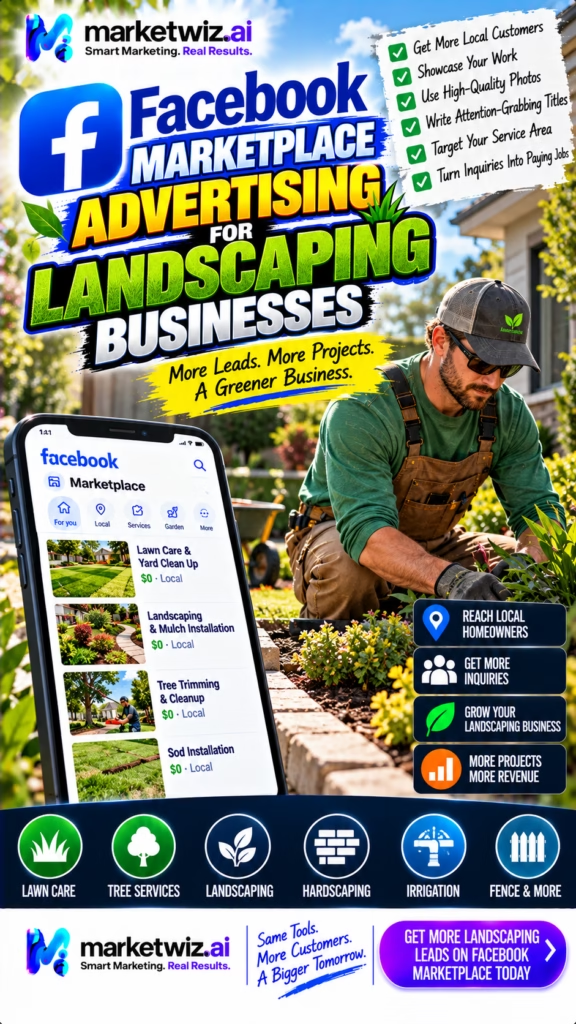
Facebook Marketplace Advertising for Landscaping Businesses
Landscaping is one of the most visual local industries. Finished lawns, patios, retaining walls, landscape beds, outdoor living spaces, planting projects, drainage improvements, and complete property transformations can immediately communicate value. This guide explains how landscaping businesses can build a smarter Facebook Marketplace marketing system around strong visuals, local relevance, lead qualification, follow-up, CRM tracking, Google Maps, SEO, AI automation, and revenue-focused measurement.
Updated October 20261. Understand the Marketplace Opportunity for Landscaping Businesses
Landscaping companies compete in an industry where customers often want to see results before they decide who deserves a conversation. That makes visual marketing particularly important.
A homeowner considering a yard transformation may not know the technical vocabulary for every material, drainage method, planting strategy, retaining system, or hardscape detail. They do, however, understand the difference between a neglected outdoor space and an attractive finished property.
Facebook Marketplace can be evaluated as one local discovery channel within this larger customer journey when the company's listings and activity fit current platform requirements.
The opportunity is not simply to publish more content. The opportunity is to use accurate visual marketing to create relevant local conversations and then move those conversations into an organized sales process.
For landscaping companies, visual proof can be one of the strongest marketing assets available. A professionally completed property can communicate craftsmanship, design ability, project scale, and transformation before a prospect reads the full description.
2. Understand Landscaping Customer Intent
Landscaping leads do not all represent the same buying intent.
One homeowner may be researching ideas for a future backyard renovation. Another may need a retaining wall soon. A property manager may need recurring grounds work. Another customer may already have a patio design and simply be searching for a qualified local company capable of completing it.
Understanding these differences helps landscaping businesses create more relevant marketing.
Common landscaping customer needs can include:
- Landscape design
- Landscape installation
- Lawn improvements
- Sod installation
- Mulch installation
- Planting projects
- Landscape bed renovations
- Patios
- Walkways
- Retaining walls
- Outdoor living spaces
- Drainage improvements
- Property cleanups
- Commercial landscape projects
The more clearly a company understands the customer need behind the inquiry, the easier it becomes to route that prospect toward the correct next step.
3. Make Sure the Marketplace Strategy Fits Current Platform Rules
Before building a Facebook Marketplace campaign, landscaping businesses should confirm what types of listings and activity are currently permitted.
Platform policies, commerce requirements, category availability, account eligibility, and listing functionality can change. A strategy should therefore be built around current requirements rather than assumptions based on older platform behavior.
Before scaling Marketplace activity, review:
- Current Marketplace eligibility
- Commerce policies
- Available listing categories
- Location requirements
- Account requirements
- Listing accuracy
- Image requirements
- Any restrictions relevant to the specific offer
Sustainable local marketing starts with an accurate, compliant foundation.
4. Choose Landscaping Projects Worth Featuring
Landscaping businesses often have years of completed work but fail to organize that work into a usable marketing library.
Every completed project does not need to become a campaign. Start with work that demonstrates the types of customers and projects the company wants more of.
Strong visual project categories may include:
Property Transformations
Major before-and-after projects can demonstrate how dramatically the company improved an outdoor environment.
Hardscaping
Patios, walkways, retaining walls, stonework, pavers, and outdoor living features can provide strong visual examples of craftsmanship.
Landscape Installation
New beds, shrubs, trees, mulch, edging, sod, and complete landscape layouts can show design and installation capabilities.
Commercial Projects
Larger properties can help communicate the company's ability to handle commercial or multi-property opportunities when relevant.
The marketing library should reflect the company's real capabilities rather than stock imagery that cannot demonstrate actual completed work.
5. Use Before-and-After Landscaping Photography
Landscaping is naturally suited to transformation marketing.
A before-and-after sequence can show the customer what changed without requiring a long explanation.
A plain backyard can become an outdoor living area. An eroded slope can become a structured landscape. An overgrown property can become clean and inviting. An empty lawn can become a designed combination of planting beds, trees, walkways, and hardscape features.
For stronger before-and-after content:
- Photograph similar angles before and after.
- Use adequate lighting.
- Keep the property recognizable between images.
- Avoid excessive editing that misrepresents the work.
- Capture the complete finished project.
- Capture important details separately.
- Organize images by project and location.
Build a Repeatable Photo Process
Project photography should become part of operations. When crews consistently capture useful before, progress, and completed images, the marketing team receives a continuous supply of authentic content.
6. Make Landscaping Primary Images Visually Powerful
In a visual browsing environment, the primary image has a major job: earn enough attention for the prospect to investigate further.
Landscaping companies have an advantage because finished outdoor environments can be naturally attractive.
The primary image should highlight the project instead of hiding it behind excessive text, clutter, or unrelated design elements.
Strong primary images often have:
- A clearly visible finished project
- Good lighting
- Strong composition
- Visible craftsmanship
- Minimal visual clutter
- Natural colors
- A useful perspective
- Enough context to understand the property
If a customer can understand the improvement immediately, the image is doing useful marketing work.
7. Use Supporting Images to Show Landscaping Details
Landscaping projects often contain details that are difficult to appreciate in one wide photograph.
Supporting images can reveal those details and help prospects understand the quality and scope of the work.
Useful secondary photos may show:
- Paver patterns
- Retaining wall construction
- Stone borders
- Planting arrangements
- Landscape bed details
- Drainage features
- Walkways
- Outdoor seating areas
- Steps
- Lighting features
- Finished lawn areas
- Different project angles
Each additional image should provide new information rather than simply repeating the same view.
8. Write Clear Landscaping Marketplace Titles
Landscaping titles should help the prospect understand what the content represents quickly.
Avoid making every title a generic statement about being the best landscaper in the area. Specific language is usually more informative.
Relevant title concepts may focus on:
- Patio projects
- Retaining wall projects
- Landscape transformations
- Sod installation
- Landscape beds
- Paver projects
- Outdoor living areas
- Property cleanup transformations
- Commercial landscaping projects
- Other accurately represented project categories
Clarity beats hype. A title should help a relevant local customer recognize the project type instead of relying on exaggerated promotional language.
9. Write Landscaping Descriptions That Educate Prospects
A landscaping description can do more than repeat the title.
It can explain what the customer is seeing, provide relevant project context, and answer common questions before the prospect begins a conversation.
Depending on the project, useful details may include:
- Project type
- Materials used
- General scope
- Property type
- Location or market
- Major design features
- Relevant options
- Important limitations
- The appropriate next step
The description should remain accurate. If pricing varies substantially based on property conditions, materials, dimensions, access, design, or other factors, avoid presenting a misleading universal price.
10. Organize Landscaping Marketing by Real Local Markets
Landscaping is geographically constrained. Travel time, crew logistics, material delivery, equipment movement, project size, and profitability all affect how far a company should realistically travel.
That makes territory planning important.
Instead of treating an entire state or massive region as one market, landscaping companies can identify the cities and communities that align with their actual operating territory.
Evaluate each market using:
- Drive time
- Existing customer density
- Average project value
- Property types
- Competition
- Crew availability
- Material logistics
- Project profitability
The objective is not simply to generate leads everywhere. It is to generate profitable opportunities in places the company actually wants to work.
11. Separate Landscaping Campaigns by Project Category
Someone interested in a retaining wall may respond to different creative than a homeowner planning a complete backyard transformation.
Separating project categories can make marketing more relevant and reporting more useful.
| Project Category | Useful Marketing Focus |
|---|---|
| Landscape Design | Complete property transformations, layouts, planting combinations, and finished environments. |
| Hardscaping | Patios, pavers, stonework, walkways, retaining walls, and outdoor living features. |
| Sod & Lawn Projects | Before-and-after lawn transformations and completed installation results. |
| Planting & Beds | Shrubs, trees, mulch, edging, seasonal color, and complete bed renovations. |
| Drainage | Accurate explanations of property problems and completed improvement work. |
| Commercial Landscaping | Property scale, consistency, appearance, and relevant commercial capabilities. |
This structure also helps the business identify which categories generate the best customers.
12. Separate Residential and Commercial Landscaping Strategies
Residential and commercial buyers may have different priorities.
A homeowner may focus on appearance, outdoor enjoyment, property improvement, and budget. A commercial property decision-maker may care about appearance, reliability, consistency, scheduling, property standards, documentation, and the ability to manage larger locations.
Businesses serving both segments should avoid assuming one message fits everyone.
Residential
Focus marketing around property transformations, outdoor enjoyment, visual improvement, project quality, and locally relevant completed work.
Commercial
Emphasize relevant commercial capabilities, property scale, consistency, professional operations, and experience with appropriate project types.
13. Build Landscaping Marketing Around Seasonal Demand
Landscaping demand can shift throughout the year depending on climate, region, project category, weather, and customer planning cycles.
Businesses can organize their marketing calendar around the work customers are most likely to consider during different periods.
Seasonal content might emphasize:
- Spring landscape renovations
- Mulch and bed improvements
- Planting projects
- Summer outdoor living projects
- Patios and hardscaping
- Drainage improvements
- Fall cleanups
- Property preparation
- Commercial planning
- Off-season project scheduling where appropriate
Seasonal planning gives the marketing team a reason to rotate content rather than repeating the same generic message all year.
14. Build Trust Around Landscaping Leads
Landscaping projects can involve meaningful investments in a customer's property. Prospects may therefore research the company beyond the original discovery channel.
A strong digital trust layer can help the company during that research process.
Useful trust assets include:
- Authentic completed project photography
- Accurate business information
- Professional website
- Google Business Profile
- Authentic customer reviews
- Project galleries
- Clear business contact information
- Consistent branding
- Professional customer communication
The objective is to make it easy for a serious prospect to verify that the company is legitimate and capable of performing the work being discussed.
15. Build a Fast Landscaping Lead Response Process
A marketing campaign is incomplete if nobody is responsible for the leads it generates.
Landscaping businesses should establish a clear process for handling incoming conversations.
Acknowledge the Inquiry
Make sure new prospects receive a timely and useful response during the company's normal lead-handling process.
Identify the Project
Determine what type of landscaping work the customer is considering.
Confirm Geographic Fit
Determine whether the property is inside the company's legitimate operating territory.
Move Qualified Leads Forward
Route appropriate opportunities toward the estimate, consultation, sales, or scheduling process used by the company.
16. Qualify Landscaping Leads Before Scheduling
Not every inquiry should automatically become an on-site appointment.
Sending estimators to every unqualified lead can consume substantial time and reduce sales efficiency.
A short qualification process can help determine whether the opportunity is appropriate.
Useful landscaping qualification questions may cover:
- Property location
- Residential or commercial property
- Type of landscaping project
- Approximate project area
- Desired materials or features
- Current property condition
- Desired timeline
- Relevant access issues
- Photos when useful
- Other project-specific requirements
Qualification should reduce wasted effort without making legitimate customers fight through unnecessary friction. Ask only for information that helps determine the correct next step.
17. Create a Clear Path From Marketplace Inquiry to Landscaping Estimate
Once a landscaping lead is qualified, the company needs a defined transition into its sales process.
Depending on the project, that may involve requesting additional photos, arranging a phone conversation, scheduling a site visit, preparing an estimate, or assigning the opportunity to a salesperson or project manager.
A simple lead path can look like this:
Marketplace discovery → inquiry → qualification → project information → estimate process → follow-up → decision → booked project.
Every stage should have an owner. When responsibility is unclear, leads can stall between marketing and sales.
18. Track Landscaping Marketplace Leads in a CRM
Qualified opportunities should not remain scattered across individual conversations with no central record.
A CRM can help landscaping businesses understand what happens after the initial inquiry.
Useful CRM fields may include:
- Lead name
- Contact information
- Original source
- Marketplace campaign or listing
- Property location
- Project category
- Project notes
- Qualification status
- Estimate date
- Estimated project value
- Follow-up date
- Sales stage
- Won or lost status
- Final project value
This creates the foundation for revenue-based marketing decisions.
19. Follow Up With Landscaping Prospects Systematically
Landscaping projects are not always immediate purchases.
Customers may be comparing several contractors, waiting for a property closing, considering financing, coordinating another home improvement project, choosing materials, or planning for a later season.
A structured follow-up system keeps those opportunities from disappearing.
Follow-up can reference:
- The requested project
- The property location
- The estimate
- Questions discussed previously
- Material selections
- Scheduling considerations
- The customer's stated timeline
Useful follow-up feels connected to the actual conversation rather than like an unrelated generic sales message.
20. Test Landscaping Creative Systematically
Landscaping companies can build large libraries of visual content. That creates an opportunity to test which project presentations attract the strongest prospects.
Creative tests may compare:
- Before-and-after images
- Finished project images
- Wide property views
- Close-up craftsmanship
- Patios versus planting projects
- Retaining walls versus complete transformations
- Residential versus commercial projects
- Different authentic project styles
The goal is not merely to identify the image with the most engagement. Measure which creative produces qualified landscaping opportunities.
21. Compare Landscaping Lead Performance by City
A landscaping company covering several communities may discover major differences in lead quality and project economics between those markets.
One city may generate many small inquiries. Another may produce fewer but significantly larger projects. Another may have excellent demand but poor travel economics.
Track by market:
- Inquiry volume
- Qualified lead rate
- Estimate rate
- Close rate
- Average project value
- Travel requirements
- Operational cost
- Revenue
- Profitability where available
The Best Market Is Not Always the Market With the Most Leads
A smaller number of higher-value, better-fitting projects can be more valuable than a large volume of low-quality inquiries.
22. Compare Lead Performance by Landscaping Project Type
Project category can be just as important as geography.
A company may discover that patio leads convert differently from retaining wall leads, complete landscape renovations, sod projects, or commercial opportunities.
Tracking these categories allows management to align marketing with the work the company actually wants.
Compare project categories using:
- Lead volume
- Qualified lead percentage
- Estimate rate
- Close rate
- Average project size
- Gross revenue
- Seasonality
- Crew requirements
- Strategic fit
23. Use AI to Support Landscaping Marketplace Marketing
Landscaping businesses can accumulate hundreds or thousands of project photos, customer conversations, estimates, market records, and marketing assets.
AI can help organize and process repetitive marketing work when it is connected to accurate business information.
Potential AI-assisted workflows include:
- Drafting project descriptions
- Creating title variations
- Organizing content by project category
- Summarizing incoming lead conversations
- Preparing CRM notes
- Supporting lead qualification
- Preparing follow-up drafts
- Creating reporting summaries
- Repurposing completed project content
- Organizing city-specific marketing campaigns
AI should amplify accurate company information, not invent project details, locations, capabilities, pricing, or customer results.
24. Combine Marketplace Marketing With Google Maps
A homeowner who discovers a landscaping company through social content or Marketplace may search the company name before making a decision.
That makes Google Business Profile optimization an important supporting strategy.
A strong landscaping Google presence can include:
- Accurate company information
- Correct business categories
- Current operating information
- Authentic customer reviews
- Completed project photography
- Regular photo updates
- Relevant business information
- Website connection
Marketplace can create discovery while Google Maps can help reinforce local credibility.
25. Build Local SEO Around Landscaping Project Categories
Marketplace captures one type of customer behavior. Search engines capture another.
Someone actively searching for a landscaper, patio contractor, retaining wall company, landscape designer, or related provider may begin with Google instead of Facebook.
Local SEO helps landscaping businesses build visibility for those searches.
Useful website content may include:
- Landscape design pages
- Landscape installation pages
- Patio pages
- Retaining wall pages
- Sod installation pages
- Drainage pages
- Commercial landscaping pages
- Location pages
- Project galleries
- Case studies
- Frequently asked questions
- Educational landscaping articles
Marketplace and SEO can therefore reach prospects through different stages of local discovery.
27. Build a Multi-Channel Landscaping Lead Generation System
Facebook Marketplace should not carry the entire responsibility for customer acquisition.
Landscaping companies can reduce dependence on any single source by creating multiple ways for local customers to discover the business.
A diversified landscaping marketing system may include:
- Facebook Marketplace where appropriate
- Google Maps
- Local SEO
- Company website
- Facebook business content
- TikTok
- YouTube Shorts
- Craigslist where appropriate
- Referral marketing
- Customer reviews
- Email follow-up
- CRM management
Different customers use different discovery paths. A multi-channel system gives the company more opportunities to be found.
28. Measure Landscaping Marketplace Advertising by Revenue
Views and messages are useful early indicators, but they do not tell the complete business story.
Landscaping companies should eventually connect marketing activity to sales outcomes.
| Metric | Why It Matters |
|---|---|
| Inquiries | Shows how much conversation the campaign generates. |
| Qualified Leads | Shows how many inquiries fit the company's territory and project criteria. |
| Estimate Opportunities | Shows how many leads progress toward an actual sales event. |
| Estimates Completed | Shows how many opportunities reach formal pricing or proposal stage. |
| Close Rate | Shows how effectively qualified opportunities become booked projects. |
| Average Project Value | Shows the financial quality of acquired customers. |
| Revenue | Shows the measurable business value associated with the marketing source. |
Once this information is available, the business can compare markets, project categories, campaigns, and acquisition channels more intelligently.
29. Avoid Common Landscaping Marketplace Marketing Mistakes
Landscaping businesses can weaken otherwise strong marketing by overlooking the operational details surrounding the campaign.
Common mistakes include:
- Using weak or blurry project photos
- Using unrelated stock images instead of authentic work
- Writing vague titles
- Using generic descriptions
- Misrepresenting project details
- Targeting areas outside the practical territory
- Failing to separate project categories
- Failing to capture before-and-after photos
- Responding inconsistently to leads
- Scheduling unqualified opportunities automatically
- Leaving qualified leads inside message threads
- Failing to track the original source
- Failing to follow up on estimates
- Measuring performance only by views
- Ignoring Google Maps and reviews
- Ignoring local SEO
- Relying entirely on one marketing channel
The best landscaping marketing systems connect visual content to operations. Project photography, lead response, qualification, estimating, CRM tracking, follow-up, reviews, search visibility, and revenue measurement should reinforce one another.
30. Follow a 90-Day Landscaping Marketplace Growth Plan
A landscaping company does not need to rebuild its entire marketing system in one day. A structured 90-day process can create a stronger foundation while producing useful performance data.
Days 1–30: Build the Foundation
- Review current Marketplace requirements.
- Define the company's real operating territory.
- Identify priority landscaping project categories.
- Audit existing project photography.
- Organize before-and-after images.
- Create a project content library.
- Improve titles and descriptions.
- Define lead qualification questions.
- Define the estimate handoff process.
- Create CRM source tracking.
- Audit Google Business Profile information.
Days 31–60: Test and Improve
- Compare project categories.
- Test different authentic primary images.
- Test title structures.
- Compare legitimate local markets.
- Track qualified lead rates.
- Track estimate opportunities.
- Improve response workflows.
- Improve follow-up.
- Add fresh Google project photos.
- Build or improve priority local SEO pages.
Days 61–90: Optimize Around Revenue
- Identify stronger project categories.
- Identify stronger geographic markets.
- Measure estimate rates.
- Measure close rates.
- Measure average project value.
- Connect won projects to original sources.
- Reduce low-quality lead activity.
- Expand winning content themes.
- Use AI to streamline repetitive marketing work.
- Repurpose successful project content across social channels.
- Strengthen Google Maps visibility.
- Expand the local SEO footprint.
The Landscaping Lead Generation Formula
Authentic project visuals + accurate local marketing + clear project categories + useful descriptions + reliable response + lead qualification + estimate tracking + CRM management + systematic follow-up + Google Maps + local SEO + social content + AI-assisted workflows + revenue measurement.
Build a Landscaping Marketing System That Turns Visual Attention Into Customers
Landscaping businesses have something many industries struggle to create: naturally visual proof.
A completed backyard transformation can tell a story immediately.
A new patio can demonstrate craftsmanship.
A retaining wall can demonstrate both function and appearance.
A redesigned landscape bed can show attention to detail.
A newly installed lawn can communicate dramatic property improvement.
A commercial landscape project can demonstrate scale and operational capability.
The first step is to capture that work consistently.
Crews should understand that project photography is not an afterthought. It is a reusable business asset.
Photograph the property before work begins.
Capture useful progress images when appropriate.
Photograph the completed project from strong angles.
Capture details.
Organize the files by project, location, date, and project category.
Over time, the company develops an authentic library of local work.
That library can support Facebook content, Instagram, TikTok, YouTube Shorts, Google Business Profile, website galleries, case studies, local SEO, sales presentations, and Marketplace activity where appropriate.
This dramatically increases the value of every completed project.
The next step is relevance.
Not every landscaping company wants every landscaping project.
A business specializing in higher-value outdoor living projects should not judge marketing success solely by how many small inquiries it receives.
A company focused on patios, retaining walls, and complete landscape renovations should organize marketing around those categories.
A company with a strong commercial division should create separate tracking for commercial opportunities.
A company serving multiple cities should measure those cities independently.
This turns marketing from generic promotion into customer acquisition strategy.
Facebook Marketplace can be one component of that strategy when the company's activity fits current platform requirements.
Strong visual presentation matters.
Use authentic completed work.
Choose primary images that make the transformation or finished project immediately understandable.
Use supporting images to reveal craftsmanship and important details.
Keep the content connected to the actual work the company performs.
Titles should prioritize clarity.
A prospect should be able to understand whether the content is about a patio, retaining wall, landscape transformation, lawn installation, planting project, or another relevant category.
Descriptions can then explain the project in greater detail.
What was completed?
What materials were used?
What kind of property was involved?
What market was the project located in?
What should a potential customer understand before beginning a conversation?
Accuracy matters because landscaping projects are highly variable.
Property conditions vary.
Dimensions vary.
Access varies.
Materials vary.
Design complexity varies.
Drainage conditions vary.
Labor requirements vary.
Businesses should avoid creating unrealistic expectations simply to generate more messages.
Better marketing creates better-informed prospects.
Geography is equally important.
A landscaping lead 10 minutes from the shop is operationally different from a lead 90 minutes away.
Marketing territory should account for travel, equipment, crew time, project value, material logistics, and profitability.
This is why city-level performance tracking matters.
The business may discover that one community produces larger projects while another generates more inquiries but smaller jobs.
That information can influence where the company focuses future marketing.
Lead handling is the next major piece.
A beautiful landscaping image can generate attention, but somebody still needs to manage the resulting conversation.
Define who responds.
Define what information is collected.
Confirm the property location.
Identify the project category.
Determine whether the opportunity fits the company's capabilities.
Gather the information required for the next step.
Then route qualified prospects into the estimate or sales process.
This qualification step can save substantial operational time.
An estimator does not need to drive across the market before anyone confirms what the prospect actually needs.
At the same time, qualification should remain customer-friendly.
Do not turn a simple inquiry into an interrogation.
Ask the questions required to determine fit and move the prospect forward.
Qualified opportunities should then enter the CRM.
Record Facebook Marketplace as the source when that is where the customer journey began.
Record the project type.
Record the city.
Record the estimate status.
Record the estimated project value.
Record follow-up.
Record whether the project was won or lost.
Record final revenue when available.
Once this information exists, the company can answer much better marketing questions.
Which city produces the best landscaping customers?
Which project category generates the highest average value?
Which creative produces qualified inquiries?
Which leads become estimates?
Which estimates close?
Which acquisition channels generate profitable work?
Those questions are more valuable than simply asking how many views a post received.
Follow-up matters because landscaping purchases often involve consideration.
A homeowner may collect several estimates.
They may need time to choose materials.
They may want to complete another property project first.
They may be planning around weather or a future event.
They may simply need a few days to make the decision.
A company without structured follow-up can lose opportunities it already paid time and money to acquire.
Follow-up should preserve the context of the original project.
That makes CRM organization valuable.
AI can support this process.
It can help summarize lead conversations.
It can help organize project information.
It can prepare follow-up drafts.
It can assist with content variations.
It can help turn one project into multiple pieces of social content.
It can help summarize marketing performance across cities and project categories.
But AI works best when it is connected to reliable information and a clearly defined workflow.
The landscaping company's wider digital presence should support the Marketplace campaign as well.
A prospect may see a project and then search the business on Google.
They may read reviews.
They may look at the Google Business Profile.
They may visit the website.
They may look for additional examples of completed work.
They may compare the company with several local competitors.
Google Maps optimization helps the business create a stronger local trust layer.
Local SEO creates additional discovery opportunities for customers who begin with search.
A homeowner searching for patio installation may never open Marketplace.
Another customer may discover a project on Facebook and only later search Google.
Both paths matter.
Market Wiz AI approaches landscaping customer acquisition as a connected system: visual local marketing can create discovery, Google Maps and SEO can strengthen visibility and trust, AI can help streamline repetitive workflows, and structured lead tracking can connect marketing activity to estimates, customers, and revenue.
This broader approach also reduces dependence on one platform.
Landscaping businesses can build visibility through Google Maps, organic search, project galleries, social media, referrals, customer reviews, short-form video, Marketplace where appropriate, Craigslist where appropriate, and other relevant local channels.
Each channel can play a different role.
The business does not need every platform to perform the same way.
It needs a system that creates enough qualified customer opportunities to support profitable growth.
The strongest landscaping marketing therefore begins with the work itself.
Complete quality projects.
Capture them professionally.
Organize the content.
Present the work accurately.
Target legitimate local markets.
Respond reliably.
Qualify opportunities.
Track estimates.
Follow up.
Measure customers and revenue.
Strengthen Google Maps.
Expand local SEO.
Repurpose authentic projects across social channels.
Use AI to reduce repetitive work.
Then use real performance data to decide what to scale.
When those pieces work together, Facebook Marketplace advertising for landscaping businesses becomes more than a collection of posts. It becomes one component of a broader local customer acquisition engine built around authentic work, strong local visibility, organized lead management, and measurable business growth.
Frequently Asked Questions About Facebook Marketplace Advertising for Landscaping Businesses
1. Can landscaping businesses advertise on Facebook Marketplace?
Landscaping businesses should review current Facebook Marketplace eligibility, commerce policies, categories, and listing requirements before using Marketplace. The exact approach should reflect what the platform currently permits.
2. Is Facebook Marketplace useful for landscaping lead generation?
Marketplace can be evaluated as one local discovery channel when the landscaping company's listings fit current platform rules and the business has a strong process for responding to and qualifying local inquiries.
3. What landscaping projects should be featured in Marketplace marketing?
Businesses can prioritize relevant projects and eligible offers that are visually compelling, accurately represented, locally relevant, and aligned with the type of work the company wants to acquire.
4. What photos work best for landscaping marketing?
Clear authentic project photography, completed landscapes, before-and-after transformations, hardscape details, outdoor living spaces, lawn improvements, planting work, and other relevant finished projects can help prospects understand the company's capabilities.
5. Should landscapers use before-and-after photos?
Before-and-after photography can be useful when it accurately represents work completed by the landscaping company because it communicates transformation quickly.
6. How should a landscaping Marketplace title be written?
Use clear language that identifies the relevant landscaping project, product, material, or eligible offer without excessive promotional language or keyword repetition.
7. Should landscaping Marketplace posts include city names?
Local information can be useful when it is accurate and relevant to the listing and the company's actual operating territory.
8. How can landscaping companies improve local lead quality?
Use accurate local targeting, specific project information, strong visual examples, clear qualification questions, fast lead handling, and CRM tracking to focus on realistic opportunities.
9. What information should landscaping leads provide?
Useful information may include project location, property type, requested work, approximate project scope, desired timeline, relevant dimensions, and other details needed to determine whether the opportunity is a fit.
10. How fast should a landscaping company respond to Marketplace inquiries?
Landscaping businesses should build a reliable response workflow so interested prospects are acknowledged and routed appropriately rather than being left in unmanaged message threads.
11. Should landscaping leads go into a CRM?
Qualified landscaping opportunities can be entered into a CRM so the company can track the source, project details, estimate status, follow-up, sales stage, outcome, and revenue.
12. Can AI help landscaping companies manage Marketplace leads?
AI can assist with content drafts, lead summaries, qualification workflows, CRM notes, follow-up preparation, reporting, and other repetitive marketing tasks when used with accurate business information.
13. Can landscaping businesses use Marketplace for hardscaping leads?
Hardscape-related project content can be visually effective, but businesses should ensure their Marketplace activity and listings comply with current platform eligibility and commerce requirements.
14. Can Marketplace help generate patio and outdoor living leads?
Completed patios, walkways, retaining walls, outdoor living areas, and similar projects can provide useful visual marketing content when the underlying listing approach is appropriate for Marketplace.
15. Can lawn care companies use Facebook Marketplace?
Companies should first confirm whether the specific listing or offer is eligible under current Marketplace rules. If appropriate, Marketplace can be evaluated as part of a broader local marketing strategy.
16. Should landscapers target multiple cities?
Landscaping companies can organize marketing around multiple legitimate markets when those locations fall within the company's real operating territory and the content remains accurate.
17. How should landscaping companies track Marketplace leads?
Track the original source, campaign or listing, location, requested project, qualification status, estimate, follow-up, sales outcome, and revenue where possible.
18. Are Marketplace views enough to judge landscaping advertising?
No. Views measure exposure but do not show whether the advertising creates qualified landscaping opportunities, estimates, booked work, customers, or revenue.
19. What landscaping marketing metrics matter most?
Useful metrics include inquiries, qualified leads, estimate requests, estimates completed, close rate, booked project value, customer acquisition cost, and revenue.
20. Should landscaping companies test different Marketplace images?
Yes. Testing different authentic project images can help identify which types of visual presentation generate stronger engagement and higher-quality inquiries.
21. Should landscapers test different Marketplace titles?
Clear title variations can be tested while keeping the listing accurate and measuring downstream lead quality rather than relying only on views.
22. Can Facebook Marketplace work with Google Maps for landscapers?
Yes. Marketplace can create discovery while a well-maintained Google Business Profile can help prospects verify the landscaping company, view reviews, see project photos, and find business information.
23. Can Marketplace work with landscaping SEO?
Yes. Marketplace and local SEO can support different customer discovery paths, allowing a landscaping company to reach both social marketplace browsers and search engine users.
24. What should a landscaping website include?
A useful landscaping website can include clear project categories, local market information, authentic project photos, customer reviews, frequently asked questions, contact information, and pages explaining the company's capabilities.
25. How important are Google reviews for landscaping companies?
Authentic reviews can help prospective customers evaluate a landscaping company after discovering it through Marketplace, search, referrals, or other channels.
26. Should landscaping companies rely only on Facebook Marketplace?
No. A diversified local marketing strategy can include Google Maps, SEO, a website, reviews, social media, referrals, email follow-up, and other appropriate channels.
27. Can landscaping companies use social media with Marketplace?
Yes. Completed project photography and educational content can be repurposed appropriately across Facebook, Instagram, TikTok, YouTube Shorts, Google Business Profile content, and other channels.
28. How do landscaping companies turn Marketplace inquiries into estimates?
Use a structured workflow that collects project information, confirms geographic fit, determines project relevance, routes qualified opportunities to the appropriate team member, and tracks the estimate process.
29. What are common landscaping Marketplace marketing mistakes?
Common mistakes include weak project photography, vague content, inaccurate information, poor geographic targeting, inconsistent responses, no qualification process, no CRM tracking, and measuring success only by views or messages.
30. What is the best Facebook Marketplace advertising strategy for landscaping businesses?
A strong strategy combines accurate eligible listings, compelling project visuals, local relevance, clear content, reliable response, lead qualification, CRM tracking, follow-up, systematic testing, Google Maps, local SEO, AI-assisted workflows, and revenue-focused measurement.
30 Additional SEO Keywords
These supporting keyword themes expand topical relevance around Facebook Marketplace advertising, landscaping lead generation, local marketing, hardscaping, Google Maps, local SEO, AI automation, and landscaping customer acquisition.
Build a Smarter Landscaping Lead Generation System
Market Wiz AI helps local businesses strengthen Facebook Marketplace marketing, Google Maps visibility, local SEO, social content, AI automation, lead tracking, and multi-channel customer acquisition.
Call MarketWiz.ai: (910) 601-2938












26. Turn Landscaping Projects Into Multi-Channel Social Content
One completed landscaping project can create far more than one marketing asset.
Businesses can repurpose authentic project media across multiple channels while adapting the presentation for each platform.
One project might produce:
Think in Content Systems, Not Individual Posts
Every quality project represents an opportunity to build a library of authentic local proof. Capturing content systematically allows landscaping companies to market continuously without inventing unrelated material.