
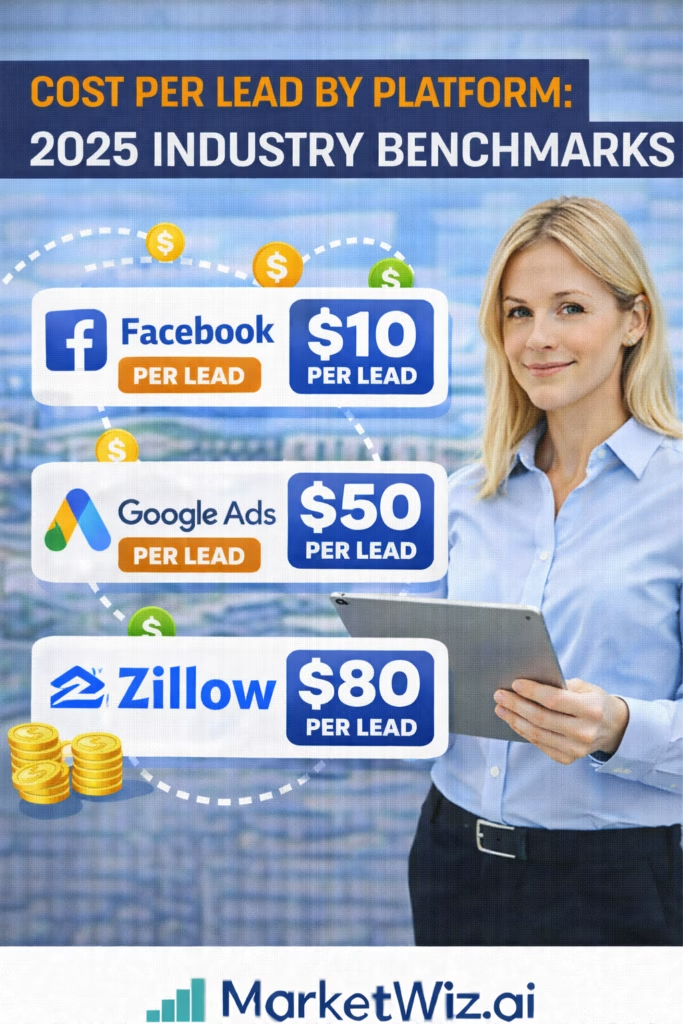
Cost Per Lead by Platform: 2025 Industry Benchmarks
Cost Per Lead by Platform: 2025 Industry Benchmarks helps you set realistic budgets, stop guessing, and compare channels like Google, Meta, LinkedIn (and more) using practical, operator-friendly benchmarks.
Note: Benchmarks vary by offer, geo, seasonality, tracking setup, and funnel design. Use this as a baseline, then calibrate using your lead-to-customer conversion rate and revenue per customer.
Introduction
Cost Per Lead by Platform: 2025 Industry Benchmarks is the cheat code for one of the most common marketing mistakes: comparing your cost per lead to a random screenshot on the internet.
In 2025, platforms got more competitive, tracking got harder, and lead quality became the real differentiator. You can’t optimize CPL in a vacuum. A “cheap lead” that never answers is expensive. A “pricey lead” that closes fast is profitable.
This guide gives you:
- Practical benchmarks for CPL by major platforms (with context on what “counts” as a lead).
- Industry ranges so you stop underbudgeting high-CPL categories.
- A simple calculator framework to convert CPL into profitability.
- The levers that reliably reduce CPL without wrecking lead quality.
Quick definition: CPL = total channel spend ÷ total qualified leads from that channel. Your definition of “qualified” is the difference between truth and chaos.
Expanded Table of Contents
- 1) Definitions that make CPL benchmarks comparable
- 2) 2025 CPL benchmarks by platform (Google, Meta, LinkedIn + more)
- 3) Industry CPL benchmarks: what’s “normal” by vertical
- 4) Why CPL varies so much (and what controls it)
- 5) Lead quality vs lead cost: the profitability lens
- 6) CPL calculator: the only math that actually matters
- 7) Google Search CPL benchmarks (2025) + how to lower CPL
- 8) Meta (Facebook/Instagram) lead CPL benchmarks (2025) + fixes
- 9) LinkedIn CPL benchmarks (2025) + when the premium is worth it
- 10) TikTok & emerging platforms: how to estimate CPL correctly
- 11) Paid vs organic CPL: how to mix channels for stability
- 12) Measurement: tracking rules that prevent fake benchmarks
- 13) Optimization playbook: 21 levers that reduce CPL
- 14) 30–60–90 day benchmark rollout plan
- 15) 25 Frequently Asked Questions
- 16) 25 Extra Keywords
- References
1) Definitions that make CPL benchmarks comparable
If you want Cost Per Lead by Platform: 2025 Industry Benchmarks to be useful, you need consistent definitions. Most “benchmarks” fall apart because people count different things as “a lead.”
What counts as a lead?
- Lead Form Submit (Meta Lead Ads / LinkedIn Lead Gen Forms)
- Contact Form (website forms, quote forms)
- Qualified Call (call tracking + disposition)
- Booked Appointment (calendar booking)
- Inbound Message (SMS, chat, marketplace inquiry)
Tip: pick 1–2 “primary lead actions” and standardize across channels.
What makes a lead “qualified”?
- Fit: correct geo, service category, budget range
- Intent: buying language, urgency, next-step behavior
- Contactability: real phone/email, responds within X hours
- Outcome: booked, showed, proposal requested
If you measure only raw leads, you’ll optimize into spam.
Benchmark warning: A platform can look “cheap” by generating more low-intent leads. Benchmarks must be paired with conversion-to-sale, not just CPL.
2) 2025 CPL benchmarks by platform (Google, Meta, LinkedIn + more)
Here’s the high-level view most teams want first. These benchmarks are best used as directional baselines—not strict performance targets.
| Platform | 2025 Typical CPL (Baseline) | Best For | Reality Check |
|---|---|---|---|
| Google Search Ads | $70.11 avg (all industries) | High intent demand capture | Usually higher CPL, often higher close rate |
| Meta Lead Ads (Facebook/Instagram) | $27.66 avg (leads campaigns) | Volume lead gen, retargeting, local services | Fast CPL wins require strict lead validation |
| LinkedIn (B2B Lead Gen) | Premium range; often ~$110 avg for B2B | Decision-makers, job title targeting | Higher CPL can be worth it if ACV is high |
| TikTok | Varies widely (estimate via CPM/CTR/CVR) | Top-of-funnel + creator-style offers | Use math; don’t copy “CPL screenshots” |
| SEO / Content | Often lower blended CPL over time | Durable compounding acquisition | Slow ramp, but can dominate LTV:CAC |
Bottom line: In many funnels, Meta wins on raw CPL, Google wins on intent, and LinkedIn wins on precision (with a higher price tag).
3) Industry CPL benchmarks: what’s “normal” by vertical
Industry matters more than platform. Legal, finance, and high-ticket B2B categories often have higher CPL because the lead value is higher and competition is intense.
Blended industry CPL benchmarks (paid vs organic context)
The table below shows a blended view across channels (paid vs organic benchmarks vary, but this gives a realistic baseline for planning).
| Industry | Avg Paid CPL | Avg Organic CPL | Avg CPL (Blended) | Why It’s High/Low |
|---|---|---|---|---|
| Legal Services | $784 | $516 | $649 | High LTV + aggressive auction pressure |
| Financial Services | $761 | $555 | $653 | Regulated + high-value customers |
| Higher Education | $1,261 | $705 | $982 | Long cycle + competitive acquisition |
| IT & Managed Services | $617 | $385 | $503 | Complex offer + high competition |
| Cybersecurity | $411 | $404 | $406 | Premium buyers + niche targeting |
| Construction | $280 | $174 | $227 | Local + seasonal + variable job size |
| HVAC | $115 | $69 | $92 | Strong local intent + repeat demand |
| eCommerce | $98 | $83 | $91 | High volume + measurable conversion |
| Entertainment | $116 | $111 | $114 | Lower ticket + broader audiences |
| B2B SaaS | $310 | $164 | $237 | Higher ACV, longer nurture |
Interpretation: If you sell high-ticket services, “high CPL” may simply reflect reality. The question is whether your lead-to-customer economics support it.
4) Why CPL varies so much (and what controls it)
Teams obsess over “platform CPL” when the biggest drivers are usually offer, targeting, and funnel friction. Here are the top drivers to understand before you try to “beat the benchmark.”
Offer strength
If your offer is generic (“Free Quote”), you’ll pay more. If your offer is specific (“Same-Day Quote + 3 Options”), CPL drops and quality improves.
Lead definition
If you count every click as a lead, CPL looks amazing—but revenue collapses. Consistent definitions make benchmarks usable.
Geo and seasonality
Urban metros usually cost more. HVAC spikes in summer/winter. Real estate shifts with rates and inventory.
Targeting precision
Broader targeting often lowers CPL but harms quality. Narrower targeting can raise CPL but increase close rate.
Conversion friction
More fields, slower pages, unclear next steps = higher CPL. Reduce friction and your CPL often drops immediately.
Follow-up speed
Slow response increases effective CPL because fewer leads convert. Speed makes your CPL “work harder.”
Key insight: CPL is not a marketing KPI. It’s a business KPI. Optimize CPL alongside lead-to-customer conversion and profit per customer.
5) Lead quality vs lead cost: the profitability lens
Cost Per Lead by Platform: 2025 Industry Benchmarks only matters if it connects to outcomes. Here’s the simplest truth:
Best CPL = the lowest cost per lead that still produces the highest revenue per lead.
Two leads, two realities
| Scenario | CPL | Lead-to-Customer | Revenue per Customer | Result |
|---|---|---|---|---|
| Cheap lead flood | $15 | 1% | $1,000 | $15 / lead looks great, but revenue per lead is low |
| Premium high-intent | $120 | 15% | $5,000 | Higher CPL, far better ROI and sales efficiency |
Benchmark trap: Copying “low CPL” strategies often increases spam and no-shows. The goal is a profitable pipeline, not a cheap spreadsheet.
6) CPL calculator: the only math that actually matters
Use this framework to translate CPL benchmarks into business decisions. This is how you stop arguing about platforms and start optimizing profit.
Inputs (per channel)
- CPL
- Lead-to-Appointment Rate
- Show Rate (if appointments)
- Close Rate
- Revenue per Customer (or Gross Profit per Customer)

Derived
Revenue per Lead = (Lead→Customer Rate) × (Revenue per Customer)
ROI Proxy = (Revenue per Lead) ÷ CPL

Example
CPL = $70
Lead→Customer = 5%
Revenue per Customer = $4,000
Revenue per Lead = 0.05 × 4000 = $200
ROI Proxy = 200 ÷ 70 = 2.86x (before fulfillment costs)
Operating rule: Don’t chase the lowest CPL. Chase the highest Revenue per Lead relative to CPL.
7) Google Search CPL benchmarks (2025) + how to lower CPL
Google Search is demand capture. When someone is actively looking, Google is often the cleanest path to high-intent leads—at a typically higher CPL.
Google Ads: headline benchmark
Average CPL in Google Ads in 2025: $70.11 (all industries).
Google Ads: examples of higher CPL categories
- Attorneys & Legal Services and other high-LTV categories often sit at the top.
- Furniture and longer-cycle purchases can trend higher due to research-heavy buyers.
- Business services can be high because lead value is high and competition is strong.
How to lower Google CPL without killing lead quality
Offer + landing page levers
- Match ad copy to one clear offer (no “kitchen sink” pages).
- Reduce form fields; ask for the minimum to qualify.
- Add proof above the fold (reviews, logos, guarantees).
- Use “next step” language: Get a 2-minute estimate.
Account levers
- Fix keyword intent: bid heavier on bottom-funnel terms.
- Use negatives to block job seekers, DIY researchers, and irrelevant queries.
- Separate brand vs non-brand campaigns.
- Route high-intent leads to fast follow-up (speed improves effective CPL).
Google benchmark reality: A “higher CPL” can still be better if leads close faster. Pair CPL with close rate by keyword cluster.
8) Meta (Facebook/Instagram) lead CPL benchmarks (2025) + fixes
Meta’s superpower is distribution. You can generate lead volume quickly—especially for local services, high-frequency needs, and offer-driven funnels.
Meta Leads: headline benchmark
Average CPL for Meta leads campaigns in 2025: $27.66 (all industries).
Meta leads: example CPLs by category (illustrative benchmarks)
| Category | Average CPL (Meta Leads, 2025) | What That Usually Means |
|---|---|---|
| Real Estate | $16.61 | Low friction leads; quality depends on qualification |
| Home & Home Improvement | $41.26 | Competitive local auctions; strong intent with urgency angles |
| Health & Fitness | $52.98 | Offer and follow-up matter heavily |
| Dentists & Dental Services | $76.71 | Higher value leads; higher CPL is normal |
| Restaurants & Food | $3.16 | High volume, low ticket; depends on conversion action |
How to reduce Meta CPL while improving lead quality
Fix #1: Add qualification inside the form
Use 1–3 qualifying questions (budget range, service area, timeline). Yes, CPL may rise—but cost per booked job often drops.
Fix #2: Confirm contactability
Require phone + confirmation. Follow up with SMS within minutes. Meta leads decay fast if you wait.
Fix #3: Use “proof-first” creative
Short testimonials, before/after, review snippets, guarantees, and “what happens next” clarity reduce low-quality submissions.
Fix #4: Route “hot” leads differently
Separate campaigns for high-intent offers vs awareness. Give hot leads their own fast-lane follow-up.
Meta benchmark tip: You can win on CPL and still lose on revenue if you don’t validate leads. Always track lead-to-appointment and show rate.
9) LinkedIn CPL benchmarks (2025) + when the premium is worth it
LinkedIn is the “precision tool” for B2B: job titles, seniority, company size, industry filters. That precision usually costs more.
LinkedIn: what to expect in 2025
- LinkedIn is commonly the most expensive CPL channel for B2B—but can deliver higher lead quality for certain offers.
- In many B2B mixes, teams see LinkedIn CPLs that are meaningfully higher than Google Search or Meta leads.
- LinkedIn tends to perform best when you have: clear ICP, strong offer, credible proof, and fast follow-up.
When paying more is smart
| If you sell… | Then higher CPL can be OK because… | What you must track |
|---|---|---|
| High ACV B2B services | One deal pays for many leads | Pipeline, close rate, sales cycle length |
| Enterprise SaaS | Job title targeting finds buyers faster | Qualified opp rate, CAC payback |
| Specialty consulting | Precision beats volume | Booked call quality + conversion |
LinkedIn CPL reduction levers
Offer levers
- Swap “Book a demo” for a clear outcome: Get a 12-point audit.
- Use proof: client logos, quantified results, a clear niche.
- Reduce friction: fewer fields, better value explanation.
Targeting levers
- Start broader than you think; tighten after you see winners.
- Use exclusions to remove irrelevant roles/industries.
- Retarget engagers with a bottom-funnel offer.
LinkedIn truth: If your close rate is low or follow-up is slow, LinkedIn will feel “too expensive.” Fix your funnel before blaming the platform.
10) TikTok & emerging platforms: how to estimate CPL correctly
TikTok often publishes cost benchmarks in CPM/CPC terms more than direct CPL (because lead actions vary widely). The right approach is to estimate CPL using your funnel math.
The CPL estimation formula
CPL ≈ CPM ÷ (Clicks per 1,000 impressions × Conversion Rate)

Where:
Clicks per 1,000 = (CTR × 1,000)
Conversion Rate = % of clicks that become leads

Example:
CPM = $6.00
CTR = 1.0%  → 10 clicks per 1,000
Lead CVR = 8%
Leads per 1,000 = 10 × 0.08 = 0.8
CPL ≈ 6.00 ÷ 0.8 = $7.50
Important: This is why TikTok can look “cheap” or “expensive” depending on creative and offer. Your CTR and CVR are the real drivers.
When TikTok is worth testing for lead gen
- You can deliver a compelling offer in 3–8 seconds (hook + proof + CTA).
- Your product/service has a strong visual or emotional payoff.
- You can follow up instantly (SMS + calendar + reminders).
- You can run creator-style creative that blends with the feed.
Pro tip: Use TikTok to create demand and retarget on Google/Meta where intent is higher. That combo often lowers blended CPL.
11) Paid vs organic CPL: how to mix channels for stability
Paid channels scale fast. Organic channels compound. The best programs use both so they can survive auction swings, seasonality, and platform changes.
Paid channels (Google/Meta/LinkedIn)
- Pros: fast volume, controllable spend, strong targeting
- Cons: costs rise with competition, attribution gets messy
- Best use: launches, promotions, consistent pipeline needs
Organic channels (SEO/content/referrals)
- Pros: compounding lead flow, durable intent capture
- Cons: slower ramp, requires consistency
- Best use: stabilize CPL long-term and increase brand trust
Best practice: Use paid to learn what converts (offers + messaging), then turn those winners into content and organic assets that reduce blended CPL over time.
12) Measurement: tracking rules that prevent fake benchmarks
The #1 reason teams can’t compare CPL is inconsistent tracking. Fix these and your benchmarks become reliable.
Tracking rules
- One primary lead event per funnel (don’t count everything).
- Deduplicate leads (same person submitting multiple times).
- Tag lead source correctly using UTMs and platform IDs.
- Call tracking + call outcomes if calls matter.
- Define “qualified lead” and report both raw CPL and qualified CPL.
Benchmark integrity: If you don’t dedupe and qualify, your CPL will look better than it is—until your sales team revolts.
13) Optimization playbook: 21 levers that reduce CPL
Below are the highest-impact levers that consistently lower CPL and improve lead quality.
1) Tighten your offer
Make the next step obvious. A specific promise beats a vague “contact us.”
2) Reduce friction
Shorten forms, speed up pages, remove distractions, clarify what happens next.
3) Add proof early
Reviews, case studies, before/after, results, guarantees—above the fold.
4) Segment by intent
Separate high-intent (pricing/quote/booking) from low-intent (awareness) campaigns.
5) Add lead validation
Qualifying questions, phone verification, spam filters, and routing rules.
6) Improve response speed
Follow up in minutes, not hours. Speed increases conversion and lowers effective CPL.
7) Retarget intelligently
Retarget high-intent visitors with a clear offer. Retargeting often lowers CPL.
8) Fix negative keywords / exclusions
Block job seekers, DIY terms, irrelevant roles, irrelevant geos.
9) Improve creative hooks
Start with the pain + outcome. Then proof. Then CTA. Especially on social.
10) Track qualified CPL
Raw CPL is easy to game. Qualified CPL drives revenue.
11) Use tiered follow-up
Fast-lane the hottest leads; nurture the rest with automation.
12) Build an FAQ-driven landing page
Answer objections before they ask. Lower friction = better conversion.
13) Pre-qualify with pricing context
Including “starting at” pricing can increase CPL slightly but reduce junk leads.
14) Improve scheduling
Calendar booking, reminders, and confirmations reduce no-shows and improve ROI.
15) Track show rate
Low show rate means you’re paying for leads that don’t become conversations.
16) Optimize for outcomes
Feed back closed-won signals when possible; optimize beyond clicks and submits.
17) Tighten geo targeting
Local businesses should align ads to service areas and exclude dead zones.
18) Improve messaging consistency
Ad promise must match landing page and follow-up script. Misalignment raises CPL.
19) Use multi-step conversion
For some industries, a micro-commitment improves conversion (quiz → lead).
20) Stabilize with content
Turn best-performing paid messaging into SEO content and social proof assets.
21) Review weekly
Benchmarks drift. Weekly reviews keep CPL under control before it spikes.
Golden rule: Lowering CPL is easiest when you improve conversion rate and reduce junk leads at the same time.
14) 30–60–90 day benchmark rollout plan
Days 1–30 (Baseline + definitions)
- Define what a “lead” is (and what doesn’t count).
- Set up deduplication, UTMs, and source tracking.
- Report both raw CPL and qualified CPL.
- Build a simple benchmark dashboard by channel.
Days 31–60 (Quality + follow-up)
- Add lead validation (questions, phone verification, spam filters).
- Implement fast follow-up: SMS + email + task routing.
- Track appointment rate + show rate.
- Split campaigns by intent level (cold vs warm vs hot).
Days 61–90 (Optimization + scaling)
- Test 5–10 new creatives and offers per channel.
- Optimize landing pages and forms for conversion.
- Retarget high-intent visitors and nurture warm leads.
- Calibrate spend using profit per lead, not just CPL.
Reality check: The goal is not to “beat benchmarks.” The goal is stable, profitable lead flow you can scale.
15) 25 Frequently Asked Questions
1) What is Cost Per Lead by Platform: 2025 Industry Benchmarks?
It’s a practical, data-driven guide to typical CPL ranges by marketing platform and industry in 2025, with an emphasis on lead quality and profitability.
2) What’s the difference between CPL and CPA?
CPL is cost per lead. CPA is cost per acquisition (customer). CPL is earlier in the funnel; CPA is closer to revenue.
3) Why is my CPL higher than benchmarks?
Common reasons include weaker offer, poor landing page conversion, competitive geo, broad targeting, or counting only qualified leads (which is good).
4) Why is my CPL lower than benchmarks?
It may be a strong offer and funnel—or it may mean you’re collecting low-quality leads. Check close rate and show rate.
5) What’s the average CPL on Google Ads in 2025?
One widely cited all-industry benchmark is about $70.11 for Google Ads in 2025, though it varies by industry.
6) What’s the average CPL on Meta Lead Ads in 2025?
One benchmark for Meta leads campaigns is about $27.66 across industries, with category-level variation.
7) Why does LinkedIn CPL cost more?
LinkedIn’s job-title and firmographic targeting is powerful for B2B, but the auction is expensive and audiences are narrower.
8) Is a higher CPL ever better?
Yes—if lead-to-customer conversion and revenue per customer are high, a higher CPL can produce higher ROI.
9) Should I optimize for lowest CPL?
No. Optimize for qualified CPL and profit per lead. Lowest CPL often increases spam.
10) What metrics should I pair with CPL?
At minimum: appointment rate, show rate, close rate, revenue per customer, and speed to lead response.
11) How do I calculate qualified CPL?
Qualified CPL = spend ÷ number of leads that meet your qualification criteria (fit + contactability + intent).
12) What’s the fastest way to lower CPL?
Improve conversion rate on landing pages/forms and tighten targeting to reduce irrelevant clicks and submissions.
13) How does seasonality affect CPL?
Many categories fluctuate: HVAC in peak seasons, real estate with market shifts, B2B around budgeting cycles.
14) Should I include pricing on landing pages?
Often yes. It can reduce low-quality leads and improve close rate, even if raw CPL rises slightly.
15) How do I reduce no-shows?
Use SMS reminders, confirmations, calendar links, and fast follow-up. No-show reduction improves ROI and effective CPL.
16) Do lead forms perform better than landing pages?
Lead forms reduce friction and can lower CPL, but sometimes reduce lead quality. Test both and track outcomes.
17) How many form fields should I use?
As few as possible while still qualifying. Start with 2–4 fields and 1–3 qualifying questions.
18) How do I prevent spam leads?
Use validation, blocklists, hidden fields (honeypots), CAPTCHA where appropriate, and follow-up confirmation steps.
19) What’s a reasonable benchmark for local service businesses?
It varies by service and market. Use platform benchmarks as a baseline, but judge success by booked jobs and revenue.
20) Which platform is best for high-intent leads?
Google Search often captures the highest intent. Meta can create demand; LinkedIn is best for B2B precision.
21) How do I choose a budget using CPL benchmarks?
Start with target leads per month × expected CPL, then adjust using lead-to-customer conversion and revenue per customer.
22) What is a good CPL for eCommerce?
eCommerce varies by product and margin. Focus on cost per purchase and profit per order; CPL is secondary unless you run lead capture funnels.
23) How long does it take to improve CPL?
You can often improve CPL within 1–2 weeks via conversion rate, targeting, and creative changes—if tracking is correct.
24) What should I do if CPL rises suddenly?
Check competition, creatives fatiguing, tracking issues, targeting drift, and landing page performance. Then test new angles fast.
25) What’s the smartest way to use benchmarks?
Use benchmarks to set expectations, then optimize toward qualified leads and revenue outcomes. Benchmarks guide planning; your CRM confirms truth.
16) 25 Extra Keywords
- Cost Per Lead by Platform: 2025 Industry Benchmarks
- cost per lead benchmarks 2025
- average cpl by platform
- google ads cost per lead 2025
- facebook lead ads cpl 2025
- instagram lead generation cost
- linkedin lead gen form cpl
- tiktok ads lead generation benchmarks
- paid vs organic cost per lead
- average cost per lead by industry 2025
- legal services lead cost
- financial services lead cost
- hvac lead generation cost
- real estate cost per lead benchmark
- b2b saas cost per lead benchmark
- reduce cost per lead
- qualified cost per lead
- lead quality vs lead volume
- lead-to-customer conversion rate
- marketing budget planning benchmarks
- cpl calculator
- lead gen funnel optimization
- landing page conversion rate improvements
- retargeting to lower cpl
- cost per booked appointment
References
These sources are included to provide transparency on benchmark baselines referenced in this guide. Benchmarks vary by funnel type, lead definition, and measurement setup.
- WordStream: Google Ads Benchmarks 2025 (CPL baseline)
- WordStream: Facebook Ads Benchmarks 2025 (Leads campaigns CPL baseline + categories)
- First Page Sage: Average Cost Per Lead by Industry (dataset-based paid vs organic context)
- Flyweel: CPL Benchmarks 2025 (platform mix commentary; use as directional context)
- Darkroom: TikTok advertising cost ranges (CPM/CPC inputs for CPL estimation)